Principles of Managerial Finance, Brief, 7e (Gitman)
Chapter 11 Capital Budgeting Cash Flows and Risk Refinements
11.1 Discuss relevant cash flows and the three major cash flow components.
1) Accounting figures and cash flows are not necessarily the same due to the presence of certain
non-cash expenditures on a firm’s income statement.
2) Relevant cash flows are the incremental cash outflows and inflows associated with a proposed
capital expenditure.
3) The relevant cash flows for a proposed capital expenditure are the incremental after-tax cash
outflows and resulting subsequent inflows.
4) Incremental cash flows represent the additional cash flows expected as a direct result of the
proposed project.
5) The three major cash flow components include the initial investment, operating cash flows,
and terminal cash flow.
6) The three major cash flow components include the initial investment, nonoperating cash
flows, and terminal cash flow.
7) Initial cash outflows and subsequent operating cash inflows for a project are referred to as
________.
A) necessary cash flows
B) relevant cash flows
C) perpetual cash flows
D) ordinary cash flows
8) Relevant cash flows for a project are best described as ________.
A) incidental cash flows
B) incremental cash flows
C) sunk cash flows
D) contingent cash flows
9) Should financing costs such as the returns paid to bondholders and stockholders be considered
in computing after-tax operating cash flows? Why or why not?
11.2 Discuss expansion versus replacement decisions, sunk costs and opportunity costs.
1) If a new asset is being considered as a replacement for an old asset, the relevant cash flows
would be found by adding the operating cash flows from the old asset to the operating cash flows
from the new asset.
2) Sunk costs are cash outlays that have already been made and therefore have no effect on the
cash flows relevant to the current decision.
3) Opportunity costs should be included as cash outflows when determining a project’s
incremental cash flows.
4) A sunk cost is a cash flow that could be realized from the best alternative use of an owned
asset.
5) An opportunity cost is a cash flow that could be realized from the best alternative use of an
owned asset.
6) A sunk cost is a cash outlay that has already been made and cannot be recovered.
7) When making replacement decisions, the development of relevant cash flows is complicated
when compared to expansion decisions, due to the need to calculate ________ cash inflows.
A) conventional
B) opportunity
C) incremental
D) sunk
8) In developing the cash flows for an expansion project, the analysis is the same as the analysis
for replacement projects where ________.
A) all cash flows from the old assets are equal
B) prior cash flows are irrelevant
C) all cash flows from the old asset are zero
D) cash inflows equal cash outflows
9) Cash outlays that had been previously made and have no effect on the cash flows relevant to a
current decision are called ________.
A) incremental historical costs
B) incremental past expenses
C) opportunity costs foregone
D) sunk costs
10) Cash flows that could be realized from the best alternative use of an owned asset are called
________.
A) incremental costs
B) lost resale opportunities
C) opportunity costs
D) sunk costs
11) Please explain the difference between a sunk cost and an opportunity cost and give an
example of each type of cost.
11.3 Calculate the initial investment, operating cash flows, and terminal cash flow associated
with a proposed capital expenditure.
1) To calculate the initial investment, we subtract all cash inflows occurring at time zero from all
cash outflows occurring at time zero.
2) The basic cash flows that must be considered when determining the initial investment
associated with a capital expenditure are the installed cost of the new asset, the after-tax proceeds
(if any) from the sale of an old asset, and the change (if any) in net working capital.
3) Under MACRS depreciation, the depreciable value of an asset is equal to the asset’s purchase
price minus any installation costs.
4) The book value of an asset is equal to its installed cost of asset minus the accumulated
depreciation.
5) In case of an existing asset which is depreciable and is used in business and is sold for a price
equal to its initial purchase price, the difference between the sales price and its book value is
considered as recaptured depreciation and will be taxed as ordinary income.
6) Recaptured depreciation is the portion of the sale price that is below the book value.
7) Capital gain is the portion of the sale price that is in excess of the initial purchase price.
8) Recaptured depreciation is the portion of the sale price that is in excess of the initial purchase
price.
9) If an asset is depreciable and used in business, any loss on the sale of the asset is tax-
deductible only against other capital gains income, not against ordinary income.
10) If an asset is sold for more than its initial purchase price, the gain on the sale is composed of
two parts: a capital gain and recaptured depreciation.
11) If an asset is sold for book value, the gain on the sale is composed of two parts: a capital gain
and accumulated depreciation.
12) If an asset is sold for less than its book value, the loss on the sale may be used to offset
ordinary operating income provided the asset is used in the business.
13) The change in net working capital—regardless of whether an increase or decrease—is not
taxable because it merely involves a net buildup or net reduction of current accounts.
14) If an investment in a new asset results in a change in current assets that exceeds the change
in current liabilities, this change in net working capital represents an initial cash outflow.
15) Net working capital is the difference between a firm’s total assets and its total liabilities.
16) All benefits expected from a proposed project must be measured on a cash flow basis which
may be found by adding any non-cash charges deducted as an expense on a firm’s income
statement back to net profits after taxes.
17) In computing after-tax operating cash flows, both operating costs and financing costs must
be deducted from any cash inflows received.
18) In computing after-tax operating cash flows, only operating costs but not financing costs
must be deducted from any cash inflows received.
19) In evaluating a proposed project, incremental operating cash inflows are relevant cash flows.
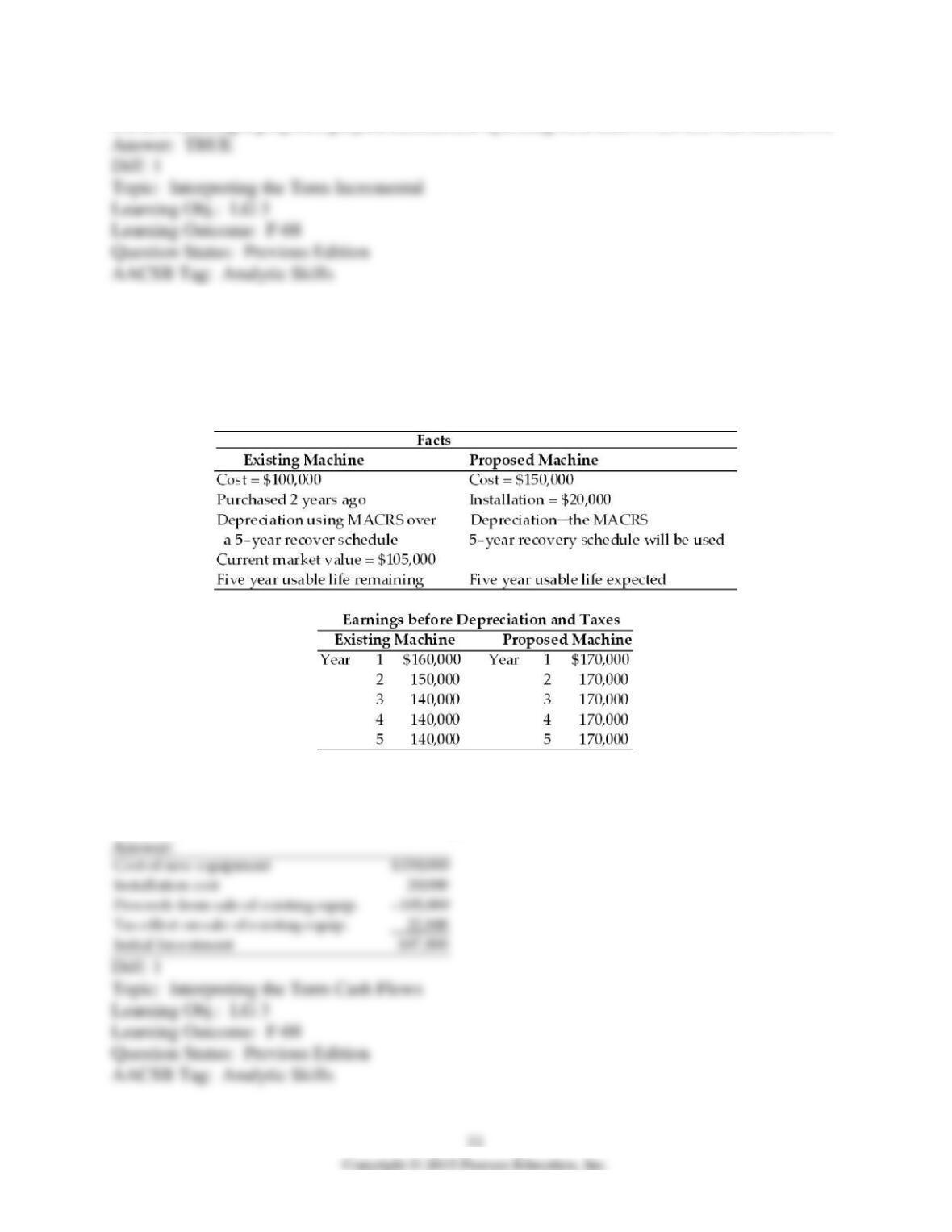
Table 11.4
Degnan Dance Company, Inc., a manufacturer of dance and exercise apparel, is considering
replacing an existing piece of equipment with a more sophisticated machine. The following
information is given.
The firm pays 40 percent taxes on ordinary income and capital gains.
20) Given the information in Table 11.4, compute the initial investment.
21) Given the information in Table 11.4, compute the incremental annual cash flows.
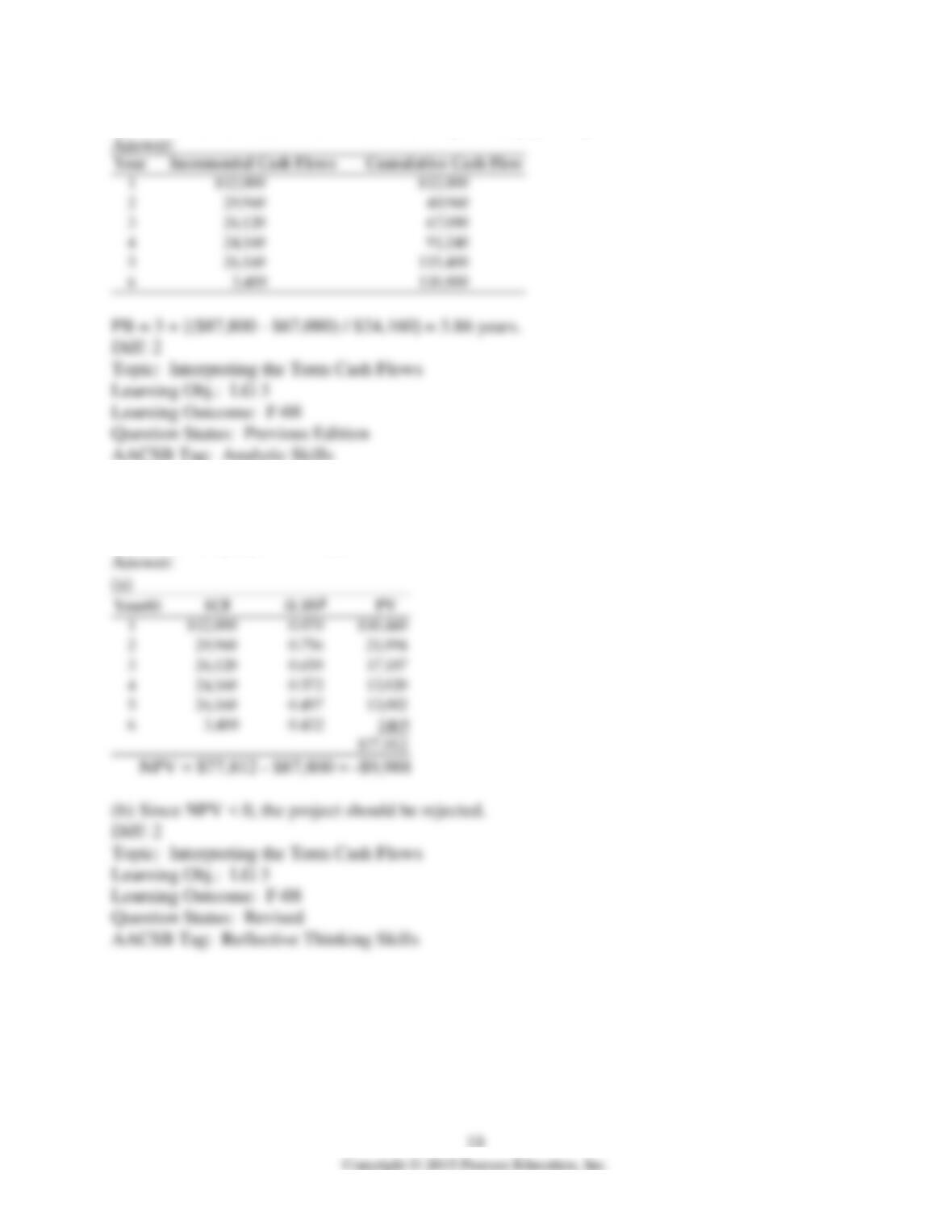
22) Given the information in Table 11.4, compute the payback period.
23) Given the information in Table 11.4 and 15 percent cost of capital,
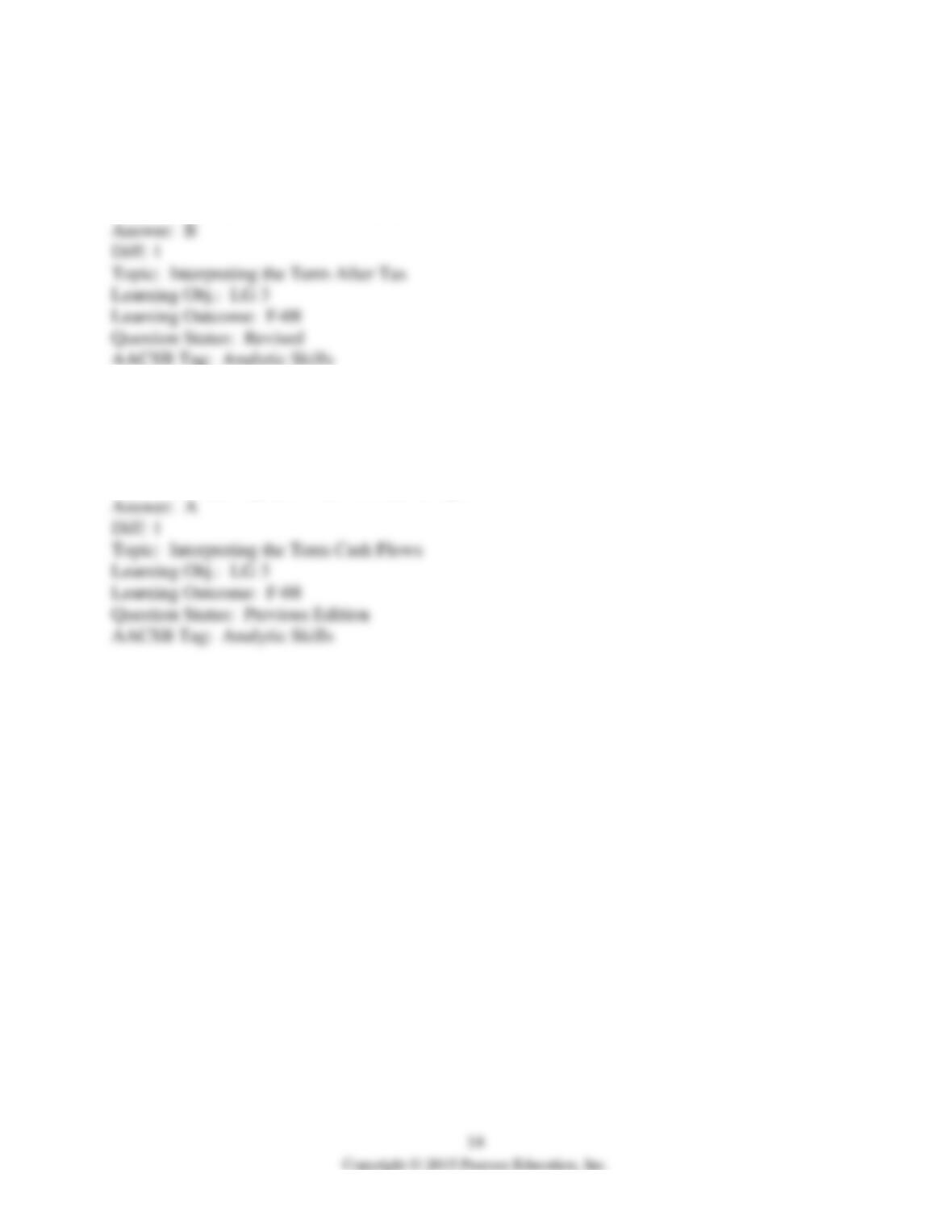
(a) Compute the net present value.
(b) Should the project be accepted?
24) Benefits expected from proposed capital expenditures ________.
A) must be on a pre-tax basis because it provides the true position of profits by the firm
B) must be on an after-tax basis because no benefits may be used until tax claims are satisfied
C) may be valued either on pre-tax or after-tax basis based on the size of the firm
D) are independent of interest and taxes
25) One basic technique used to evaluate after-tax operating cash flows is to ________.
A) add noncash charges to net income
B) subtract depreciation from operating revenues
C) add cash expenses to net income
D) subtract cash expenses from noncash charges
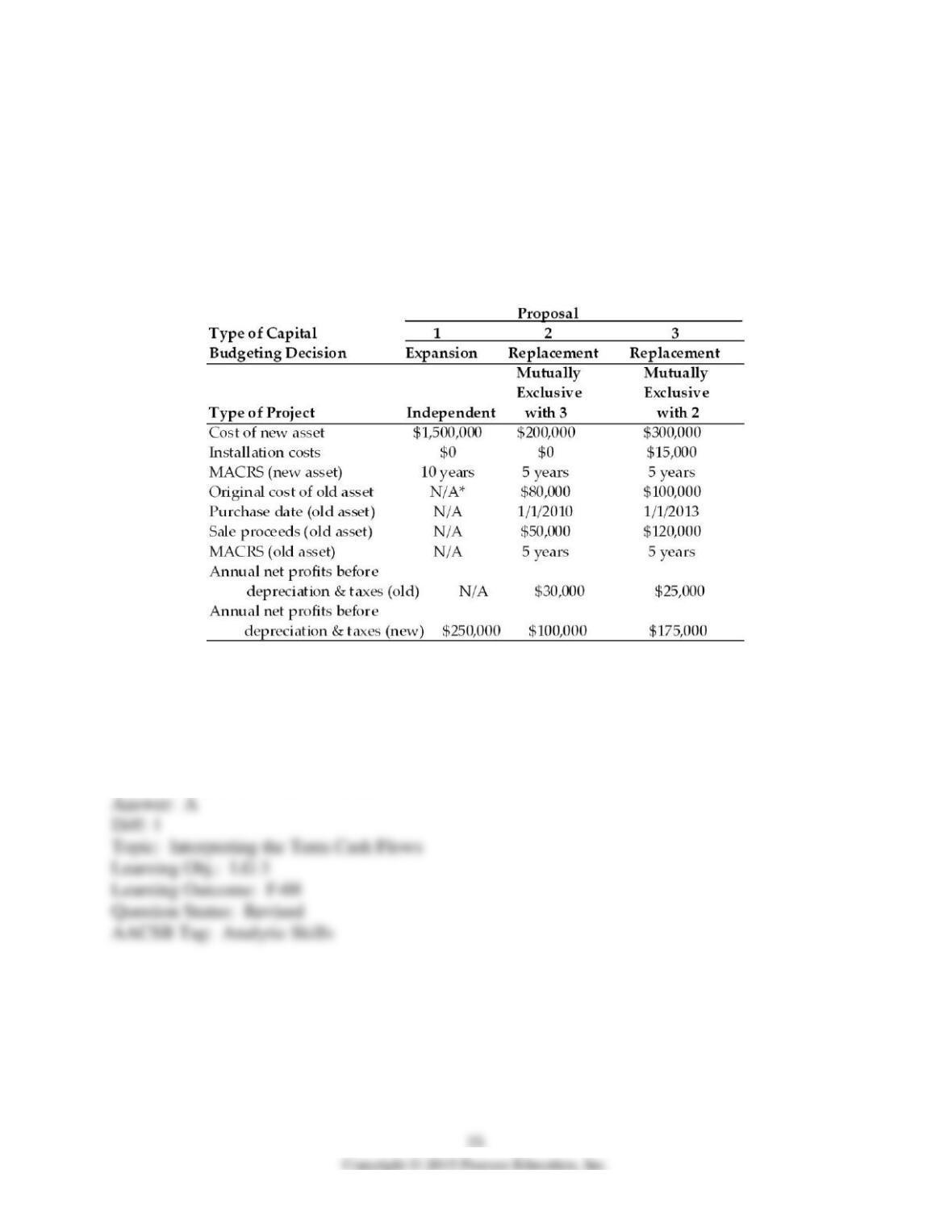
Table 11.2
Computer Disk Duplicators, Inc. has been considering several capital investment proposals for
the year beginning in 2014. For each investment proposal, the relevant cash flows and other
relevant financial data are summarized in the table below. In the case of a replacement decision,
the total installed cost of the equipment will be partially offset by the sale of existing equipment.
The firm is subject to a 40 percent tax rate on ordinary income and on long-term capital gains.
The firm’s cost of capital is 15 percent.
______________________________________________________________________
*Not applicable
26) For Proposal 1, the cash flow pattern for the expansion project is ________. (See Table 11.2)
A) a mixed stream and conventional
B) a mixed stream and nonconventional
C) a perpetuity and conventional
D) an annuity and nonconventional
27) For Proposal 1, the initial outlay equals ________. (See Table 11.2)
A) $1,380,000
B) $1,440,000
C) $1,500,000
D) $1,620,000
28) For Proposal 1, the depreciation expense for year 1 is ________. (See Table 11.2)
A) $110,400
B) $115,200
C) $150,000
D) $300,000
29) For Proposal 1, the annual incremental after-tax cash flow from operations for year 1 is
________. (See Table 11.2)
A) $60,000
B) $255,000
C) $300,000
D) $210,000
30) For Proposal 2, the cash flow pattern for the replacement project is ________. (See Table
11.2)
A) a mixed stream and conventional
B) a mixed stream and nonconventional
C) a perpetuity and conventional
D) an annuity and nonconventional
31) For Proposal 2, the book value of the existing asset at the end of the fifth year is ________.
(See Table 11.2)
A) $13,600
B) $34,400
C) $66,400
D) $80,000
32) For Proposal 2, the tax effect on the sale of the existing asset at the end of the fifth year
results in ________. (See Table 11.2)
A) $12,000 tax liability
B) $14,560 tax liability
C) $25,280 tax liability
D) $16,600 tax liability
33) For Proposal 2, the initial outlay equals ________. (See Table 11.2)
A) $120,720 cash outflow
B) $164,560 cash outflow
C) $150,000 cash outflow
D) $167,520 cash outflow
34) For Proposal 2, the incremental depreciation expense for year 2 is ________. (See Table
11.2)
A) $16,800
B) $26,400
C) $38,400
D) $60,000
35) For Proposal 2, the annual incremental after-tax cash flow from operations for year 2 is
________. (See Table 11.2)
A) $18,000
B) $24,000
C) $56,000
D) $84,000
36) For Proposal 3, the cash flow pattern for the replacement project is ________. (See Table
11.2)
A) a mixed stream and conventional
B) a mixed stream and nonconventional
C) a perpetuity and conventional
D) an annuity and nonconventional
37) For Proposal 3, the book value of the existing asset is ________. (See Table 11.2)
A) $21,000
B) $43,000
C) $52,000
D) $80,000
38) For Proposal 3, the tax effect on the sale of the existing asset results in ________. (See Table
11.2)
A) $8,000 tax liability
B) $16,000 tax liability
C) $20,000 tax liability
D) $23,200 tax liability
39) For Proposal 3, the initial outlay equals ________. (See Table 11.2)
A) $170,400
B) $211,000
C) $196,000
D) $300,000
40) For Proposal 3, the incremental depreciation expense for year 3 is ________. (See Table
11.2)
A) $21,000
B) $42,000
C) $47,850
D) $50,850
41) For Proposal 3, the incremental depreciation expense for year 6 is ________. (See Table
11.2)
A) $15,750
B) $10,750
C) $23,000
D) $36,150