CHAPTER 11: CRYPTOGRAPHIC HASH FUNCTIONS
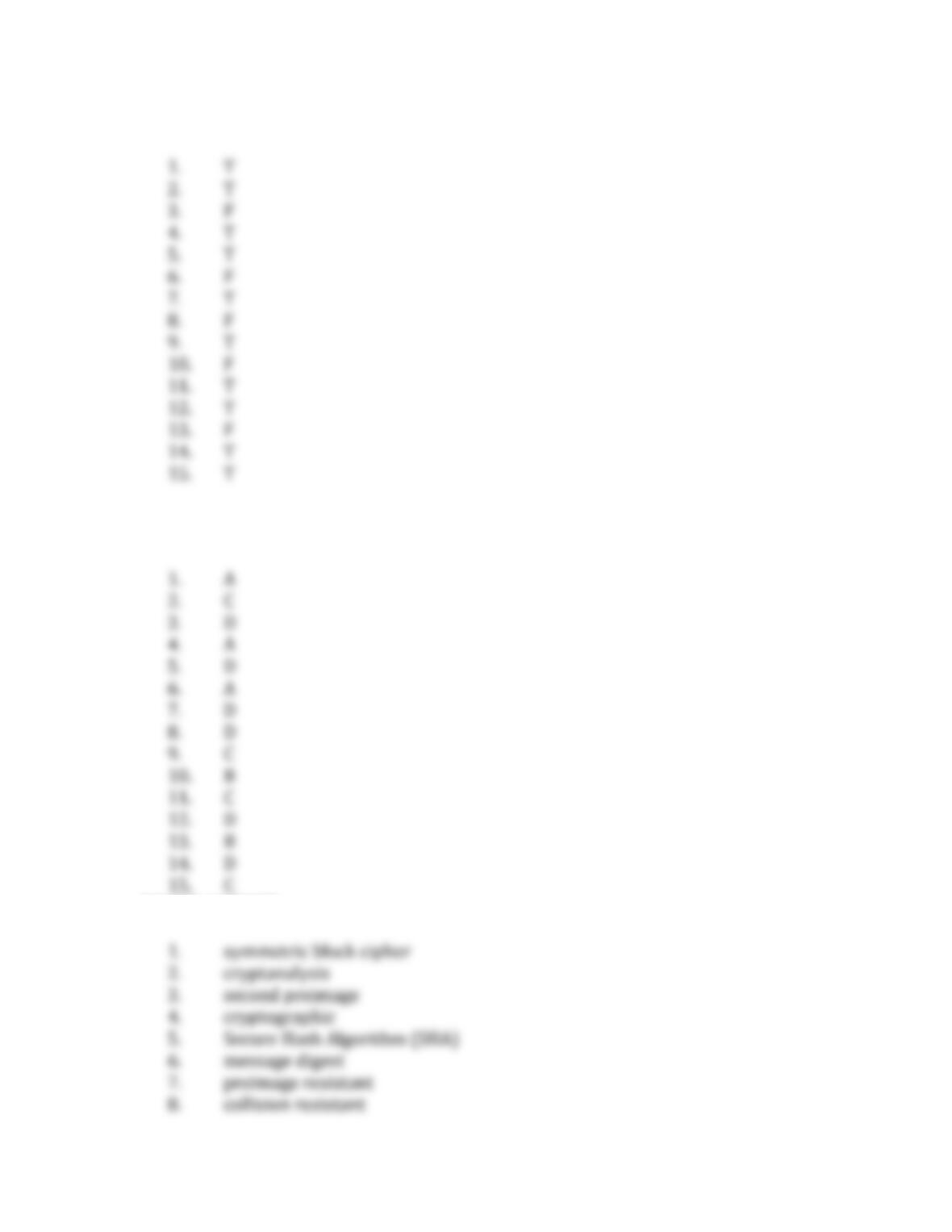
TRUE OR FALSE
T F 1. Virtually all cryptographic hash functions involve the iterative use
of a compression function.
T F 2. A good hash function has the property that “the results of applying
the function to a large set of inputs will produce outputs that are
evenly distributed and apparently random”.
T F 3. Limited characteristics make it impossible for hash functions to be
used to determine whether or not data has changed.
T F 4. Hash functions can be used for intrusion and virus detections.
T F 5. Whirlpool is a popular cryptographic hash function.
T F 6. The cryptographic hash function is not a versatile cryptographic
algorithm.
T F 7. It is possible to use a hash function but no encryption for message
authentication.
T F 8. Encryption hardware is optimized toward smaller data sizes.
T F 9. Hash functions are commonly used to create a one–way password
file.
T F 10. A weak hash function is sufficient to protect against an attack in
which one party generates a message for another party to sign.
T F 11. The way to measure the resistance of a hash algorithm to
cryptanalysis is to compare its strength to the effort required for a
brute–force attack.
T F 12. It can be shown that some form of birthday attack will succeed
against any hash scheme involving the use of cipher block
chaining without a secret key, provided that either the resulting
hash code is small enough or that a larger hash code can be
decomposed into independent subcodes.
T F 13. The most widely used hash function has been the Whirlpool.
T F 14. Big–endian format is the most significant byte of a word in the
low–address byte position.
T F 15. The SHA–512 algorithm has the property that every bit of the hash
code is a function of every bit of the input.
MULTIPLE CHOICE
1. The principal object of a hash function is __________ .
A. data integrity B. compression
C. collision resistance D. mapping messages
2. A ___________ accepts a variable length block of data as input and produces a
fixed size hash value h = H(M).
A. hash resistance B. hash value
C. hash function D. hash code
3. The Secure Hash Algorithm design closely models, and is based on, the hash
function __________ .
A. MD5 B. FIPS 180
C. RFC 4634 D. MD4
4. A ___________ is an algorithm for which it is computationally infeasible to find
either (a) a data object that maps to a pre-specified hash result or (b) two
data objects that map to the same hash result.
A. cryptographic hash function B. strong collision resistance
C. one-way hash function D. compression function
5. The cryptographic hash function requirement that guarantees that it is
impossible to find an alternative message with the same hash value as a
given message and prevents forgery when an encrypted hash code is used is
the ___________ .
A. collision resistant B. pseudorandomness
C. preimage resistant D. second preimage resistant
6. __________ is a mechanism or service used to verify the integrity of a message.
A. Message authentication B. Data compression
C. Data mapping D. Message digest
7. Message authentication is achieved using a __________ .
A. DES B. MDF
C. SHA D. MAC
8. __________ are measures of the number of potential collisions for a given hash
value.
A. MACs B. Primitives
C. Hash codes D. Preimages
9. A hash function that satisfies the properties of variable input size, fixed
output size, efficiency, preimage resistant and second preimage resistant is
referred to as a __________.
A. strong hash function B. collision resistant function
C. weak hash function D. preimage resistant function
10. The effort required for a collision resistant attack is explained by a
mathematical result referred to as the ___________ .
A. Whirlpool B. birthday paradox
C. hash value D. message authentication code
11. An ideal hash algorithm will require a cryptanalytic effort __________ the brute–
force effort.
A. less than or equal to B. greater than or equal to
C. less than D. greater than
12. The Secure Hash Algorithm was developed by the ___________ .
A. ITIL B. IEEE
C. ISO D. NIST
13. SHA-1 produces a hash value of __________ bits.
A. 224 B. 160
C. 384 D. 256
14. “Given a hash function H, with n possible outputs and a specific value H(x), if
H is applied to k random inputs, what must be the value of k so that the
probability that at least one input y satisfies H(y) = H(x) is 0.5″ is a reference
to the __________ .
A. authentication code B. collision resistant
C. big endian D. birthday attack
15. Three new versions of SHA with hash value lengths of 256, 384, and 512 bits
are collectively known as __________ .
A. SHA-3 B. SHA-1
C. SHA-2 D. SHA-0
SHORT ANSWER
1. The compression function used in secure hash algorithms falls into one of
two categories: a function specifically designed for the hash function or an
algorithm based on a ___________ .
2. A __________ is an attack based on weaknesses in a particular cryptographic
algorithm.
3. The __________ resistant guarantees that it is impossible to find an alternative
message with the same hash value as a given message.
4. The kind of hash function needed for security applications is referred to as a
__________ hash function.
5. The most important and widely used family of cryptographic hash functions
is the __________ family.
6. When a hash function is used to provide message authentication, the hash
function value is often referred to as a ___________ .
7. Requirements for a cryptographic hash function include ___________ which is
the one-way property.
8. A hash function that satisfies the properties of variable input size, fixed
output size, efficiency, preimage resistant, second preimage resistant and
__________ is referred to as a strong hash function.
9. The two categories of attacks on hash functions are __________ attacks and
cryptanalysis.
10. If collision resistance is required the value _________ determines the strength
of the hash code against brute-force attacks.
11. The hash algorithm involves repeated use of a __________ function, f, that takes
two inputs (an n-bit input and a b-bit block) and produces an n-bit output.
12. SHA-1 is very similiar in structure and in the basic mathematical operations
used to __________ and SHA-0.
13. The evaluation criteria for SHA-3 are security, ___________, and algorithm and
implementation characteristics.
14. A message authentication code is also known as a __________ hash function.
15. The hash value of a message in the __________ application is encrypted with a
user’s private key.
TRUE OR FALSE
MULTIPLE CHOICE
SHORT ANSWER