Test Bank—Chapter Eleven (Artificial Intelligence)
Multiple Choice Questions
1. Which of the following is an example of procedural knowledge?
A. Knowing the rate of growth of the world’s population
B. Knowing how to tie your shoes
C. Knowing your name
D. Knowing the exchange rate of different national currencies
2. Which of the following is not a component of a production system?
A. Control system B. Collection of states
C. Associative memory D. Collection of productions
3. Which of the following is actually constructed during a heuristic search?
A. State graph B. Search tree C. Production system
4. A heuristic is applied during a search process in hopes of producing a
A. Depth-first search B. Breadth-first search
5. If the heuristic being used is the-number-of-tiles-out–of-place, which of the following eight-puzzle will
be given priority for further consideration by a heuristic search?
A. 1 2 3 B. 2 3 C. 1 3 D. 1 3
4 5 1 5 6 4 2 6 4 2 6
7 8 6 4 7 8 7 5 8 7 5 8
6. If a heuristic search is used to solve the eight-puzzle from the starting configuration below using the–
number-of-tiles-out-of-place as the heuristic, which of the following nodes will not be considered during
the search?
1 2
4 5 3
7 8 6
A. 1 2 B. 1 5 2 C. 1 5 2 D. 1 2 3
4 5 3 4 3 4 3 4 5
7 8 6 7 8 6 7 8 6 7 8 6
7. Which of the following learning technique results in an agent merely performing a pre-recorded
sequence of steps?
A. Imitation B. Supervised training C. Reinforcement
8. In an artificial neural network, which of the following pairs of input connection weights would cause a
neuron with two inputs and a threshold value of 3 to produce an output of 1 only when both of its inputs are
1?
A. 0, 0 B. 2, 0 C. 0, 2 D. 2, 2
9. In an artificial neural network, which of the following pairs of input connection weights would cause a
neuron with two inputs and a threshold value of 2 to produce an output of 0 only when both of its inputs are
0?
A. 0, 0 B. 3, 0 C. 0, 3 D. 3, 3
10. In an artificial neural network, what must be true about the threshold value of a neuron that processes
an output of 1 when all of its inputs are 0?
A. It is less than –2.
B. It is not positive.
C. Both A and B are true.
D. Nothing can be determined without knowing the weights.
11. A memory system that is able to provide related information is called
A. Read-only memory (ROM) B. Associative memory
C. An artificial neural network D. Main memory
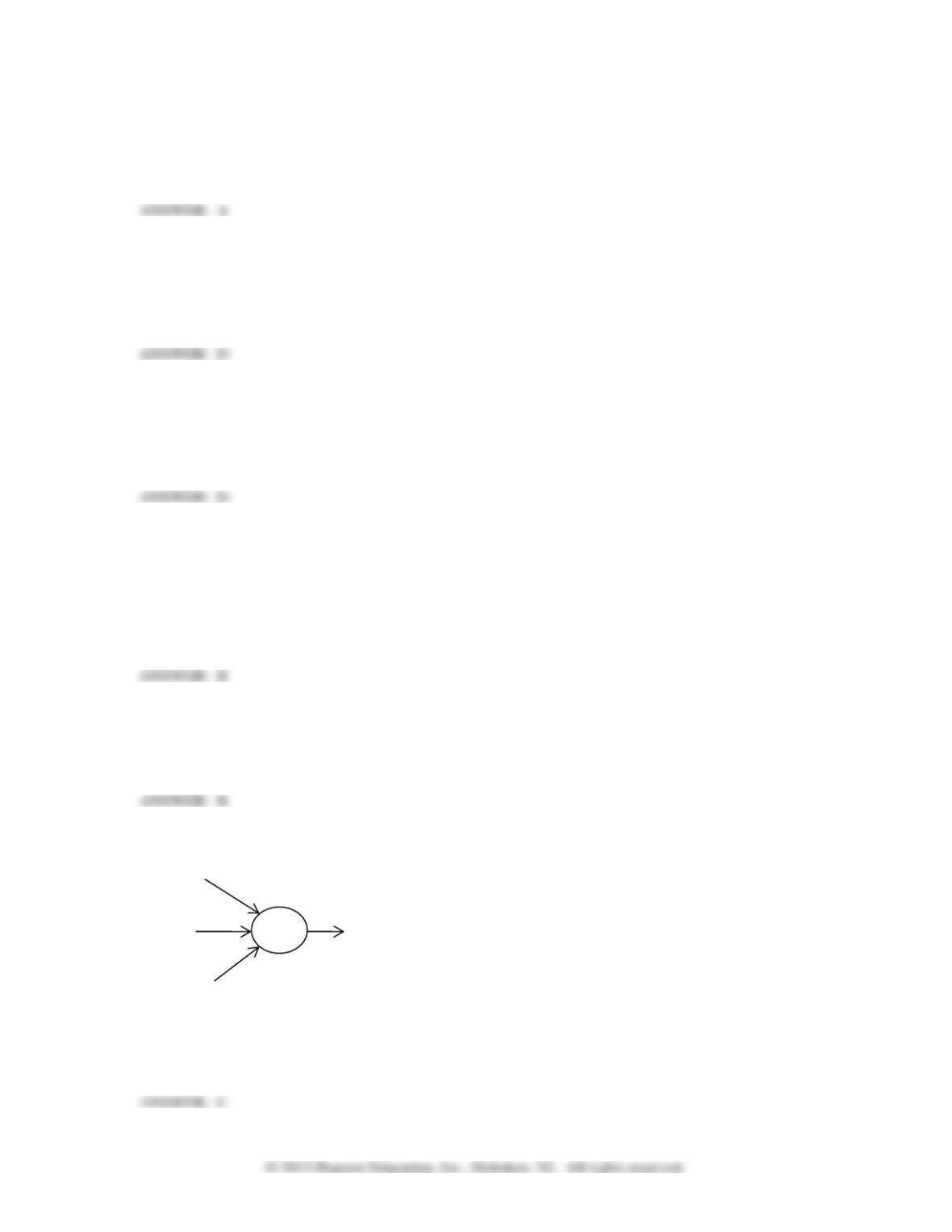
12. In an artificial neural network, what input values will cause the neuron below to produce an output of 1.
.5
1
1
-2
A. All three 0
B. All three 1
C. Any combination in which the center input is 0 and at least one other input is 1
D. Any combination in which at least one input is 1
13. In an artificial neural network, which of the Boolean operations AND, OR, and XOR can a single
neuron with two inputs be programmed to compute?
A. AND only B. OR only C. XOR only D. AND and OR only
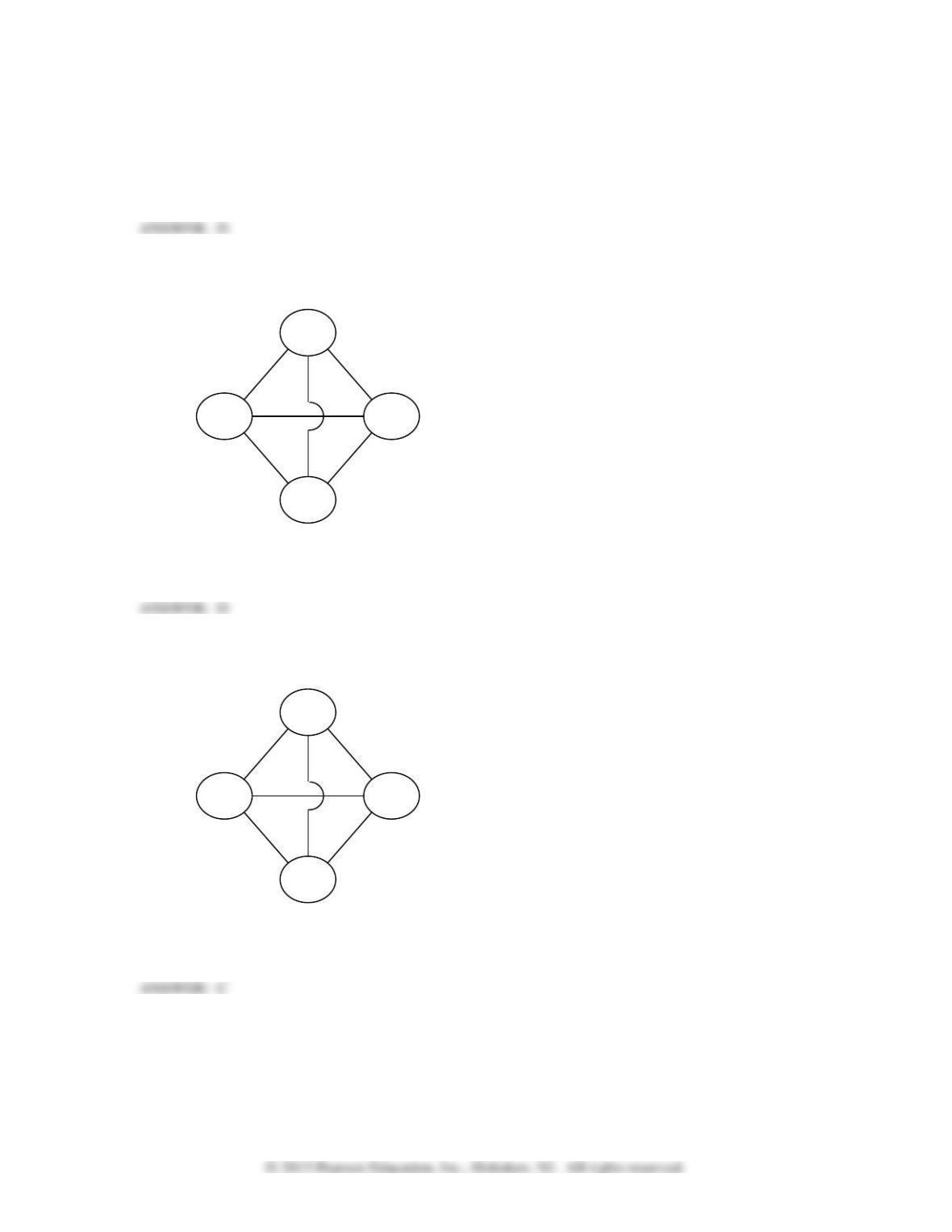
14. The diagram below represents an associative memory as described in the text. What stable state will the
system reach if it is initiated with the top and bottom neurons excited and the others inhibited?
.5
.5
.5
.5
-1
-1
-1
-1
1
1
A. All neurons excited B. Only the side neurons excited
C. No neurons excited D. Only the top and bottom neurons excited
15. The diagram below represents an associative memory as described in the text. What stable state will the
system reach if it is initiated with the top and left-most neurons excited and the others inhibited?
.5
.5
.5
.5
-1
-1
-1
-1
1
1
A. All neurons excited B. No stable state will be reached.
C. No neurons excited D. Only the top and left-most neurons excited
16. The diagram below represents an associative memory as describe in the text. Under what condition will
the center neuron become excited?

-1
-1
-1
-1
12.5
1
1
1
A. Any of the other neurons excited B. Will never be excited
C. Any two of the other neurons excited D. At least three of the other neurons excited
17. Which of the following programming methodologies seeks to develop software by a “trial and error”
approach?
A. Object-oriented programming B. Structured programming
C. Evolutionary programming D. Declarative programming
18. At what “stage” of analysis is the meaning of a pronoun such as he or she identified?
A. Syntactic analysis B. Semantic analysis C. Contextual analysis
19. At what “stage” of analysis are the sentences
There were exactly twelve books on the table.
and
There were twelve books on the table, no more and no less.
recognized as saying the same thing?
A. Syntactic analysis B. Semantic analysis C. Contextual analysis
20. At what “stage” of analysis is the meaning of the word ball in the following sentence determined?
At the party John was having a ball.
A. Syntactic analysis B. Semantic analysis C. Contextual analysis

21. Which of the following is a statement of the closed-world assumption?
A. The database contains only partial information.
B. The database contains only true statements.
C. If a statement is not a consequence of information in the database, then the statement is false.
D. The database contains all the information known to humans.
Fill-in-the-blank/Short-answer Questions
1. List two types of agent actions/responses that are more complex than mere reflect actions.
_________________
_________________
2. In each blank below place a P or an S to indicate whether the associated activity is performance oriented
(P) or simulation oriented (S).
____ Writing a program that applies a particular economic theory to see if that theory leads to
realistic consequences.
____ Writing a program to allow a database system to receive requests verbally.
____ Writing a program to control an automated aircraft landing system.
____ Writing a program to handle a university’s registration system.
3. Place an X in the blanks below that are associated with tasks that could likely be performed by means of
relatively simple pattern matching methods as opposed to requiring advanced image analysis techniques.
____ Identifying characters on a printed page
____ Identifying one domino from another
____ Distinguishing the parts of a photograph that represent living organic entities as opposed to
inert objects.
____ Distinguishing photographs of family outings from those of business meetings
4. A production system consists of a collection of ___________ representing various configurations of the
problem at hand, a collection of ______________ representing potential steps from one “configuration” to
another, and a ____________________ whose task is to find a solution to the problem at hand.

5. Suppose the task of solving the equation 3x + 2 = 17 were analyzed as a production system.
A. What would be the goal state?
__________
B. What would be the production that would probably be applied first?
______________________________________________________________________
6. How many nodes would be in the search tree generated by a heuristic search when solving the eight-
puzzle from the starting configuration below if the-number–of-tiles-out–of-place were used as the heuristic?
1 2
4 5 3
7 8 6
____________
7. Suppose the search tree below is being constructed to solve the eight-puzzle using the-number-of-tiles-
out–of-place as the heuristic. In each blank under a terminal node, write the heuristic value of the associated
node. Then, circle the node that the search would pursue next.
1 3
4 2 6
7 5 8
/ | \
1 3 1 2 3 1 3
4 2 6 4 6 4 2 6
7 5 8 7 5 8 7 5 8
___ ___ ___
8. What is the effective input of an artificial neuron whose inputs are 1, 0, 1 and whose associated
connection weights are 3, –3, -1, respectively?
____________
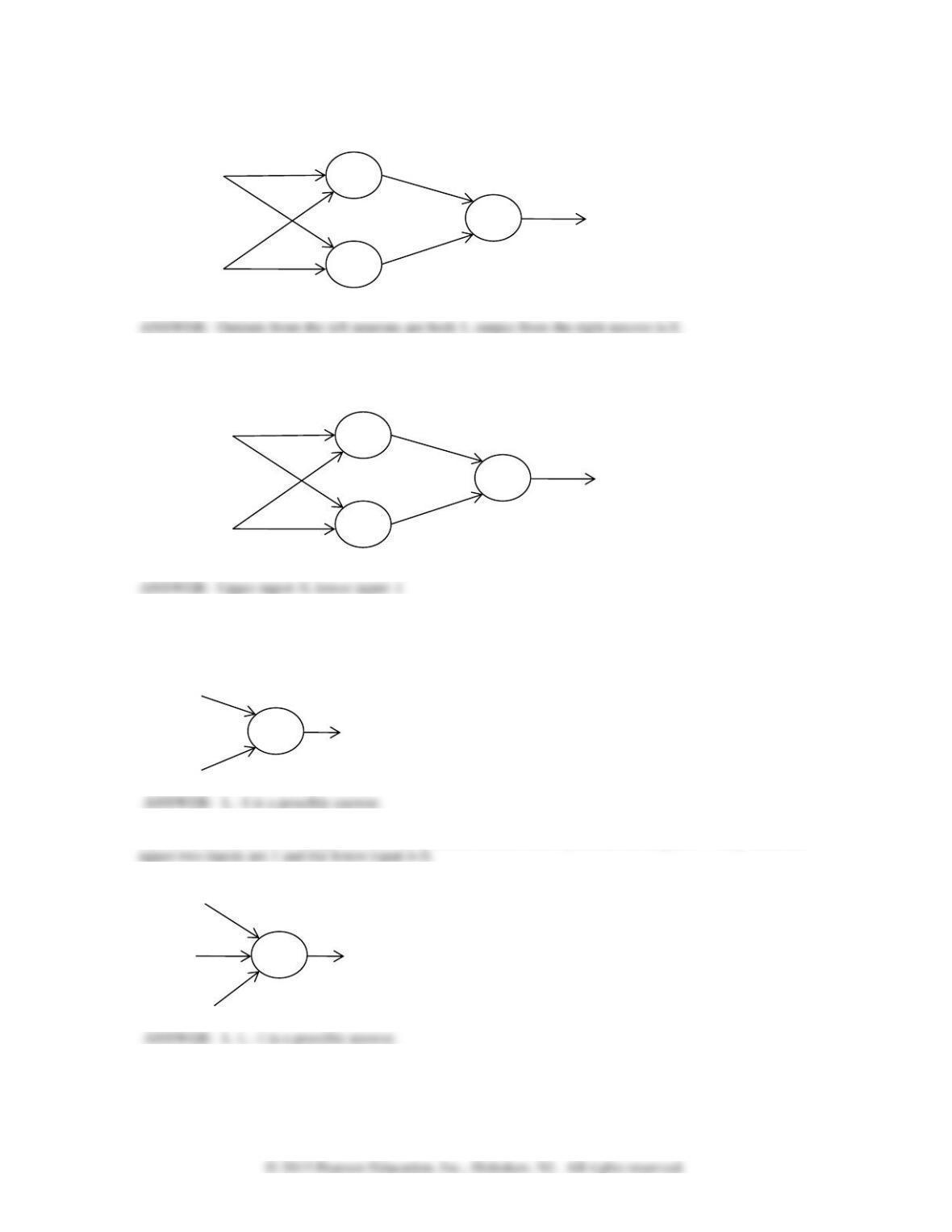
9. Fill in the blank at the output end of each neuron in the artificial neural network below.
.5
1-1
2
.5
.5
-3
4
-2
1
1
__
__ __
10. Fill in the blanks with input values that will cause the artificial neural network below to produce an
output of 1.
.5
__ -1
2
.5
.5
-3
4
-2
1
__
1
11. Fill in the connection weights so that the artificial neuron below produces an output of 1 only when the
upper input is 1 and the lower input is 0.
.5
__
__
12. Fill in the connection weights so that the artificial neuron below produces an output of 1 only when the
1.5
__
__
__
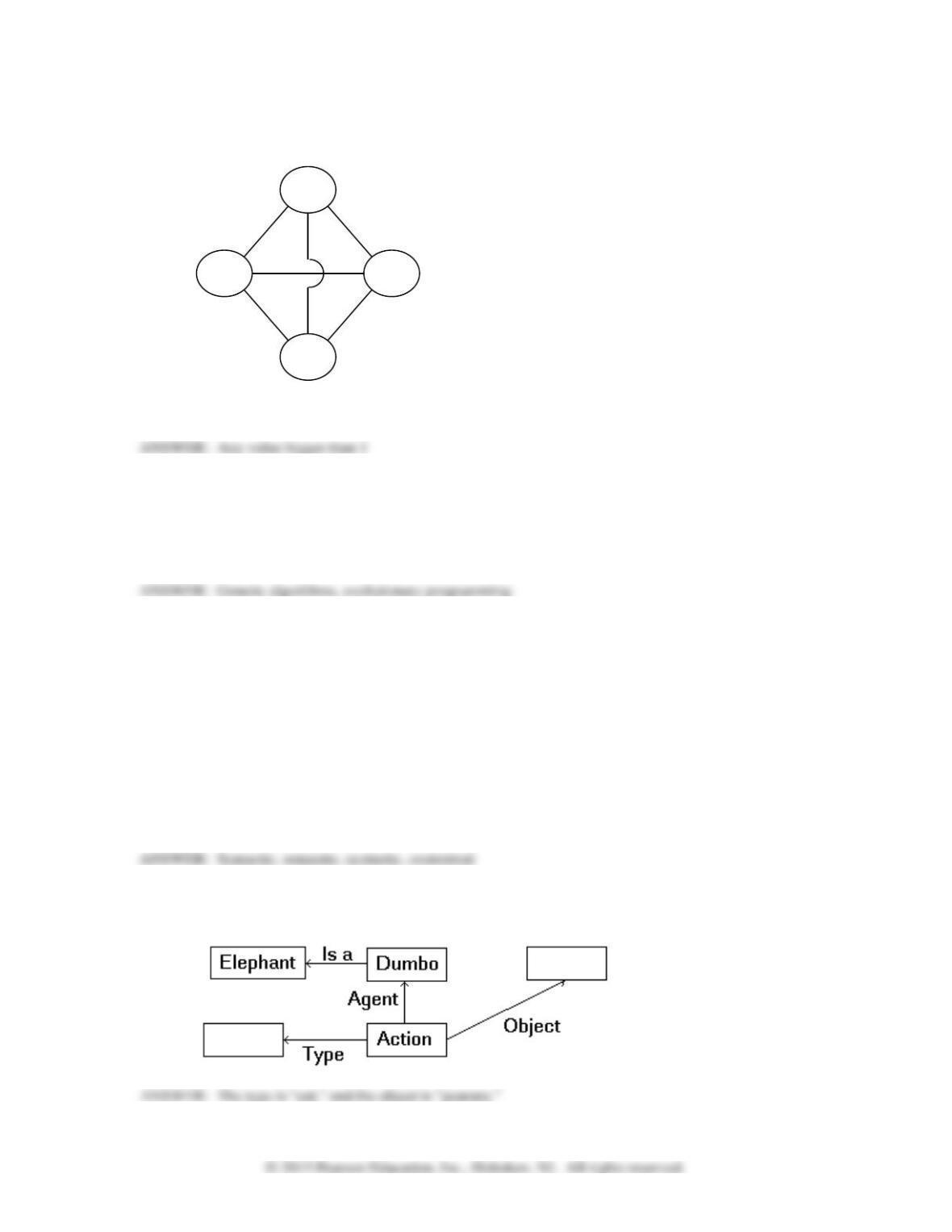
13. The diagram below represents an associative memory as described in the text. What threshold value
could be assigned to all the neurons to ensure that no neuron would ever be excited by the others?
__
__
__
__
-1
-1
-1
-1
1
1
_________
14. The field of research known as _______________________ seeks to apply survival–of-the-fittest
theories to the problem solving process. In particular, _________________________ is the subfield that
seeks to apply such evolutionary principles to the programming process.
15. In each blank below, write syntactic, semantic, or contextual to indicate which form of analysis is
required to perform the associated task.
______________ Identify the subject in the sentence “John ate the ice cream.”
______________ Recognize that the sentence “John ate the ice cream” means the same as the
sentence “The ice cream was eaten by John.”
______________ Identify the object in the sentence “John ate the ice cream.”
______________ Identify the person referred to by the pronoun he in the sentence “He ate the ice
cream.”
16. Fill in the blank entries in the semantic net below to reflect the meaning of the sentence “Dumbo ate
peanuts.”

17. Place an X in each blank below that is associated with a conclusion that would require the closed–world
assumption in the context of a database that contained a list of subscribers to the New York Times.
_____ John Doe subscribes to the New York Times.
_____ John Doe does not subscribe to the New York Times.
_____ Either Mary Doe or John Doe does not subscribe to the New York Times.
_____ Either Mary Doe or John Doe subscribes to the New York Times.
18. Place an X in each blank below that is associated with a statement that would be considered true by a
closed-world database containing only the statement “Kermit is a frog OR Miss Piggy is an actress.”
_____ Kermit is a frog.
_____ Miss Piggy is not an actress.
_____ Kermit is not a frog AND Miss Piggy is not an actress.
_____ Kermit is not a frog.
Vocabulary (Matching) Questions
The following is a list of terms from the chapter along with descriptive phrases that can be used to produce
questions (depending on the topics covered in your course) in which the students are ask to match phrases
and terms. An example would be a question of the form, “In the blank next to each phrase, write the term
from the following list that is best described by the phrase.”
Term Descriptive Phrase
agent A responsive entity
Turing test A means of measuring a machine’s ability to perform like a human
image analysis The task of understanding an image
breadth-first A search algorithm that processes all the nodes in a layer, one layer at a
time at ever increasing depths
template matching To identify by comparing to predefined patterns
production system A “universal” approach to the construction of reasoning systems
semantic analysis A task of language processing that identifies the meaning of words
heuristic A tool for simulating intuition
breadth-first search The result of considering all options equally important
image processing The task of identifying characteristics found within an image
state graph A “picture” of all states and productions
inference rule A means of obtaining a statement that is a logical consequence of other
statements
real-world knowledge The “database” used by an intelligent system to support its reasoning
artificial neural network A computer processing model that able to learn by adjusting a set of
weights and thresholds
genetic algorithms A field of artificial intelligence that applies evolutionary theories to the
software development process
associative memory The ability to recall related information
expert system A software package for solving problems within a particular field
semantic net A means of representing knowledge
A* algorithm A search algorithm that uses both a heuristic and an accumulated cost
in determining the next node to process
contextual analysis To relate a sentence to its environment
supervised training An agent generalizes known responses for given set of examples
linguistics The study of human communication
General Format Questions
1. Explain the distinction between declarative knowledge and procedural knowledge.
2. Explain the distinction between image processing and image analysis.
3. Describe the distinction between a state graph and a search tree.
4. Draw the search tree that would be generated by a best-fit heuristic search when solving the eight-puzzle
from the starting configuration below assuming that “the number of tiles out of place” were used as the
heuristic.
1 2 3
5 6
4 7 8
5. Draw the search tree that would be generated by a breadth-first search when solving the eight-puzzle
from the starting configuration below.
1 2 3
4 5 6
7 8
6. Explain the distinction between weak AI and strong AI.
7. Why would the search process used in the text to solve the eight-puzzle not be applicable in cases of
competitive games such as chess or checkers?
8. Suppose the eight-puzzle was extended to a four–by-four tray containing 11 tiles with the solved puzzle
appearing as below.
1 2 3 4
5 6 7 8
9 10 11 12
13 14 15
What problem would occur if our heuristic search (using the-number-of-tiles-out–of-place) was applied to
solve the puzzle start from the configuration below? How could that problem be overcome?
1 11 15 12
5 6 7 8
9 10 2 3
13 14 4
9. How does the process of “programming” an artificial neural network differ from the traditional
programming process?
10. When trying to understand a natural language, what are the distinctions between syntactic analysis,
semantic analysis, and contextual analysis?
11. Do you believe the weak AI conjecture, the strong AI conjecture, or neither? Support your choice.
12. What is the frame problem?
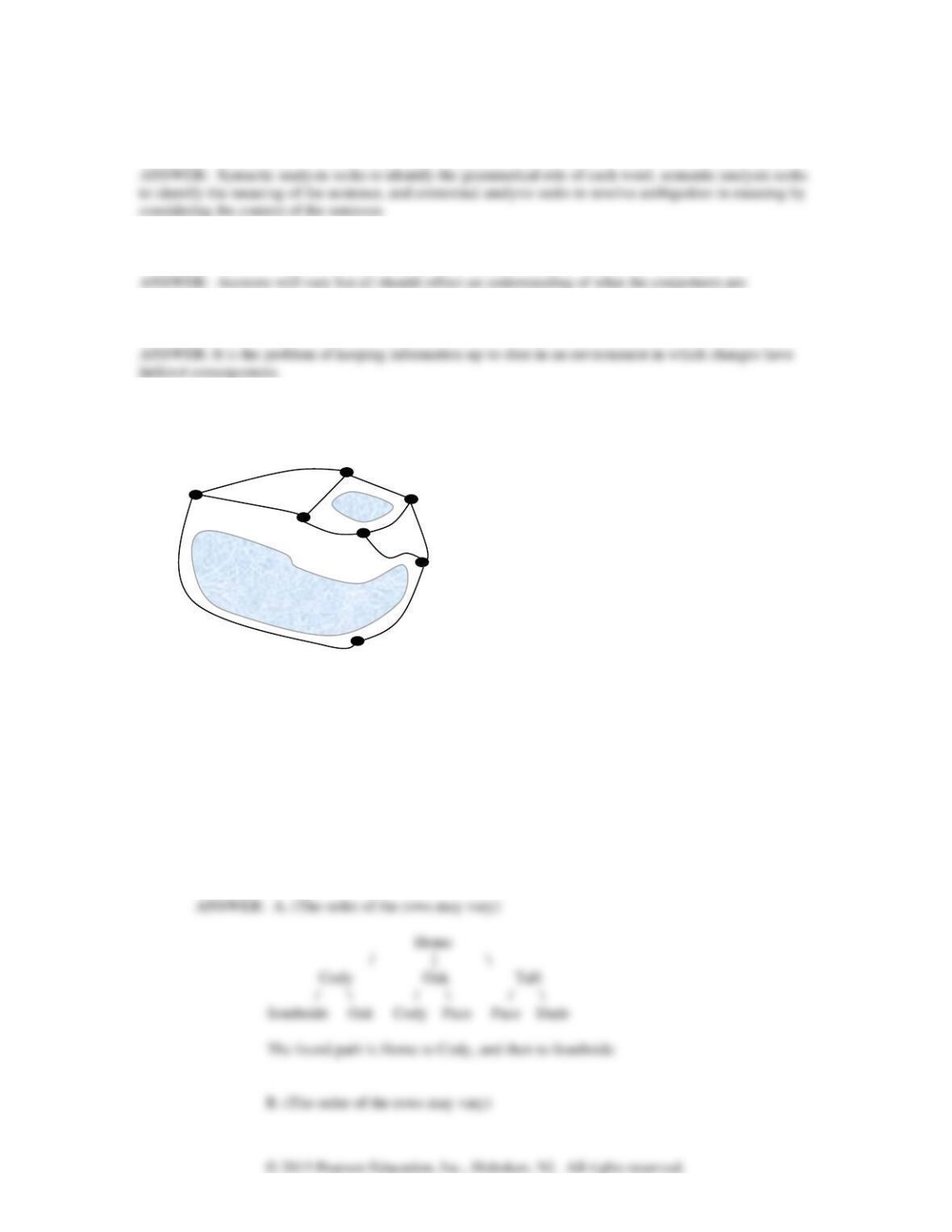
13. For the following map:
Lake Mary
Pace
Home
Taft
Southside
Cody
Oak
Dade
4
4
4
4
4
5
6
6
8
16
Straight line distance to
Southside from:
Cody 11
Dade 5
Home 9
Oak 7
Pace 6
Taft 8
A. Draw the search tree generated by a breadth-first search in finding a path from Home to
Southside. What is the found path?
B. Draw the search tree generated by a best-fit search in finding a path from Home to Southside
assuming that “the straight line distance to Southside” were used as the heuristic. What is the
found path?
C. Draw the search tree generated by the A* algorithm in finding the path from Home to
Southside assuming that “the straight line distance to Southside” were used as the heuristic.
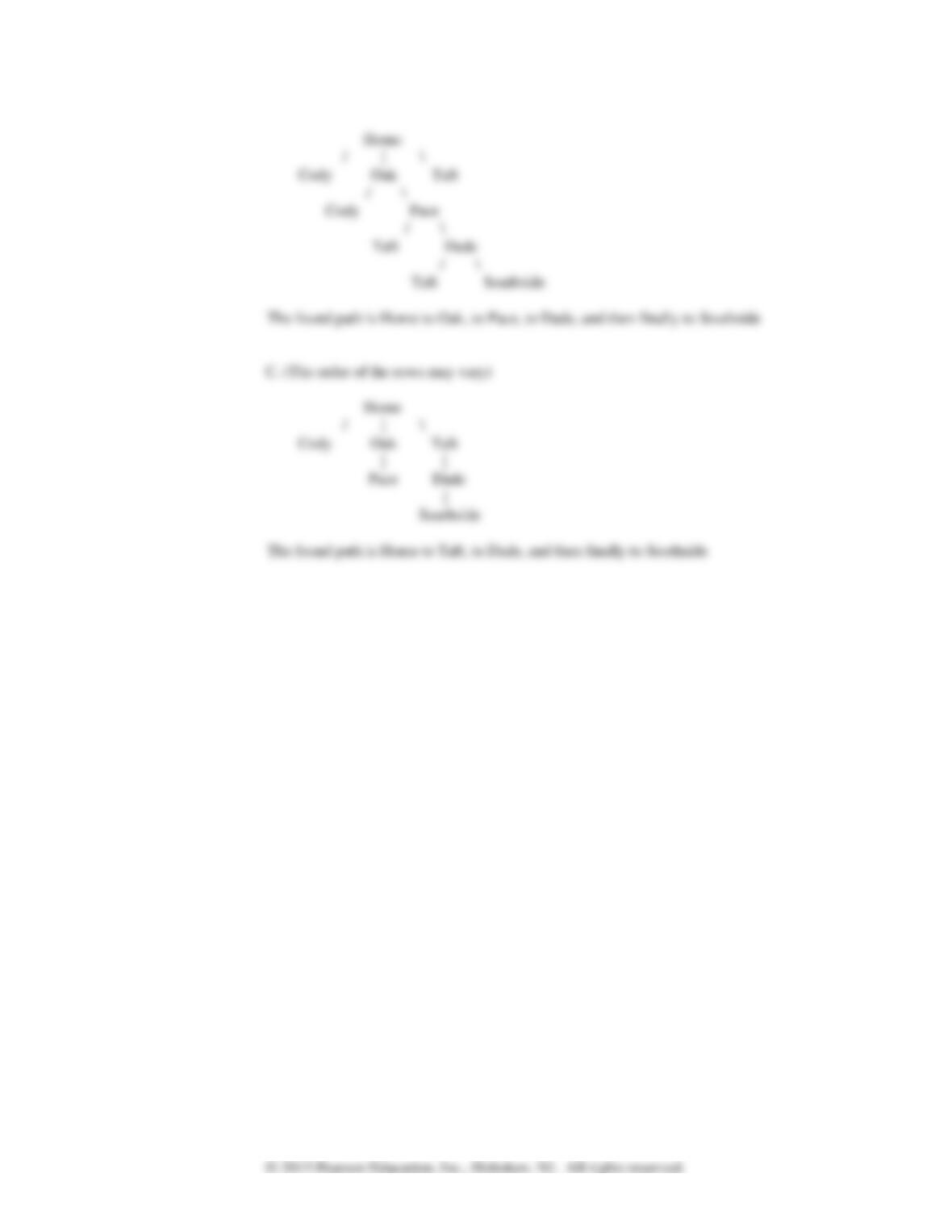
What is the found path?