Exam
Name___________________________________
MULTIPLE CHOICE. Choose the one alternative that best completes the statement or answers the question.
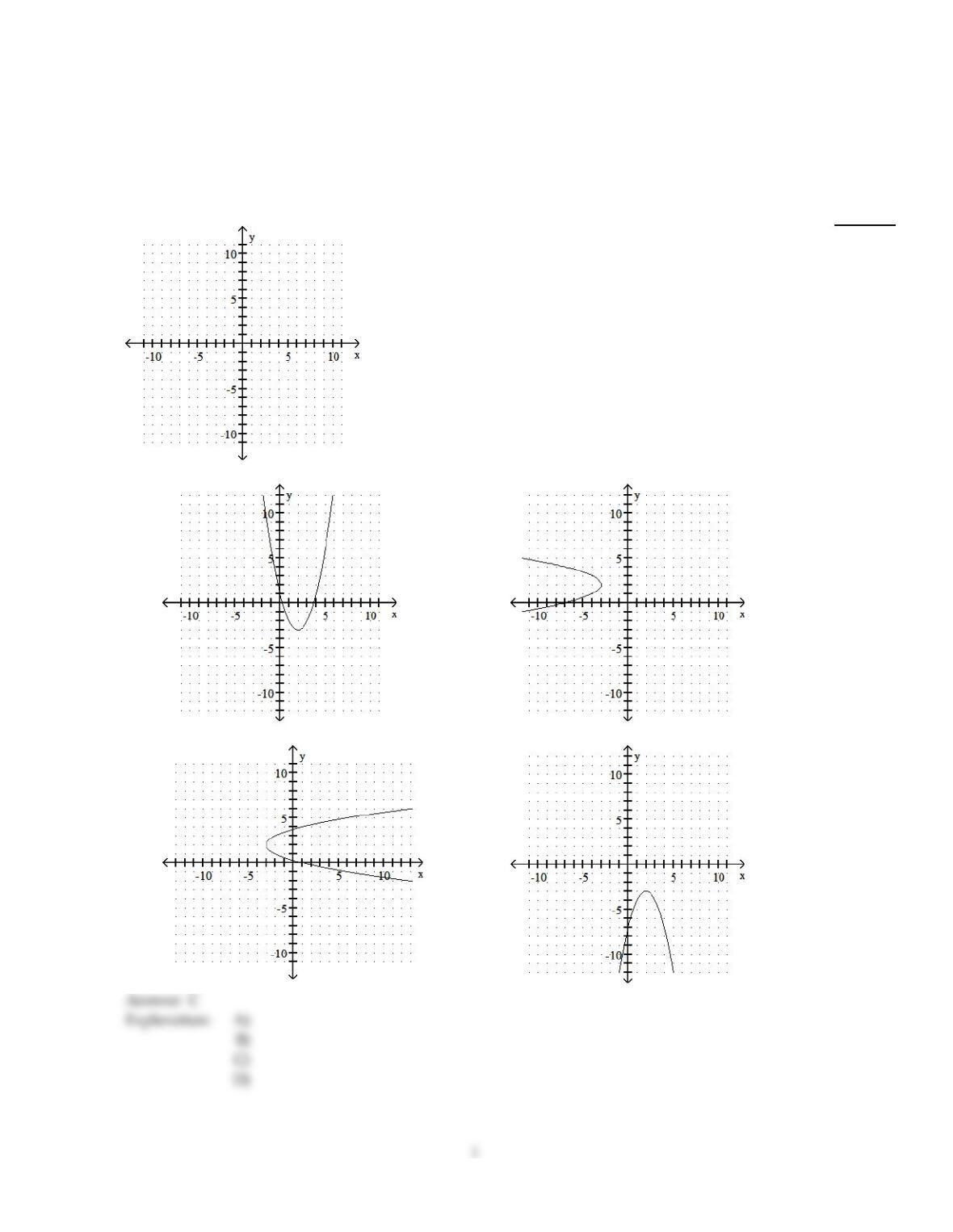
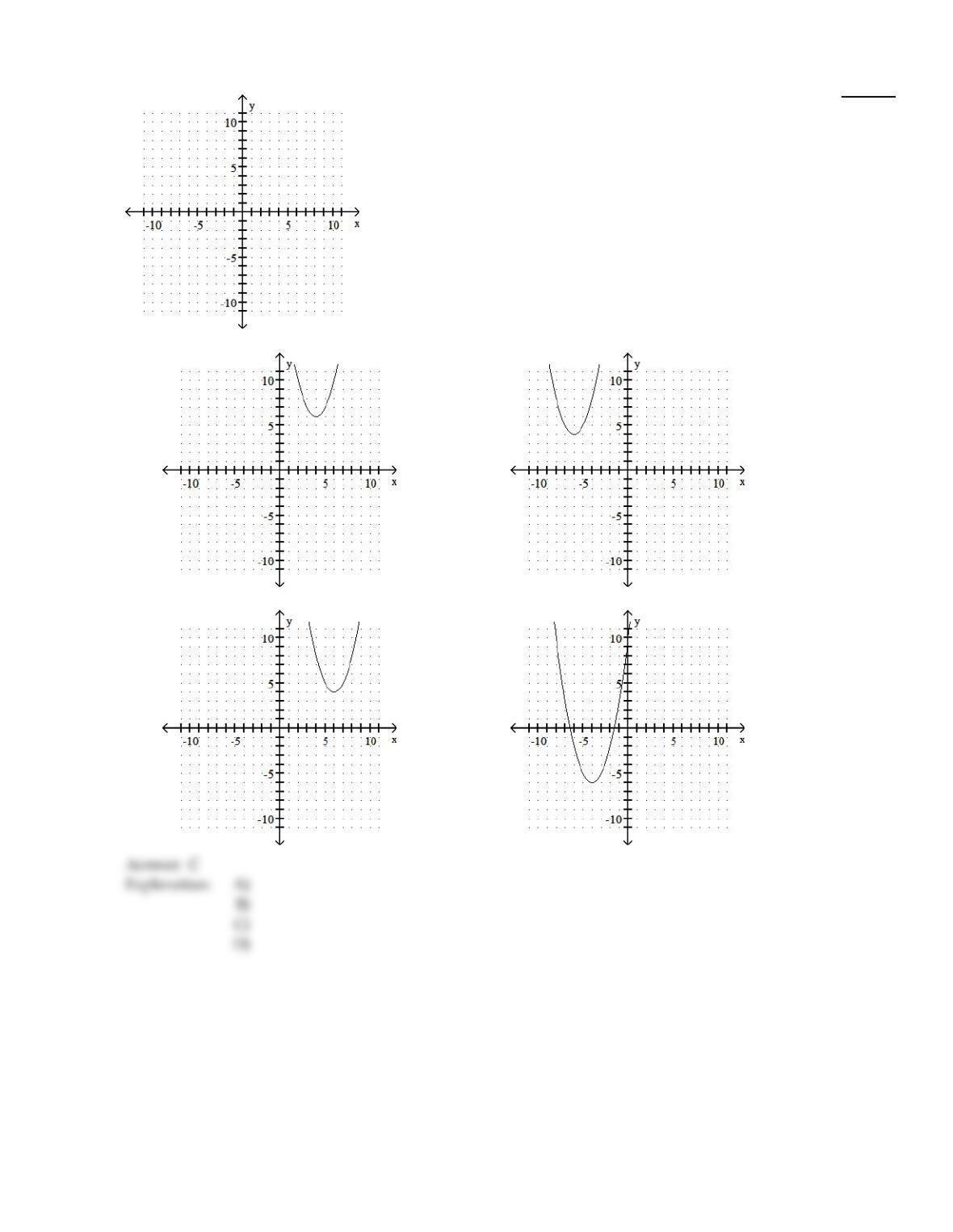
Graph the parabola.
1)
x = (y – 2)2– 3
1)
A)
B)
C)
D)
Provide an appropriate response.
2)
Which one of the following methods cannot be used to solve the equation x2– 4x – 9 = 0?
2)
A)
Quadratic formula
B)
Factoring
C)
Completing the square
D)
All of the methods can be used.
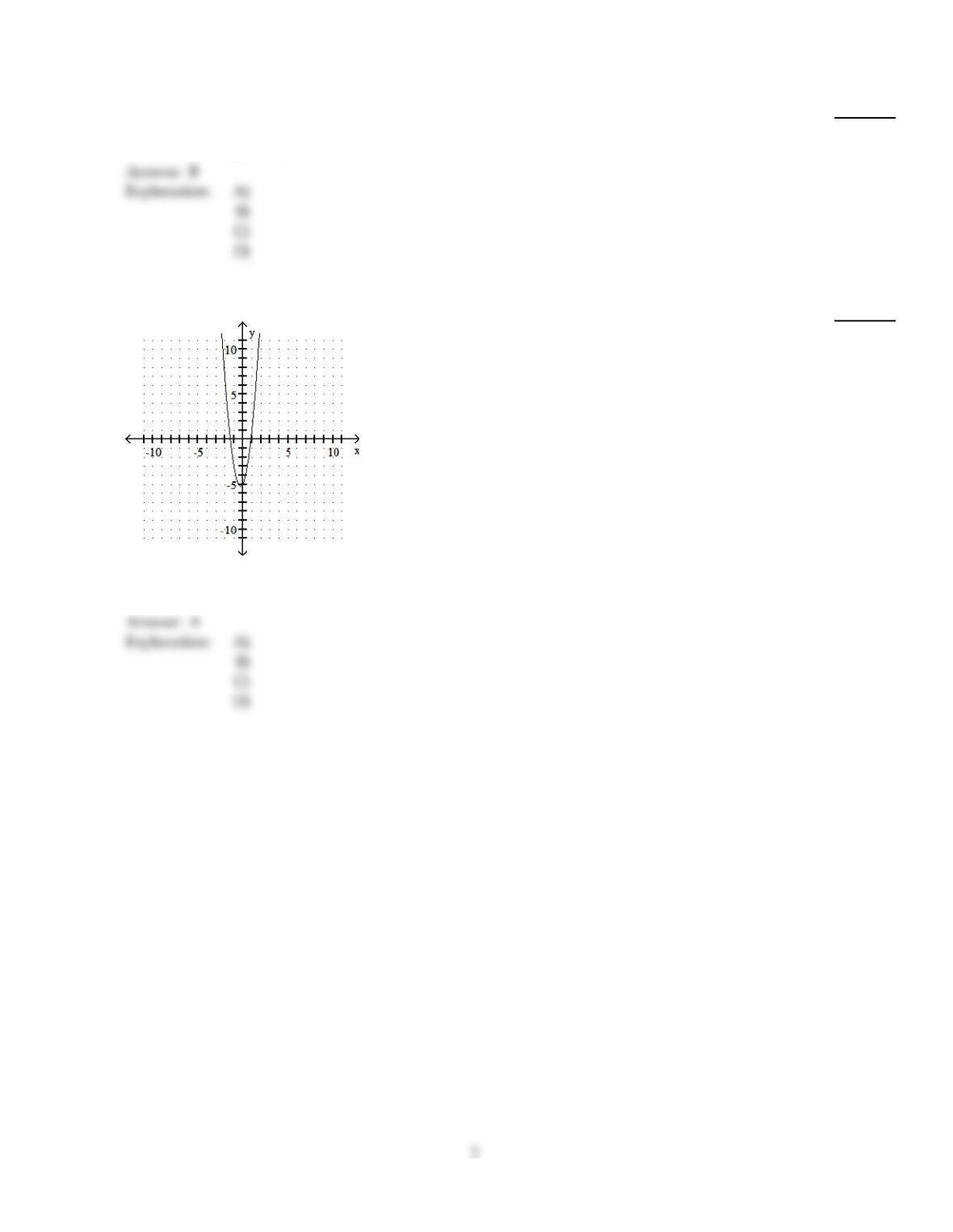
Choose the equation that matches the graph.
3)
3)
A)
f(x) =4x2+ 2x – 5
B)
f(x) = – 4x2+ 2x – 5
C)
f(x) =4x2– 2x – 5
D)
f(x) =4x2+ 2x + 5
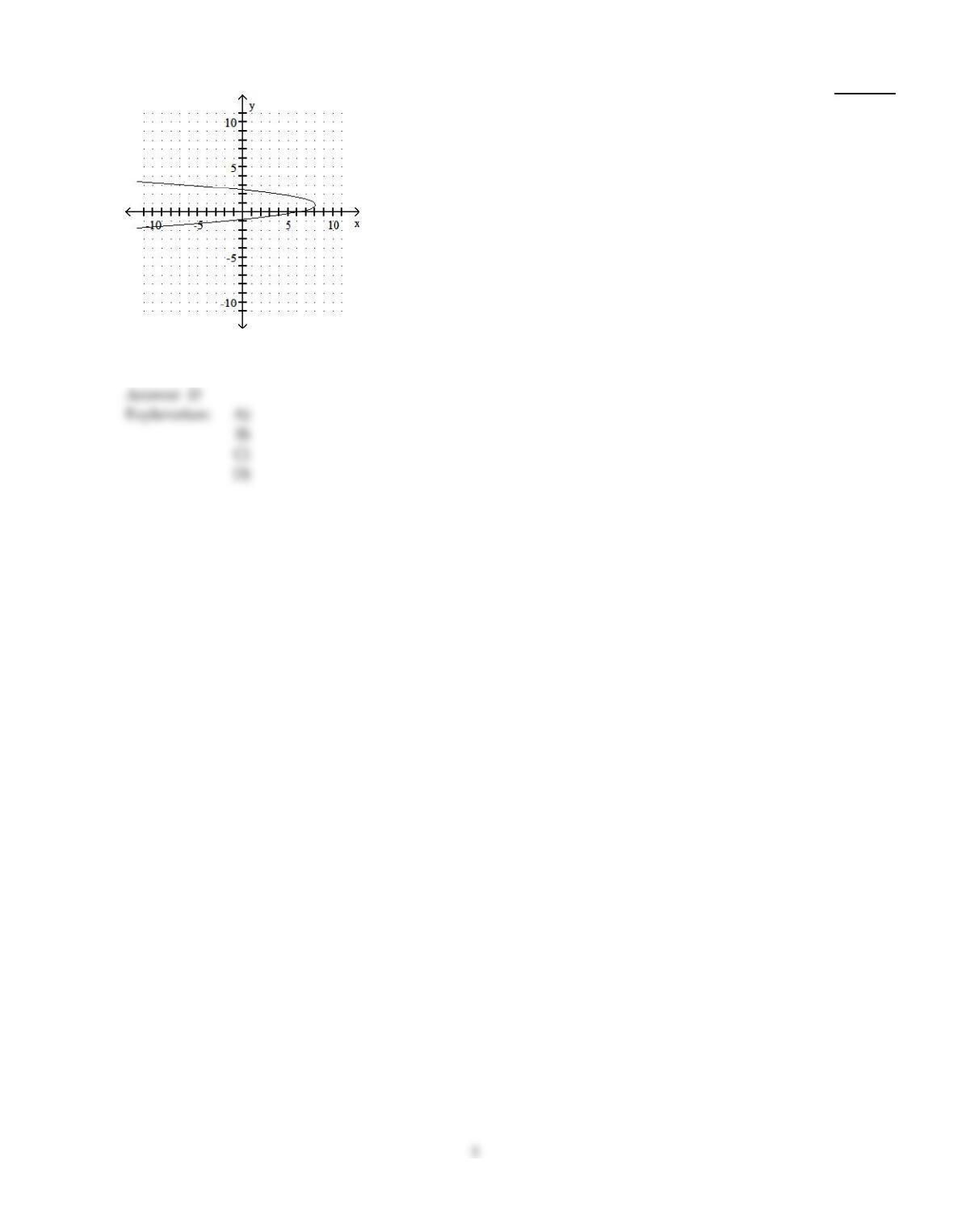
4)
4)
A)
x = – 3y2+ 5y – 6
B)
f(x) = – 3x2– 5x + 6
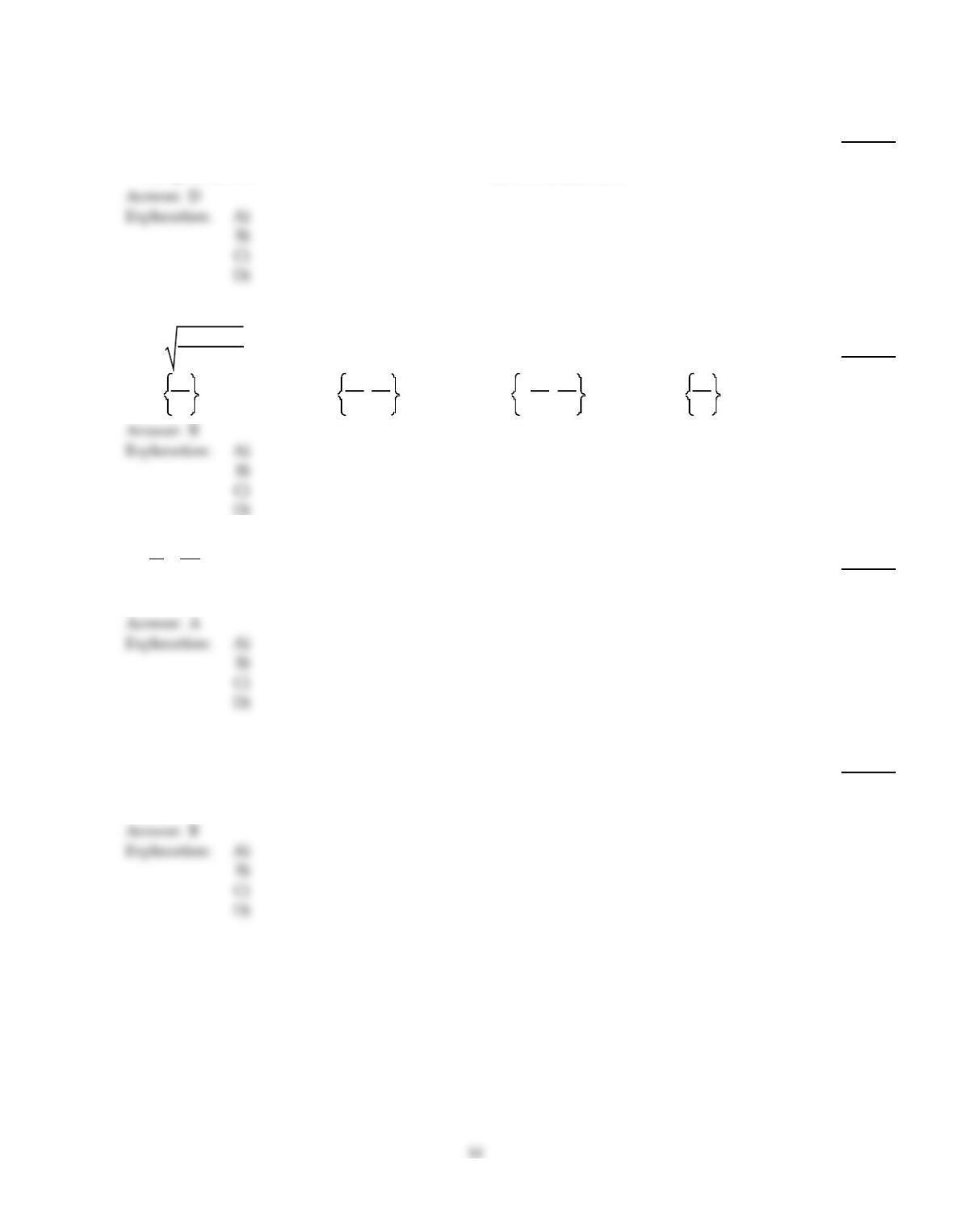
C)
f(x) = – 3x2+ 5x + 6
D)
x = – 3y2+ 5y + 6
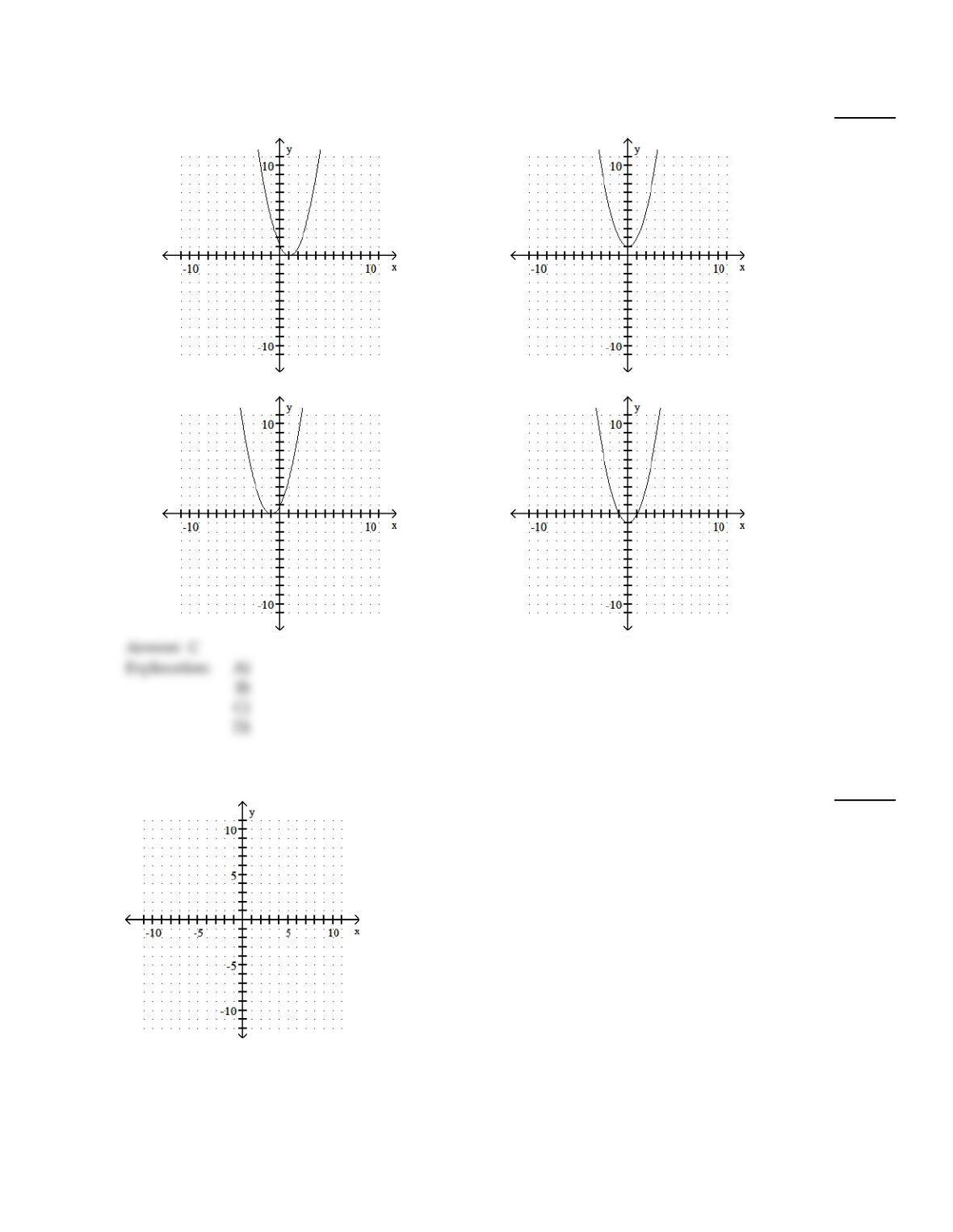
Identify which graph matches the equation.
5)
f(x) =(x + 1)2
5)
A)
B)
C)
D)
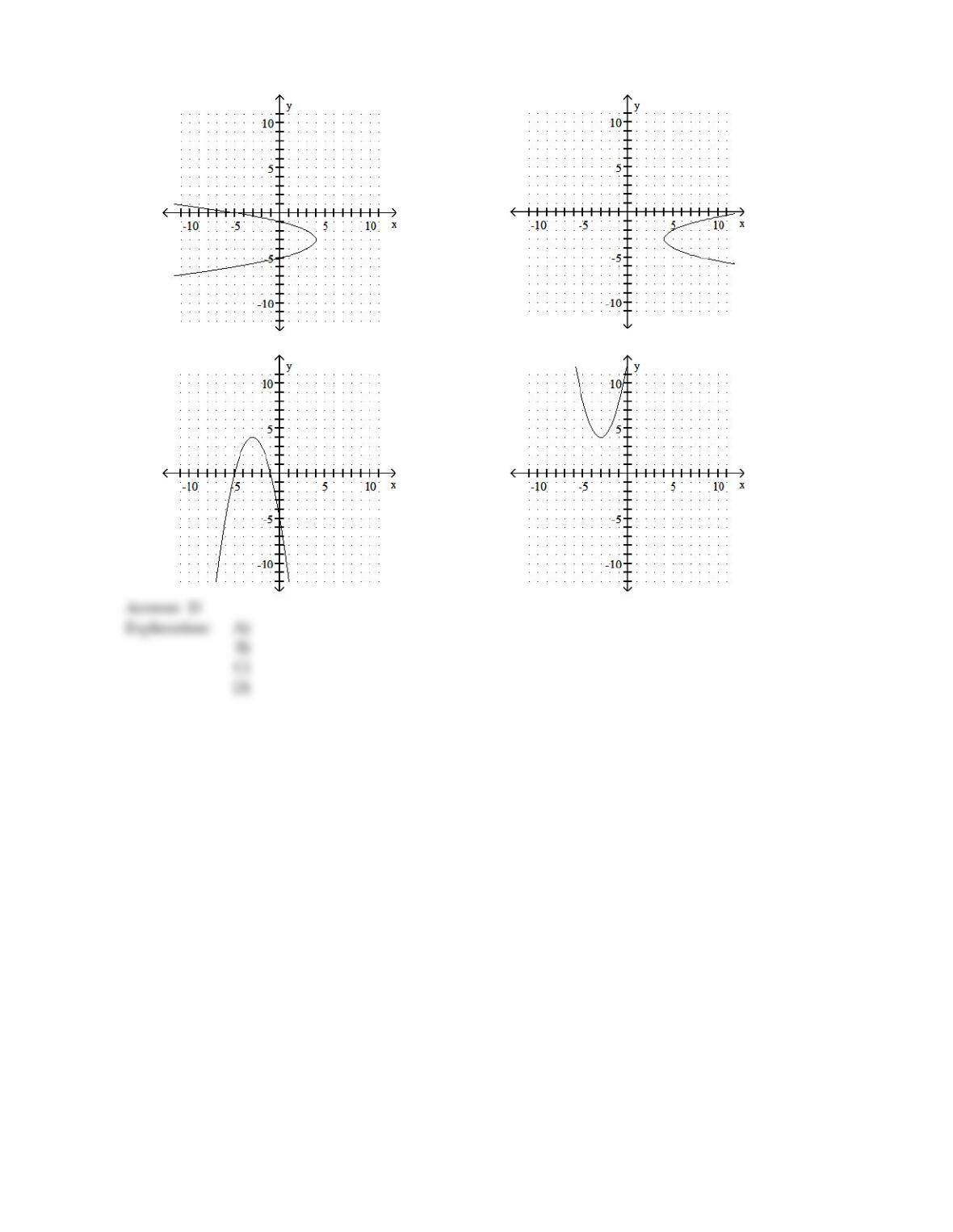
Graph the parabola.
6)
f(x) = (x + 3)2+ 4
6)
4
A)
B)
C)
D)
5
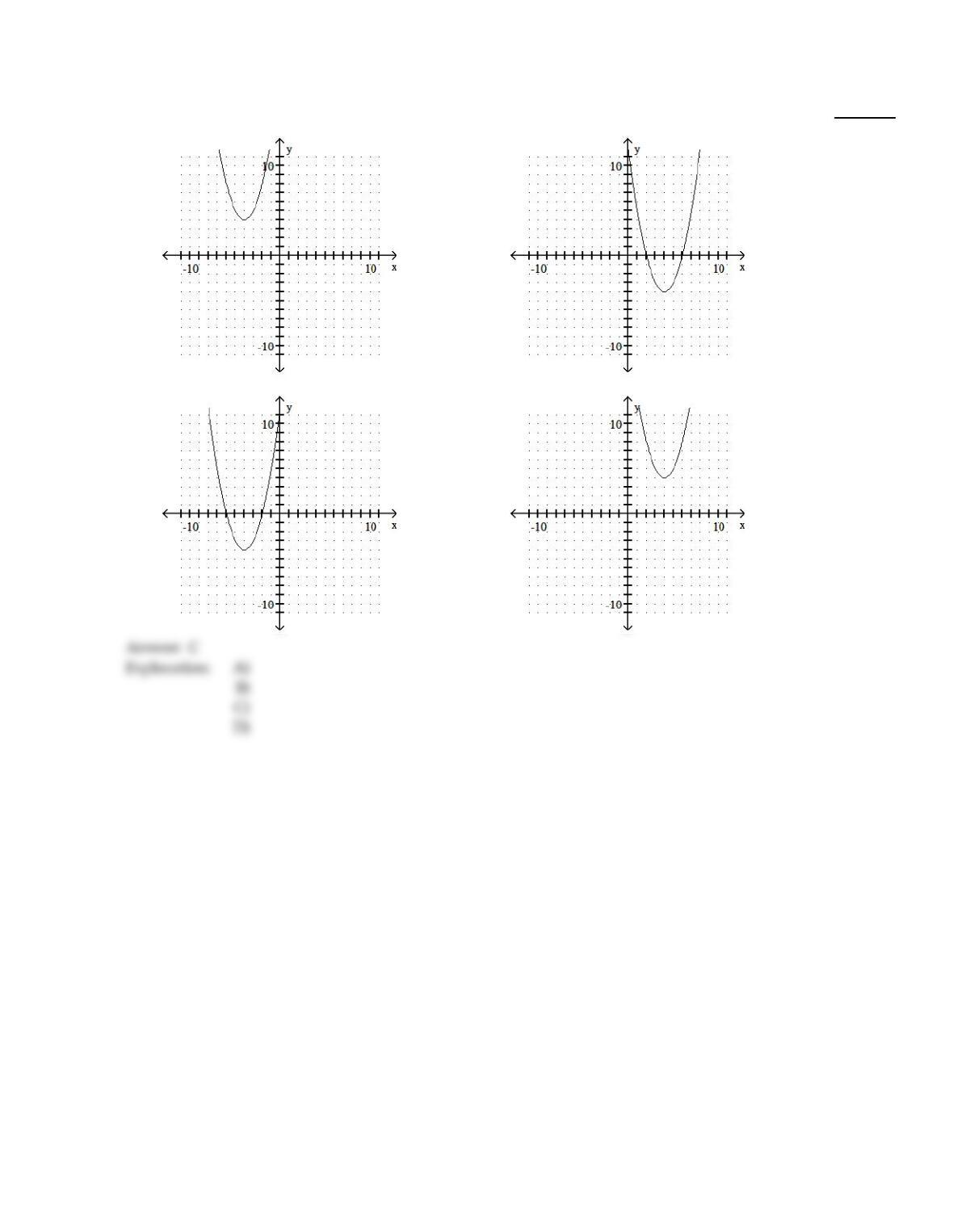
Identify which graph matches the equation.
7)
f(x) =(x + 4)2– 4
7)
A)
B)
C)
D)
6
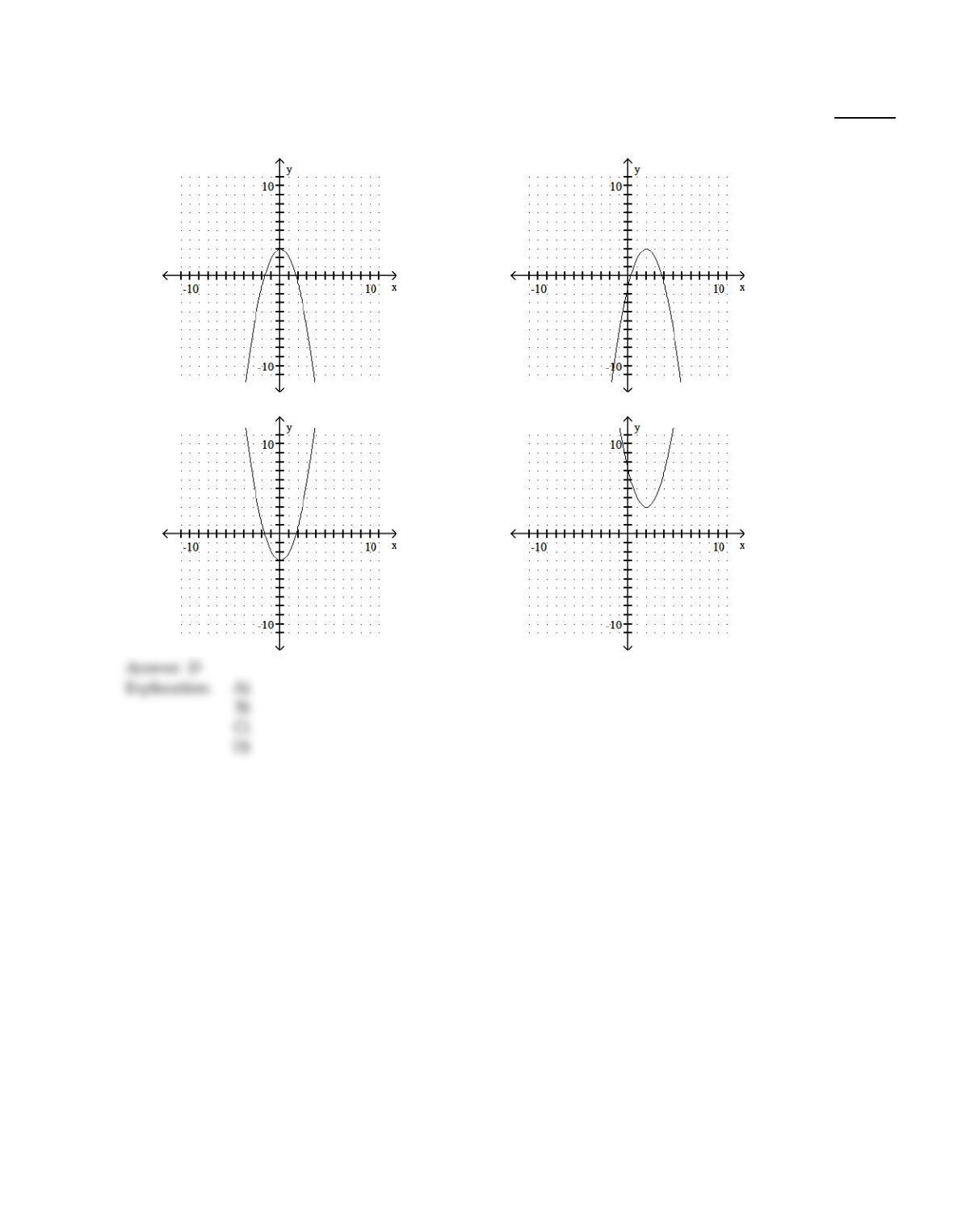
Provide an appropriate response.
8)
Which one of the following most closely resembles the graph of f(x) = a(x – h)2+ k if a > 0, h < 0,
and k > 0?
8)
A)
B)
C)
D)
7
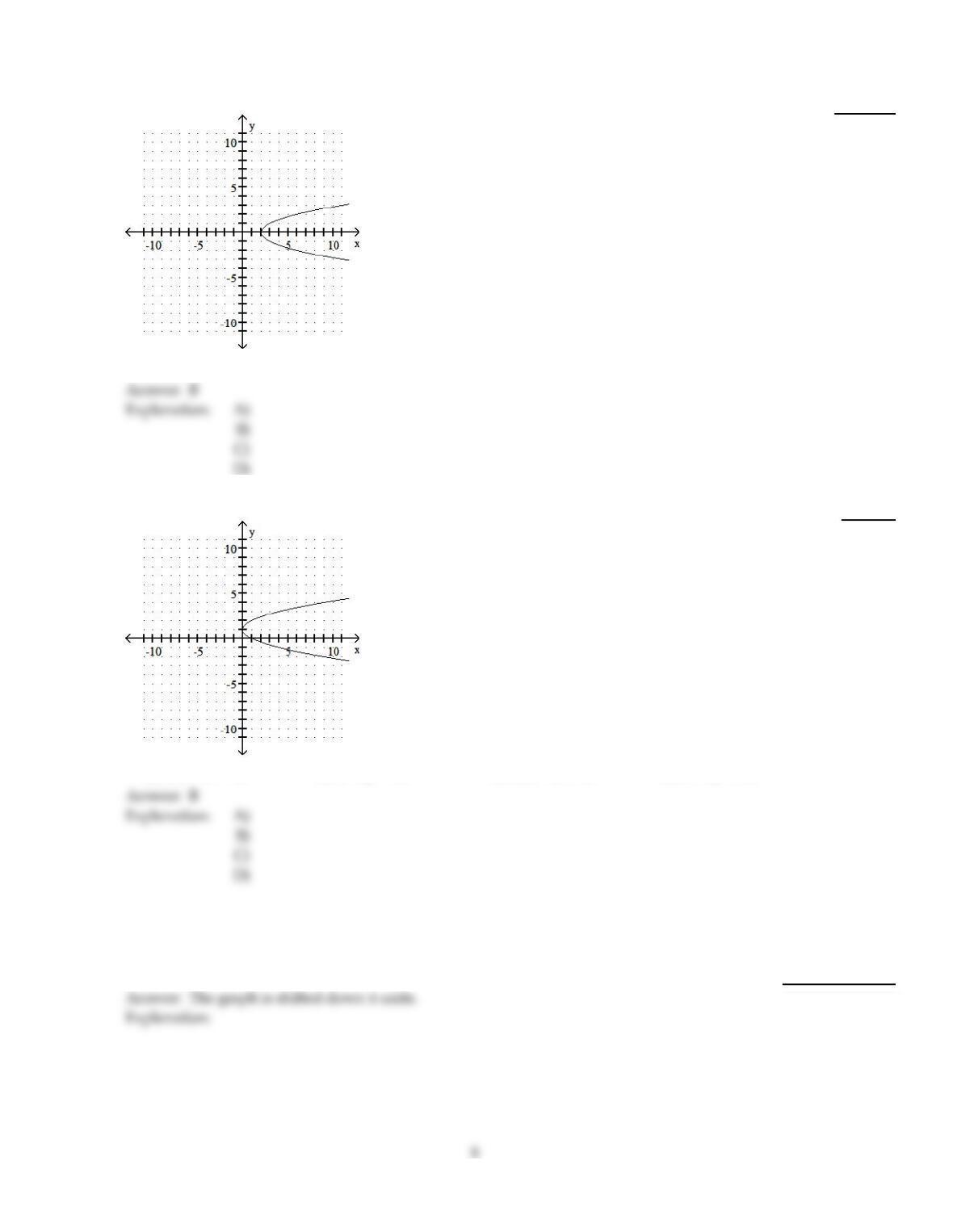
Choose the equation that matches the graph.
9)
9)
A)
f(x) =x2+ 2
B)
x =y2+ 2
C)
x =y2– 2
D)
f(x) =x2– 2
10)
10)
A)
f(x) =(x – 1)2
B)
x =(y – 1)2
C)
f(x) =(x + 1)2
D)
x =(y + 1)2
SHORT ANSWER. Write the word or phrase that best completes each statement or answers the question.
Provide an appropriate response.
11)
Describe how the graph of y =x2– 4 differs from the graph of y =x2.
11)
12)
What are the advantages and disadvantages of the quadratic formula as a method of
solving quadratic equations?
12)
13)
The equation s = – 16t2+ 68t + 460 gives the position s in feet above the ground, where t is
the number of seconds elapsed after a ball is projected upward from a building. Determine
the height of the building, if possible. Explain your reasoning.
13)
Answer:
Explanation:
14)
Write the equation so that it is quadratic in form.
–7=7 x – 7x
14)
Answer:
Explanation:
15)
What are the advantages and disadvantages of factoring as a method of solving quadratic
equations?
15)
Answer:
Explanation:
16)
Describe how the graph of y = 5x2 differs from the graph of y =x2.
16)
Answer:
Explanation:
17)
Tell what restrictions, if any, must be made on d and k (both real numbers) to guarantee
that t is a real number. Assume that the denominator is not zero.
t =dk
k
17)
Answer:
Explanation:
18)
Describe how the graph of y =x2+ 4 differs from the graph of y =x2.
18)
Answer:
The graph is shifted up 4 units.
Explanation:
9
Answer:
Explanation:
19)
Solve the equation y =3x2+ bx – 2 for x. If y is positive and b is negative, what, if
anything, can you determine about the signs of the solutions? Explain your reasoning.
19)
Explanation:
20)
Give a definition or an example of the word or phrase. Quadratic function
20)
Explanation:
21)
Why is it not possible to choose h and k, neither zero, so the parabola f(x) = a(x – h)2+ k
has its vertex at the origin?
21)
Explanation:
22)
Which of the other three methods for solving quadratic equations is used to derive the
quadratic formula?
22)
Explanation:
23)
Solve the equation y =5x2+ bx – 2 for x. If y is positive and b is positive, what, if anything,
can you determine about the signs of the solutions? Explain your reasoning.
23)
Explanation:
24)
Explain why the vertex of a parabola must lie on its axis.
24)
Explanation:
25)
Tell what restrictions, if any, must be made on s, k, and w to guarantee that d is a real
number. Assume that s, k, and w are all real numbers and that the denominator is not zero.
d =skw
kw
25)
26)
Tell what restrictions, if any, must be made on k, l, and p (all real numbers) to guarantee
that g is a real number. Assume that the denominator is not zero.
g =kl
p2
26)
27)
What is the first step in solving the following formula for t?
zt2= kl – 3
27)
28)
Describe how the graph of y = – 5x2 differs from the graph of y =x2.
28)
29)
Which of the four methods of solving quadratic equations work for any quadratic
equation?
29)
MULTIPLE CHOICE. Choose the one alternative that best completes the statement or answers the question.
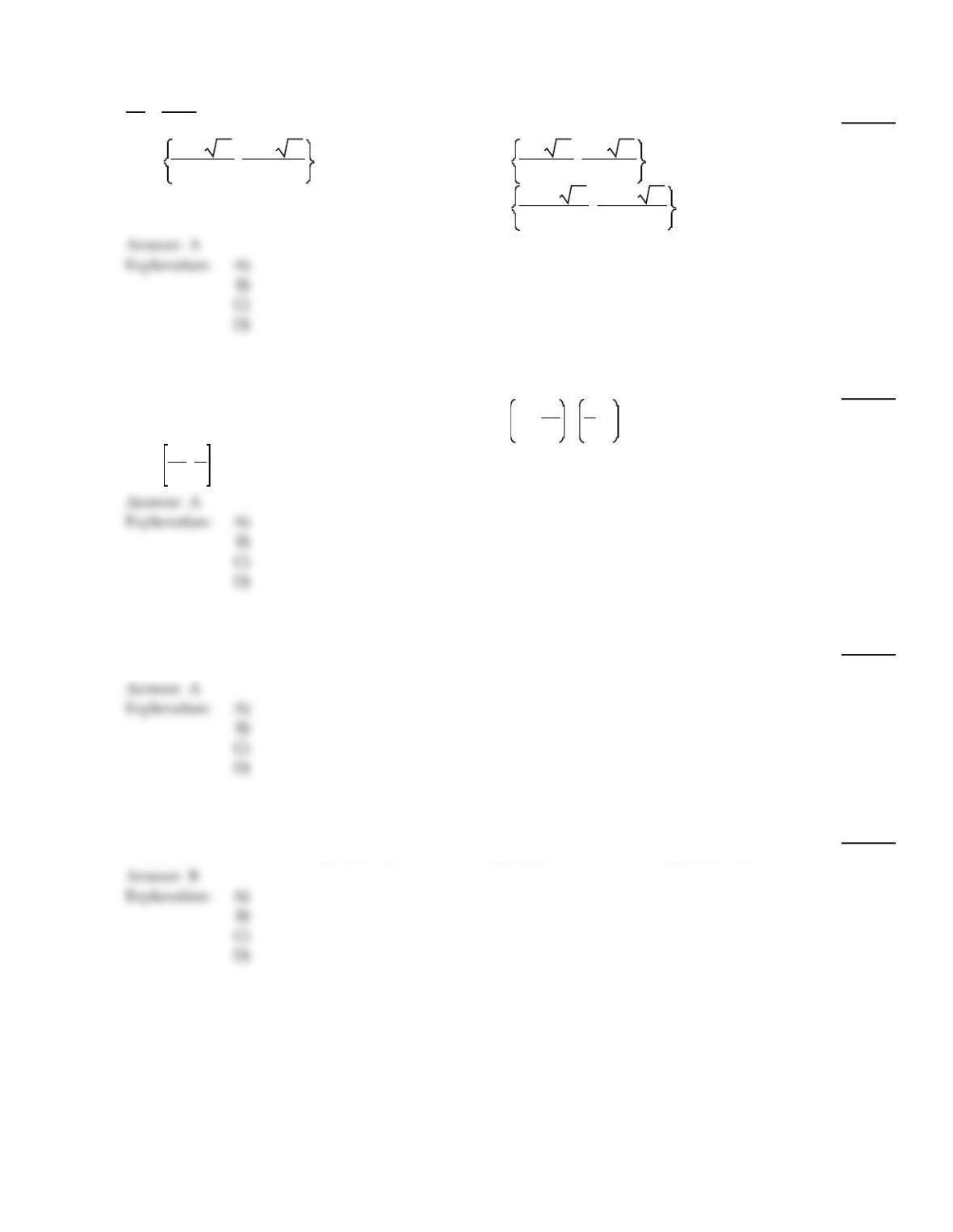
Use the quadratic formula to solve the equation. (All solutions are real numbers.)
30)
4n2= – 12n – 3
30)
A)
–3+3
2, –3–3
2
B)
–12 +6
2, –12 –6
2
C)
–3+6
2, –3–6
2
D)
–3+6
8, –3–6
8
Solve the equation.
31)
2
3x –3
x +3= 1
31)
A)
–8+82
3, –8–82
3
B)
8+82
3, 8–82
3
C)
D)
–10 +82
3, –10 –82
3
Solve the inequality.
32)
(8 – 4x)2–9
32)
A)
(–, )
B)
–, 11
45
4,
C)
11
4, 5
4
D)
A
Use a calculator to solve the equation. Round to the nearest hundredth, if necessary.
33)
(2.76m – 7.30)2=6.97
33)
A)
{3.60, 1.69}
B)
{3.22, 0.04}
C)
{–1.69, 3.60}
D)
{3.60, –3.60}
A
Find the value of k so that the equation will have exactly one rational solution.
34)
4x2+ kx + 9 = 0
34)
A)
6 or –6
B)
12 or –12
C)
None
D)
12i or –12i
B
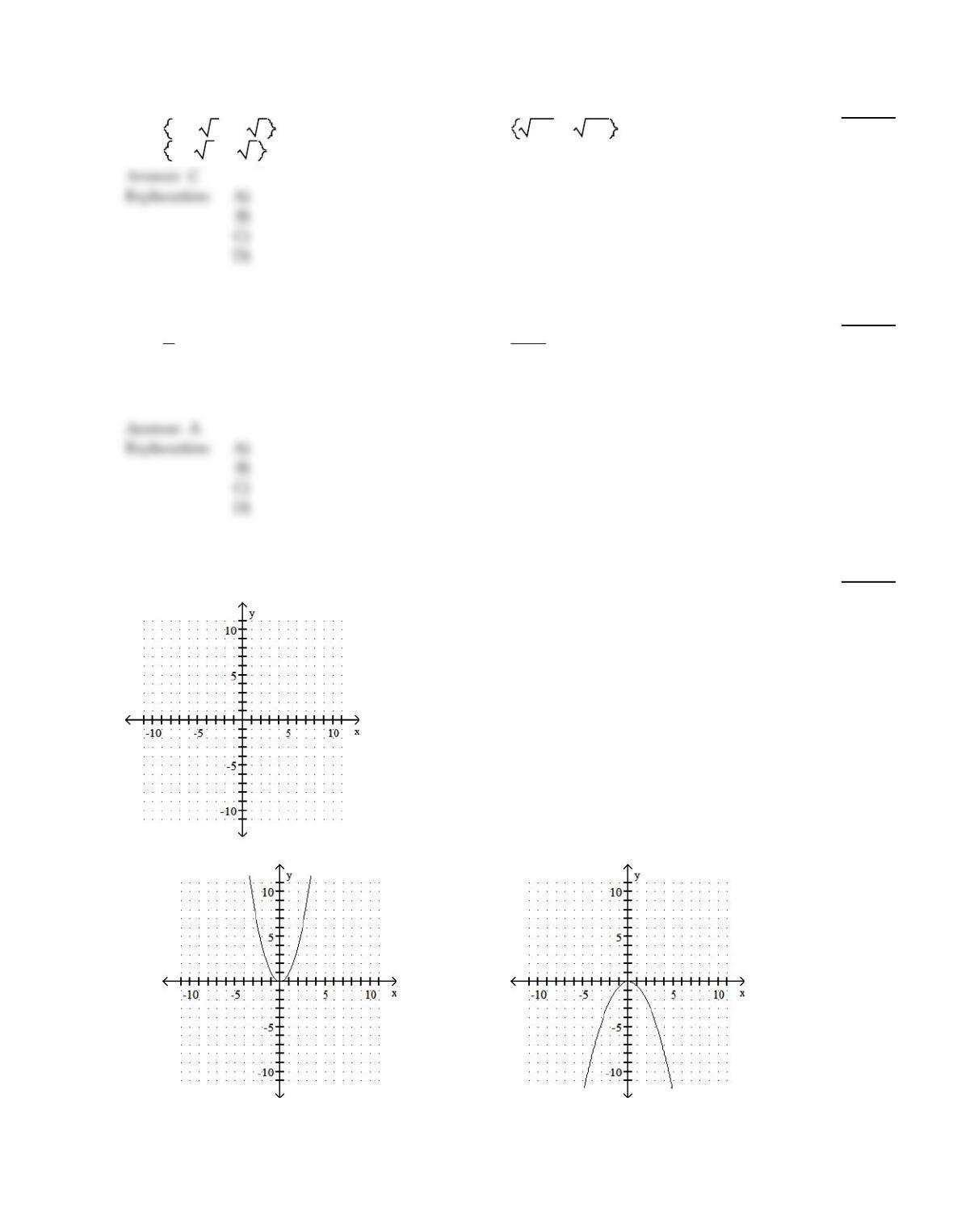
Sketch the graph of the parabola.
12
A
35)
y = (x – 6)2+ 4
35)
A)
B)
C)
D)
13
Decide whether the graph of the equation opens up, down, to the left, or to the right; and whether it is wider, narrower, or
the same shape as the graph of f(x) =x2 (or x =y2).
36)
f(x) = – 2x2– 9x
36)
A)
Down; wider
B)
Up; wider
C)
Up; narrower
D)
Down; narrower
Solve by any method.
37)
11x =121x –14
2
37)
A)
2
11
B)
2
11 , 7
22
C)
–2
11 , 7
22
D)
7
22
38)
1 –4
x
–45
x2= 0
38)
A)
{9, –5}
B)
{–9, –5}
C)
{9, 5}
D)
{–9, 5}
Solve the problem.
39)
A projectile is thrown upward so that its distance above the ground after t sec is given by
h(t) = – 13t2+ 442t. After how many seconds does it reach its maximum height?
39)
A)
34 sec
B)
17 sec
C)
25.5 sec
D)
8 sec
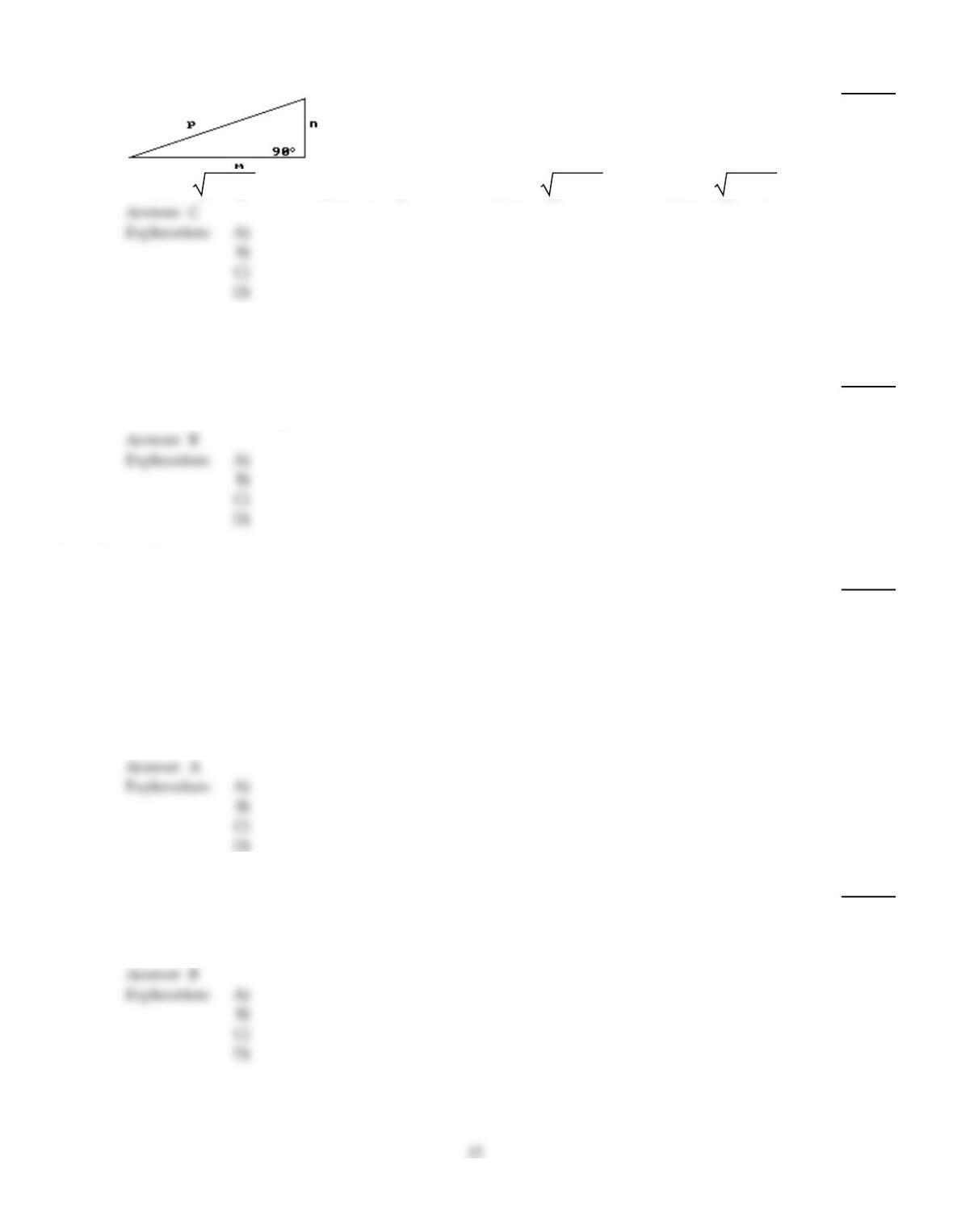
40)
Solve for m in terms of the other variables.
40)
A)
m =n2– p2
B)
m =n2– p2
C)
m =p2– n2
D)
m =p2+ n2
Use the discriminant to determine whether the equation has two rational solutions, one rational solution, two irrational
solutions, or two nonreal complex solutions. Do not actually solve.
41)
v2+ 3v – 3 = 0
41)
A)
One rational solution
B)
Two irrational solutions
C)
Two nonreal complex solutions
D)
Two rational solutions
Solve the problem.
42)
The percent increase for in–state tuition at a certain public university during the years 1991
through 1999 can be modeled by the quadratic function defined by
f(x) =0.151x2–2.05x +10.9,
where x = 1 represents 1991, x = 2 represents 1992, and so on.
(i) Based on this model, by what percent (to the nearest tenth) did tuition increase in 1991?
(ii) In what year was the minimum tuition increase? (Round down to the nearest year.) To the
nearest tenth, by what percent did tuition increase that year?
42)
A)
(i) 9%;
(ii) 1997; 3.9%
B)
(i) 18.4%;
(ii) 1998; 37%
C)
(i) 10.9%;
(ii) 1996; 4%
D)
(i) 7.4%;
(ii) 1995; 4.4%
43)
The number of mosquitoes M(x), in millions, in a certain area depends on the June rainfall x, in
inches, according to the formula M(x) =12x –x2. What rainfall produces the maximum number of
mosquitoes?
43)
A)
12 in.
B)
6 in.
C)
144 in.
D)
0 in.
Solve for x. Assume that a and b represent positive real numbers.
44)
x2=100b
44)
A)
–10i b, 10i b
B)
10b, –10b
C)
–10 b, 10 b
D)
{–10b, 10b}
Provide an appropriate response.
45)
If it takes xdays to build a house, what is the worker’s rate (in jobs per day)?
45)
A)
1
x jobs per day
B)
1
x– 1 jobs per day
C)
x jobs per day
D)
x– 1 jobs per day
A
Sketch the graph of the parabola.
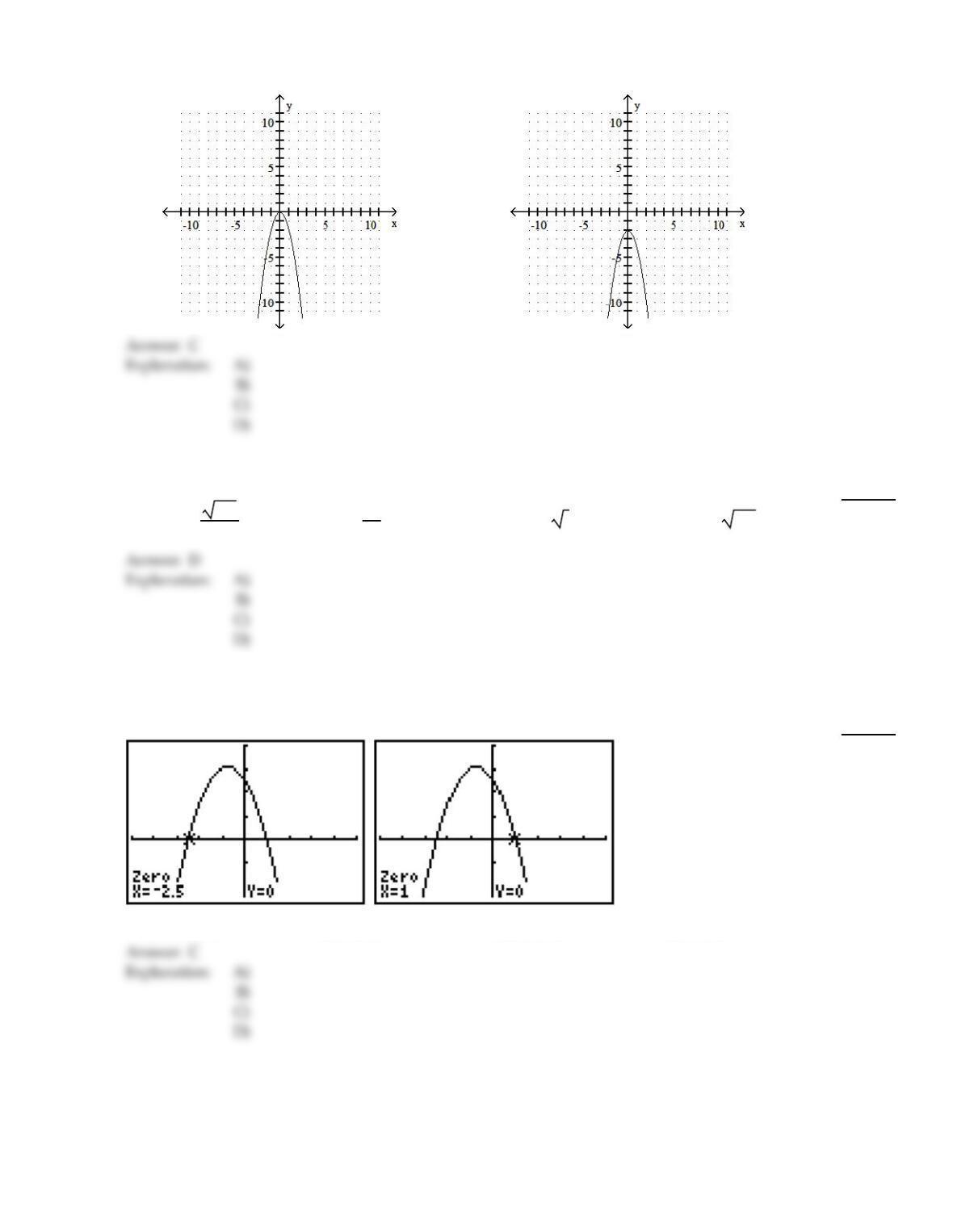
46)
y = – 2x2
46)
A)
B)
16
C
C)
D)
Solve the equation for the indicated variable. (Leave ± in your answer, when appropriate.)
47)
v2= 2as for v
47)
A)
v = ± 2as
s
B)
v =2a
s
C)
v = 2a s
D)
v = ± 2as
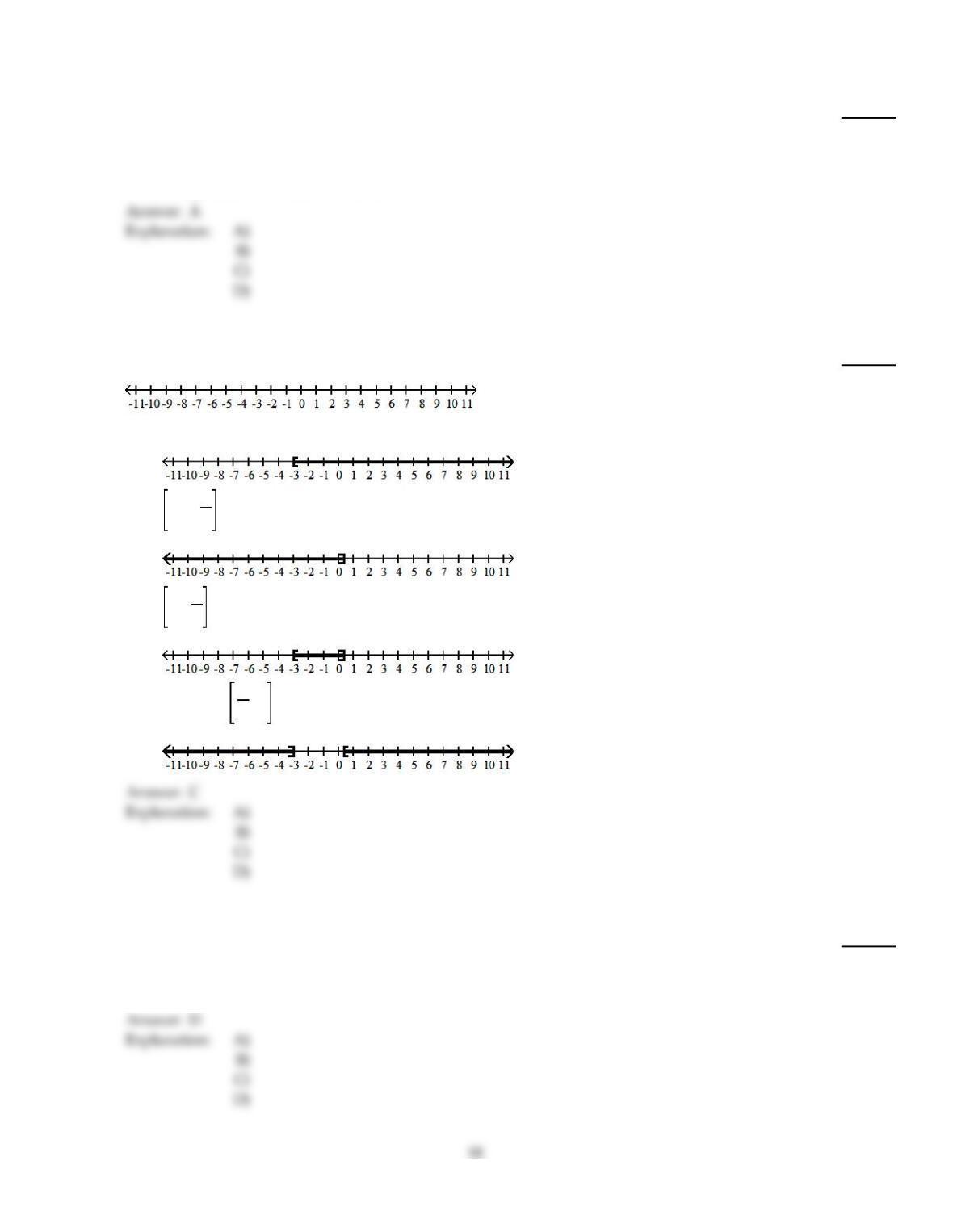
The calculator graphs shows the x–values of the x–intercepts of the graph of the polynomial in the equation. Use the
graphs to solve the equation.
48)
–2x2–3x +5 = 0
48)
A)
{–1, 2.5}
B)
{–3, 5}
C)
{–2.5, 1}
D)
{–5, 2}
17
Provide an appropriate response.
49)
Describe how the graph of y =(x + 9)2 is shifted compared to the graph of y =x2.
49)
A)
The parabola is shifted 9 units to the left.
B)
The parabola is shifted 9 units up.
C)
The parabola is shifted 9 units to the right.
D)
The parabola is shifted 9 units down.
Solve the inequality, and graph the solution set.
50)
3x2+ 8x 3
50)
A)
[–3, )
B)
–, 1
3
C)
–3, 1
3
D)
(–, –3] 1
3,
Provide an appropriate response.
51)
If we apply the quadratic formula and find that the value of b2– 4ac is positive, what can we
conclude?
51)
A)
The equation has one rational solution.
B)
The equation has two irrational solutions.
C)
The equation has no real solutions.
D)
The equation has two real solutions.
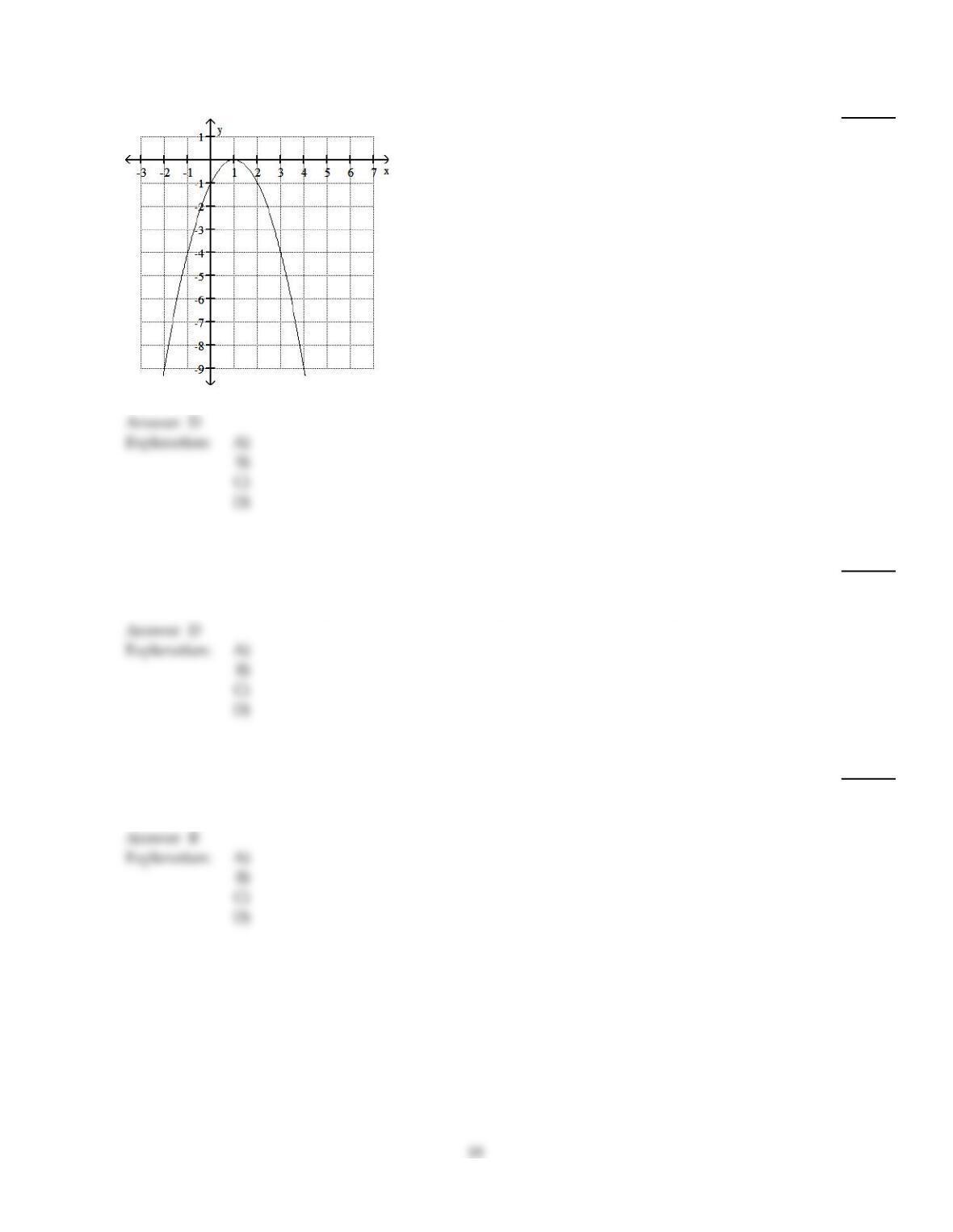
Use the graph of a quadratic function to find the solution set of the equation or inequality.
52)
–x2+2x –1< 0
52)
A)
B)
x =1
C)
(–, )
D)
(–, 1) (1, )
Solve the problem.
53)
If an object is thrown upward with an initial velocity of 10 ft per sec, then its height (in feet) is given
by h(t) = – 10t2+ 40t after time t seconds. What is its maximum height?
53)
A)
20 ft
B)
100 ft
C)
102 ft
D)
40 ft
Solve the problem. Round your answer to the nearest tenth, when appropriate.
54)
A ball is thrown downward from a window in a tall building. Its position at time t in seconds is
given by s(t) = 16t2+ 32t, where s is in feet. How long will it take the ball to fall 119 ft?
54)
A)
2.7 sec
B)
1.9 sec
C)
1.7 sec
D)
3.6 sec
Solve the equation by completing the square. Then (i) give the exact solutions and (ii) give the solutions rounded to the
nearest thousandth.
55)
(2t + 2)2=11
55)
A)
(i) ±9
2 (ii) {1.5, –1.5}
B)
(i) 11 + 2
2 (ii) {2.5}
C)
(i) –2±11
2 (ii) {0.658, –2.658}
D)
(i) {–2±11} (ii) {1.317, –5.317}
Solve the problem. Round your answer to the nearest tenth, when appropriate.
56)
A grasshopper is perched on a reed 6 inches above the ground. It hops off the reed and lands on the
ground about 6.6 inches away. During its hop, its height is given by the equation
h = – 0.4x2+1.75x +6, where x is the distance in inches from the base of the reed, and h is in inches.
How far was the grasshopper from the base of the reed when it was 4.75 inches above the ground?
56)
A)
0.6 in.
B)
0.9 in.
C)
5.0 in.
D)
6.6 in.
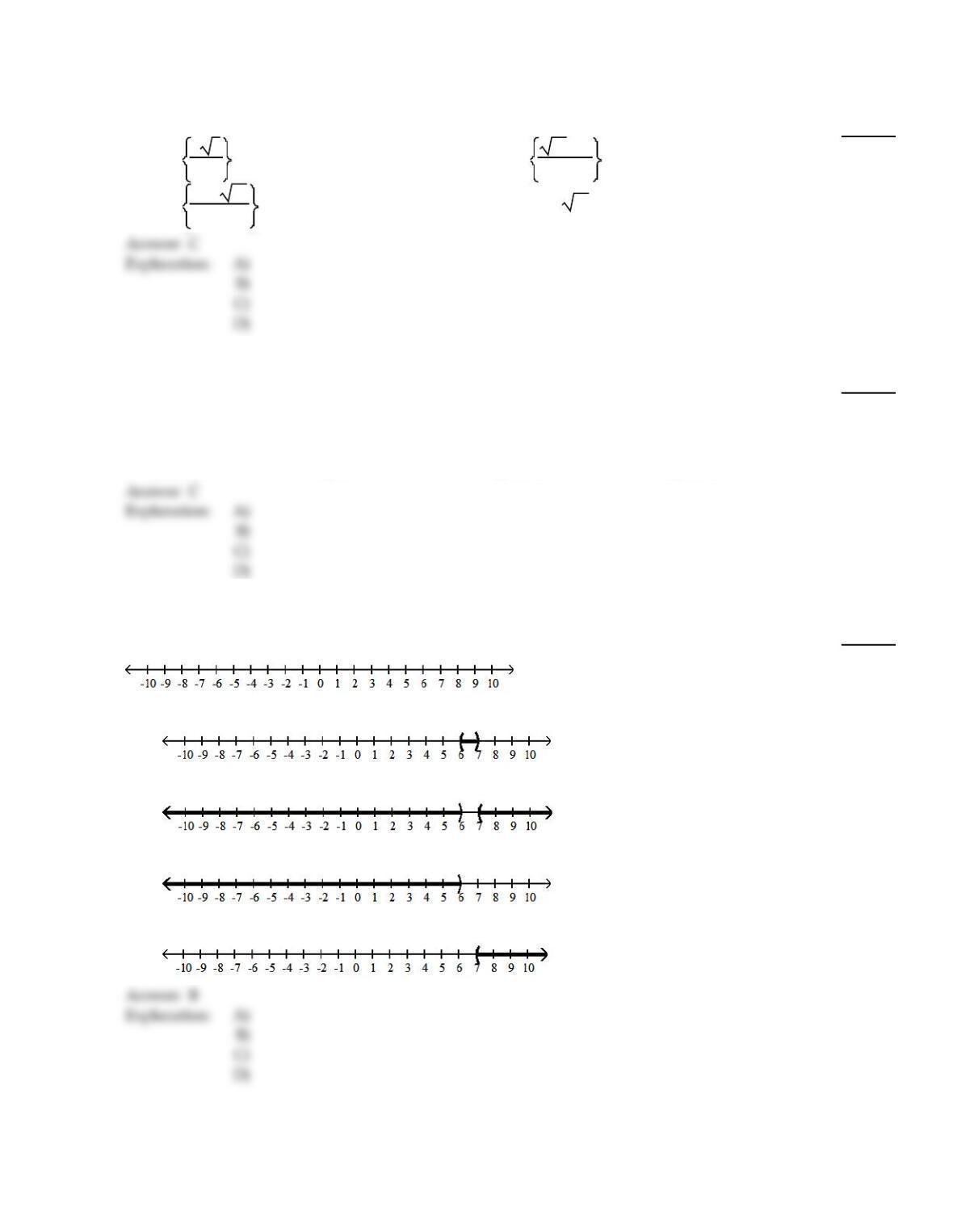
Solve the inequality, and graph the solution set.
57)
p2– 13p + 42 > 0
57)
A)
(6, 7)
B)
(–, 6) (7, )
C)
(–, 6)
D)
(7, )
20