Microeconomics, 4e (Hubbard/O’Brien)
Chapter 11 Technology, Production, and Costs
11.1 Technology: An Economic Definition
1) A firm has successfully adopted a positive technological change when
A) it can produce more output using the same inputs.
B) it produces less pollution in its production process.
C) can pay its workers less yet increase its output.
D) it sees an increase in worker productivity.
2) Which of the following is not a source of technological advancement for a producer?
A) better trained workers
B) more efficient physical capital
C) higher skill level of managers
D) outsourcing some aspect of production
3) Which of the following is an example of market “production”, as used by economist?
A) Garvey takes out a low-cost government loan to start his pet-sitting business.
B) Heidi makes a pizza for her family’s dinner.
C) Katrina works as a cashier at the local produce stand.
D) The theatre and film studies department in Fine Art’s College stages a play at the local
theatre.
4) A firm’s cost of production is determined by all of the following except
A) the technology used to produce its output.
B) the productivity of its workers.
C) the cost of raw material used in production.
D) the amount of corporate taxes it must pay on its profit.
5) A firm increased its production and sales because the firm’s manager rearranged the layout of
his factory floor. This is an example of
A) investment in human capital.
B) economies of scale.
C) positive technological change.
D) inspired management.
6) The difference between technology and technological change is that
A) technology refers to the processes used by a firm to transform inputs into output while
technological change is a change in a firm’s ability to produce a given level of output with a
given quantity of inputs.
B) technology is carried out by firms producing physical goods but technological change is an
intellectual exercise into seeking ways to improve production.
C) technology is product-centered, that is, developing new products with our limited resources
while technological change is process-centered in that it focuses on developing new production
techniques.
D) technology involves the use of capital equipment while technological change requires the use
of brain power.
7) Which of the following is an example of positive technological change?
A) A firm offers workers a higher wage to work on weekends and at night. As a result, the firm
is able to increase its weekly production of surf boards.
B) A firm buys an additional machine that it uses to make surf boards. As a result, the firm is
able to increase its weekly production of surf boards.
C) A firm conducts a new advertising campaign. As a result, the demand for the firm’s surf
boards increases.
D) A firm’s workers participate in a training program designed to increase the number of surf
boards they can produce per day.
8) Suppose a chain of convenience stores reorganized its system of supplying its stores with
food. This led to a sharp reduction in the number of trucks that the company had to use and
increased the amount of fresh food on store shelves. Which of the following statements best
describes the chain stores’ actions?
A) The change implemented is not an example of technological change because it did not require
the use of new machinery of equipment.
B) Technological change refers only to the introduction of new products or improvements to
existing product. As such, the scenario described in the question is not technological change.
C) The firm is able to produce more output (increase its sales) using fewer inputs (less trucks).
Therefore, the chain of convenience stores has implemented a positive technological change.
D) The scenario described is an example of management efficiency and not technological
change. Essentially, the chain changes its way of operating its business.
9) Improvements in inventory control represent a positive technological change because they
allow firms to produce the same output with fewer inputs. In recent years, many firms have
adopted an inventory system in which firms accept shipments from suppliers as close as possible
to the time they will be needed. Wal-Mart has been a pioneer in using inventory control systems
to this in its stores. This type of inventory system is called a ________ inventory system.
A) first-in-first-out
B) cash-and-carry
C) just-in–time
D) buy-now-pay-later
10) The process a firm uses to turn inputs into outputs of goods and services is called technology.
11) If a firm experiences positive technological change, it is able to produce more output using
the same inputs.
12) Is it possible for technological change to be negative? If so, give an example.
13) Describe how Wal-Mart has used positive technological change to manage its inventory.
11.2 The Short Run and the Long Run in Economics
1) A characteristic of the long run is
A) there are fixed inputs.
B) all inputs can be varied.
C) plant capacity cannot be increased or decreased.
D) there are both fixed and variable inputs
2) Which of the following is a factor of production that generally is fixed in the short run?
A) raw materials
B) labor
C) a factory building
D) water
3) Which of the following is an example of a long run adjustment?
A) Your university offers Saturday morning classes next fall.
B) Ford Motor Company lays off 2,000 assembly line workers.
C) A soybean farmer turns on the irrigation system after a month long dry spell.
D) Wal-Mart builds another Supercenter.
4) Which of the following is the best example of a short run adjustment?
A) A local bakery purchases another commercial oven as part of its capacity expansion.
B) Your local Wal-Mart hires two more associates.
C) Smith University completed negotiations to acquire a large piece of land to build its new
library.
D) Toyota builds a new assembly plant in Texas.
5) If a producer is not able to expand its plant capacity immediately, it is
A) bankrupt.
B) operating in the long run.
C) operating in the short run.
D) losing money.
6) Which of the following is a fixed cost?
A) payment to hire a security worker to guard the gate to the factory around the clock
B) wages to hire assembly line workers
C) payments to an electric utility
D) costs of raw materials
7) Academic book publishers hire editors, designers, and production and marketing managers
who help prepare books for publication. Because these employees work on several books
simultaneously, the number of people the company hires will not go up and down with the
quantity of books the company publishes during any particular year. The salaries and benefits of
people in these job categories will be included in
A) fixed cost and marginal cost but not variable cost.
B) fixed cost but not variable cost and total cost.
C) marginal cost and total cost but not fixed cost.
D) fixed cost and total cost but not variable cost.
8) Economic costs of production differ from accounting costs in that
A) economic costs include expenditures for hired resources while accounting costs do not.
B) economic costs add the opportunity costs of a firm using its own resources while accounting
costs do not.
C) accounting costs include expenditures for hired resources while economic costs do not.
D) accounting costs are always larger than economic cost.
9) Implicit costs can be defined as
A) accounting profit minus explicit cost.
B) the non-monetary opportunity cost of using the firm’s own resources.
C) the deferred cost of production.
D) total cost minus fixed costs.
10) Which of the following is an implicit cost of production?
A) interest paid on a loan to a bank
B) wages paid to labor plus the cost of carrying benefits for workers
C) the utility bill paid to water, electricity, and natural gas companies
D) rent that could have been earned on a building owned and used by the firm
11) Which of the following is an implicit cost of production?
A) the loss in the value of capital equipment due to wear and tear
B) the salary you pay yourself for running your business
C) the utility bill paid to water, electricity, and natural gas companies
D) the interest you pay your mother for the money she loaned you to start your business
12) The explicit cost of production is also called
A) variable cost.
B) accounting cost.
C) direct cost.
D) overhead cost.
13) Which of the following are implicit costs for a typical firm?
A) opportunity costs of capital owned and used by the firm
B) the cost of labor hired by the firm
C) utilities cost
D) a business licensing fee
14) Jayanthi moves her yoga studio from her home to a space she rents in Oakland, California.
Holding everything else constant, as a result of this move,
A) her explicit cost falls and her implicit cost rises.
B) her implicit cost falls and her explicit cost rises.
C) her economic cost rises.
D) her opportunity cost rises.
15) Which of the following would be categorized as an opportunity cost?
a. not being able to spend your $10,000 savings if you sink the money in your business
b. the cost of purchasing supplies for your house-cleaning business
c. the cost of purchasing auto insurance for your dry-cleaning delivery business
A) a only
B) a and c only
C) b and c only
D) all of the above
16) Golda Rush quit her job as a manager for Home Depot to start her own hair dressing salon,
Goldilocks. She gave up a salary of $40,000 per year, invested her savings of $30,000 (which
was earning 5 percent interest) and borrowed $10,000 from a close friend, agreeing to pay 5
percent interest per year. In her first year, Golda spent $18,000 to rent a salon, hired a part-time
assistant for $12,000 and incurred another $15,000 on equipment and hairdressing material.
Based on this information, what is the amount of her explicit costs?
A) $45,000
B) $45,500
C) $47,000
D) $87,000
17) Golda Rush quit her job as a manager for Home Depot to start her own hair dressing salon,
Goldilocks. She gave up a salary of $40,000 per year, invested her savings of $30,000 (which
was earning 5 percent interest) and borrowed $10,000 from a close friend, agreeing to pay 5
percent interest per year. In her first year, Golda spent $18,000 to rent a salon, hired a part-time
assistant for $12,000 and incurred another $15,000 on equipment and hairdressing material.
Based on this information, what is the amount of her implicit costs?
A) $80,000
B) $70,000
C) $42,000
D) $41,500
18) The production function shows
A) the total cost of producing a given quantity of output.
B) the maximum output that can be produced from each possible quantity of inputs.
C) the technology used to produce output.
D) the incremental output gained by improving the production process.
19) The average total cost of production
A) is the extra cost required to produce one more unit.
B) equals the explicit cost of production.
C) equals total cost of production divided by the level of output.
D) equals total cost of production multiplied times the level of output.
20) Vipsana’s Gyros House sells gyros. The cost of ingredients (pita, meat, spices, etc.) to make a
gyro is $2.00. Vipsana pays her employees $60 per day. She also incurs a fixed cost of $120 per
day. Calculate Vipsana’s variable cost per day when she produces 50 gyros using two workers?
A) $100
B) $124.40
C) $220
D) $240
21) Vipsana’s Gyros House sells gyros. The cost of ingredients (pita, meat, spices, etc.) to make a
gyro is $2.00. Vipsana pays her employees $60 per day. She also incurs a fixed cost of $120 per
day. Calculate Vipsana’s total cost per day when she produces 50 gyros using two workers?
A) $100
B) $124.40
C) $220
D) $340
22) Vipsana’s Gyros House sells gyros. The cost of ingredients (pita, meat, spices, etc.) to make a
gyro is $2.00. Vipsana pays her employees $60 per day. She also incurs a fixed cost of $120 per
day. Calculate Vipsana’s average fixed cost per day when she produces 50 gyros using two
workers?
A) $2.00
B) $2.40
C) $4.40
D) $6.80
23) Vipsana’s Gyros House sells gyros. The cost of ingredients (pita, meat, spices, etc.) to make a
gyro is $2.00. Vipsana pays her employees $60 per day. She also incurs a fixed cost of $120 per
day. What is Vipsana’s total cost per day when she does not produce any gyros and does not hire
any workers?
A) $0
B) $2
C) $60
D) $120
24) The short run is the time period during which a firm has at least one input constraint.
25) A characteristic of the long run that is not available in the short run is that a firm is free to
vary its output.
26) Consider a manufacturing operation that uses specialized machinery and labor to produce its
output. In this case, the input that is not fixed in the short run is labor.
27) Accounting costs exclude implicit costs.
28) If the firm is producing no output in the short run, then its total costs are zero.
29) In economics, what is the difference between the short run and the long run?
30) What is the difference between explicit costs and implicit costs? List three examples each of
explicit costs and implicit costs that may be experienced by a small business.
31) Explain whether each of the following is a fixed cost or a variable cost for Damian
Dandridge’s tattoo parlor.
a. The payment he makes to buy tattoo ink.
b. The wages he pays his employees.
c. The $500-per-month payment he makes to advertise his shop on highway billboards.
d. The lease payment he makes to the landlord who owns the building where his shop is located.
e. The payment he makes on his liability insurance policy.
11.3 The Marginal Product of Labor and the Average Product of Labor
1) The marginal product of labor is defined as
A) the additional sales revenue that results when one more worker is hired.
B) the additional output that results when one more worker is hired, holding all other resources
constant.
C) the additional number of workers required to produce one more unit of output.
D) the cost of hiring one more worker.
2) If four workers can produce 18 chairs a day and five can produce 20 chairs a day, the marginal
product of the fifth worker is
A) 2 chairs.
B) 3 chairs.
C) 4 chairs.
D) 38 chairs.
3) Red Stone Creamery currently hires 5 workers. When it added a 6th worker, its output actually
fell. Which of the following statements is true?
A) The marginal product of the sixth worker must be negative.
B) The average product of the sixth worker is negative.
C) The sixth worker is not as skilled as the fifth worker.
D) The total product becomes negative.
4) The law of diminishing marginal returns states
A) that at some point, adding more of a fixed input to a given amount of variable inputs will
cause the marginal product of the variable input to decline.
B) that at some point, adding more of a variable input to a given amount of a fixed input will
cause the marginal product of the variable input to decline.
C) that in the presence of a fixed factor, at some point average product of labor starts to fall as
more and more variable inputs are added.
D) average total costs of production initially fall and after some point starts to rise at a
decreasing rate as output increases.
5) The law of diminishing marginal returns
A) explains why the average total cost and marginal cost curves are U-shaped in the short run.
B) explains why the average total cost, average fixed cost and the marginal cost curves are U-
shaped in the short run.
C) causes average total costs to rise at a decreasing rate as output increases.
D) causes the difference between average total cost and average variable cost to get smaller as
output increases.
6) As a firm hires more labor in the short run, the
A) level of total product stays constant.
B) output per worker rises.
C) extra output of another worker may rise at first, but eventually must fall.
D) costs of production are increasing at a fixed rate per unit of output.
7) If diminishing marginal returns have already set in for Golden Lark Woodworks, and the
marginal product of the 6th carpenter is 8 chairs, then the marginal product of the 7th carpenter is
A) negative.
B) less than 8 chairs.
C) more than 8 chairs.
D) zero.
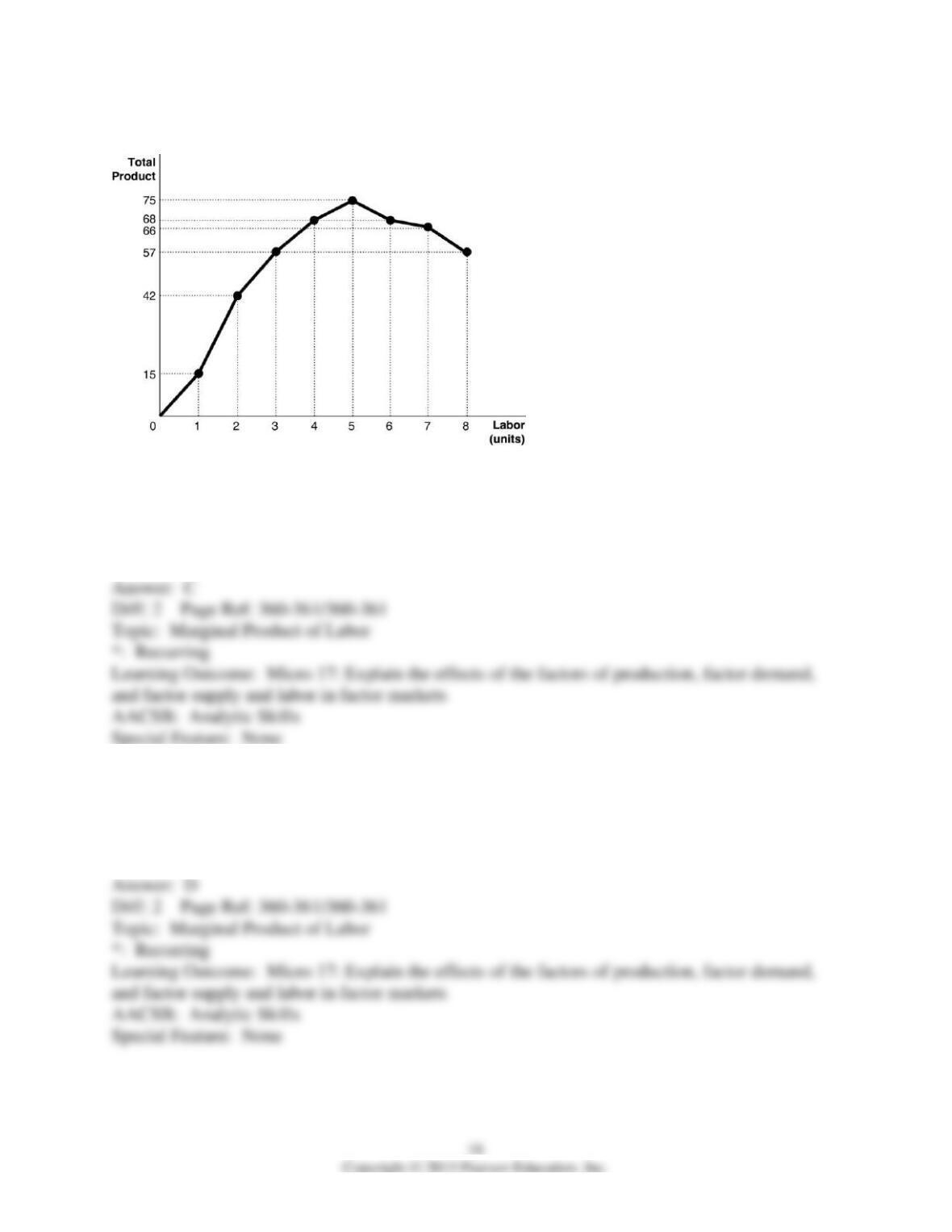
Figure 11-1
8) Refer to Figure 11-1. The marginal product of the 3rd worker is
A) 57.
B) 19.
C) 15.
D) 11.
9) Refer to Figure 11-1. The marginal product of the 7th worker is
A) 66.
B) 9.43.
C) 2.
D) -2.
10) Refer to Figure 11-1. The average product of the 4th worker
A) is 68.
B) is 17.
C) is 11.
D) cannot be determined.
11) Refer to Figure 11-1. Diminishing marginal productivity sets in after
A) the 2nd worker is hired.
B) the 3rd worker is hired.
C) the 4th worker is hired.
D) the 5th worker is hired.
12) Refer to Figure 11-1. In a diagram that shows the marginal product of labor on the vertical
axis and labor on the horizontal axis, the marginal product curve
A) never intersects the horizontal axis.
B) intersects the horizontal axis at a point corresponding to the 5th worker.
C) intersects the horizontal axis at a point corresponding to the 6th worker.
D) intersects the horizontal axis at a point corresponding to the 8th worker.
13) If 11 workers can produce a total of 54 units of a product and a 12th worker has a marginal
product of 6 units, then the average product of 12 workers is
A) 60 units.
B) 54 units.
C) 48 units.
D) 5 units.
14) If another worker adds 9 units of output to a group of workers who had an average product of
7 units, then the average product of labor
A) will remain the same.
B) will increase.
C) will decrease.
D) and what will happen to it cannot be determined.
15) In the short run, marginal product of labor increases at first and then falls because
A) as more labor is hired, they are not as skilled as the first ones hired.
B) there are fewer opportunities for division of labor and specialization when fewer workers are
hired.
C) managerial inefficiency sets in when a firm gets too large.
D) the new workers do not have as much experience as those who have been with the firm for a
long time and therefore are not as productive.