
Introduction to Financial Accounting, 10e (Horngren)
Chapter 11 Intercorporate Investments and Consolidations
Learning Objective 11.1 Questions
11.1-1) If an investment is to be held only for a short time, it should be classified on the balance sheet as a
________.
A) current liability
B) noncurrent asset, which appears in a separate investments category
C) noncurrent asset, which appears as part of other assets below the plant assets category
D) current asset
E) liquid asset
11.1-2) The key to classifying a marketable security as short–term is
A) whether or not it is a government issued security.
B) whether or not management has a written contract to sell the asset within the next 3 months.
C) the type of security held (i.e., Is it a note, bond, or stock?).
D) whether or not management expects to convert it into cash within a year after the date on the balance
sheet (or operating cycle if longer).
E) the small dollar amount.
11.1-3) ________ are largely government and business issued notes and bonds with maturities of 1 year or
less.
A) Certificates of deposit
B) Commercial paper
C) U.S. Treasury obligations
D) Cash equivalents
E) Short–term debt securities
11.1-4) ________ consist of short–term investments with original maturities of 3 months or less.
A) Cash equivalents
B) Commercial paper
C) U.S. Treasury obligations
D) Certificates of deposit
E) Short–term debt securities
11.1-5) A spin–off is when ________.
A) a company buys a security for a very short period of time and then sells it
B) a bond is retired through the issuance of another bond
C) part of a company which is usually a distinct business unit is separated from the company and shares
of the divested company are distributed to stockholders
D) a company acquires another company in a different industry
E) a company acquires another company in the same industry
11.1-6) Spin–offs often separate similar business segments.
11.1-7) Describe reasons and benefits to corporate mergers.
11.1-8) Describe spin–offs including the benefits to spinning off a segment.
Learning Objective 11.2 Questions
11.2-1) The method of accounting for trading securities and available–for–sale securities in which the
assets are valued at market value on the balance sheet is known as the
A) balance sheet method.
B) market method.
C) equity method.
D) consolidated method.
E) maturity method.
11.2-2) The accumulated other comprehensive income on stockholders’ equity shows the difference
between historical cost and market for which account(s)?
A) Trading securities
B) Held–to–maturity securities
C) Available–for–sale securities
D) Trading securities and available–for–sale securities
E) Trading securities and held–to–maturity securities
11.2-3) The term “highly liquid” means an investment ________.
A) that could be classified as either a current or long–term asset
B) which pays either a high dividend or a high interest rate
C) that has generated a substantial gain and is thus very likely to be sold
D) that could be easily converted to cash
E) in an equity security which has undergone a stock split or a stock dividend
11.2-4) ________ are current investments in equity or debt securities held for short–term profit.
A) Short–term equity securities
B) Trading securities
C) Held–to–maturity securities
D) Available–for–sale securities
E) Cash equivalents
11.2-5) ________ are investments in equity or debt securities that are not held for active trading but that
may be sold before maturity.
A) Short–term equity securities
B) Held–to–maturity securities
C) Trading securities
D) Available–for–sale securities
E) Cash equivalents

11.2-6) ________ are debt securities that the investor expects to hold until maturity.
A) Short–term equity securities
B) Trading securities
C) Cash equivalents
D) Available–for–sale securities
E) Held–to–maturity securities
11.2-7) Which of the following securities are accounted for at market value?
1. Trading securities
2. Held–to–maturity securities
3. Available for sale securities
A) 1 only
B) 2 only
C) 3 only
D) 1 and 3
E) 1 and 2
11.2-8) Which of the following statements is false?
A) Trading securities are short–term investments with unrealized gains and losses in market value
recognized in the income statement.
B) The unrealized gains and losses from changes in market value of available–for–sale securities are not
recognized in the income statement, but rather are carried in a separate account in the stockholders’
equity section.
C) Held–to–maturity securities are always classified as long–term investments.
D) Available for sale securities are accounted for at market value.
E) Held–to–maturity securities are accounted for at amortized cost.
11.2-9) Raylor Company purchased 20, $1,000 6% U.S. Treasury bonds for $18,600, as a short–term
investment on December 16, 20X9. Raylor classified these bonds as available–for–sale securities on their
balance sheet. On December 31, 2X10, the U.S. Treasury bonds were trading at 94 (94% of face value). The
rise in market price is believed to be a temporary fluctuation. Which of the following statements is
correct?
A) Since it is a temporary fluctuation, no loss is recognized.
B) Since the bonds are still owned by Raylor Company, no loss is recognized.
C) Because Raylor Company bought US Treasury bonds, which are risk–free, no loss is recognized.
D) A gain of $200 is recognized as a contra equity account, therefore there is no income statement effect.
E) A gain of $200 is recognized on the income statement.

Table 11–1
Layla Fun N’ Games acquired the following short–term equity securities on January 1, 20X9:
Company # of Shares Price/share Total Cost
Ticket Company 200 $31 $ 6,200
Pinball Company 300 22 6,600
Skeetball Company 500 14 7,000
$19,800
The quarter–end prices per share were as follows:
Company 03/31/2X09 06/30/2X10 09/30/2X11 12/31/2X12
Ticket Company $30 $32 $31 $32
Pinball Company 24 20 23 24
Skeetball Company 15 14 13 13
Layla Fun N’ Games considers Ticket Company stock to be a trading security and the Pinball Company
and the Skeetball Company to be available–for–sale securities.
11.2-10) Referring to Table 11–1, what will be the net gain or loss recorded on the income statement of
Layla Fun N’ Games for the 3 month period ending March 31, 20X9?
A) $200
B) $(200)
C) $900
D) $1,100
E) $2,000
11.2-11) Referring to Table 11–1, what will be the net gain or loss recorded on the income statement of
Layla Fun N’ Games for the three month period ending June 30, 20X9?
A) $200
B) $(400)
C) $(200)
D) $(1,300)
E) $400

11.2-12) Referring to Table 11–1, what will be the net gain or loss recorded on the income statement of
Layla Fun N’ Games for the 3 month period ending September 30, 20X9?
A) $(400)
B) $(200)
C) $–0–
D) $200
E) $400
11.2-13) Referring to Table 11–1, what will be the net gain or loss recorded on the income statement of Fun
N’ Games for the 3 month period ending December 31, 20X9?
A) $(500)
B) $–0–
C) $200
D) $300
E) $500
11.2-14) Referring to Table 11–1, what will be the net increase or decrease recorded in the accumulated
other comprehensive income in the stockholders’ equity section of the balance sheet for the 3 month
period ending March 31, 20X9?
A) $(200)
B) $200
C) $900
D) $1,100
E) $2,000
11.2-15) Referring to Table 11–1, what will be the net increase or decrease recorded in the accumulated
other comprehensive income in the stockholders’ equity section of the balance sheet for the three month
period ending September 30, 20X9?
A) $–0–
B) $(200)
C) $(400)
D) $200
E) $400

11.2-16) Trading securities and available–for–sale securities are reflected on the balance sheet as:
A) Trading securities Available–for–sale securities
market value market value
B) Trading securities Available–for–sale securities
market value historical cost
C) Trading securities Available–for–sale securities
historical cost market value
D) Trading securities Available–for–sale securities
historical cost historical cost
11.2-17) U.S. Treasury obligations are interest–bearing notes, bonds, and bills issued by the U.S.
government.
11.2-18) “Due diligence” is the phrase for carefully investigating a target company for a merger.
11.2-19) Comprehensive income includes both net income and the change in market value of available–
for–sale securities.
11.2-20) The market method applies to short–term debt securities, because a drop in market value below
cost will result in a write–down of the investment.
11.2-21) Marketable securities are notes, bonds, or stocks that can be readily sold.
11.2-22) Typically, debt security investments include short–term obligations of banks and short–term notes
payable issued by large corporations with top credit ratings.

11.2-23) Trading securities include both debt and equity securities.
11.2-24) The accounting for investments differs depending upon the purpose of the investment.
11.2-25) Held–to–maturity securities are equity securities that the company purchases with the intent to
hold them to a maturity date.
11.2-26) As the market value of trading securities changes, companies report the gains from increases in
market value and losses from decreases in market value on the income statement.
11.2-27) As the market value of available–for–sale securities changes, companies report the gains from
increases in market value and losses from decreases in market value on the income statement.
11.2-28) Even if a company holds part of its portfolio of short–term investments for more than 1 year, that
portion of the portfolio will not be reclassified as a long–term investment.
11.2-29) Available–for–sale securities are debt securities that the company purchases with the intent to
hold them until they mature.
11.2-30) Changes in the market value of held–to–maturity investments are ignored on the balance sheet
except in cases of probable default.
11.2-31) Increases in the market value of available–for–sale securities increase total stockholders’ equity,
but increases in the market value of trading securities do not increase total stockholders’ equity.
11.2-32) Debt securities classified as available–for–sale securities are carried at amortized cost on the
balance sheet.
11.2-33) Held–to–maturity securities are carried on the balance sheet at amortized cost.
11.2-34) The investor will increase interest revenue when the discount on a held–to–maturity security is
amortized.
11.2-35) On June 1, 20X9, Karman Company purchased trading securities consisting of common and
preferred stocks. The portfolio consists of 500 shares of Floglar Company (purchased at $24 per share)
and 300 shares of Gangly Company (purchased at $18 per share). The market value of the securities on a
per share basis on June 30 were $27 per share for Floglar and $16 for Gangly. What will be the net gain or
loss recorded on Karman Company’s income statement for the quarter ended June 30, 20X9?
11.2-36) On June 1, 20X9, Tundra Greenhouses purchased available–for–sale securities consisting of
common and preferred stocks. The portfolio consists of 100 shares of Blooming Company (purchased at
$37 per share) and 305 shares of Leaf Company (purchased at $29 per share). The market value of the
securities on a per share basis on June 30 were $35 for Blooming and $26 for Leaf. Prepare the journal
entry that will need to be made on June 30, 20X9.
10
Table 11–2
Outriggers, Inc., held two securities. Outriggers, Inc., purchased 100 Best Kayak Company securities on
January 1, 2X09 for $22 per share and classified it as a trading security and purchased 80 Roald Roping
Company securities on the same day for $34 per share and classified it as an available–for–sale security.
Market values for both securities as of December 31, for 2X09, 2X10, 2X11, 2X12 follow.
2X09 2X10 2X11 2X12
Best Kayak 24 21 22 20
Roald Roping 32 31
34 35
11.2-37) 1. Based on the information in Table 11–2, prepare journal entries for Best Kayak Company
effective as of
a. December 31, 2X09.
b. December 31, 2X10.
c. December 31, 2X11.
d. December 31, 2X12.
2. How would the journal entries differ for Roald Roping Company?
3. Where would gains and losses be recognized for
a. Best Kayak Company?
b. Roald Roping Company?

Learning Objective 11.3 Questions
11.3-1) If bonds are purchased at less than face value, then the amortization of the discount ________ the
interest revenue of the investors.
A) increases
B) decreases
C) does not change
D) increases or decreases depending on the current market rate
E) Cannot be determined without more information
11.3-2) If bonds are purchased at more than face value, then the amortization of the premium ________
the interest revenue of the investors.
A) increases or decreases depending on the current market rate
B) increases
C) decreases
D) does not change
E) Cannot be determined without more information
Table 11–3
On January 1, 20X9, Karmani Company acquired, as a long–term investment, 20 bonds with a face value
of $1,000 each. The bonds have a 10–year life, a 10% coupon rate, and pay interest semi–annually every
June 30 and December 31.
11.3-3) Referring to Table 11–3 and using the present value tables, what is the journal entry to be made by
Karmani Company on January 1, 20X9, if the bonds were purchased at a price to yield 12%?
A) Investment in Bonds 9,543.40
Cash 9,543.40
B) Investment in Bonds 11,037.28
Cash 11,037.28
C) Investment in Bonds 17,705.90
Cash 17,705.90
D) Investment in Bonds 20,000.00
Cash 20,000.00
E) Investment in Bonds 22,492.64
Cash 22,492.64

11.3-4) Referring to Table 11–3 and using the present value tables, what is the journal entry to be made by
Karmani Company on January 1, 20X9, if the bonds were purchased at a price to yield 8%?
A) Investment in Bonds 14,108.10
Cash 14,108.10
B) Investment in Bonds 17,507.76
Cash 17,507.76
C) Investment in Bonds 20,000.00
Cash 20,000.00
D) Investment in Bonds 22,718.30
Cash 22,718.30
E) Investment in Bonds 25,912.90
Cash 25,912.90
11.3-5) Referring to Table 11–3, if the bonds were purchased by Karmani Company to yield 12% and were
acquired for $17,705.90, what is the journal entry to be made by Karmani Company with respect to
interest on June 30, 20X9?
A) Cash 1,000.00
Investment in Bonds 62.35
Interest Revenue 1,062.35
B) Cash 1,000.00
Investment in Bonds 1,200.00
Interest Revenue 2,200.00
C) Cash 1,200.00
Investment in Bonds 137.65
Interest Revenue 1,062.35
D) Cash 1,200.00
Investment in Bonds 200.00
Interest Revenue 1,000.00
E) Cash 2,000.00
Investment in Bonds 124.71
Interest Revenue 2,124.71

11.3-6) Referring to Table 11–3, if the bonds were purchased by Karmani Company to yield 12%, and were
acquired for $17,705.90, what is the interest revenue to be recognized by Karmani Company with respect
to the interest to be received on December 31, 20X9?
A) $1,200.00
B) $1,062.35
C) $1,066.10
D) $1,000.00
E) $2,124.71
11.3-7) Referring to Table 11–3, if the bonds were purchased by Karmani Company to yield 8%, and were
acquired for $22,718.30, what is the journal entry to be made by Karmani Company with respect to
interest on June 30, 20X9?
A) Cash 800.00
Investment in Bonds 200.00
Interest Revenue 1,000.00
B) Cash 800.00
Investment in Bonds 335.92
Interest Revenue 1,135.92
C) Cash 1,000.00
Investment in Bonds 91.27
Interest Revenue 908.73
D) Cash 1,000.00
Investment in Bonds 200.00
Interest Revenue 800.00
E) Cash 2,000.00
Investment in Bonds 182.54
Interest Revenue 1,817.46
11.3-8) Referring to Table 11–3, if the bonds were purchased by Karmani Company to yield 8% and were
acquired for $22,718.30, what is the interest revenue to be recognized by Karmani Company with respect
to interest on December 31, 20X9?
A) $1,817.46
B) $905.08
C) $908.73
D) $1,000.00
E) $800.00

11.3-9) Referring to Table 11–3 if the bonds were purchased by Karmani Company to yield 12% and were
acquired for $17,705.90, what journal entry would Karmani Company make on June 30, 20X9, if the
company sold the bonds for $18,000.00? Assume the bonds were sold after Karmani Company properly
recorded the receipt of the June 30, 20X9, interest payment?
A) Cash 18,000.00
Loss on Disposal of Bonds 2,000.00
Investment in Bonds 20,000.00
B) Cash 18,000.00
Loss on Disposal of Bonds 905.90
Investment in Bonds 18,905.90
C) Cash 18,000.00
Gain on Disposal of Bonds 94.10
Investment in Bonds 17,905.90
D) Cash 18,000.00
Gain on Disposal of Bonds 231.75
Investment in Bonds 17,768.25
E) Cash 18,000.00
Gain on Disposal of Bonds 294.10
Investment in Bonds 17,705.90
11.3-10) If a company calls a bond early and the carrying value of the bond is less than the cash received
by the investor for the bond, the difference for the company
A) decreases bonds payable.
B) increases bonds payable.
C) is not recognized.
D) is a gain.
E) is a loss.
11.3-11) The investor will debit investment in bonds when the premium on a held–to–maturity security is
amortized.
11.3-12) Although the issuer of bonds typically keeps a separate account for unamortized discounts and
premiums, investors do not.
11.3-13) If an investor acquires a 10% long–term bond at a price that yields the investor 12%, interest
revenue will decrease over the life of the bond.
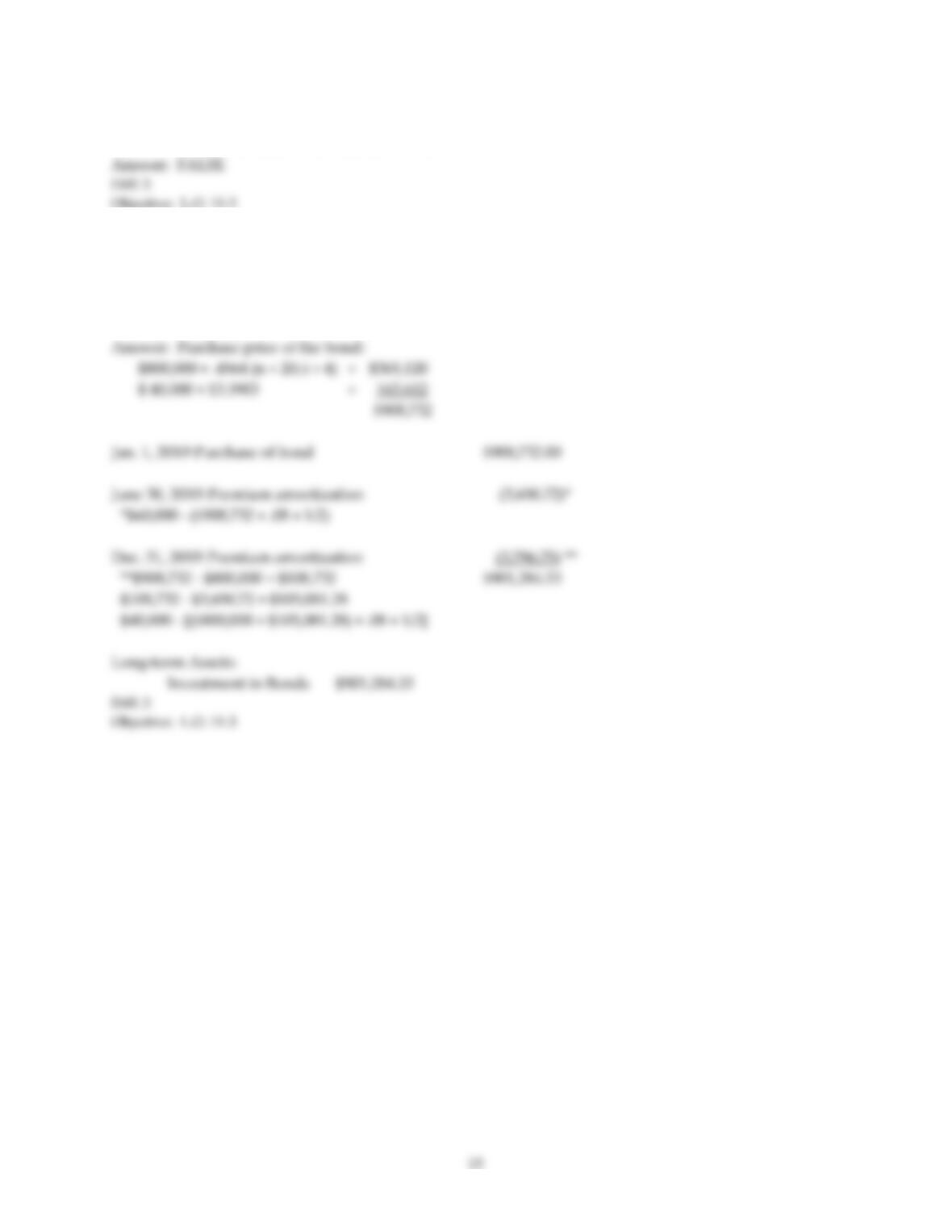
11.3-14) On January 1, 20X9, Thronly Company acquired an $800,000 face value bond. The bond has a
10% coupon rate and pays interest semi–annually every June 30 and December 31. The bond matures in
10 years. Thronly Company acquired the bond at a price that would yield 8%. Using the present value
tables, determine the balance sheet presentation of the bond on the December 31, 20X9, balance sheet of
Thronly Company.
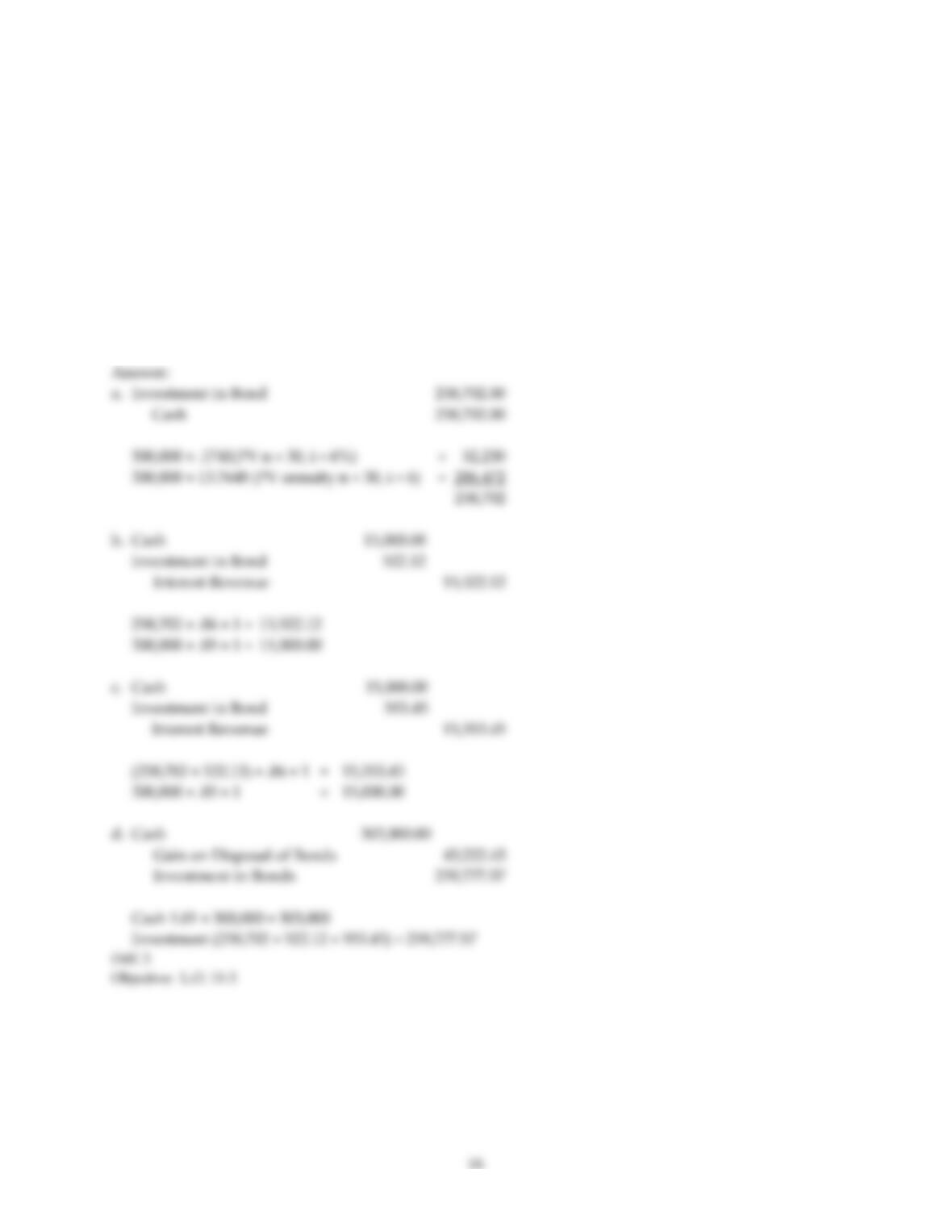
11.3-15) Columbus Catering acquired a $300,000 15–year, 10% callable bond on January 1, 20X9, for cash
of $258,702. The bond was acquired at a price to yield 12%. The bond pays interest every June 30 and
December 31. On December 31, 20X9, after interest had been received, the bond owned by Columbus
Catering was called at a price of 101 (101% of face value). Assume the company intends to hold the bond
until maturity and the company uses the effective interest method of discount or premium amortization.
Prepare the appropriate journal entry for each of the following events:
a. The purchase of the bond on January 1, 20X9
b. The receipt of the June 30, 20X9, interest payment
c. The receipt of the December 31, 20X9, interest payment
d. The bond being called on December 31, 20X9

Learning Objective 11.4 Questions
11.4-1) If State, Inc., invests $100,000 in City Company when City Company totaled $50,000 in net income,
paid $30,000 in dividends, acquired $80,000 in total assets, and had a market value of $400,000 what
percentage does State, Inc., own of City Company?
A) 25%
B) 50%
C) 30%
D) 80%
E) 40%
Table 11–4
Approach Company acquired as a long–term investment some of the common stock of Rinaldi Company
on December 31, 20X9. During 2X10, Rinaldi Company had net income of $200,000 and declared and paid
cash dividends of $70,000.
11.4-2) Referring to Table 11–4, what journal entry would Approach Company make for 2X10 to recognize
the net income of Rinaldi Company, assuming that Approach Company acquired 10% of the outstanding
common stock of Rinaldi Company?
A) Deferred Investment Income 20,000
Unrealized Gain on Long–term Investment 20,000
B) Investment in Rinaldi Company 20,000
Investment Revenue 20,000
C) Investment in Rinaldi Company 20,000
Unearned Revenue 20,000
D) Investment in Rinaldi Company 20,000
Unrealized Gain on Long–term Investments 20,000
E) No journal entry is necessary.

11.4-3) Referring to Table 11–4, what journal entry would Approach Company make for 2X10 to recognize
dividends received from Rinaldi Company, assuming the Approach Company acquired 10% of the
outstanding stock of Rinaldi Company?
A) Cash 7,000
Dividend Revenue 7,000
B) Cash 7,000
Investment in Rinaldi Company 7,000
C) Cash 7,000
Realized Gain on Long–term Investments 7,000
D) Cash 7,000
Unearned Revenue 7,000
E) Investment in Rinaldi Company 7,000
Dividend Revenue 7,000
11.4-4) Referring to Table 11–4, what journal entry would Approach Company make for 2X10 to recognize
the net income of Rinaldi Company, assuming that Approach Company acquired 40% of the outstanding
common stock of Rinaldi Company?
A) Deferred Investment Income 80,000
Unrealized Gain on Long–term Investment 80,000
B) Investment in Rinaldi Company 80,000
Investment Revenue 80,000
C) Investment in Rinaldi Company 80,000
Unearned Revenue 80,000
D) Investment in Rinaldi Company 80,000
Unrealized Gain on Long–term Investments 80,000
E) No journal entry is necessary.

11.4-5) Referring to Table 11–4, what journal entry would Approach Company make for 2X10 to recognize
dividends received from Rinaldi Company, assuming the Approach Company acquired 40% of the
outstanding stock of Rinaldi Company?
A) Cash 28,000
Dividend Revenue 28,000
B) Cash 28,000
Investment in Rinaldi Company 28,000
C) Cash 28,000
Realized Gain on Long–term Investments 28,000
D) Cash 28,000
Unearned Revenue 28,000
E) Investment in Rinaldi Company 28,000
Dividend Revenue 28,000
11.4-6) GAAP requires companies using the equity method to report equity investments on the balance
sheet at market.
11.4-7) An affiliated company is one that has 20% to 50% of its voting shares owned by another company.
11.4-8) When a company owns 20% to 50% of the voting stock in another company, the market method
generally will not reflect the economic relationship between the investor and the investee.
11.4-9) Under the market method, the investor recognizes revenue when dividends are received.
11.4-10) Under the market method, the investor recognizes revenue based upon an appropriate share of
the investee’s net income.