
Chapter 11: Notes, Bonds, and Leases Key
1. Firms typically finance long-term assets, particularly property, plant, and equipment, with long-term
borrowing or funds provided directly or indirectly by shareholders.
2. The more long-term debt in a firm’s capital structure, the less the risk that the firm will experience difficulty
making the required payments when due.
3. The more long-term debt in a firm’s capital structure, the less the risk of default or bankruptcy.
4. Modern business usage has come to restrict the word equity to mean only shareholders’ equity, both
contributed capital and retained earnings.
5. Firms classify the portion of bonds due within the next year as a noncurrent liability.
6. Firms must disclose a list of their long-term debt obligations in notes to the financial statements.
7. The amount borrowed initially and the market value of a note or bond at any date subsequent to the initial
borrowing equals the present value of the future, or remaining, cash flows discounted at an appropriate interest
rate.

8. The internal rate of return, often called yield to maturity, is the discount rate that equates the future cash
flows to the market value at any date.
9. Historical market interest rate is the discount rate prevailing at the date of the initial borrowing.
10. Common terminology refers to the calculations for amortizing a financial instrument to its maturity value
over time as the imputed interest method.
11. The term face value refers to the principal amount printed on the face of the bond certificate.
12. When the coupon rate equals the historical market interest rate or initial yield to maturity, then the initial
issue price equals the face value of the bonds.
13. U.S. GAAP and IFRS provide for two methods of accounting for long-term leases: the operating lease
method and the capital or finance lease method.
14. Operating leases are economically similar to purchasing assets with funds obtained from issuing long-term
bonds and result in similar accounting.
15. Capital leases are economically similar to purchasing assets with funds obtained from issuing long-term
bonds and result in similar accounting.

17. Firms must disclose in notes to the financial statements the cash flows associated with capital leases and
with operating leases for each of the succeeding five years and for all years after five years in the aggregate.
18. Both the lease asset and the lease liability appear on the lessee’s balance sheet under the capital lease
method, whereas neither appears on the lessee’s balance sheet under the operating lease method.
19. The capital lease method classifies all of the lease payment each period as an operating
use of cash on the statement of cash flows.
20. Which of the following is/are not true?
21. Which of the following is/are true?
22. Big City Electric is a regulated monopoly providing electric services in a large city. Property, plant, and
equipment dominate the asset side of the balance sheet. Which of the following is not true?
23. Charm City Electric is a regulated monopoly providing electric services in a large city. Property, plant, and
equipment dominate the asset side of the balance sheet. Which of the following is/are true?
24. Divine Paper, a United States-based company, processes wood pulp into paper products in fixed-asset
intensive facilities. It has a large ratio of property, plant, and equipment to total assets and a high debt-equity
ratios. Which of the following is/are true?
25. Excellent Paper, a United States-based company, processes wood pulp into paper products in fixed-asset
intensive facilities. It has a large ratio of property, plant, and equipment to total assets and a high debt-equity
ratios. Which of the following is/are not true?
26. First Communications Group is a communication services firm whose employees provide advertising,
market research, public relations, and other services world-wide. Other than relatively small amounts of
equipment, it owns virtually no property, plant, and equipment (it leases most of its office space). Which of the
following is/are true?
27. General Semiconductor is a European-based designer and manufacturer of semiconductors. It manufactures
semiconductors in fixed-asset intensive plants. The moderate fraction of its total assets that are property, plant,
and equipment results from depreciating its technology-intensive manufacturing facilities over periods as short
as four years. Which of the following is/are true?
28. Firms that need cash for long-term purposes, such as acquiring buildings and equipment or financing a
business acquisition, and that wish to use debt as a means of obtaining cash, will
29. Firms that need cash for long-term purposes, such as acquiring buildings and equipment or financing a
business acquisition, and that wish to use debt as a means of obtaining cash, will
30. Loans from commercial banks and other financial institutions often require firms to pledge assets as _____.
31. Which of the following is/are true?
32. Which of the following is/are not true?
33. A _____ is a financial contract in which the borrower and the lender agree to certain conditions about
repayment, operating policies, other borrowing activities while they are outstanding, and other provisions.
34. Which of the following is/are true?
35. Which of the following is/are not true?
36. Which of the following is not true regarding specific bond provisions?

37. A zero coupon bond provides for _____ periodic payments of interest while the bond is outstanding; and the
bond requires payment of all _____ at maturity.
38. A _____ bond requires periodic payments of interest plus a portion of the principal throughout the life of the
bond.
39. Some bonds are _____, which means the issuing firm has the right to repurchase the bonds prior to maturity
at a specified price.
40. Investors in bonds sometimes hold a _____ option, meaning they can force the issuing company to repay the
bonds prior to maturity under specified contractual conditions.
41. Investors in bonds might exercise a _____ option if interest rates increase, and investors can reinvest the
cash proceeds in debt securities with a higher yield.

42. The typical _____ bond pays interest periodically, usually every six months, during the life of the bond and
repays the principal amount borrowed at maturity.
43. _____bonds permit the holder to exchange the bonds for shares of the firm’s common stock under certain
conditions.
44. The conversion option of convertible bonds has value because the holder can benefit from some of the later
increases in the market value of the firm’s _____ after issuance of the bonds.
45. What determine(s) the risk of investing in a bond issue, which in turn affects the interest rate investors
demand and therefore the bond’s price?
46. Notes, bonds, leases and derivatives are _____.
47. _____ of a note or bond at any date subsequent to the initial borrowing equals the present value of the
future, or remaining, cash flows discounted at an appropriate interest rate.
48. The amount borrowed initially and the market value of a note or bond at any date subsequent to the initial
borrowing equals
49. On the date of initial issuance of a financial instrument , the market value will equal
50. The approach which dominates current financial reporting of financial instruments [uses the historical
market interest rate to compute the carrying value of notes and bonds while these obligations are outstanding] is
the _____ approach.
51. Firms typically borrow from banks, insurance companies, and other financial institutions by signing a note,
which specifies the terms of the borrowing arrangement. The initial valuation of the loan equals _____.
52. When the stated interest rate for a loan equals the yield required by the lender, then the amount borrowed
equals the
53. The amount reported on the balance sheet throughout the life of a loan (that is, its carrying value) equals
54. _____ often advise corporate borrowers on the sorts of financial instruments the lending market appears to
prefer at the time the firm wants to borrow.
55. Bonds whose indentures contain a provision which gives the issuing company the option to retire portions of
the bond issue before maturity if it so desires, but the provision does not require the company to do so are called
_____ bonds.
56. A firm classifies liabilities which fall due after the operating cycle, usually greater than one year, as
57. A firm classifies mortgages, notes, bonds, and leases which were used to acquire its long-term assets that
fall due after the operating cycle, (usually greater than one year) as
58. When the bond indenture provides that stated amounts of principal will become due during the term of the
bond, the bond is called a _____ bond.
59. A callable bond
60. Bonds whose indentures contain a provision which requires the issuing firm to make a provision for partial
early retirement of the bond issue include serial bonds and _____ bonds.
61. A firm classifies liabilities which fall due within the operating cycle, usually one year, as
62. In return for promising to make future payments, a firm receives cash or other assets with a measurable
cash-equivalent value. The firm records a long-term liability for that amount and the book value of that
borrowing at any time equals the
63. In return for promising to make future payments, a firm receives cash or other assets with a measurable
cash-equivalent value. The firm records a long-term liability for that amount and determines the market interest
rate by finding the
64. The interest rate that discounts a series of future cash flows to its present value is called the
65. Borrowers who retire long-term liabilities debit the liability account for its current book value, credit Cash,
and recognizes any difference on the retirement of the debt as a

66. Bonds whose indentures contain a provision which requires the issuing firm to make a provision for partial
early retirement of the bond issue are sinking fund bonds and _____ bonds.
67. U.S. GAAP requires that all long-term monetary liabilities appear on the balance sheet at the
68. In historical cost accounting, the discounting process uses the original interest rate appropriate for the
particular borrower at the time it incurred the obligation. That rate will have depended on the amount and terms
of the borrowing arrangement as well as the risk that the borrower will default on the obligations. The rate is
known as the
69. A document or agreement giving the terms of the bond and the rights and duties of the borrower and other
parties to the contract that provides some protection to the bondholders and typically limits the borrower’s right
to declare dividends, to make other distributions to owners, and to acquire other businesses is known as a
70. The most common type of corporate bond, except in the railroad and public utility industries, that carries no
special collateral and the borrower issues it on the general credit of the business is called a
71. A bond that does not require a periodic cash payment, but instead promises a single payment at maturity, is
called a _____ bond.
72. Debentures that the holder (lender) can exchange, possible after some specific period of time has elapsed,
for a specific number of shares of common stock or, perhaps, preferred stock of the borrower are called _____
bonds.
73. Common terminology refers to the calculations for amortizing a financial instrument to its maturity value
over time as the _____ interest method.
74. When using the effective interest method the amount of interest expense each period equals the
75. An initial issue price equal to the face value of the bonds means that the implicit interest rate equals the
_____.

76. On January 1, Year 4, Jones Realty Company issued 8 percent term bonds with a face amount of $1 million
due January 1, Year 14. Interest is payable semi-annually on January 1 and July 1. On the date of issue,
investors were willing to accept an effective interest rate of 6 percent. Assume the bonds were issued on
January 1, Year 4. for $1,148,959. Using the effective interest amortization method, Jones Realty Company
recorded interest expense for the six months ended June 30, Year 4, in the amount of
77. On January 1, Year 4, Jones Realty Company issued 8 percent term bonds with a face amount of $1 million
due January 1, Year 14. Interest is payable semi-annually on January 1 and July 1. On the date of issue,
investors were willing to accept an effective interest rate of 6 percent. Assume the bonds were issued on
January 1, Year 4. for $1,148,959. The bonds were issued on January 1, Year 4, at
78. On February 1, Year 1, Centra issues $100,000 semi-annual 12% bonds at par plus accrued interest. The
interest is payable on July 1 and January 1 of each year. What entry is necessary to record the issuance of the
bonds on February 1?
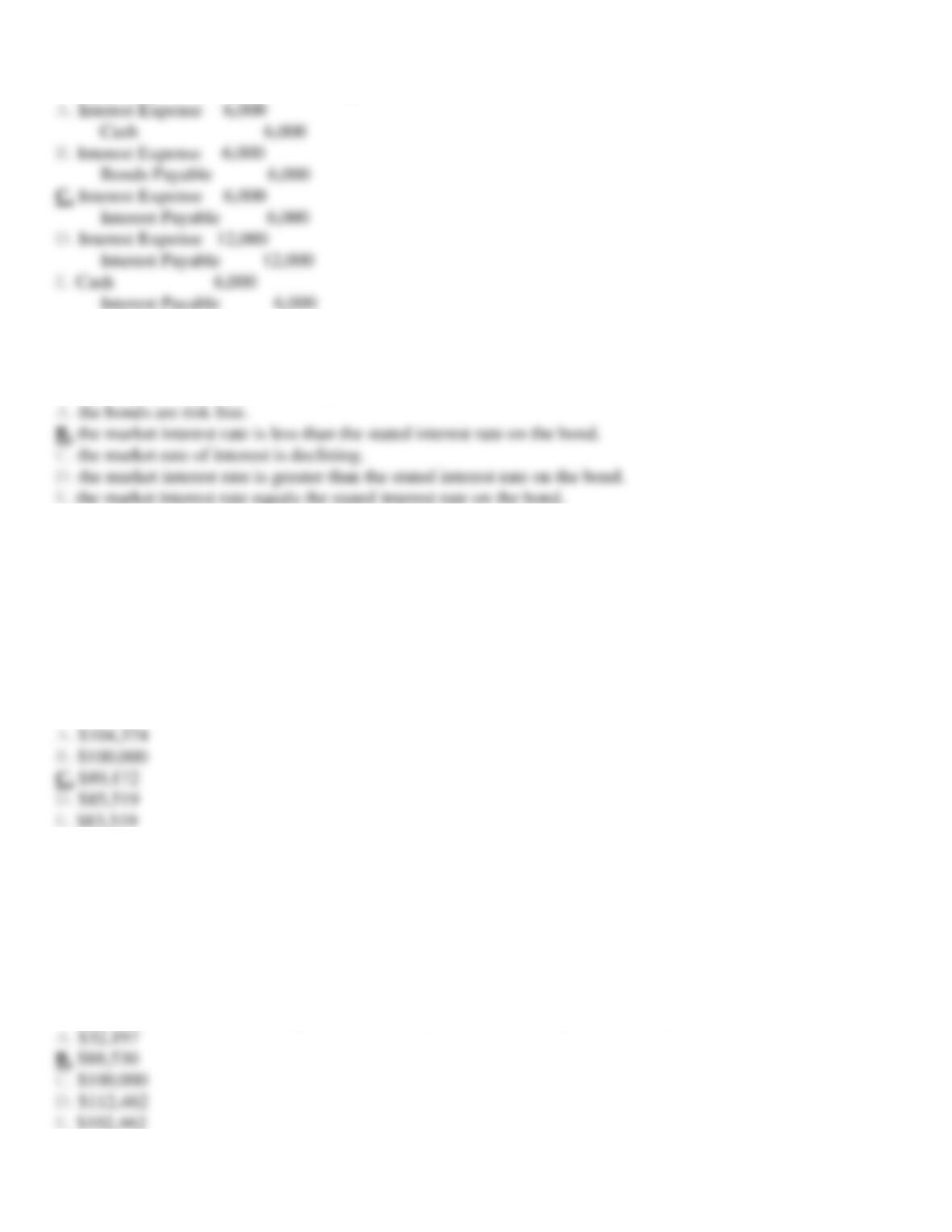
79. In Year 7, Nortel Manufacturing issued $100,000 semi-annual 12% bonds at par. Interest is payable on July
1 and January 1. What entry is necessary at December 31, Year 9?
80. Bonds are issued at greater than par value when
81. Fox Co., Inc.
On January 1, Year 1, Fox Co., Inc., issues $100,000 par value, 10% bonds maturing in 10 years to yield 12%
per year, compounded semiannually on January 1 and July 1. Use the present value tables.
Refer to the Fox Co. Inc. example. What is the bonds payable account (net of any bond discount or premium)
at the end of Year 2 to the nearest amount shown?
82. Fox Co., Inc.
On January 1, Year 1, Fox Co., Inc., issues $100,000 par value, 10% bonds maturing in 10 years to yield 12%
per year, compounded semiannually on January 1 and July 1. Use the present value tables.
Refer to the Fox Co., Inc. example. How much are the initial issue proceeds to the nearest amount shown?
83. When the market interest rate exceeds the coupon rate; the market price of the bond
84. (CMA adapted, Jun 86 #5) A bond issue sold at a premium is valued on the statement of financial position
at the
85. (CMA adapted, Dec 86 #20) On January 1, Year 1, Nicole Company sold its 5-year, $100,000 face value,
8% bonds at $108,530, to yield an effective annual interest rate of 6%. The bonds are dated January 1, Year 1,
and interest is payable annually on January 1. Using the effective interest method of premium amortization, the
amount of interest expense (rounded to the nearest dollar) reported by Nicole Company in Year 1 is
86. Heather Corporation
Heather Corporation issued $2,000,000, 10-percent, 10-year bonds on January 2, Year 2. The bonds pay interest
semiannually on January 1 and July 1. The bonds were priced on the market to yield 8 percent.
Refer to the Heather Corporation example. The issue price of the bonds is calculated as follows:

87. (CMA adapted, Dec 90 #12) Marla, Inc. issued $6,000,000 of 12% bonds on December 1, Year 1, due on
December 1, Year 6, with interest payable each December 1 and June 1. The bonds sold for $5,194,770 to yield
16%. If the discount is amortized by the effective interest method, Marla, Inc.’s interest expense for the fiscal
year ended November 30, Year 2 related to its $6,000,000 bond issue will be
88. U.S. GAAP and IFRS permit firms to account for notes and bonds under which of the following
approach(es)?
89. The FASB and the IASB refer to the approach that uses the current market interest rate instead of the
historical market interest rate to discount the remaining cash flows from financial instruments as the
90. A firm that does not account for long-term notes and bonds using the fair value option, uses the _____ to
account for the loan while it is outstanding.
91. Authoritative guidance requires firms that account for notes and bonds using the _____ market interest rate
to report the carrying values, or book values, on the balance sheet and to disclose the _____ of these notes and
bonds in notes to the financial statements.
92. The fair value of long-term debt
93. U.S. GAAP and IFRS provide for which of the following methods of accounting for long-term leases?
94. The operating lease method is appropriate when the
95. The capital lease method is appropriate when the lessee enjoys most of the _____ and bears most of the
_____ of ownership.
96. The operating lease method is appropriate when the lessor enjoys most of the _____ and bears most of the
_____ of ownership.
97. Upon entering in the lease agreement, capital leases require that the lessee records
98. Upon entering in the lease agreement, operating leases require that the lessee records
99. The operating lease method classifies all of the lease payment each period as _____.
100. The capital lease method classifies the portion of the lease payment related to interest expense as an
________use of cash and the portion related to a reduction in the lease liability as a _________ use of cash.
101. Why do lessees tend to prefer the operating lease method to the capital lease method?