CHAPTER 11
DEPRECIATION, IMPAIRMENTS, AND DEPLETION
IFRS questions are available at the end of this chapter.
TRUE-FALSE—Conceptual
Answer No. Description
MULTIPLE CHOICE—Conceptual
Test Bank for Intermediate Accounting, Sixteenth Edition
11 – 2
MULTIPLE CHOICE—Conceptual (cont.)
Answer No. Description
P These questions also appear in the Problem-Solving Survival Guide.
S These questions also appear in the Study Guide.
* This topic is dealt with in an Appendix to the chapter.
MULTIPLE CHOICE—Computational
Answer No. Description
c 75. Sum-of–the-years’-digits method.
Depreciation, Impairments, and Depletion
11 – 3
MULTIPLE CHOICE—Computational (cont.)
Answer No. Description
Test Bank for Intermediate Accounting, Sixteenth Edition
11 – 4
MULTIPLE CHOICE—CPA Adapted
Answer No. Description
BRIEF EXERCISES
Item Description
BE11-126 Definitions.
BE11-127 True or False
BE11-128 Depreciation methods.
EXERCISES
Item Description
E11-129 Calculate depreciation.
E11-130 Calculate depreciation.
E11-131 Asset depreciation and disposition.
E11-132 Composite depreciation.
E11-133 Depletion allowance.
PROBLEMS
Item Description
P11-134 Depreciation methods.
P11-135 Adjustment of depreciable base.
P11-136 Impairment.
P11-137 Impairment.

Depreciation, Impairments, and Depletion
11 – 5
CHAPTER LEARNING OBJECTIVES
1. Understand depreciation concepts and methods of depreciation.
2. Explain special depreciation methods and other depreciation issues.
3. Explain the accounting issues related to asset impairment.
4. Explain the accounting procedures for depletion of natural resources.
5. Explain how to report and analyze property, plant, equipment, and natural resources.
*6. Describe income tax methods of depreciation.
7. Compare the accounting for property, plant, and equipment under GAAP and IFRS.
Test Bank for Intermediate Accounting, Sixteenth Edition
11 – 6
SUMMARY OF QUESTIONS BY LEARNING OBJECTIVES AND BLOOM’S TAXONOMY
Item
LO
BT
Item
LO
BT
Item
LO
BT
Item
LO
BT
Item
LO
BT
TRUE-FALSE STATEMENTS
1.
1
K
5.
1
K
9.
1
C
13.
2
K
17.
4
K
2.
1
K
6.
1
K
10.
1
K
14.
3
K
18.
4
C
3.
1
K
7.
1
K
11.
2
C
15.
3
K
19.
5
K
4.
1
K
8.
1
K
12.
2
C
16.
3
K
20.
5
K
MULTIPLE CHOICE QUESTIONS
21.
1
K
42.
2
K
63.
1
AP
84.
2
AP
105.
4
AP
22.
1
K
43.
2
C
64.
1
AP
85.
2
AP
106.
4
AP
23.
1
K
44.
2
K
65.
1
AP
86.
2
AP
107.
4
AP
24.
1
K
45.
3
C
66.
1
AP
87.
2
AP
108.
4
AP
25.
1
C
46.
4
C
67.
1
AP
88.
2
AP
109.
5
AP
26.
1
K
47.
4
C
68.
1
AP
89.
2
AP
110.
5
AP
27.
1
K
48.
4
C
69.
1
AP
90.
2
AP
111.
5
AP
28.
1
K
49.
4
K
70.
1
AP
91.
2
AP
112.
5
AP
29.
1
K
50.
4
K
71.
1
AP
92.
2
AP
113.
5
AP
30.
1
K
51.
4
K
72.
1
AP
93.
2
AP
114.
5
AP
31.
1
C
52.
4
C
73.
1
AP
94.
3
AP
115.
6
AP
32.
1
C
53.
5
K
74.
1
AP
95.
3
AP
116.
6
AP
33.
1
C
54.
5
K
75.
1
AN
96.
3
AP
117.
1
AP
34.
1
C
55.
5
K
76.
1
AP
97.
3
AP
118.
1
C
35.
1
C
56.
5
K
77.
1
AP
98.
2
AP
119.
1
AP
36.
1
C
57.
5
K
78.
1
AP
99.
2
AP
120.
1
AP
37.
2
AN
58.
6
K
79.
1
AN
100.
2
AP
121.
1
C
38.
2
K
59.
6
K
80.
1
AN
101.
3
AP
122.
1
C
39.
2
C
60.
6
K
81.
1
AP
102.
4
AP
123.
1
AN
40.
2
K
61.
1
AP
82.
1
AP
103.
4
AP
124.
4
AP
41.
2
K
62.
1
AP
83.
1
AP
104.
4
AP
125.
4
AP
BRIEF EXERCISES
126.
1
K
127.
1
K
128.
1
K
EXERCISES
129.
1
AP
130.
1
AP
131.
1
AP
132.
2
AP
133.
4
AP
PROBLEMS
134.
1
AP
135.
2
AP
136.
3
AP
137.
3
AP
Depreciation, Impairments, and Depletion
11 – 7
TRUE-FALSE—Conceptual
1. Depreciation is a means of cost allocation, not a matter of valuation.
2. Depreciation is based on the decline in the fair market value of the asset.
3. Depreciation, depletion, and amortization all involve the allocation of the cost of a long-
lived asset to expense.
4. The cost of an asset less its salvage value is its depreciation base.
5. The three factors involved in the depreciation process are the depreciation base, the
useful life, and the risk of obsolescence.
6. Inadequacy is the replacement of one asset with another more efficient and economical
asset.
7. The major objection to the straight-line method is that it assumes the asset’s economic
usefulness and maintenance repair expense are the same each year.
8. The units-of-production approach to depreciation is appropriate when depreciation is a
function of time instead of activity.
9. An accelerated depreciation method is appropriate when the asset’s economic usefulness
is the same each year.
10. The declining-balance method does not deduct the salvage value in computing the
depreciation base.
Test Bank for Intermediate Accounting, Sixteenth Edition
11 – 8
11. Gains or losses on disposals of assets do not distort periodic income when the group or
composite method is used to compute depreciation.
12. Companies frequently use the composite approach when the assets are similar in nature
and have approximately the same useful lives.
13. Changes in estimates are handled prospectively by dividing the asset’s book value less
any salvage value by the remaining estimated life.
14. An impairment loss is the amount by which the carrying amount of the asset exceeds the
sum of the expected future net cash flows from the use of that asset.
15. The first step in determining whether an impairment has occurred is to estimate the future
net cash flows expected from the use of that asset and its eventual disposition.
16. Impaired assets held for disposal should be reported at the lower of cost or net realizable
value.
17. Normally, companies compute depletion on a straight-line basis.
18. Intangible development costs and restoration costs are part of the depletion base.
19. The asset turnover is computed by dividing net sales by ending total assets.
20. The profit margin on sales is a measure for analyzing the use of property, plant, and
equipment.
Depreciation, Impairments, and Depletion
11 – 9
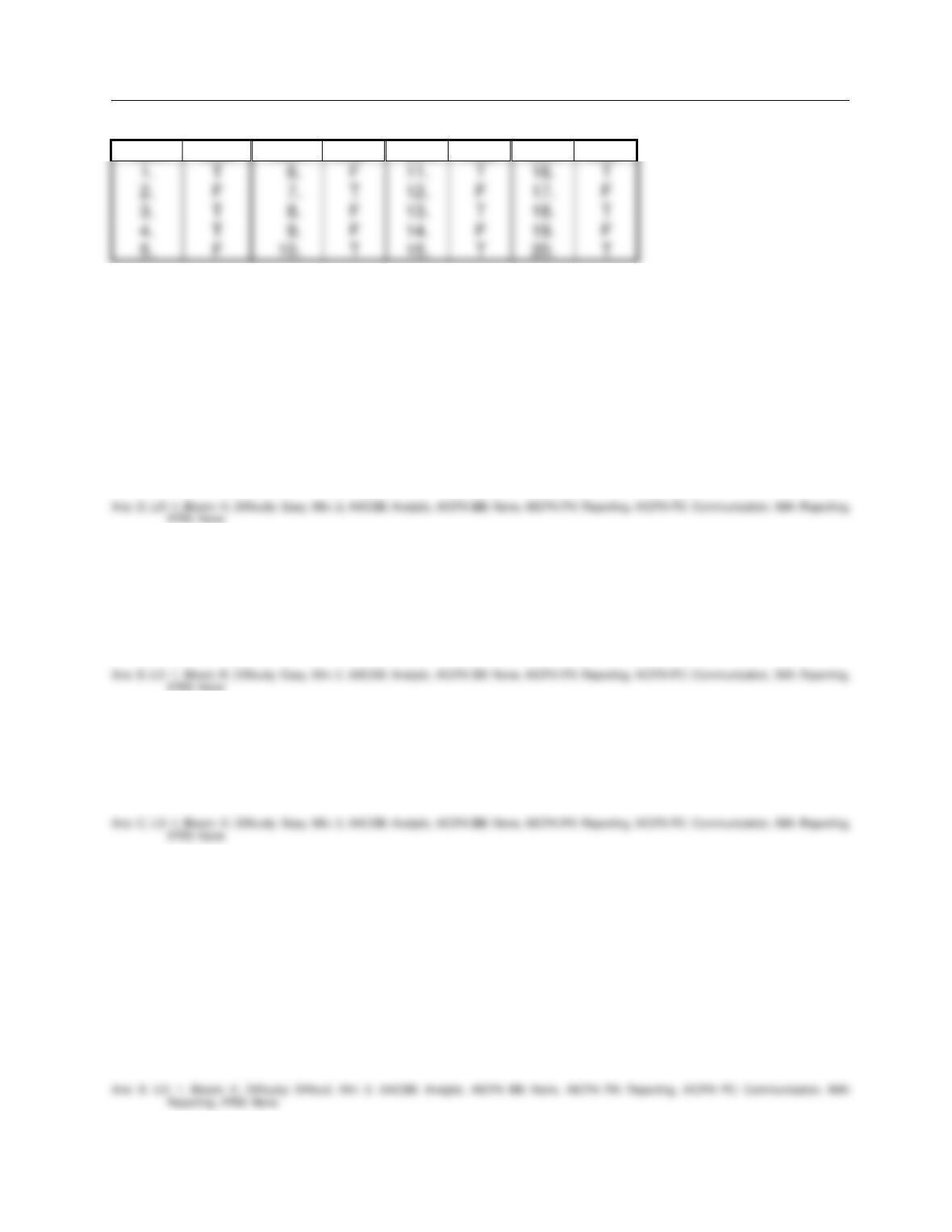
True False Answers—Conceptual
Item
Ans.
Item
Ans.
Item
Ans.
Item
Ans.
MULTIPLE CHOICE—Conceptual
21. Which of the following is true of depreciation accounting?
a. It is not a matter of valuation.
b. It is part of the matching of revenues and expenses.
c. It is the process of cost allocation.
d. All of these answers are correct.
22. Which of the following principles best describes the conceptual rationale for the methods
of matching depreciation expense with revenues?
a. Associating cause and effect
b. Systematic and rational allocation
c. Immediate recognition
d. Partial recognition
23. Each of the following are physical factors affecting depreciation except
a. casualties.
b. decay.
c. obsolescence.
d. wear and tear.
S24. Which of the following most accurately reflects the concept of depreciation as used in
accounting?
a. The process of charging the decline in value of an economic resource to income in the
period in which the benefit occurred.
b. The process of allocating the cost of tangible assets to expense in a systematic and
rational manner to those periods expected to benefit from the use of the asset.
c. A method of allocating asset cost to an expense account in a manner which closely
matches the physical deterioration of the tangible asset involved.
d. An accounting concept that allocates the portion of an asset used up during the year
to the contra asset account for the purpose of properly recording the fair market value
of tangible assets.
Test Bank for Intermediate Accounting, Sixteenth Edition
11 – 10
S25. The major difference between the service life of an asset and its physical life is that
a. service life refers to the time an asset will be used by a company and physical life
refers to how long the asset will last.
b. physical life is the life of an asset without consideration of salvage value and service
life requires the use of salvage value.
c. physical life is always longer than service life.
d. service life refers to the length of time an asset is of use to its original owner, while
physical life refers to how long the asset will be used by all owners.
P26. The term “depreciable base,” or “depreciation base,” as it is used in accounting, refers to
a. the total amount to be charged (debited) to expense over an asset’s useful life.
b. the cost of the asset less the related depreciation recorded to date.
c. the estimated market value of the asset at the end of its useful life.
d. the acquisition cost of the asset.
27. Economic factors that shorten the service life of an asset include
a. obsolescence.
b. supersession.
c. inadequacy.
d. all of these answers are correct.
28. Which of the following is not one of the basic questions that must be answered before the
amount of depreciation charge can be computed?
a. What is the depreciation base to use for the asset?
b. What is the asset’s useful life?
c. What method of cost apportionment is best for this asset?
d. What product or service is the asset related to?
S29. Which of the following is a realistic assumption of the straight-line method of depreciation?
a. The asset’s economic usefulness is the same each year.
b. The repair and maintenance expense is essentially the same each period.
c. The rate of return analysis is enhanced using the straight-line method.
d. Depreciation is a function of time rather than a function of usage.
30. The activity method of depreciation
a. is a variable charge approach.
b. assumes that depreciation is a function of the passage of time.
c. conceptually associates cost in terms of input measures.
d. all of these answers are correct.
Depreciation, Impairments, and Depletion
11 – 11
31. For income statement purposes, depreciation is a variable expense if the depreciation
method used is
a. units–of-production.
b. straight-line.
c. sum-of–the-years’-digits.
d. declining-balance.
32. If an industrial firm uses the units-of-production method for computing depreciation on its
only plant asset, factory machinery, the credit to accumulated depreciation from period to
period during the life of the firm will
a. be constant.
b. vary with unit sales.
c. vary with sales revenue.
d. vary with production.
33. Use of the double-declining balance method
a. results in a decreasing charge to depreciation expense.
b. means salvage value is not deducted in computing the depreciation base.
c. means the book value should not be reduced below salvage value.
d. all of these answers are correct.
34. Use of the sum-of–the-years’-digits method
a. results in salvage value being ignored.
b. means the denominator is the years remaining at the beginning of the year.
c. means the book value should not be reduced below salvage value.
d. all of these answers are correct.
35. A graph is set up with “yearly depreciation expense” on the vertical axis and “time” on the
horizontal axis. Assuming linear relationships, how would the graphs for straight-line and
sum-of–the-years’-digits depreciation, respectively, be drawn?
a. Vertically and sloping down to the right
b. Vertically and sloping up to the right
c. Horizontally and sloping down to the right
d. Horizontally and sloping up to the right
36. A principal objection to the straight-line method of depreciation is that it
a. provides for the declining productivity of an aging asset.
b. ignores variations in the rate of asset use.
c. tends to result in a constant rate of return on a diminishing investment base.
d. gives smaller periodic write-offs than decreasing charge methods.
Test Bank for Intermediate Accounting, Sixteenth Edition
11 – 12
37. Each year a company has been investing an increasingly greater amount in machinery.
Since there is a large number of small items with relatively similar useful lives, the
company has been applying straight-line depreciation at a uniform rate to the machinery
as a group. The ratio of this group’s total accumulated depreciation to the total cost of the
machinery has been steadily increasing and now stands at .75 to 1.00. The most likely
explanation for this increasing ratio is the
a. company should have been using one of the accelerated methods of depreciation.
b. estimated average life of the machinery is less than the actual average useful life.
c. estimated average life of the machinery is greater than the actual average useful life.
d. company has been retiring fully depreciated machinery that should have remained in
service.
38. For the composite method, the composite
a. rate is the total cost divided by the total annual depreciation.
b. rate is the total annual depreciation divided by the total depreciable cost.
c. life is the total cost divided by the total annual depreciation.
d. life is the total depreciable cost divided by the total annual depreciation.
P39. Worley Truck Rental uses the group depreciation method for its fleet of trucks. When it
retires one of its trucks and receives cash from a salvage company, the carrying value of
property, plant, and equipment will be decreased by the
a. original cost of the truck.
b. original cost of the truck less the cash proceeds.
c. cash proceeds received.
d. cash proceeds received and original cost of the truck.
S40. Composite or group depreciation is a depreciation system whereby
a. the years of useful life of the various assets in the group are added together and the
total divided by the number of items.
b. the cost of individual units within an asset group is charged to expense in the year a
unit is retired from service.
c. a straight-line rate is computed by dividing the total of the annual depreciation
expense for all assets in the group by the total cost of the assets.
d. the original cost of all items in a given group or class of assets is retained in the asset
account and the cost of replacements is charged to expense when they are acquired.
S41. When depreciation is computed for partial periods under a decreasing charge depreciation
method, it is necessary to
a. charge a full year’s depreciation to the year of acquisition.
b. determine depreciation expense for the full year and then prorate the expense
between the two periods involved.
c. use the straight-line method for the year in which the asset is sold or otherwise
disposed of.
d. use a salvage value equal to the first year’s partial depreciation charge.
Depreciation, Impairments, and Depletion
11 – 13
42. Depreciation is normally computed on the basis of the nearest
a. full month and to the nearest cent.
b. full month and to the nearest dollar.
c. day and to the nearest cent.
d. day and to the nearest dollar.
43. McDonald Company acquired machinery on January 1, 2012 which it depreciated under
the straight-line method with an estimated life of fifteen years and no salvage value. On
January 1, 2017, McDonald estimated that the remaining life of this machinery was six
years with no salvage value. How should this change be accounted for by McDonald?
a. As a prior period adjustment
b. As the cumulative effect of a change in accounting principle in 2017
c. By setting future annual depreciation equal to one-sixth of the book value on January
1, 2017
d. By continuing to depreciate the machinery over the original fifteen year life
44. A change in estimate should
a. result in restatement of prior period statements.
b. be handled in current and future periods.
c. be handled in future periods only.
d. be handled retroactively.
45. Lamar Printing Company determines that a printing press used in its operations has
suffered a permanent impairment in value because of technological changes. An entry to
record the impairment should
a. recognize an unusual loss for the period.
b. include a credit to the equipment accumulated depreciation account.
c. include a credit to the equipment account.
d. not be made if the equipment is still being used.
46. Which of following is not a similarity in the accounting treatment for depreciation and
depletion?
a. The estimated life is based on economic or productive life.
b. Assets subject to either are reported in the same classification on the balance sheet.
c. The rates may be changed upon revision of the estimated productive life used in the
original rate computations.
d. Both depreciation and depletion are based on time.
Test Bank for Intermediate Accounting, Sixteenth Edition
11 – 14
47. Which of the following is not a difference between the accounting treatment for
depreciation and depletion?
a. Depletion applies to natural resources while depreciation applies to plant and
equipment.
b. Depletion refers to the physical exhaustion or consumption of the asset while
depreciation refers to the wear, tear, and obsolescence of the asset.
c. Many formulas are used in computing depreciation but only one is used to any extent
in computing depletion.
d. The cost of the asset is the starting point from which computation of the amount of the
periodic charge is made to operations for depreciation, but the fair value reassessed
each year is the starting point for the periodic charge for depletion.
48. Dividends representing a return of capital to stockholders are not uncommon among
companies which
a. use accelerated depreciation methods.
b. use straight-line depreciation methods.
c. recognize both functional and physical factors in depreciation.
d. none of these answers are correct.
49. Depletion expense
a. is usually part of cost of goods sold.
b. includes tangible equipment costs in the depletion base.
c. excludes intangible development costs from the depletion base.
d. excludes restoration costs from the depletion base.
50. The most common method of recording depletion for accounting purposes is the
a. percentage depletion method.
b. decreasing charge method.
c. straight-line method.
d. units–of-production method.
51. Reserve recognition accounting
a. is presently the generally accepted accounting method for financial reporting of oil and
gas reserves.
b. is a historical cost method similar to the full cost approach and the successful efforts
approach.
c. is used for reporting of oil and gas reserves for federal income tax purposes.
d. requires estimates of future production costs, the appropriate discount rate, and the
expected selling price of oil and gas reserves.
Depreciation, Impairments, and Depletion
11 – 15
S52. Of the following costs related to the development of natural resources, which one is not a
part of depletion cost?
a. Acquisition cost of the natural resource deposit
b. Exploration costs
c. Tangible equipment costs associated with machinery used to extract the natural
resource
d. Intangible development costs such as drilling costs, tunnels, and shafts
S53. Which of the following disclosures is not required in the financial statements regarding
depreciation?
a. Accumulated depreciation, either by major classes of depreciable assets or in total.
b. Details demonstrating how depreciation was calculated.
c. Depreciation expense for the period.
d. Balances of major classes of depreciable assets, by nature and function.
P54. The book value of a plant asset is
a. the fair market value of the asset at a balance sheet date.
b. the asset’s acquisition cost less the total related depreciation recorded to date.
c. equal to the balance of the related accumulated depreciation account.
d. the assessed value of the asset for property tax purposes.
55. A general description of the depreciation methods applicable to major classes of
depreciable assets
a. is not a current practice in financial reporting.
b. is not essential to a fair presentation of financial position.
c. is needed in financial reporting when company policy differs from income tax policy.
d. should be included in corporate financial statements or notes thereto.
56. The asset turnover is computed by dividing
a. net income by ending total assets.
b. net income by average total assets.
c. net sales by ending total assets.
d. net sales by average total assets.
57. The rate of return on total assets is computed by dividing
a. Net income by ending total assets.
b. Net sales by average total assets.
c. Net sales by ending total assets.
d. Net income by average total assets.
Test Bank for Intermediate Accounting, Sixteenth Edition
11 – 16
*58. A major objective of MACRS for tax depreciation is to
a. reduce the amount of depreciation deduction on business firms’ tax returns.
b. assure that the amount of depreciation for tax and book purposes will be the same.
c. help companies achieve a faster write-off of their capital assets.
d. require companies to use the actual economic lives of assets in calculating tax
depreciation.
*59. Under MACRS, which one of the following is not considered in determining depreciation
for tax purposes?
a. Cost of asset
b. Property class
c. Half-year convention
d. Salvage value
*60. The computation of depreciation under MACRS differs from the GAAP computation
except for
a. a mandated tax life, which is generally shorter than the economic life.
b. Cost recovery on an accelerated basis.
c. the determination of asset cost.
d. an assigned salvage value of zero.
Multiple Choice Answers—Conceptual
Item
Ans.
Item
Ans.
Item
Ans.
Item
Ans.
Item
Ans.
Item
Ans.
Item
Ans.
Solutions to those Multiple Choice questions for which the answer is “none of these.”
48. do not expect to purchase additional property after depleting existing property.
MULTIPLE CHOICE—Computational
61. Falcon Company purchased a depreciable asset for $175,000. The estimated salvage
value is $14,000, and the estimated useful life is 10 years. The straight-line method will be
used for depreciation. What is the depreciation base of this asset?
a. $16,100
b. $17,500
c. $161,000
d. $175,000
Depreciation, Impairments, and Depletion
11 – 17
62. Henry Company purchased a depreciable asset for $360,000. The estimated salvage
value is $33,000, and the estimated useful life is 10 years. The straight-line method will be
used for depreciation. What is the depreciation base of this asset?
a. $33,000
b. $36,000
c. $327,000
d. $360,000
63. Slotkin Products purchased a machine for $65,000 on July 1, 2017. The company intends
to depreciate it over 8 years using the double-declining balance method. Salvage value is
$5,000. Depreciation for 2017 is
a. $32,500
b. $8,125
c. $14,219
d. $15,000
64. Slotkin Products purchased a machine for $65,000 on July 1, 2017. The company intends
to depreciate it over 8 years using the double-declining balance method. Salvage value is
$5,000. Depreciation for 2018 to the closest dollar is
a. $32,500
b. $8,125
c. $14,219
d. $12,500
65. Grover Corporation purchased a truck at the beginning of 2017 for $109,200. The truck is
estimated to have a salvage value of $4,200 and a useful life of 120,000 miles. It was
driven 21,000 miles in 2017 and 29,000 miles in 2018. What is the depreciation expense
for 2017?
a. $19,845
b. $18,375
c. $25,375
d. $43,750
66. Grover Corporation purchased a truck at the beginning of 2017 for $109,200. The truck is
estimated to have a salvage value of $4,200 and a useful life of 120,000 miles. It was
driven 21,000 miles in 2017 and 29,000 miles in 2018. What is the depreciation expense
for 2018?
a. $27,405
b. $7,000
c. $25,375
d. $43,750
Test Bank for Intermediate Accounting, Sixteenth Edition
11 – 18
67. Carson Company purchased a depreciable asset for $560,000. The estimated salvage
value is $28,000, and the estimated useful life is 10,000 hours. Carson used the asset for
1,500 hours in the current year. The activity method will be used for depreciation. What is
the depreciation expense on this asset?
a. $53,200
b. $79,800
c. $88,200
d. $532,000
68. Jasmine Company purchased a depreciable asset for $375,000. The estimated salvage
value is $25,000, and the estimated useful life is 8 years. The double-declining balance
method will be used for depreciation. What is the depreciation expense for the second
year on this asset?
a. $43,750
b. $65,625
c. $70,313
d. $93,750
69. Endeavor Company purchased a depreciable asset for $1,200,000. The estimated
salvage value is $60,000, and the estimated useful life is 10,000 hours. Endeavor used
the asset for 1,100 hours in the current year. The activity method will be used for
depreciation. What is the depreciation expense on this asset?
a. $114,000
b. $125,400
c. $132,000
d. $1,140,000
70. Halltown Company purchased a depreciable asset for $600,000. The estimated salvage
value is $40,000, and the estimated useful life is 8 years. The double-declining balance
method will be used for depreciation. What is the depreciation expense for the second
year on this asset?
a. $70,000
b. $105,000
c. $112,500
d. $150,000
71. On July 1, 2017, Mendes Corporation purchased factory equipment for $300,000. Salvage
value was estimated to be $8,000. The equipment will be depreciated over five years using
the double-declining balance method. Counting the year of acquisition as one-half year,
Mendes should record depreciation expense for 2018 on this equipment of
a. $120,000.
b. $96,000.
c. $93,440.
d. $72,000.
Depreciation, Impairments, and Depletion
11 – 19
72. Klayton Corporation purchased factory equipment that was installed and put into service
January 2, 2017, at a total cost of $150,000. Salvage value was estimated at $10,000. The
equipment is being depreciated over four years using the double-declining balance method.
For the year 2018, Klayton should record depreciation expense on this equipment of
a. $35,000.
b. $37,500.
c. $70,000.
d. $75,000.
73. On July 1, 2017, Nowton Co. purchased machinery for $240,000. Salvage value was
estimated to be $10,000. The machinery will be depreciated over ten years using the
double-declining balance method. If depreciation is computed on the basis of the nearest
full month, Nowton should record depreciation expense for 2018 on this machinery of
a. $41,400.
b. $43,200.
c. $43,700.
d. $38,400.
74. Ramos Co. purchased machinery that was installed and ready for use on January 3,
2017, at a total cost of $230,000. Salvage value was estimated at $30,000. The
machinery will be depreciated over five years using the double-declining balance method.
For the year 2018, Ramos should record depreciation expense on this machinery of
a. $48,000.
b. $55,200.
c. $60,000.
d. $92,000.
75. A plant asset has a cost of $40,000 and a salvage value of $10,000. The asset has a
three-year life. If depreciation in the third year amounted to $5,000, which depreciation
method was used?
a. Straight-line
b. Declining-balance
c. Sum-of–the-years’-digits
d. Cannot tell from information given
76. On January 1, 2017, Garden Company purchased a new machine for $4,200,000. The
new machine has an estimated useful life of nine years and the salvage value was
estimated to be $150,000. Depreciation was computed using the sum-of–the-years‘-digits
method. What amount should be shown in Garden’s balance sheet at December 31,
2018, net of accumulated depreciation, for this machine?
a. $3,390,000
b. $2,670,000
c. $2,613,331
d. $2,488,500
Test Bank for Intermediate Accounting, Sixteenth Edition
11 – 20
77. On January 1, 2011, Forrest Company purchased equipment at a cost of $390,000. The
equipment was estimated to have a salvage value of $12,000 and it is being depreciated
over eight years under the sum-of–the-years’-digits method. What should be the charge for
depreciation of this equipment for the year ended December 31, 2018?
a. $10,500
b. $10,833
c. $48,750
d. $47,250
78. On September 19, 2017, Markham Co. purchased machinery for $475,000. Salvage value
was estimated to be $25,000. The machinery will be depreciated over eight years using the
sum–of–the-years’-digits method. If depreciation is computed on the basis of the nearest full
month, Markham should record depreciation expense for 2018 on this machinery of
a. $102,257.
b. $97,111.
c. $96,875.
d. $87,500.
79. On January 3, 2016, Salazar Co. purchased machinery. The machinery has an estimated
useful life of eight years and an estimated salvage value of $120,000. The depreciation
applicable to this machinery was $260,000 for 2018, computed by the sum-of–the-years’-
digits method. The acquisition cost of the machinery was
a. $1,440,000.
b. $1,560,000.
c. $1,680,000.
d. $1,872,000.
80. On January 2, 2015, Wang Company acquired equipment to be used in its manufacturing
operations. The equipment has an estimated useful life of 10 years and an estimated
salvage value of $45,000. The depreciation applicable to this equipment was $210,000 for
2018, computed under the sum–of–the-years’-digits method. What was the acquisition cost
of the equipment?
a. $1,605,000
b. $1,695,000
c. $1,650,000
d. $1,625,000