11-1: ABC and Average Cost in a Service Industry
For many years the Honey Lake Summer Camp had used the number of campers per week
to estimate weekly costs. The summer camp is open for ten weeks during the summer with a
different number of campers each week. July is busiest with June and the end of August least
busy. Costs from the last week of summer camp in 1998 are used to estimate costs for 1999 for
pricing purposes. The following costs occurred during the last week of 1998 and the costs of each
cost category are expected to be the same for 1999:
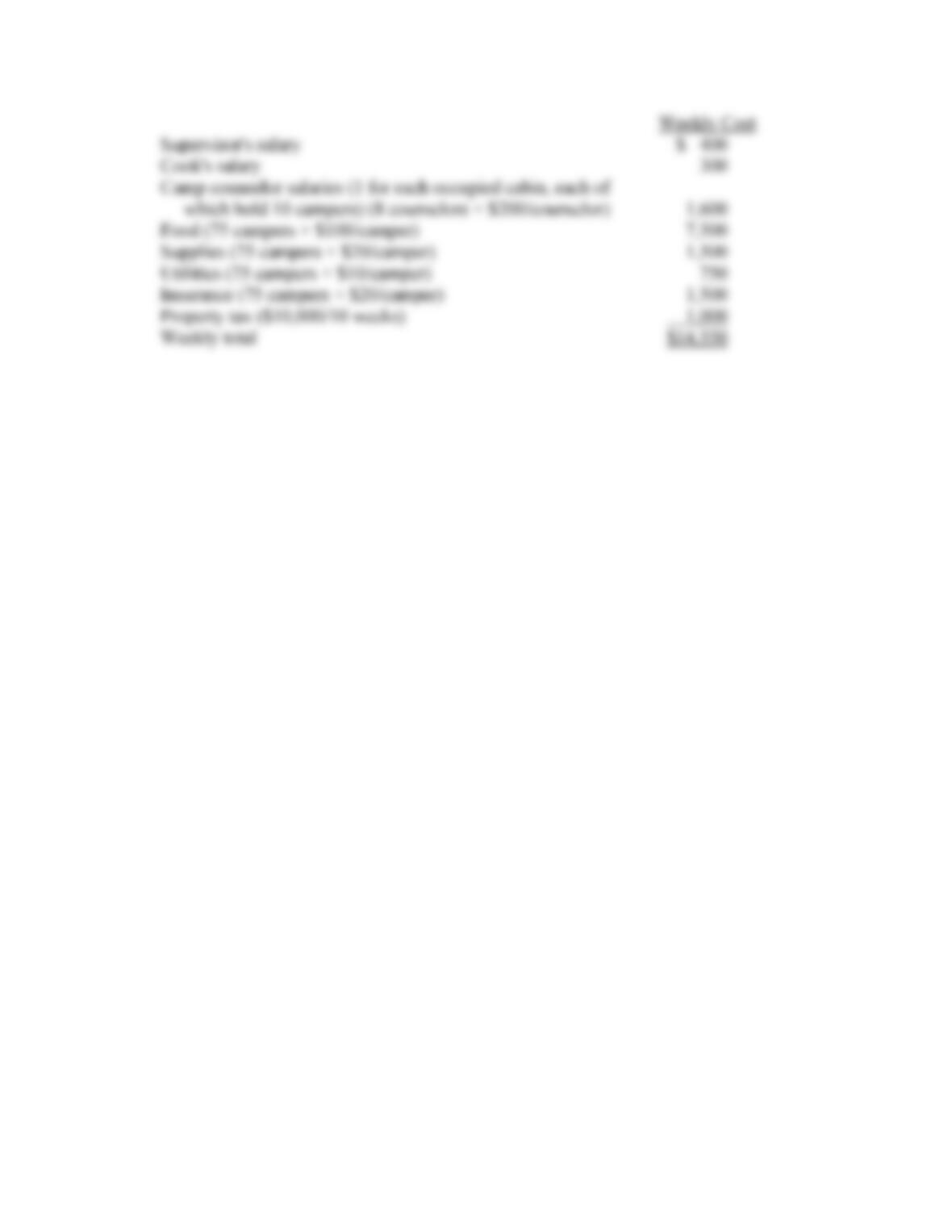
Weekly Cost
Supervisor’s salary $ 400
Cook’s salary 300
Camp counselor salaries (1 for each occupied cabin, each of
which hold 10 campers) (5 counselors × $200/counselor) 1,000
Food (50 campers × $100/camper) 5,000
Supplies (50 campers × $20/camper) 1,000
Utilities (50 campers × $10/camper) 500
Insurance (50 campers × $20/camper) 1,000
Property tax ($10,000/10 weeks) 1,000
Weekly total $12,200
Cost per camper: $12,200/50 campers = $244/camper
The Honey Lake Summer Camp expects 75 campers during the second week of July.
Required:
a. What is the expected cost of that week using the average cost?
b. What is the expected cost of that week using ABC?
11-1: Solution to ABC and Average Cost in a Service Industry (20 minutes)
11-2: Different Overhead Allocation Bases
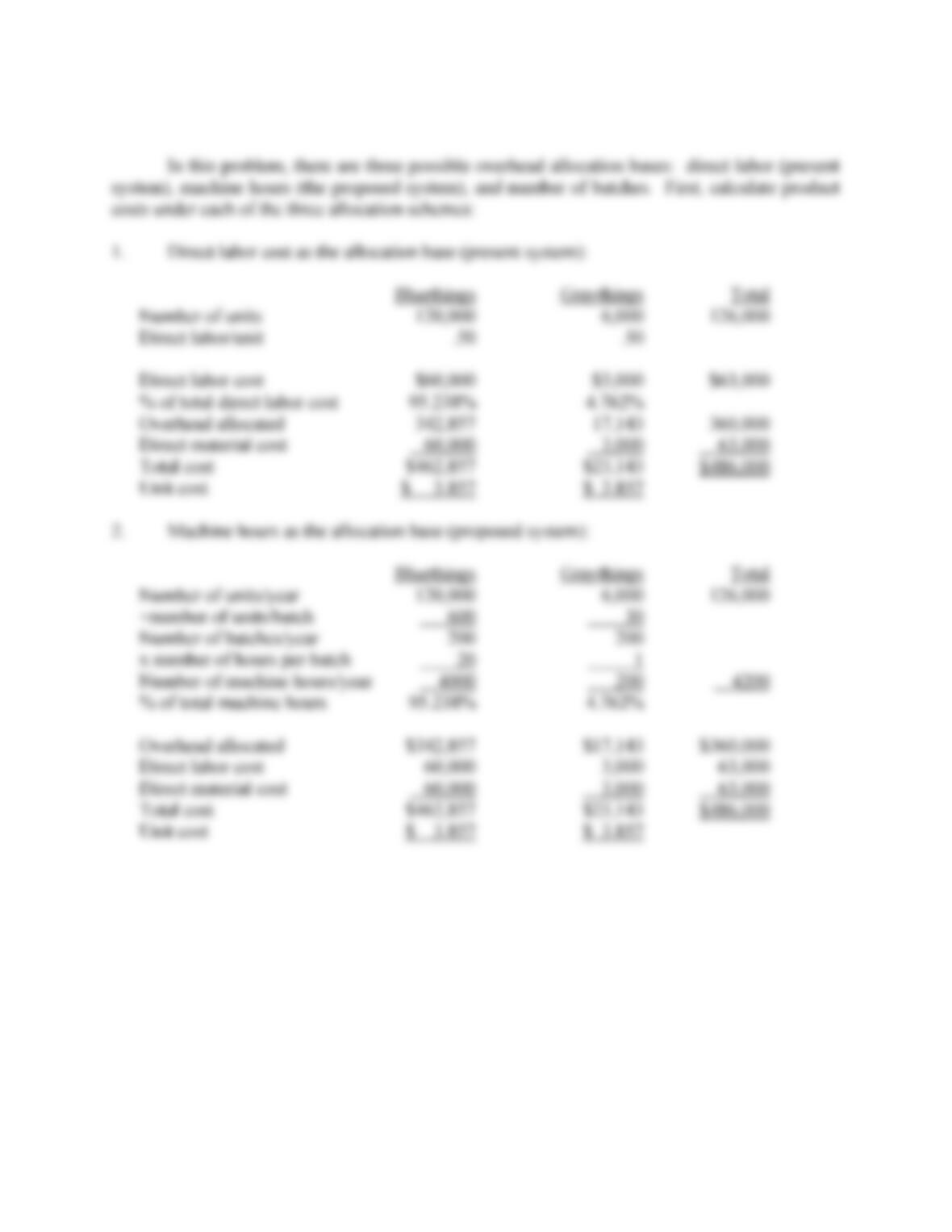
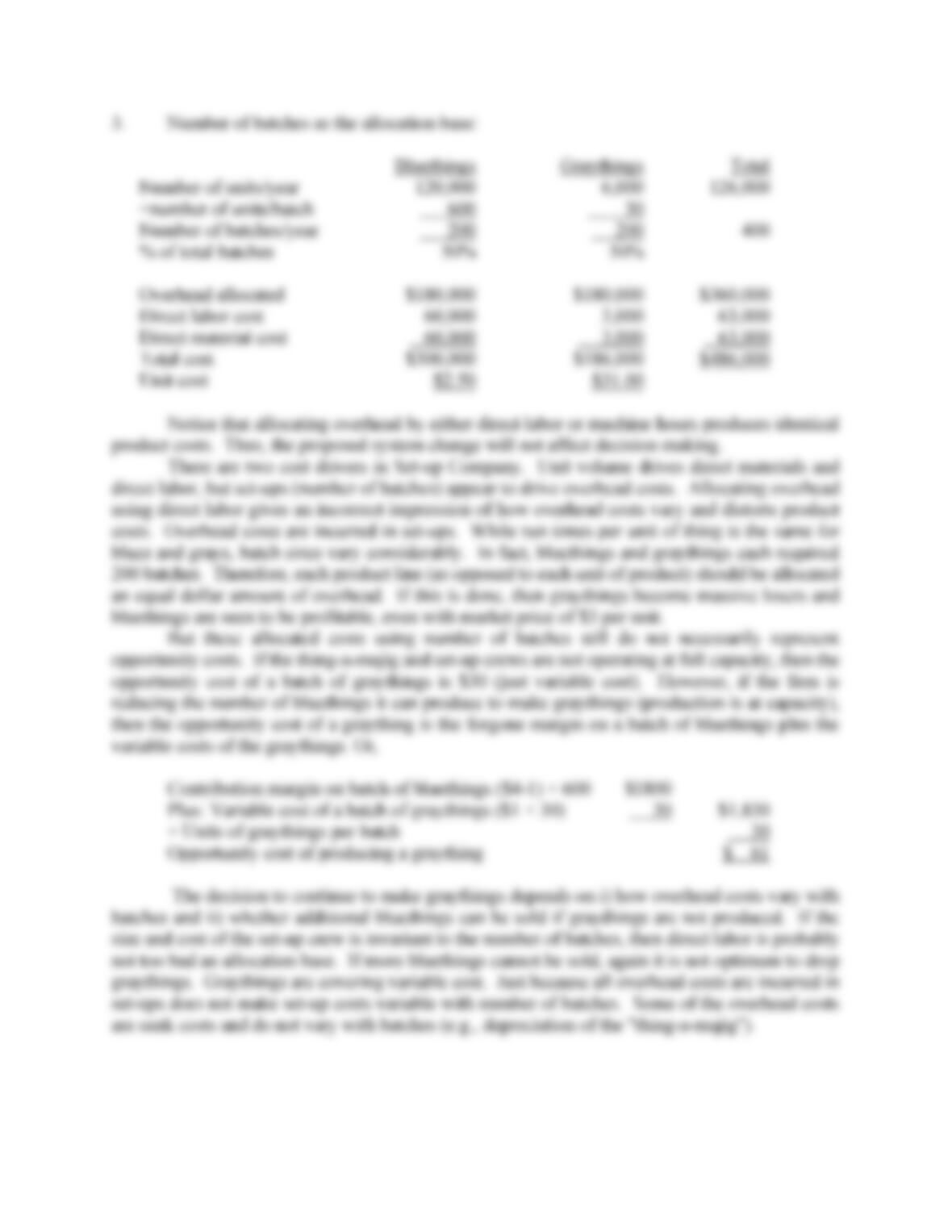
Set-Up Company produces blue things and gray things. Blue things are in much greater
demand in the market and the firm sells 120,000 blue things a year. Set-Up Co. sells 6,000 gray
things per year in small boutiques. Things have a short shelf life. They must be distributed, sold,
and consumed within two months of manufacture.
Both things use the identical production process and production facilities. Direct labor is
$0.50 per thing and direct material is $0.50 per thing. Things are produced in batches. Blue things
are produced in batches of 600 units and gray things in batches of 30. Each batch of things goes
through the thingamajig, which is the machine that converts raw inputs into things. Each batch
requires engineers to reset the machine for the next batch, calibrate settings, and test the first 10
things for product quality and conformity to standards. Even if sequential batches of the same
things are made, setups must be performed for each new batch. All the overhead costs are incurred
in setups. Indirect labor, indirect materials, and supplies consumed during setup cost $360,000
per year. The only costs of producing things are direct labor, direct materials, and the overhead of
setups. The company is currently allocating setup costs to things based on direct labor cost.
The firm has been selling blue things for $4 per unit and gray things for $6 per unit. But
foreign competition for blue things is starting to put pressure on the $4 price. Some competitors
are selling blue things for as low as $3 per unit. Management is considering putting more emphasis
on selling gray things, whose margins are higher. On the other hand, management worries that the
current system for allocating overhead costs is misrepresenting the costs of the two products
because direct labor costs are not representative of the time spent by each product on the
thingamajig. Management is considering allocating setup costs using machine hours on the
thingamajig. A batch of gray things requires one hour of machine time and a batch of blue things
requires 20 hours of machine time.
Required:
Analyze the present situation. Is there anything wrong with the costing system? If so,
should management change to the proposed allocation base of machine hours?
11-2: Solution to Different Overhead Allocation Bases (40 minutes)
11-3: Describe ABC
Required:
a. What is activity-based costing and how does it differ from traditional absorption costing?
b. Describe the advantages and disadvantages of activity-based costing systems.
11-3: Solution to Describe ABC (15 minutes)