Essentials of Entrepreneurship & Small Business Mgmt., 7e (Scarborough)
Chapter 11 Creating a Successful Financial Plan
1) In order to reach profit objectives, entrepreneurs must be aware of their firms’:
A) current ratio and liabilities.
B) fixed assets and owner’s equity.
C) assets and liabilities.
D) overall financial position and any changes in the financial status.
2) The ________ shows what assets the business owns and what claims creditors and owners
have against those assets, and is built on the basic accounting equation:
Assets = Liabilities + Owner’s Equity.
A) income statement
B) sources and uses of funds statement
C) balance sheet
D) cash budget
3) The ________ represents a “snapshot” of a business, showing an estimate of its value on a
given date, while the ________ is a “moving picture” of the firm’s profitability over time.
A) balance sheet; income statement
B) income statement; balance sheet
C) statement of cash flows; income statement
D) balance sheet; statement of cash flows
4) Which of the following associations is correct?
A) Balance sheet – cost of goods sold
B) Income statement – owner’s equity
C) Current assets – inventory
D) Long-term liabilities – accounts payable
5) The first section of a balance sheet lists:
A) assets.
B) liabilities.
C) claims creditors have against the firm’s assets payable within one year.
D) the owner’s equity in terms of initial capital invested and retained earnings.
6) Which of the following items would not be listed as a current asset in a company’s financial
reports?
A) Cash
B) Accounts receivable
C) Fixtures
D) Inventory
7) ________ are those items of value the business owns; ________ are those things the business
owes.
A) Assets; liabilities
B) Liabilities; assets
C) Ratios; equities
D) Equities; liabilities
8) Cost of goods sold is located on which financial statement?
A) Income statement
B) Balance sheet
C) Statement of cash flows
D) All of the above
9) Which of the following is not true regarding the components of the income statement?
A) Cost of goods sold represents the total cost, excluding shipping, of the merchandise sold
during the accounting period.
B) Gross profit margin is calculated by dividing gross profit by net sales revenue.
C) Operating expenses include those costs that contribute directly to the manufacture and
distribution of goods.
D) A and B above
10) The statement of cash flows:
A) compares costs and expenses against a firm’s net profits.
B) is built on the basic accounting equation: Assets = Liabilities + Capital.
C) shows what assets the business owns and what claims creditors and owners have against those
assets.
D) shows changes in working capital by listing sources and uses of funds.
11) On a company’s statement of cash flows, depreciation is:
A) the difference between the total sources available to the owner and the total uses of those
assets.
B) listed as a source of funds because it is a noncash expense, already deducted as a cost of doing
business.
C) the owner’s total investment at the company’s inception plus retained earnings.
D) creditors’ total claims against the firm’s assets.
12) Creating projected (pro forma) financial statements would allow a business owner to answer
which of the following questions?
A) What profit can my business expect to achieve?
B) What sales level must my business reach if our targeted profit is × dollars?
C) What fixed and variable expenses can my business expect to incur at our targeted sales level?
D) All of the above
13) On a projected income statement, a business owner’s target income is:
A) the sum of a reasonable salary for the time spent running the business and a normal return on
the amount invested in it.
B) the income at which the company’s total revenues and its total expenses are equal.
C) the income that will produce a 10 percent return on the owner’s financial investment in the
business.
D) the income that the owner could earn working for someone else.
14) You are to prepare a projected income statement for a proposed business venture. Your
desired income is $28,000 and you have the following published statistics:
Costs of goods sold = 56.9 percent of net sales
Operating expenses = 37.1 percent of net sales
Gross profit margin = 43.1 percent of net sales
This information indicates the net sales on your pro forma “P & L” (income statement) would be:
A) $466,667.
B) $491,228.
C) $500,000.
D) None of the above
15) Gaither Mack is preparing projected financial statements to include in the business plan he is
preparing for the launch of a specialty retail store. Using published financial statistics, Mack
finds that the typical net profit margin for a store like his is 7.3 percent. If Mack’s target income
for his first year of operation is $32,000, what level of sales must he achieve to reach it?
A) $233,600
B) $438,356
C) $2,966,400
D) Cannot be determined from the information provided
16) Michelle Becker’s target income in her business for the upcoming year is $78,500. The
company’s gross profit margin averages 32.6 percent of sales, and its total operating expenses
run 24.7 percent of sales. To achieve her target income, sales of Michelle’s company should be:
A) $148,773.
B) $993,671.
C) $317,814.
D) $1,271,348.
17) If Anita’s research suggests that she can expect net sales of $475,000, what net profit could
she expect?
A) $202,825
B) $46,550
C) $69,350
D) $156,275
18) If Anita’s net profit target is $32,000, what level of net sales must she achieve?
A) $74,941
B) $97,264
C) $326,531
D) $219,178
19) Cash requirements can be determined by dividing cash expenses by:
A) liabilities.
B) accounts receivables.
C) total assets.
D) the average inventory turnover.
20) A technique that allows the small business owner to perform financial analysis by
understanding the relationship between two accounting elements is called:
A) creating the pro forma.
B) budgeting.
C) break-even analysis.
D) ratio analysis.
21) Analyzing financial ratios could alert a business owner to which of these problems?
A) Excessive inventory
B) Overextending credit
C) Too much debt
D) All of the above
22) Which of the following is not a liquidity ratio?
A) Current ratio
B) Total asset turnover ratio
C) Quick ratio
D) None of the above
23) The ________ ratio is a measure of the small company’s ability to pay current debts from
current assets and is the liquidity ratio most commonly used as a measure of short-term solvency.
A) quick
B) debt-to-net worth
C) current
D) debt-to-assets
24) ________ ratios tell whether or not the small company will be able to meet its short-term
obligations.
A) Leverage
B) Profitability
C) Liquidity
D) Operating
25) Financial analysts suggest that a small business should maintain a current ratio of at least:
A) 1:1.
B) 2:1.
C) 3:1.
D) 4:1.
26) The ________ ratio is a conservative measure of a firm’s liquidity and shows the extent to
which a firm’s most liquid assets cover its current liabilities.
A) current
B) quick
C) turnover
D) net profit
27) Bettina has just calculated her company’s current ratio. To calculate the quick ratio, she
should:
A) subtract current liabilities from current assets before dividing by total liabilities.
B) subtract total liabilities from current assets before dividing by current liabilities.
C) subtract inventory from current assets before dividing by current liabilities.
D) subtract depreciation expense from current assets before dividing by current liabilities.
28) When a company is forced into liquidation, owners are most likely to incur a loss when
selling:
A) accounts receivable.
B) inventory.
C) marketable securities.
D) real estate.
29) ________ ratios measure the extent to which an entrepreneur relies on debt capital rather
than equity capital to finance a business.
A) Liquidity
B) Leverage
C) Operating
D) Profitability
30) Which of the following combinations of ratios would indicate that a company is financially
mismanaged and is not a good credit risk?
A) High liquidity; high leverage
B) Low liquidity; high leverage
C) High liquidity; low leverage
D) Low liquidity; low leverage
31) The ________ ratio measures the percentage of total assets financed by a small company’s
creditors compared to its owners.
A) debt
B) times-interest-earned
C) net sales to total assets
D) total asset turnover
32) A high debt ratio:
A) means that creditors provide a large percentage of the company’s total financing.
B) gives a small business more borrowing capacity.
C) decreases the chances that creditors will lose money if the business is liquidated.
D) represents a lower risk to potential lenders and creditors.
33) Which ratio would best give an owner an indication that the business is undercapitalized?
A) Debt-to-net worth
B) Net sales to total assets
C) Average inventory turnover
D) Quick
34) The higher the ________ ratio, the lower the degree of protection afforded creditors, and the
closer creditors’ interest approaches the owner’s interest.
A) debt-to-net worth
B) quick
C) asset turnover
D) current
35) ________ is one indication that a small business may be undercapitalized.
A) A current ratio below 1:1
B) A quick ratio above 2:1
C) A debt-to-net worth ratio above 1:1
D) A net sales-to-working capital ratio equal to 3:1
36) The ________ ratio tells how many times the company’s earnings cover the interest
payments on the debt it is carrying.
A) debt
B) debt-to-net worth
C) times-interest-earned
D) net sales-to-working capital
37) ________ ratios help a business owner evaluate the company’s performance and indicate
how effectively the business employs its resources.
A) Liquidity
B) Leverage
C) Operating
D) Profitability
38) The average inventory turnover ratio:
A) measures the number of times a company’s inventory is sold out during the accounting period.
B) tells a business owner whether she is managing the company’s inventory properly.
C) tells a business owner how fast the merchandise is moving through the business.
D) All of the above
39) Sarah’s Smart Shop has an inventory turnover ratio of 3 times per year and an average
inventory of $156,000. If Sarah could manage her inventory better and increase the number of
turnovers to the industry average of 6 times per year, what average inventory would she need to
generate the same level of sales?
A) $78,000
B) $52,000
C) $468,000
D) $312,000
40) A business that turns over its receivables 5.9 times a year would have an average collection
period of about:
A) 30 days.
B) 2/10, net 30.
C) 71 days.
D) 62 days.
41) If the accounting period is one year with credit sales totaling $2,500,000 and accounts
receivable totaling $200,000, what is the average collection period ratio?
A) 29.2 days
B) 365 days
C) 119.3 days
D) Cannot be determined from the information provided
42) For the most meaningful interpretation, the small business owner should compare his firm’s
average collection period to:
A) other businesses in the same geographic area.
B) a direct competitor.
C) the universal standard of 25 days.
D) the average for the industry and the firm’s credit terms.
43) A business with a payables turnover ratio of 10.4 times a year would have an average
payable period of about:
A) 3 days.
B) 30 days.
C) 35 days.
D) 62 days.
44) An excessively high average payable period ratio:
A) suggests that the company is making the best use of its available cash balance.
B) indicates that the company is doing a poor job of collecting its accounts receivable.
C) indicates the presence of a significant amount of past-due accounts payable.
D) suggests that the company is highly liquid.
45) The ________ ratio measures a company’s ability to generate sales in relation to its assets.
A) net sales-to-working capital
B) net sales to total assets
C) average collection period
D) average inventory turnover
46) ________ ratios indicate how efficiently the small firm is being managed.
A) Liquidity
B) Profitability
C) Leverage
D) Operating
47) Which ratio would be most helpful to a business owner to measure the profit per dollar of
sales?
A) Net sales to total assets
B) Net sales to working capital
C) Net profit on sales
D) Net profit to equity
48) The ________ ratio shows the portion of each sales dollar remaining after deducting all
expenses.
A) net profit on sales
B) net profit to equity
C) net sales to total assets
D) net sales to working capital
49) Port Royal’s debt-to-net worth ratio is:
A) 0.36:1.
B) 0.08:1.
C) 1.57:1.
D) 0.57:1.
50) Port Royal’s profit margin on sales is:
A) 5.2 percent.
B) 32.5 percent.
C) 16.1 percent.
D) 8.0 percent.
51) Port Royal’s net profit-to-equity ratio is:
A) 23.8 percent.
B) 37.4 percent.
C) 16.1 percent.
D) 232.7 percent.
52) A business should provide the owner with a reasonable rate of return based upon:
A) the time and money invested in the business.
B) industry averages.
C) the capital borrowed from the bank.
D) an acceptable annual salary.
53) Ideally, a company reaches a point where increases in operating efficiency mean that
expenses as a percentage of sales revenue flatten or even decline. This is referred to as:
A) net profit to assets ratio.
B) profitability ratio.
C) net profit to equity.
D) operating leverage.
54) The ________ ratio measures the owner’s rate of return on the investment in the business.
A) net profit to equity
B) net profit on sales
C) quick profit
D) net sales to working capital
55) The net profit to asset ratio measures:
A) the owner’s rate of return on investment.
B) how much profit a company generates for each dollar of assets that it owns.
C) a company’s profit per dollar of sales.
D) a company’s ability to generate sales in relation to its asset base.
56) You are provided this information about a retail store called “BoardSports:”
BoardSports Industry Mean
Current Ratio 1.5 : 1 2: 1
Quick ratio .75 : 1 1 : 1
Debt ratio 0.87 : 1 0.75 : 1
Average collection ratio 46 days 33 days
Net profit on sales ratio 5.5% 8.2%
Net profit to equity ratio 7.7% 13.2%
What can you reasonably assess about the current financial status of this company?
A) The company is in excellent financial condition with no changes required.
B) The company is in respectable financial condition with no changes required.
C) The company is in questionable financial condition with minor changes required.
D) The company is in poor financial condition with significant changes required.
57) The break-even point:
A) occurs where a company’s total revenue equals its total expenses.
B) is the point at which a company neither earns a profit nor incurs a loss.
C) tells a business owner the minimum level of activity needed to keep her company in
operation.
D) All of the above
58) Which of the following is an assumption of break-even analysis?
A) Fixed expenses remain constant for all levels of sales volume.
B) Variable expenses change in direct proportion to changes in sales volume.
C) Changes in sales volume have no effect on unit sales price.
D) All of the above
59) Refer to the following information
Smith Office Supply Industry Mean
Current ratio 2.3 1.8
Quick ratio .4 .8
Average inventory turnover 2.0 3.9
Net sales-to-working capital 4.0 7.8
Debt-to-net worth ratio 3.0 1.7
Net profit to equity ratio 40.1 percent 22.2 percent
Which of the following statements is most likely false?
A) Smith relies heavily on inventory to meet its debt obligations.
B) Smith is sufficiently capitalized.
C) Smith’s sales are inadequate.
D) Smith’s prices may be too high and/or the inventory too “stale.”
60) What is the net profit margin for Meters, Inc.?
A) 8.5 percent
B) 1.91:1
C) 21.8 percent
D) 29.3 percent
61) What is the return on net worth ratio for Meters, Inc.?
A) 8.5 percent
B) 1.91:1
C) 21.8 percent
D) 29.3 percent
Regarding Gunther’s Emporium, refer to the following to answer the question(s) below :
Gunther’s Emporium expects net sales of $2,396,919 for the upcoming year, with variable
expenses totaling $1,813,443 and fixed expenses of $412,190.
62) Using break-even analysis, what is Gunther’s contribution margin?
A) 4 percent
B) 32 percent
C) 24 percent
D) 12 percent
63) Gunther’s Emporium expects net sales of $2,396,919 for the upcoming year, with variable
expenses totaling $1,813,443 and fixed expenses of $412,190.
What is Gunther’s break-even point?
A) $1,876,324
B) $1,693,276
C) $5,667,009
D) Insufficient information given to determine
64) If Gunther’s net profit target for the year is $190,000, what sales level must he achieve?
A) $2,473,796
B) $1,876,324
C) $5,667,009
D) None of the above
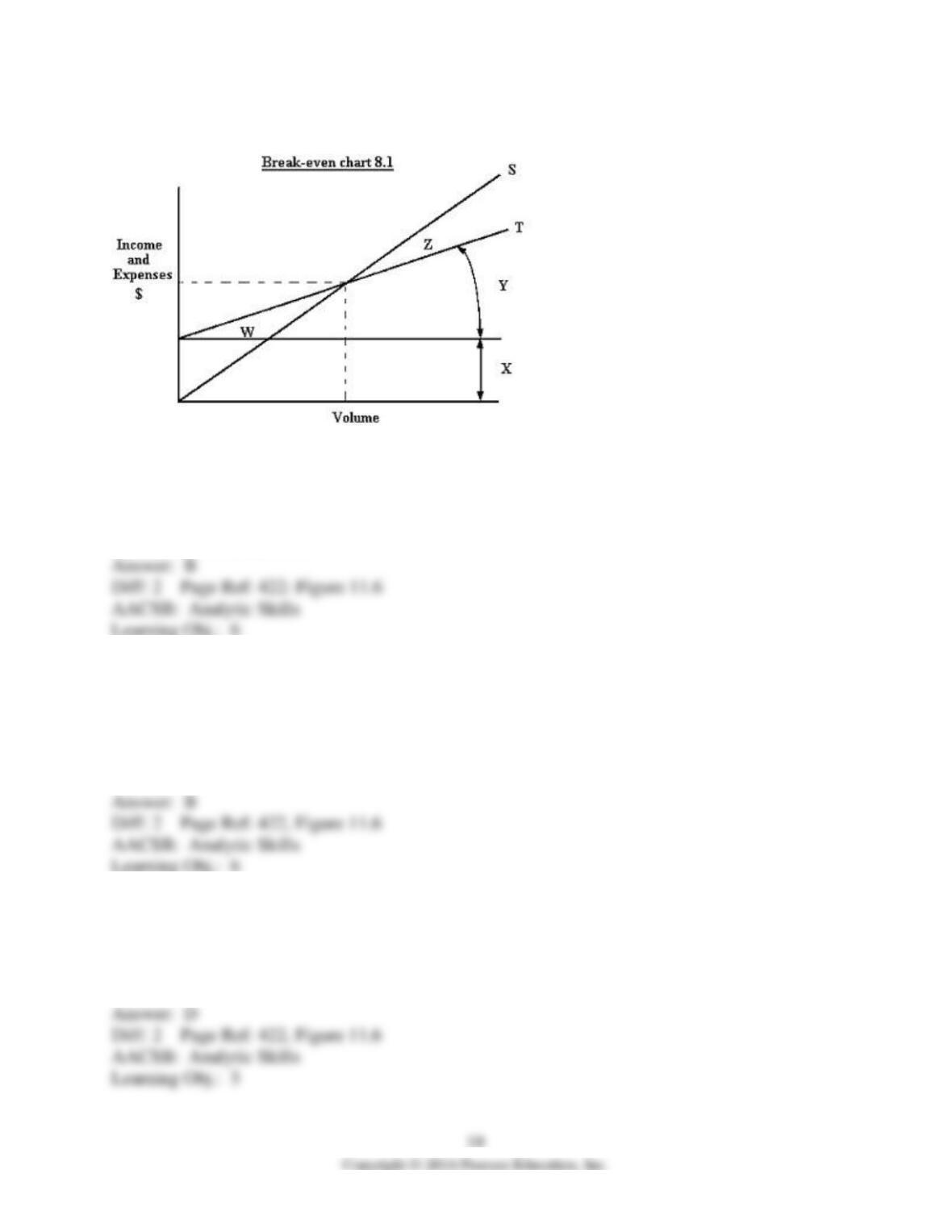
Refer to the following break-even Chart to answer the question(s) below:
65) Line T is the ________ line, while Line S is the ________ line.
A) total revenue; total expense
B) total expense; total revenue
C) fixed cost; variable cost
D) variable cost; fixed cost
66) The area labeled ________ represents the firm’s fixed expenses, while ________ represents
its variable expenses.
A) Z; W
B) X; Y
C) Y; X
D) W; Z
67) The area labeled ________ is the “profit area.”
A) W
B) X
C) Y
D) Z
68) The area labeled ________ is the “loss area.”
A) W
B) X
C) Y
D) Z
69) According to one study, 23 percent of small business owners lack financial literacy to
identify the cost that has the greatest impact on their companies.
70) The balance sheet provides owners with an estimate of the firm’s worth for a specific
moment in time, while the income statement presents a “moving picture” of its profitability over
a period of time.
71) Assets represent what a business owns, while liabilities represent the claims creditors have
against a company’s assets.
72) The income statement is based on the fundamental accounting equation:
Assets = Liabilities + Owner’s Equity.
73) On the income statement, the cost of goods sold represents the total cost, excluding shipping,
of the merchandise sold during the year.