11-1
Chapter 11
Long-Term Liabilities: Notes, Bonds, and Leases
MULTIPLE CHOICE QUESTIONS
1. Which one of the following will result from receiving cash upon issuing long-term debt?
a. Increase of the company’s indebtedness
b. Decrease of the current ratio
c. Increase of retained earnings
d. Increase of total shareholders’ equity
2. If the maximum debt/equity ratio as specified by a debt covenant is close to being
violated, which one of the following actions would increase the likelihood of violating the
debt covenant?
a. Issuing capital stock
b. Skip current cash dividends
c. Acquire money by issuing a non-interest-bearing note payable
d. Acquire money by collecting accounts receivable
3. If the maximum debt/equity ratio as specified by a debt covenant is close to being
violated, which of the following actions would help avoid a violation of the covenant?
a. Purchase long-term investments
b. Increase current cash dividends declared
c. Exchange bonds payable for common stock
d. Acquire money by selling land at its balance sheet value
4. The debt/equity ratio will increase if a company
a. pays off its long-term debt.
b. decides to pay cash for more of its capital purchases.
c. purchases long-term investments for cash.
d. declares more current cash dividends.
11-2 Test Bank – Chapter 11 – Long-Term Liabilities: Notes, Bonds, and Leases
5. A non-interest-bearing obligation
a. requires recognition of interest expense over the life of the obligation.
b. is an example of an installment obligation.
c. requires collateral.
d. is free of interest expense.
6. The difference in computing the effective interest rate for non-interest-bearing
obligations as compared to installment obligations is
a. one has an effective interest rate of zero, while the other is determined using present
value factors.
b. one uses the ‘present value of a single sum’ table and the other uses the ‘present
value of an ordinary annuity’ table.
c. one is based on the market rate of interest, while the other is based on a stated rate
of interest.
d. determined by the length of the debt maturity period.
7. Interest expense recognized over the life of an obligation is the difference between cash
received at the time of issuance and cash paid over the life of the obligation for
a. dividends declared.
b. convertible bonds.
c. non-interest-bearing obligations.
d. receivables due from customers.
8. Payments on an installment obligation typically include the payment of
a. principal only.
b. both principal and interest.
c. interest only.
d. interest, but only if collateral is involved.
9. Which one of the following is needed in order to find the present value of an obligation?
a. The discount rate of the associated cash flows
b. All debt covenants that are a component of the obligation
c. The gross profit rate of the borrower
d. The rate of inflation during the year
Test Bank – Chapter 11 – Long-Term Liabilities: Notes, Bonds, and Leases 11-3
10. How is interest expense calculated according to GAAP?
a. Stated rate of interest x maturity value.
b. Effective interest rate x maturity value.
c. Effective interest rate x book value.
d. Stated rate of interest x book value.
11. Interest expense calculated under GAAP is equal to the stated rate of interest times the
maturity value if the interest-bearing obligation is issued at
a. a discount.
b. either a discount or a premium.
c. a premium.
d. par.
12. If a company issues a non-interest-bearing note payable, then
a. no interest expense will be recognized over the life of the note.
b. no principal payments will be made over the life of the note.
c. no interest payments will be made over the life of the note.
d. the covenants should be rewritten to conform to GAAP.
13. If a company issues a non-interest-bearing note payable, then
a. the cash received will exceed the maturity value of the note.
b. the interest is not accrued.
c. the cash received will be less than the maturity value of the note.
d. the cash received will be more than the maturity value of the note.
14. If a company issues a note payable when the market rate of interest is greater than the
stated rate, then
a. the cash received will exceed the maturity value of the note.
b. the note will be issued at a discount.
c. the note will be issued at a premium.
d. the cash received will be equal to the maturity value of the note.
11-4 Test Bank – Chapter 11 – Long-Term Liabilities: Notes, Bonds, and Leases
15. If a company issues a note payable when the market rate of interest is less than the
stated rate, then
a. the note will be discounted at maturity.
b. the cash received will be equal to the maturity value of the note.
c. the cash received will exceed the maturity value of the note.
d. the note will be issued at a discount.
16. If a company issues a note payable when the market rate of interest is equal to the
stated rate, then
a. the cash received will exceed the maturity value of the note.
b. the note will be issued at a discount.
c. the note will be issued at a premium.
d. the note will be issued at par.
17. If an interest-bearing note payable is issued at par, then the contractual cash payment
for interest is
a. equal to interest expense.
b. less than interest expense.
c. greater than interest expense.
d. It cannot be determined from the information given.
18. If an interest-bearing note payable is issued at a discount, then the contractual cash
payment for interest is
a. less than interest expense.
b. greater than interest expense.
c. equal to interest expense.
d. ignored since no interest payment will be made.
19. If an interest-bearing note payable is issued at a premium, then the contractual cash
payment for interest is
a. greater than interest expense.
b. less than interest expense.
c. equal to interest expense.
d. based on the market rate of interest.
Test Bank – Chapter 11 – Long-Term Liabilities: Notes, Bonds, and Leases 11-5
20. If interest expense is greater than the contractual interest payment, then
a. the note was issued at par.
b. a debt covenant violation occurred.
c. the note was issued at a premium.
d. the note was issued at a discount.
21. If interest expense is less than the contractual interest payment, then
a. the note was issued at a premium.
b. the note was issued at a discount.
c. the note was issued at par.
d. the company should refinance the note to get a better interest rate.
22. If interest expense is equal to the contractual interest payment, then
a. the note was issued at a premium.
b. the note was issued at a discount.
c. the note was issued at par.
d. It cannot be determined from the information given.
23. A debt covenant
a. serves to give assurance to a creditor that the debtor will have the ability to pay
interest and principal at maturity.
b. serves to give assurance to the debtor that the interest rate is reasonable.
c. allows the creditor to become an owner of the company if the covenant is violated.
d. allows the debtor to forego any interest on the debt.
24. On January 1, a 6-year, $5,000, non-interest-bearing note payable was issued when the
market rate of interest was 8%. The present value of the note is
a. $3,151.
b. $2,080.
c. $865.
d. $5,000.
11-6 Test Bank – Chapter 11 – Long-Term Liabilities: Notes, Bonds, and Leases
25. On January 1, a 3-year, $8,000, non-interest-bearing note payable was issued when the
market rate of interest was 11%. To determine the amount at which the note will be
valued on the balance sheet on the issue date, use the
a. present value of $1 table.
b. future value of an annuity due table.
c. present value of an annuity table.
d. future value of an annuity table.
26. On January 1, a 7-year, $8,000, non-interest-bearing note payable was issued when the
market rate of interest was 7%. What amount should be recorded for the note on the
balance sheet at the issue date?
a. $3,570
b. $4,982
c. $11,241
d. $37,725
27. Companies generate assets in three different ways. They are
a. equity contributed by owners, borrowings, and receivables from affiliates.
b. equity issuances, borrowings, and interest rates.
c. borrowings, profitable operations, and equity issuances.
d. equity issuances, debt issuances, and financial instruments.
28. Which one of the following is not one of the three contractual kinds of notes?
a. Non-interest-bearing note
b. Interest-bearing notes
c. Installment notes
d. Bank notes
Test Bank – Chapter 11 – Long-Term Liabilities: Notes, Bonds, and Leases 11-7
29. Which type of note consists of periodic payments covering both interest and principal?
a. Interest-bearing bond
b. Receivable note
c. Non-interest-bearing note
d. Installment note
30. A provision of a contractual obligation that is designed to protect the interest of lenders is
called
a. a lenders’ security provision
b. a restrictive covenant.
c. a non-interest-bearing obligation.
d. collateral.
31. The actual interest rate used to calculate the interest payments by the issuer of the
obligation is
a. the market rate of interest.
b. the effective interest rate.
c. the stated interest rate.
d. equal to the actual interest expense rate.
32. A non-interest-bearing note was recorded in the accounting records. The book value of
the note
a. remains the same during the maturity period.
b. decreases during the maturity period.
c. increases throughout the maturity period.
d. is reported on income statement.
11-8 Test Bank – Chapter 11 – Long-Term Liabilities: Notes, Bonds, and Leases
33. A five-year, non-interest-bearing, $5,000 note, dated January 1, 2017, has a present
value of $3,917. The market rate of interest is 5%. Interest expense for the period ending
December 31, 2017, is
a. $392.
b. $196.
c. $250.
d. $217.
34. A coupon payment is
a. the payment of principal that is the ‘coupon’ of the total payments.
b. the amount of interest expense reported on the income statement.
c. calculated by multiplying the book value of the bonds times the effective rate of
interest.
d. the amount paid to bondholders on each interest payment date.
35. A call provision in a bond contract may specify that the issuing company
a. can issue the bonds at any interest rate it can entice the investors to accept.
b. must make periodic interest payments.
c. must deposit cash in the bank to be available when the bonds mature.
d. may buy back bonds from the investors.
36. Which one of the following bonds is considered unsecured?
a. $50,000, 8%, debenture bonds
b. $100,000, 12%, restricted bonds
c. $20,000, 10%, five-year callable bonds
d. $40,000, 6%, collateralized bonds
37. RJC Company issued $8,000 of 10% bonds on January 1, 2017. The bonds were issued
at a premium. The cash payment for annual interest on the bonds
a. is equal to annual interest expense.
b. is greater than annual interest expense.
c. is less than annual interest expense.
d. equals the balance in Premium on Bonds Payable on the day the bonds were issued.
Test Bank – Chapter 11 – Long-Term Liabilities: Notes, Bonds, and Leases 11-9
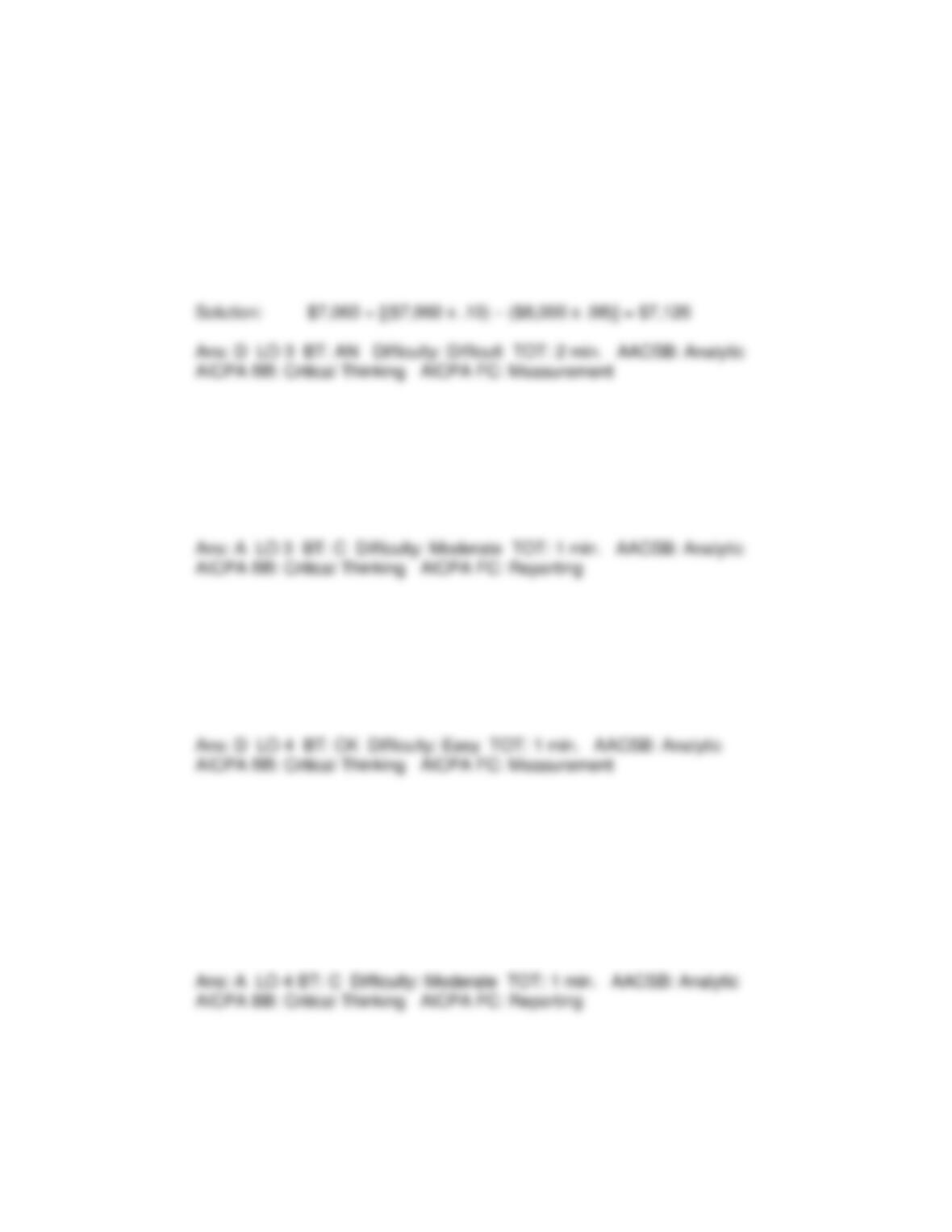
38. Darren Company issued $8,000 of 8% bonds on January 1, 2017, at a discount of $940.
The market rate of interest on the issue date was 10%. The carrying value of the bonds
on December 31, 2017 is
a. $6,994.
b. $7,060.
c. $8,940.
d. $7,126.
39. The amount of amortized bond premium
a. reduces interest expense on the income statement.
b. is reported as a deduction from bonds payable on the balance sheet.
c. is reported as an addition to bonds payable on the balance sheet.
d. is added to the present value of bonds.
40. Bonds payable that are redeemed by the issuer
a. typically pay far less interest than the market rate of interest.
b. are considered unsecured.
c. have no market value.
d. are repurchased or retired.
41. Financial instruments that are not listed on the balance sheet of a company
a. may involve significant risks that must be disclosed in the notes to the financial
statements.
b. are reported as assets if the company can determine the fair value.
c. must be reported as a liability on the balance sheet at the end of the accounting
period.
d. must be reported on the income statement.
11–10 Test Bank – Chapter 11 – Long-Term Liabilities: Notes, Bonds, and Leases
42. Which one of the following is not a financial instrument?
a. Commitments to pay dividends
b. Commitments to guarantee indebtedness of third parties
c. Commitments to provide financing to customers
d. Financial arrangements designed to reduce risks
43. Capital leases are rental agreements for which
a. periodic rental payments are recorded as rental revenue on the asset owner’s
income statement.
b. the contractual arrangements are similar to a purchase.
c. the period of the lease is generally a very small portion of the leased asset’s useful
life.
d. the lessee has legal ownership of the asset.
44. Woodsman Company issued $400,000 of 6-year, 6% bonds with interest payments
occurring annually at the end of each year. What additional information is needed in
order to determine the selling price of these bonds?
a. The face amount of the bonds
b. The bond covenants
c. The market rate of interest
d. The stated rate of interest
45. Gibson Corporation amortizes its bonds using the effective interest method. Which
statement is correct?
a. [Interest expense] = [Stated rate] X [Carrying value of the bonds]
b. [Interest expense] – [Cash interest paid] = [Increase in carrying value if sold at a
discount]
c. [Cash interest payment] = [Bond face amount] X [Market interest rate]
d. [Interest expense] – [Cash interest paid] = [Increase in carrying value if sold at a
premium]
Test Bank – Chapter 11 – Long-Term Liabilities: Notes, Bonds, and Leases 11-11
46. In a capital lease, GAAP requires the lessee
a. to record the lease on its balance sheet at the present value of future lease
payments.
b. to record rental revenue as each lease payment is received.
c. to not depreciate the leased asset.
d. to transfer ownership to the lessee.
47. Operating leases are treated as
a. increases in liabilities for both the lessor and the lessee.
b. a sale if the leased asset has been transferred from the lessor to the lessee.
c. capital leases by the lessee.
d. rental expense by the lessee.
48. Which one of the following is one of the capital lease criteria?
a. The lease term is 75% or more of the useful life of the leased property.
b. Ownership of the property is transferred back to lessor at the end of the lease term.
c. The present value of the lease payments equals or exceeds 75% of the FMV of the
property.
d. The lease does not contain a bargain purchase option.
49. Countries throughout the world typically
a. pay extremely large dividends to shareholders.
b. rely heavily on local stock and bond markets.
c. have less comprehensive accounting disclosure requirements than the U.S.
d. carry a normal debt/equity ratio that is less than 25%.
50. Investments in bonds are accounted for using
a. historical cost.
b. capital leases.
c. the effective interest method.
d. net realizable value.
11–12 Test Bank – Chapter 11 – Long-Term Liabilities: Notes, Bonds, and Leases
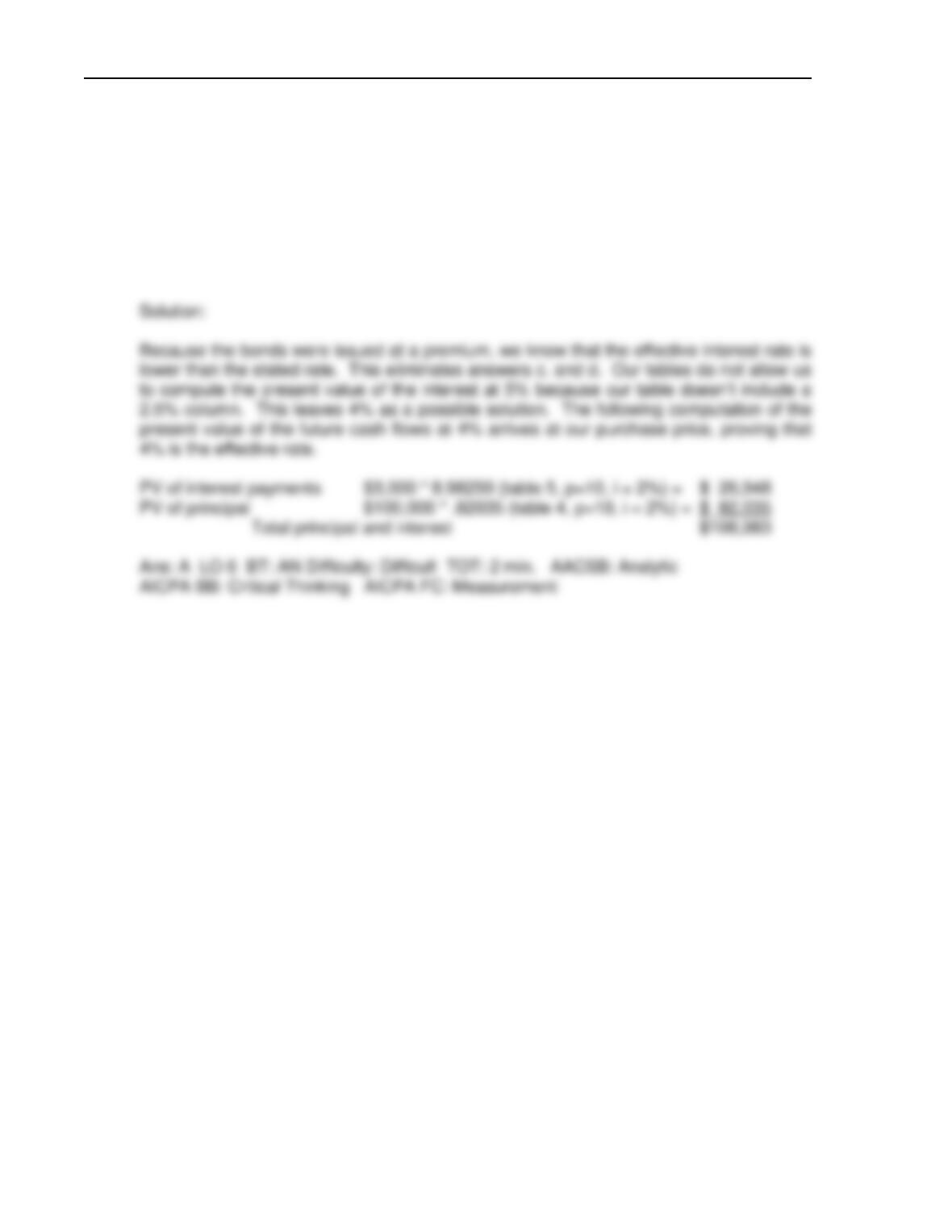
51. McCourt Investment Advisors purchased newly issued bonds on October 1, 2017,
paying $108,983. The bonds had a face value of $100,000, maturing on September 30,
2022, and pay interest semiannually on March 31 and September 30. The stated
interest rate is 6%. What is the effective interest rate?
a. 4%.
b. 5%.
c. 6%.
d. 7%.
Test Bank – Chapter 11 – Long-Term Liabilities: Notes, Bonds, and Leases 11-13
52. The following information was extracted from the financial records of Lewis Company.
2017
2016
Balance Sheet
Notes payable
$400,000
$400,000
Less: Discount on notes payable
24,000
28,800
Income Statement
Interest expense
$32,800
$32,400
Based on this information, what is the effective interest rate on the notes payable?
a. 8.2%
b. 8.8%
c. 6.0%
d. 2.2%
53. The following information was extracted from the financial records of Lewis Company.
2017
2016
Balance Sheet
Notes payable
$400,000
$400,000
Less: Discount on notes payable
24,000
28,800
Income Statement
Interest expense
$32,800
$32,400
Based on this information, the journal entry Lewis Company should prepare to record
interest expense during 2017 would include:
a. a credit to Interest Payable for $32,800.
b. a credit to Discount on Notes Payable for $24,000.
c. a credit to Cash for $28,000.
d. a credit to Notes Payable for $4,800.
11–14 Test Bank – Chapter 11 – Long-Term Liabilities: Notes, Bonds, and Leases
54. On September 10, 2016, Humbert Company issued bonds with a face value of $600,000
for a price of 96. During 2017, Humbert exercised a call provision and redeemed the
bonds for 101. At the time of the redemption, the bonds had a book value of $590,000.
The journal entry to record the redemption includes:
a. a credit to Bonds Payable for $576,000.
b. a debit to Loss on Bond Redemption for $16,000.
c. a credit to Discount on Bonds for $24,000.
d. a debit to Discount on Bonds Payable for $10,000.
55. On September 10, 2016, Humbert Company issued bonds with a face value of $600,000
for a price of 102. During 2017, Humbert exercised a call provision and redeemed the
bonds for 101. At the time of the redemption, the bonds had a book value of $607,000.
The journal entry to record the redemption includes:
a. a credit to Gain on Bond Redemption for $13,000.
b. a debit to Premium on Bonds for $7,000.
c. a credit to Discount on Bonds for $7,000.
d. a credit to Bonds Payable for $600,000.
Test Bank – Chapter 11 – Long-Term Liabilities: Notes, Bonds, and Leases 11-15
56. Brown Company is about to issue $300,000 of 8-year bonds paying a 12% interest rate
with interest payable semiannually. The effective interest rate for such securities is 10%.
Below are available time value of money factors.
8 periods,
10%
16 periods,
5%
8 periods,
12%
16 periods,
6%
Present Value of 1
0.46651
0.45811
0.40388
0.39365
Future Value of 1
2.14359
2.18287
2.47596
2.54035
Present Value of an Annuity of 1
5.33493
10.83777
4.96764
10.10590
Future Value of an Annuity of 1
11.43589
23.65749
12.29969
25.67253
To the closest dollar, how much can Brown expect to receive for the sale of these
bonds?
a. $319,339
b. $229,371
c. $332,513
d. $540,000
57. Stevens Company is about to issue $400,000 of 10-year bonds paying an 8% interest
rate with interest payable semiannually. The effective interest rate for such securities is
10%. Below are available time value of money factors that Stevens chooses from to
calculate compounded interest.
To the closest dollar, how much can Stevens expect to receive for the sale of these
bonds?
a. $350,151
b. $292,637
c. $800,000
d. $1,405,503
10 periods,
8%
20 periods,
4%
10 periods,
10%
20 periods,
5%
Present Value of 1
0.46319
0.45639
0.38554
0.37689
Future Value of 1
2.15892
2.19112
2.59374
2.65330
Present Value of an
Annuity of 1
6.71008
13.59033
6.14457
12.46221
Future Value of an
Annuity of 1
14.48656
29.77808
15.93743
33.06595
11–16 Test Bank – Chapter 11 – Long-Term Liabilities: Notes, Bonds, and Leases
58. Torrey Corporation issued $1,000,000 of ten-year, 10 percent bonds payable dated
January 1, 2016. The market rate of interest at that time was 11 percent. The journal
entry to record this transaction will include a:
a. debit to Discount on Bonds Payable.
b. credit to Premium on Bonds Payable.
c. credit to Discount on Bonds Payable.
d. credit to Cash.
59. Crosson Company uses the straight-line method of amortization and had a ten-year, 12
percent, $1,000,000 bond issue outstanding that had been sold at a $12,000 discount in
2015. The bonds pay interest on June 30 and December 31, and the company’s fiscal
year end is December 31. The journal entry on June 30, 2018, will include:
a. a $6,000 credit to Cash.
b. a $1,200 credit to Premium on Bonds Payable.
c. a $58,800 debit to Interest Expense
d. a $600 credit to Discount on Bonds Payable.
60. Duncan Industries sold $100,000 of 12 percent bonds on January 1, 2017, when the
market interest rate was 10 percent and received $107,732 for them. The bonds mature
on January 1, 2022 and pay interest on June 30 and December 31. Duncan uses the
effective interest method of amortization. The total annual cash payment for interest on
the bonds is:
a. $10,000
b. $12,000
c. $5,000
d. $6,000
Test Bank – Chapter 11 – Long-Term Liabilities: Notes, Bonds, and Leases 11-17
61. Duncan Industries sold $100,000 of 12 percent bonds on January 1, 2017, when the
market interest rate was 10 percent and received $107,732 for them. The bonds mature
on January 1, 2022 and pay interest on June 30 and December 31. Duncan uses the
effective interest method of amortization. The June 30, 2017 entry will include:
a. A $5,000 debit to Interest Expense.
b. A $5,386.60 debit to Interest Expense
c. A $5,000 credit to Cash
d. A $5,386.60 debit to Premium on Bonds Payable
Ans: B LO 3 BT: AN Difficulty: Difficult TOT: 2 min. AACSB: Analytic
AICPA BB: Critical Thinking AICPA FC: Reporting
62. Duncan Industries sold $100,000 of 12 percent bonds on January 1, 2017, when the
market interest rate was 10 percent and received $107,732 for them. The bonds mature
on January 1, 2022 and pay interest on June 30 and December 31. Duncan uses the
effective interest method of amortization. The interest expense for 2017 is:
a. $12,000
b. $10,000
c. $10,743
d. $ 9,246
63. Bowlin Company issued $1,000,000 of 9 percent, ten-year bonds for $937,790 on July 1,
2017, when the market rate of interest was 10 percent. The bonds mature in ten years
and pay interest on June 30 and December 31. Bowlin’s fiscal year ends on December
31 and the company uses the effective interest method of amortization. The interest
expense for the six months ending December 31, 2017 is:
a. $50,000.00
b. $45,000.00
c. $46,889.50
d. $93,779.00
11–18 Test Bank – Chapter 11 – Long-Term Liabilities: Notes, Bonds, and Leases
64. Bowlin Company issued $1,000,000 of 9 percent, ten-year bonds for $937,790 on July 1,
2017, when the market rate of interest was 10 percent. The bonds mature in ten years
and pay interest on June 30 and December 31. Bowlin’s fiscal year ends on December
31and the company uses the effective interest method of amortization. The book value
of the bonds on December 31, 2017 is:
a. $1,000,000.00
b. $ 944,011.00
c. $ 941,452.90
d. $ 939,679.50
65. Burns Company issued $1,000,000 of 9 percent, ten-year bonds for $937,790 on July 1,
2017, when the market rate of interest was 10 percent. The bonds mature in ten years
and pay interest on June 30 and December 31. Burn’s fiscal year ends on December 31
and the company uses the effective interest method of amortization. The journal entry
on December 31, 2017 will include:
a. a debit to Interest Expense for $45,000.00
b. a credit to Discount on Bonds Payable for $1,889.50
c. a credit to Interest Payable for $45,000.00
d. a credit to Cash for $46,973.95
66. Barkley Brothers Inc. shows the following information on its balance sheet for December
31, 2017.
Bonds payable
$100,000
Less Unamortized discount
5,350
$94,650
The bonds have a stated annual interest rate of 5 percent and will mature on December
31, 2019. The market value of the bonds as of December 31, 2017, is $98,167.
Assume that Barkley retired the bonds by purchasing them on the open market. The
journal entry to record this purchase would include:
a. a credit to Bonds Payable for $100,000.
b. a debit to Discount on Bonds Payable for $5,350.
c. a credit to Discount on Bonds Payable for $5,350.
d. a debit to Cash for $98,167.
Test Bank – Chapter 11 – Long-Term Liabilities: Notes, Bonds, and Leases 11-19
MATCHING QUESTIONS
1. Identify the balance sheet classification (a through e) in which each account description
numbered 1 through 7 would be reported. You may use each letter more than once or
not at all. You may assign more than one category to an account if it can be classified in
more than one category.
Balance Sheet Classifications
a. Current assets
b. Long-term assets
c. Current liabilities
d. Long-term liabilities
e. Not reported on the balance sheet
____1. Loss on bond redemption
____2. 1-year non-interest-bearing note receivable
____3. Discount on bonds that mature in 3 years
____4. 6-month note payable
____5. Premium on bonds issued that mature in 8 months
____6. Discount on notes payable due in 12 months
____7. Lease liability on a 5-year capital lease paid annually
11–20 Test Bank – Chapter 11 – Long-Term Liabilities: Notes, Bonds, and Leases
2. Identify the effect(s) as a result of each transaction listed as 1 through 4 below by
placing the letter of the effect on total liabilities and the effect on net income in the two
columns provided. Keep in mind that there are currently no accrued expenses recorded
on the balance sheet as liabilities.
Effects
I. Increase
D. Decrease
X. Does not change
Liabilities
Net Income
1. Acquired the use of equipment under a capital lease
2. A capital lease payment is paid (principal and interest)
3. Periodic interest and amortization of bond discount is
recognized
4. Paid interest on bonds issued at par