Exam
Name___________________________________
MULTIPLE CHOICE. Choose the one alternative that best completes the statement or answers the question.
1)
Why have several advertising agencies unbundled their media buying function?
1)
A)
They wanted to avoid client conflicts.
B)
They can aggregate the buying function across many different clients.
C)
They could become more of an expert in media buying if it was removed from the overall
agency structure.
D)
They were required to unbundled their media buying function by the FTC.
E)
They could better consolidate it with the media planning function.
2)
What concept refers to the production time needed to get the advertisement in to the medium?
2)
A)
just–in–time
B)
flow
C)
continuity
D)
lead time
E)
duration
3)
________ is the percentage of a medium’s audience that is exposed at least once to the advertiser’s
message during a specific time frame.
3)
A)
Frequency
B)
Continuity
C)
Cost per thousand
D)
Impression
E)
Reach
4)
Which calculation of efficiency is an estimate of the cost to expose 1,000 audience members?
4)
A)
cost per impression (CPI)
B)
cost per thousand (CPM)
C)
category development index (CDI)
D)
cost per point (CPP)
E)
brand development index (BDI)
5)
A policy of compensating advertisers for errors, such as missed positions or errors in handling the
message presentation, is known as ________.
5)
A)
recompensations
B)
make–goods
C)
remuneration
D)
make–ups
E)
up–fronts
B
6)
Which of the following is a function of a media buyer?
6)
A)
negotiate cost and make the media buy
B)
select the media vehicles
C)
provide information to media planners
D)
handle all billing and payment
E)
all of the above
E
B
7)
The period of time during which there is no advertising during a flighting schedule is known a(n)
________.
7)
A)
flight
B)
hiatus
C)
pulse
D)
down time
E)
carryover
8)
Which is a method of comparing media vehicles by relating the cost of the message to the audience
rating?
8)
A)
cost per point (CPP)
B)
category development index (CDI)
C)
cost per thousand (CPM)
D)
cost per prospect (CPP)
E)
brand development index (BDI)
A
9)
Which of the following sources of information provides information to the media planner
regarding targeted markets, previous promotions and their performance, product sales and
distribution patterns, brand plans, and the budget?
9)
A)
consumer information
B)
client information
C)
market research
D)
media information
E)
competitive advertising
B
B
Consider the following magazine media schedule:
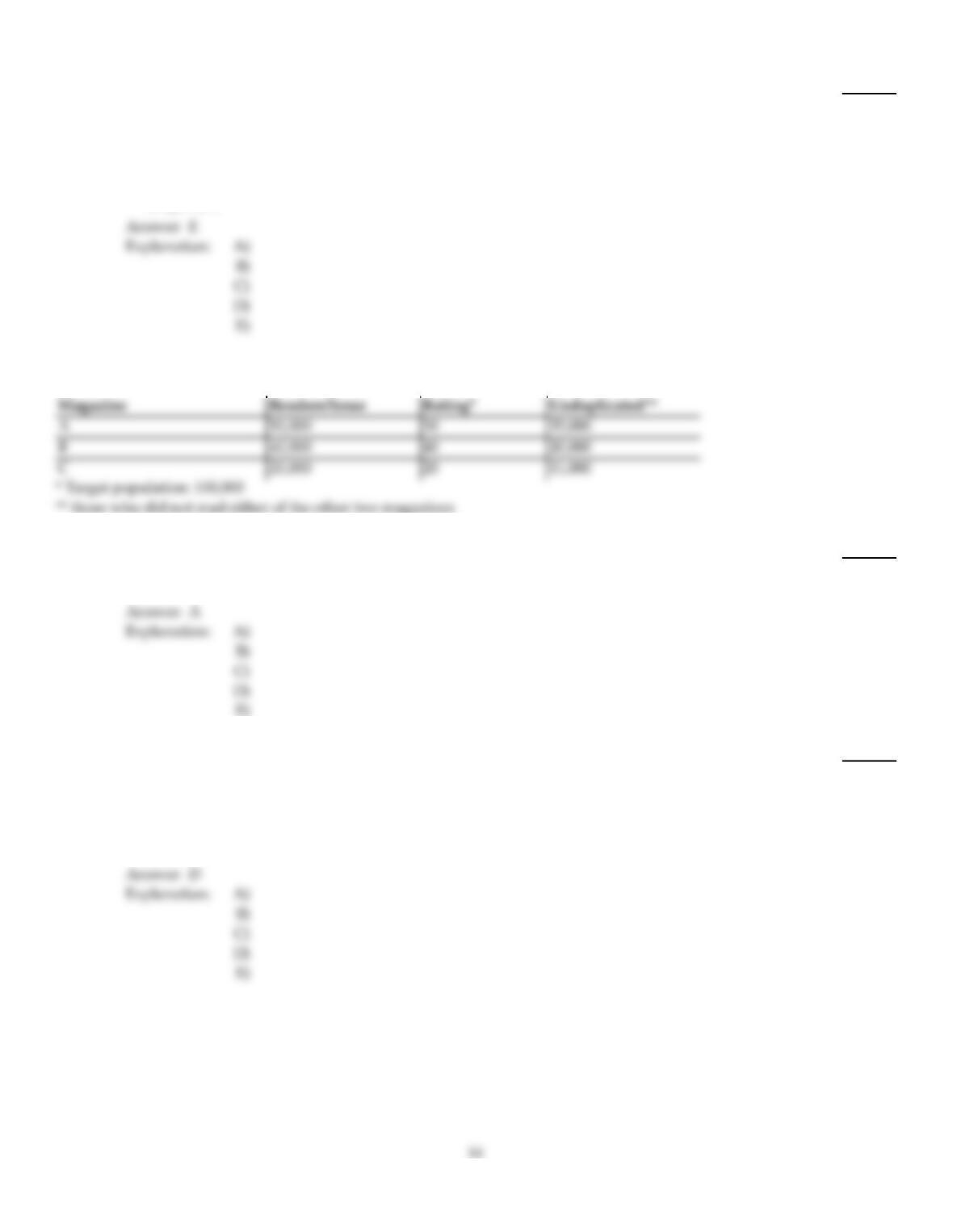
Magazine Readers/Issue Rating* Unduplicated**
A50,000 50 35,000
B40,000 40 20,000
C20,000 20 11,000
* Target population: 100,000
** those who did not read either of the other two magazines
10)
Mini–Case Question. What are the total gross rating points (GRPs)?
10)
A)
11,000,000
B)
36.7
C)
110
D)
166
E)
1.1
11)
What decision criterion designed to show the relative proportion of media activity in terms of any
number of factors, such as seasonality, geography, or audience segment, do media planners use to
help them decide how much to budget.
11)
A)
average frequency
B)
image transfer
C)
weighting
D)
effective frequency
E)
optimum frequency
12)
When it comes to timing with respect to scheduling strategies, what two critical questions must the
media planner consider?
12)
A)
CPM and CPP
B)
reach and frequency
C)
impressions and ratings
D)
flighting and pulsing
E)
duration and continuity
13)
What was the Big Idea for Audi‘s A3 hatchback advertising campaign that was described in the
chapter’s opening vignette?
13)
A)
at major golf tournaments, they displayed the cars
B)
the slogan “I’ve Got it Made” delivered through creative print ads and billboards
C)
a Web–based campaign of TV commercials
D)
the Web–based alternative reality game, “The Art of the Heist”
E)
a $500 gift for all referrals that resulted in sales
14)
What concept refers to the amount of time allowed before the beginning of the sales period to reach
people when they are just beginning to think about seasonal buying as well as to the production
time needed to get the advertisement into the medium?
14)
A)
duration
B)
just–in–time
C)
continuity
D)
flow
E)
lead time
15)
The newspaper in Panama City, Florida, The News Herald, charges national advertisers $45.00 per
column inch. On Sunday, which is the day most national advertisers would want to advertise, this
newspaper has a circulation of 70,000 households. Assuming only 40,000 are part of an advertiser’s
target audience, calculate CPM for one column inch.
15)
A)
$11.30
B)
$6.40
C)
$1.13
D)
$1,800
E)
$0.64
16)
Which of the following statements is true regarding cost per thousand (CPM) and/or cost per point
(CPP)?
16)
A)
CPM and CPP are both ways of measuring a target audience’s size against the cost of reaching
that audience based on calculations of efficiency.
B)
The efficiency calculations cannot be used to compare one medium to another.
C)
CPP is calculated by dividing the ad cost by the rating and then multiplying by 1,000.
D)
CPM is calculated by dividing the ad cost by the estimated audience reached.
E)
CPM is a measure of efficiency and CPP is a measure of effectiveness.
17)
Which media scheduling decision relates to factors such as seasonality, holidays, days of the week,
time of day, how often product is bought, whether it is used more in some months than in others,
the consumer’s best aperture, and competitors’ advertising schedules?
17)
A)
timing
B)
continuity
C)
duration
D)
reach
E)
frequency
18)
Based on the concept of aperture, what is the goal of media planning?
18)
A)
to get the broadest reach at the lowest cost
B)
to get the highest frequency at the lowest cost
C)
to get the broadest reach and highest frequency at the lowest cost
D)
to reach as many people as possible within the constraints of the media budget
E)
to reach the right people at the right time with the right message
19)
Which of the following is the key function of media buying?
19)
A)
negotiate cost and make the media buy
B)
handle all billing and payment
C)
provide information to media planners
D)
select the media vehicles
E)
monitor the media plan performance
20)
As Heather Beck described in “The Inside Story,” conference calls with counterparts on the client
side are about taking specifics about projects, sharing detailed feedback. These calls are essential in
________.
20)
A)
catching up
B)
creating sales promotion
C)
planning event sponsorship
D)
public relations
E)
tailoring the media plans
21)
Which of the following is NOT a critical element that media planners must consider in setting
specific media objectives?
21)
A)
cost per thousand
B)
impressions
C)
reach
D)
frequency
E)
All of the above are critical elements that media planners must consider in setting specific
media objectives.
22)
Which of the following is a source of information for a media planner?
22)
A)
market research
B)
competitive advertising
C)
consumer information
D)
client information
E)
all of the above
23)
What type of schedule is used in special regions or cities that need to be emphasized more than
others?
23)
A)
pulsing schedule
B)
flighting schedule
C)
heavy–up schedule
D)
frequency schedule
E)
continuous schedule
24)
Which of the following is NOT a source of information for a media planner?
24)
A)
consumer information
B)
competitive advertising
C)
market research
D)
client information
E)
All of the above are sources of information for media planners.
25)
With the current trend toward using other forms of marketing communication in addition to
advertising, buyers often demand additional promotional support, and these activities are
sometimes called ________.
25)
A)
value–added media services
B)
incentives
C)
preferred placements
D)
add–ons
E)
make–goods
26)
Which of the following groups of people are NOT involved in the development of an advertiser’s
media plan?
26)
A)
advertiser’s brand management group
B)
media buying companies
C)
advertiser’s operations staff
D)
agency’s media department
E)
agency’s account and creative teams
27)
What was the positioning of the two target markets for Dentsu’s new subcompact car introduced in
the “A Matter of Practice”?
27)
A)
“hanging out often” and “always and all ways forever”
B)
“hot car for hot guys” and “guy–magnet”
C)
“fun driving for grown men” and “a small, cute model for young women”
D)
“freedom in comfort” and “fun chic, fun car”
E)
“family safety matters” and “vacation away with me”
28)
Assessing the media for target audience opportunities is a major challenge for media planners, so
media planners have to consider the ________ of a specific media vehicle.
28)
A)
targeted frequency
B)
effective frequency
C)
targeted reach
D)
effective reach
E)
average frequency
29)
What is the distinguishing characteristic of Procter & Gamble’s media strategy that they call
communications planning and was described in the “Hands–On” case at the end of the chapter?
29)
A)
This approach maps out the entire media schedule on a media flowchart.
B)
This approach maps out the entire media schedule in the CrossTab format, which is consistent
with most consumer research.
C)
This approach puts the medium before the message.
D)
This approach includes the simultaneous production of the message and the media plan.
E)
This approach puts the message before the medium.
30)
What format is a standard research display format that allows multiple variables of related data to
be grouped together?
30)
A)
Multivariate
B)
Univariate
C)
CrossTab
D)
CrossRelate
E)
CrossIndex
C
31)
Jamie is a media planner for an advertising agency. The guiding principle he uses to determine a
client’s media plan is that advertising is most effective when it reaches the right people at the right
time with the right message. What concept is this principle based on?
31)
A)
touch point concept
B)
marketing concept
C)
aperture concept
D)
maximization concept
E)
contact point concept
C
C
32)
What is the most common format used to present the media allocation decisions?
32)
A)
flowchart
B)
scatter plot
C)
pie chart
D)
scree plot
E)
spreadsheet
33)
28th Avenue Wine & Spirits decided to start advertising their business, but they do not have a large
budget to devote to it. However, their sales are seasonal, with the highest sales occurring between
Thanksgiving and New Year’s. Because they would like to have a media presence all year round,
which continuity schedule would you recommend they follow to make the most of their budget?
33)
A)
pulsing strategy
B)
continuous strategy
C)
burst strategy
D)
flighting strategy
E)
heavy–up strategy
34)
What do media planners use to assist them in making intelligent decisions regarding the media mix
selection, given factors such as budget, timing, and so forth?
34)
A)
media matrix analysis
B)
computer simulations
C)
computer optimization modeling
D)
linear programming
E)
synergistic analysis
35)
In the Dentsu campaign that was described in “A Matter of Practice” ________ was used to select
the most effective contact points to achieve the communication goals and implement the optimum
integrated communication programs that eliminate waste.
35)
A)
WebContact Advertising
B)
ContactPoint Management
C)
ContactMail Management
D)
ContactSport Series
E)
Stay In Instant Touch Message Management
36)
Which of the following statements is TRUE regarding gross rating points (GRPs)?
36)
A)
There is no good rule of thumb regarding how many GRPs are enough.
B)
The calculation of GRPs takes into account duplication of exposure.
C)
An effective media plan should deliver at least 100 GRPs per week.
D)
The desired level of GRPs should remain constant among different markets.
E)
GRPs should not be used to compare the efficiency of different media schedules.
37)
One study assessed consumers’ regard for specific brands and related that score to the brand’s
advertising expenditures relative to competitors’ expenditures. The study found that all of the top
brands in a given product category also represented the largest percentage of total advertising
spending in a product category relative to competitors. What concept measures the percentage of
total advertising spending by one brand in a product category relative to the competition?
37)
A)
CrossTab assessment
B)
share of voice
C)
share of market
D)
marketing concept
E)
aperture concept
38)
A television advertisement for life insurance uses the song “Time” by Alan Parson’s Project and
shows a family sharing tender moments together. They also use the same song in their radio ads in
the hope that it will reinforce and re–create the message in the listener’s mind. Which concept best
describes this situation?
38)
A)
hard–sell advertising
B)
image transfer
C)
transformational advertising
D)
mental imagery
E)
soft–sell advertising
39)
When is NOT advisable to use radio in the media plan according to “Practical Tips” in the chapter?
39)
A)
you need to show the product
B)
you are a local business and want to reach a local market
C)
your audience aligns with certain types of music
D)
you want to build frequency
E)
you have a reminder message
Explanation:
40)
Which continuity schedule is designed to intensify advertising before an open aperture and then to
reduce advertising to much lower levels until the aperture opens again and has peaks and valleys,
also called bursts?
40)
A)
steady
B)
even
C)
continuous
D)
flighting
E)
pulsing
Explanation:
Explanation:
41)
Prospective customers for a product or service have one or more ideal times and places at which
they can be reached with an advertising message. This ideal point is called a(n) ________.
41)
A)
targeted reach
B)
impression
C)
contact point
D)
touch point
E)
aperture
Consider the following magazine media schedule:
42)
Mini–Case Question. If there were one insertion each week in all the magazines for a four week
period what would the total insertions be for the plan?
42)
A)
12
B)
36
C)
9
D)
30
E)
24
43)
Which two methods do media planners use to estimate the frequency of a schedule?
43)
A)
gross frequency and frequency distribution
B)
pulsing and flighting
C)
weighted frequency and weighted reach
D)
average frequency and frequency distribution
E)
average frequency and gross frequency
44)
Which of the following is NOT a reason most organizations need a variety of waysa media mix
to get their messages out to their customers?
44)
A)
Some people reject certain media.
B)
Different media have different strengths in terms of reach and frequency.
C)
They attempt to create a synergistic effect between the messages delivered in different media.
D)
Using a number of media distributes the message more widely because different media tend
to have different audience profiles.
E)
They would not be able to attain the desired level of reach and frequency if relying on just one
medium.
45)
To introduce the new luxury A3 hatchback to the market Audi chose a creative media mix centered
on an adver–game “The Art of the Heist.” What was Audi trying to accomplish as described in the
chapter’s opening vignette?
45)
A)
They were trying to reach the affluent, 24– to 30–year–old males who are hard to reach with
and skeptical of traditional advertising. and create buzz and excitement.
B)
They were bored with traditional luxury car introductions through expensive TV campaigns
and wanted to do something cool.
C)
They were trying to reach the affluent 50 + male who buys most of the luxury cars.
D)
They analyzed several target markets and determined that a broad media mix was required.
E)
They analyzed geographic trading data and allocated more exposure in regions where car
sales were lowest.
A
Explanation:
46)
Which continuity strategy is the most severe type of continuity adjustment and is characterized by
alternating periods of intense advertising activity and periods of no advertising (hiatus)?
46)
A)
flighting
B)
steady
C)
continuous
D)
even
E)
pulsing
A
Explanation:
E
Explanation:
Consider the following magazine media schedule:
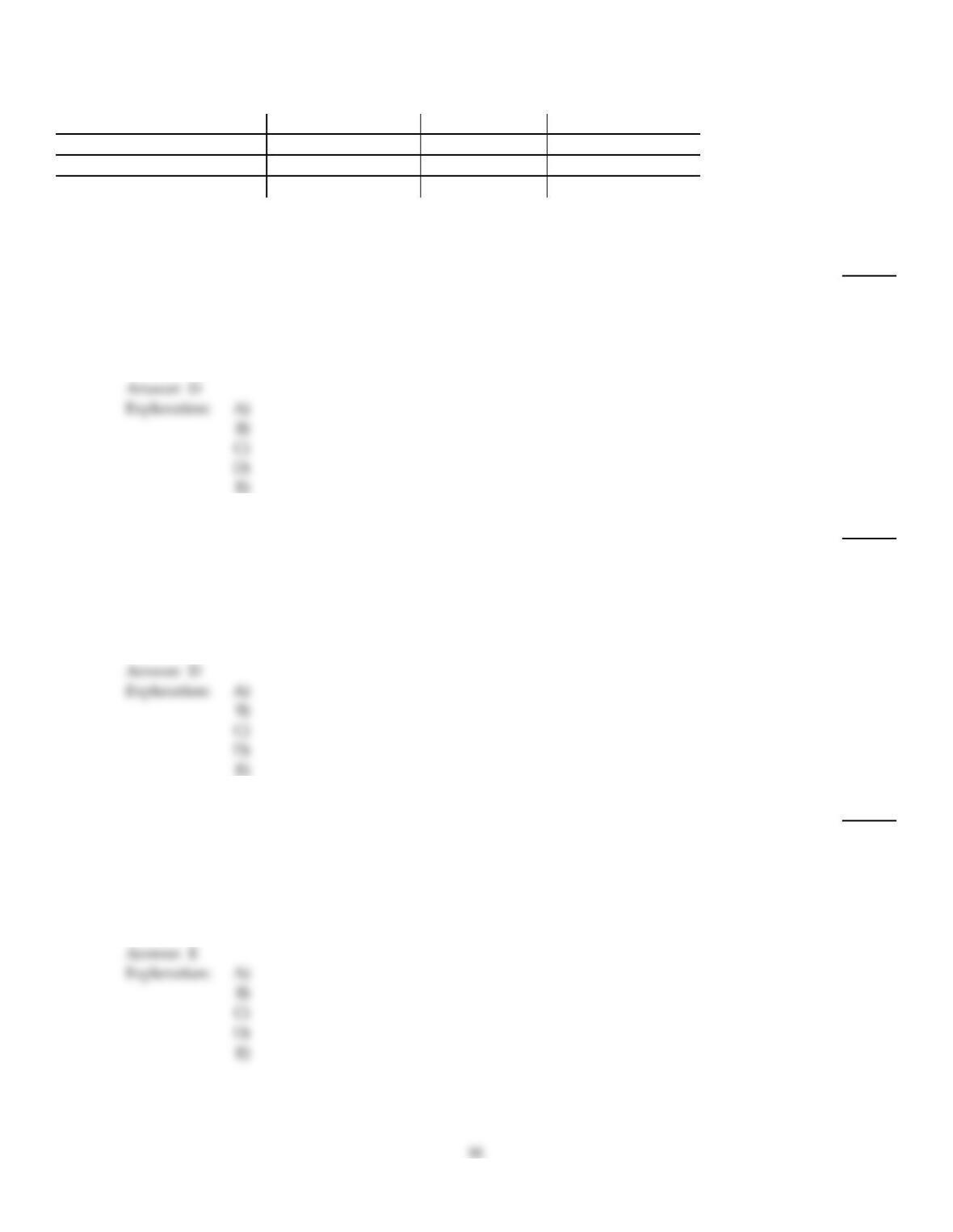
Magazine Readers/Issue Rating* Unduplicated**
A50,000 50 35,000
B40,000 40 20,000
C20,000 20 11,000
* Target population: 100,000
** those who did not read either of the other two magazines
47)
Mini–Case Question. What is the average frequency?
47)
A)
the number of the target audience exposed to the message
B)
the average of reach multiplied by two
C)
number of times a person in the target market is exposed to the message plus four
D)
the average of the number of times an exposure is expected to happen
E)
reach plus frequency
48)
The growth of media buying services as separate companies that specialize in media buying that
has shifted the way the media industry is organized is referred to as ________.
48)
A)
spinning media services
B)
detaching media services
C)
acquiring media services
D)
unbundling media services
E)
consolidating media service
49)
After the schedule has been worked out in terms of what media run when and for how long, these
decisions ________.
49)
A)
plotted on a scatter plot
B)
plotted on a scree plot
C)
are entered into a spreadsheet
D)
are written in a report to the client
E)
plotted on a media flow chart
50)
A(n) ________ is a point where a consumer has an opportunity to connect with a brand and
respond in some way to a brand message.
50)
A)
contact point
B)
impression point
C)
touch point
D)
aperture point
E)
rating point
51)
________ refers to the way the advertising is spread over the length of a campaign.
51)
A)
Flow
B)
Continuity
C)
Lead time
D)
Duration
E)
Just–in–time
52)
Which concept reflects the rate of exposure and measures the number of times the exposure is
expected to happen?
52)
A)
frequency
B)
continuity
C)
reach
D)
impression
E)
effective frequency
53)
Which is the first and most important media objective?
53)
A)
average frequency
B)
effective frequency
C)
continuity
D)
frequency
E)
reach
54)
Which of the following is NOT a media scheduling strategy media planners must consider?
54)
A)
duration of exposure
B)
cost per thousand
C)
continuity of exposure
D)
timing
E)
All of the above are media scheduling strategies media planners must consider.
55)
When is NOT advisable to use magazines in the media plan according to “Practical Tips” in the
chapter?
55)
A)
a high quality image is important
B)
you need to explain how something works
C)
you need to demonstrate the product
D)
you have a target market defined by some special interest
E)
you have a product that needs to be shown accurately and beautifully
56)
What is a general rule of thumb regarding the number of exposures needed for a message to sink
in?
56)
A)
three to ten
B)
more than five
C)
two to three
D)
one to two
E)
four to five
57)
On Wednesday nights, one TV hit commanded the highest advertising rates for the network TV
season, costing advertisers $658,333 per 30 seconds. During one Wednesday in April, the hit show
had almost 25 million viewers. Assuming all viewers represent an advertiser’s target audience,
calculate CPM.
57)
A)
$2.63
B)
$37.97
C)
$26.33
D)
$263.30
E)
$0.04
58)
Which of the following statements is false regarding average frequency and/or frequency
distribution?
58)
A)
Most planners prefer to use average frequency instead of frequency distribution.
B)
The frequency distribution method is more revealing than the average frequency method of
reporting repetition.
C)
Average frequency can give the planner a distorted idea of the plan’s performance.
D)
Media planners can also calculate the average frequency from the gross impressions and the
unduplicated impressions.
E)
To figure the average frequency, you need only two numbers: the gross rating points of a
schedule and the reach estimate.
19
Consider the following magazine media schedule:
Magazine Readers/Issue Rating* Unduplicated**
A50,000 50 35,000
B40,000 40 20,000
C20,000 20 11,000
* Target population: 100,000
** those who did not read either of the other two magazines
59)
Mini–Case Question. What is the reach?
59)
A)
110
B)
22
C)
66
D)
150
E)
176
60)
Which continuity schedule spreads the advertising evenly over the campaign?
60)
A)
continuous
B)
flighting
C)
even
D)
steady
E)
pulsing
A
Explanation:
61)
Which of the following is NOT a function of a media buyer?
61)
A)
negotiate cost and make the media buy
B)
provide information to media planners
C)
evaluate media choice after campaign
D)
handle all billing and payment
E)
All of the above are functions of a media buyer.
E
Explanation:
C
Explanation: