Exam
Name___________________________________
MULTIPLE CHOICE. Choose the one alternative that best completes the statement or answers the question.
1)
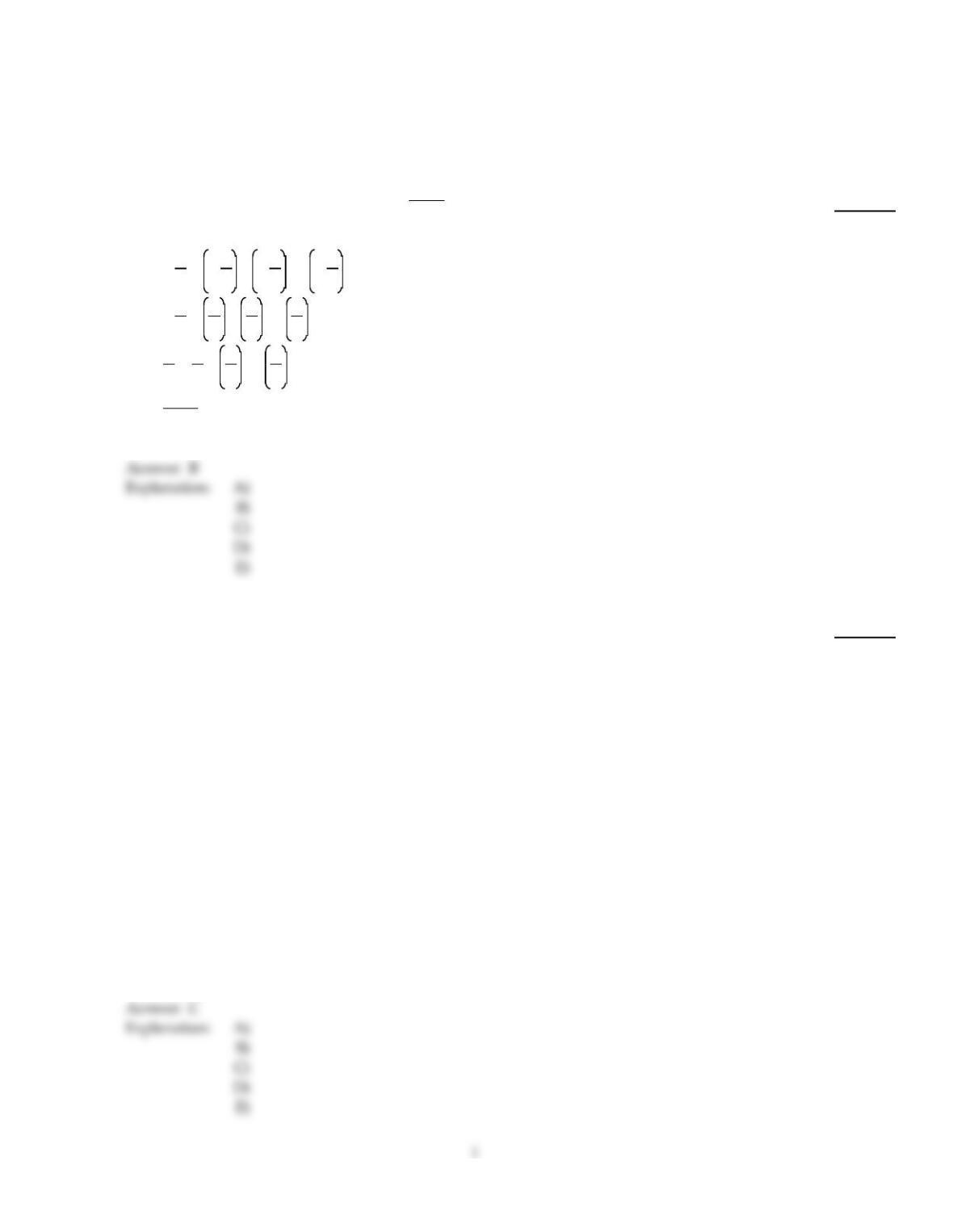
Find the Taylor series expansion for f(x) =x
1 – x and use it to determine which of the following is
false?
1)
A)
–1
3= – 1
2+ – 1
2
2
+ – 1
2
3
+ …
B)
–3
5=3
2+3
2
2
+3
2
3
+…
C)
1
2=1
3+1
3
2
+1
3
3
+ …
D)
x
1 – x = x +x2+x3+x4+…
E)
All the statements are true.
Solve the problem.
2)
A patient receives M milligrams of a certain drug every hour. Each hour the body eliminates a
fraction p of the amount of drug in the body. After an extended period of time, which of the
following series approximates the amount of drugs present in the patient’s body immediately
before receiving an hourly dose?
2)
A)
k = 1
Mpk
B)
k = 0
Mpk
C)
k = 1
M(1 – p)k
D)
k = 1
Mp–k
E)
k = 0
M(1– p)k

3)
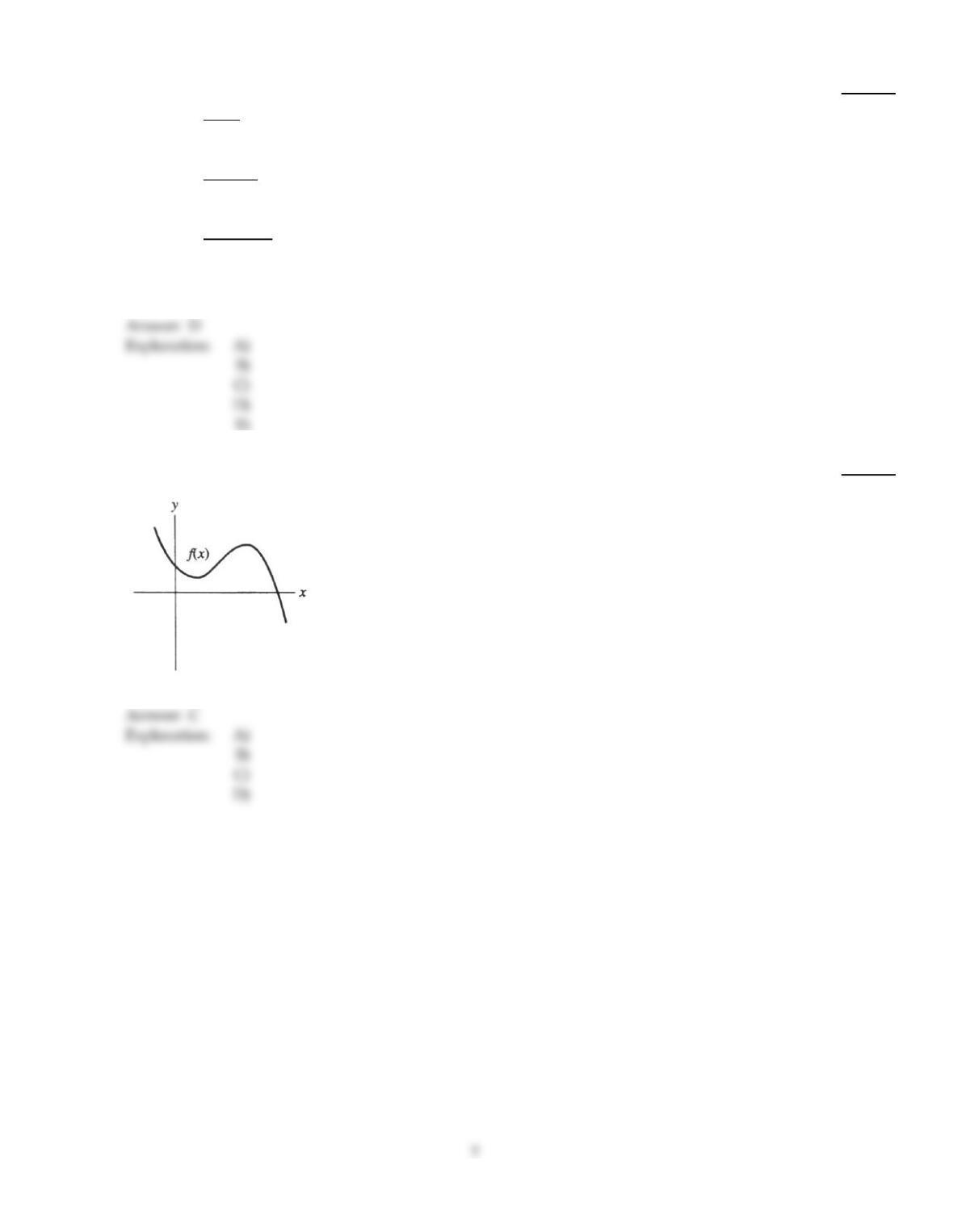
Below is a graph of the function f(x). Which of the following could be the first Taylor polynomial of
f(x) at x = 0 ?
3)
A)
p1(x) = – 2 + 2x
B)
p1(x) = – 2 – 3x
C)
p1(x) = 3 – 2x
D)
p1(x) = 3 + 4x
E)
none of these
4)
Which of the following series converge?
4)
A)
n = 1
en
nen+ 10
B)
n = 1
1
(ln n)3
C)
n = 1
e1/n
n
D)
all of these
E)
none of these
5)
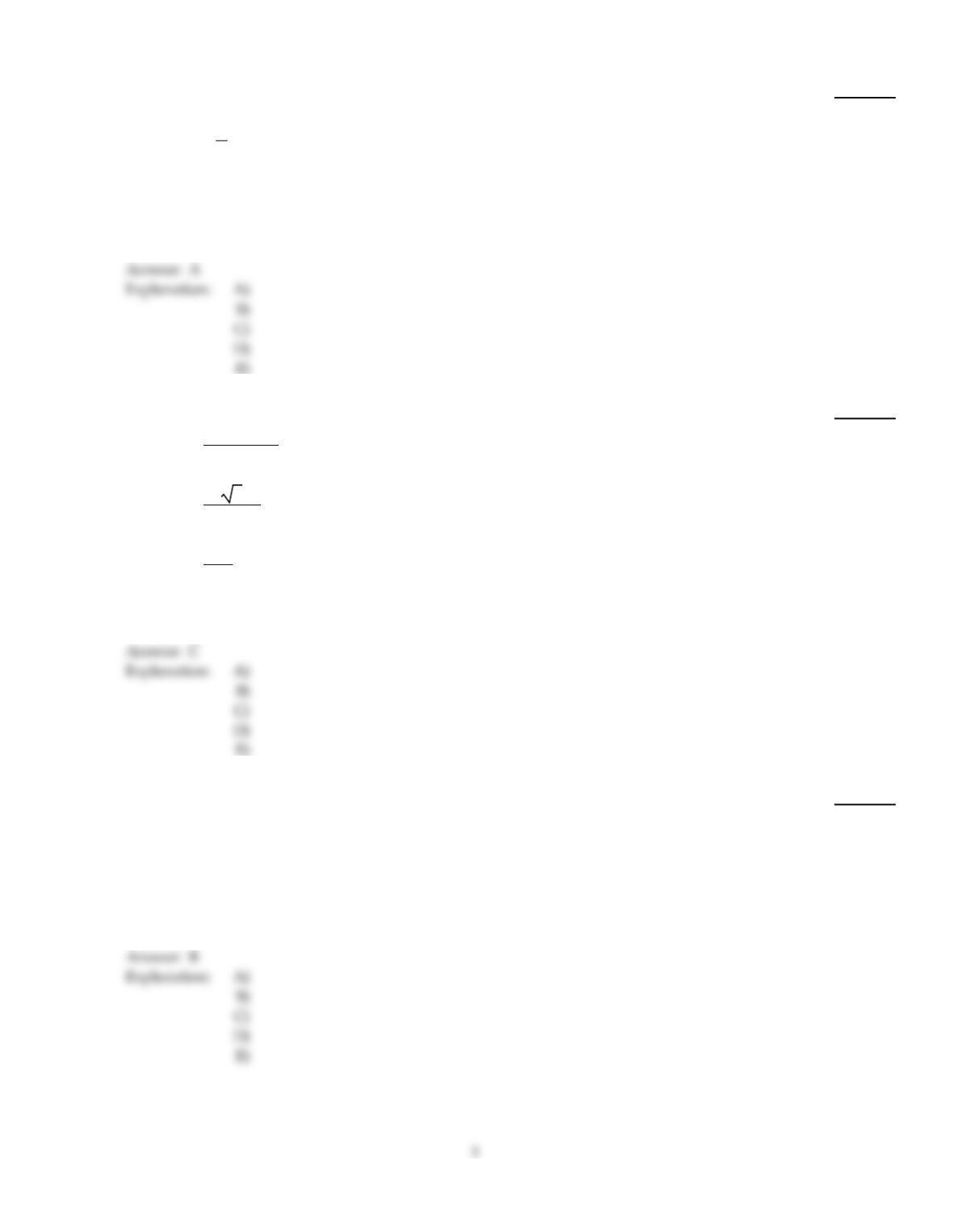
The function f(x) = sin x2 is approximated by its second Taylor polynomial p2(x) at x = 0. Which of
the following statements is NOT true?
5)
A)
p2(x) =1
3+x2
B)
p2(x) =x2
C)
f'(0) = 0
D)
f”(0) = 2
E)
none of these
6)
Which of the following series converge?
6)
A)
n = 1
n2
10n3+ 100
B)
n = 1
n
n3/2 + n
C)
n = 1
ln n
n2
D)
none of these
E)
all of these
7)
Let f(x) =x3– 4x – 1. Which of the following statements is true? (All Taylor polynomials are at x =
0.)
7)
A)
p1(3) = – 11
B)
pn= f(x) for all n 3
C)
p3(1) = 7
D)
p2(–1) = 0
E)
none of these
8)
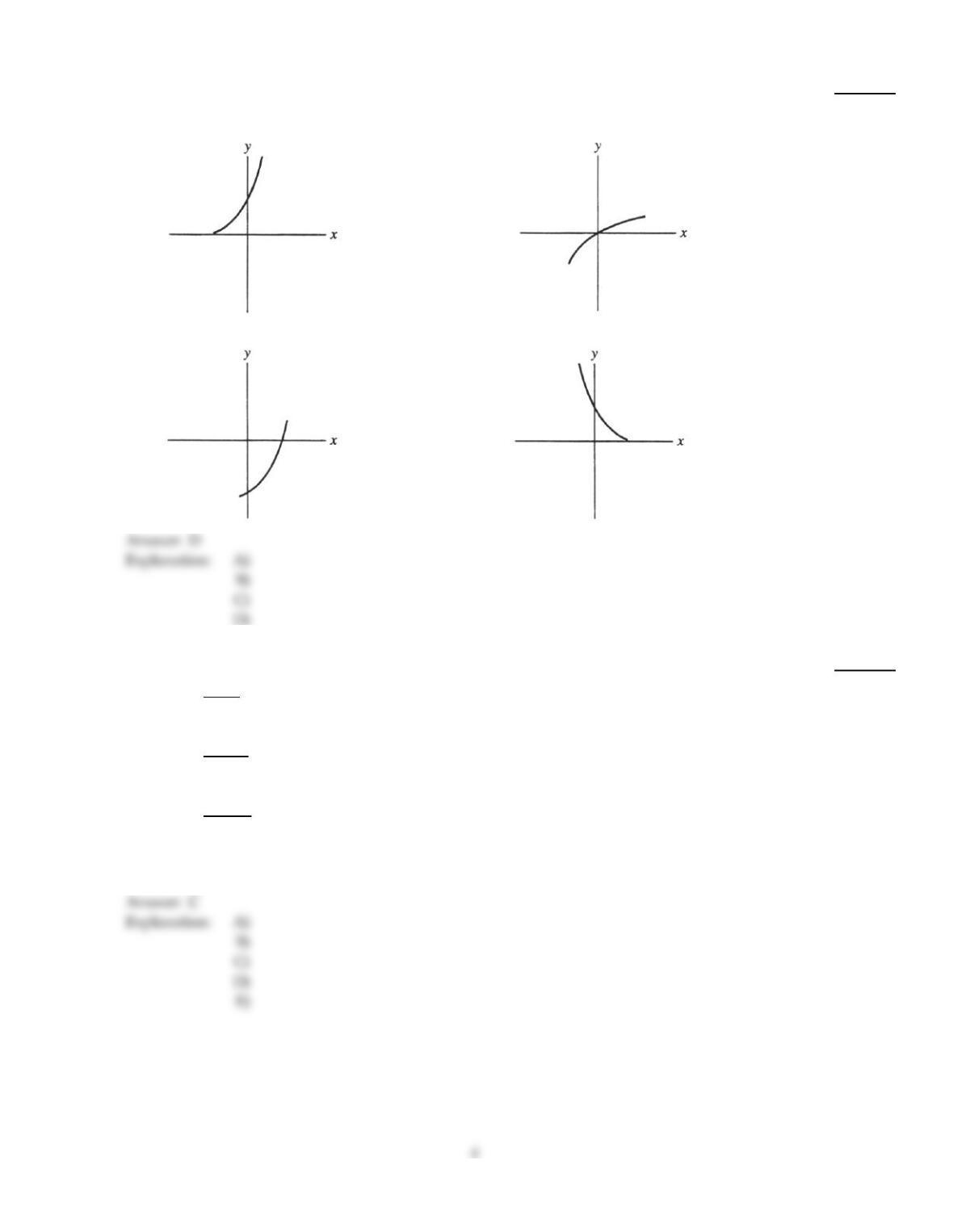
Suppose that the first Taylor polynomial of a function f(x) at x = 0 is p1(x) = 2 – 3x. Which of the
following could be a graph of f(x) ?
8)
A)
B)
C)
D)
9)
Which of the following series converge?
9)
A)
n = 1
n
n + 1
B)
n = 1
n
n2+ 1
C)
n = 1
n1/2
n2+ 1
D)
all of these
E)
none of these
10)
The Newton–Raphson algorithm is applied to estimate a zero of f(x) with x0= 3. Which of the
following statements is true?
10)
A)
x1= 3 +f'(3)
f(3)
B)
x1= 3 –f'(3)
f(3)
C)
x1=f'(3)
f(3)
D)
x1= 3 –f(3)
f'(3)
E)
none of these
11)
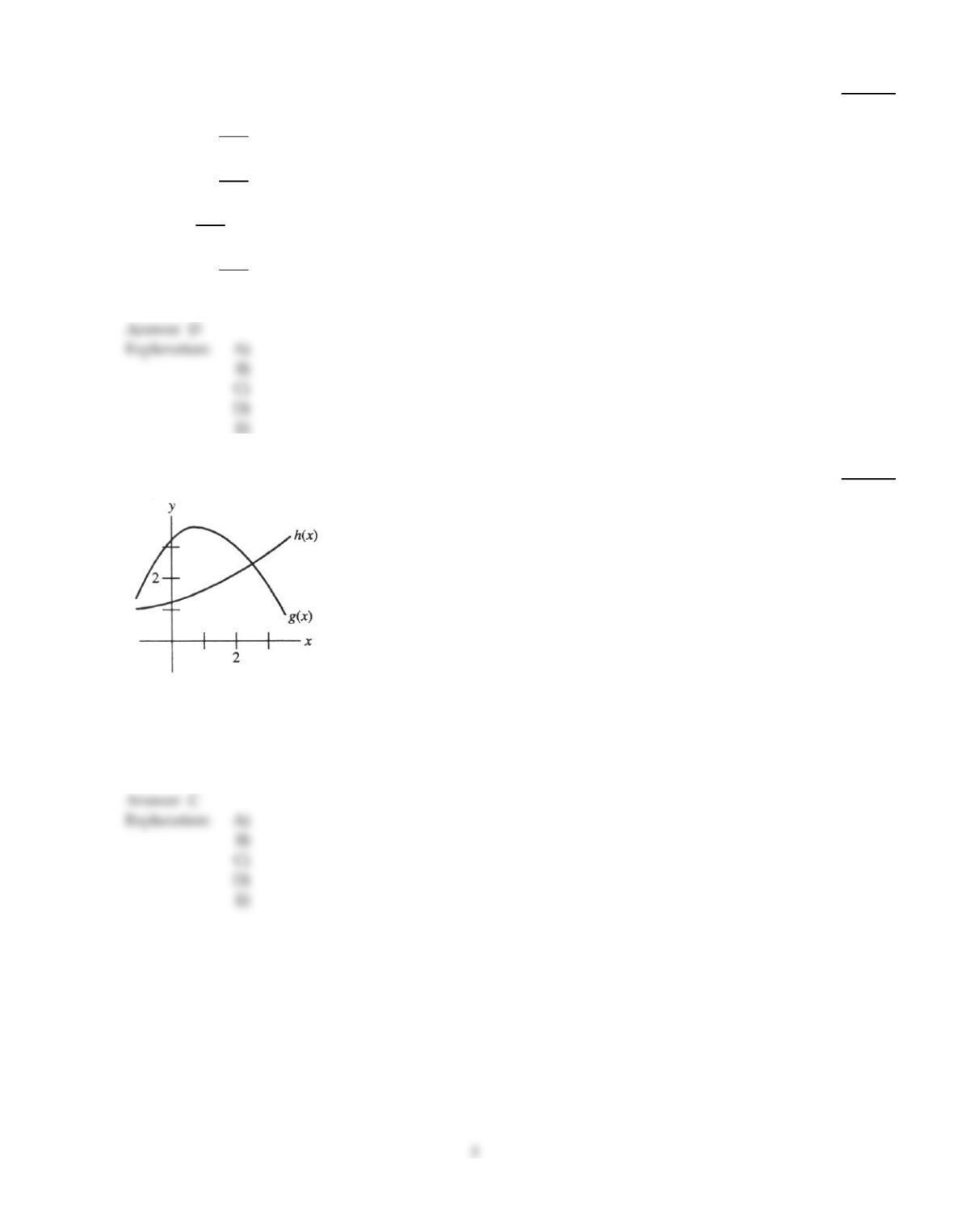
Below is a graph of the functions h(x) and g(x). In using the Newton–Raphson algorithm to find
where h(x) = g(x), which of the following statements is false?
11)
A)
x0= 4 could be used as the initial approximation.
B)
Use the Newton–Raphson algorithm to find the zeroes of f(x) = g(x) – h(x).
C)
Use the Newton–Raphson algorithm to find the zeroes of f(x) = h(x) + g(x).
D)
Use the Newton–Raphson algorithm to find the zeroes of f(x) = h(x) – g(x).
E)
x0= 3 could be used as the initial approximation.

12)
Suppose x0 is an initial approximation of a zero of the function f(x). Using the Newton–Raphson
algorithm, a second approximation, x1 is obtained. Which of the following must be true?
12)
A)
f(x1) = 0
B)
x1 is the x–coordinate of the x–intercept of the tangent line to f(x) at (x0, f(x0))
C)
x1=x0–
f'(x0)
f(x0)
D)
x1 is closer to the zero of f(x) than x0 .
E)
all of these
Solve the problem.
13)
Consider the following geometric series: 25
2–15
2+9
2–27
10 + … . Which of the following
statements is true?
13)
A)
The ratio r of this series is 3
5.
B)
The sum of this series is 125
4.
C)
Another way writing this series is
k = 1
–3
5
k
D)
This series diverges.
E)
none of these
14)
A polynomial f(x) of degree 3 for which f(1) = – 1, f'(1) = 2, f”(1) = – 1, and f”'(1) = – 2 is given by
14)
A)
f(x) =x3– 2x2– 3x + 2
B)
f(x) = – 1 + 2(x – 1) – 1(x – 1)2– 2(x – 1)2
C)
f(x) = – 1 + 2x –x2– 2x3
D)
f(x) = – 1 + 2(x – 1) –1
2(x – 1)2–1
3(x – 1)3
E)
none of these
15)
Which of the following series converge?
15)
A)
n = 1
sin n
n2
B)
n = 1
n
(1 + n)3
C)
n = 1
1
n2+ sin n
D)
all of these
E)
none of these
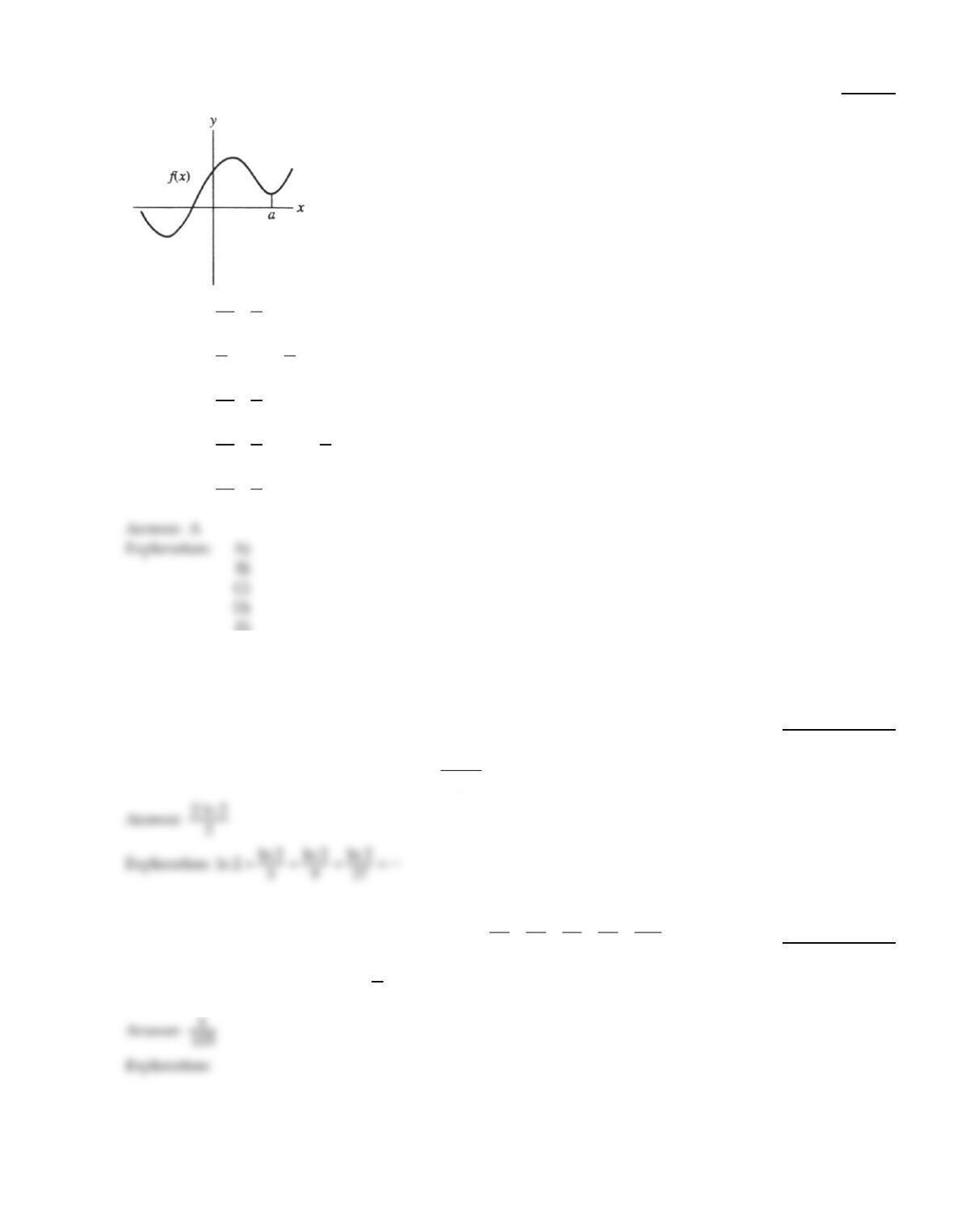
16)
If the following is a graph of f(x), which of the following could be the first Taylor polynomial of f at
x = 0?
16)
A)
p1(x) = 2x + 5
B)
p1(x) = 2x – 2
C)
p1(x) = 2 – 2x
D)
p1(x) = 2 + 2x
17)
Below is a graph of function f(x). Which of the following could be the second Taylor polynomial of
f(x) at x = a?
17)
A)
p2(x) =13
3+2
3(x – a)2
B)
p2(x) =5
3(x – a) –2
3(x – a)2
C)
p2(x) =13
3–2
3(x – a)2
D)
p2(x) =13
3–5
3(x – a) +2
3(x – a)2
E)
p2(x) =13
3+5
3(x – a)
E)
SHORT ANSWER. Write the word or phrase that best completes each statement or answers the question.
18)
Determine the sum of the infinite geometric series
k = 0
3–k ln 2.
Enter your answer exactly in the reduced form a ln b
c.
18)
19)
Determine the sum of the following geometric series: 22
53+24
55+26
57+28
59+210
511 + … .
Enter just a reduced fraction of form a
b.
19)
8
B)
Solve the problem.
20)
Suppose
k = 0
2
m
kconverges. What can you say about the value of m?
Enter your answer in standard interval notation (no variables).
20)
21)
Determine the sum of the following geometric series: 27
5+18
5+12
5+8
5+ … .
Enter a reduced fraction of form a
b.
21)
22)
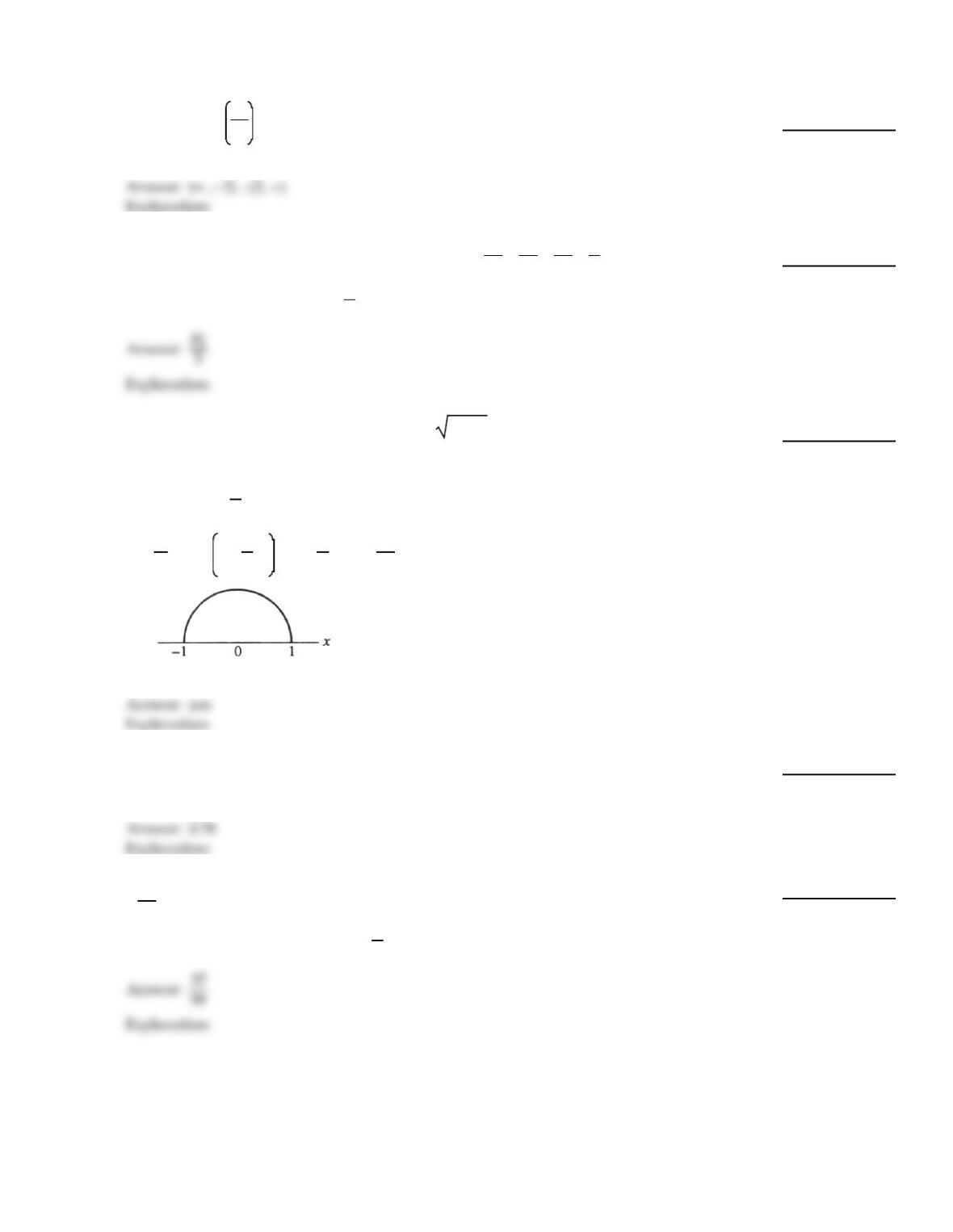
The area of a circle with radius 1 is . If f(x) =1 –x2 gives the top half of this circle, as
illustrated below, use the second Taylor polynomial of f(x) at x = 0 to find an approximate
value for . Is the following correct?
p2(x) = 1 –1
2x2;
2
1
–1
1 –1
2x2 dx =5
3 so 10
3
Enter “yes” or “no”.
22)
23)
Use two repetitions of the Newton–Raphson algorithm to approximate the zero of f(x) =
sin x – cos x near x = 0.
Enter just a real number rounded off to two decimal places.
23)
24)
Sum an appropriate infinite series to find the rational number whose decimal expansion is:
0.37.
Enter just a reduced fraction of form a
b.
24)
9
25)
Use the Newton–Raphson algorithm with three repetitions to approximate the zero of f(x)
=ex– 2 near x = 1.
Enter just a real number rounded off to two decimal places.
25)
26)
Find the first four non–zero terms of the Taylor series at x = 0 of f(x) = cos 3x + sin 2x.
Is 1 + 2x –9x2
2! –8x3
3! + … the correct answer?
Enter “yes” or “no”.
26)
27)
It can be shown that
0
xe–x dx = 1. Use this fact and the integral test to construct an
appropriate convergent infinite series. Is
k = 0
e–k the correct series?
Enter just “yes” or “no”.
27)
Solve the problem.
28)
A student receives $1000 at the start of each month from his parents. Every month the
student spends 70% of all the money he has. If the only money the student receives is the
money from his parents, estimate how much money the student will have at the beginning
of each month after an extended period of time.
Enter just a reduced fraction of form a
b.
28)
29)
Find the second Taylor polynomial of f(x) =x at x = 9 and use it to approximate 9.1.
Enter just a real number rounded off to two decimal places.
29)
30)
Determine the sum of the following infinite series:
n =1
2n+(–1)n
3n . Enter just a reduced
fraction of form a
b.
30)
31)
Determine the sum of the following geometric series: 1 +(0.25)2+(0.25)4+(0.25)8+ … .
Enter a reduced fraction of form a
b.
31)
32)
Use the comparison test to determine whether the infinite series
k = 1
k2
k +k2+k5/2 is
convergent or divergent.
Enter just “convergent” or “divergent”.
32)
33)
Use the Newton–Raphson algorithm with three repetitions to approximate the solution to
e–x= 2 – x near x = 2.
Enter just a real number rounded off to two decimal places.
33)
34)
Use two repetitions of the Newton–Raphson algorithm to approximate the value of x for
which ex= 3x. Use x = 0 as the first approximation.
Enter just a real number rounded off to two decimal places.
34)
35)
Determine the third Taylor polynomial of f(x) = ln(2 – x) at x = 1 and use it to estimate
ln(1.3).
[Hint: ln (1.3) = f(0.7).]
Enter your answer as an unlabeled polynomial in x – 1 in standard form (i.e., highest
powers first) followed by a comma and “yes” or “no” depending on whether or not the
following is the correct estimate of ln(1.3): ln(1.3) p3(0.7) = 0.264
35)
11
36)
Determine the third Taylor polynomial of f(x) =x3– 3x at x = 0.
Enter an unlabeled polynomial in x in standard form (i.e., highest powers first).
36)
37)
The Taylor series at x = 0 for f(x) = tan x is x +1
3x3+2
15 x5+17
315x7+ … . Find f(5)(0).
Enter just an integer.
37)
38)
Determine the sum of the following geometric series: 1 +1
2
+1
2+ … .
Enter your answer exactly in the form a
a– b .
38)
39)
Use two repetitions of the Newton–Raphson algorithm to approximate 15.
Enter just a real number rounded off to two decimal places.
39)
40)
Find the first four non–zero terms of the Taylor series at x = 0 of f(x) =e–2x.
Is f(x) = 1 + 2x +4x2
2! +8x3
3! correct?
Enter “yes” or “no”.
40)
41)
Sum an appropriate infinite series to find the rational number whose decimal expansion is:
0.498 .
Enter just a reduced fraction of form a
b.
41)
12
42)
Find the third Taylor polynomial of f(x) = cos x at x =
2.
Enter your answer as an unlabeled polynomial in x –
2 in standard form (i.e., highest
powers first).
42)
43)
Is this the graph of y =ex and are its first two Taylor polynomials at x = 0 on the same axis?
Enter “yes” or “no”.
43)
44)
Find an infinite series that converges to the value of
0
x2e–x3 dx. Is 1
3–1
6+1
18 –1
72 …
correct?
Enter “yes” or “no”.
44)
45)
Determine the sum of the following infinite series:
k = 0
(1 –2)k.
Enter your answer exactly in the reduced form a
b.
45)
46)
Estimate
1
0
ex2 dx by using the second Taylor polynomial for f(x) =ex2. Is
1
0
ex2 dx 4
3 the solution?
Enter “yes” or “no”.
46)
47)
Use the integral test to determine whether the infinite series
k = 1
1
(k + 2)2is convergent or
divergent?
Enter just the word “convergent” or “divergent“.
47)
48)
f(x) =x5+ x – 3 has a zero between 1 and 2 .
Use two repetitions of the Newton–Raphson algorithm to approximate this zero with
x0= 1.
Enter just a real number rounded off to two decimal places.
48)
49)
Use three repetitions of the Newton–Raphson algorithm to approximate 3. Let x0= 4.
Enter just a real number rounded off to two decimal places.
49)
50)
Determine the sum of the following geometric series: 2 +4
3+8
9+ … .
Enter just an integer.
50)
14
51)
Determine the sum of the following geometric series: 1 –1
23+1
26–1
29+1
212 – … .
Enter just a reduced fraction of form a
b.
51)
52)
Find the second Taylor polynomial of f(x) = sin x2 at x = 0 and use it to approximate the
area under the curve f(x) between 0 and
2.
Enter an unlabeled polynomial in x in standard form followed by a comma and then just a
quotient representing the area ( in the numerator).
52)
53)
Find the Taylor series expansion at x = 0 of 2xe–x dx. Is
x2+2
3x3+1
4x4+1
15 x5+ … + C correct?
Enter “yes” or “no”.
53)
54)
Determine the sum of the following infinite series:
n = 1
2n1
3
n – 1 .
Enter just an integer.
54)
55)
Use the comparison test to determine whether the infinite series
k = 1
1
2 +ek is convergent
or divergent.
Enter just “convergent” or “divergent”.
55)
56)
Find the Taylor series at x = 0 of f(x) =e3x by computing four derivatives and using the
definition of the Taylor series. Is 1 – 3x +32
2! x2–33
3! x3+34
4! x4– … the correct answer?
Enter “yes” or “no”.
56)
57)
Use two repetitions of the Newton–Raphson algorithm to find the value of x near zero for
which ex= 2 cos x.
Enter just a real number rounded off to two decimal places.
57)
58)
Determine the third Taylor polynomial of f(x) =x3– 2x + 4 at x = 1.
Enter an unlabeled polynomial in x – 1 in standard form (i.e., highest powers first).
58)
59)
Use the Newton–Raphson algorithm with three repetitions to approximate the zero of
f(x) = cos x + x – 2 near x = 3.
Enter just a real number rounded off to two decimal places.
59)
60)
Sum an appropriate infinite series to find the rational number whose decimal expansion is:
0.185185. Enter just a reduced fraction of form a
b.
60)
61)
Find the first four non–zero terms of the Taylor series at x = 0 of f(x) = ln(x + 1) .
Is f(x) = x +x2
2! +2x3
3! +6x4
4! correct?
Enter “yes” or “no”.
61)
16
62)
Determine the sum of the following infinite series:
k = 0
(–1)k2
7k .
Enter just a reduced fraction of form a
b.
62)
63)
Find the Taylor series of f(x) =1
1 + x for x< 1 then multiply the series by x to obtain a
series expansion of x
x + 1 , and then use these two series to obtain a series expansion of
1 – x
1 + x for x< 1.
Is 1 – x
1 + x = 1 + 2x + 2x2+2x3+2x4+ … the correct expansion?
Enter “yes” or “no”.
63)
64)
Find the first four non–zero terms of the Taylor series at x = 0 of f(x) =ex.
Is f(x) = 1 – x +x2
2! –x3
3! correct?
Enter “yes” or “no”.
64)
65)
Use the integral test to determine whether the infinite series
k = 1
1
k k is convergent or
divergent.
Enter just the word “divergent” or “convergent”.
65)
66)
Find an infinite series that converges to the value of
1
0
2xe–x dx. Is 1 –2
3+1
4–1
15 …
correct?
Enter “yes” or “no”.
66)
67)
Let x0= 2. Use three repetitions of the Newton–Raphson algorithm to approximate 35.
Enter just a real number rounded off to two decimal places (no label).
67)
68)
Use the integral test to determine whether the infinite series
k = 1
5k2+ 1
2k3– 1 is convergent or
divergent.
Enter just “convergent” or “divergent”.
68)
69)
Find the third Taylor polynomial of f(x) =ex at x = 0 and use it to approximate e.
Enter just a reduced fraction of form a
b.
69)
70)
Find the first four non–zero terms of the Taylor series at x = 0 of f(x) =4 – x .
Is f(x) = 2 –x
4–x2
32 · 2! –3x3
256 · 3! correct?
Enter “yes” or “no”.
70)
71)
Write down the fourth Taylor polynomial of f(x) =e–x2 at x = 0.
Enter your answer an an unlabeled polynomial in x in standard Taylor polynomial form
(i.e., constant first, highest power last ).
71)

72)
Determine the second Taylor polynomial of sin x2 at x = 0.
Enter an unlabeled polynomial in x in standard form (i.e., highest powers first).
72)
74)
Use the integral test to determine whether the infinite series
k = 1
k
(k2+2)2is convergent
or divergent.
Enter just “convergent” or “divergent”.
74)
75)
Use the integral test to determine whether the infinite series
k = 2
2
2k + 1 is convergent or
divergent. Then use the comparison test to determine whether the infinite series
k = 1
4
k + 1 is convergent or divergent.
Enter just two words which answer the two questions above in order (separated by a
comma) where each word is either “convergent” or “divergent”.
75)
76)
Use the Newton–Raphson algorithm with two repetitions to estimate the positive solution
of sin x =1
2x. Use x0= 2.
Enter just a real number rounded off to two decimal places.
76)
77)
If f(x) = 2 + 3x – 2x2+ 2x3, then what i f”'(0)?
Enter just an integer.
77)
19
73)
73)
78)
Find the third Taylor polynomial of f(x) = sin x at x = 0 and use it to approximate sin 1
2.
Enter just a real number rounded off to two decimal places.
78)
79)
Use the comparison test to determine whether the infinite series
k = 1
1
k+ 1 is
convergent or divergent.
Enter just “convergent” or “divergent”.
79)
80)
Find the Taylor series expansion at x = 0 of x
1 +x3 dx. Is
1
2x2+1
5x5+1
8x8+1
11 x11 … + C correct?
Enter “yes” or “no”.
80)
81)
Find the third Taylor polynomial of f(x) =x2+ sin x at x = 0.
Enter an unlabeled polynomial in x in standard form (i.e., highest powers first).
81)
82)
Find the first four non–zero terms of the Taylor series at x = 0 of f(x) = sin 2x.
Is f(x) = 2x –8x3
3! +32x5
5! –128x7
7! the correct answer?
Enter “yes” or “no”.
82)
83)
Use the comparison test to determine whether the infinite series
k = 1
1
k3+ k – 1 is
convergent or divergent.
Enter just “convergent” or “divergent”.
83)