
College Physics: A Strategic Approach, 3e (Knight)
Chapter 11 Using Energy
11.1 Conceptual Questions
1) Which two temperature changes are equivalent?
A) 1 K = 1 F°
B) 1 F° = 1 C°
C) 1 C° = 1 K
D) none of the above
2) The temperature in your classroom is closest to
A) 68 K.
B) 68°C.
C) 50°C.
D) 295 K.
3) A 10-L flask and a 1-L flask each contain two moles of ideal diatomic gas (but not the same
gas) at 25°C. Which of the following statements about these gases must be true? (There could be
more than one correct choice.)
A) The internal (thermal) energy of the gas in both flasks is the same.
B) The internal (thermal) energy of the gas in the larger flask is greater than the internal
(thermal) energy of the gas in the smaller flask.
C) The internal (thermal) energy of the gas in the smaller flask is greater than the internal
(thermal) energy of the gas in the larger flask.
D) The molecules in the larger flask have the same root-mean-square speed as those in the
smaller flask.
E) The molecules in the smaller flask have the same average kinetic energy per molecule as
those in the larger flask.
4) A certain gas is compressed adiabatically. The amount of work done on the gas is 800 J. What
is the change in the internal (thermal) energy of the gas?
A) 800 J
B) -800 J
C) 400 J
D) 0 J
E) More information is needed to answer this question.
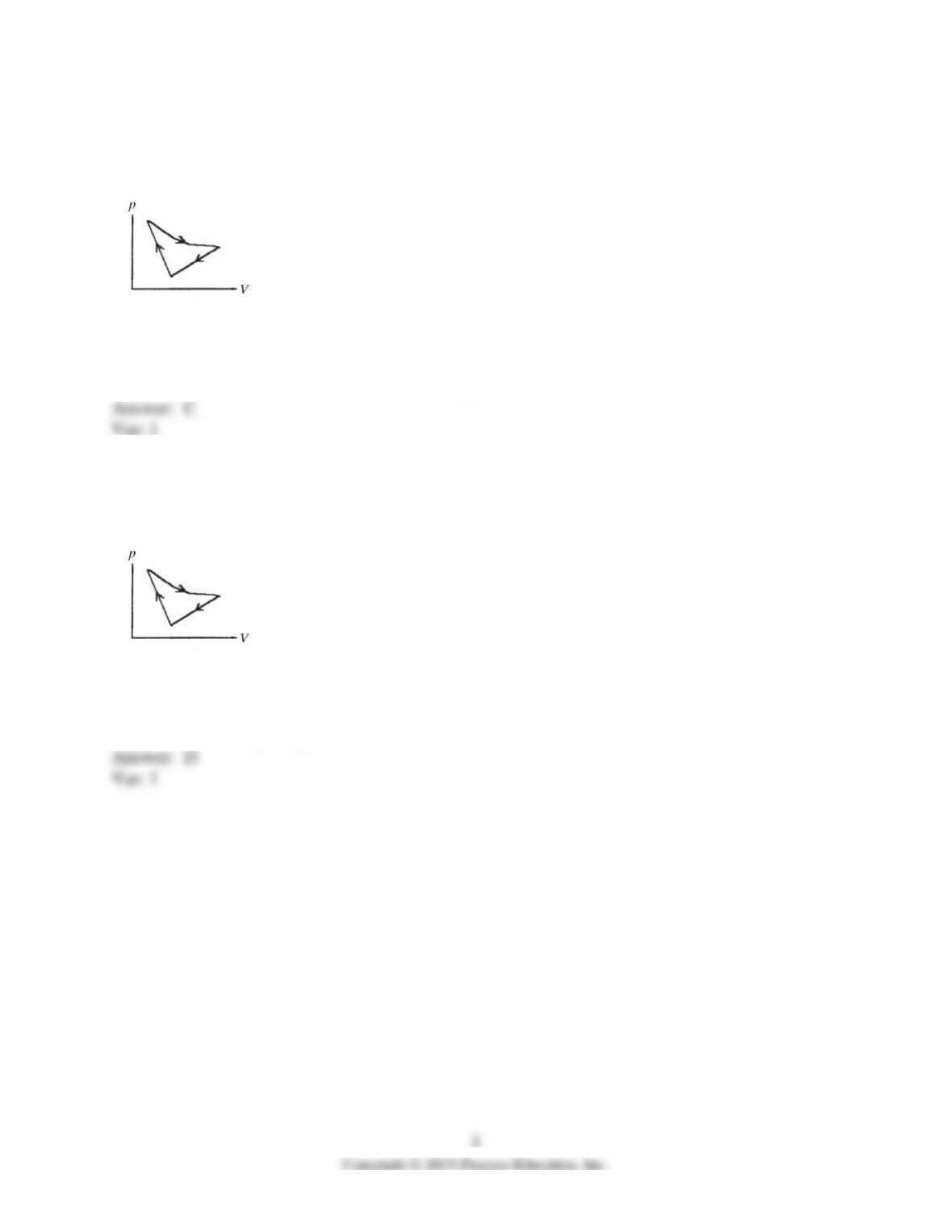
5) A cyclic process is carried out on an ideal gas such that it returns to its initial state at the end
of a cycle, as shown in the pV diagram in the figure. If the process is carried out in a clockwise
sense around the enclosed area, as shown on the figure, then the change of internal energy over
the full cycle
A) is positive.
B) is negative.
C) is zero.
D) cannot be determined from the information given.
6) A cyclic process is carried out on an ideal gas such that it returns to its initial state at the end
of a cycle, as shown in the pV diagram in the figure. If the process is carried out in a clockwise
sense around the enclosed area, as shown on the figure, then the magnitude of the enclosed area
represents
A) the heat that flows out of the gas.
B) the work done on the gas.
C) the heat added to the gas.
D) the work done by the gas.

7) A cyclic process is carried out on an ideal gas such that it returns to its initial state at the end
of a cycle, as shown in the pV diagram in the figure. If the process is carried out in a counter-
clockwise sense around the enclosed area, as shown on the figure, then the magnitude of the
enclosed area represents
A) the heat that flows out of the gas.
B) the work done on the gas.
C) the heat added to the gas.
D) the work done by the gas.
8) Which one of the following is a true statement?
A) The second law of thermodynamics is a consequence of the first law of thermodynamics.
B) It is possible for heat to flow spontaneously from a hot body to a cold one or from a cold one
to a hot one, depending on whether or not the process is reversible or irreversible.
C) It is not possible to convert work entirely into heat.
D) It is impossible to transfer heat from a cooler to a hotter body.
E) All of these statements are false.
9) The second law of thermodynamics leads us to conclude that
A) the total energy of the universe is constant.
B) disorder in the universe is increasing with the passage of time.
C) it is theoretically possible to convert heat into work with 100% efficiency.
D) the average temperature of the universe is increasing with the passage of time.
E) the entropy of the universe remains constant.
10) If the efficiency of a Carnot engine were to be 100%, the heat sink would have to be
A) at absolute zero.
B) at 0°C.
C) at 100°C.
D) infinitely hot.

11) A Carnot cycle consists of
A) two adiabats and two isobars.
B) two isobars and two isotherms.
C) four isotherms.
D) two adiabats and two isotherms.
E) four adiabats.
12) An important feature of the Carnot cycle is that
A) its efficiency can be 100%.
B) its efficiency depends only on the absolute temperature of the hot reservoir used.
C) its efficiency is determined by the temperatures of the hot and cold reservoirs between which
it works and by the properties of the working substance used, and on nothing else.
D) it is an example of an irreversible process that can be analyzed exactly without
approximations.
E) no engine can be more efficient than a Carnot engine operating between the same two
temperatures.
13) Which of the following is a false statement?
A) Entropy is a quantitative measure of disorder.
B) The total entropy change in one cycle of a Carnot engine is zero.
C) The entropy of an isolated system must be conserved (it remains constant).
D) Entropy can be measured in units of J/K.
14) An ideal gas undergoes an isothermal expansion. During this process, its entropy
A) decreases.
B) remains unchanged.
C) increases.
D) cannot be predicted from the data given.
15) When water at 0°C freezes, the entropy of the water
A) increases.
B) decreases.
C) remains constant.
D) could either increase or decrease; it depends on other factors.

11.2 Problems
1) Express a body temperature 98.6°F in Celsius degrees.
A) 37.0°C
B) 45.5°C
C) 66.6°C
D) 72.6°C
2) Express -40°C in °F.
A) -72°F
B) -54°F
C) -40°F
D) 4.4°F
3) The temperature changes from 35°F during the night to 75°F during the day. What is the
temperature change on the Celsius scale?
A) 72 C°
B) 40 C°
C) 32 C°
D) 22 C°
4) A temperature change of 20 C° corresponds to a Fahrenheit temperature change of
A) 68 F°.
B) 11 F°.
C) 36 F°.
D) 18 F°.
5) At what, if any, temperature are the numerical readings on the Fahrenheit and Celsius scales
the same?
A) -30°
B) -40°
C) -50°
D) -60°
E) They can never read the same because they are based on different zeroes.

6) Oxygen condenses into a liquid at approximately 90 K. What temperature, in degrees
Fahrenheit, does this correspond to?
A) -193°F
B) -217°F
C) -265°F
D) -297°F
7) What is absolute zero on the (a) Celsius scale and (b) on the Fahrenheit scale?
8) Nitrogen boils at -196°C. What is the corresponding temperature in the Fahrenheit scale?
A) -315°F
B) -196°F
C) -346°F
D) -290°F
E) -321°F
9) The weather outside is frightful. The temperature is -22°F. What is the corresponding
temperature in the Celsius scale?
A) -35°C
B) -30°C
C) -22°C
D) -20°C
E) -12°C
10) Platinum melts at 3215°F. What is the corresponding temperature in the Kelvin scale?
A) 2041 K
B) 2135 K
C) 2207 K
D) 2296 K
E) 3215 K

11) At room temperature, a typical person loses energy to the surroundings at the rate of 62 W. If
this energy loss has to be made up by an equivalent food intake, how many kilocalories (food
calories) does this person need to consume every day just to make up this heat loss? (1 cal =
4.186 J)
A) 1000 kcal
B) 1100 kcal
C) 1300 kcal
D) 1500 kcal
E) 1600 kcal
12) A person running in place on an exercise machine for 10 min uses up 17 kcal (food calories).
Another person exercises by repeatedly lifting two 2.5-kg weights a distance of 50 cm. How
many repetitions of this exercise are equivalent to 10 minutes of running in place? Assume that
the person uses negligible energy in letting down the weights after each lift. (1 cal = 4.186 J)
A) 730
B) 1450
C) 1500
D) 2200
E) 2900
13) A person consumes a snack containing 14 food calories (14 kcal). What is the power this
food produces if it is to be “burned off” due to exercise in 6 hours? (1 cal = 4.186 J)
A) 2.7 W
B) 9763 W
C) 0.6 W
D) 0.0027 W
14) A monatomic ideal gas undergoes an isothermal expansion at 300 K, as the volume increased
from to The final pressure is What is the change in the internal
(thermal) energy of the gas during this process? (R = 8.31 J/mol ∙ K)
A) 0.0 kJ
B) 3.6 kJ
C) 7.2 kJ
D) -3.6 kJ
E) -7.2 kJ
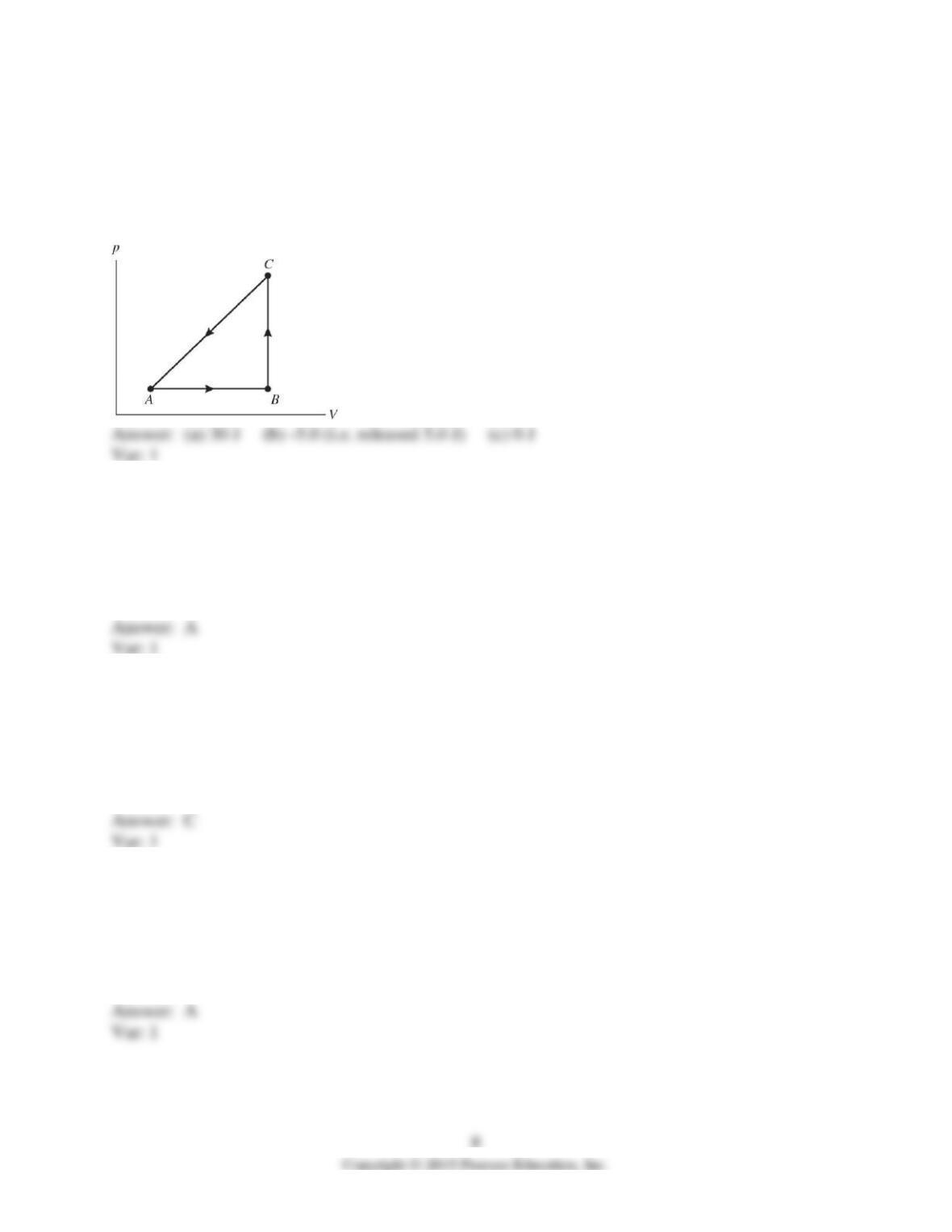
15) The figure shows a pV diagram for a gas going through a cycle from A to B to C and back to
A. From point A to point B, the gas absorbs 50 J of heat and finds its internal (thermal) energy
has increased by 20 J. Going from B to C, the internal (thermal) energy decreases by 5.0 J.
(a) How much work was done by the gas from A to B?
(b) How much heat was absorbed by the gas from B to C?
(c) How much work was done by the gas going from B to C?
16) During an isothermal process, 5.0 J of heat is removed from an ideal gas. What is the change
in internal (thermal) energy of the gas?
A) 0 J
B) 2.5 J
C) 5.0 J
D) 10 J
17) During an isothermal process, 5.0 J of heat is removed from an ideal gas. What is the work
done by the gas in the process?
A) 0 J
B) 5.0 J
C) -5.0 J
D) -10 J
18) The work done on an ideal gas system in an isothermal process is -400 J. What is the change
in internal (thermal) energy of the gas?
A) 0 J
B) -400 J
C) 400 J
D) 200 J

19) In an adiabatic compression, 200 J of work is done on a gas. What is the change in internal
(thermal) energy of the gas during this compression?
A) 0 J
B) 100 J
C) 200 J
D) -200 J
20) An ideal gas undergoes an adiabatic process while doing 25 J of work. What is the change in
the internal (thermal) energy of the gas?
A) 0 J
B) 25 J
C) -25 J
D) 50 J
E) -50 J
21) In an isochoric process, the internal (thermal) energy of a gas decreases by 50 J. How much
work is done by the gas during this process?
A) 0 J
B) 50 J
C) -50 J
D) 25 J
E) -25 J
22) During an isochoric process, the internal (thermal) energy of a gas decreases by 50 J. How
much heat is added to the gas during this process?
A) 0 J
B) 50 J
C) -50 J
D) 25 J
E) -25 J

23) A fixed amount of an ideal monatomic gas is maintained at constant volume as it is cooled
by 50 K. This feat is accomplished by removing 400 J of energy from the gas. How much work
is done by the gas during this process?
A) 0 J
B) 400 J
C) -400 J
D) -200 J
E) 200 J
24) An external heat source supplies heat to a system at a rate of 187 W as the system does work
at a rate of 131 W. At what rate is the internal (thermal) energy of the system changing?
A) -56 W
B) 320 W
C) 56 W
D) 190 W
E) -320 W
25) The gas in a perfectly insulated but flexible container does work at a rate of At what
rate is the internal (thermal) energy of the gas changing?
A) -13 W
B) 13 W
C) 0 W
D) 6.5 W
26) A fluid in an insulated, flexible bottle is heated by a high resistance wire and expands. If
of heat is applied to the system and it does of work, how much does the internal
(thermal) energy of the fluid change?
A) 4.0 kJ
B) 14 kJ
C) -4.0 kJ
D) 45 kJ
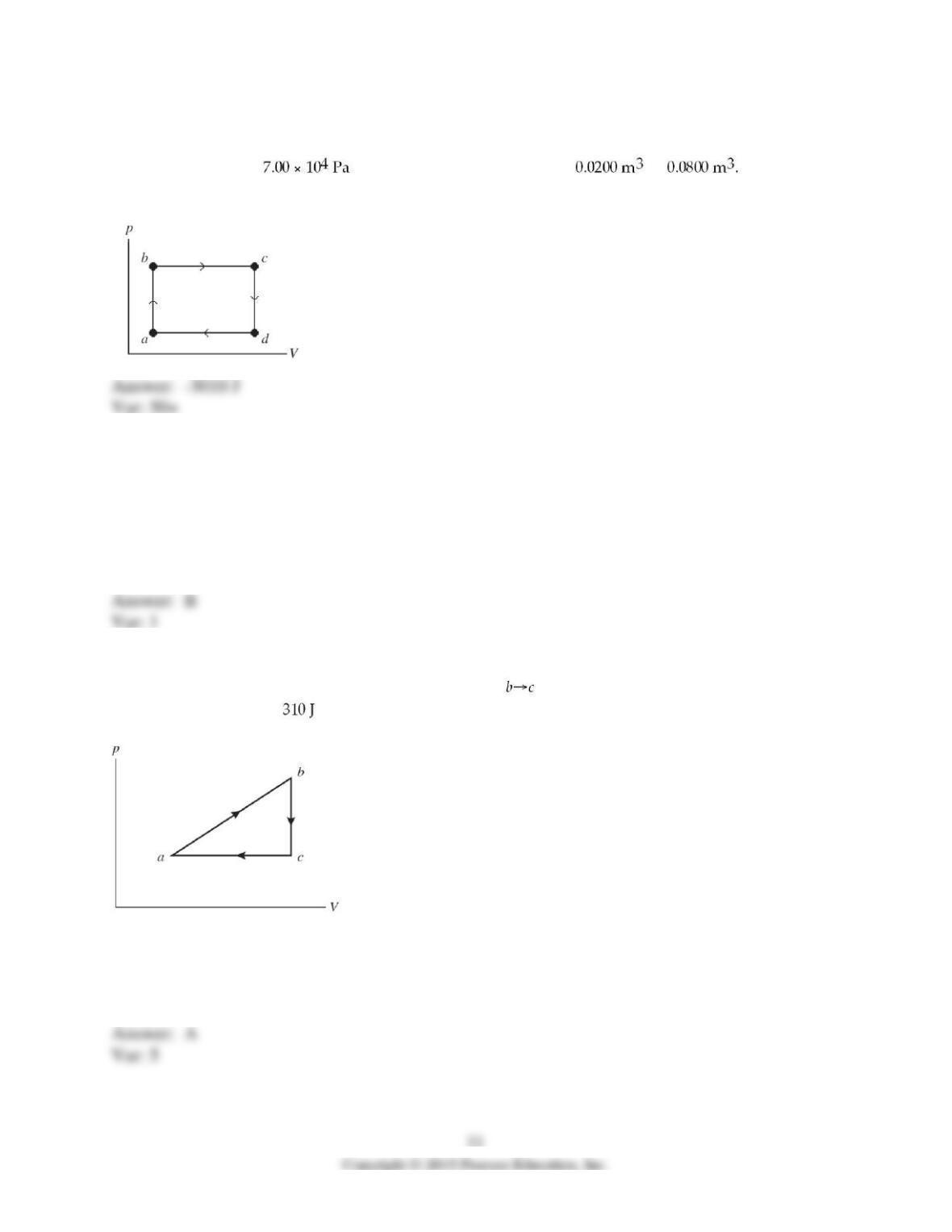
27) The figure shows a pV diagram of a gas for a complete cycle. During part bc of the cycle,
1190 J of heat flows into a system, and at the same time the system expands against a constant
external pressure of as its volume increases from to Calculate
the change in internal (thermal) energy of the system during part bc of the cycle. If the change is
nonzero, be sure to indicate whether the change is positive or negative.
28) An athlete doing push-ups performs 650 kJ of work and loses 425 kJ of heat. What is the
change in the internal (thermal) energy of the athlete?
A) -225 kJ
B) -1075 kJ
C) 1075 kJ
D) 225 kJ
E) 276 kJ
29) An ideal gas undergoes the process a→b→c→a shown in the pV diagram. The heat gained
by the gas in process a→b is 546 J, while in process the gas loses 62.0 J of heat. In process
a→b the gas performs of work, while in process c→a 223 J of work is done on the gas.
How much heat is gained by the gas in process c→a?
A) -397 J
B) -62 J
C) 223 J
D) 18 J
E) -236 J
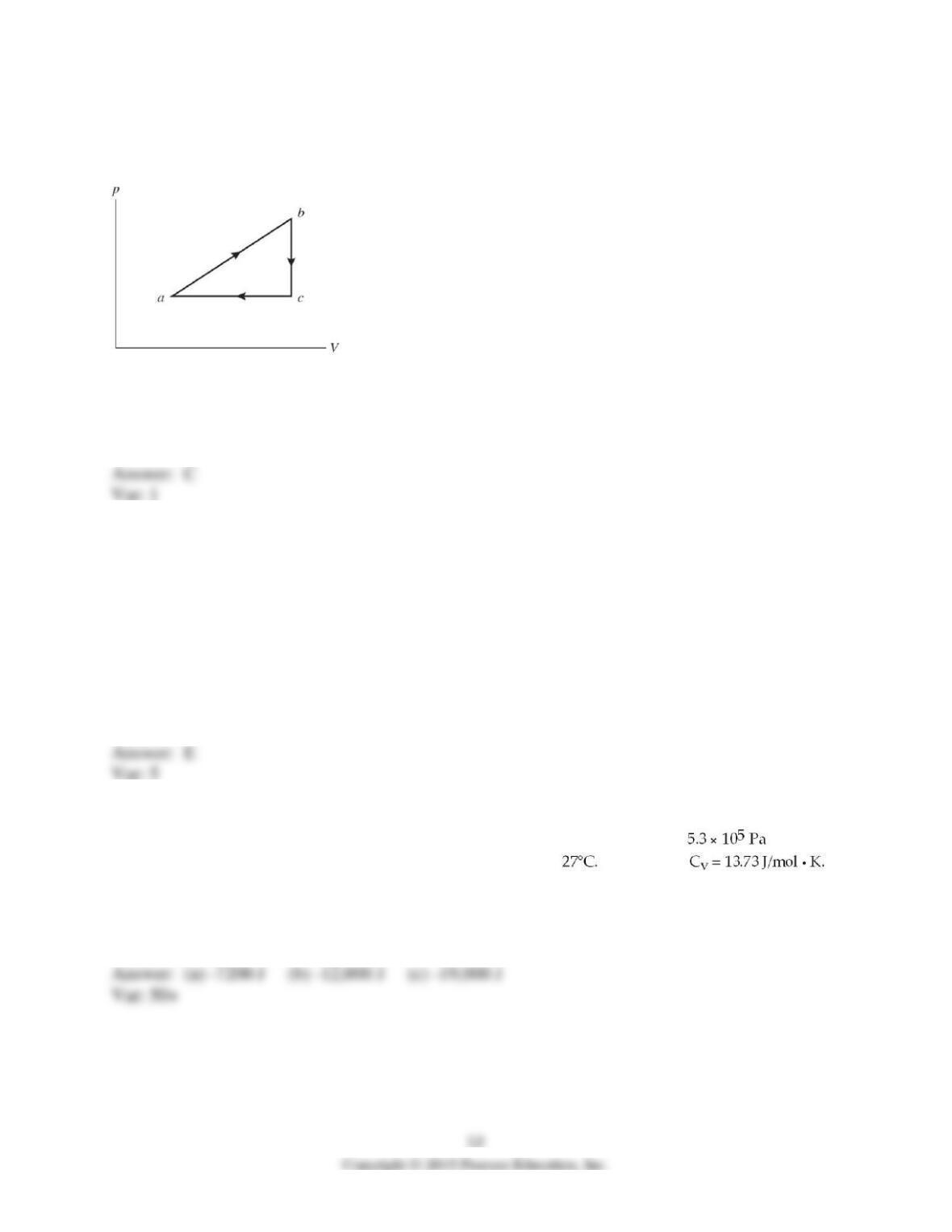
30) An ideal gas undergoes the process a→b→c→a shown in the pV diagram. In the figure, Pa =
Pc = 240 kPa, Vb = Vc = 40 L, Va = 15 L, and Pb = 400 kPa. How much heat is gained by the
gas in this a→b→c→a process?
A) 1000 J
B) 1500 J
C) 2000 J
D) 2500 J
E) 3000 J
31) A 40.0-L container is divided into two equal parts by a rubber membrane. One half of the
container has 1.50 moles of an ideal monatomic gas at 250 K, and the other half is a vacuum.
The container is well insulated, so there is no exchange of heat with the surroundings. The
membrane breaks, and eventually the gas reaches a new equilibrium condition occupying the
entire volume. What is the final temperature of the gas?
A) 100 K
B) 125 K
C) 157 K
D) 180 K
E) 250 K
32) A cylinder contains 8.8 moles of ideal gas, initially at a temperature of 126°C. The cylinder
is provided with a frictionless piston, which maintains a constant pressure of on the
gas. The gas is cooled until its temperature has decreased to For the gas
The ideal gas constant is R = 8.314 J/mol ∙ K. For this process, calculate:
(a) the work done by gas
(b) the net change in the internal (thermal) energy of the gas
(c) the heat transferred to the gas.

33) An expandable container holds 2.30 mole of helium, He, gas with an initial pressure of 770
kPa and an initial volume of 2.10 L. The gas expands isothermally to a final pressure of 350
kPa. How much heat is gained by the gas during this process? (R = 8.31 J/mol ∙ K)
A) 1280 J
B) 792 J
C) 685 J
D) 1370 J
E) 1700 J
34) A compression, at a constant pressure of 140 kPa, is performed on 4.0 moles of an ideal
monatomic gas for which CV = 3/2 R. The compression reduces the volume of the gas from
to What is the change in the internal (thermal) energy of the gas during this
process? (R = 8.31 J/mol ∙ K)
A) -29 kJ
B) -49 kJ
C) 29 kJ
D) 49 kJ
E) 0 kJ
35) An expansion process on an ideal diatomic ideal gas for which CV = 5/2 R has a linear path
between the initial and final coordinates on a pV diagram. The coordinates of the initial state are:
the pressure is the volume is and the temperature is The final pressure is
and the final temperature is What is the change in the internal (thermal) energy of
the gas, during this process? (R = 8.31 J/mol ∙ K)
A) -2900 J
B) -1700 J
C) 2900 J
D) 1700 J
E) 0 J
36) A cylinder contains 1.50 moles of an ideal monatomic gas that is initially at a temperature of
317 K. If the gas gains 2730 J of heat and performs 780 J of work, what is its final temperature?
(R = 8.31 J/mol ∙ K)
A) 359 K
B) 421 K
C) 526 K
D) 687 K
E) 756 K