23) One reason college students do not study enough to get high grades is that they are
unrealistic about their future behavior.
24) A sunk cost is a cost that has already been paid and cannot be recovered.
25) Explain the endowment effect.
26) Why do many film processing companies have a policy of printing every picture on a roll of
film or a memory card, even if the picture is very fuzzy and customers are allowed to ask for
refunds on any pictures they do not like?
27) Behavioral economists examine choices that consumers make that are not economically
rational. Economists generally assume that people are rational; that is, they weigh the benefits
and costs of an action and choose an action only if the benefits outweigh the costs. Why do
consumers not act rationally when the result is that they make themselves worse off?
28) Some online penny auctions charge a fee, such as $1, for every bid placed. Why should these
costs of $1 per bid be considered sunk costs? Would it be smart for someone who has “already
invested $5 in bidding costs” to keep bidding to “protect his or her sunk investments”? Why or
why not?
10.5 Appendix: Using Indifference Curves and Budget Lines to Understand Consumer
Behavior
1) Which of the following statements about utility and preferences is false?
A) If Sidra prefers tea to coffee and coffee to hot chocolate, then she must prefer tea to hot
chocolate.
B) Preferences can be ranked.
C) If two individuals, Ingrid and Inez, each consume the same bundle of goods, then both Inez
and Ingrid must receive the same utility from the bundle.
D) Utility cannot be compared across consumers.
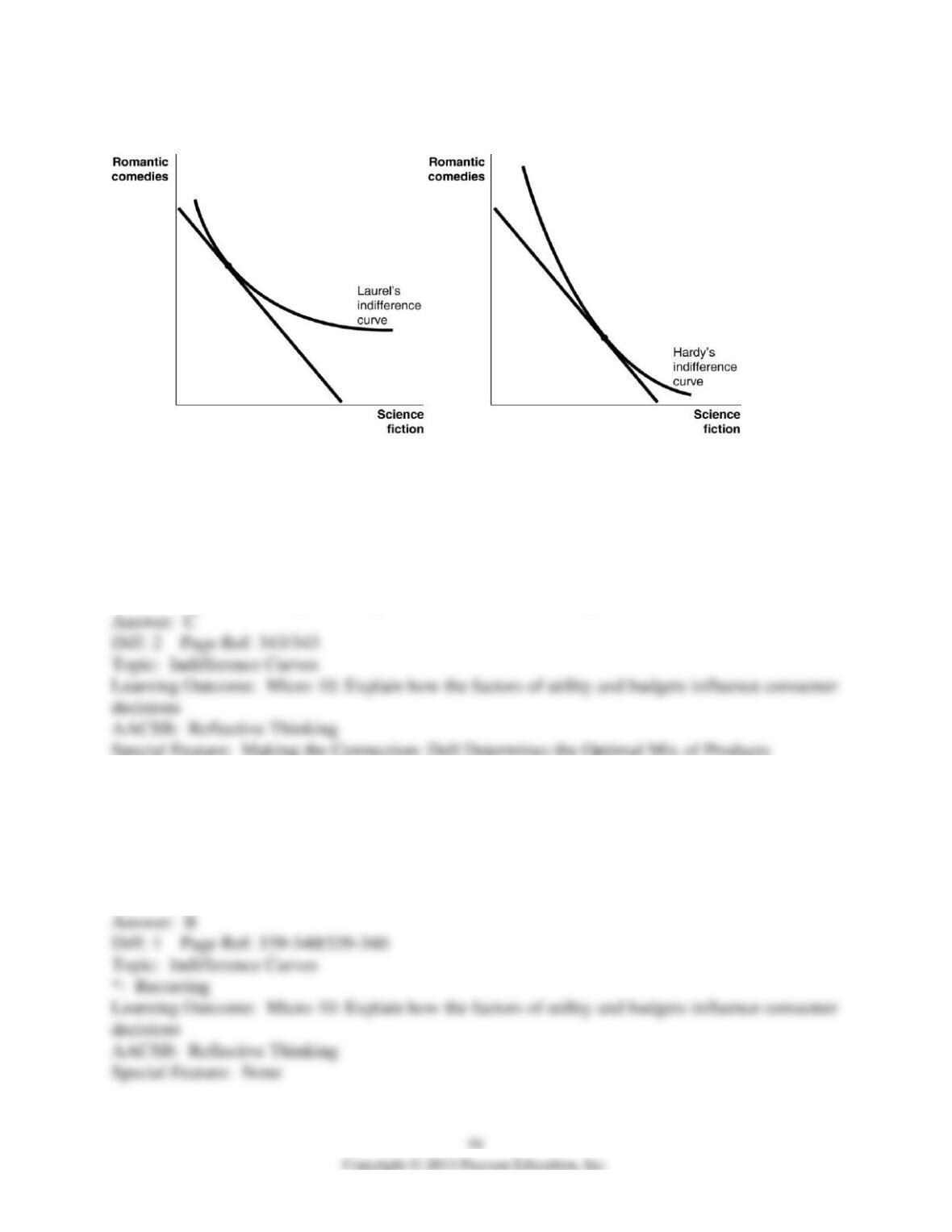
Figure 10-2
2) Refer to Figure 10-2. Best friends Laurel and Hardy both enjoy watching romantic comedies
and science fiction movies. Based on the diagrams above what can you conclude about their
movie preferences?
A) They have identical movie preferences.
B) Hardy enjoys romantic comedies more than Laurel.
C) Hardy enjoys science fiction movies more than Laurel.
D) The diagrams do not provide any information about relative preferences.
3) A curve that shows combinations of consumption bundles that give a consumer the same
utility is called
A) a utility curve.
B) an indifference curve.
C) a preference curve.
D) a demand curve.
4) The slope of the indifference curve is referred to as
A) the marginal rate of substitution.
B) the price ratio.
C) the marginal rate of consumption.
D) the marginal tradeoff rate.
5) What does the marginal rate of substitution measure?
A) It measures the rate at which a consumer must give up one good to purchase another good.
B) It measures the rate at which a consumer will substitute one good for another when the price
of one good changes.
C) It measures the change in utility from consuming one additional unit of a good.
D) It measures the rate at which a consumer is willing to trade off one product for another while
keeping utility constant.
6) Which of the following is held constant along an indifference curve?
A) the prices of the goods in question
B) the marginal rate of substitution between the two goods in question
C) the marginal utility derived from consuming any bundle of goods on the indifference curve
D) the total utility derived from consuming any bundle of goods on the indifference curve
7) In the utility maximizing model, consumer preferences are assumed to be transitive. What
does this mean?
A) that consumers prefer more of a good to less
B) that consumers have the freedom to change their preferences from time to time
C) that consumers have preferences that are relatively consistent in the time period under
consideration
D) that consumers go through cycles in their consumption behavior
8) Why do convex indifference curve have a negative slope?
A) because consumers take market prices as given
B) because consumers face a budget constraint
C) because to keep utility constant, a consumer must get more of one good if she is to give up
some of the other
D) because scarcity implies that it is not possible to consume more of one good without giving
up some of the other
9) What happens to the absolute value of marginal rate of substitution as you move down a
convex (bowed toward the origin) indifference curve?
A) increases
B) decreases
C) remains constant
D) could increase or decrease
10) A consumer’s budget constraint is
A) the limited income that a consumer has to spend on goods and services.
B) the rate at which the consumer must give up one good to purchase an additional unit of the
other goods in the market.
C) the price ratio a consumer faces in the marketplace.
D) the extent to which one’s preferences are limited by one’s income.
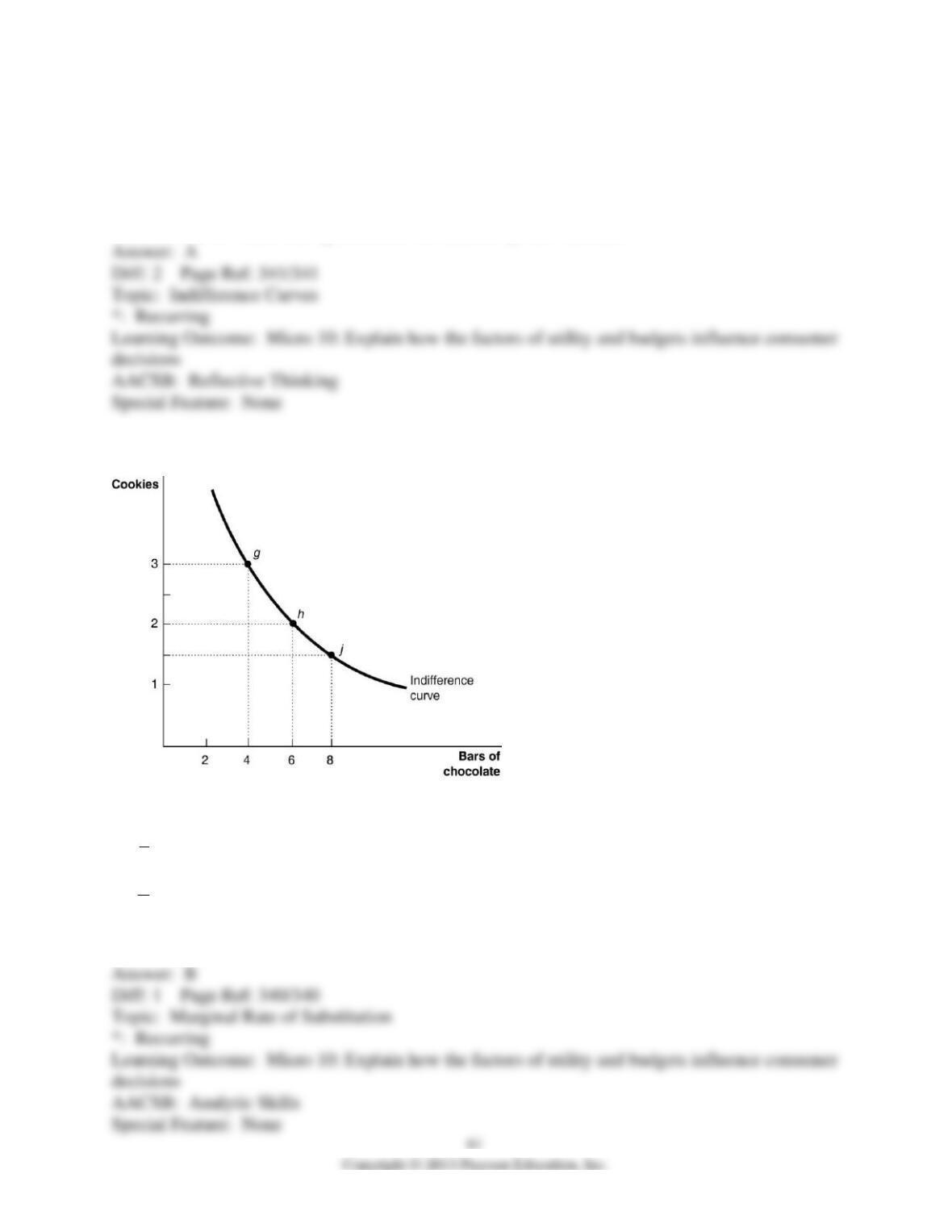
Figure 10-3
11) Refer to Figure 10-3. What is the marginal rate of substitution between h and j?
A)
8
1
cookie.
B)
4
1
cookie.
C) 2 cookies.
D) 4 cookies.
12) Vinny consumes tacos and chicken wings. To keep his utility constant, he must consume
more tacos if he consumes fewer chicken wings. This means that
A) Vinny’s indifference curve for tacos and chicken wings must have a negative slope.
B) the prices Vinny pays for tacos and chicken wings are always the same.
C) Vinny’s marginal utility from each good must be constant along his convex indifference
curves for tacos and chicken wings.
D) Vinny’s marginal rate of substitution must be constant along his indifference curves for tacos
and chicken wings.
13) Which of the following statements is false?
A) There is an indifference curve associated with any combination of goods selected by a
consumer.
B) A consumer is indifferent among all consumption bundles along a given budget line.
C) All consumption bundles along a given indifference curve are equally desirable.
D) Consumption bundles that lie on higher indifference curves yield higher utility.
14) Which of the following is not a characteristic of indifference curves?
A) Indifference curves cannot intersect.
B) Indifference curves are usually bowed in, or convex.
C) The slope of an indifference curve is negative.
D) The closer to the origin, the greater the utility level.
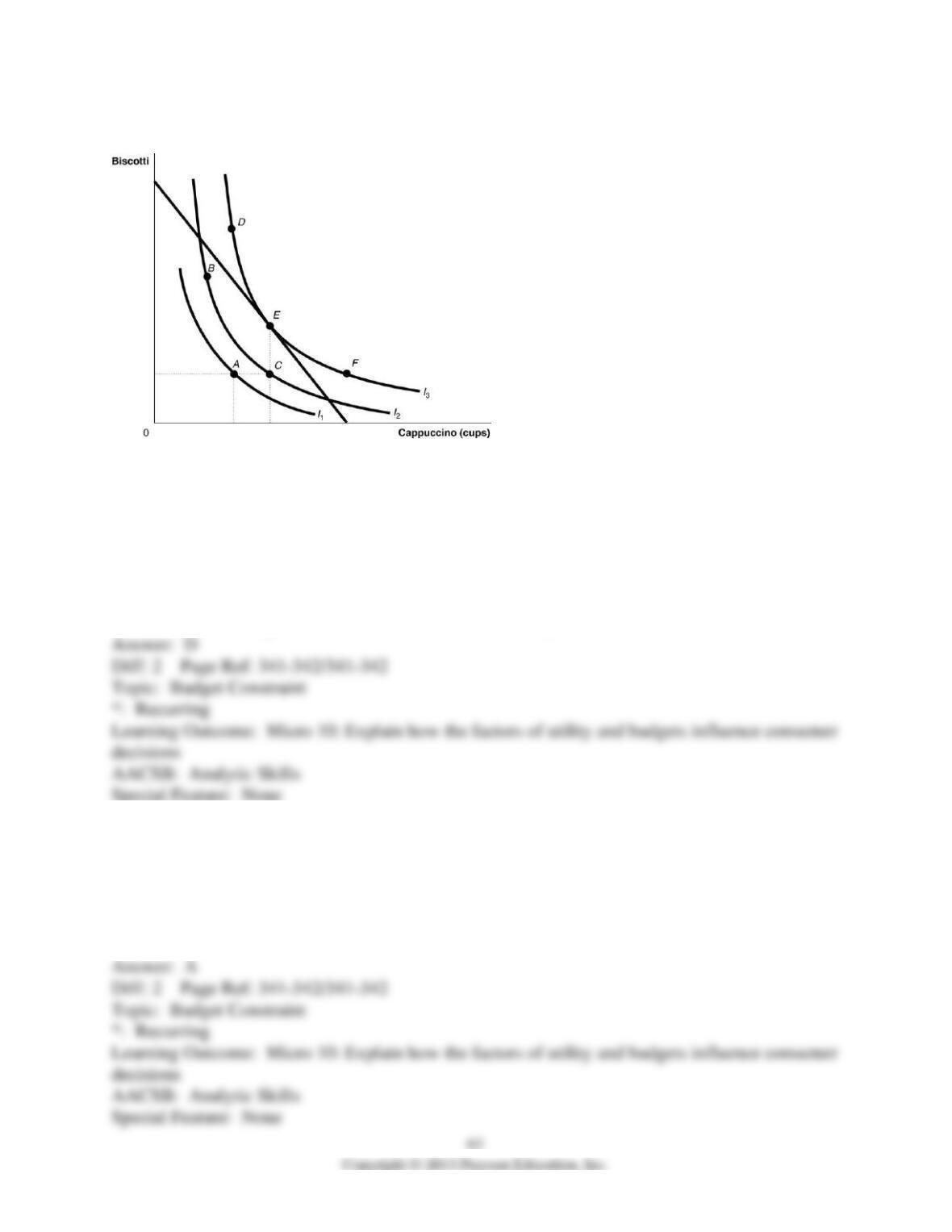
Figure 10-4
15) Refer to Figure 10-4. Given the budget constraint in the diagram, which of the following
statements is false?
A) The consumer receives the same level of utility from consumption bundles d, e and f.
B) Consumption bundles b and c yield the same level of utility, which is higher than the utility
represented by bundle a.
C) Although the consumer receives the same level of utility from bundles d and e, she cannot
afford to purchase bundle d.
D) The consumer’s optimal bundle could be bundle d, e or f.
16) Refer to Figure 10-4. If the price of biscotti is $1.50 and the price of a cappuccino is $3.00,
what is the slope of the budget constraint?
A) -2
B) -(3.00 – 1.50)/(3.00 + 1.50) = -1/3
C) -1/2
D) The slope cannot be determined without the value of income.
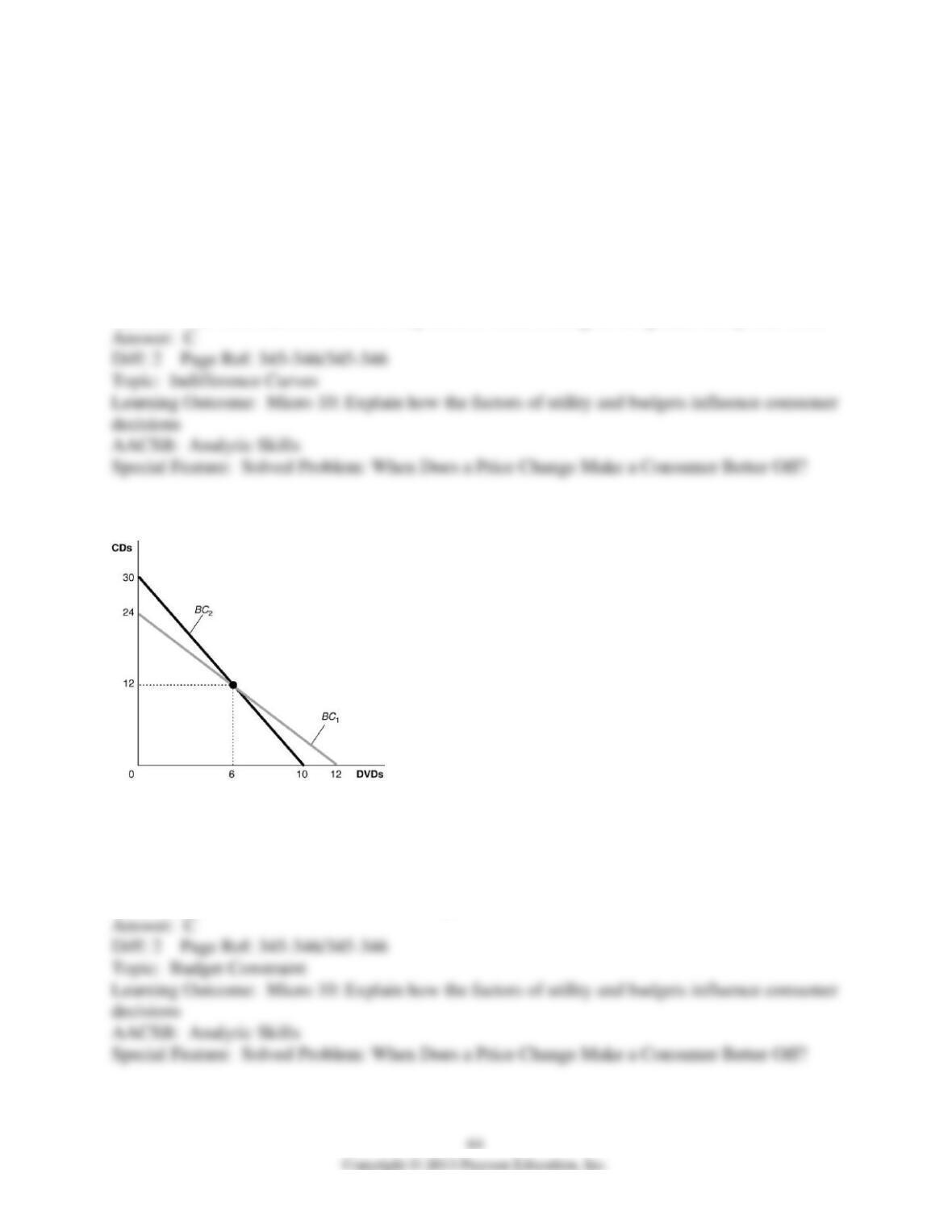
17) Assume that Anne has $300 to spend on DVDs and CDs. Her optimal consumption of DVDs
and CDs is illustrated by a tangency between a budget line and an indifference curve. Now
assume that the price of CDs rises but the price of DVDs falls. How can you show that Anne is
made better off by these price changes?
A) Show that the price changes shift Anne’s budget line outward; the budget line is tangent to a
higher indifference curve.
B) Show that the price changes move Anne along her budget line to a higher indifference curve.
C) Show that Anne can afford to buy the optimal combination of DVDs and CDs at their original
prices; then show that Anne can now reach a higher indifference curve.
D) Show that Anne can now afford to buy more DVDs, which give her greater utility than CDs.
Figure 10-5
18) Refer to Figure 10-5. The change in the budget constraint from BC1 to BC2 implies
A) the prices of DVDs and CDs have increased.
B) income and the prices of DVDs and CDs have increased.
C) the price of DVDs has increased and the price of CDs has decreased.
D) the price of DVDs has decreased and the price of CDs has increased.
19) Refer to Figure 10-5. Consider the budget constraint BC1. If the price of DVDs is $20 and
the price of CDs is $10, what is the consumer’s income?
A) $120
B) $240
C) $360
D) $480
20) Refer to Figure 10-5. If the consumer has $240 to spend on DVDs and CDs, what is the
price of a DVD if the budget constraint is BC1?
A) $10
B) $20
C) $24
D) $40
21) Refer to Figure 10-5. If the consumer has $240 to spend on DVDs and CDs, what is the
price of a CD if the budget constraint is BC2?
A) $8
B) $10
C) $20
D) $40
22) Total utility is constant along a given indifference curve.
23) An increase in income results in an outward shift of an indifference curve.
24) All consumption bundles along a given indifference curve are equally desirable.
25) What is an indifference curve? Why can indifference curves never cross?
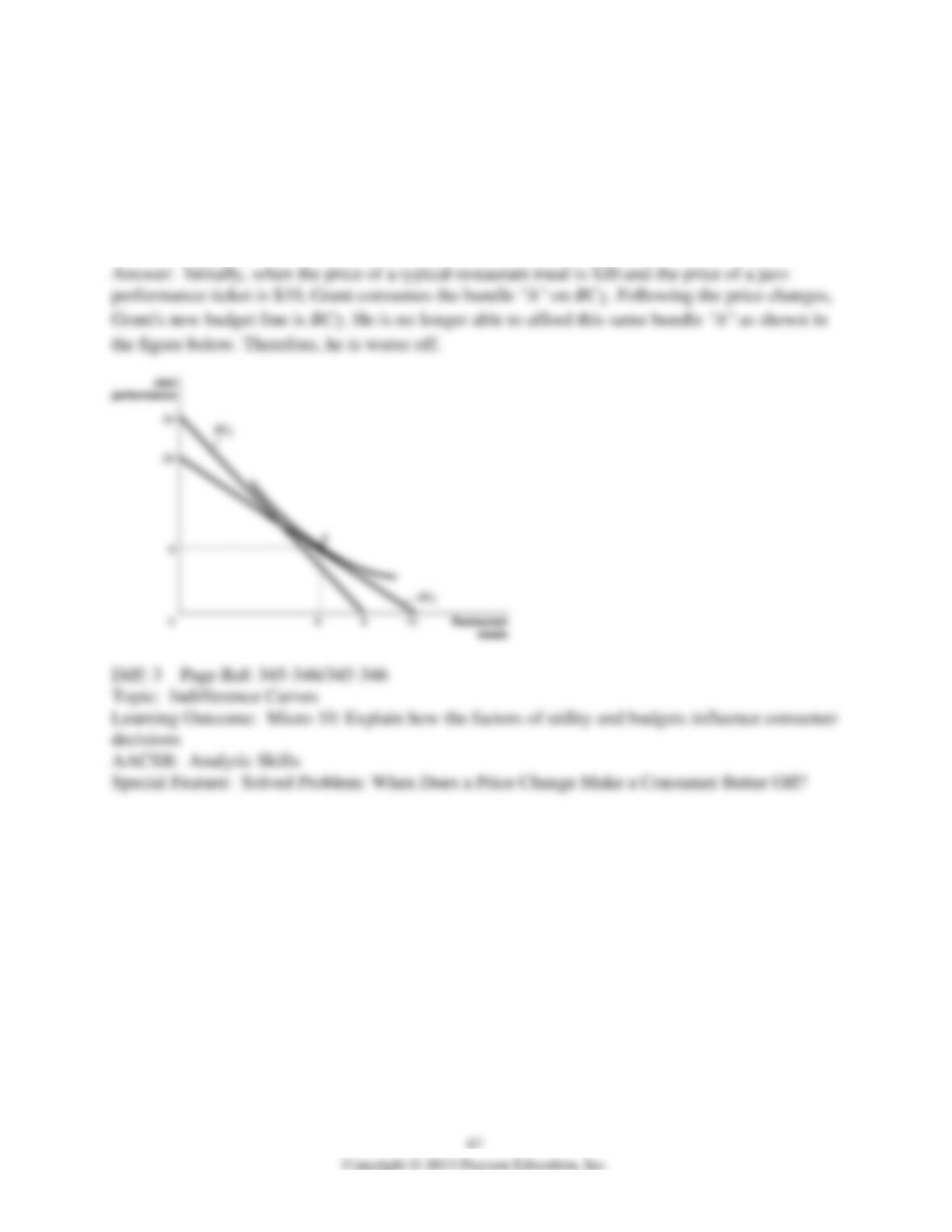
26) Grant has $200 to spend each month on restaurant meals and jazz performances at his
neighborhood jazz club. The price of a typical restaurant meal is $20 and the price of a jazz
performance ticket is $10. Grant is maximizing his utility by consuming 6 restaurant meals and
attending 8 jazz performances. Suppose Grant still has $200 to spend, but the price of restaurant
meal rises to $25, while the price of jazz performance ticket drops to $8. Is Grant better off or
worse off than he was before the price change? Use a budget constraint/indifference curve graph
to illustrate your answer.