39) The income effect of a price change refers to
A) the change in demand that occurs when consumer income changes.
B) the change in the quantity demanded that results from a change in price, making the good
more or less expensive relative to other goods, holding everything else constant.
C) the change in demand that occurs when both income and price change.
D) the change in the quantity demanded of a good that results from the effect of a change in price
on consumer purchasing power, holding everything else constant.
40) Which of the following describes the substitution effect of a price change?
A) The change in demand that results from a change in price, making the good more or less
expensive relative to other goods, holding constant the effect of the price change on consumer
purchasing power.
B) The change in quantity demanded of a good that results from the effect of a change in price
on consumer purchasing power, holding everything else constant.
C) The change in quantity demanded of a good that results from the change in the price of a
substitute for the good.
D) The change in quantity demanded of a good that results from a change in price, making the
good more or less expensive relative to other goods, holding constant the effect of the price
change on consumer purchasing power.
41) Which of the following correctly describes the result of a price increase for an inferior good?
A) Both the substitution effect and the income effect cause the consumer to buy less of the good.
B) The substitution effect causes the consumer to buy less of the good and the income effect
causes the consumer to buy more of the good.
C) The substitution effect causes the demand for the good to decrease; the income effect causes
the demand for the good to increase.
D) The substitution effect causes the demand for the good to increase; the income effect causes
the demand for the good to decrease.
42) The substitution effect of a decrease in the price of movie tickets results in
A) an increase in the quantity demanded of movie tickets.
B) a decrease in the quantity demanded of movie tickets.
C) an increase in the demand for movie tickets.
D) a decrease in the demand for movie tickets.
43) The income effect of a decrease in the price of macaroni and cheese (assume this is an
inferior good) results in
A) a decrease in the demand for macaroni and cheese.
B) an increase in the quantity demanded of macaroni and cheese.
C) a decrease in the quantity demanded of macaroni and cheese.
D) an increase in the demand for macaroni and cheese.
44) The income effect of an increase in the price of peaches is
A) the change in the quantity demanded of peaches that results from the price increase making
peaches more expensive than other fruit, holding constant the effect of the price change on
consumer purchasing power.
B) the change in the demand for peaches as a result of the change in the price of peaches, holding
all other factors constant.
C) the change in the quantity demanded of other fruit that results from the impact of the price
change on purchasing power, holding all other factors constant.
D) the change in the quantity demanded of peaches that results from the effect of the change in
price on consumer purchasing power, holding all other factors constant.
45) The substitution effect of an increase in the price of peaches is
A) the change in the quantity demanded that results from a change in the price of peaches
making peaches more expensive relative to other goods, holding constant the effect of the price
change on consumer purchasing power.
B) the change in the demand for nectarines (a substitute good) that results when peaches become
more expensive relative to nectarines, holding constant the effect of the price change on
consumer purchasing power.
C) the change in the quantity demanded of peaches that results from the effect of the change in
the price of peaches on the consumer’s purchasing power.
D) the change in the demand for peaches that results when the price of peaches increases.
46) The French Bakery ran a special which decreased the price of its croissants from $1.50 to
$1.00. Although her money income had not changed, Toni decided to buy 2 croissants instead of
her usual 1 bagel and 1 croissant. Toni’s actions are explained by which of the following?
A) income effect only or substitution effect only but not both effects
B) income and substitution effects
C) price effect
D) consumption effect
47) The income effect of a decrease in the price of legal services, a normal good, results in
A) a decrease in the demand for legal services.
B) a decrease in the quantity demanded of legal services.
C) an increase in the quantity demanded of legal services.
D) an increase in the demand for legal services.
48) A change in the price of a good has two effects on the quantity consumed. What are these
effects?
A) the income effect and the substitution effect
B) the utility effect and the budget effect
C) the total utility effect and marginal utility effect
D) the consumption effect and expenditure effect

49) The substitution effect of a change in the price of cauliflower is the portion of the change in
the quantity of cauliflower demanded that can be attributed to the change in the price of a
substitute vegetable such as asparagus.
50) To maximize utility consumers should buy goods and services to the point where the
marginal utility of each item consumed is equal.
51) In explaining consumer behavior economists explain how consumer tastes and preferences
are formed.
52) If by purchasing more apples and fewer oranges you increase your total utility, then apples
must be cheaper than oranges.
53) Economists assume people’s tastes are identical.
54) Economists do not think it is possible to compare the relative utility that two people get from
consuming an additional unit of a particular good.
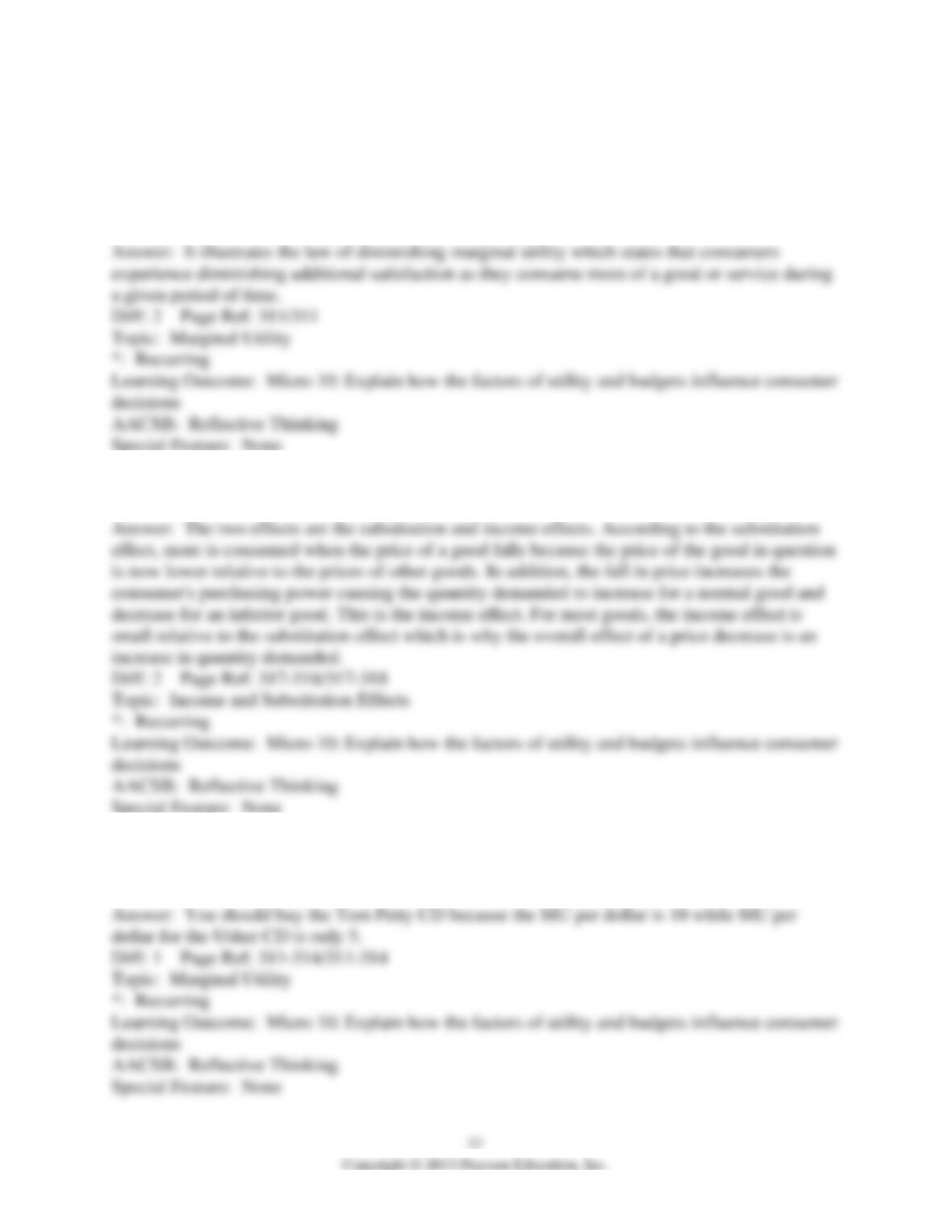
55) The Wong family consumes 3 pounds of fish and 5 pounds of chicken per month. The price
of fish is $8 per pound and chicken is $4 per pound.
a. What is the amount of income allocated to fish and chicken consumption?
b. What is the price ratio (the price of fish relative to the price of chicken)?
c. Explain the meaning of the price ratio you computed.
d. If the Wongs maximize utility, what is the ratio of the marginal utility of fish to the marginal
utility of chicken?
e. If the price of chicken rises, will the Wong family consume more chicken, less chicken or the
same amount of chicken? Explain your answer using the rule of equal marginal utility per dollar.
56) You participate in a taste test for a new protein supplement called “Boost.” You are given
five consecutive one ounce vials of the supplement and after consuming each vial you are asked
to note your reaction. You consume the first vial and your response is: “Hmmm, quite good!”
After the second, you say, “Not bad at all.” After the third, you note, “It’s alright.” and after the
fourth you wince, “No more, the after-taste is getting to me. I need water.” What economic
principle does this scenario illustrate? Define the principle.
57) The increase in consumption of a good when its price falls is caused by two effects. What are
these two effects? Explain the difference between these effects.
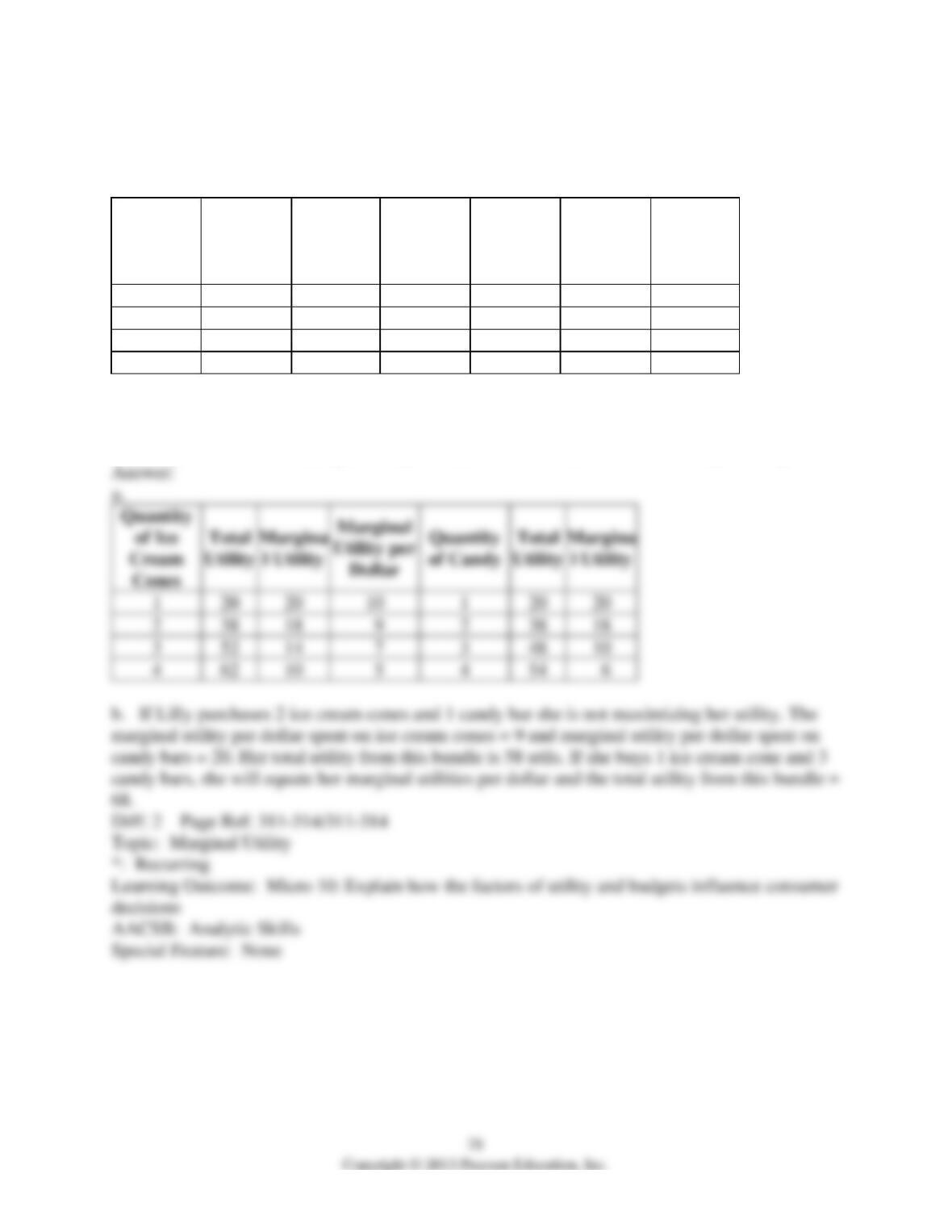
58) You wish to buy only one CD. Use the rule of equal marginal utility per dollar to determine
which one to purchase: (a) Usher’s latest CD for $15 which gives you 75 units of utility, or (b)
Tom Petty and the Heartbreakers’ Greatest Hits for $10 that gives you 100 units of utility?
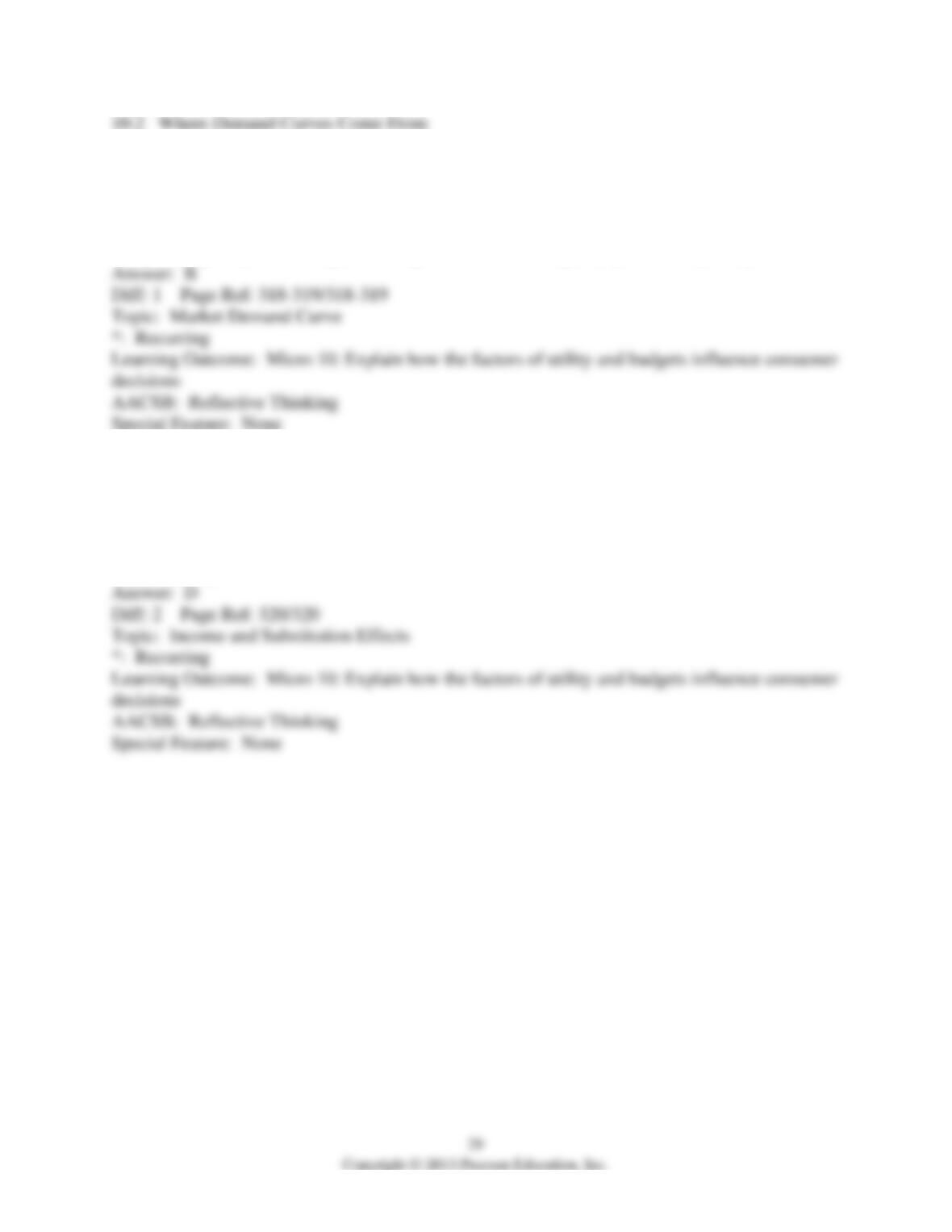
59) Lilly Davis has $5 per week to spend on any combination of ice cream and candy. The price
of an ice cream cone is $2 and the price of a candy bar is $1. The table below shows Lilly’s
utility values. Use the table to answer the questions that follow the table.
Quantity
of Ice
Cream
Cones
Total
Utility
Marginal
Utility
Marginal
Utility per
Dollar
Quantity
of Candy
Total
Utility
Marginal
Utility
1
20
1
20
2
38
2
38
3
52
3
48
4
62
4
54
a. Complete the table by filling in the blank spaces.
b. Suppose Lilly purchases 2 ice cream cones and 1 candy bar. Is she consuming the optimal
consumption bundle? If so, explain why. If not, what combination should she buy and why?
Quantity
of Ice
Cream
Cones
Total
Marginal
Utility per
Dollar
Quantity
of Candy
Total
1
10
1
2
9
2
3
7
3
4
5
4
1) We can derive the market demand curve for gold earrings
A) only if the tastes of all gold earring consumers are similar.
B) by adding horizontally the individual demand curves of each gold earring consumer.
C) by adding vertically the quantity demanded of each gold earring consumed at each price.
D) by adding the prices each gold earring consumer is willing to pay for each quantity.
2) The income effect due to a price decrease will result in an increase in the quantity demanded
for
A) a Giffen good.
B) an inferior good.
C) a public good.
D) a normal good.
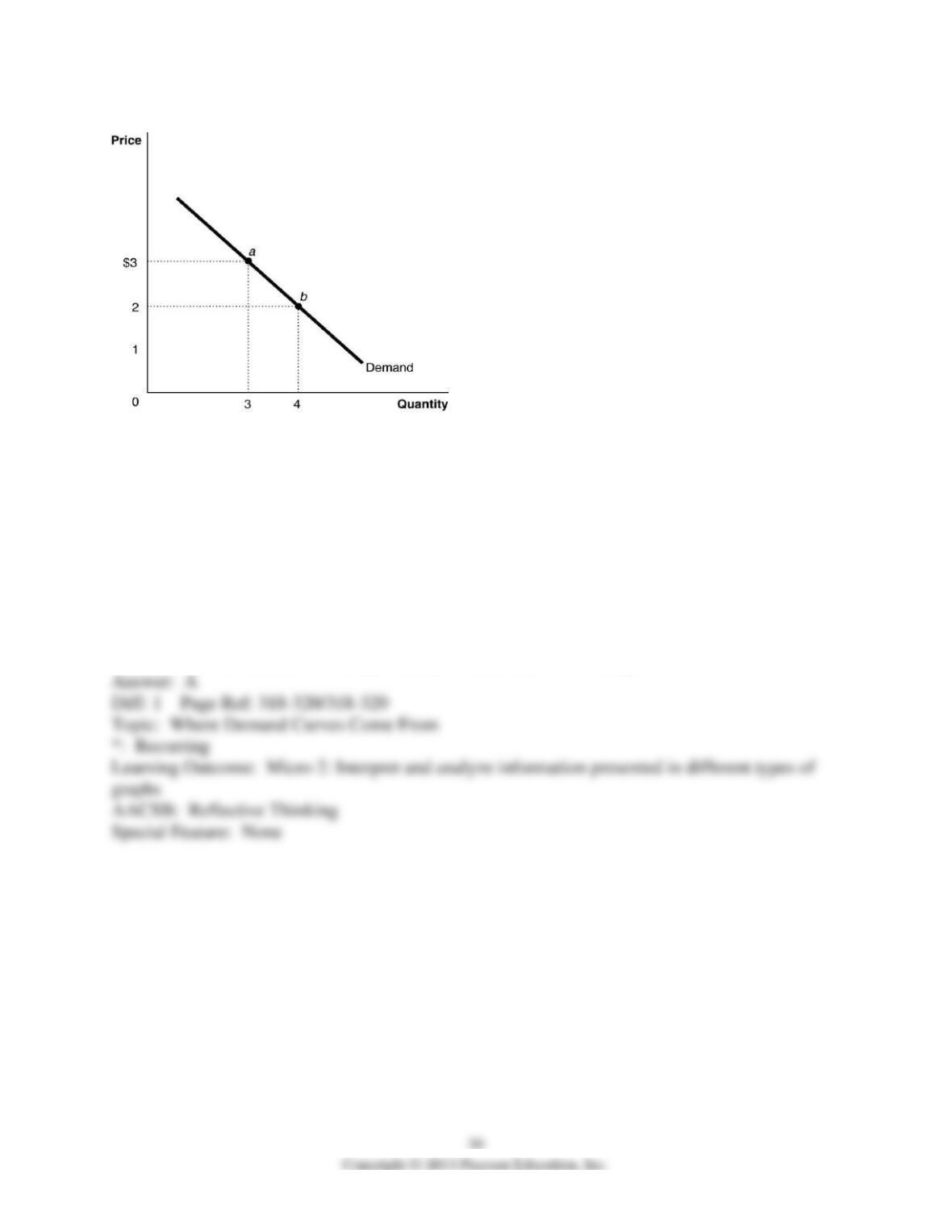
Figure 10-1
Figure 10-1 represents the demand for ice cream cones.
3) Refer to Figure 10-1. Which of the following statements is true?
A) Points a and b are the utility-maximizing quantities of ice-cream cones at two different prices
of ice-cream.
B) Points a and b may not necessarily be the utility-maximizing quantities of ice-cream cones at
two different prices because we have no information on the consumer’s budget or the price of
other goods.
C) Point a could be a utility-maximizing choice if the price is $3 but point b may not be because
we have no information on the marginal utility per dollar when price changes.
D) Points a and b are derived independently of the utility-maximizing model.
4) Refer to Figure 10-1. When the price of ice cream cones increases from $2 to $3, quantity
demanded decreases from 4 ice cream cones to 3 ice cream cones. This change in quantity
demanded is due to
A) the price and output effects.
B) the income and substitution effects.
C) the law of diminishing marginal utility.
D) the fact that marginal willingness to pay falls.
5) Goods with upward sloping demand curves are referred to as
A) Marshall goods.
B) Giffen goods.
C) substitute goods.
D) luxury goods.
6) For a demand curve to be upward sloping, the good would have to be an inferior good, and
A) the income effect would have to be larger than the substitution effect.
B) the income effect would have to be smaller than the substitution effect.
C) the income effect would have to be equal to the substitution effect.
D) the income effect and the substitution effect would have to be nonexistent.
7) The income effect results in consumers increasing the quantity of normal goods demanded
when the price falls.
8) The demand for a Giffen good slopes upward.
9) The only Giffen goods that have been identified so far in the real world are luxury goods.
10) Describe the demand curve for a Giffen good.
11) What did economists Robert Jensen and Nolan Miller determine must be true for a good to
be a Giffen good, where the income effect is larger than its substitution effect?
10.3 Social Influences on Decision Making
1) Traditionally, economists have considered culture, customs, and religion as
A) very important influences on the choices consumers make.
B) relatively unimportant factors in explaining the choices consumers make.
C) important influences in explaining consumer choices in command economies but less
important in market economies.
D) subject to normative economic analysis rather than positive economic analysis.
2) Which of the following statements describes economists’ attitudes regarding the influence of
social factors on the choices consumers make?
A) Economists formerly believed they were very important but now they believe they are not
important.
B) Economists believe social factors affect consumer choice in markets for public goods but not
in markets for private goods.
C) Liberal economists believe social factors are very important; conservative economists do not
believe social factors have any influence on consumers.
D) Economists traditionally believed they were unimportant, but many economists now believe
social factors are important.
3) Economists Gary Becker and Kevin Murphy are associated with which of the following?
A) the discovery of the first example of a Giffen good
B) They have argued that social factors are not important in explaining the choices consumers
make.
C) Consumers appear to receive utility from consuming goods they believe are popular.
D) They discovered that price changes have both income and substitution effects.
4) During the 2011 Super Bowl, Best Buy ran a commercial featuring Justin Bieber and Ozzy
Osbourne. If the endorsements of Justin Bieber and Ozzy Osbourne resulted in a subsequent
increase in sales at Best Buy, this would be an example of ________ on decision making.
A) the income effect
B) a social influence
C) the substitution effect
D) a scientific influence
5) Which of the following is not a reason why companies such as Under Armour and Movado
pay Tom Brady to endorse their products?
A) Many consumers feel more fashionable if they use the same products that Tom Brady uses.
B) Some consumers will buy a product endorsed by Tom Brady because they believe he is
particularly knowledgeable about the product.
C) Some consumers want to feel closer to a celebrity who endorses a product.
D) Some consumers believe that Tom Brady is more rational than the average consumer.
6) Which of the following refers to the increase in the usefulness of a product as the number of
consumers who use it increases?
A) positive externalities
B) network externalities
C) external marginal utility
D) the impact of celebrity endorsements
7) Tom Brady endorses Movado watches and Under Armour athletic wear. One reason Under
Armour pays Tom Brady for his endorsement is that consumers believe he is more
knowledgeable about athletic wear than they are. Why would the makers of Movado watches
pay Tom Brady to endorse their products?
A) Many consumers believe Tom Brady is more knowledgeable about watches than they are.
B) More people watch football than any other sport.
C) Some consumers believe that buying products endorsed by Tom Brady makes them appear to
be more fashionable.
D) Movado receives free publicity whenever Tom Brady wins a football game.
8) Which of the following is used to explain why a consumer’s willingness to buy a cell phone
increases as the number of other people who own and use cell phones increases?
A) network externalities
B) market failure
C) diminishing marginal utility
D) the income effect of a price change
9) The order of the letters along the rows of computer keyboards could be changed to allow users
to type faster, but this would inconvenience the vast majority of people who learned to type with
the current keyboard layout. The costs of switching to a new layout make this change unlikely.
This is an example of
A) path dependency.
B) how social influences overwhelm the substitution effect of a price change.
C) how the elasticity of demand for typewriters has been affected by externalities.
D) how consumers sometimes do not behave rationally.
10) An advantage of Microsoft windows is its compatibility with the widest range of hardware
and software. The dominance of Windows is self-reinforcing: hardware and software
manufacturers ensure that their products are compatible with Windows in order to have access to
the large number of Windows users. Which principle best describes this scenario?
A) endowment effects
B) endorsement effects
C) economies of scale
D) network externalities
11) Some economists have argued that path dependence and switching costs can lead to market
failure. Which of the following is an example of this argument?
A) Costly celebrity endorsements lead many consumers to buy a product even though it is more
expensive or less effective than a product that is not endorsed by a celebrity.
B) A consumer who won a lottery for a Super Bowl ticket refuses to sell it for $3,000 even
though he would not have paid $3,000 for a ticket if he had not won the lottery.
C) While playing the ultimate game, an allocator decides to share $20 equally with a recipient
rather than keep the $20 for herself.
D) VHS video recorders became more popular with consumers than Sony Betamax recorders
even though the Betamax recorders embodied a superior technology.
12) All but one of the following have been suggested by some economists as possible
consequences of path dependency and switching costs. Which of the following is not a possible
consequence of path dependency and switching costs?
A) Consumers may get locked into using products with inferior technology.
B) market failure
C) diseconomies of scale
D) Government intervention may be necessary in affected markets in order to improve economic
efficiency.
13) Some economists have suggested that network externalities result in consumers being locked
into the use of products with inferior technologies. Economists Stan Leibowitz and Stephen
Margolis have studied cases that have been cited as examples of this and found
A) there is no convincing evidence that the alternative technologies were superior.
B) consumers sometimes do become locked into the use of products with inferior technologies.
C) that in all of these cases network externalities resulted in market failure.
D) that consumers use products with inferior technologies when their prices are lower than
products with superior technologies.
14) Maurice Allais, Reinhard Selten and Vernon Smith all were awarded the Nobel Prize in
Economics in part because
A) of their work with experimental economics.
B) they discovered the first example of a Giffen good.
C) of their work on the substitution and income effects of price changes.
D) they proved that external economies would lead to market failure.
15) ________ is an experiment that tests the significance of fairness in consumer decision
making.
A) The fairness challenge
B) The consumer choice paradigm
C) The ultimatum game
D) The Giffen paradox
16) The quantity demanded of tickets to the Super Bowl is always greater than the than the
quantity supplied. Which of the following in the best explanation why the National Football
League does not raise the price of tickets to the level where the quantity demanded equals the
quantity supplied?
A) Raising the price would reduce the demand for tickets; there would then be a surplus and the
game would not sell out.
B) The cost of raising the price and printing new tickets would exceed the revenue the NFL
would receive from higher ticket prices.
C) The demand for Super Bowl tickets is elastic; raising the price would reduce total revenue.
D) The NFL is concerned that raising ticket prices would be considered unfair.
17) Many airlines have not reduced or eliminated fuel surcharges despite the price of oil
dropping. A logical reason for this is that the decline in fuel prices ________ the supply of
airline tickets while at the same time the demand for airline tickets ________, so airline ticket
prices still increased.
A) decreased; increased
B) decreased; decreased
C) increased; increased
D) increased; decreased
18) During its run on Broadway, the play The Producers regularly sold out all available tickets at
the St. James Theater. The theater could have raised ticket prices from $75 to $125 and still sold
all available tickets but chose not to do so. The best explanation for this decision is
A) theater owners are unaware of the elasticity of demand for Broadway shows.
B) theater owners do not want to raise their tickets on weekends, when demand is high, and then
have to lower prices during the week, when demand is lower.
C) firms sometimes give up profits in the short run to keep their customers happy and increase
their profits in the long run.
D) theater owners are not motivated to maximize their profits.
19) All but one of the following economists were awarded a Nobel prize for their contributions
to experimental economics and their explorations of the influence fairness has on consumer
decision-making. Which economist did not receive a Nobel Prize for this work?
A) Vernon Smith
B) Alan Krueger
C) Daniel Kahneman
D) Maurice Allais