CHAPTER 10 APPENDIX 10B—COMPARING PROJECTS WITH
UNEQUAL LIVES
TRUE/FALSE
1. The equivalent annual annuity method involves calculating the annual payment amount that a
particular project would provide if it were a series of equal annual payments from year one
through infinity.
2. The replacement chain, or common life, approach is applicable whether two projects with
differing lives are mutually exclusive or independent.
3. Although the replacement chain or common life approach is appealing for dealing with projects
with different lives, it is not used in industry because there are no projects which meet the
assumptions the method requires.
4. Mutually exclusive projects sometimes have long and different lives which makes applying the
replacement chain method difficult because the lowest common denominator is very large. The
equivalent annual annuity is a substitute method which uses an infinite horizon to value a
project’s cash flows.
5. The equivalent annual annuity (EAA) assumes continuous replacements can and will be made
each time the asset’s life ends, and it also assumes that the EAAs will continue on out to infinity.
6. The replacement chain and equivalent annual annuity method always lead to the same decision if
consistent assumptions are used.
7. Extending projects with different lives to a common life for comparison purposes, while
theoretically appealing, should be done only if there is a high probability that the projects will
actually be replicated beyond their initial lives.
Chapter 10 Appendix 10B Project Cash Flows and Risk 253
MULTIPLE CHOICE
1. Vanderheiden Inc. is considering two average-risk alternative ways of producing its patented polo
shirts. Process S has a cost of $8,000 and will produce net cash flows of $5,000 per year for 2
years. Process L will cost $11,500 and will produce cash flows of $4,000 per year for 4 years.
The company has a contract that requires it to produce the shirts for 4 years, but the patent will
expire after 4 years, so the shirts will not be produced after 4 years. Inflation is expected to be
zero during the next 4 years. If cash inflows occur at the end of each year, and if Vanderheiden’s
required rate of return is 10 percent, by what amount will the better project increase
Vanderheiden’s value?
a.
$677.69
b.
$1,098.89
c.
$1,179.46
d.
$1,237.76
e.
$1,312.31
2. Ecodevelopment Company has two mutually exclusive construction projects to evaluate. Each
type of project can be duplicated repeatedly in different geographic locations around the country,
but each requires a very different set of assets to construct. Thus, Ecodevelopment uses the
equivalent annual annuity method to evaluate such projects. Project type A costs $6.0 million
initially and generates expected end of year cash flows of $3.0 million, $5.0 million, and then
$10.0 million when it is sold after 3 years. Project type B costs $9.0 million initially and has
projected end of year cash flows of $3.0, $3.0, $6.0, and $6.0 million in Year 1 through Year 4,
and then $10.0 million in Year 5. The project types are equally risky and the firm’s required rate
of return is 12 percent. What are (1) the EAA and (2) the infinite horizon NPV of the higher
valued project type?
a.
EAA = $2.726 million; infinite horizon NPV = $22.7 million.
b.
EAA = $3.24 million; infinite horizon NPV = $27.0 million.
c.
EAA = $6.0 million; infinite horizon NPV = $7.8 million.
d.
EAA = $2.726 million; infinite horizon NPV = $13.6 million.
e.
EAA = $5.6 million; infinite horizon NPV = $9.8 million.
254 Chapter 10 Appendix 10B Project Cash Flows and Risk
3. A small manufacturer is considering two alternative machines. Machine A costs $1 million, has
an expected life of 5 years, and generates after-tax cash flows of $350,000 per year. At the end of
5 years, the salvage value of the original machine is zero, but the company will be able to
purchase another Machine A at a cost of $1.2 million. The second Machine A will generate after-
tax cash flows of $375,000 a year for another 5 years at which time its salvage value will again be
zero. Alternatively, the company can buy Machine B at a cost of $1.5 million today. Machine B
will produce after-tax cash flows of $400,000 a year for ten years, and after ten years it will have
an after-tax salvage value of $100,000. Assume that the required rate of return is 12 percent. If
the company chooses the machine which adds the most value to the firm, by how much will the
company’s value increase?
a.
$347,802.00
b.
$451,775.21
c.
$633,481.19
d.
$792,286.54
e.
$811,357.66
Chapter 10 Appendix 10B Project Cash Flows and Risk 255
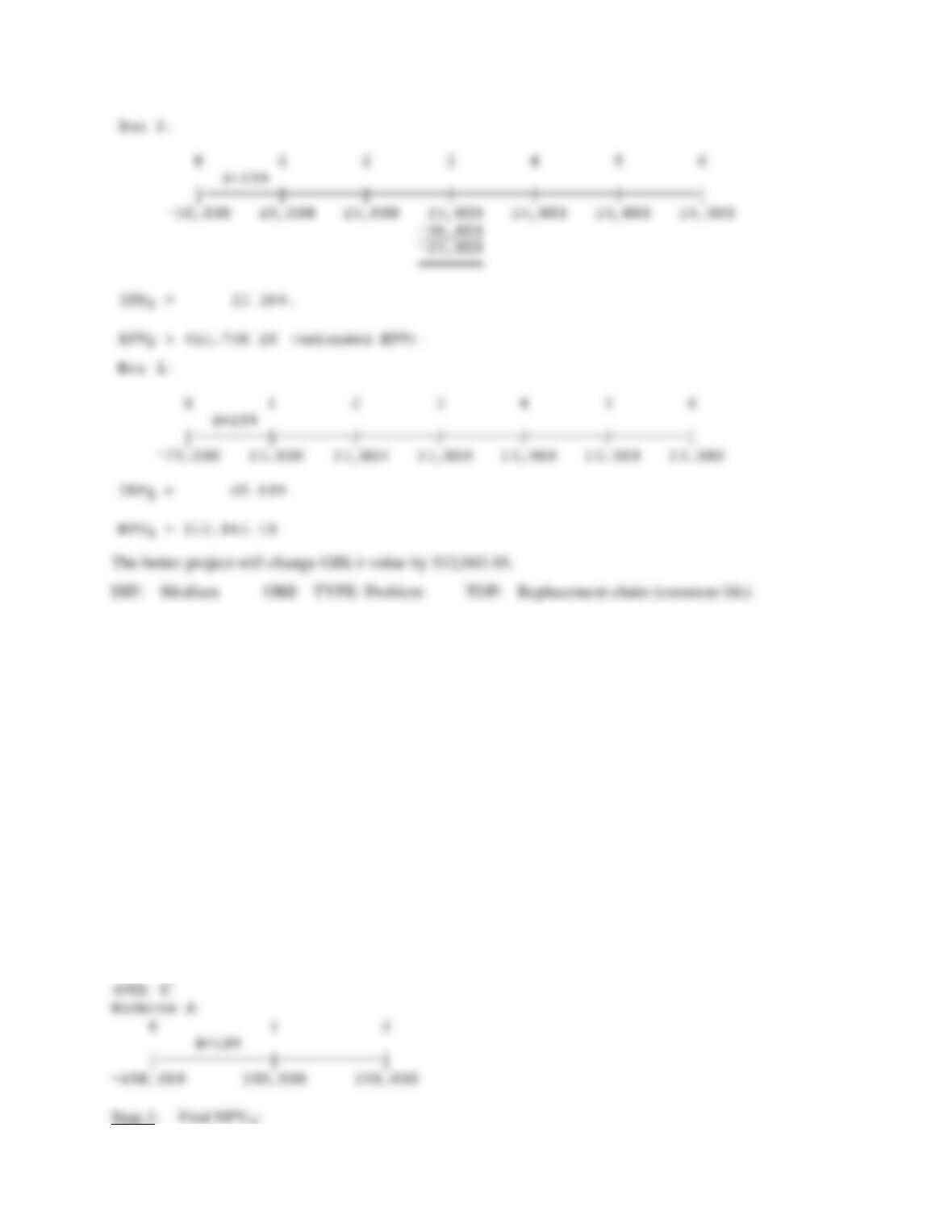
4. Gainesville Bus Lines (GBL) is considering two alternative busses to transport people from the
commuter lot to the main campus. Bus S has a cost of $50,000 and will produce end-of-year net
cash flows of $25,000 per year for 3 years. Bus L will cost $75,000 and will produce cash flows
of $23,000 per year for 6 years. The company must provide bus service for 6 years, after which it
plans to give up its franchise and to cease operating the route. Inflation is not expected to affect
either costs or revenues during the next 6 years. If GBL’s required rate of return is 15 percent, by
what amount will the better project change the company’s value?
a.
$10,225.18
b.
$11,736.26
c.
$12,043.10
d.
$13,424.66
e.
$14,081.19
256 Chapter 10 Appendix 10B Project Cash Flows and Risk
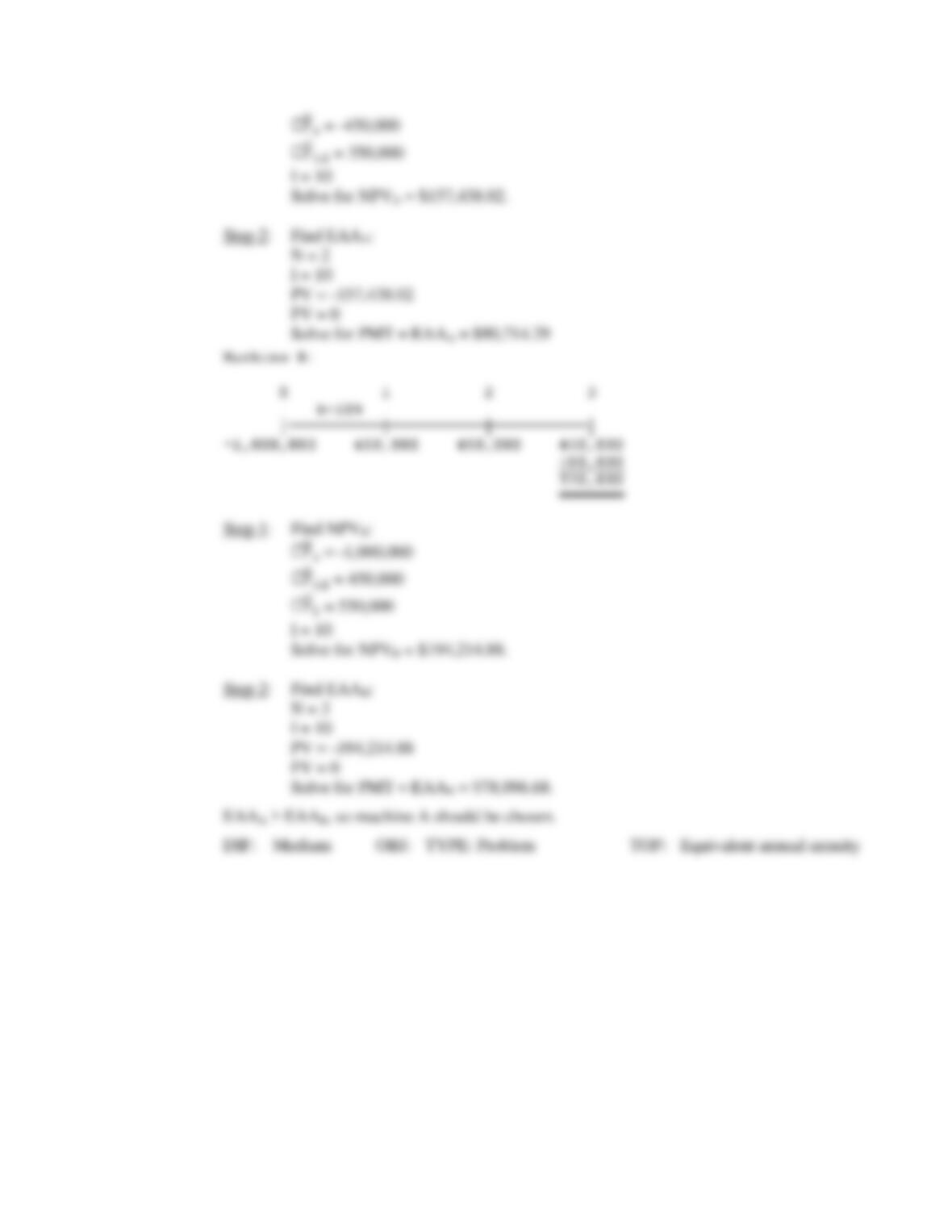
5. Mills Corp. is considering adopting one of two machines. Machine A requires an up-front
expenditure at t=0 of $450,000. Machine A has an expected life of two years, and will generate
positive after-tax cash flows of $350,000 per year (all cash flows are realized at the end of the
year). At the end of two years, the machine will have zero salvage value. Every two years the
company can purchase a replacement machine with identical cash flows.
Alternatively, Machine B requires an expenditure of $1 million at t=0. Machine B has an
expected life of three years, and will generate positive after-tax cash flows of $450,000 per year
(all cash flows are realized at year end). At the end of three years, Machine B will have an after-
tax salvage value of $100,000. Every three years the company can purchase a replacement
machine with identical cash flows.
The required rate of return is 10 percent. What is the equivalent annual annuity (EAA) of the
better machine?
a.
$69,234.02
b.
$78,096.68
c.
$90,714.29
d.
$157,438.02
e.
$194,214.88
Chapter 10 Appendix 10B Project Cash Flows and Risk 257
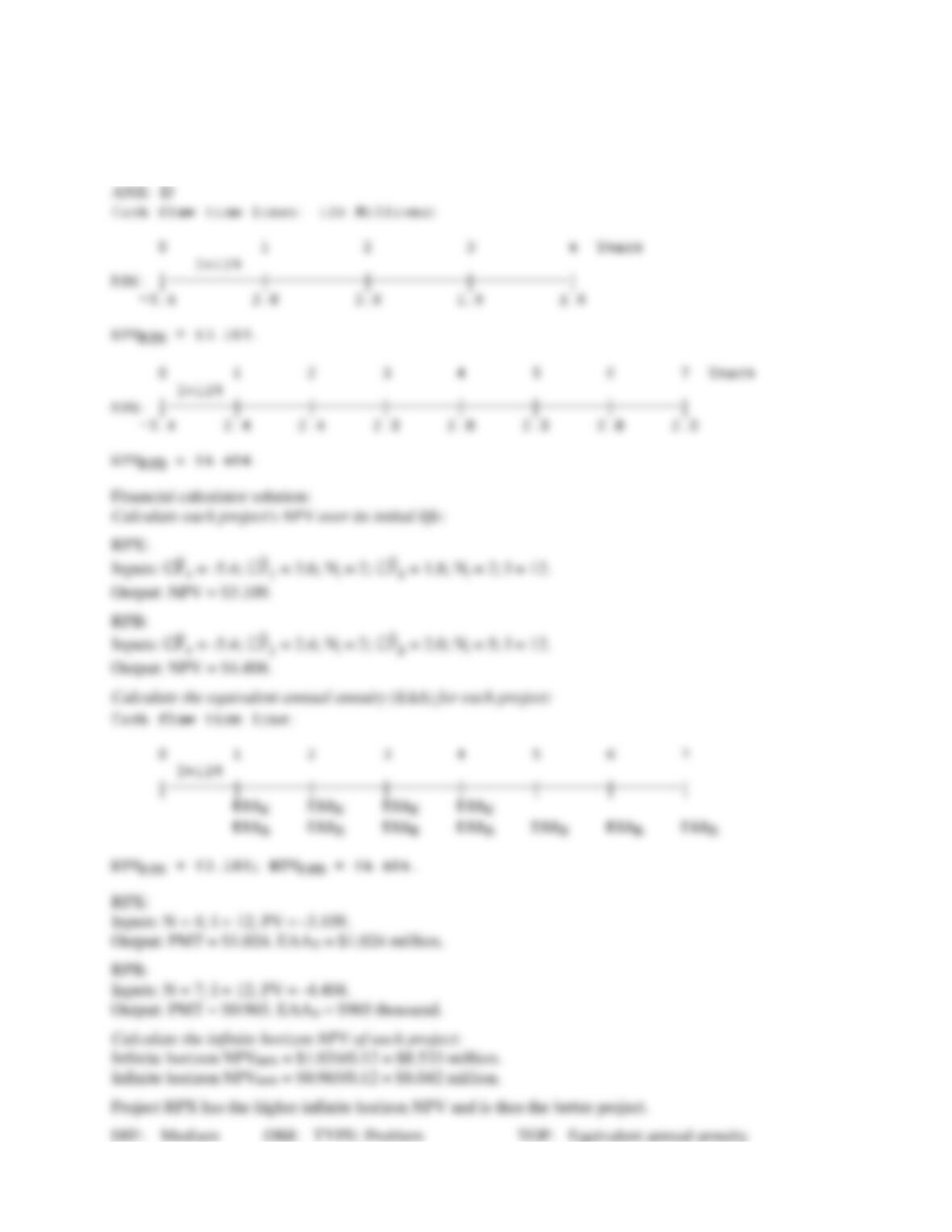
6. King Racing Company (KRC) is considering which of two mutually exclusive engine
development projects to pursue. King’s RPX design has an expected life of 4 years and projected
cash inflows are $3.6 million at the end of each of the first two years and $1.8 million in each of
the next two years. King’s RPB design is more flexible and has a 7-year life. The projected end of
year flows from the RPB design are $2.4 million in each of the first two years and $2.0 million in
each of the next five years. Both projects require an initial investment of $5.4 million, and King’s
required rate of return is 12 percent. Frequent changes in racing rules and engine technology
make engine development risky, but King feels that the basic designs can be refined and
modified. Thus, King often assumes that continuous replacements can be made as a project’s life
ends. However, the length of the future project replacements is variable, so King does not use
replacement chain (common life) analysis, but rather evaluates such projects on an equivalent
annual cash flow basis. What is the infinite horizon NPV of the better project?
a.
$3.109 million
b.
$4.404 million
258 Chapter 10 Appendix 10B Project Cash Flows and Risk
c.
$8.042 million
d.
$8.533 million
e.
$10.605 million