
Chapter 10—Stockholders’ Equity Key
1. All authorized stock is issued.
2. Shares outstanding may be less than shares issued.
3. All treasury stock is outstanding.
4. When true no-par stock is sold for cash, the amount credited to the stock account is the par value times the
number of shares sold.
5. Treasury stock is stock that has been issued but is no longer outstanding.
6. When treasury stock is reissued at a price that is less than their cost, the difference should be credited to
retained earnings.
7. When treasury stock is reissued at a price that is greater than their cost, the difference should be credited to
the Treasury Stock account.
8. Treasury stock is reported as a reduction of stockholders’ equity.

9. Since stock dividends are paid with shares of stock instead of cash, no reduction in Retained Earnings is
recorded.
10. The par value of stock is reduced when stock dividends are issued.
11. The stockholders’ equity section of the balance sheet shows all changes in stockholders’ equity for the
period.
12. Comprehensive income represents the increase in net assets resulting from all transactions occurring during
the accounting period except transactions with owners.
13. Accumulated other comprehensive income is NOT considered to be a source of stockholders’ equity.
14. If a new business does not have access to the major capital markets, it may depend upon venture capital for
its initial equity capital.
15. Private corporations typically issue their stock to management and employees rather than the general
public.
16. A corporation may become chartered by applying to the federal government.
17. A corporate charter is sometimes called the articles of incorporation.

18. The preemptive right entitles a common stockholder to a proportionate share of any dividend payouts.
19. The residual claim entitles a common stockholder to a proportionate share of a liquidating payout before
preferred stockholders are paid.
20. Cumulative and participating dividend features are typically associated with preferred stock.
21. A call provision sets forth provisions for a corporation to redeem its preferred stock at a fixed price on or
after a specified date.
22. Preferred stockholders typically do not have the right to vote at stockholders meetings.
23. If preferred stock is convertible, then the preferred shareholders have the option to trade voting privileges
for the dividend payment preference.
24. If preferred stock is participating, then the preferred shareholders have the right to share in excess dividends
above their stated dividend.
25. Par value is adjusted annually to reflect the current market value of the stock.
26. When a company issues no-par stock with no stated value, there is no need for an account titled “paid-in
capital in excess of par.”

27. Stated capital is the amount of capital that, under law, cannot be returned to the corporation’s owners except
upon liquidation.
28. A stock option is the same as a stock warrant.
29. The stated value is the price at which employees can exercise stock options.
30. A corporation may extend a tender offer when it desires to acquire treasury stock.
31. Large corporations are profitable enough to maintain their own stockholder lists and arrange for the issuance
of their stock certificates to stockholders rather than having to retain an independent stock transfer agent to do
those things.
32. Dividend-related dates follow this chronological order: declaration date, record date, and payment date.
33. When a corporation declares a dividend, a liability must be recorded.
34. Liquidating dividends must be charged against the capital stock accounts because the corporation’s retained
earnings are appropriated for future business expansion.
35. Capitalization of retained earnings occurs when a corporation’s stock is split.

36. Both stock dividends and stock splits increase the number of a corporation’s outstanding shares without
altering the proportionate ownership of the corporation.
37. A stock split has the effect of reducing the par value per share and the number of shares outstanding.
38. No formal journal entry is required to record a stock split.
39. Dividends in arrears are associated with the cumulative preferred stock only.
40. Restricted earnings are usually disclosed in the footnotes to the financial statements, but may sometimes be
disclosed in a reserve account in the equity section of the balance sheet.
41. In general, retained earnings represents accumulated earnings of the corporation less dividends paid.
42. When computing earnings per share, the numerator includes net income minus any dividends paid to
common stockholders.
43. When computing the dividend yield, net income is divided by the common stock price.
44. When computing the dividend payout ratio, net income is divided by the common stock dividends.

45. When computing the total payout ratio, common stock dividends plus common stock repurchases are
included in the numerator.
46. ____________________ represents the owners’ claims against the assets of a corporation after deducting all
liabilities.
47. The number of shares sold to stockholders are ____________________ shares.
48. The corporate _________________ is the legal document that authorizes the creation of a corporation.
49. An arbitrary monetary amount that has a stated value on each share of stock and establishes a minimum
price for the stock when issued is the ____________________.
50. The number of shares issued minus the number of shares of treasury stock is ____________________
shares.
51. ____________________ shares are the maximum number of shares a corporation may issue in accordance
with its corporate charter.
52. ____________________ is the name of the account credited when a corporation issues common stock for a
price greater than par.

53. The corporation’s accumulated net income that has not been paid out as dividends is
____________________.
54. The corporation’s retained earnings is computed by adding the beginning balance and net income, then
subtracting the current year ____________________.
55. Issued stock that is repurchased by the corporation but not retired is ____________________.
56. The ____________________ ratio is computed by dividing common stock dividends by net income.
57. The ____________________ ratio is computed by subtracting the dividend payout ratio from the total
payout ratio.
58. To compute the return on common equity ratio, the numerator includes ____________________ minus
preferred dividends, and the denominator is the average common stockholders’ equity.
59. When stockholders exchange their shares of stock for additional shares, and there is a corresponding
reduction in the par value of the stock, a stock ____________________ has occurred.
60. When stockholders receive a distribution of additional shares of stock, and there is a corresponding
capitalization of retained earnings, a stock ____________________ has occurred.
61. The _________________ preference is a preferred stock feature that provides for the current stated
dividends to be paid to preferred stockholders before they are paid to common stockholders.

62. The __________________ dividend preference is a preferred stock feature that provides for the current
stated dividends plus dividends in arrears before any dividends are paid to the common stockholders.
63. The _______________ dividend preference is a preferred stock feature that provides for the current stated
dividends plus a share of dividends available for distribution to other classes of stockholders.
64. A ____________________ is a correction of retained earnings resulting from a previous error that affected
net income.
65. The ____________________ right provides that common stockholders may keep the same percentage of
ownership if new stock is issued.
66. The designated price for which employees may exercise stock options is called the ____________________
price.
67. The ____________________ date is the date on which a corporation announces that it will pay a dividend.
68. When a corporation is in the process of being dissolved, any additional dividends are referred to as
____________________ dividends.
69. If the stated cash dividend on cumulative preferred stock has been unpaid for a period of one year or more,
it is referred to as a dividend ____________________.
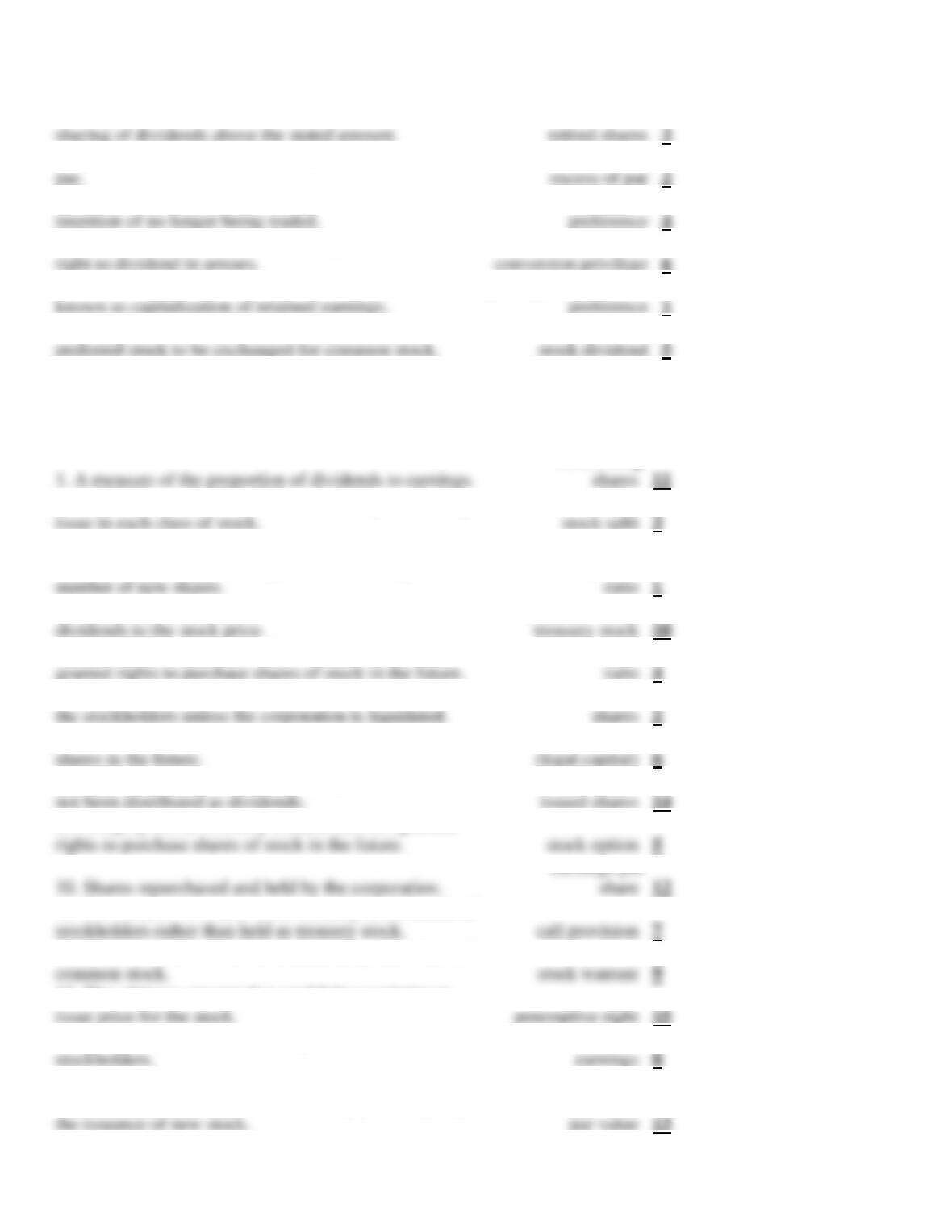
70. Match the terms to the definitions.
1. The preferred stock feature which provides for the
2. The portion of the stock’s issue price that exceeds
paid-in capital in
3. Shares of stock that are repurchased with the
cumulative dividend
4. The preferred stock feature which provides the
5. Shares of stock that are distributed in a process
participating dividend
6. The preferred stock feature which provides for
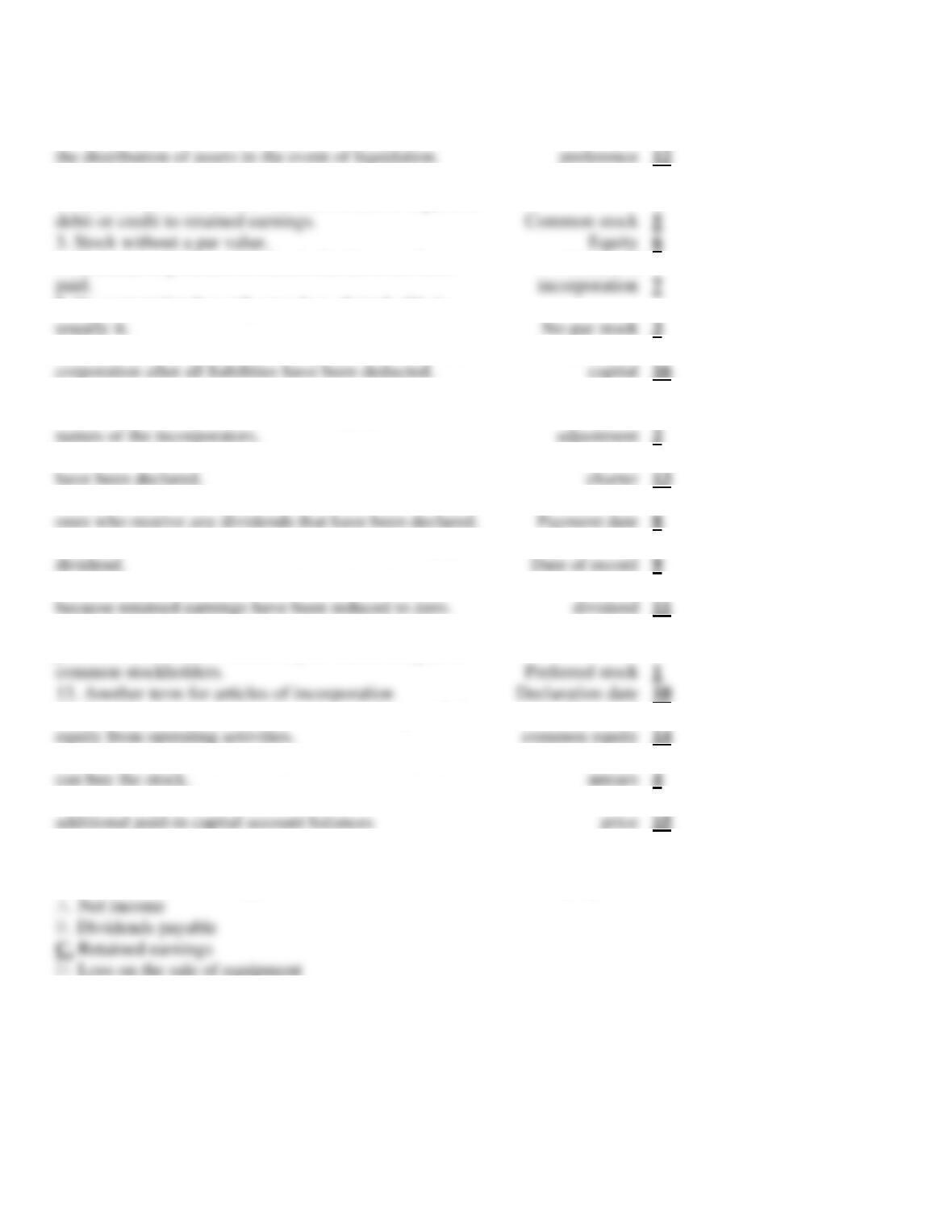
71. Match the terms to the definitions.
outstanding
2. The maximum number of shares the corporation may
3. A decrease in the par value of a class of stock brought
about by the exchange of original shares for a greater
dividend payout
4. A measure of the proportion of common stock
5. A form of compensation whereby employees are
dividend yield
6. A stated amount of capital that cannot be returned to
authorized
7. Authorization for the corporation to redeem preferred
stated capital
8. Accumulated net income of the corporation that has
9. An equity kicker whereby stockholders are granted
earnings per
11. The number of issued shares actually in the hands of
12. A measure of net income measured by each share of
13. The arbitrary amount that establishes a minimum
14. The number of shares the corporation has sold to
retained
15. A common stock provision that provides for the
maintenance of stockholders’ ownership percentage upon
72. Match the following terms to their correct definition.
1. Individuals who hold this stock receive priority over
common shareholders in the payment of dividends and
Current dividend
2. Refers to a situation where an error resulted in a
misstatement of net income and the correction requires a
4. Cumulative preferred dividends that have not been
Articles of
5. If a corporation has only one class of stock, this is
6. Represents the owners’ claims against the assets of a
Contributed
7. Document that authorizes the creation of the
corporation, setting forth its name and purpose and the
Prior period
8. Date on which shareholders receive dividends that
Corporate
9. Shareholders holding the shares on this date are the
10. Date on which the Board of Directors votes to pay a
11. Dividends that are paid out of contributed capital
Liquidating
12. Provides that current dividends must be paid to
preferred stockholders before any dividends are paid to
14. A performance measures that assesses the growth in
Return on
15. In a stock option plan, the price at which employees
Dividends in
16. The sum of all preferred stock, common stock, and
Exercise (strike)
73. Which of the following is one of the elements of stockholders’ equity?
74. Which of the following statements is true with regard to equity capital?
75. Authorized stock represents the
76. Issued shares represent the
77. Outstanding shares represent the
78. Treasury shares represent the
79. Par value represents the

80. Total stockholders’ equity includes $50,000 of common stock with a stated value of $0.50, and 5,000 shares
of treasury stock with a total cost of $25,000. How many total shares are outstanding?
81. The stockholders’ equity section of a balance sheet at December 31, 2015 is provided below:
Common stock, $0.50 par value
$10,000
Paid-in capital in excess of par—common stock
40,000
Total capital stock
50,000
Retained earnings
25,000
Less: Treasury stock (at cost, $20 per share)
< 2,000>
Total Stockholders’ Equity
$73,000
How many shares of stock are issued?
82. On January 1, 2012, a company issued 10,000 shares of 10%, $10 par value cumulative preferred stock. No
dividends were declared in 2012 or 2013. In 2014, the company declared a dividend of $200,000. How much of
the 2014 dividend should be paid to common stockholders?
83. A corporation has 5,000 shares of $5 par, 6% cumulative preferred stock outstanding and 25,000 shares of
$2 par common stock outstanding. No dividends have been paid for the past two years. If the company wishes
to distribute $2 per share to the common stockholders this year, what is the total amount of dividends that must
be paid?
84. Which of the following statements is true with regard to 7% cumulative, participating preferred stock?
85. Which of the following types of information is not set forth within the corporate charter?
86. A particular balance sheet includes the following information within the stockholders’ equity section:
Common stock, $5 par value
$ 300,000
Paid-in capital in excess of par
1,740,000
Assume that common stock is the only class of stock that has been issued and that there have been two issues of stock since the corporation began
business. What is the average issue price per share of stock?
87. The balance in the retained earnings account represents
88. Which of the following statements is true pertaining to participating preferred stock?
89. Many stockholders choose to invest in preferred stock because
90. Suppose a corporation issues 5,000 shares of $1 par common stock for $30 per share. In addition to the
increase in cash, what effect does this transaction have on the accounting equation?
91. Which of the following is true for a corporation that issues 1,000 shares of $2 par common stock at $5 per
share?
92. What will be the increase in the Paid-in capital in excess of par account if a corporation issues 20,000 shares
of $1.00 par common stock for $6 per share?
93. Lanier Tech
This company was incorporated as a new business on January 1, 2015. The company is authorized to issue
50,000 shares of $5 par common stock and 10,000 shares of 6%, $10 par, cumulative, participating preferred
stock. On January 1, 2015, the company issued 8,000 shares of the common stock for $15 per share and 2,000
share of the preferred stock for $30 per share. Net income for the year ended December 31, 2015 was $375,000.
Refer to Lanier Tech. What is the amount of the company’s total capital stock at December 31, 2015?
94. Lanier Tech
This company was incorporated as a new business on January 1, 2015. The company is authorized to issue
50,000 shares of $5 par common stock and 10,000 shares of 6%, $10 par, cumulative, participating preferred
stock. On January 1, 2015, the company issued 8,000 shares of the common stock for $15 per share and 2,000
share of the preferred stock for $30 per share. Net income for the year ended December 31, 2015 was $375,000.
Refer to Lanier Tech. What is the number of the company’s unissued shares of common stock at December 31,
2015?
95. Lanier Tech
This company was incorporated as a new business on January 1, 2015. The company is authorized to issue
50,000 shares of $5 par common stock and 10,000 shares of 6%, $10 par, cumulative, participating preferred
stock. On January 1, 2015, the company issued 8,000 shares of the common stock for $15 per share and 2,000
share of the preferred stock for $30 per share. Net income for the year ended December 31, 2015 was $375,000.
Refer to Lanier Tech. Assume that no dividends were declared or paid during the first year of operations. What
is the dollar amount of total stockholders’ equity reported on the balance sheet at December 31, 2015?
96. Lanthier’s Heating & Air
This company began business on June 1, 2014. The articles of incorporation authorize issuance of 10,000 shares
of $2 par common stock and 5,000 shares of $8 par 6% cumulative preferred stock.
Refer to Lanthier’s Heating & Air. On June 5, 2014, the company issued 2,400 shares of common stock for $20
per share. What effect does the entry to record the stock issuance have on total stockholders’ equity?
97. Lanthier’s Heating & Air
This company began business on June 1, 2014. The articles of incorporation authorize issuance of 10,000 shares
of $2 par common stock and 5,000 shares of $8 par 6% cumulative preferred stock.
Refer to Lanthier’s Heating & Air. What is the maximum amount that can be reported on the balance sheet for
common stock and preferred stock, respectively, if all of the stock is issued?
Common Stock Preferred Stock
98. Lasik Vision, Inc. began business on June 1, 2014. The corporate charter authorized issuance of 1,000
shares of no-par common stock and 4,000 shares of $6 par, 6% cumulative preferred stock. As of the beginning
of 2015, 200 shares of common stock had been issued and none of the preferred stock had been issued. If the
company issues 400 shares of common stock on March 1, 2015 for $10 per share, the journal entry would
include a
99. Ladder Distributors
The stockholders’ equity section of the December 31, 2014, balance sheet is provided below:
Common Stock, $30 par, 20,000 shares issued and outstanding
$ 600,000
Paid-in Capital in Excess of Par—Common Stock
240,000
Retained Earnings
700,000
Total Stockholders’ Equity
$1,540,000
Assume that all of the 20,000 shares of stock that was issued as of December 31, 2014, was issued for $42 per share. On March 1, 2015, the company
reacquired 4,000 shares of its common stock for $50 per share.
Refer to Ladder Distributors. How much should be reported on the company’s March 31, 2015, balance sheet for treasury stock?
100. Ladder Distributors
The stockholders’ equity section of the December 31, 2014, balance sheet is provided below:
Common Stock, $30 par, 20,000 shares issued and outstanding
$ 600,000
Paid-in Capital in Excess of Par—Common Stock
240,000
Retained Earnings
700,000
Total Stockholders’ Equity
$1,540,000
Assume that all of the 20,000 shares of stock that was issued as of December 31, 2014, was issued for $42 per share. On March 1, 2015, the company
reacquired 4,000 shares of its common stock for $50 per share.
Refer to Ladder Distributors. What is the total amount of stockholders’ equity that will be presented on the company’s March 31, 2015, balance
sheet?
101. Ladder Distributors
The stockholders’ equity section of the December 31, 2014, balance sheet is provided below:
Common Stock, $30 par, 20,000 shares issued and outstanding
$ 600,000
Paid-in Capital in Excess of Par—Common Stock
240,000
Retained Earnings
700,000
Total Stockholders’ Equity
$1,540,000
Assume that all of the 20,000 shares of stock that was issued as of December 31, 2014, was issued for $42 per share. On March 1, 2015, the company
reacquired 4,000 shares of its common stock for $50 per share.
Refer to Ladder Distributors. Suppose the company reissued 1,000 shares of its treasury stock on June 1, 2015, for $44 each. Which of the following
is true regarding the entry required to record this transaction?
102. Ladder Distributors
The stockholders’ equity section of the December 31, 2014, balance sheet is provided below:
Common Stock, $30 par, 20,000 shares issued and outstanding
$ 600,000
Paid-in Capital in Excess of Par—Common Stock
240,000
Retained Earnings
700,000
Total Stockholders’ Equity
$1,540,000
Assume that all of the 20,000 shares of stock that was issued as of December 31, 2014, was issued for $42 per share. On March 1, 2015, the company
reacquired 4,000 shares of its common stock for $50 per share.
Refer to Ladder Distributors. Suppose the company reissued 1,000 shares of its treasury stock on June 1, 2015, for $39 each. Which of the following
is true regarding the entry required to record this transaction?
103. A corporation began operations on October 1, 2014, with 3,000 shares of $2 par common stock authorized.
The company issued common stock on several occasions during 2014 and 2015. On December 31, 2015, the
company repurchased 1,000 shares of its outstanding shares and then reissued 500 of these shares on March 1,
2016. On June 1, 2016, the company’s board of directors declared a 2-for-1 stock split. As a result of this stock
split, which of the following is true?
104. Lake Lanier Grill
The stockholders’ equity section of the December 31, 2014, balance sheet is provided below:
Common Stock, $3 par, 2,000 shares issued and outstanding
$6,000
Paid-in Capital in Excess of Par—Common Stock
1,000
Retained Earnings
5,400
Total Stockholders’ Equity
$12,400
Assume that all 2,000 shares of stock were issued as of December 31, 2014 for $3.50 per share. On March 1, 2015, the company reacquired 1,000
shares of its common stock for $4.50 per share.
Refer to Lake Lanier Grill, Inc. The journal entry to record the transaction on March 1 includes a credit to what account and for what amount?
105. Lake Lanier Grill
The stockholders’ equity section of the December 31, 2014, balance sheet is provided below:
Common Stock, $3 par, 2,000 shares issued and outstanding
$6,000
Paid-in Capital in Excess of Par—Common Stock
1,000
Retained Earnings
5,400
Total Stockholders’ Equity
$12,400
Assume that all 2,000 shares of stock were issued as of December 31, 2014 for $3.50 per share. On March 1, 2015, the company reacquired 1,000
shares of its common stock for $4.50 per share.
Refer to Lake Lanier Grill, Inc. If all of the 1,000 shares that Lake Lanier Grill repurchased on March 1 were later reissued for $4.00 per share, the
journal entry to record this transaction includes a debit to what account and for what amount?
106. All of the following are reasons that a corporation may purchase treasury stock except:
107. Which of the following statements is true regarding a corporation’s purchase of treasury stock?
108. If a corporation repurchases 500 shares of its previously-issued common stock for $5,000 and then reissues
it for $4,000, which of the following statements is true regarding the difference in the amounts of the repurchase
and reissuance?
109. If a corporation repurchases 500 shares of its previously-issued common stock then retires these shares,
which of the following is true?
110. If a corporation declares a 2-for-1 stock split, which of the following is true?
111. If a corporation declares a 2-for-1 stock split, which of the following is true?
112. If a corporation declares a 2-for-1 stock split, which of the following is true?
113. A growing corporation had $180,000 of its $30 par common stock issued before its recent 3-for-1 stock
split. The market price of the stock was $120 per share before the split. Which of the following is true as a result
of the split?