Managerial Decision Modeling w/ Spreadsheets, 3e (Balakrishnan/Render/Stair)
Chapter 10 Simulation Modeling
10.1 Chapter Questions
1) John Smith is planning to refinance his home mortgage to take advantage of the lower current interest
rates. As part of the refinancing application, the bank needs to appraise Mr. Smith’s home. Mr. Smith
expects an appraisal of at least $175,000 but no more than $250,000. All values between $175,000 and
$250,000 have the same probability of being the actual appraised value. What is the appropriate
distribution for simulating appraisal values?
A) continuous uniform
B) triangular
C) binomial
D) discrete uniform
E) normal
2) What is the correct distribution for simulating the outcome of a single coin?
A) continuous uniform
B) triangular
C) binomial
D) exponential
E) normal
3) The technique of randomly generating values for unknown elements in a model using random
sampling is known as ________.
A) optimization
B) Markov analysis
C) discrete-event simulation
D) simulation gaming
E) Monte Carlo simulation
4) What distribution is appropriate for simulating the event of rolling a single die?
A) continuous uniform
B) triangular
C) binomial
D) discrete uniform
E) normal
5) A five-star hotel accepts 100 room reservations daily. For each reservation accepted, there is a 7%
chance that the guest will not arrive. You decide to build a simulation model to describe the number of
guests who will show up. The best appropriate distribution to use is:
A) normal
B) continuous uniform
C) discrete uniform
D) binomial
E) triangular
6) A queuing system has an arrival rate of 5 customers per hour and a service rate of 8 customers per
hour. You decide to build a simulation model to describe the service time per customer. The best
appropriate distribution to use is:
A) triangular
B) exponential
C) normal
D) binomial
E) discrete uniform
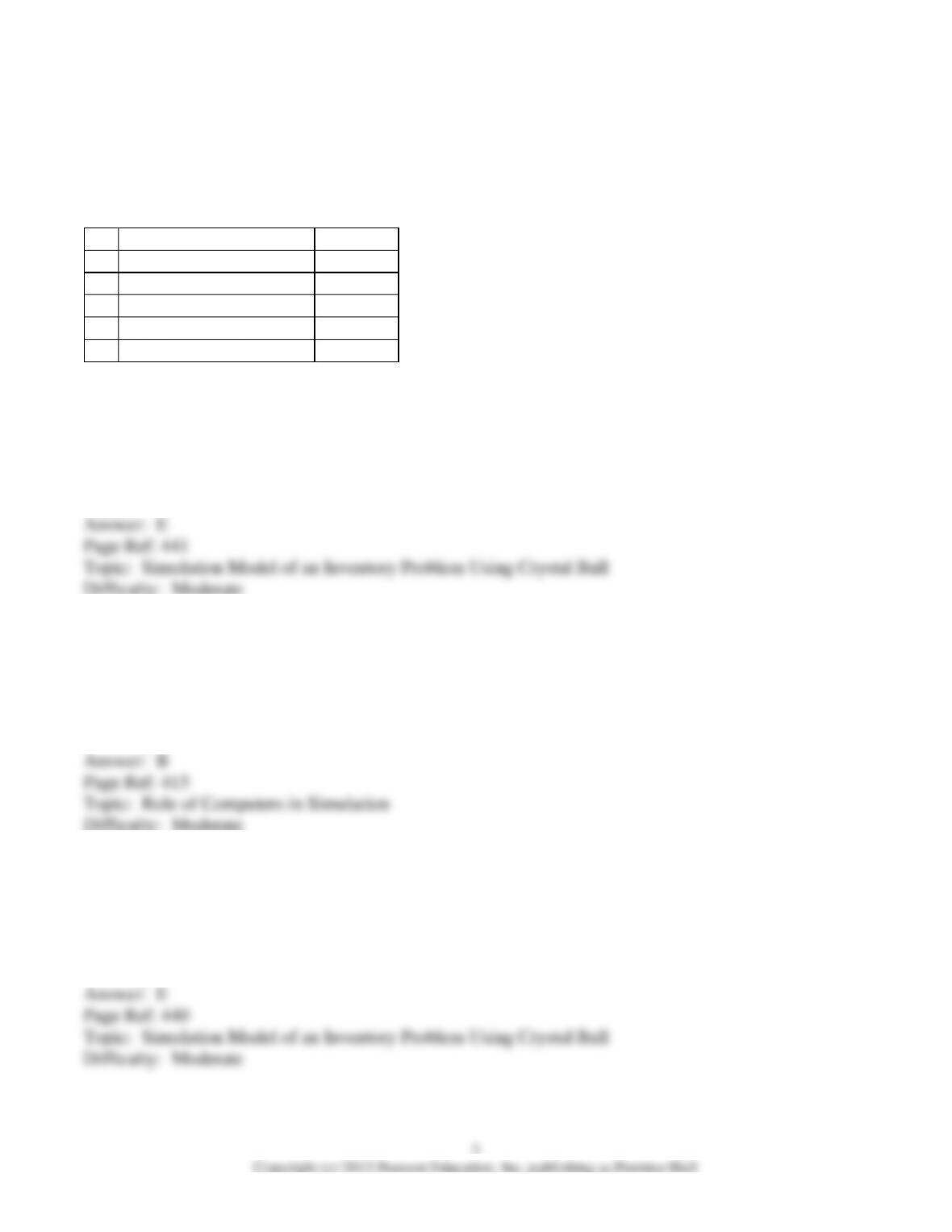
Use this information and output to answer the following questions.
Rentals-R-Us specializes in 4WD car rentals. The number of rentals per month typically ranges between
10 and 50. You may assume equal probability for the number of rentals to assume any value in that
range. The monthly operating costs for Rentals-R-Us can range anywhere from $2,000 to $4,000, with
$3,000 being the most probable cost. Each rented vehicle generates $55 in revenues. You decide to
build a simulation model in Crystal Ball to simulate monthly profits.
A
B
1
Rentals-R-Us
2
Number of car rentals
50
3
Rental per car
$55
4
Monthly operating costs
$2,000
5
Profit or loss
$750
7) Refer to the table. Which cell(s) would be designated as the “Forecast cell”?
A) A5
B) B2
C) B3
D) B4
E) B5
8) Refer to the table. What is the appropriate distribution for the variable “Number of car rentals”?
A) continuous uniform
B) discrete uniform
C) normal
D) binomial
E) triangular
9) Refer to the table. What is the appropriate distribution for the variable “Monthly operating costs”?
A) continuous uniform
B) discrete uniform
C) normal
D) binomial
E) triangular
10) Refer to the table. What is the appropriate equation for cell B5?
A) =B2 – B4
B) =B3 – B4
C) =B4 – B2*B3
D) =B4 – B3*B2
E) =(B2*B3) – B4
11) The Excel function =RAND() generates random numbers that are:
A) greater than 0
B) less than 1
C) between 0 and 0.9999
D) between -1 and 1
E) greater than 1
12) What are output measures called in Crystal Ball?
A) forecasts
B) decisions
C) assumptions
D) random variables
E) cell preferences
13) Which of the following is considered a disadvantage of simulation?
A) Simulation models do not allow for time compression.
B) Simulation models do not allow for what-if analysis.
C) Simulation models cannot emulate real systems.
D) Simulation models do not generate optimal solutions.
E) Simulation models are not unique.
14) The sum of all previous probabilities up to the current probability is the ________.
A) cumulative probability
B) conditional probability
C) marginal probability
D) prior probability
E) posterior probability
15) Simulation usually generates optimal solutions.
16) Simulation results can produce different solutions in repeated runs.
17) The uniform distribution can be discrete or continuous.
18) Replicating a model about 20 times is adequate for the simulation results to be valid and useful.
19) To establish a probability distribution, the relative frequency for each possible outcome of the
variable is found by dividing the frequency of observation by the total number of observations.
20) If you simulate the event of tossing a coin 10 times, exactly 5 of the outcomes will be heads and 5
will be tails.
21) Excel uses the RAND() function to generate discrete values between 0 and 1.
22) A simulation model may contain several output measures.
23) In Crystal Ball, probability distributions for input variables can be specified using either built-in
functions or using Crystal Ball’s menu.
24) Crystal Ball’s CB.Custom function can be used to simulate discrete uniform random values.
25) A Decision Table is used in Excel to try at most 2 values automatically for a parameter in the model.
26) In Excel, the function =NORMINV(RAND(),100,5) will return a normally distributed random
number with a standard deviation of 100 and mean of 5.
27) A binomial distribution can yield only two outcomes.
28) Monte Carlo simulation and operational gaming are the only two categories of simulation.
10.2 Excel Problems
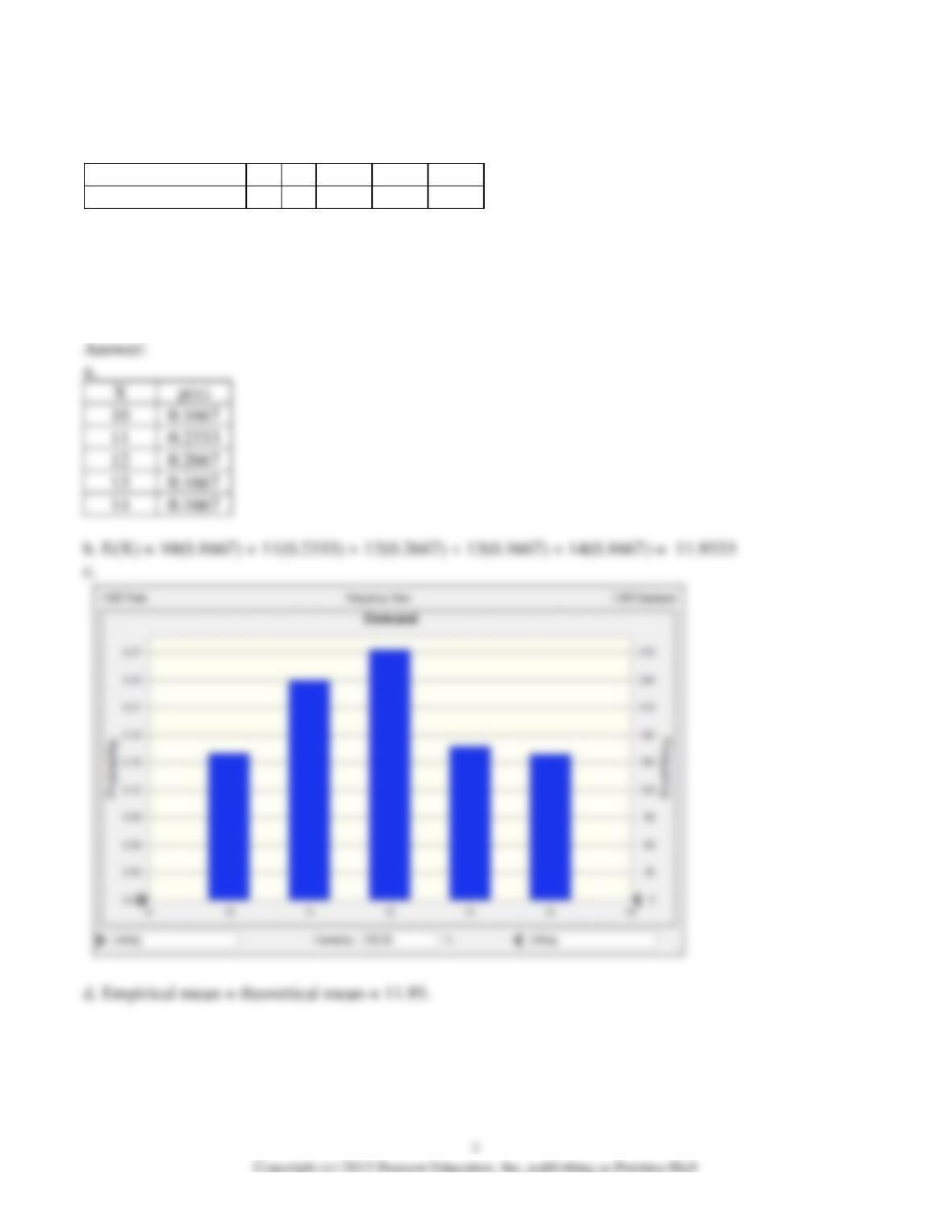
1) Cheap Rentals has collected the following information on the demand for compact cars over the last
30 days.
Daily Demand
10
11
12
13
14
Number of Days
5
7
8
5
5
a. Use the historical data to estimate the probability distribution of demand for compact cars.
b. What is the theoretical expected demand?
c. Use Crystal Ball to simulate 1000 sample demand values.
d. Compare the mean of the 1000 sample values with the theoretical expected mean.
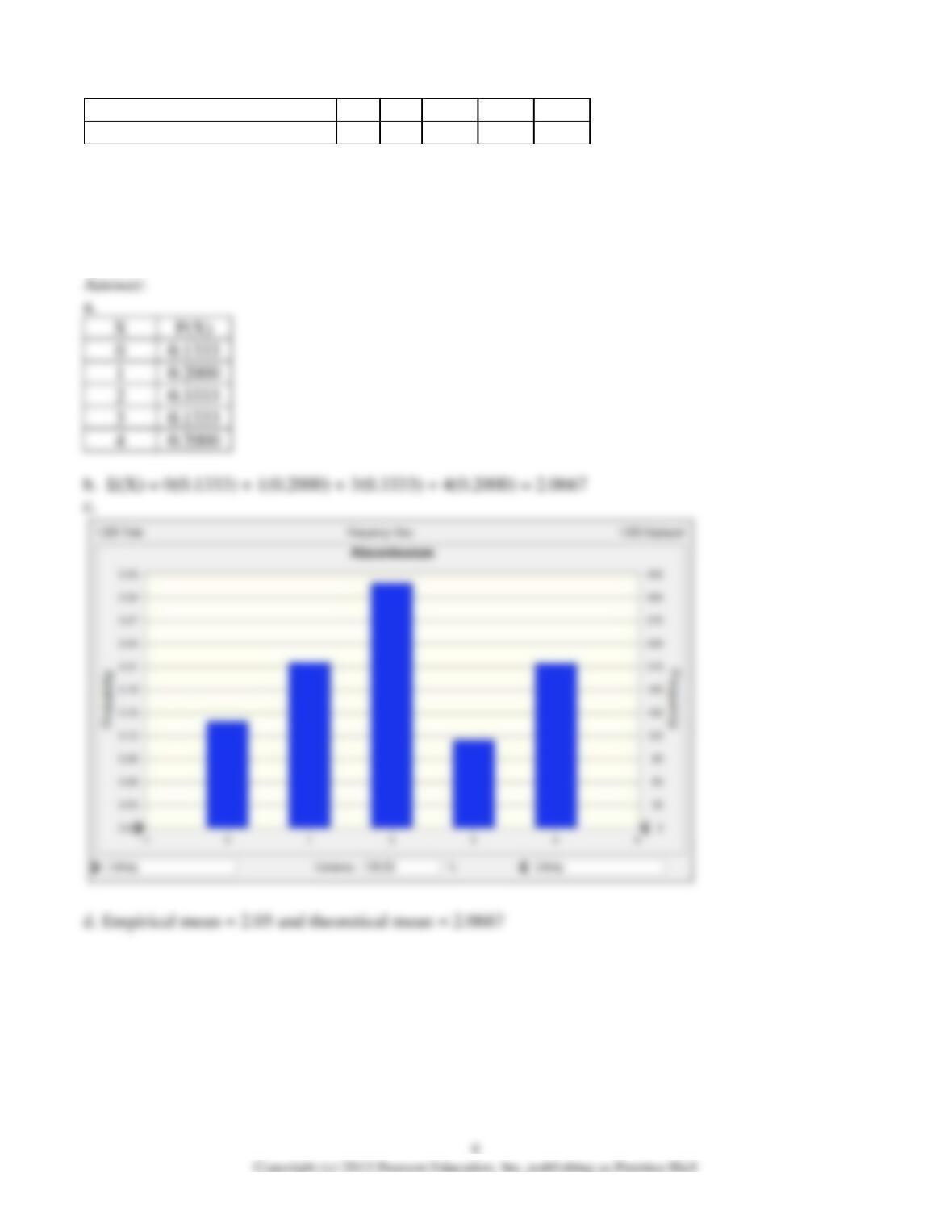
2) An assembly plant has experienced the following daily absenteeism over the past 30 days.
Number of Employees Absent
0
1
2
3
4
Number of Days
4
6
10
4
6
a. Use the historical data to estimate the probability distribution of absenteeism.
b. What is the theoretical expected absenteeism?
c. Use Crystal Ball to simulate 1000 sample absenteeism values.
d. Compare the mean of the 1000 sample values with the theoretical expected mean.
P(X)
3) Consider the event of tossing three coins. You are interested in computing the probability of getting
three heads. Use Crystal Ball to simulate the event of tossing three coins 1000 times.
a. What is the theoretical probability of getting three heads?
b. What is the percentage of getting three heads using the 1000 simulated values?
4) Consider the following game involving a single die. Someone offers to give you $1 if you toss a 1,
$2 if you toss a 2, $3 if you toss a 3, etc. In other words, your earnings will correspond to the face value
of the die. However, to play this game, each toss will cost you $2.50. You decide to use Crystal Ball to
simulate your net earnings per toss based on 1000 simulation runs. What is your mean net earning per
toss based on the simulated sample values?
10
5) In a game of backgammon, your movement is based on the outcome that you get from rolling a pair
of dice. Tossing a pair of sixes on the very first roll will give you a significant initial advantage over
your opponent. Use Crystal Ball to determine the odds of rolling a pair of sixes in 1000 simulation
runs.
6) An insurance company derives its revenues from its three primary business units: home insurance,
auto insurance, and life insurance. The revenues for the year ending 2005, along with the potential
growth rates per business unit for 2006 are illustrated below.
Business Unit 2005 Revenues 2006 Growth Rates
Home Insurance $500,000 Normal; µ = 7%, σ = 2%
Auto Insurance $450,000 Triangular, min = 2%, max = 6%,
most probable = 4%
Life Insurance $550,000 Uniform, min = 4%, max = 10%
a. Use Crystal Ball to simulate total revenues for 2006. Run 1000 replications of the model to find the
average revenues.
b. What is the probability that 2006 revenues will exceed $1.6 million?
7) Joe Smith is a handyman who owns his own plumbing business. In a typical month, the number of
service calls that he gets varies according to the following distribution:
Number of Calls
15
16
17
18
19
Probability
0.3
0.3
0.2
0.1
0.1
His revenues per service call are normally distributed with a mean of $100 and a standard deviation of
$20. His monthly expenses can range between a minimum of $1000 and a maximum of $1500, where all
values between the minimum and maximum occur with equal likelihood.
a. Use Crystal Ball to simulate Mr. Smith’s monthly profits. Run 1000 replications of the model.
b. What is the average monthly profit?
Answer:
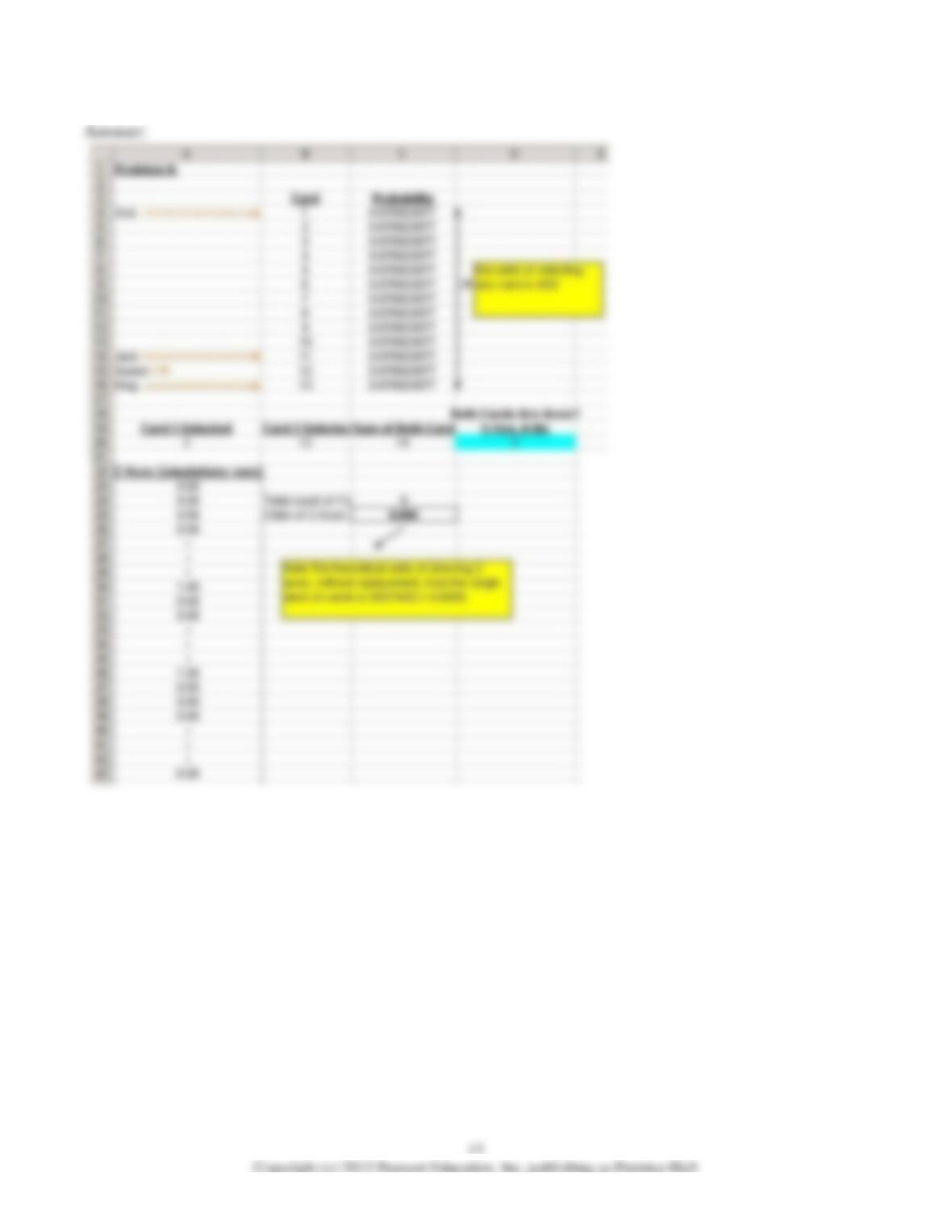
8) Consider a single deck of cards. Use Crystal Ball to determine the odds of drawing 2 aces without
replacement. Use 1000 replications.
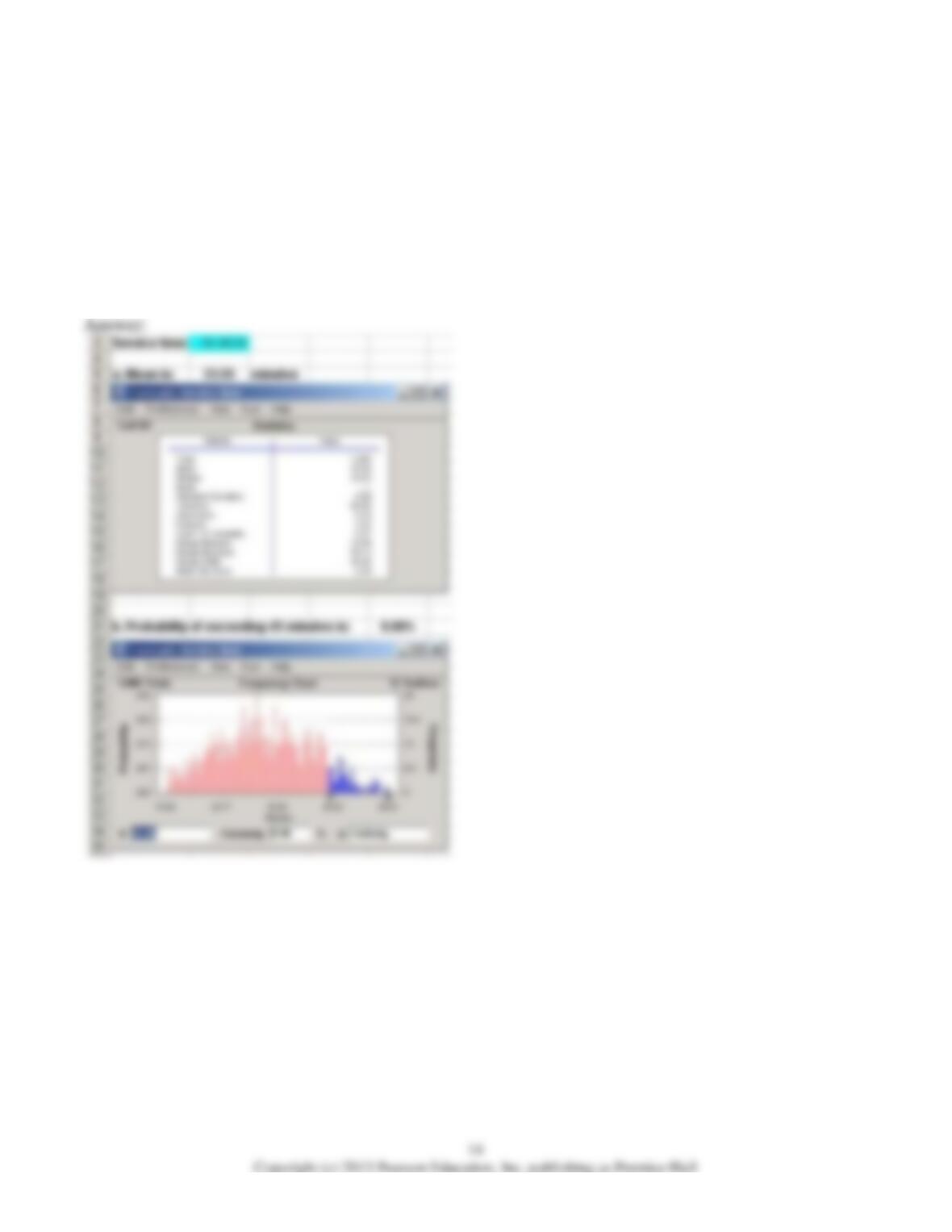
9) A handyman specializes in fixing plumbing and electrical problems. Assume that 40% of the service
calls that he gets relate to electrical problems, while 60% of the service calls relate to plumbing
problems. On average, the time it takes to fix an electrical problem can range between 15 and 45
minutes, where all values between the minimum and maximum occur with equal likelihood. Moreover,
the time it takes to fix a plumbing related problem can take a minimum of 15 minutes and a maximum of
60 minutes, where 30 minutes is the most probable time.
a. Use Crystal Ball to find the average time it takes the handyman to fix a given service call. Use 1000
replications.
b. What is the probability that it will take the handyman more than 45 minutes to complete a given
service call?
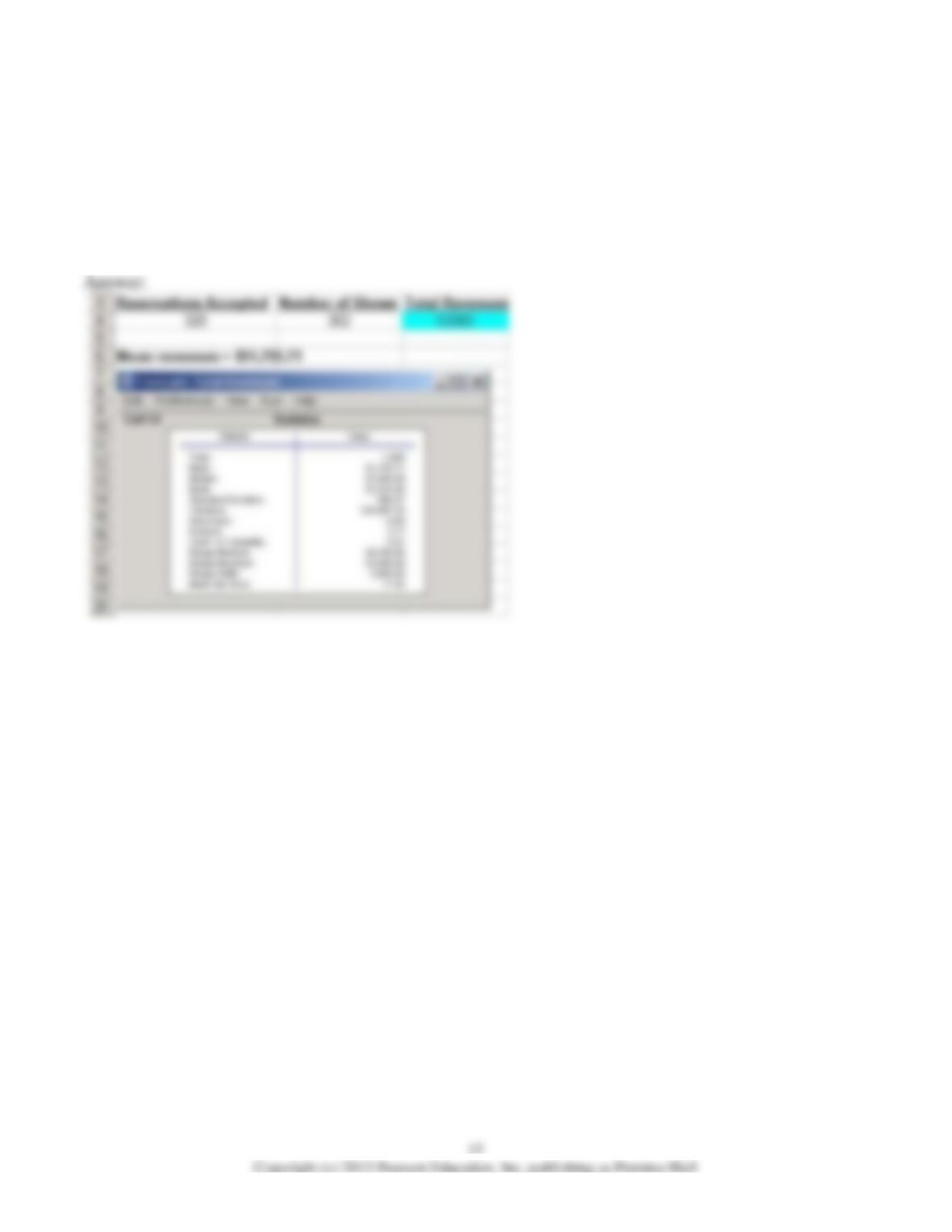
Use this information to answer the following questions.
The Gambler Hotel in Las Vegas has 300 rooms that each rent for $175 per night. For each reservation
accepted, there is a 7% chance that the guest will not arrive. If the hotel overbooks, it incurs $220 for
each reservation that is not honored.
10) Refer to the information above. Suppose that the hotel’s manager believes that accepting 320 nightly
reservations is a policy that the hotel should implement. Use Crystal Ball to estimate the average daily
profit using the manager’s policy. Use 1000 replications.
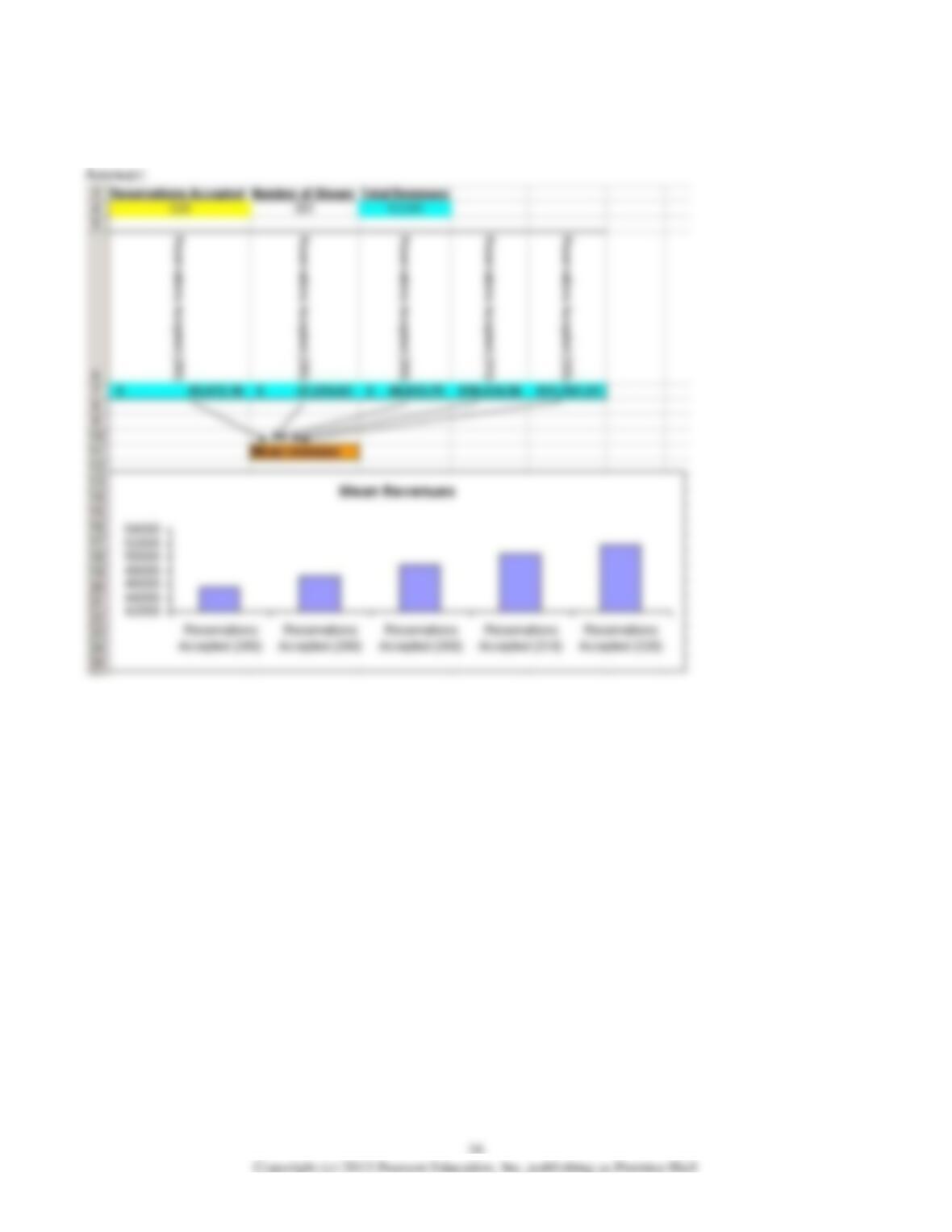
11) Refer to the information above. Suppose that the manager wishes to examine the effect of different
reservation levels on average profitability. In specific, the manager wishes to consider reservation levels
of 280, 290, 300, 310, and 320. Use Crystal Ball’s Decision Table to find the reservation level that
maximizes average profitability. Use 1000 replications.