67. Instructions: Use the present value and future value tables included in Appendix 8 and on the textbook
companion website.
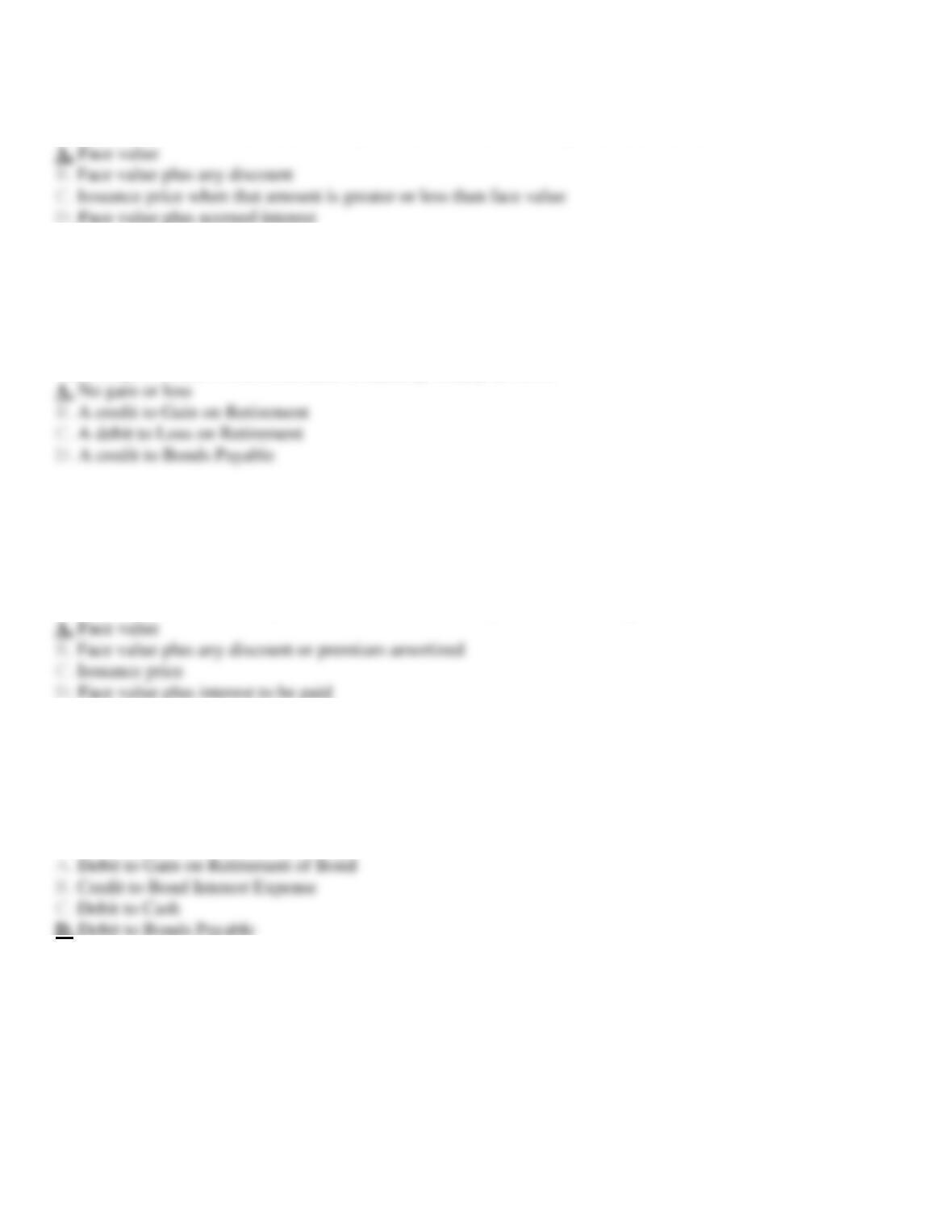
When bonds are first issued, the liability is entered in the Bonds Payable account at the bond’s
68. Instructions: Use the present value and future value tables included in Appendix 8 and on the textbook
companion website.
The entry to record a bond retirement at maturity usually involves
69. Instructions: Use the present value and future value tables included in Appendix 8 and on the textbook
companion website.
Just before bonds are retired, the balance in the Bonds Payable account is equal to the bond’s
70. Instructions: Use the present value and future value tables included in Appendix 8 and on the textbook
companion website.
A bond retired before maturity usually involves a
71. Instructions: Use the present value and future value tables included in Appendix 8 and on the textbook
companion website.
If a gain occurs on the early retirement of bonds, it is
72. Instructions: Use the present value and future value tables included in Appendix 8 and on the textbook
companion website.
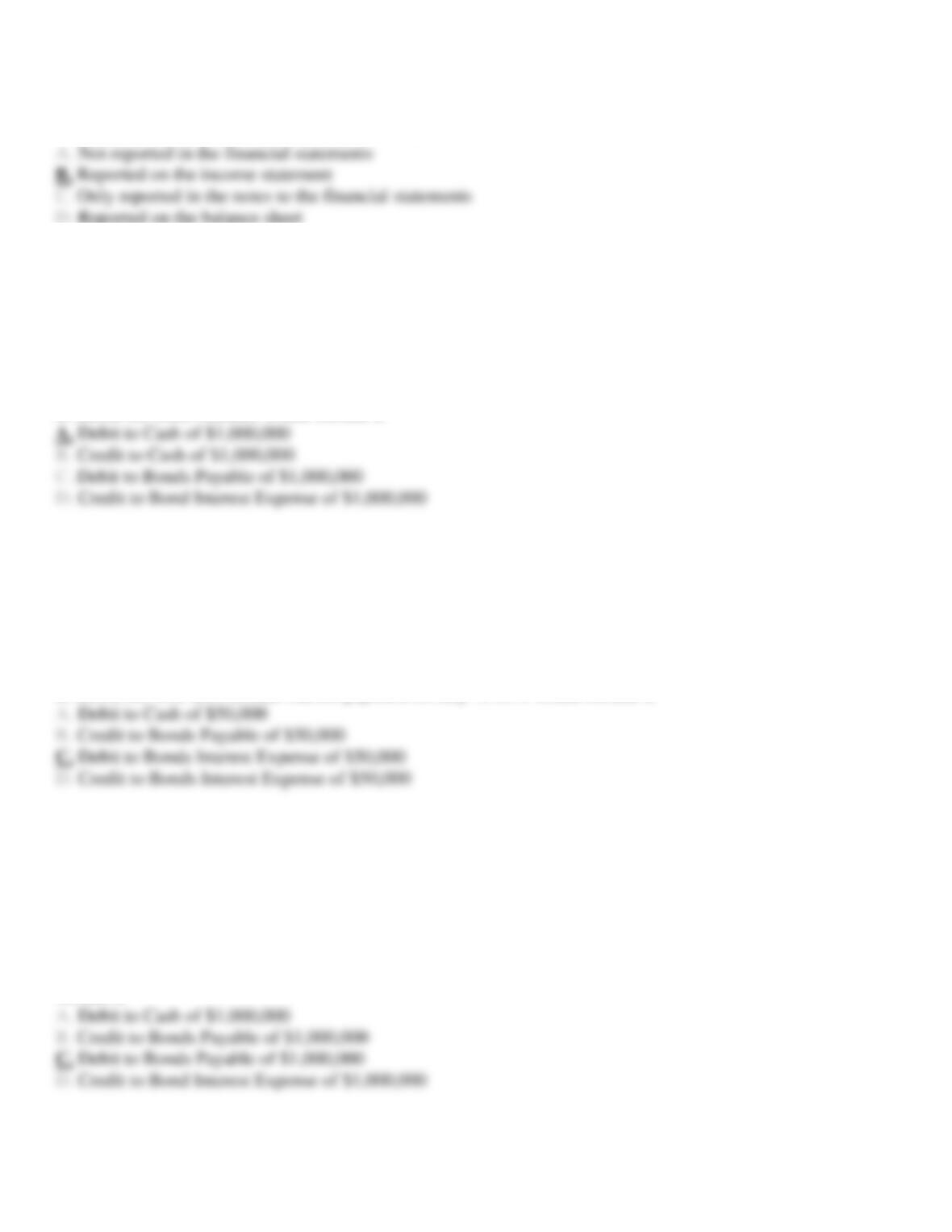
On January 1, 2012, Lawton Corporation issued 10-year, $1,000,000 bonds with a stated interest rate of 10%.
The effective interest rate is 10% and interest is paid semi-annually on January 1 and July 1. The journal entry
to record the bond issuance would include a
73. Instructions: Use the present value and future value tables included in Appendix 8 and on the textbook
companion website.
On January 1, 2012, Lawton Corporation issued 10-year, $1,000,000 bonds with a stated interest rate of 10%.
The effective interest rate is 10% and interest is paid semi-annually on January 1 and July 1. The journal entry
to record the first semi-annual interest payment on July 1, 2012 would include a
74. Instructions: Use the present value and future value tables included in Appendix 8 and on the textbook
companion website.
On January 1, 2012, Lawton Corporation issued 10-year, $1,000,000 bonds with a stated interest rate of 10%.
The effective interest rate is 10% and interest is paid semi-annually on January 1 and July 1. The journal entry
to record the retirement of the bonds on January 1, 2022, assuming all interest has been accounted for, would
include a
75. Instructions: Use the present value and future value tables included in Appendix 8 and on the textbook
companion website.
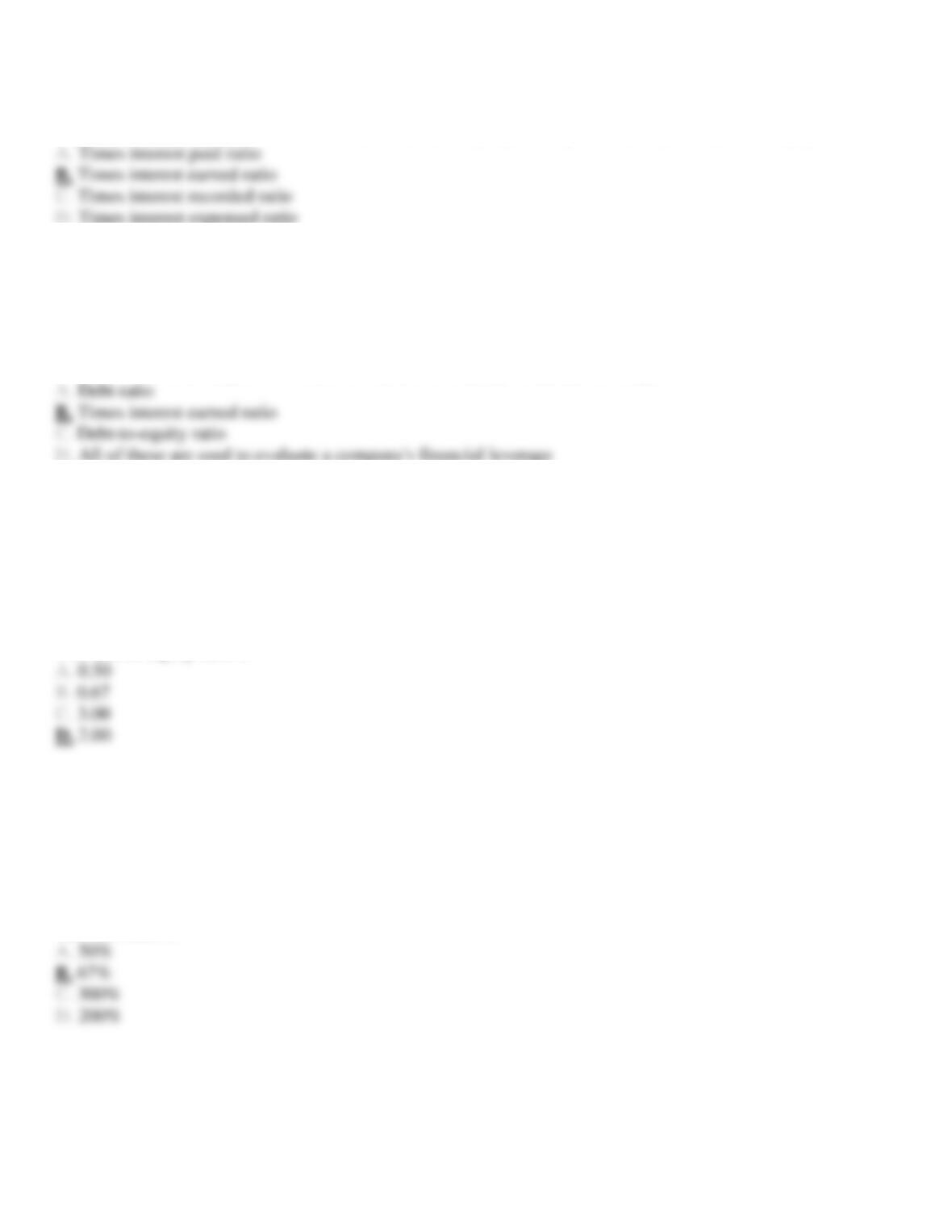
Which of the following ratios is used to evaluate a company’s ability to meet its periodic interest payments?
76. Instructions: Use the present value and future value tables included in Appendix 8 and on the textbook
companion website.
Which of the following is NOT used to evaluate a company’s financial leverage?
77. Instructions: Use the present value and future value tables included in Appendix 8 and on the textbook
companion website.
Hakeem, Inc. reported the following data in its 2011 financial statements: total liabilities $38,400; total
stockholders’ equity, $19,200; net income, $4,320; income tax expense, $2,880; and interest expense, $2,400.
The debt-to-equity ratio is
78. Instructions: Use the present value and future value tables included in Appendix 8 and on the textbook
companion website.
Hakeem, Inc. reported the following data in its 2011 financial statements: total liabilities $38,400; total
stockholders’ equity, $19,200; net income, $4,320; income tax expense, $2,880; and interest expense, $2,400.
The debt ratio is
79. Instructions: Use the present value and future value tables included in Appendix 8 and on the textbook
companion website.
Hakeem, Inc. reported the following data in its 2011 financial statements: total liabilities $38,400; total
stockholders’ equity, $19,200; net income, $4,320; income tax expense, $2,880; and interest expense, $2,400.
The times interest earned ratio is
80. Instructions: Use the present value and future value tables included in Appendix 8 and on the textbook
companion website.
The method of bond amortization that results in a varying amount of amortization each period is the
81. Instructions: Use the present value and future value tables included in Appendix 8 and on the textbook
companion website.
Which of the following is true of a premium on bonds payable?
82. Instructions: Use the present value and future value tables included in Appendix 8 and on the textbook
companion website.
A bond discount is reported on the financial statements in the
83. Instructions: Use the present value and future value tables included in Appendix 8 and on the textbook
companion website.
The net amount of a bond liability that appears on the balance sheet is the
84. Instructions: Use the present value and future value tables included in Appendix 8 and on the textbook
companion website.
When a company issues bonds, how are unamortized bond discounts and premiums classified on the balance
sheet?
85. Instructions: Use the present value and future value tables included in Appendix 8 and on the textbook
companion website.
When interest expense is calculated using the effective-interest amortization method, interest expense
(assuming that interest is paid annually) always equals the
86. Instructions: Use the present value and future value tables included in Appendix 8 and on the textbook
companion website.
The effective-interest method of amortizing bond premiums
87. Instructions: Use the present value and future value tables included in Appendix 8 and on the textbook
companion website.
The net amount required to retire a bond before maturity (assuming no call premium and constant interest
rates) is the
88. Instructions: Use the present value and future value tables included in Appendix 8 and on the textbook
companion website.
On January 1, 2012, $50,000 of 20-year, 6 percent debentures were issued for $56,275.20. Interest payment
dates on the bonds are January 1 and July 1. When using the straight-line method, the amount of premium to be
amortized on July 1, 2012 is
89. Instructions: Use the present value and future value tables included in Appendix 8 and on the textbook
companion website.
The total interest expense on a $600,000, 8 percent, 10-year bond issued at 106 would be
90. Instructions: Use the present value and future value tables included in Appendix 8 and on the textbook
companion website.
The effective interest rate of a 10-year, 8 percent, $1,000 bond issued at 103 would be approximately
91. Instructions: Use the present value and future value tables included in Appendix 8 and on the textbook
companion website.
On January 1, 2012, Cabuki Corporation issued $500,000 of 10 percent, 10-year bonds at 88.5. Interest is
payable on December 31. If the market rate of interest was 12 percent at the time the bonds were issued, how
much cash was paid for interest in 2012?
92. Instructions: Use the present value and future value tables included in Appendix 8 and on the textbook
companion website.
On January 1, 2012, Cabuki Corporation issued $500,000 of 10 percent, 10-year bonds at 88.5. Interest is
payable on December 31. If the market rate of interest was 12 percent at the time the bonds were issued, how
much was interest expense in 2012 (assuming Cabuki uses the effective-interest amortization method)?
93. Instructions: Use the present value and future value tables included in Appendix 8 and on the textbook
companion website.
Kwancom Corporation, a calendar-year firm, is authorized to issue $200,000 of 10 percent, 20-year bonds
dated January 1, 2012, with interest payable on January 1 and July 1 of each year. The entry to account for the
discount amortization and accrual of interest on December 31, 2012, would include a
94. Instructions: Use the present value and future value tables included in Appendix 8 and on the textbook
companion website.
Assuming the straight-line method of amortization is used, the average yearly interest expense on a $450,000,
11 percent, 20-year bond issued at 106 would be
95. Instructions: Use the present value and future value tables included in Appendix 8 and on the textbook
companion website.
On January 1, 2012, Santos Hospital issued a $250,000, 10 percent, 5-year bond for $231,601. Interest is
payable on June 30 and December 31. Santos uses the effective-interest method to amortize all premiums and
discounts. Assuming an effective interest rate of 12 percent, how much interest expense should be recorded on
June 30, 2012?
96. Instructions: Use the present value and future value tables included in Appendix 8 and on the textbook
companion website.
On January 1, 2012, Santos Hospital issued a $250,000, 10 percent, 5-year bond for $231,601. Interest is
payable on June 30 and December 31. Santos uses the effective-interest method to amortize all premiums and
discounts. Assuming an effective interest rate of 12 percent, approximately how much discount will be
amortized on December 31, 2012?
97. Instructions: Use the present value and future value tables included in Appendix 8 and on the textbook
companion website.
Riverview County issued a $500,000, 10 percent, 10-year bond on January 1, 2012, for 113.6 when the
effective interest rate was 8 percent. Interest is payable on June 30 and December 31. Riverview uses the
effective-interest method to amortize all premiums and discounts. How much premium or discount should be
amortized on June 30, 2012?
98. Instructions: Use the present value and future value tables included in Appendix 8 and on the textbook
companion website.
Riverview County issued a $500,000, 10 percent, 10-year bond on January 1, 2012, for 113.6 when the
effective interest rate was 8 percent. Interest is payable on June 30 and December 31. Riverview uses the
effective-interest method to amortize all premiums and discounts. How much interest expense should Riverview
record on December 31, 2012?
99. Instructions: Use the present value and future value tables included in Appendix 8 and on the textbook
companion website.
A $200,000 bond with a carrying value of $208,000 was called at 103 and retired. In recording the retirement,
the issuing company should
100. Instructions: Use the present value and future value tables included in Appendix 8 and on the textbook
companion website.
A $100,000 bond with a carrying value of $104,000 was called at 107 and retired. In recording the retirement,
the issuing company should
101. Instructions: Use the present value and future value tables included in Appendix 8 and on the textbook
companion website.
Smith Corporation issued a $100,000, 10-year, 10 percent bond on January 1, 2010, for $112,000. Smith uses
the straight-line method of amortization. On April 1, 2013, Smith reacquired the bonds for retirement when they
were selling at 102 on the open market. Assuming no call premiums, how much gain or loss should Smith
recognize on the retirement of the bonds?
102. Use the present value and the future value tables or a financial calculator to calculate answers to the
following problems.
a.
What is the present value of receiving $900 annually for 5 years at an interest rate of 12% compounded annually?
b.
If $5,000 is deposited in the bank today, what will be its future value in 10 years with an interest rate of 10%, compounded semi-annually?
c.
In order to accumulate $20,000 in 20 years, what annual payment must be made assuming an interest rate of 8% compounded annually?
d.
If $9,000 is desired in five years, what amount must be deposited today assuming an interest rate of 12% compounded quarterly.
e.
If $1,000 is deposited in an account every year for 15 years, what will be its value in 15 years assuming an interest rate of 9% compounded
annually?
103. Altus Company just borrowed $300,000 from its bank. Compute Altus’ payment amount under each of the
following set of independent terms.
a.
Payments are made annually; interest rate of 10% compounded annually; five year loan
b.
Payments are made annually; interest rate of 8% compounded annually; eight year loan
c.
Payments are made semi-annually; interest rate of 10% compounded semi-annually; five year loan
d.
Payments are made monthly; interest rate of 12% compounded monthly; five year loan
a.
$300,000 ¸ 3.7908 = $79,138.97; PV = $300,000, I/YR = 10, N = 5, PMT = $79,139.24
b.
$300,000 ¸ 5.7466 = $52,204.78; PV = $300,000, I/YR = 8, N = 8, PMT = $52,204.43
c.
$300,000 ¸ 7.7217 = $38,851.55; PV = $300,000, I/YR = 5, N = 10, PMT = $38,851.37
d.
$300,000 ¸ 44.955 = $6,673.34; PV = $300,000, I/YR = 1, N = 60, PMT = $6,673.33
104. On June 1, 2012, Bellamy Corporation borrowed $400,000 on a 15-year mortgage to purchase land and a
building. The land and building are pledged as collateral on the mortgage, which has an interest rate of 12
percent compounded monthly. The payments of $4,800 are made at the end of each month, beginning on June
30, 2012. (Round amounts to the nearest dollar.)
a.
Prepare the journal entry for the purchase of the land and building, assuming that $100,000 is assignable to the land.
b.
Prepare journal entries for the monthly payments on June 30, July 31, and August 31. Round the amounts to the nearest dollar.
c.
Calculate the balance in the mortgage liability account after the August 31 payment.
a.
$900 ´ 3.6048 = $3,244.32; PMT = $900, I/YR = 12, N = 5, PV = $3244.30
b.
$5,000 ´ 2.6533 = $13,266.50; PV = $5,000, I/YR = 5, N = 20, FV = $13,266.49
c.
$20,000 ¸ 45.7620 = $437.04; FV = $20,000, I/YR = 8, N = 20, PMT = $437.04
d.
$9,000 ´ .5537 = $4983.30; FV = $9,000, I/YR = 3, N = 20, PV = $4983.08
e.
$1,000 ´ 29.3609 = $29,360.90; PMT = $1,000, I/YR = 9, N = 15, FV = $29,360.92
105. On March 1, 2012, Enid Corporation borrowed $800,000 on a 30-year mortgage to purchase land and a
building. The land and building are pledged as collateral on the mortgage, which has an interest rate of 6
percent compounded monthly. The payments of $4,800 are made at the end of each month, beginning on March
31, 2012. Prepare a mortgage amortization schedule for the first year of the mortgage. (Round amounts to the
nearest dollar.)
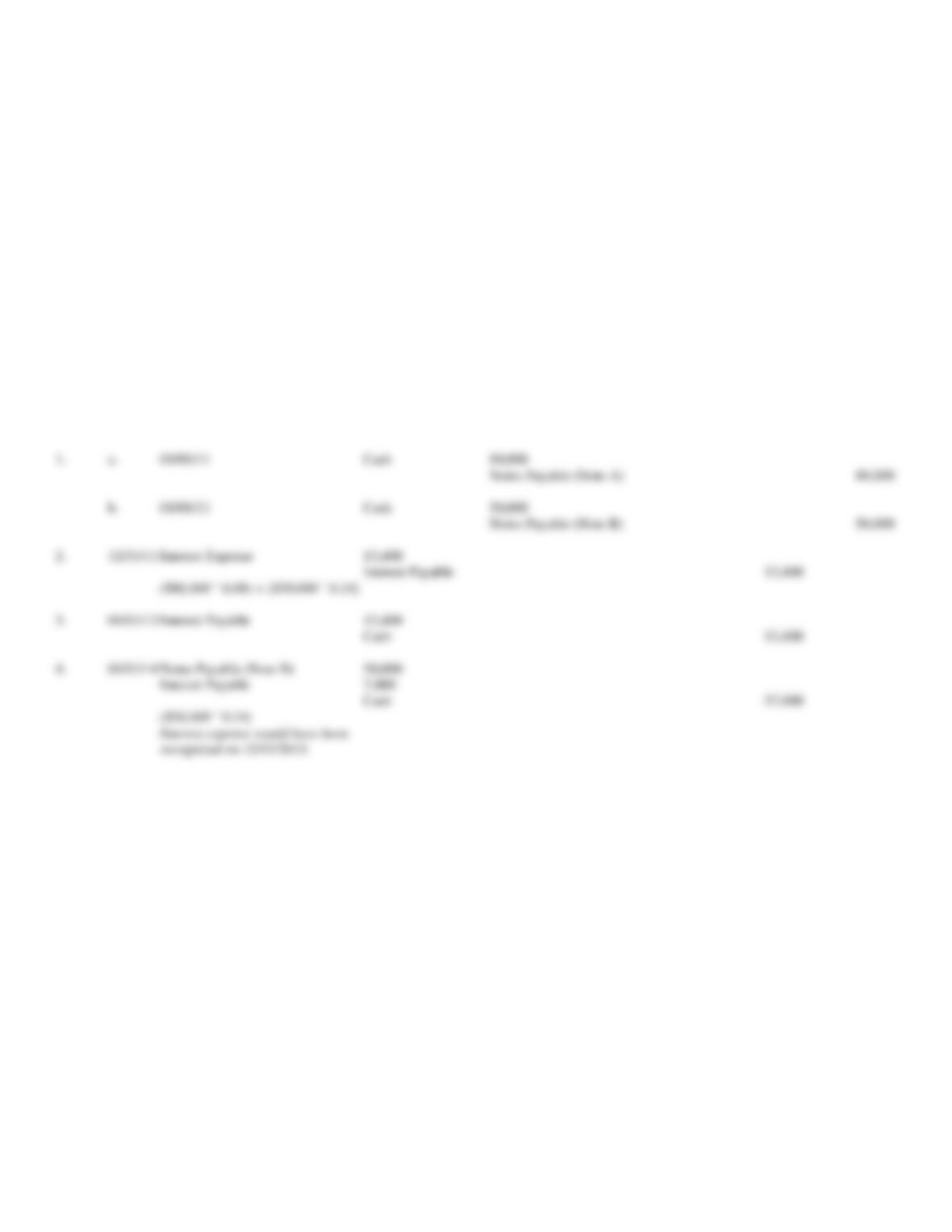
106. On January 1, 2011, Bixby Corporation borrowed $80,000 on a 2-year interest bearing note from Cache
Bank at an annual interest rate of 8 percent (Note A). Also on January 1, 2011, Bixby borrowed $50,000 from
Dewey Bank, signing a 3-year interest bearing note at an annual interest rate of 14 percent (Note B). For both
notes, interest is payable yearly on January 1. Prepare the following journal entries. (Round all amounts to the
nearest dollar.)
1.
January 1, 2011 borrowings on:
a.
Note A
b.
Note B
2.
Recognition of interest December 31,
2011 (Interest on both notes can be in
one entry).
3.
Interest payment on January 1, 2012
(Interest on both notes can be in one
entry).
4.
Repayment of Note B on January 1,
2014.
107. On January 1, 2011, Watters Corporation leased a truck under a capital lease. The lease agreement
specified payments of $15,000 per year (payable each year on January 2, starting in 2012) for 6 years. The
market rate of interest for lease transactions of this type is 12 percent compounded annually.
a.
What is the present value of the lease? (Round to the nearest dollar)
b.
Prepare journal entries for the initiation of the lease on January 1, 2011, and for the required entries on December 31, 2011, and January 2,
2012. (Round to the nearest dollar.)
01/01/11
Cash
80,000
Notes Payable (Note A)
b.
Cash
50,000
Notes Payable (Note B)
2.
Interest Expense
13,400
Interest Payable
13,400
3.
Interest Payable
13,400
Cash
13,400
4.
Notes Payable (Note B)
50,000
Interest Payable
7,000
Cash
57,000
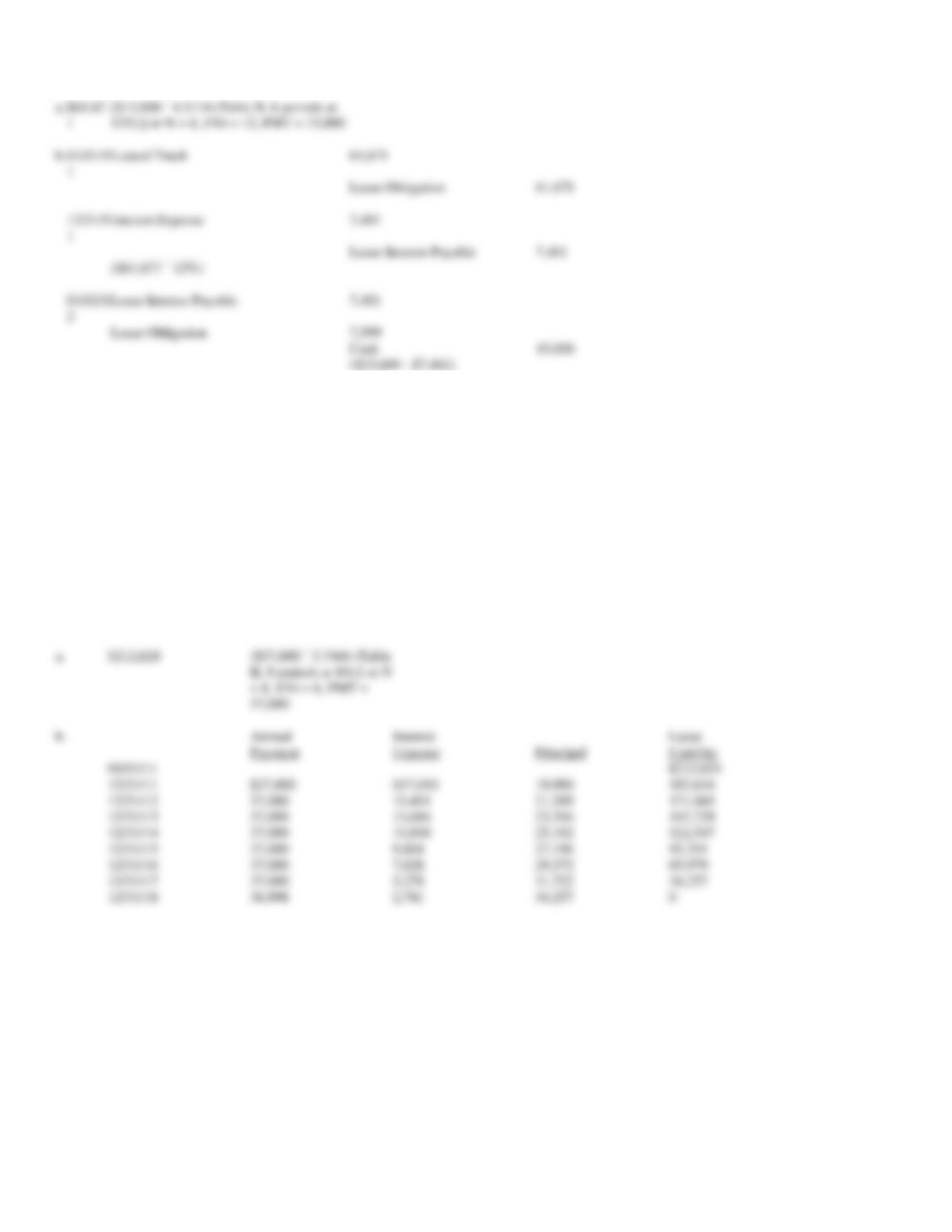
108. On January 1, 2011, Geary Corporation leased equipment under a capital lease. The lease agreement
specified payments of $37,000 per year (payable each year on December 31, starting at the end of 2011) for 8
years. The market rate of interest for lease transactions of this type is 8 percent compounded annually.
a.
Calculate the present value of the lease. (Round to the nearest dollar)
b.
Prepare a schedule of all the lease payments. (Round to the nearest dollar)
b.
Annual
Interest
Lease
Payment
Expense
Principal
Liability
$212,624
37,000
15,411
21,589
171,045
37,000
13,684
23,316
147,729
37,000
11,818
25,182
122,547
37,000
9,804
27,196
95,351
37,000
5,278
31,722
34,257
36,998
2,741
34,257
0
Lease Obligation
61,671
Lease Interest Payable
7,401
Cash
15,000
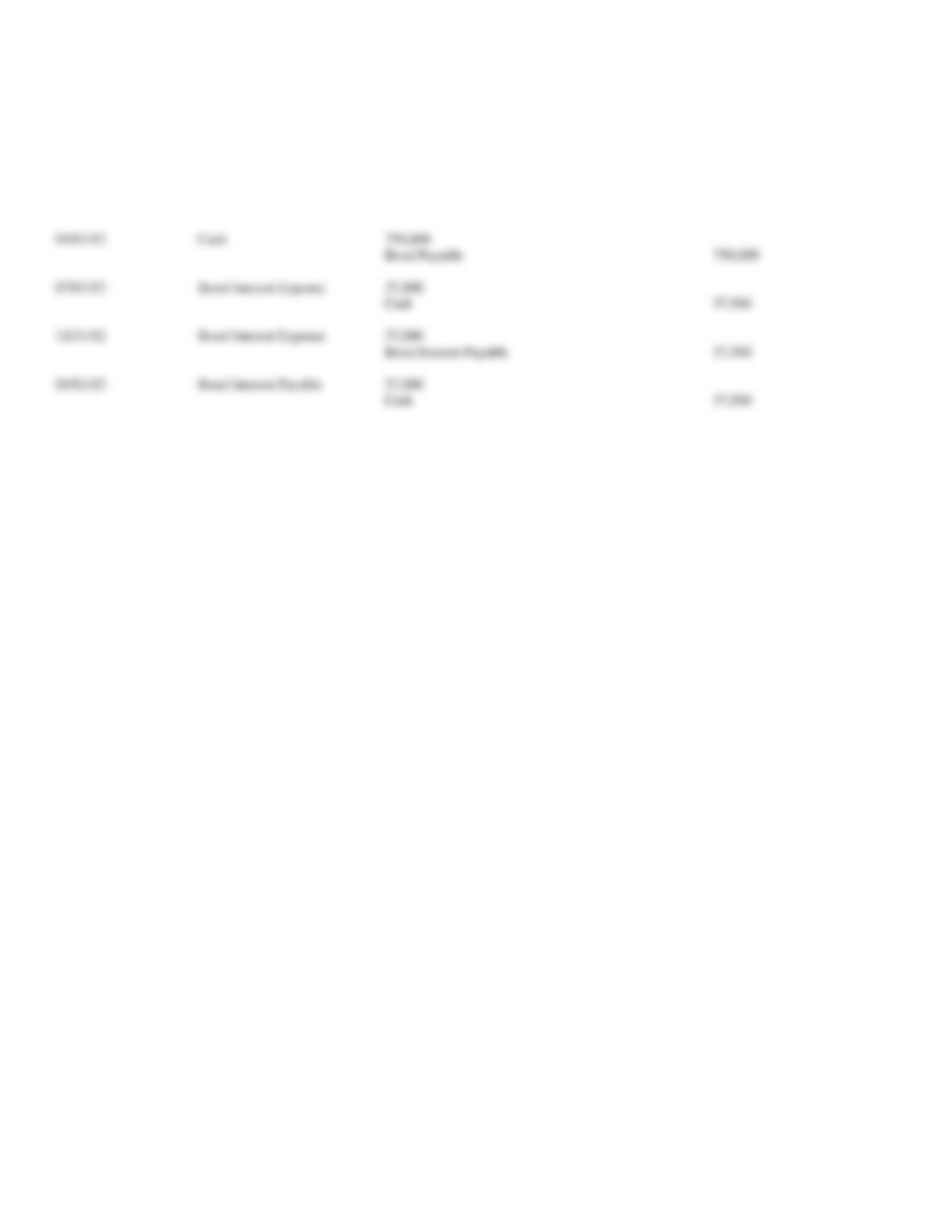
109. On January 1, 2012, Almond Corporation issued $750,000 bonds with a stated interest rate of 10%,
compounded semiannually. Interest is paid on January 1 and July 1 and the bonds mature in 10 years. The
effective interest rate is also 10%.
Prepare the journal entries that are appropriate to account for these bonds on the following dates: January 1,
2012; July 1, 2012; December 31, 2012; and January 1, 2013.
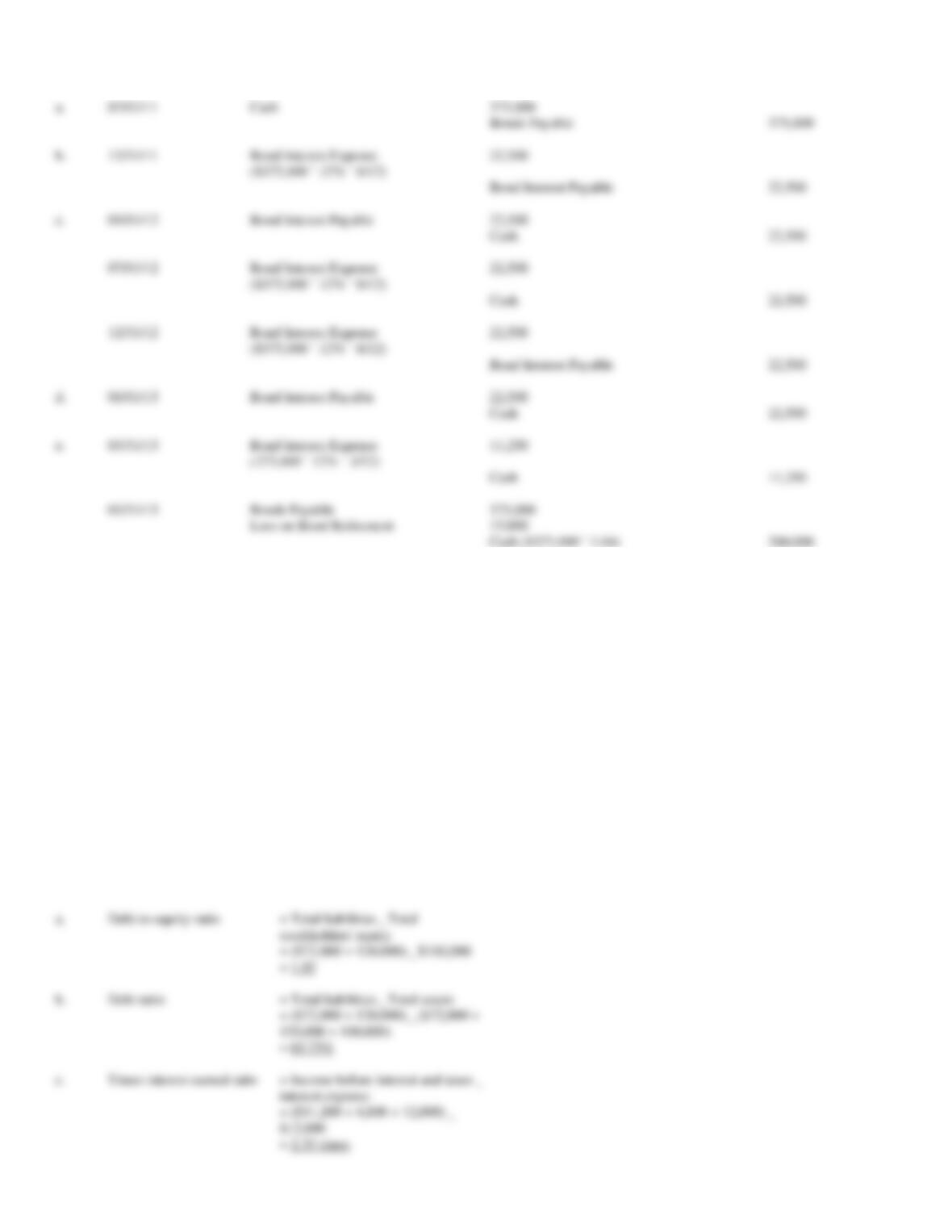
110. On July 1, 2011, Meeker Corporation issued $375,000 bonds with a stated interest rate of 12%,
compounded semiannually. Interest is paid on January 1 and July 1 and the bonds mature in 10 years. The
effective interest rate is also 12%.
a.
Prepare the journal entry to record the issuance of the bonds on July 1, 2011.
b.
Prepare the journal entry to record the interest expense on December 31, 2011.
c.
Prepare the journal entries made during 2012 relating to the bond.
d.
Prepare the journal entry required on January 1, 2013 relating to bond interest.
e.
On March 31, 2013, Meeker Corporation elected to retire the bonds early when the bonds were callable at 104. Prepare the journal entries
to record the bond retirement.
Cash
750,000
Bond Payable
750,000
Bond Interest Expense
37,500
Cash
37,500
Bond Interest Expense
37,500
Bond Interest Payable
37,500
Bond Interest Payable
37,500
Cash
37,500
111. Shidler Corporation reported the following data in its financial statements for 2011:
Current liabilities
$ 72,000
Interest expense
$12,000
Long-term liabilities
120,000
Income tax expense
4,800
Stockholders’ equity
100,000
Net income
11,200
Compute the following:
a.
Debt-to-equity ratio
b.
Debt ratio
c.
Times interest earned ratio
= ($72,000 + 120,000) ¸ $100,000
b.
Debt ratio
= Total liabilities ¸ Total assets
interest expense
a.
Cash
375,000
b.
Bond Interest Expense
22,500
Bond Interest Payable
22,500
c.
Bond Interest Payable
22,500
Cash
22,500
Bond Interest Expense
22,500
Cash
22,500
Bond Interest Expense
22,500
Bond Interest Payable
22,500
Bond Interest Payable
22,500
Cash
22,500
e.
Bond Interest Expense
11,250
Cash
11,250
Bonds Payable
375,000
Loss on Bond Retirement
15,000
390,000
112. On March 1, 2012, Lloyd Corporation sold $400,000 of 12 percent, 5-year bonds at a yield of 10 percent
compounded semiannually. Interest is payable on March 1 and September 1 of each year. The corporation is a
calendar-year corporation. Bond premiums and discounts are amortized on interest-paying dates and at year-
end.
Prepare the journal entries that are appropriate to account for these bonds on the following dates (Round
amounts to the nearest dollar.): March 1, 2012; September 1, 2012; and December 31, 2012. Use the effective-
interest method of amortization.
113. On April 1, 2011, Jenkins Corporation issued $500,000 of 10 percent, 5-year bonds at a yield of 12 percent
compounded semiannually. Interest is payable on April 1 and October 1 of each year. The corporation is a
calendar-year corporation. Bond premiums and discounts are amortized on interest-paying dates and at year-
end. On October 1, 2012, Jenkins reacquired the bonds for retirement when they were selling at 99 on the open
market (assume no call premium).
1.
Determine the issue price of the bonds. Show your
computations. (Round to the nearest dollar.)
2.
Prepare an amortization table through the first three
interest periods using the effective-interest method.
(Round to the nearest dollar.)
3.
Prepare the journal entries to record bond-related
transactions on the following dates (Round to the
nearest dollar.):
a.
April 1, 2011
b.
October 1, 2011
c.
December 31, 2011
d.
April 1, 2012
e.
October 1, 2012
Cash
430,881*
Bond Payable
400,000
Bond Premium
30,881
Bond Interest Expense**
21,544
Bond Premium
2,456
Cash
24,000
Bond Interest Expense***
14,281
Bond Premium
1,719
Bond Interest Payable
16,000
*
Amount of semi-annual interest payment:
$400,000 ´ .12 ¸ 2 = $24,000
Present value of interest payments:
$24,000 ´ 7.7217 = $185,321
Present value of principal amount:
$400,000 ´ .6139 = $245,560
Issuance price of bond:
$430,881
Using a calculator results in $430,887
$430,881 ´ 10% ´ 1/2 = $21,544
***
($430,881 – $21,544) ´ .05 ´ 4/6 = $14,281