Exam
Name___________________________________
MULTIPLE CHOICE. Choose the one alternative that best completes the statement or answers the
question.
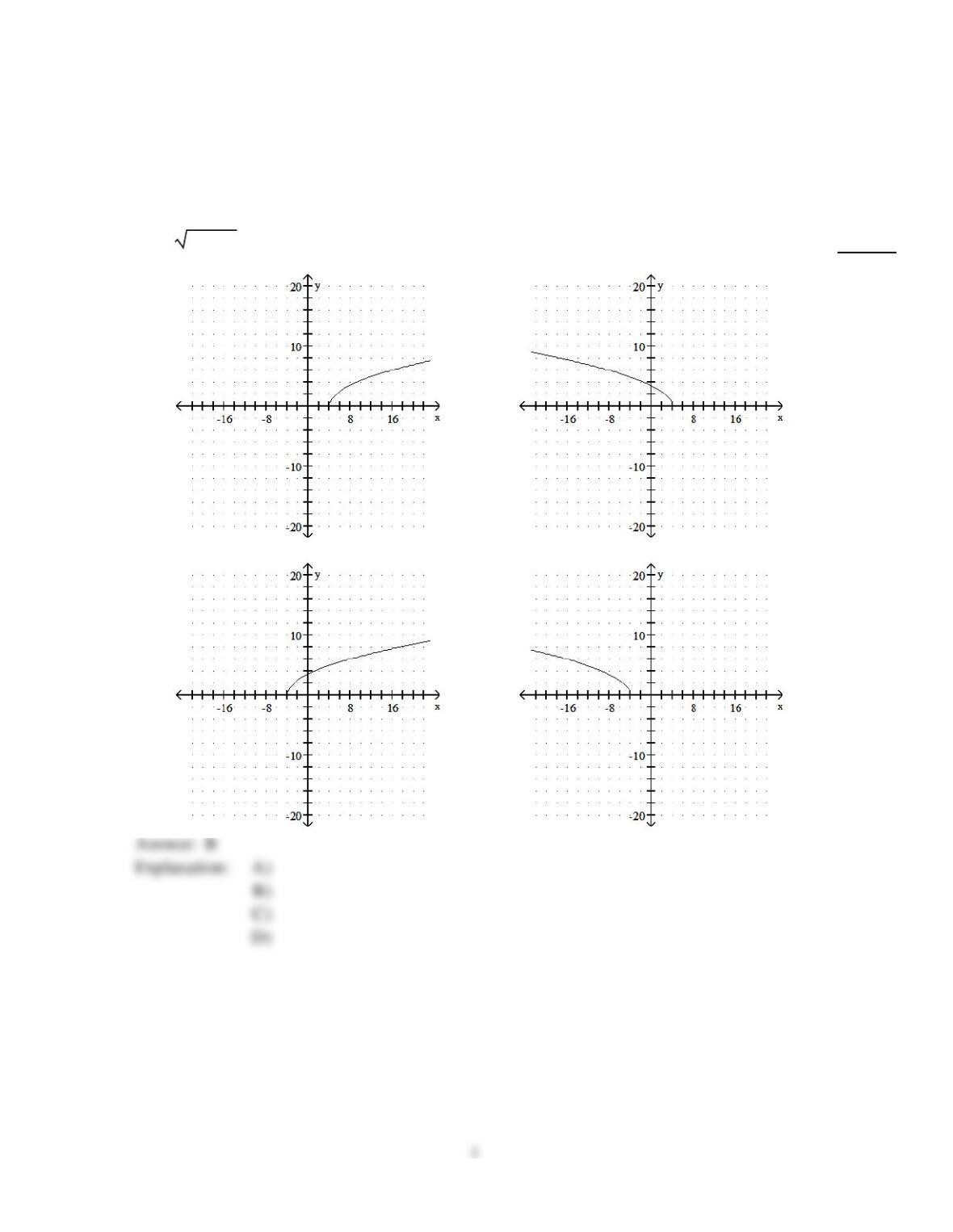
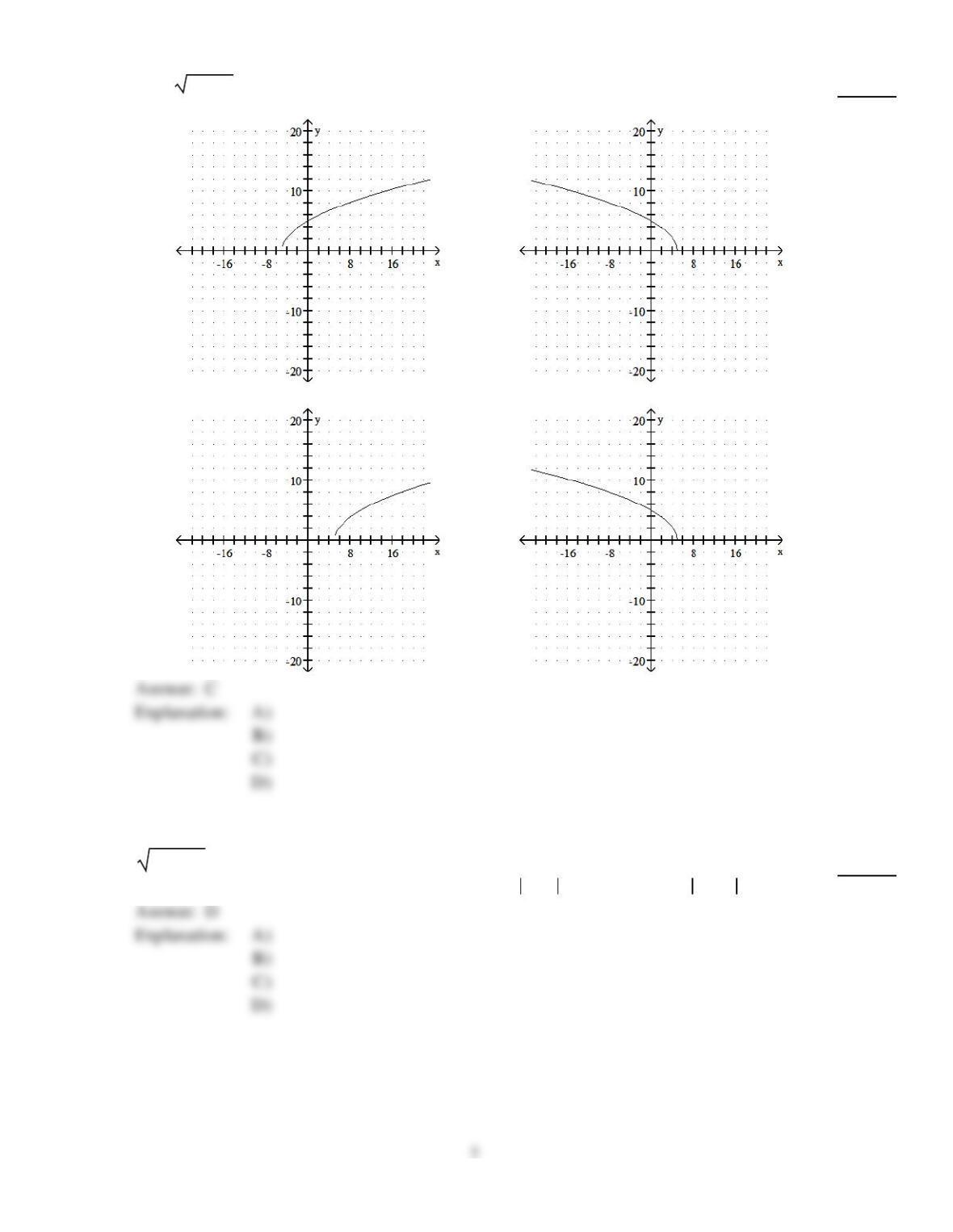
Find the domain of the square root function. Then use the domain to choose the correct graph of the function.
1)
f(x) =12 –3x
1)
A)
domain of f: [4, )
B)
domain of f: ( , 4]
C)
domain of f: [–4, )
D)
domain of f: ( , –4]
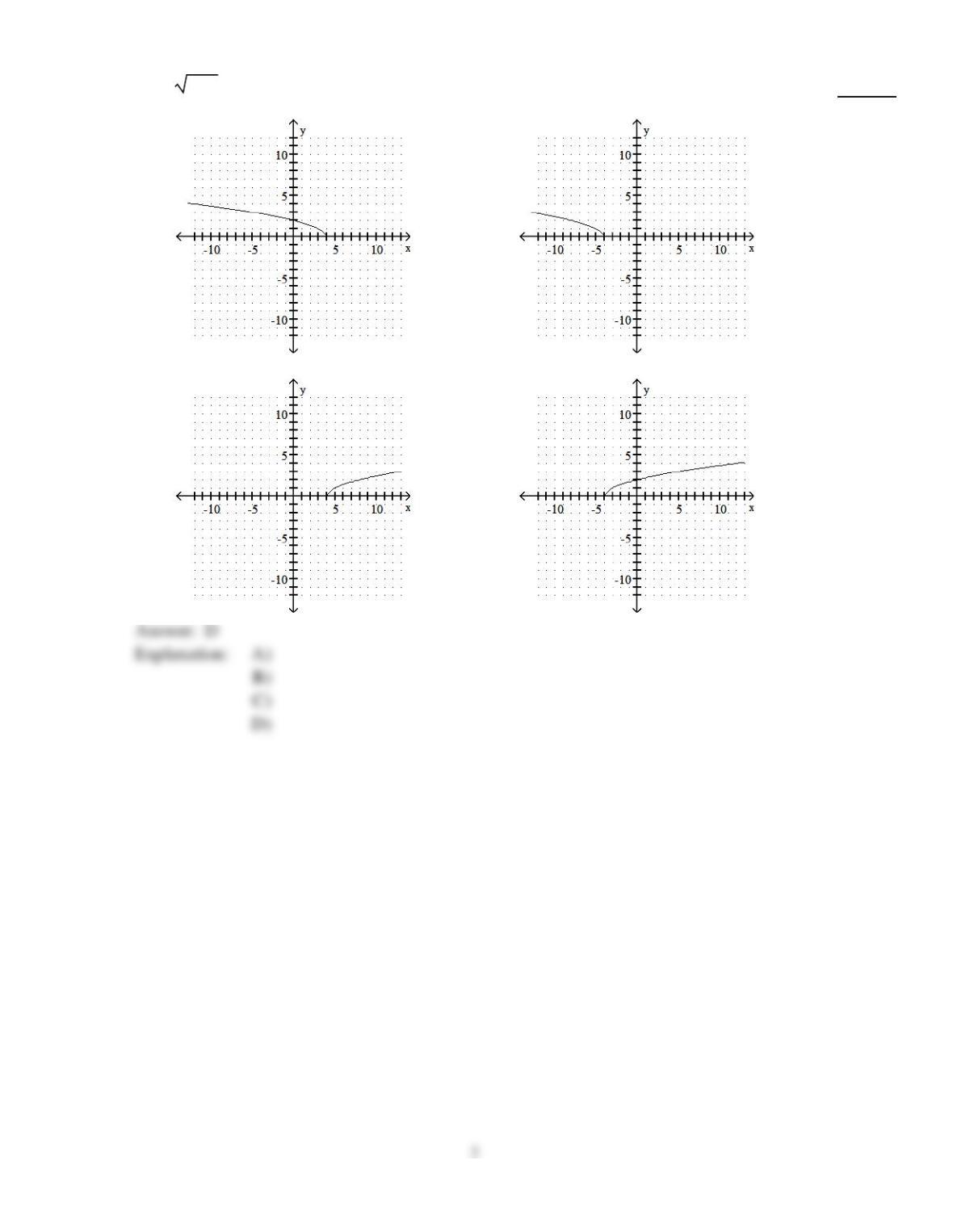
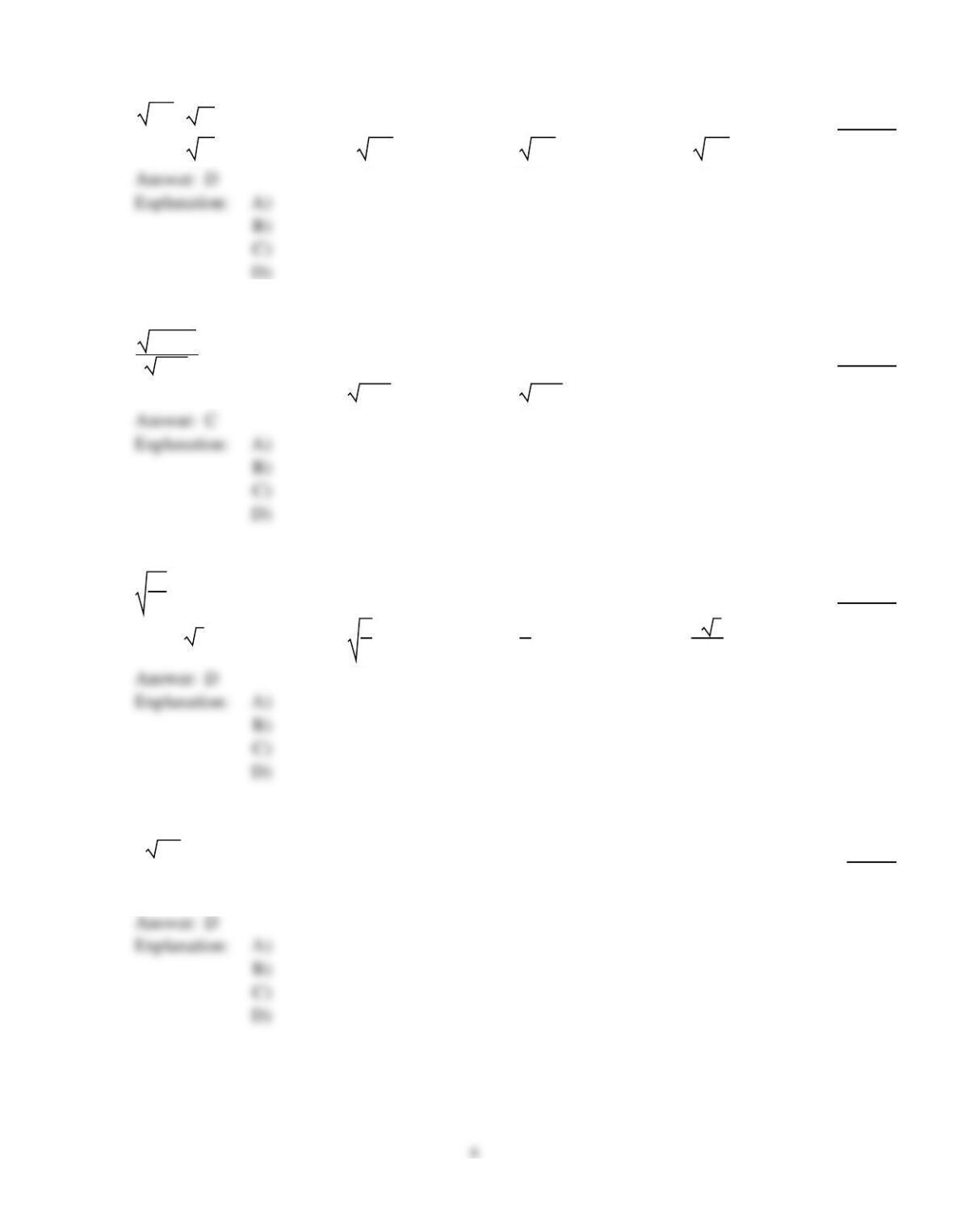
2)
f(x) =x +4
2)
A)
domain of f: ( , 4]
B)
domain of f: ( , –4]
C)
domain of f: [4, )
D)
domain of f: [–4, )
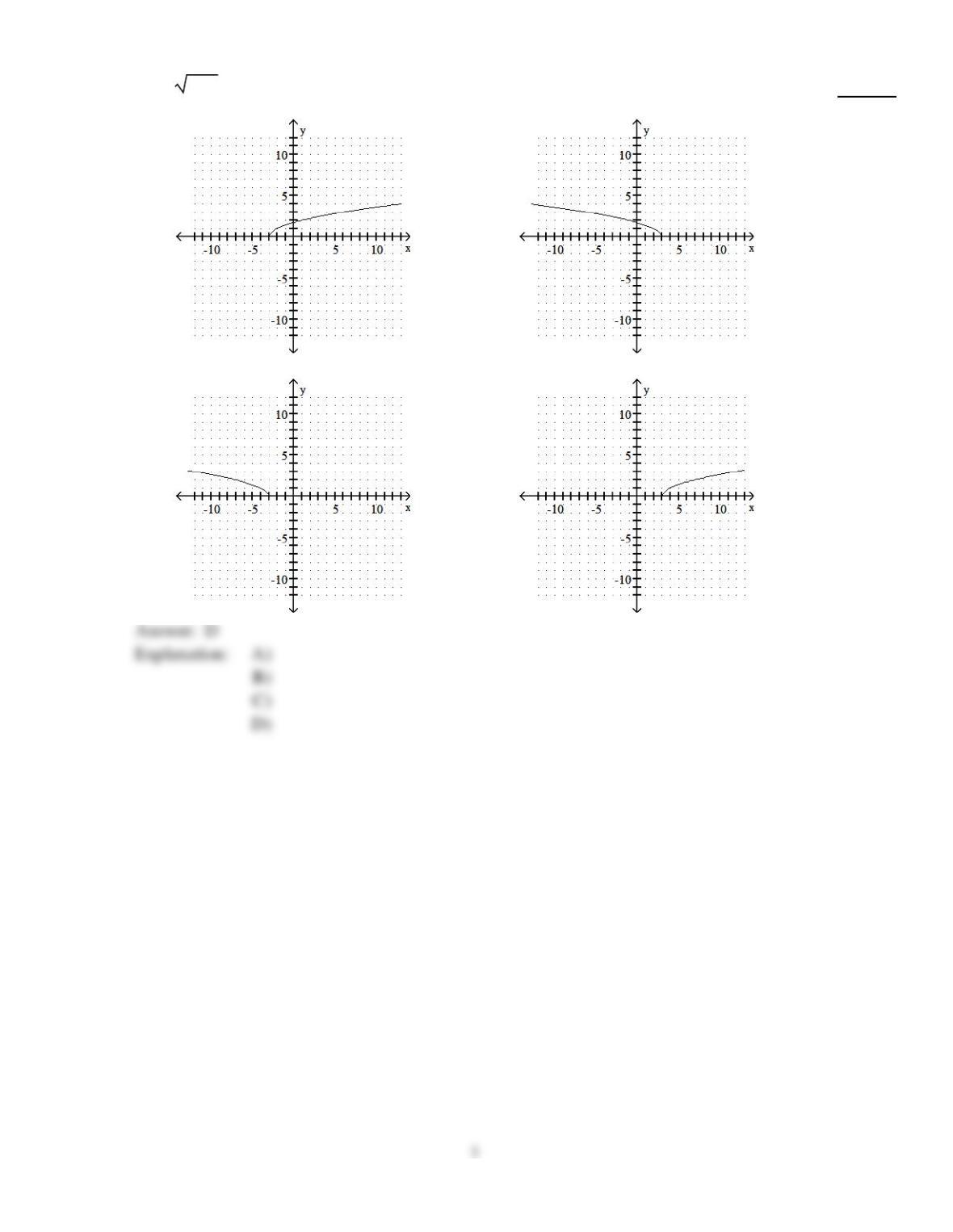
3)
f(x) =x –3
3)
A)
domain of f: [–3, )
B)
domain of f: ( , 3]
C)
domain of f: ( , –3]
D)
domain of f: [3, )
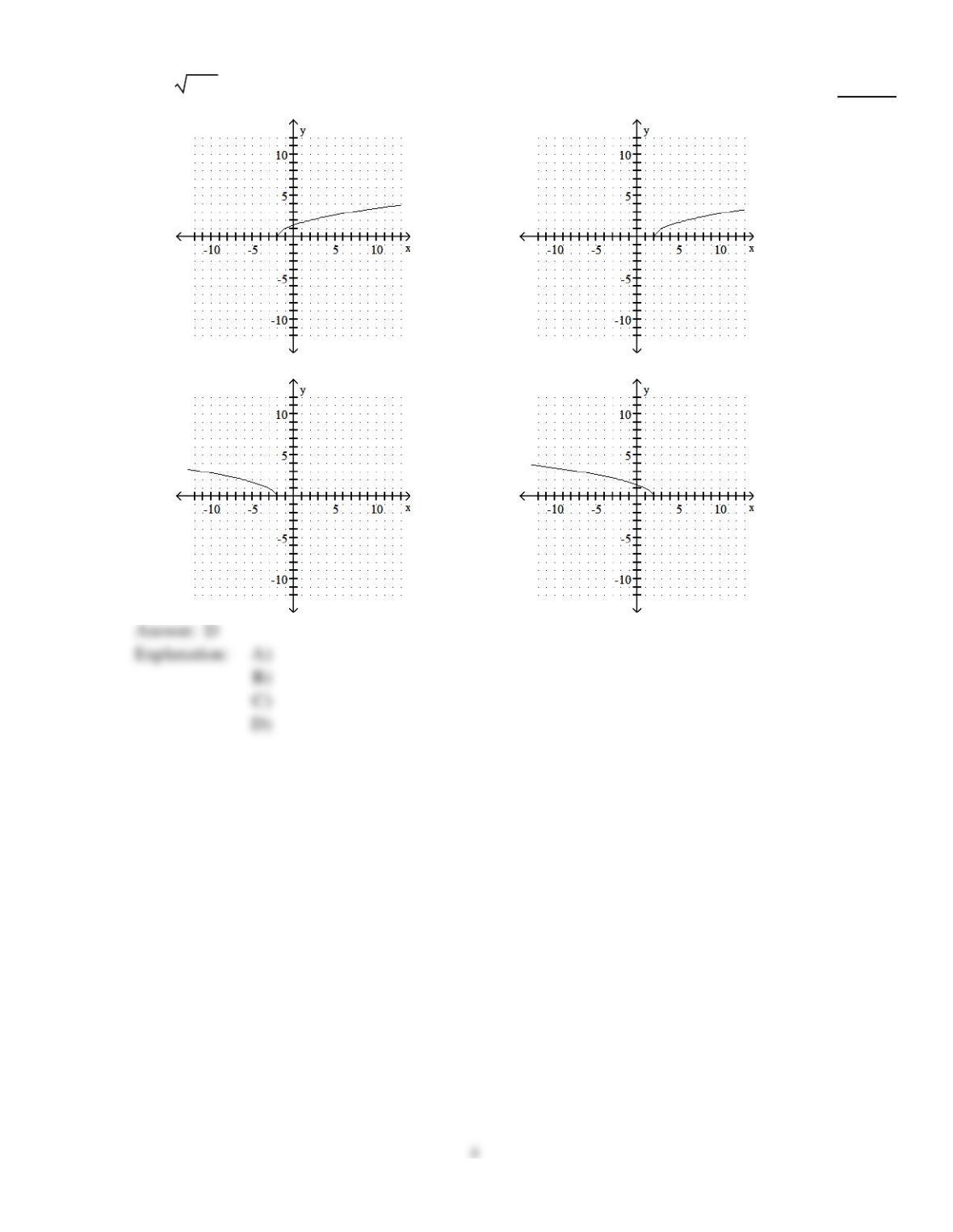
4)
f(x) =2– x
4)
A)
domain of f: [–2, )
B)
domain of f: [2, )
C)
domain of f: ( , –2]
D)
domain of f: ( , 2]
5)
f(x) =5x –25
5)
A)
domain of f: [–5, )
B)
domain of f: ( , –5]
C)
domain of f: [5, )
D)
domain of f: ( , 5]
Simplify the expression. Include absolute value bars where necessary.
6)
4(x +81)4
6)
A)
x +3
B)
x +81
C)
x +3
D)
x +81
Use the product rule to multiply.
7)
83x6·82x
7)
A)
68x7
B)
16 6x7
C)
6x7
D)
86x7
Divide and, if possible, simplify.
8)
z2–16
z +4
8)
A)
z –4
B)
z +4
C)
z –4
D)
z +4
Use the quotient rule to simplify. Assume all variables represent positive real numbers.
9)
8
25
9)
A)
4 2
B)
8
5
C)
2
5
D)
2 2
5
Find the indicated root, or state that the expression is not a real number.
10)
–4–81
10)
A)
–9
B)
3
C)
–3
D)
not a real number
Rewrite the expression with a rational exponent.
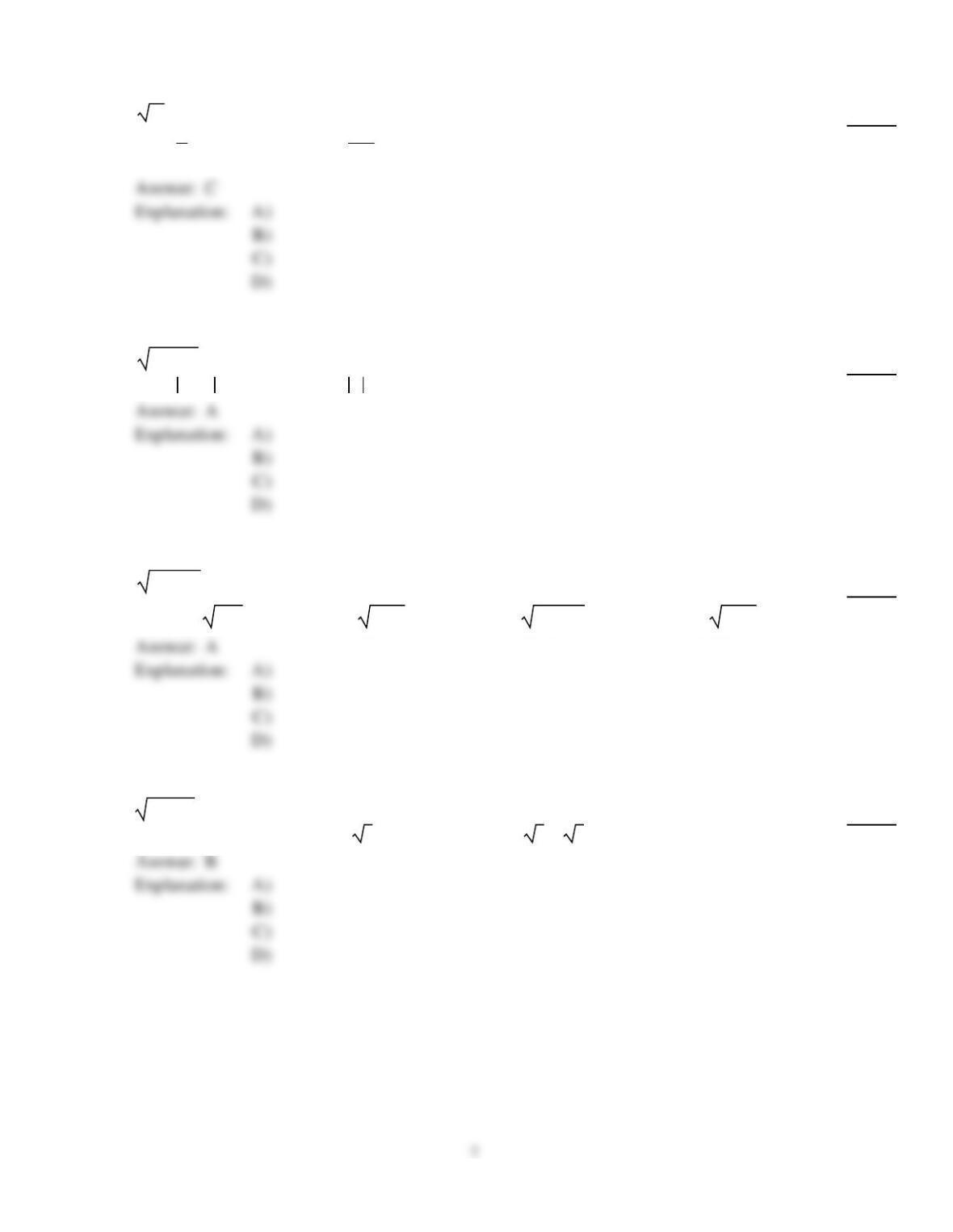
11)
335
11)
A)
1
3·35
B)
1
353
C)
351/3
D)
353
Simplify the expression. Include absolute value bars where necessary.
12)
6(x – 4)6
12)
A)
x – 4
B)
x– 4
C)
x – 4
D)
±x – 4
Simplify by factoring. Assume that any variable in a radicand represents a positive real number.
13)
3x3y17z
13)
A)
xy53y2z
B)
x3y17z
C)
3x3y17z
D)
xy 3y14z
Solve the equation.
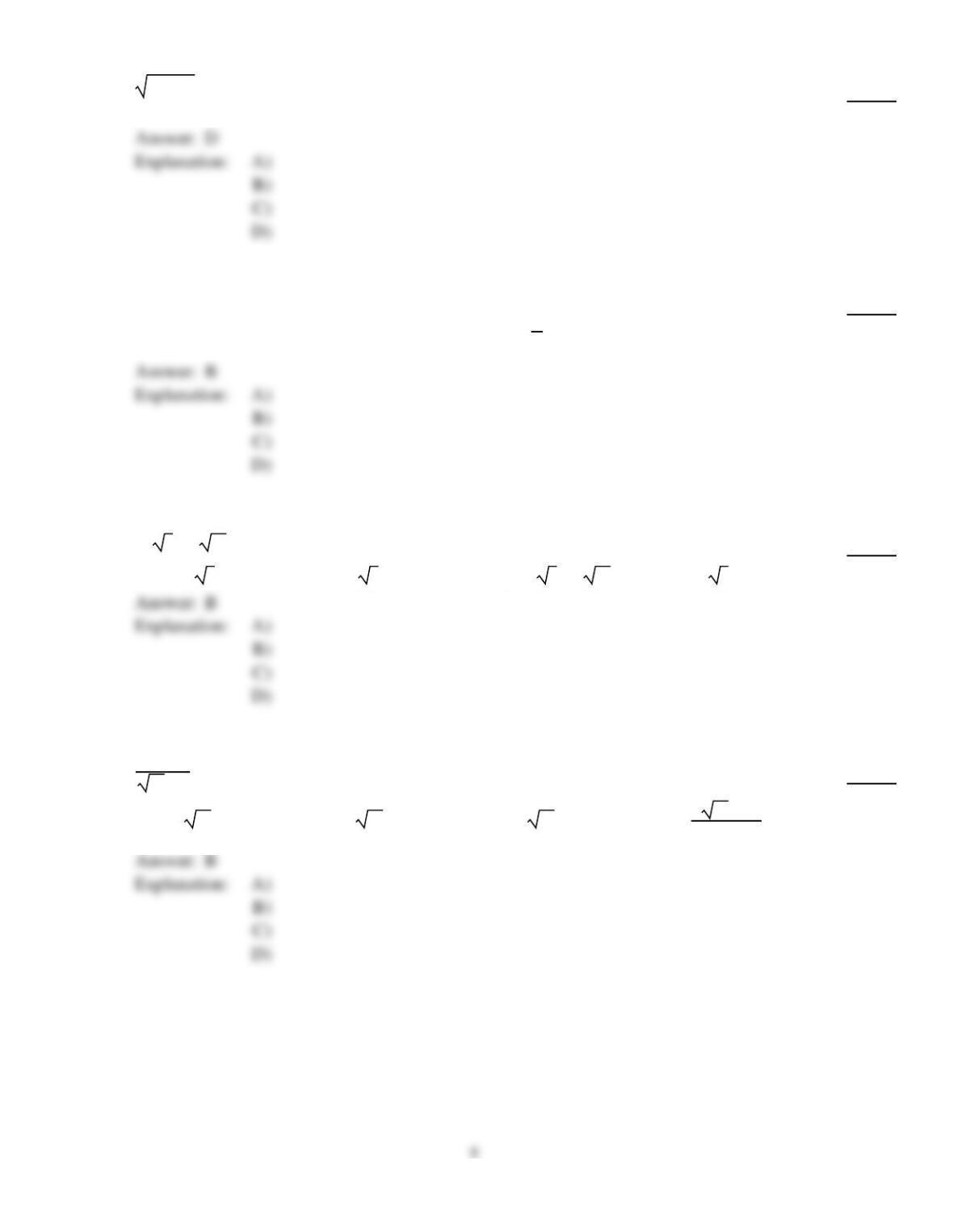
14)
2x2– 7 = x
14)
A)
{7, –7}
B)
{ 7}
C)
{ 7, –7}
D)
15)
x2– 17 =8
15)
A)
{10, –10}
B)
C)
{9}
D)
{9, –9}
Use radical notation to rewrite the expression. Simplify, if possible.
16)
(–125)2/3
16)
A)
–5
B)
25
C)
–1
5
D)
–25
Add or subtract as indicated. You will need to simplify terms to identify like radicals.
17)
13 32– 3354
17)
A)
–432
B)
432
C)
13 32– 3354
D)
10 32
Rationalize the denominator.
18)
3
37 +6
18)
A)
337 –6
B)
337 –18
C)
337 +18
D)
337 +18
74
Solve the equation.
19)
x + 4 =8
19)
A)
{144}
B)
{64}
C)
{60}
D)
{68}
Find the indicated root, or state that the expression is not a real number.
20)
416
20)
A)
–2
B)
2
C)
8
D)
4
Rewrite the expression with a positive rational exponent. Simplify, if possible.
21)
1000–1/3
21)
A)
1
1000
B)
–10
C)
1
10
D)
–1
10
Find the perimeter or area of the figure as indicated. Express your answer in simplified radical form.
22)
Find the area of a rectangle whose length is 11 2 meters and whose width is 420 meters.
22)
A)
88 10 sq m
B)
176 10 sq m
C)
44 40 sq m
D)
88 20 sq m
Solve.
23)
23)
If a number is subtracted from 21, the principal square root of this difference is equal to the
number decreased by 1. Find the number(s).
A)
–5
B)
5
C)
–4, 5
D)
–4
Use rational exponents to simplify the radical. If rational exponents appear after simplifying, write the answer in
radical notation.
24)
20 x16y8
24)
A)
5x4y
B)
5x4y2
C)
5xy2
D)
4x4y2
Divide and simplify to the form a +
bi.
25)
4– 2i
8+ 5i
25)
A)
14
13 –12
13 i
B)
22
89 –36
89 i
C)
22
39 –12
13 i
D)
42
89 –4
89 i
Simplify the expression. Assume that variables can represent any real number.
26)
3–8
k6
26)
A)
8
k2
B)
2
k2
C)
–2
k6
D)
–2
k2
10
Perform the indicated operation. Write the result in the form a +
bi.
27)
Simplify: i26
27)
A)
1
B)
i
C)
–1
D)
–i
Simplify the expression. Include absolute value bars where necessary.
28)
6p6
28)
A)
p
B)
–p
C)
p
D)
–p
Solve the equation.
29)
2x + 1 =19
29)
A)
{360}
B)
{90}
C)
{–180}
D)
{180}
Add or subtract as indicated. You will need to simplify terms to identify like radicals.
30)
23x10y2+ 43xy2
30)
A)
( 2x + 4)3xy2
B)
( 2x3+ 4)3xy2
C)
2x3+ 4 3xy2
D)
( 6x3)3xy2
11
Perform the indicated operation. Write the result in the form a +
bi.
31)
31)
(5 + 8i) – (–8+ i)
A)
13 + 7i
B)
–3+ 7i
C)
–3+ 9i
D)
13 + 9i
Multiply and simplify. Assume that all variables in a radicand represent positive real numbers.
32)
12xy ·2xy2
32)
A)
2x2y26y
B)
2xy26
C)
2xy 6y
D)
xy 24y
Multiply and simplify. Assume that all variables represent positive real numbers.
33)
3x (32000x2–3x)
33)
A)
1000x –3x
B)
10x(x 32– 1)
C)
10x 32
D)
10x 32–
3x2
Find the x–intercept(s) of the graph of the function without graphing the function.
34)
f(x) =4x +20 –4x –2
34)
A)
no x–intercepts
B)
16
C)
4
D)
64
Simplify the expression. Include absolute value bars where necessary.
35)
4(–3)4
35)
A)
– – 3
B)
–81
C)
–3
D)
3
Add or subtract as indicated. You will need to simplify terms to identify like radicals.
36)
23a+327a
36)
A)
3327a
B)
63a
C)
23a+
327a
D)
53a
Find the function value indicated for the function. If necessary, round to two decimal places. If the function value is not
a real number and does not exist, state so.
37)
Evaluate t(x) = – x +13 for t(–3)
37)
A)
4
B)
2
C)
not a real number
D)
3.16
Simplify the expression.
38)
(x + 9)2
38)
A)
x2+ 18x + 81
B)
x + 9
C)
9 x
D)
x + 9
13
Use rational exponents to simplify the radical. If rational exponents appear after simplifying, write the answer in
radical notation.
39)
36
56
39)
A)
15 36
B)
563
C)
6336
D)
15 6
Rationalize the denominator.
40)
10 –3
10 +3
40)
A)
1
B)
103 + 20 3
97
C)
103 – 20 3
97
D)
97 – 20 3
103
Simplify the expression.
41)
36x8
41)
A)
6x4
B)
36x4
C)
6x8
D)
6x
Write in terms of i.
42)
–175
42)
A)
–5i 7
B)
5i 7
C)
5 7
D)
–5 7
Multiply and simplify. Assume that all variables represent positive real numbers.
43)
( 6 +z)( 6–z)
43)
A)
6– z
B)
6– 2 z
C)
6– 2 6z
D)
6z
Use properties of rational exponents to simplify the expression. Assume that any variables represent positive numbers.
44)
x–3/7 x3/2
x–3/5
44)
A)
x33/70
B)
1
x117/70
C)
x117/70
D)
1
x33/70
Find the indicated root, or state that the expression is not a real number.
45)
–3–125
45)
A)
not a real number
B)
5
C)
–5
D)
125
Perform the indicated operation. Write the result in the form a +
bi.
46)
46)
(9 + 9i) – (–5+ i)
A)
4+ 10i
B)
14 – 8i
C)
–14 – 8i
D)
14 + 8i
15
Perform the indicated operation. Write the result in the form a +
bi.
47)
7–9i
3+ i
47)
A)
6
5+17
5i
B)
6
5–17
5i
C)
3– 2i
D)
3+ 2i
Divide and simplify to the form a +
bi.
48)
9+ 8i
9+ 5i
48)
A)
41
56 +27
56 i
B)
121
56 +27
56 i
C)
121
106 +27
106 i
D)
41
106 –117
106 i
Find the indicated root, or state that the expression is not a real number.
49)
4–10,000
49)
A)
–10
B)
10
C)
not a real number
D)
–100
Divide and, if possible, simplify.
50)
464a13z17
44az–2
50)
A)
a3z44az3
B)
2a3z44z3
C)
2az 4z3
D)
2a12z19 4az2