Fundamentals of Corporate Finance 3e Test Bank
AICPA: Industry/Sector Perspective
52.
Turnbull Corp. is in the process of constructing a new plant at a cost of $30 million. It expects
the project to generate cash flows of $13,000,000, $23,000,000, and 29,000,000 over the next
three years. The cost of capital is 20 percent. What is the net present value of this project? (Do
not round intermediate computations. Round final answer to nearest million dollars.)
A)
$10 million
B)
$12 million
C)
$14 million
D)
$16 million
Ans:
C
Fundamentals of Corporate Finance 3e Test Bank
53.
Jamaica Corp. is adding a new assembly line at a cost of $8.5 million. The firm expects the
project to generate cash flows of $2 million, $3 million, $4 million, and $5 million over the
next four years. Its cost of capital is 16 percent. What is the net present value of this project?
(Do not round intermediate computations. Round final answer to nearest dollar.)
A)
$645,366
B)
$1,213,909
C)
$905,888
D)
$777,713
Ans:
D
Required rate of return = k = 16%
Fundamentals of Corporate Finance 3e Test Bank
54.
Strange Manufacturing Company is purchasing a production facility at a cost of $21 million.
The firm expects the project to generate annual cash flows of $7 million over the next five
years. Its cost of capital is 18 percent. What is the net present value of this project? (Do not
round intermediate computations. Round final answer to nearest dollar.)
A)
$890,197
B)
$1,213,909
C)
$905,888
D)
$777,713
Ans:
A
55.
Which of the following is true about the Net Present Value method?
A)
The NPV does not utilize time value of money concepts.
B)
The NPV assumes that all cash flows are reinvested at the firm’s discount rate.
C)
The NPV allows projects to be ranked by rate of return.
D)
The NPV is a rate of return that is acceptable to the firm.
Ans:
B
Fundamentals of Corporate Finance 3e Test Bank
56.
Which of the following statements about the payback method is true?
A)
The payback method is consistent with the goal of shareholder wealth maximization
B)
The payback method represents the number of years it takes a project to recover its initial
investment plus a required rate of return.
C)
There is no economic rational that links the payback method to shareholder wealth
maximization.
D)
None of the above statements are true.
Ans:
C
57.
Which one of the following statements about the discounted payback method is NOT true?
A)
The discounted payback method represents the number of years it takes a project to
recover its initial investment.
B)
The discounted payback method calls for a project to be accepted if the payback period is
greater than a target period.
C)
The discount payback method is a risk indicator.
D)
The expected cash flows from a project are discounted at the cost of capital.
Ans:
B
AICPA: Industry/Sector Perspective
58.
Which of the following is an advantage of the payback method?
A)
The technique is simple for managers to compute and interpret.
B)
It is a good measure of liquidity risk.
C)
Both a and b
D)
None of the above
Ans:
C
Fundamentals of Corporate Finance 3e Test Bank
59.
Which of the following is a disadvantage of the payback method?
A)
It ignores the time value of money.
B)
It is inconsistent with the goal of maximizing shareholder wealth.
C)
It ignores cash flows beyond the payback period.
D)
All of the above.
Ans:
D
60.
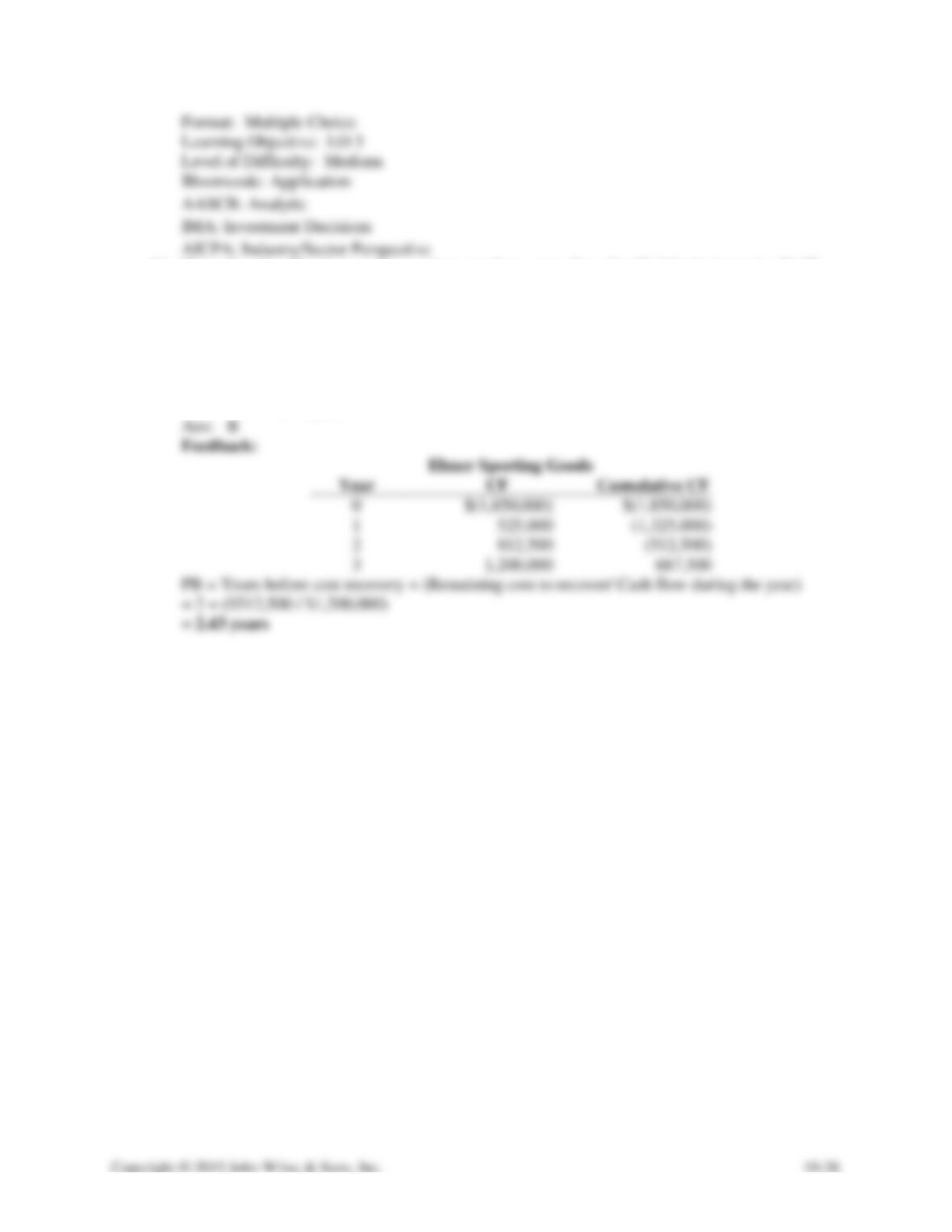
Binder Corp. has invested in new machinery at a cost of $1,450,000. This investment is
expected to produce cash flows of $640,000, $715,250, $823,330, and $907,125 over the next
four years. What is the payback period for this project? (Round your answer to two decimal
places.)
A)
2.12 years
B)
1.88 years
C)
4.00 years
D)
3.00 years.
Ans:
A
PB = Years before cost recovery + (Remaining cost to recover/ Cash flow during the year)
Fundamentals of Corporate Finance 3e Test Bank
61.
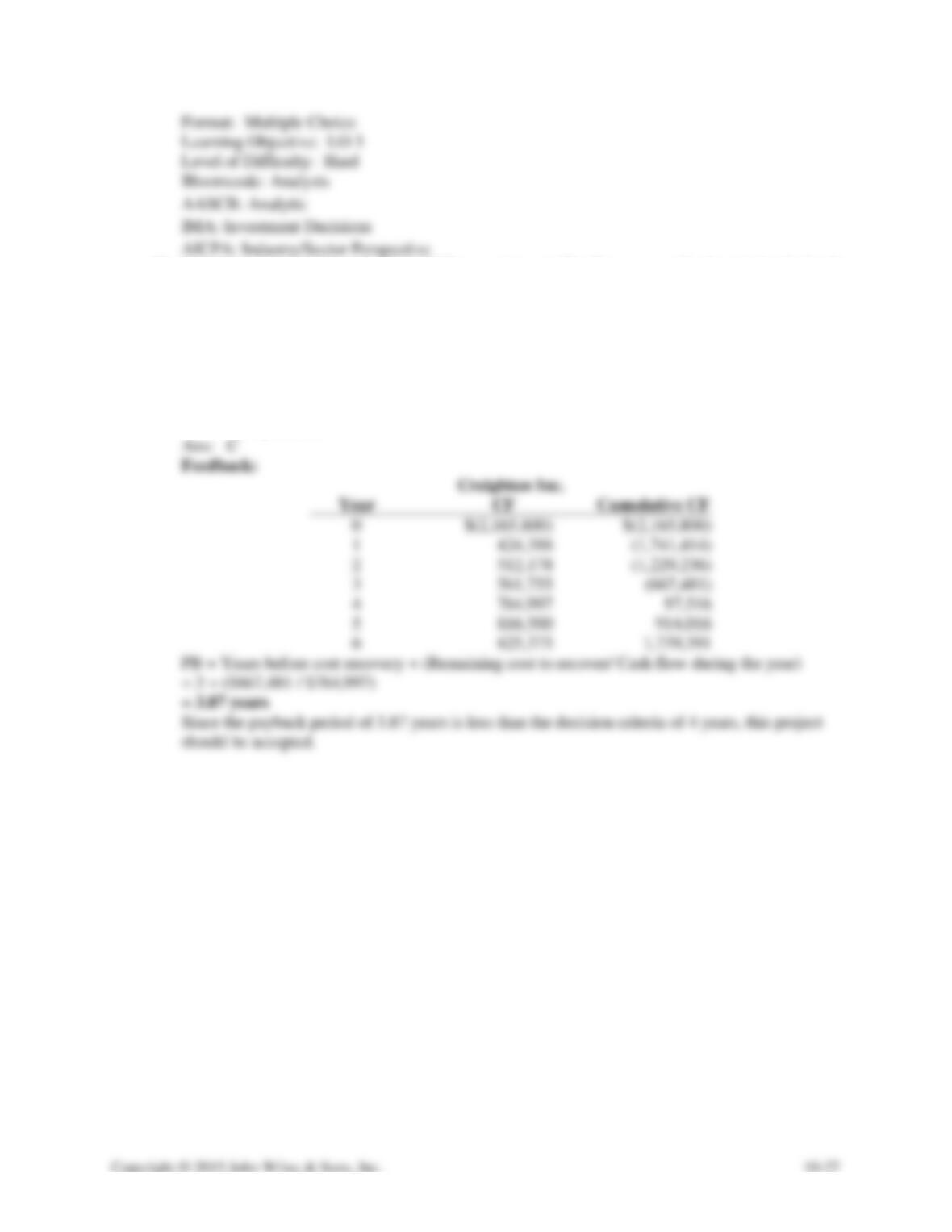
Elmer Sporting Goods is getting ready to produce a new line of golf clubs by investing $1.85
million. The investment will result in additional cash flows of $525,000, $812,500, and
1,200,000 over the next three years. What is the payback period for this project? (Round your
answer to two decimal places.)
A)
3.55 years
B)
2.43 years
C)
1.57 years
D)
More than 3 years
Ans:
B
Fundamentals of Corporate Finance 3e Test Bank
62.
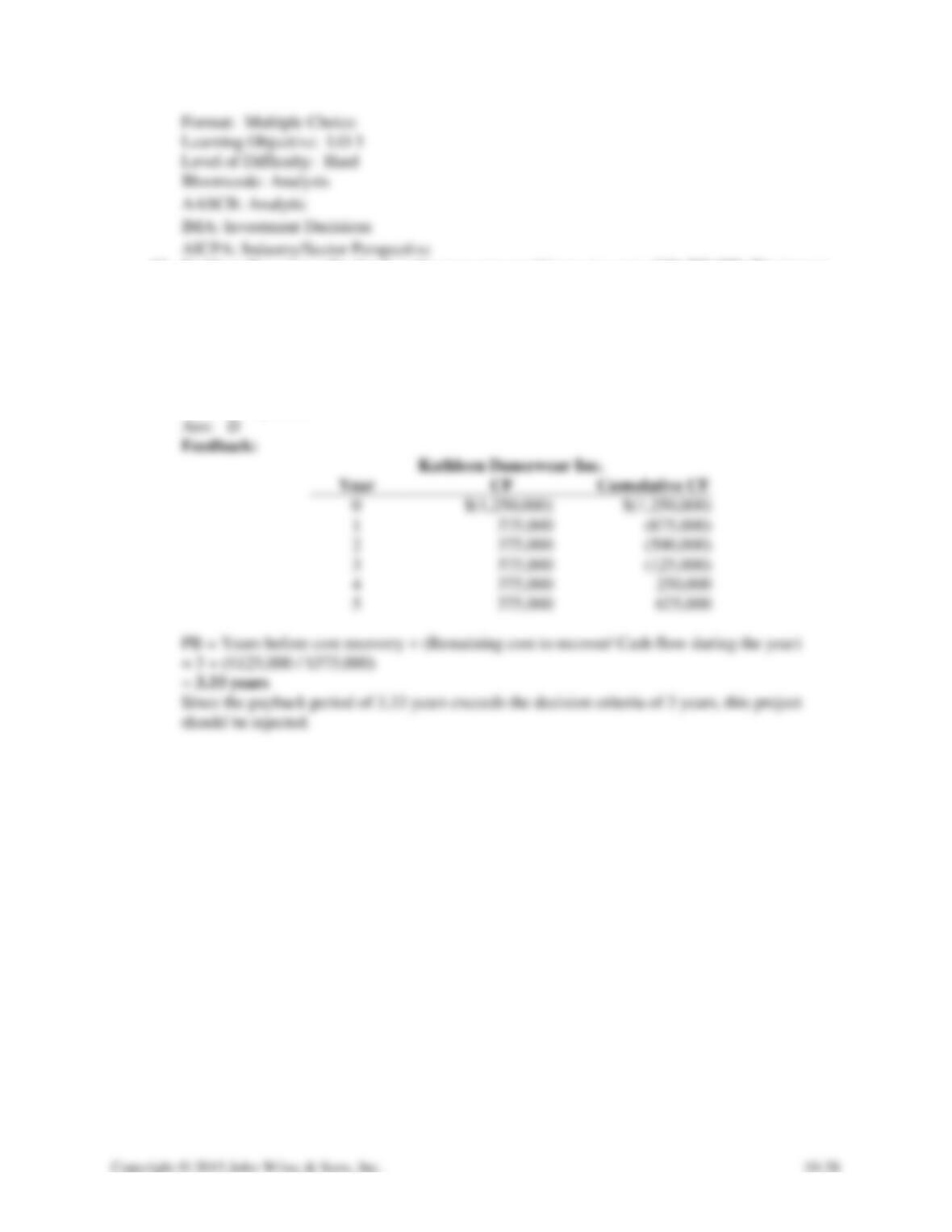
Creighton, Inc. has invested $2,165,800 on equipment. The firm uses payback period criteria of
not accepting any project that takes more than four years to recover costs. The company
anticipates cash flows of $424,386, $512,178, $561,755, $764,997, $816,500, and $825,375
over the next six years. What is the payback period, and does this investment meet the firm’s
payback criteria? (Round your answer to two decimal places.)
A)
4.13 years; no
B)
4.13 years; yes
C)
3.87 years; yes
D)
3.87 years; no
Ans:
C
PB = Years before cost recovery + (Remaining cost to recover/ Cash flow during the year)
Fundamentals of Corporate Finance 3e Test Bank
63.
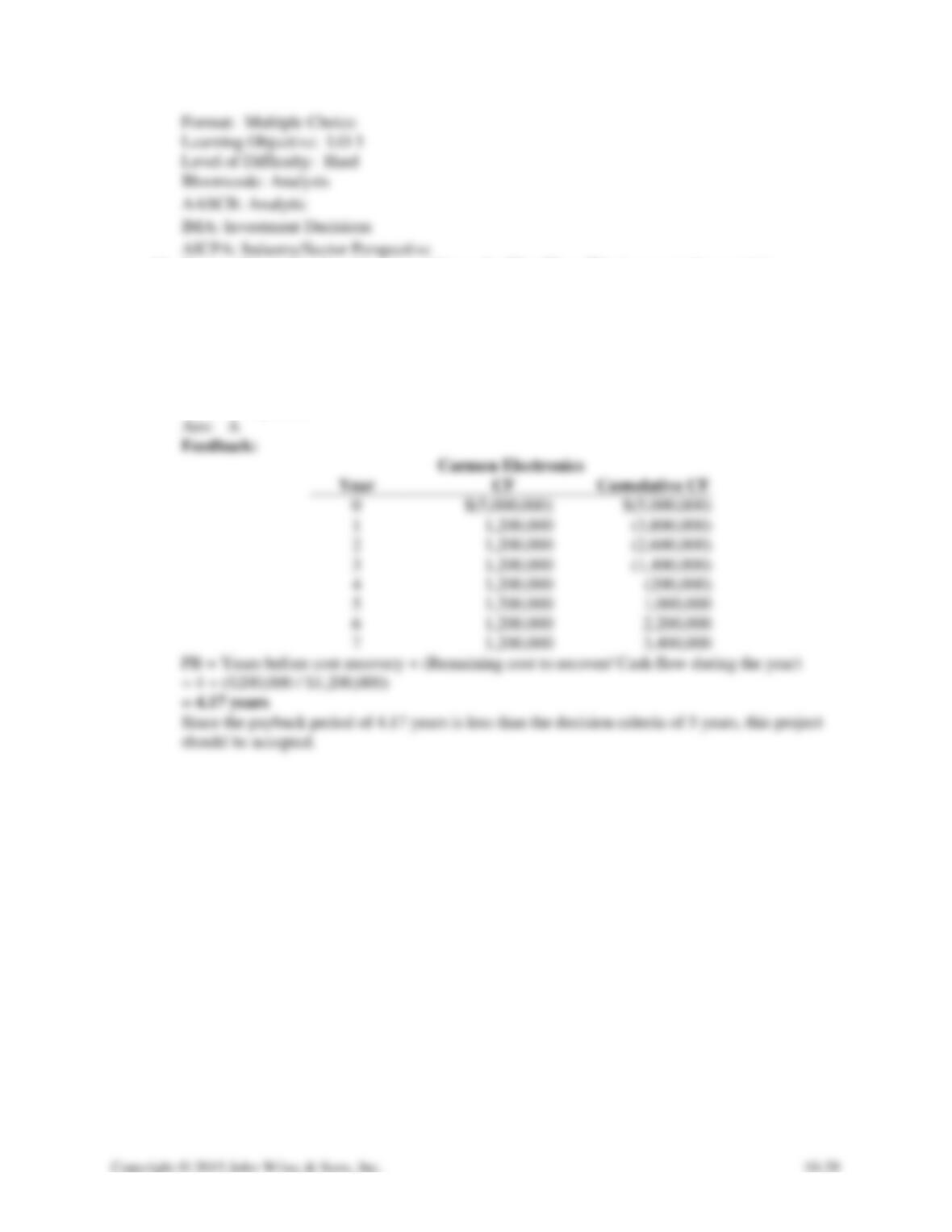
Kathleen Dancewear Co. has bought some new machinery at a cost of $1,250,000. The impact
of the new machinery will be felt in the additional annual cash flows of $375,000 over the next
five years. What is the payback period for this project? If its acceptance period is three years,
will this project be accepted? (Round your answer to two decimal places.)
A)
2.67 years; yes
B)
2.67 years; no
C)
3.33 years; yes
D)
3.33 years; no
Ans:
D
Fundamentals of Corporate Finance 3e Test Bank
64.
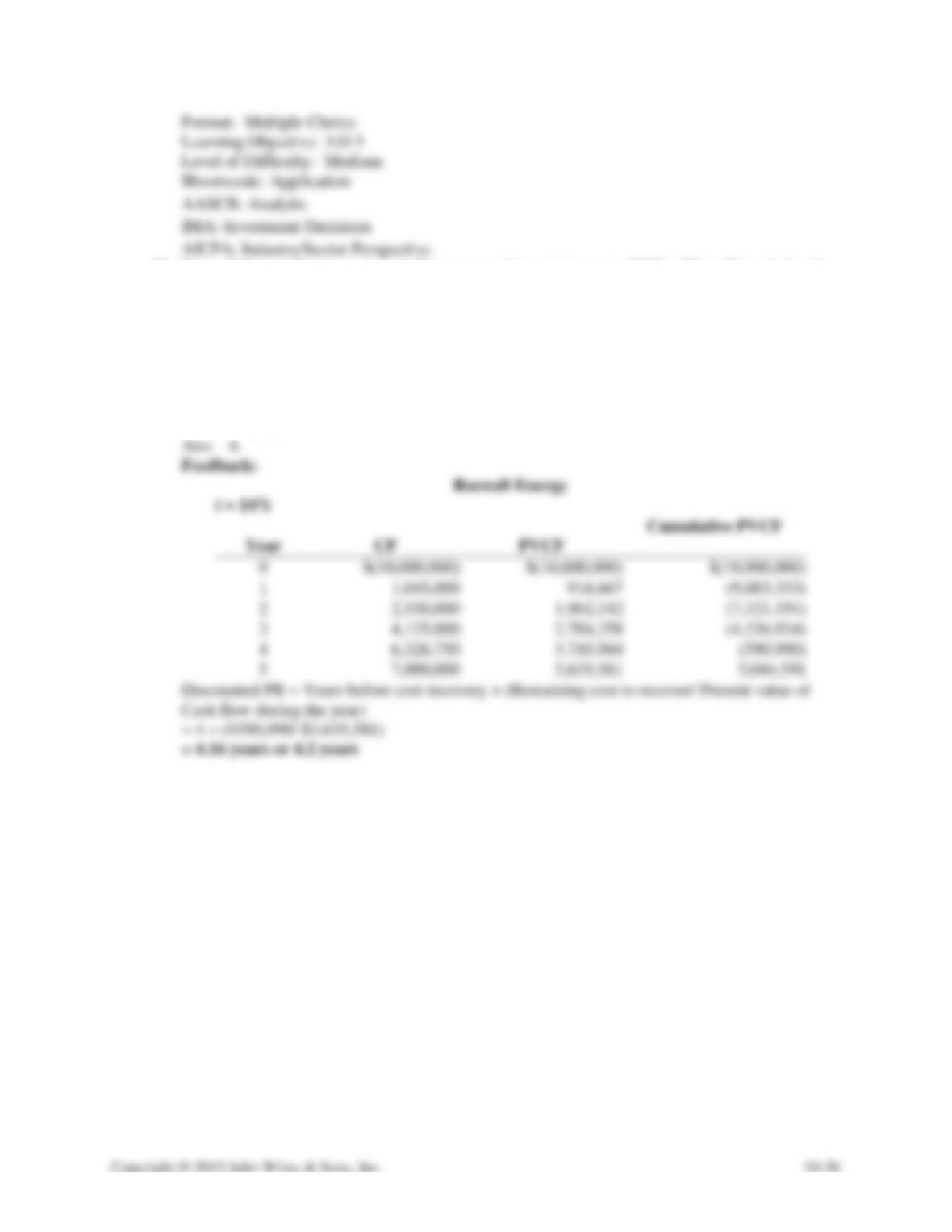
Carmen Electronics bought new machinery for $5 million. This is expected to result in
additional cash flows of $1.2 million over the next seven years. What is the payback period for
this project? If its acceptance period is five years, will this project be accepted? (Round your
answer to two decimal places.)
A)
4.17 years; yes
B)
4.17 years; no
C)
3.83 years; yes
D)
3.83 years; no
Ans:
A
= 4 + ($200,000 / $1,200,000)
Since the payback period of 4.17 years is less than the decision criteria of 5 years, this project
Fundamentals of Corporate Finance 3e Test Bank
65.
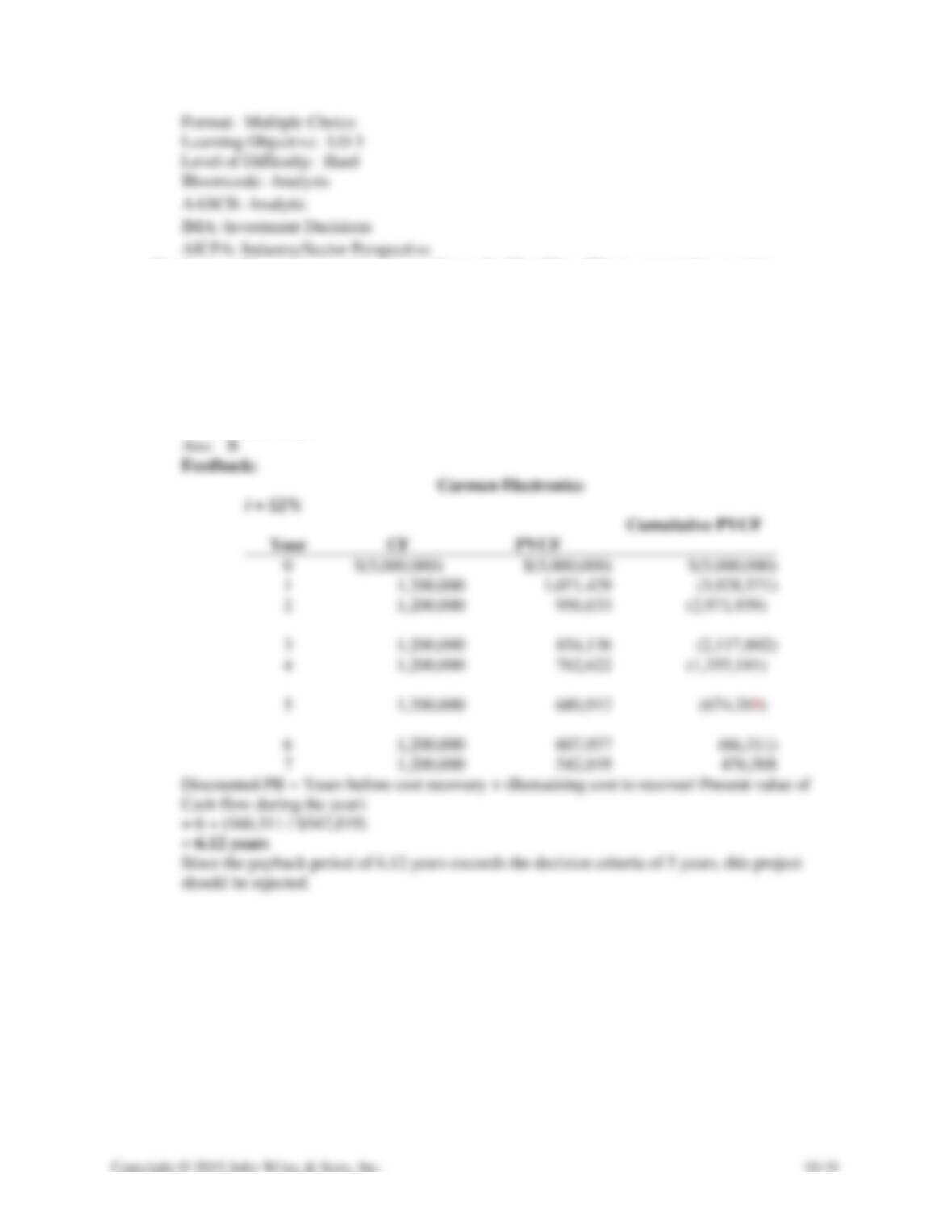
Roswell Energy Company is installing new equipment at a cost of $10 million. Expected cash
flows from this project over the next five years will be $1,045,000, $2,550,000, $4,125,000,
$6,326,750, and $7,000,000. The company’s discount rate for such projects is 14 percent. What
is the project’s discounted payback period? (Do not round intermediate computations. Round
your answer to one decimal place.)
A)
4.2 years
B)
4.4 years
C)
4.8 years
D)
5.0 years
Ans:
A
Cash flow during the year)
Fundamentals of Corporate Finance 3e Test Bank
66.
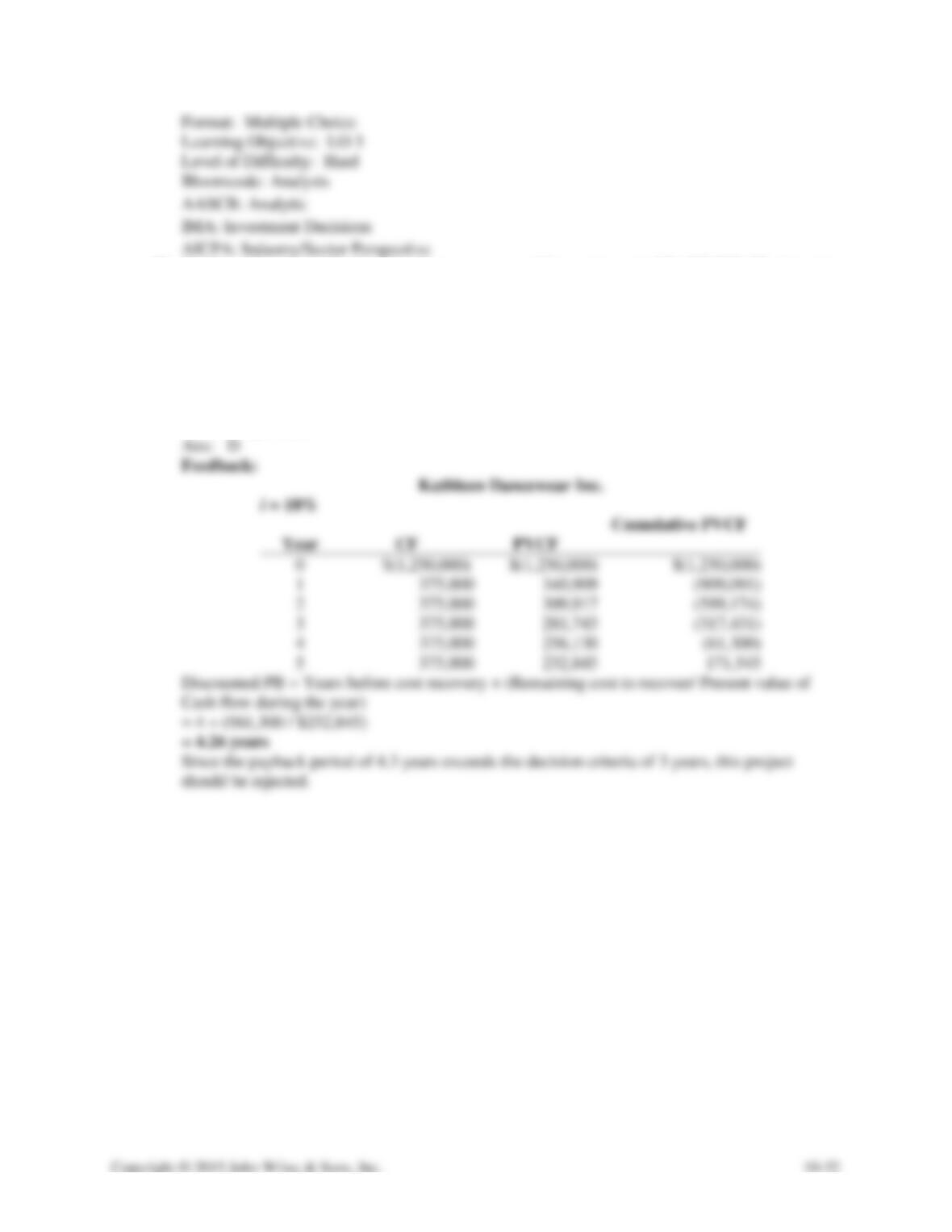
Carmen Electronics bought new machinery for $5 million. This is expected to result in
additional cash flows of $1.2 million over the next seven years. The firm’s cost of capital is 12
percent. What is the discounted payback period for this project? If the firm’s acceptance period
is five years, will this project be accepted? (Do not round intermediate computations. Round
your answer to one decimal place.)
A)
5.4 years; no
B)
6.1 years; no
C)
6.1 years; yes
D)
4.2 years; yes
Ans:
B
Cash flow during the year)
= 6 + ($66,311 / $542,819)
Fundamentals of Corporate Finance 3e Test Bank
67.
Kathleen Dancewear Co. has bought some new machinery at a cost of $1,250,000. The impact
of the new machinery will be felt in the additional annual cash flows of $375,000 over the next
five years. The firm’s cost of capital is 10 percent. What is the discounted payback period for
this project? If its acceptance period is three years, will this project be accepted? (Do not round
intermediate computations. Round your answer to one decimal place.)
A)
2.7 years; yes
B)
4.7 years; no
C)
2.3 years; yes
D)
4.3 years; no
Ans:
D
Cash flow during the year)
= 4 + ($61,300 / $232,845)
Fundamentals of Corporate Finance 3e Test Bank
68.
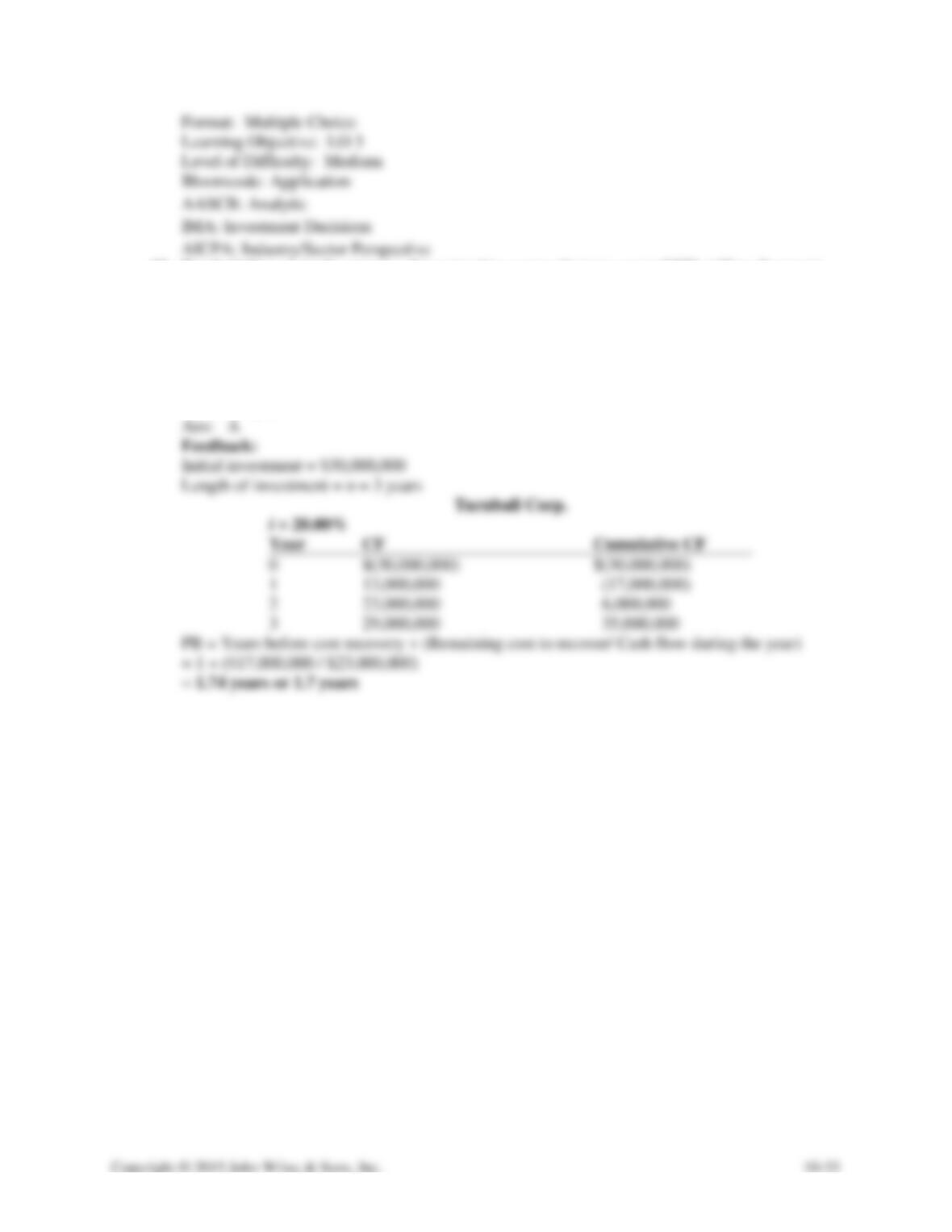
Turnbull Corp. is in the process of constructing a new plant at a cost of $30 million. It expects
the project to generate cash flows of $13,000,000, $23,000,000, and 29,000,000 over the next
three years. The cost of capital is 20 percent. What is the payback period for this project?
(Round your answer to one decimal place.)
A)
1.7 years
B)
2.2 years
C)
1.2 years
D)
2.7 years
Ans:
A
Fundamentals of Corporate Finance 3e Test Bank
69.
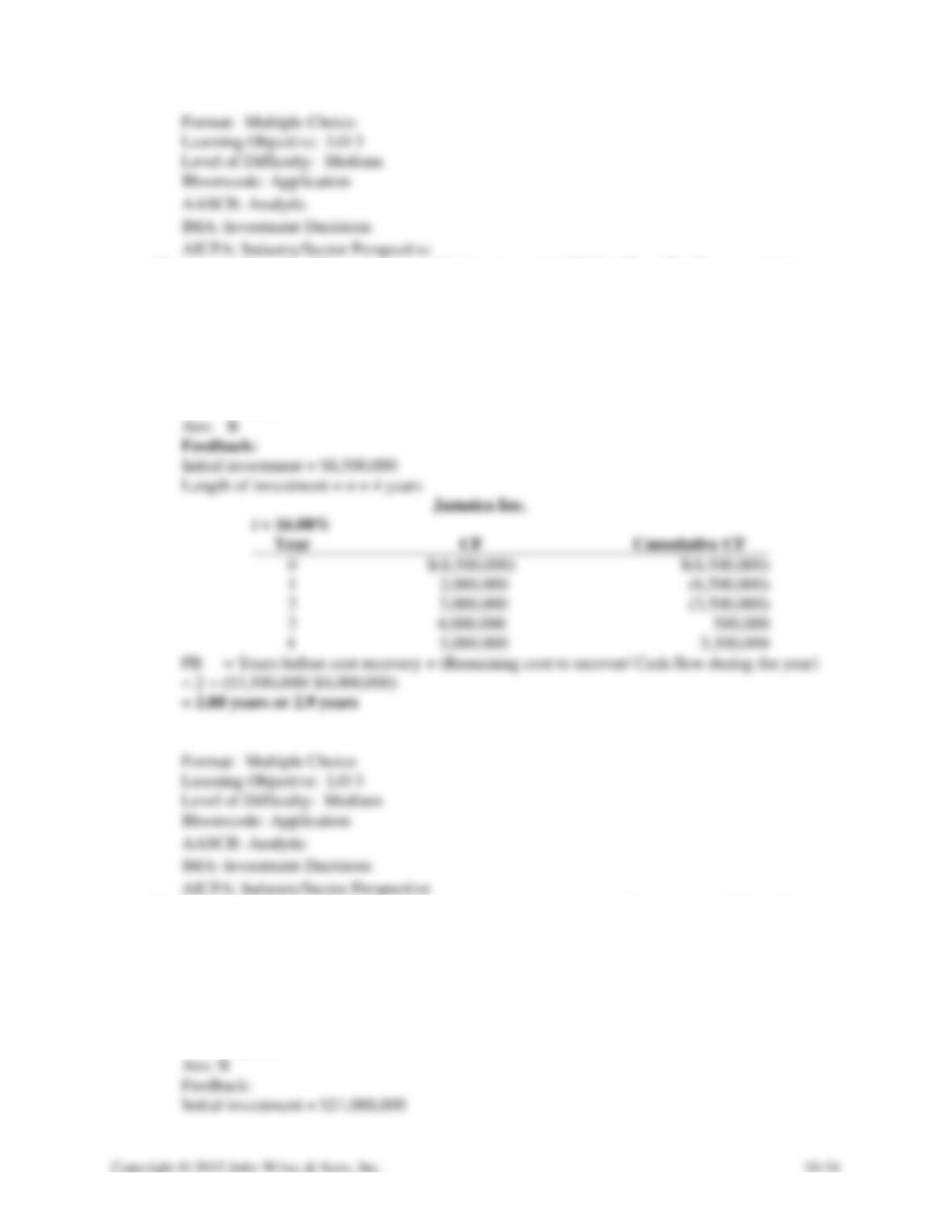
Jamaica Corp. is adding a new assembly line at a cost of $8.5 million. The firm expects the
project to generate cash flows of $2 million, $3 million, $4 million, and $5 million over the
next four years. Its cost of capital is 16 percent. What is the payback period for this project?
(Round your answer to one decimal place.)
A)
2.7 years
B)
2.9 years
C)
3.1 years
D)
3.4 years
Ans:
B
70.
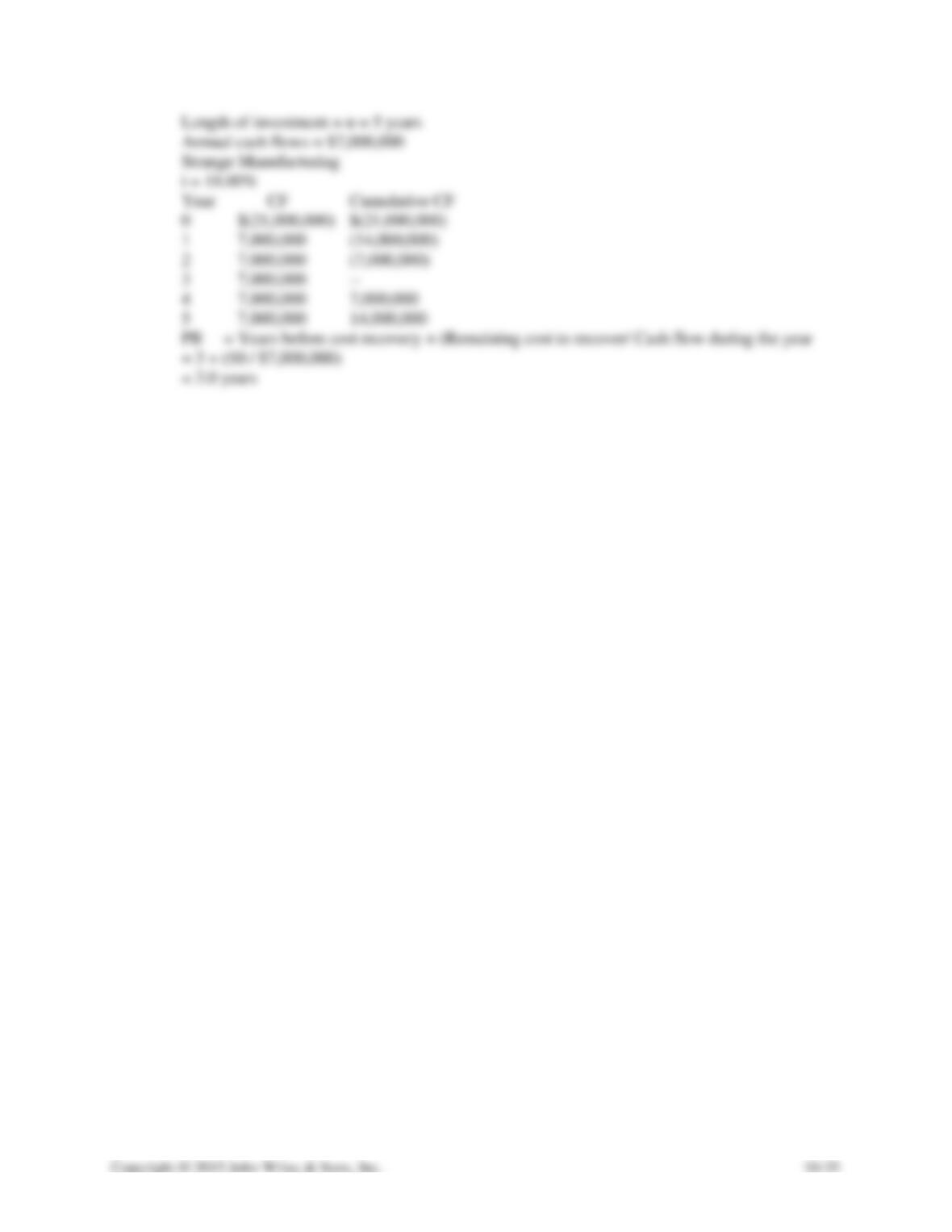
Strange Manufacturing Company is purchasing a production facility at a cost of $21 million.
The firm expects the project to generate annual cash flows of $7 million over the next five
years. Its cost of capital is 18 percent.
What is the payback period for this project?
A) 2.8 years
B) 3.0 years
C) 3.2 years
D) 3.4 years
Fundamentals of Corporate Finance 3e Test Bank
Fundamentals of Corporate Finance 3e Test Bank
AICPA: Industry/Sector Perspective
71.
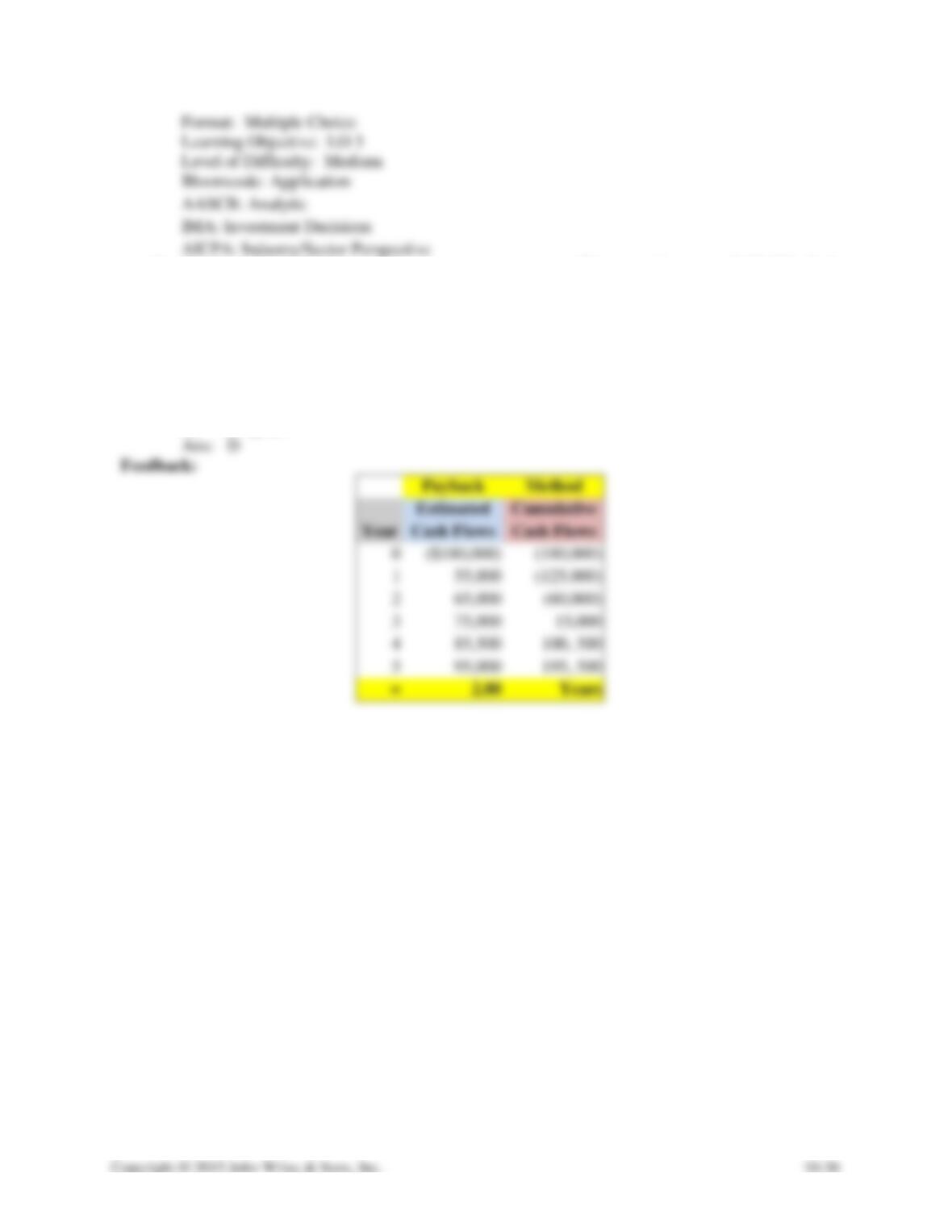
You have been asked to analyze an investment project. The project’s cost is $180,000. Cash
inflows are projected to be: year 1 = $55,000, year 2 = $65,000; year 3 = $75,000; year 4 =
$85,500; year 5 = $95,000.
What is the investment project’s payback? (Round off to the nearest 0.1 years)
A)
4.1 years
B)
1.6 years
C)
3.5 years
D)
2.8 years
Ans:
D