
Chapter 10 — Governmental Accounting: The General Fund and the
Account Groups (including Other Governmental Funds, Proprietary
Funds, and Fiduciary Funds)
MULTIPLE CHOICE
1. What is the cornerstone of external financial reporting for
governmental units and not-for-profit organizations?
a.
show the flow of financial resources
b.
to determine profit or loss
c.
to compare budgeted to actual resources
d.
accountability
2. A primary distinction between the flow of resources through a business
enterprise and through a governmental entity is that operations in a
governmental entity consume resources and assets to
a.
produce goods and services to citizens entitled to receive them.
b.
generate return on investment.
c.
generate net income.
d.
generate capital for future investments.
3. The body currently responsible for developing local governmental
accounting standards is the
a.
Financial Accounting Standards Board (FASB)
b.
Governmental Accounting Standards Board (GASB).
c.
National Council on Governmental Accounting (NCGA).
d.
Governmental Finance Officers Association (GFOA)
4. Recently effective accounting standards require the preparation of two
separate sets of financial statements. The first set of fund financial
statements are similar to the historical fund based reporting model.
Which of the following statements is false concerning the additional
financial statements that are now required?
a.
the statements are designed to focus on the governmental unit as a
whole
b.
the statements consolidate all government operations on a full
accrual basis
c.
the statements are designed to report on the profit-making ability
of the resources collected
d.
the statements adopt an economic measurement focus

10-2
5. The entry to record the Warwick City budget for the General Fund
includes the following:
Estimated Revenues…………………………. $4,000,000
Appropriations…………………………….. 3,850,000
Estimated Other Financing Uses………………. 400,000
Estimated Other Financial Sources……………. 150,000
The entry to record this budget would include a debit to
a.
Estimated Other Financing Uses.
b.
Appropriations.
c.
Budgetary Fund Balance.
d.
Encumbrances.
6. The governmental Accounting Standards Board has stated governmental
financial reporting should be designed to show:
a.
accountability
b.
interperiod equity
c.
whether future taxpayers will be required to assume burden for
services previously reported
d.
all of the above
7. The modified accrual method of accounting is applied to which of the
following funds or asset groups?
a.
Proprietary funds
b.
Governmental funds
c.
Proprietary type fiduciary funds
d.
Permanent funds
8. Which of the following correctly portrays the necessary journalization
of the budget journal entry?
Debit Credit
a.
Appropriations Estimated Revenues
b.
Estimated Revenues Est. Other Fin. Sources
c.
Estimated Revenues Appropriations
d.
Estimated Other Financing Est. Other Fin. Sources
Uses
9. Which of the following would not be considered a budgetary account in
the General Fund?
a.
Estimated Other Financial Sources
b.
Appropriations
c.
Estimated Revenues
d.
Fund Balances–Reserved for Inventory

Chapter 10
10. Which one of the following statements is false concerning the
accounting for the budget in the general fund general ledger?
a.
The budgetary accounts are affected regularly as revenues and
expenditures are recognized.
b.
The budgetary accounts can be adjusted during the year to reflect
material changes in estimates.
c.
The budgetary accounts are closed at the end of the period.
d.
The budgetary account for expenditures is called appropriations.
11. Goods ordered and originally encumbered at $7,500 were received with an
invoice price of $7,700. In recording this event,
a.
Encumbrances would be debited for $200.
b.
Fund Balances–Reserved for Encumbrances would be debited for
$7,500.
c.
Expenditures would be debited for $7,500.
d.
Appropriations would be debited for $200.
12. Property taxes are recorded as revenue in the General Fund
a.
when the property taxes are levied.
b.
when the property taxes are due.
c.
when property tax payments are received.
d.
on a monthly pro rata basis.
13. The entry in the General Fund to record the posting of a tax lien by a
city would include a credit to
a.
Tax Lien Receivable.
b.
Revenue.
c.
Taxes Receivable.
d.
Tax Receivable–Delinquent.
14. Revenue from other financing sources includes all of the following
except for:
a.
Issuing general long-term debt
b.
Receipt of interfund transfers
c.
Revenues from the donation of capital assets
d.
Sales of capital assets

15. Which of the following correctly identifies how certain transactions
are recorded in the general fund?
Debits Credits
a.
Expenditures Other financing uses
b.
Expenditures Other financing sources
c.
Other financing sources Other financing uses
d.
Revenues Expenditures
16. Which one of the following equations will yield the unobligated balance
in an expenditure subsidiary ledger account? Unobligated Balance =
a.
Appropriations – Expenditures total
b.
Appropriations – Encumbrances balance
c.
Appropriations – Expenditures total – Encumbrances balance
d.
Appropriations – Expenditures total + Encumbrances balance
17. Which of the following is not a type of account classification found in
the general fund?
a.
permanent balance sheet accounts
b.
budgetary accounts
c.
forecast accounts
d.
operating accounts
18. A special assessment levied on citizens for a service they are
receiving from a local government should be accounted for in a fund
that matches the nature of the special assessment. Which of the
following funds would not match a service activity?
a.
Capital Projects Fund
b.
General Fund
c.
Special Revenue Fund
d.
Enterprise Fund
19. Which of the following accounts would not be found in the year-end
General Fund balance sheet of a city?
a.
Cash
b.
Allowance for Uncollectible Taxes
c.
Land–Parks
d.
Fund Balance–Reserved for Encumbrances

Chapter 10
20. Which of the following items would be found in a city’s General Fund
statement of revenues, expenditures, and changes in fund balance?
a.
Depreciation expenditure
b.
Appropriation
c.
Encumbrances
d.
Other financing sources
21. Property taxes in the amount of $3,000,000 are billed to city property
owners. It is estimated that two percent will prove to be
uncollectible. In recording this event,
a.
Estimated Revenues would be credited for $2,940,000.
b.
Bad Debts would be debited for $60,000.
c.
Tax Liens Receivable would be debited for $60,000.
d.
Allowance for Uncollectible Current Property Taxes would be
credited for $60,000.
22. After the closing entries have been journalized and posted, but prior
to the next accounting period, which of the following accounts would
have a balance?
a.
Fund Balance–Unreserved, Undesignated
b.
Appropriations
c.
Other Financing Uses
d.
Revenues
23. GASB Statement 34 allows the government to avoid charging depreciation
on infrastructure assets if:
a.
the governmental unit can demonstrate they have incurred costs to
preserve the assets at or above a conditional level.
b.
the asset is not expected to be replaced.
c.
the asset has a useful life of less than five years.
d.
the asset will be replaced within five years.
24. When recording the acquisition of a fixed asset in a city’s General
Fixed Asset Account Group (GFAAG), the debit entry should be selected
from one of the following accounts except
a.
Land
b.
Expenditures
c.
Machinery and Equipment
d.
Construction in Progress

Chapter 10
25. When recording the acquisition of a fixed asset in a city’s General
Fixed Asset Account Group, the credit entry may be to which one of the
following accounts?
a.
Investment in General Fixed Assets–General Fund
b.
Fund Balance Reserved for Encumbrances
c.
Contributed Capital
d.
Fund Balance–Expended
26. To record the sale of a fixed asset carried in the General Fixed Assets
Account Group, a city could debit which one of the following accounts
in the GFAAG?
a.
Cash
b.
Expenditures
c.
Accounts Receivable
d.
Investment in General Fixed Assets–Donations
27. If a city uses a General Fixed Asset Account Group (GFAAG) and records
depreciation in anticipation of the city wide financial reports,
accumulated depreciation accounts are credited in the GFAAG. What would
be the corresponding debit entry?
a.
Expenditure in the General Fund
b.
Depreciation expenditure in the GFAAG
c.
The appropriate investment in general fixed assets account in the
GFAAG
d.
Accounting for usage is not permitted in the General Fund or GFAAG
28. Which of the following accounts would not be found on a city’s General
Fund Balance Sheet?
a.
Other Financial Sources
b.
Vouchers Payable
c.
Allowance for Uncollectible Tax Liens
d.
Due from State Government
29. If a city issues a term bond to purchase property for a city park,
which of the following entries would be made?
a.
Other Financing Sources would be credited in a Capital Projects
Fund.
b.
Cash would be debited in the General Long-Term Capital Debt
Account Group.
c.
Term Bonds Payable would be credited in the General Fund.
d.
All of these entries would be made.

Chapter 10
30. The City of Olburg failed to record invoiced expenditures for the last
year of $15,000 that were not encumbered. Of this amount, $10,000 was
id this year debited to Expenditures. The unpaid portion has not been
vouchered. The entry to record this event would include a
a.
$15,000 credit to Expenditures.
b.
$15,000 debit to Fund Balance–Unreserved and Undesignated.
c.
$5,000 debit to Expenditures.
d.
$10,000 credit to Fund Balance–Unreserved and Undesignated.
31. If the City of Billings determines that it has $200,000 of unfunded
pension liability, it would record this liability as a(n)
a.
expenditure in the General Fund
b.
deferred liability in the GLTDAG
c.
unfunded pension liability in the GLTDAG
d.
due to pension trust fund in the General Fund
32. A city should record a liability for a claim from a citizen who files
suit because their toddler drowned in the community swimming pool
unattended by a lifeguard if
a.
it is probable the lawsuit will be settled.
b.
the amount of the judgment or settlement can be estimated.
c.
the lifeguard has no private insurance to pay the claim.
d.
a and b
33. If the police department purchases a police car for $20,000 and trades
in the old car for $6,000 paying a net cash payment of $14,000, the
entry in the General Fund would
a.
debit Automobiles for $14,000.
b.
debit Expenditures for $14,000.
c.
credit Automobiles for $6,000.
d.
debit Expenditures for $20,000.

Chapter 10
10-8
34. If the city expends more during the budget year than it receives during
the budget year in revenues that are available to finance the
expenditures, it will
a.
increase interperiod equity.
b.
decrease interperiod equity.
c.
increase taxes.
d.
force the city to fire some employees.
35. Which of the following activities would NOT be accounted for in a
Special Revenue Fund?
a.
hotel taxes restricted for tourism expenditures
b.
lottery proceeds restricted for property tax relief
c.
interest earned on temporary investments of long term bond
proceeds
d.
park fees restricted to cover a small portion of park upkeep and
maintenance
36. Which of the following fund types have accounting principles most
closely related to those of the General Fund?
a.
Pension Trust
b.
Enterprise
c.
Agency
d.
Special Revenues
37. When a city pays its water and sewer bill for its administration
offices to the city owned water company, the following entry would be
made
a.
Credit to Revenue in the Utility Fund
b.
Debit to Revenues in the General Fund
c.
Credit to Expenditures in the General Fund
d.
Debit Administrative Expense in the General Fund
38. Debt Service funds account for
a.
revenue bonds.
b.
payment of principal and interest on general obligation debt.
c.
arbitrage.
d.
monies irrevocably set aside for an in-substance defeasance.

Chapter 10
10-9
39. On December 1, $125,000 was deposited with a fiscal agent for payment
on bonds payable in the amount of $90,000 and interest payable for
$35,000 due maturing on the last day of December. This will require a
debit of
a.
$125,000 to the Expenditure account in the General Fund.
b.
$35,000 to the Expenditure account in the General Fund.
c.
$125,000 to the Other Financing Uses–Operating Transfers Out
account in the General Fund.
d.
$35,000 to the Expenditure account in the Debt Service Fund.
40. Permanent Funds are established to
a.
account for general operating activities
b.
account for public purpose trust for which only the earnings are
expendable for a specific purpose
c.
record earnings and principal expended for public purpose trusts
for specific purposes
d.
account for private purpose trusts
41. The basis of accounting for the Expendable Trust Fund is the
a.
accrual basis.
b.
cash basis.
c.
modified accrual basis.
d.
modified cash basis.
42. Which of the following is an expenditure in the Debt Service Fund?
a.
The payment of principal of a matured bond accounted for in the
General Long-Term Debt Account Group
b.
Payment of principal or interest on special assessment debt for
which the government is obligated in some manner
c.
Transfers to fiscal agents for payment of bond interest
d.
All of these are expenditures in the Debt Service Fund.
43. Utilizing serial bonds to raise long term resources is preferred in debt service funds because:
a.
the face value becomes due at one time at a more distant maturity

Chapter 10
10–10
date.
b.
serial bonds do not require a substantial accumulation of money in
a sinking fund.
c.
it assists in the budgeting process.
d.
the primary function is to account for fixed asset acquisitions.
44. An enterprise fund should be used to account for
a.
a free city–run swimming pool paid for with property tax.
b.
a city-run water utility serving the general public.
c.
any activity which the city plans to sell to external users for a
fee either now or in the future.
d.
Both b and c are correct.
45. Which of the following is not a typical year-end statement for an
Enterprise Fund?
a.
Balance sheet
b.
Statement of Revenue, Expenses and Changes in Retained Earnings
c.
Statement of cash flows
d.
All of these financial statements would be used at year end by an
Enterprise Fund.
46. The activities of a central motor pool that supplies and services
vehicles for the use of municipal employees on official business should
be accounted for in a(n)?
a.
General Fund
b.
Agency Fund
c.
Internal Service Fund
d.
Special Revenue Fund
47. If a county collects taxes on behalf of the city and school district,
it would record the taxes in the
a.
General Fund.
b.
Special Revenue Fund.
c.
Agency Fund.
d.
Trust Fund.

Chapter 10
10–11
48. The best fund in which to account for the interest and dividends from
an endowment to purchase library books for a city would be a(n)
a.
Expendable Trust Fund.
b.
Agency Fund.
c.
Endowment Fund.
d.
Nonexpendable Trust Fund.
49. A redemption of the final serial of general obligation bonds, including
a deficiency covered by the general fund, would affect which funds
and/or account groups?
a.
General, Debt Service, General Long Term Debt Account Group
b.
Debt Service, General Long Term Debt Account Group, Agency Fund
c.
General, Debt Service
d.
General, Debt Service, General Long Term Debt Account Group,
Capital Projects
50. Interfund transactions include all of the following except for:
a.
one fund’s reimbursement of another for supplies paid on its
behalf
b.
interfund operating transfers between government funds for
services provided and used and recorded as other financing sources
and uses
c.
interfund loan transfers classified as Due to/from other Funds
d.
interfund non-reciprocal transfers between government funds
recorded as interfund transfers appearing after non-operating
revenues
51. Which of the following terms best describes the accounting methods used
to account for a city’s Pension Trust Fund?
a.
Cash basis
b.
Modified cash basis
c.
Accrual basis
d.
Modified accrual basis

Chapter 10
10–12
60. Which of the following funds or account groups would be
affected by a transfer of property tax receipts to pay bond principal
and interest payments? The bonds were issued several years ago to fund
the construction of a new library.
a.
Capital Project Fund
b.
Library Fund
c.
Debt Service Fund
d.
General Fixed Asset Account Group
52. Which of the following funds would use the flow of financial resources
as its measurement focus?
a.
General Fund
b.
Agency Fund
c.
Internal Service Fund
d.
Nonexpendable Trust Fund
53. When a city plans to build a fire station by issuing long–term debt, it
could obtain money to start construction before the bonds are sold by
a.
selling old fire trucks.
b.
borrowing from the pension trust fund.
c.
issuing Bond Anticipation Notes.
d.
issuing Tax Anticipation Notes.
PROBLEM
1.In the space provided, fill in the name of the one fund or account group
in which each of the following items is most likely to be recorded.
Item Name of Fund or Group
(1) Services financed by user fees
charged against other funds __________________________________
(2) Resources used for
construction of major general
fixed assets __________________________________
(3) Operations of general
governmental functions __________________________________
(4) Assets held for distribution
to other governments or for
individuals __________________________________
Chapter 10
(5) Accumulation of resources for
and payment of general long–
term debt assets __________________________________
(6) Total historical cost of
buildings owned by the
government __________________________________
(7) Activities related to an
employee retirement program __________________________________
(8) Services financed by user
charges against the general
public __________________________________
(9) Accountability for assets
whose principal must be
preserved __________________________________
2. What is infrastructure and what fund or account group would an
infrastructure item be found?
3. Explain why governmental funds use budgetary accounts.
Chapter 10
4. Describe the three basic fund types and account groups and explain what
changes, if any, the adoption of GASB standard #34 has made on these
classifications?
Chapter 10
5. The Village of Applegate General Fund has the following accounts:
a.
Budgetary Fund Balance
b.
Property Taxes Receivable
c.
Fund Balance Reserved for Encumbrances
d.
Vouchers Payable
e.
Expenditures
f.
Other Financing Source–Bond Proceeds
g.
Appropriations
h.
Investments
i.
Unreserved–undesignated Fund Balance
a.
Either d. Credit g. Credit
b.
Debit e. Debit h. Debit
c.
Credit f. Credit i. Credit
Required:
Identify the normal balance expected for each account during the fiscal
year before closing entries. Select from debit, credit or either.
6. What is the concept of interperiod equity?
Chapter 10
7. The following selected account balances for the City of Hampton on
January 1, 20X8 are listed below:
Delinquent Taxes Receivable…………………… $34,000 Dr.
Allowance for Uncollectible Delinquent Taxes……. 11,000 Cr.
Tax Liens Receivable…………………………. 12,000 Dr.
Allowance for Uncollectible Tax Liens………….. 5,000 Cr.
Required:
Record the following transactions that occurred during 20X8:
a.
Current property taxes are levied at $750,000 with a 4%
allowance for uncollectible property taxes.
b.
Property to which tax liens apply is sold for $6,000 and the
account is closed.
c.
Current property taxes are collected in the amount of
$702,000.
d.
Previous delinquent property taxes are converted to tax liens
and the current property taxes are considered delinquent.
Chapter 10
10–17
8. The City of Franklin has adopted the General Fund budget for the next
fiscal year. The details of the budget are:
Revenue and other financial sources:
Property taxes………………………………….. $500,000
Fines………………………………………….. 50,000
State and federal grants…………………………. 75,000
Estimated receipt of funds from the closing of
the Municipal Swimming Pool, account for as an
Enterprise Fund………………………………. 15,000
Estimated receipt from Water Utility Fund to finance
Expenditures (not in lieu of property taxes)…….. 50,000
Expenditures and other uses:
Equipment purchases……………………………… $150,000
General operations………………………………. 450,000
Estimated transfer to Debt Service fund to pay
interest on bond indebtedness………………….. 30,000
Required:
Prepare journal entries to record the budget for the City of Franklin.
9. The following transactions were made by the City of Morrell:
June 2, 20X5 Purchase orders of $57,000 were approved.
June 17, 20X5 Goods of $32,000 of the purch orders were
received. These items are in good order.
The invoices totaled $29,000 and vouchers were
approved for payment.
June 30, 20X5 Make entries for the City of Morell’s
year-end and the start of the next fiscal
year on July 1, 20X5.
July 16, 20X5 The remaining items arrived in good order
The invoices totaled $25,000.
Required:
Chapter 10
10–18
Make the necessary journal entries to record the transactions in the
General Fund.
10. The following transactions were made by Cape City:
August 1, 20X9 A wealthy business person donates a downtown
office building to Cape City. Its fair market
value is $2,500,000. The city intends to sell the
building.
August 15, 20X9 The city purchases a warehouse to be used for
storage and pays $1,500,000 from the General Fund.
September 1, 20X9 The donated office building is sold for $2,600,000.
Required:
Make the journal entries necessary to record the transactions in the
General Fund and in the General Fixed Assets Account Group.
Chapter 10
10–19
11. Lake City had the following transactions.
July 1, 20X9 Lake City levied $500,000 in property taxes to
be paid by its citizens before October 1, 20X9.
Estimated uncollectibles are 1% of the taxes levied.
July 31, 20X9 During July, $10,000 was collected for licenses
and permits.
August 1, 20X9 Received a grant from the state government to pay
for a drug enforcement officer for one year. The
amount is $50,000 and the officer is to begin on
October 1, 20X9.
Required:
Make the necessary journal entries to record the transactions in the
General Fund. Lake City has a June 30 year end.
Chapter 10
10–20
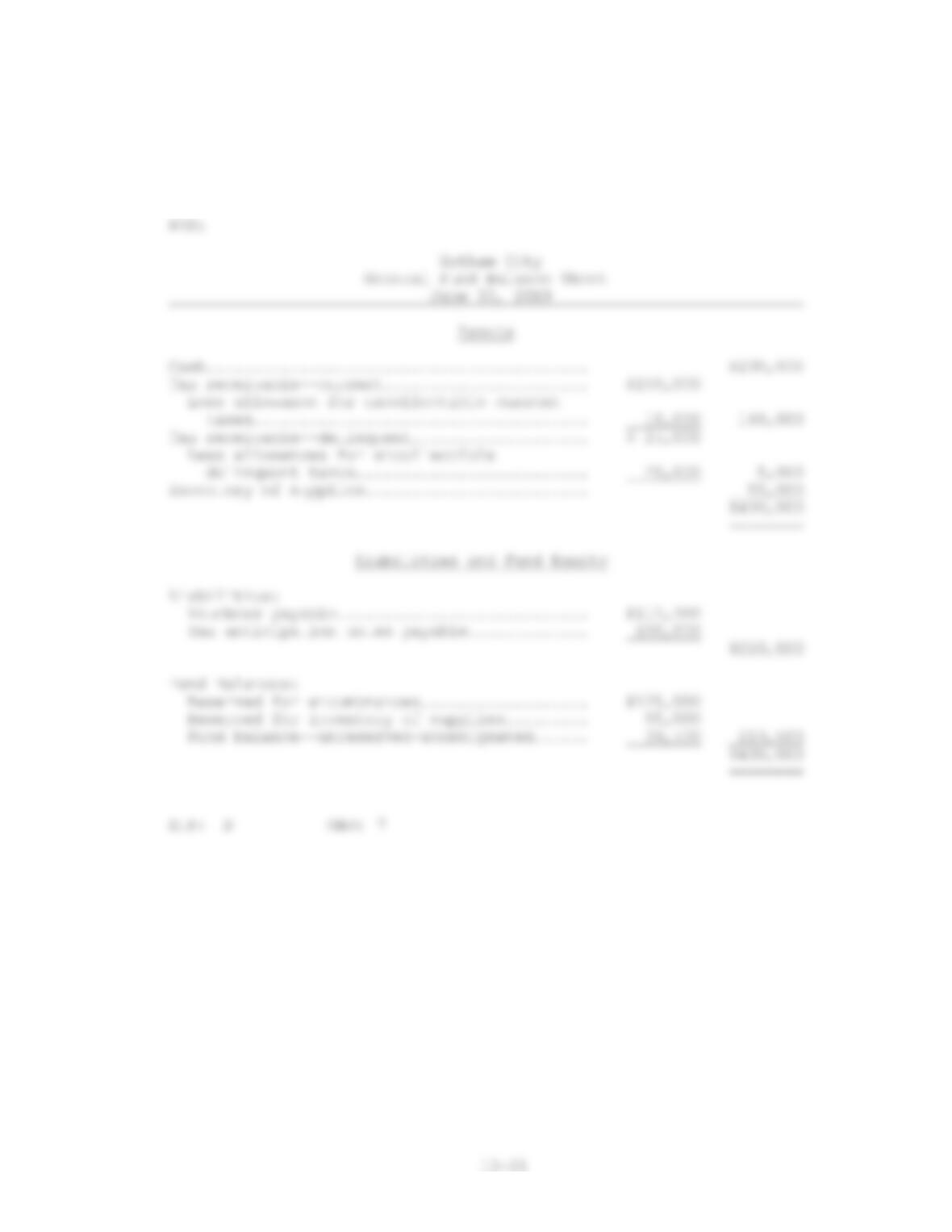
12. Using the Gotham City General Fund Trial Balance, prepare the June 30,
20X9, General Fund balance sheet for Gotham City.
____________________________________________________________________
Following is the year-end trial balance for the
General Fund of Gotham City.
Gotham City
General Fund Trial Balance
June 30, 20X9 ___
Debit Credit
Cash………………………………….. 230,000
Taxes Receivable–Current……………….. 150,000
Allowances for Uncollectible Taxes–
Current……………………………… 10,000
Taxes Receivable–Delinquent…………….. 25,000
Allowances for Uncollectible Taxes–
Delinquent ………………………….. 20,000
Inventory of Supplies…………………… 55,000
Vouchers Payable……………………….. 110,500
Tax Anticipation Notes Payable…………… 100,000
Fund Balance–Reserved for Inventory
of Supplies………………………….. 55,000
Fund Balance–Unreserved, Undesignated……. 50,000
Revenues………………………………. 2,455,000
Expenditures…………………………… 2,255,000
Other Financing Sources…………………. 110,000
Other Financing Uses……………………. 95,500
Encumbrances…………………………… 125,000
Fund Balance–Reserved for Encumbrances…… 125,000
Estimated Revenues……………………… 2,450,000
Appropriations…………………………. 2,300,000
Estimated Other Financing Sources………… 110,000
Estimated Other Financing Uses…………… 96,000
Budgetary Fund Balance………………….. 164,000
5,545,500 5,545,500
========= =========
Chapter 10
The Inventory of Supplies and Fund Balance–Reserved for Inventory of
Supplies have been adjusted to reflect ending inventory. The beginning
inventory balance was $0. Fund Balance–Unreserved-Undesignated was
$5,000 before the adjustment.

Chapter 10
10–22
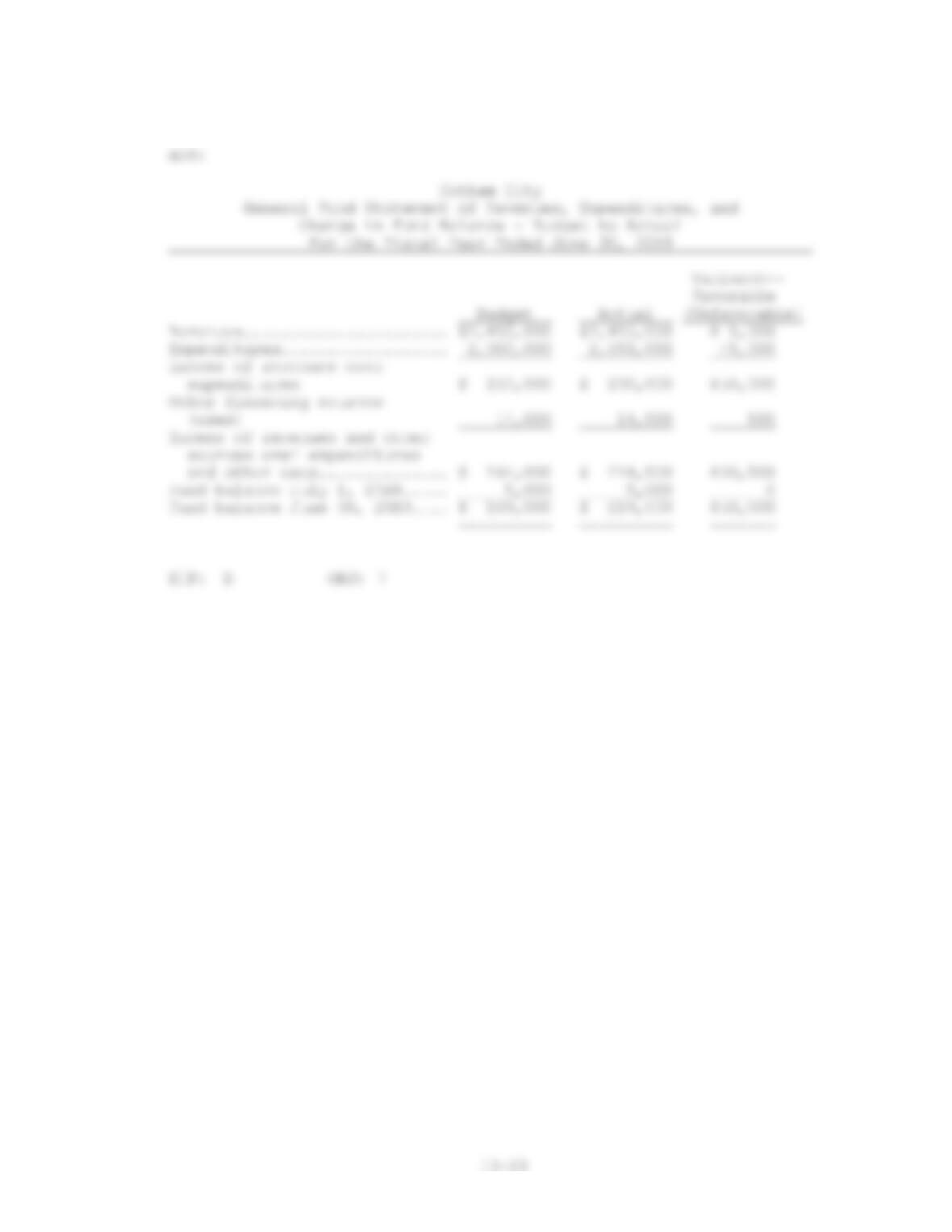
13. Use the following Gotham City General Fund Trial Balance to prepare a
Statement of Revenues, Expenditures, and Change in Fund Balance–Budget
and Actual for the General Fund for Gotham City for the year ended June
30, 20X9.
____________________________________________________________________
Following is the year-end trial balance for the
General Fund of Gotham City.
Gotham City
General Fund Trial Balance
June 30, 20X9 ___
Debit Credit
Cash………………………………….. 230,000
Taxes Receivable–Current……………….. 150,000
Allowances for Uncollectible Taxes–
Current……………………………… 10,000
Taxes Receivable–Delinquent…………….. 25,000
Allowances for Uncollectible Taxes–
Delinquent ………………………….. 20,000
Inventory of Supplies…………………… 55,000
Vouchers Payable……………………….. 110,500
Tax Anticipation Notes Payable…………… 100,000
Fund Balance–Reserved for Inventory
of Supplies………………………….. 55,000
Fund Balance–Unreserved, Undesignated……. 50,000
Revenues………………………………. 2,455,000
Expenditures…………………………… 2,255,000
Other Financing Sources…………………. 110,000
Other Financing Uses……………………. 95,500
Encumbrances…………………………… 125,000
Fund Balance–Reserved for Encumbrances…… 125,000
Estimated Revenues……………………… 2,450,000
Appropriations…………………………. 2,300,000
Estimated Other Financing Sources………… 110,000
Estimated Other Financing Uses…………… 96,000
Budgetary Fund Balance………………….. 164,000
5,545,500 5,545,500
========= =========
The Inventory of Supplies and Fund Balance–Reserved for Inventory of
Supplies have been adjusted to reflect ending inventory. The beginning
inventory balance was $0. Fund Balance–Unreserved-Undesignated was
$5,000 before the adjustment.
Chapter 10

Chapter 10
10–24
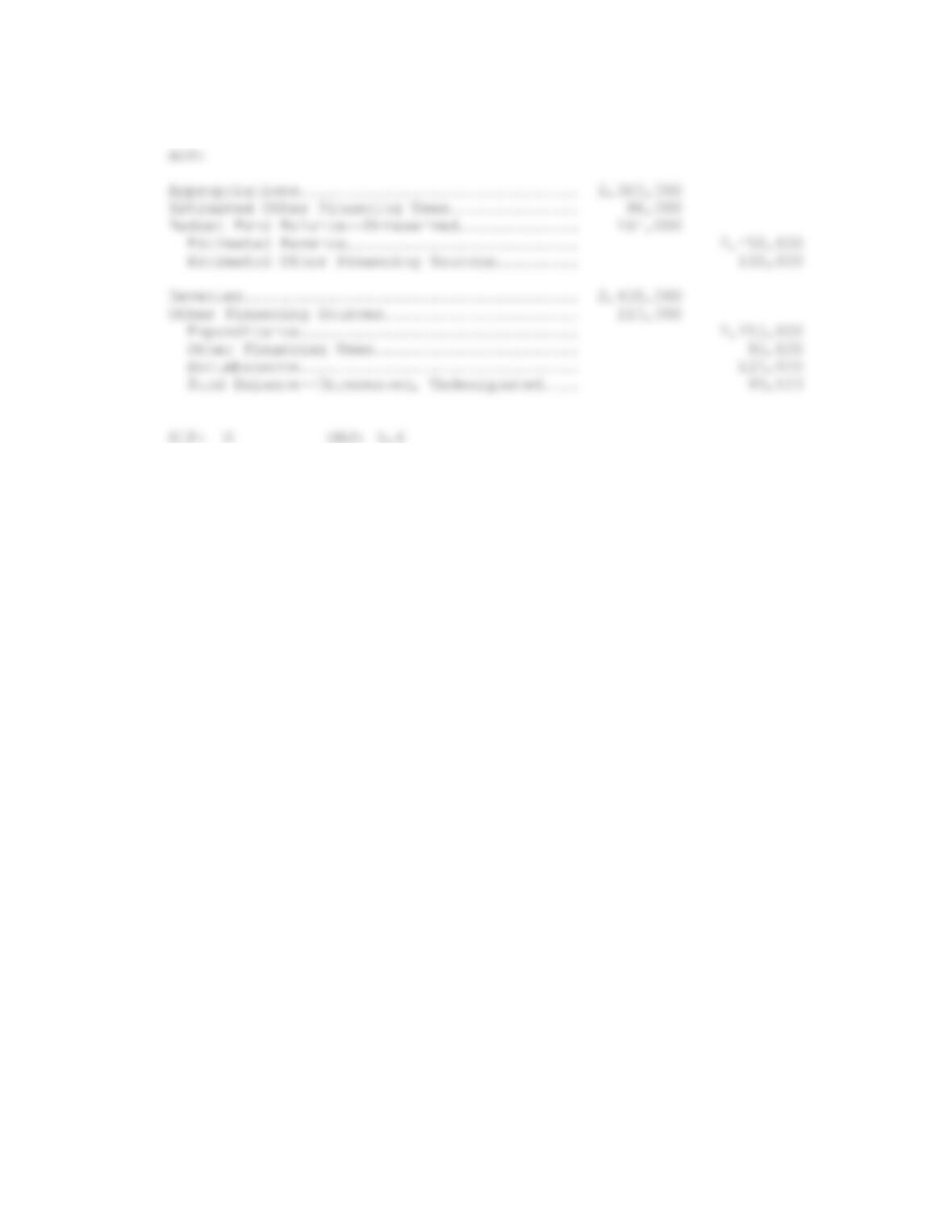
14. Using the following Gotham City General Fund Trial Balance, prepare the
closing entries for the General Fund of Gotham City on June 30, 20X9.
____________________________________________________________________
Following is the year-end trial balance for the
General Fund of Gotham City.
Gotham City
General Fund Trial Balance
June 30, 20X9 ___
Debit Credit
Cash………………………………….. 230,000
Taxes Receivable–Current……………….. 150,000
Allowances for Uncollectible Taxes–
Current……………………………… 10,000
Taxes Receivable–Delinquent…………….. 25,000
Allowances for Uncollectible Taxes–
Delinquent ………………………….. 20,000
Inventory of Supplies…………………… 55,000
Vouchers Payable……………………….. 110,500
Tax Anticipation Notes Payable…………… 100,000
Fund Balance–Reserved for Inventory
of Supplies………………………….. 55,000
Fund Balance–Unreserved, Undesignated……. 50,000
Revenues………………………………. 2,455,000
Expenditures…………………………… 2,255,000
Other Financing Sources…………………. 110,000
Other Financing Uses……………………. 95,500
Encumbrances…………………………… 125,000
Fund Balance–Reserved for Encumbrances…… 125,000
Estimated Revenues……………………… 2,450,000
Appropriations…………………………. 2,300,000
Estimated Other Financing Sources………… 110,000
Estimated Other Financing Uses…………… 96,000
Budgetary Fund Balance………………….. 164,000
5,545,500 5,545,500
========= =========
The Inventory of Supplies and Fund Balance–Reserved for Inventory of
Supplies have been adjusted to reflect ending inventory. The beginning
inventory balance was $0. Fund Balance–Unreserved-Undesignated was
$5,000 before the adjustment.
Chapter 10
10–25
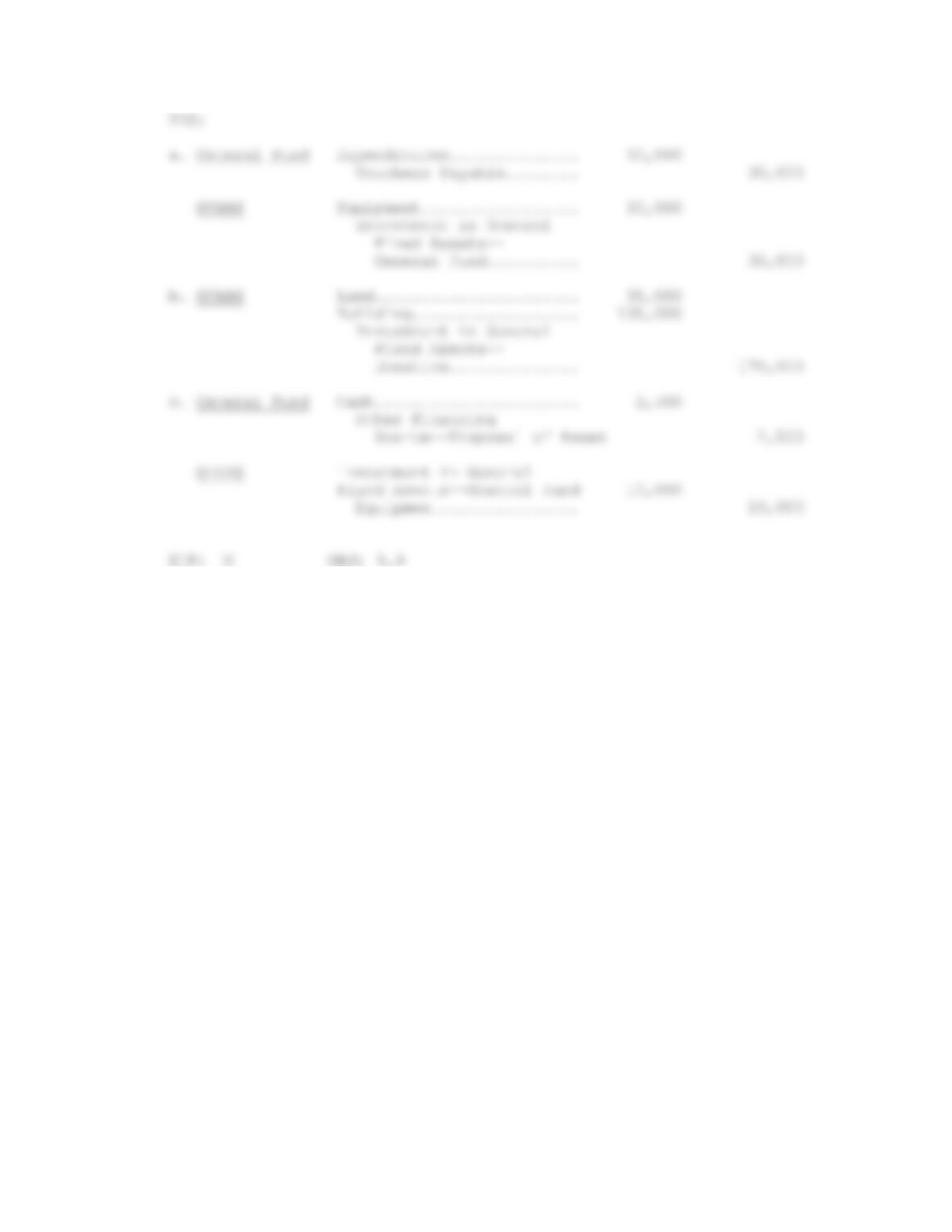
15. Following is a list of selected transactions for the City of Alpena:
a.
The city used general property taxes to purchase a computer
for the police department. The cost of the computer was
$30,000. It was not encumbered.
b.
Joseph Green donated land and a building to the city with book
values of $25,000 and $150,000, respectively. When the gift
was made, the appraisal values were $35,000 for the land and
$135,000 for the building.
c.
The city sold an old police car originally purchased by the
General Fund for $10,000. The selling price was $2,500.
Required:
Make the necessary journal entries in the funds and account groups
affected.
Chapter 10
10–26
16. Following is a list of selected transactions for the City of Andrew:
a.
The city issued $750,000 in term bonds. The bonds sold at 102.
b.
After the payment of interest, the city transferred $100,000
from the General Fund to retire serial bonds.
c.
The bonds in b are retired.
Required:
Make the necessary journal entries in the funds and account groups
affected except the Debt Service Fund.
Chapter 10
10–27
17. The following activities took place in the city of Littlewood during
20×2. Make the necessary journal entries to account for these
transactions, including the year end closing entry. Littlewood does not
utilize an encumbrance system.
a. The budget for 20×2 was approved.
Estimated Revenues $1,300,000
Estimated Other Financing Sources 50,000
Estimated Operating Expenditures 800,000
Estimated Equipment Purchases 100,000
Estimated Other Financing Uses 10,000
b. The general tax levy for 20×2 was $1,000,000 with a 5% estimate
of uncollectibles. The remaining balance from the 2001 fiscal
year was $75,000 in Taxes Receivable-Current with and Allowance
of $20,000.
c. Equipment was purchased that was invoiced at $93,500.
d. Invoices were received for operating expenditures in the amount
of $805,000 and vouchered.
e. Payment was made on items ‘c’ and ‘d’ above.
f. Collections of $895,000 on current taxes and $5,000 on
Delinquent taxes were received. A state grant was received in the
amount of $250,000.
Chapter 10
g. Fines and fees are collected in the amount of $85,000.
h. The Water Utility, an Enterprise fund of the city, will pay
$50,000 for city services that are not covered by property taxes.
i. The city will pay the motor pool fund, an internal service fund,
$10,000 for insurance costs on municipal vehicles.

Chapter 10
10–29
18. On July 1, 20X0, the beginning of its fiscal year, the trial balance of
the General Fund of the City of St. Bea was as follows:
Cash………………………………….. 20,000
Tax Receivable–Delinquent………………. 120,000
Allowances for Uncollectible Delinquent
Taxes……………………………….. 12,000
Interest and Penalties Receivable on
Taxes……………………………….. 8,000
Allowance for Uncollectible Interest
and Penalties………………………… 800
Due from Other Funds……………………. 28,000
Vouchers Payable……………………….. 87,200
Fund Balance Reserved for Encumbrances……. 16,000
Fund Balance–Unreserved, Undesignated……. 60,000
176,000 176,000
======= =======
Required:
Prepare journal entries that would be made in the General Fund for the
following events. Omit explanations.
a.
The budget shows estimated General Fund revenues of $450,000
and estimated expenditures (including amount encumbered in the
prior year) of $392,000.
b.
Late in June 20X0, an order was placed and an encumbrance
recorded for $16,000. Later in July, the item was received at
an invoice cost of $16,400. A voucher is prepared.
c.
Property taxes amounting to $300,000 were levied, with 4%
estimated to be uncollectible.
d.
Cash collections during the year were as follows:
Current taxes…………………………………. $270,000
Delinquent taxes (in full settlement)……………. 104,000
Interest and penalties on last year’s
taxes (in full settlement)……………………. 7,600
Due from other funds…………………………… 28,000
$409,600
Chapter 10
========
The controller wishes variations in estimates to be recorded in the
appropriate revenue or expenditure account.
e.
Purchase orders totaling $276,000 were placed. Later, invoices
for $260,000 were received and vouchered; supplies inventory
purchases were $16,000 of the total. The
f.
Payrolls of $50,000 were paid. (Ignore payroll taxes and other
deductions.) In addition, vouchers totaling $280,000 were
paid. (Supplies Inventory purchases were $16,000 of the
total.)
g.
An automobile was purchased for the fire department. It cost
$16,000 and was not previously encumbered. The invoice is
vouchered.
h.
At year end, $6,000 in supplies were on hand. There were no
supplies on hand a year ago. The city wishes to show the
inventory and to establish a proper reserve.
10–31
19. The pre-closing trial balance of the General Fund of Volter Village at
the end of its fiscal year, June 30, 20X1, is as follows:
Cash………………………………… 19,800
Tax Receivable–Delinquent…………….. 40,000
Allowance for Uncollectible Delinquent
Taxes……………………………… 8,400
Vouchers Payable……………………… 19,000
Fund Balance–Reserved for Encumbrances…. 22,000
Fund Balance–Unreserved, Undesignated….. 46,000
Revenues ……………………. 201,600
Expenditures ………………… 215,200
Encumbrances ………………… 22,000
Estimated Revenues …………… 200,000
Appropriations ………………. 196,000
Budgetary Fund Balance–Unreserved……… 4,000
497,000 497,000
Chapter 10
======= =======
Required:
a.
Prepare closing entries.
b.
Prepare a statement of revenues, expenditures, and changes in
fund balances for the General Fund for the year ended June 30,
20X1.
c.
Prepare the General Fund balance sheet as of June 30, 20X1.
Chapter 10
10–33
20. Consider the following events:
a.
The General Fund vouchered the purchase of trucks for $65,000.
The purchase had been encumbered earlier in the year at
$60,000.
b.
Several years ago, equipment costing $15,000 was acquired with
General Fund Revenues. It was sold for $5,000, with proceeds
belonging to the General Fund.
c.
Early in the year, a citizen donated land appraised at
$100,000 to the city. She submitted plans for a new library
and agreed to cover the total cost of construction, paying the
company directly as work proceeds. At year end, the building
was two-thirds finished, with costs to date of $300,000.
d.
A snow plow was purchased with General Fund cash for $48,000,
which represented a cost of $61,000 less trade-in of $13,000
for an old snow plow originally purchased for $35,000 from
Special Revenue Funds. As an emergency purchase, the
acquisition of the new snow plow had not been encumbered.
Required:
Prepare journal entries to record the events using the General Fund and
the General Fixed Assets Account Group:
Chapter 10
Chapter 10
acquired.
21. The following transactions occurred in the City of Maineville during
20X1:
a.
General obligation term bonds with a face value of $2,500,000
were sold for $2,550,000. The proceeds from the bond issue
were to be used to construct a new library and were received
by the Capital Projects Fund.
b.
$200,000 was transferred from the General Fund to the Debt
Service Fund to begin saving for the retirement of the bonds
in transaction a. at maturity.
c.
$150,000 was transferred from the General Fund to the Debt
Service Fund to retire a portion of a serial bond due in 20X1.
d.
A police car was purchased for $18,000 and the trade-in of an
old police car originally purchased for $15,000 from the
General Fund. The new vehicle had a list price and fair market
value of $21,500.
e.
The serial bonds funded in transaction c. were retired on
their maturity date.
f.
By year end, $450,000 of the work had been completed on the
new library.
Required:
Prepare the necessary journal entries to record the transactions and
identify the fund or account group in which it would be recorded.
Entries in the Debt Service and Capital Projects Funds should be
ignored.
Chapter 10
10–36
22. Which fund and/or account group would account for the following
activities?
a.
property taxes
b.
purchase a fire truck
c.
order some general supplies
Chapter 10
d.
build a city hall
e.
pay principal and interest on long-term debt
f.
issue long-term debt to build the city hall
g.
pay the current portion of pension liability
a.
general fund
b.
general fund and general fixed asset account group
c.
general fund
d.
capital projects fund and general fixed asset account group
e.
general fund, debt service fund, and general long-term debt
account group
f.
capital projects fund and general long-term debt account group
23. The following summary events are for the Village of Carsonville:
a.
The annual budget for the Special Revenue fund was adopted as
follows:
Estimated Revenues…………………………… $170,000
Appropriations………………………………. $150,000
b.
The state transfers $160,000 to the city for its current
year’s share of gasoline tax.
c.
$148,000 was spent on road repairs and maintenance during the
year.
d.
Closing entries are made for the year.
Required:
Prepare the journal entries necessary to record these events in the
Special Revenue Fund. The fund was established to record the city’s
share of state gasoline tax, which is used for street maintenance.
Chapter 10
24. On July 1, 20X5, Rhodes City approved the construction of a new library
costing $8,000,000. The project was to be financed with a $4,000,000
general obligation bond issue and a matching state grant.
Required:
Record the following events in the Capital Project Fund for Rhodes City
during 20X5.
a.
The city estimated that approximately one-fourth of the
contract price would be paid for in the current fiscal year
and that the bond issue will be sold this year. The project
should be completed and the matching grant received next year.
b.
The bonds are sold at 102 and premium to be used for future
principal payment, forwarded to the Debt Service Fund.
c.
A contract was signed to construct the library at a cost of
$7,900,000 with a retained percentage of 10% until final
inspection at completion.
d.
The contractor submits a $1,000,000 progress billing.
e.
The books are closed at year end.
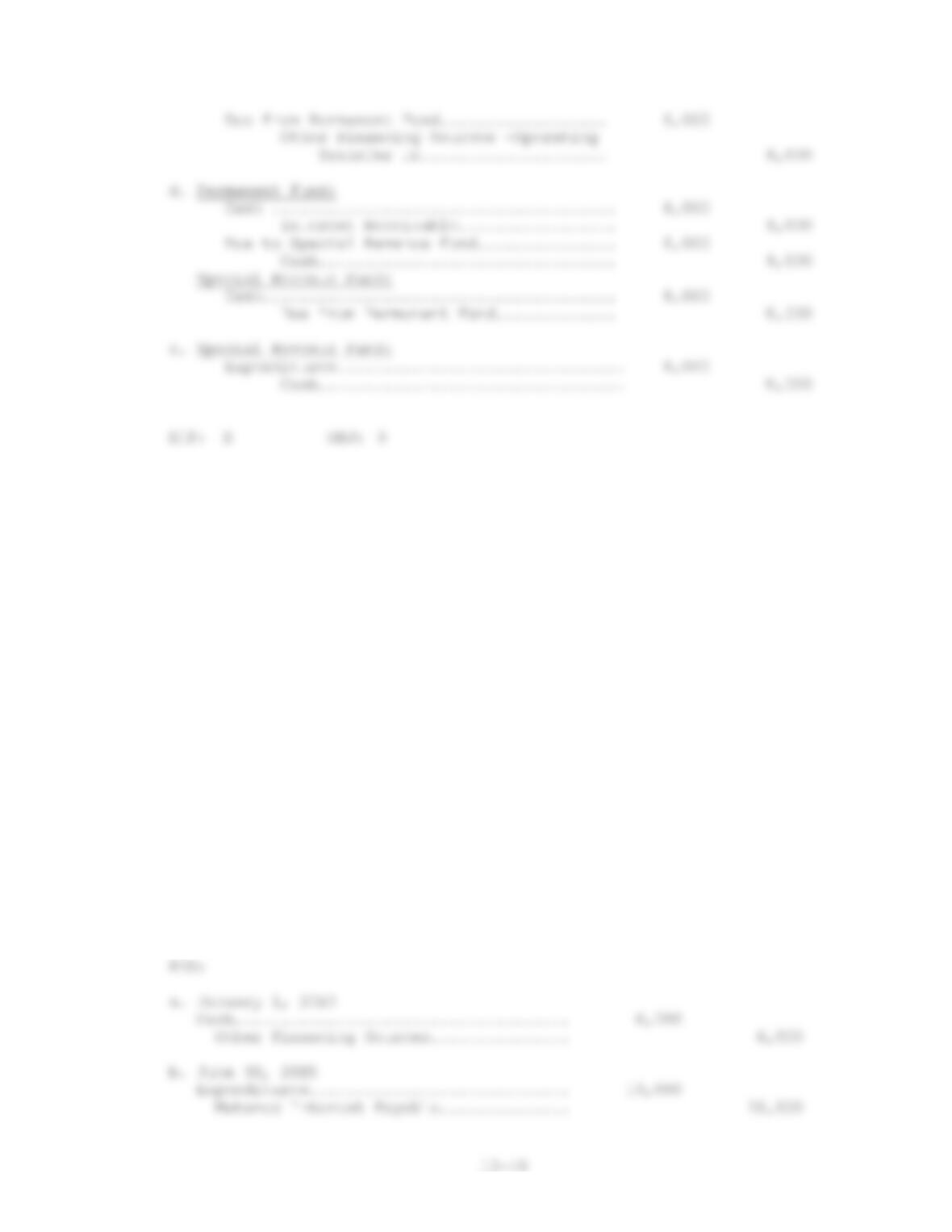
25. On 1-1-01, the City of Midville received $100,000 from a citizen, who
specifies the principal amount should remain intact. Earnings on the
principal are to be used for park beautification projects and upkeep.
Required:
Record the following events in the appropriate Permanent Fund and
Special Revenue Fund, as necessary.
a.
The deposit is made of the cash received.
b.
The cash is invested in marketable securities.
c.
Total interest accrued on investments for the year is $8,000; A
liability is established in the permanent fund for what is owed
to special revenue fund.
d.
The interest is collected and transferred to the appropriate
special revenue fund.
e.
Park Operating expenses are $2,500 and $5,500 is spent on new
park benches.
Chapter 10
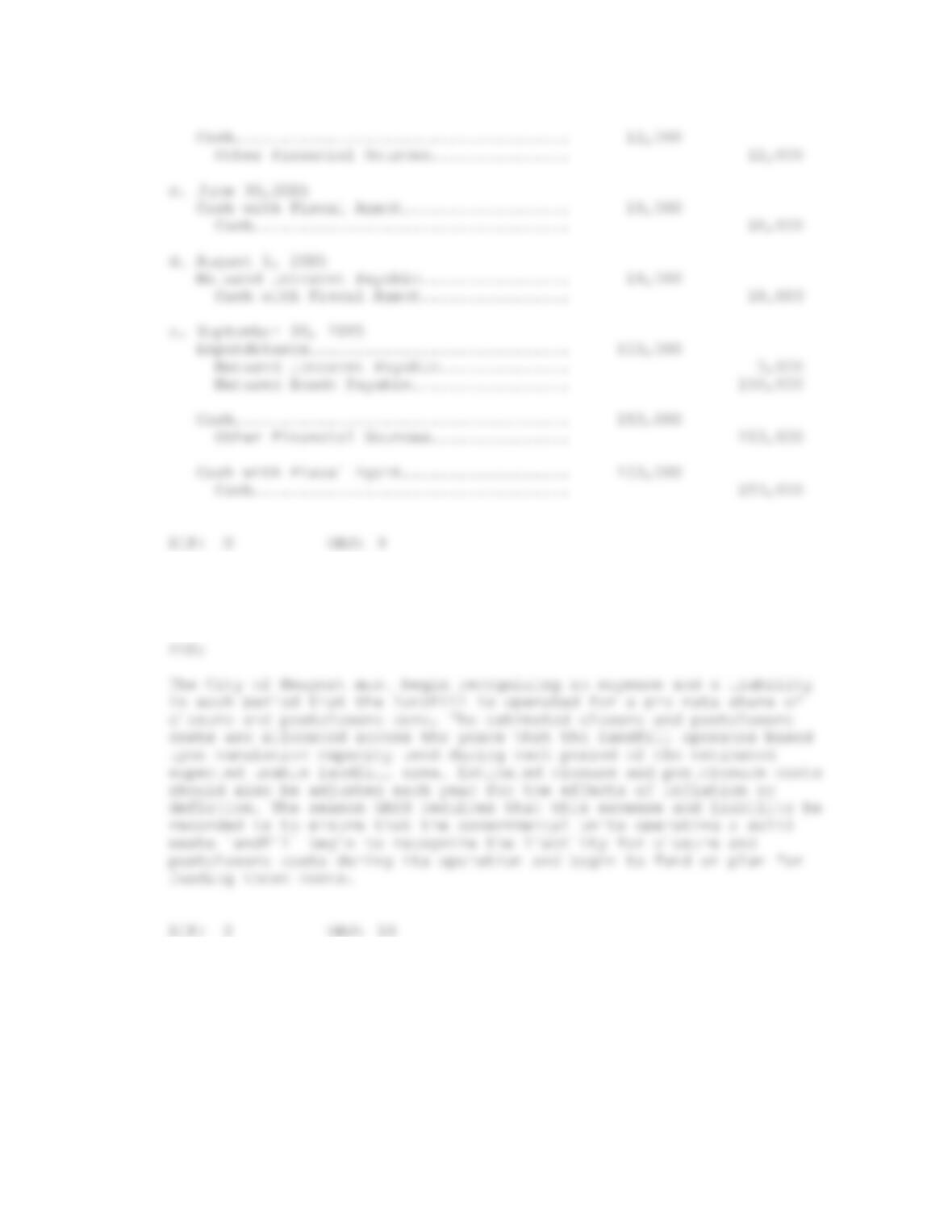
26. The following events occurred in the City of Boonebury during 20X5.
a.
On January 1, the city sells $600,000 of general obligation
bonds at 101. The premium is to be used to pay interest. The
bonds have a 6% stated interest rate and mature in 20XX.
Interest is payable on July 1 and January 1.
b.
On June, enough cash is transferred from the General Fund to
service the bonds described in a.
c.
A check is written to the fiscal agent handling the bonds on
June 30.
d.
Notification is received from the fiscal agent on August 1
that interest has been paid to the bondholders.
e.
On September 30, enough cash is transferred from the General
Fund to retire $150,000 of a serial bond issue plus $3,000 of
interest. The cash is immediately forwarded to the fiscal
agent.
Required:
Prepare the journal entries necessary to record the events in the Debt
Service Fund. The City of Boonebury is a calendar-year city.
Chapter 10
10–41
27. The City of Newport operates its own solid waste landfill and charges
fees to users who dump solid waste in the landfill. When should
estimated costs for closure and postclosure care be accounted for?
28. The City of Warwick authorized a project to modernize its street
lighting.
a.
The project will take approximately nine months to complete
and will cost $290,000. The project will be financed by a
$60,000 grant from the federal government and a $15,000
transfer from the General Fund. In addition, the city will
issue $125,000 of special assessment serial bonds. Special
assessments of $180,000, to be collected in two equal
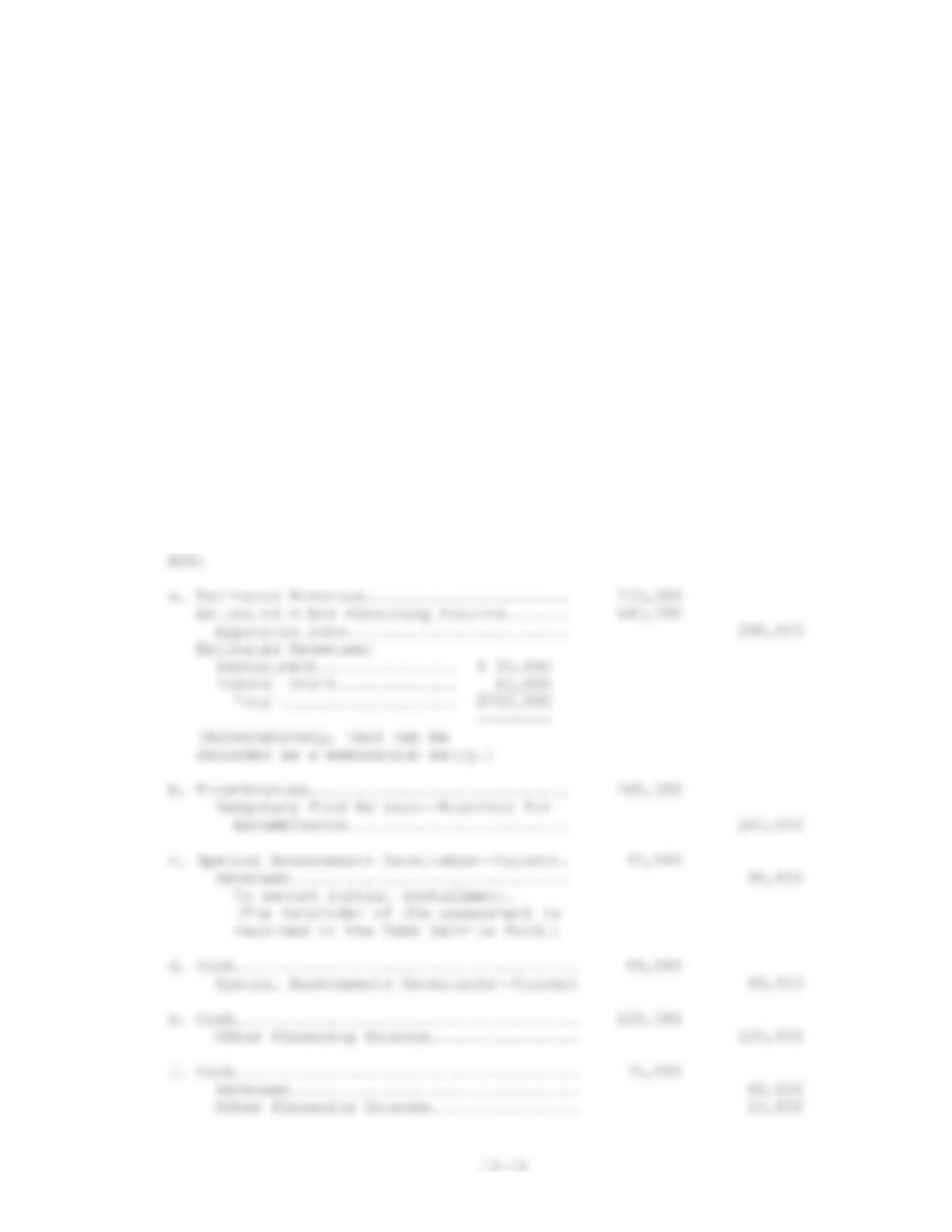
Chapter 10
installments due November 1 each year, will be levied. The
first installment is to go directly to the Capital Projects
Fund. The remaining installment will be used to repay the
related bond issue. The city desires that budgetary accounts
be established for the project.
b.
A construction contract for $265,000 is signed. The amount is
encumbered.
c.
The installment assessments of $180,000 are levied.
d.
All but $1,000 of the first installment is collected.
e.
Serial bonds are sold at a face value of $125,000 on an
interest payment date.
f.
The transfer from the General Fund and the grant from the
federal government are received.
Required:
Prepare journal entries in a Capital Projects Fund for the above
events:
Chapter 10
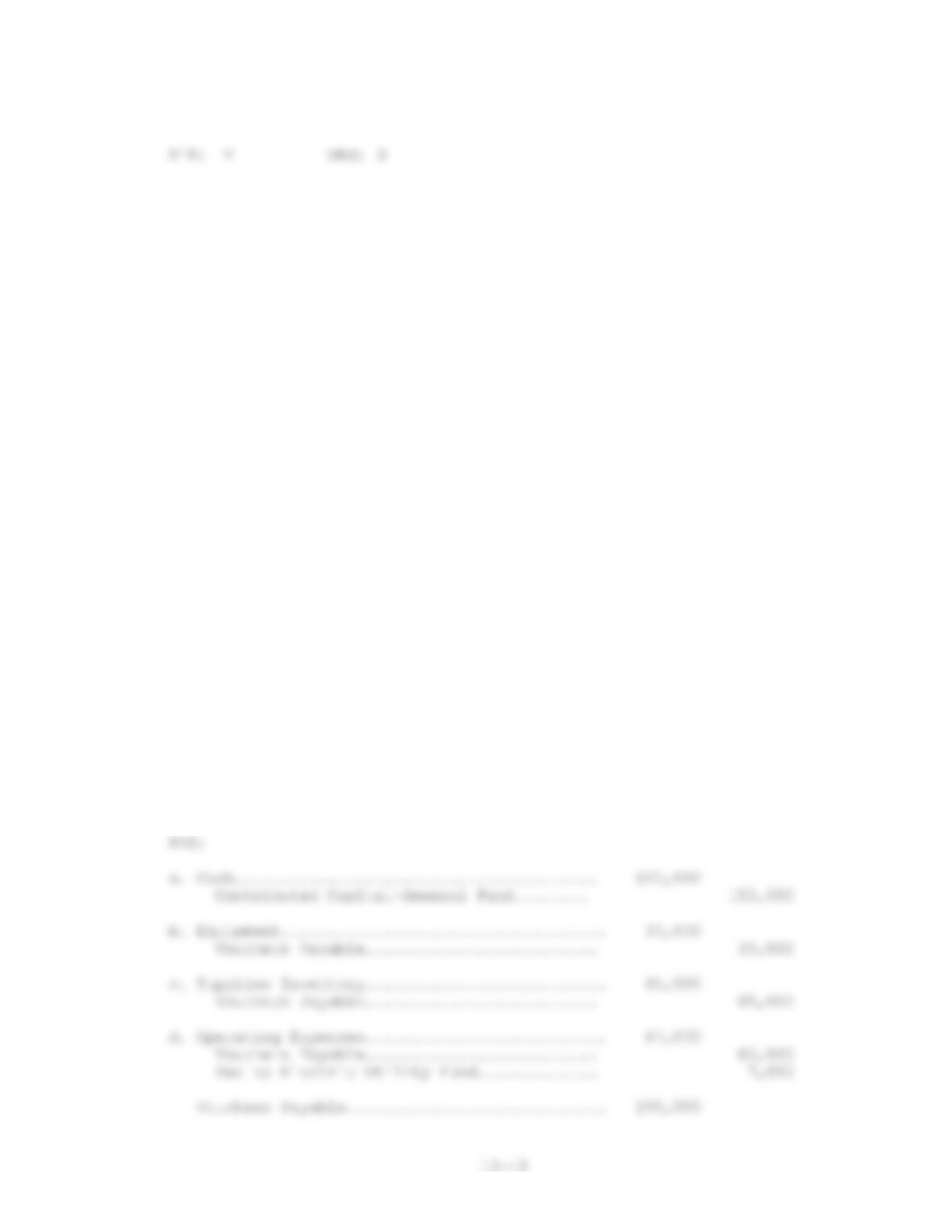
29. Rankin City established a Central Printing and Reproductions Fund
during the fiscal year ending 6/30/05. Transactions affecting the fund
are as follows:
a.
The fund was established with a $100,000 contribution from the
General Fund on 7/1/04. The transfer will be recorded as
Contributed Capital for the fund. The operation is conducted
in a facility leased on a month to month basis from a private
landlord.
b.
Equipment costing $30,000 was acquired on 7/3/04. The
equipment is assigned a 10 year life, no salvage. It will be
paid at a future date.
c.
Supplies costing $65,000 were acquired. A physical inventory
taken on 6/30/05 of the supplies and valued at $11,000. The
voucher will be paid at a later date.
d.
Various operating expenses were incurred for a total of
$67,000. Of that amount, $7,000 represented charges from the
city’s electric utility. (an enterprise fund)All the vouchers
were then paid. The payments for the equipment and supplies
acquisition are also made.
e.
Total billings to the city’s various departments were
$125,000. Of this amount, $9,000 pertained to services
performed for the city’s electric utility (enterprise fund).
f.
Cash was collected on the above billings in full.
Required:
Make the necessary journal entries for fiscal year 2004-2005 (ending
6/30/05) for Rankin City’s Internal Service Fund including any year end
adjusting entries. Closing entries are not required.
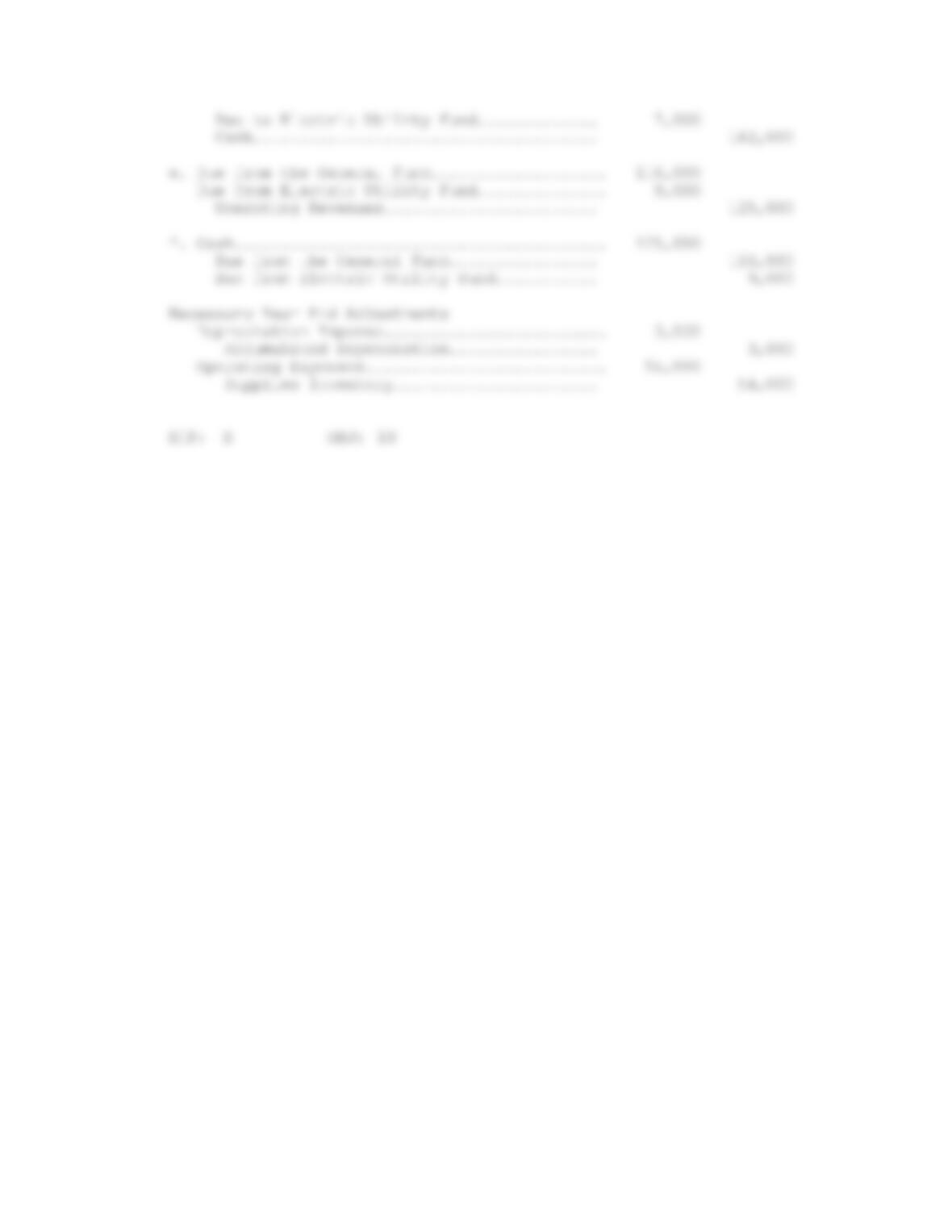
Chapter 10
10–44
30. Prepare the journal entries that would be made in a municipality’s
Debt Service Fund for each of the following events:
a.
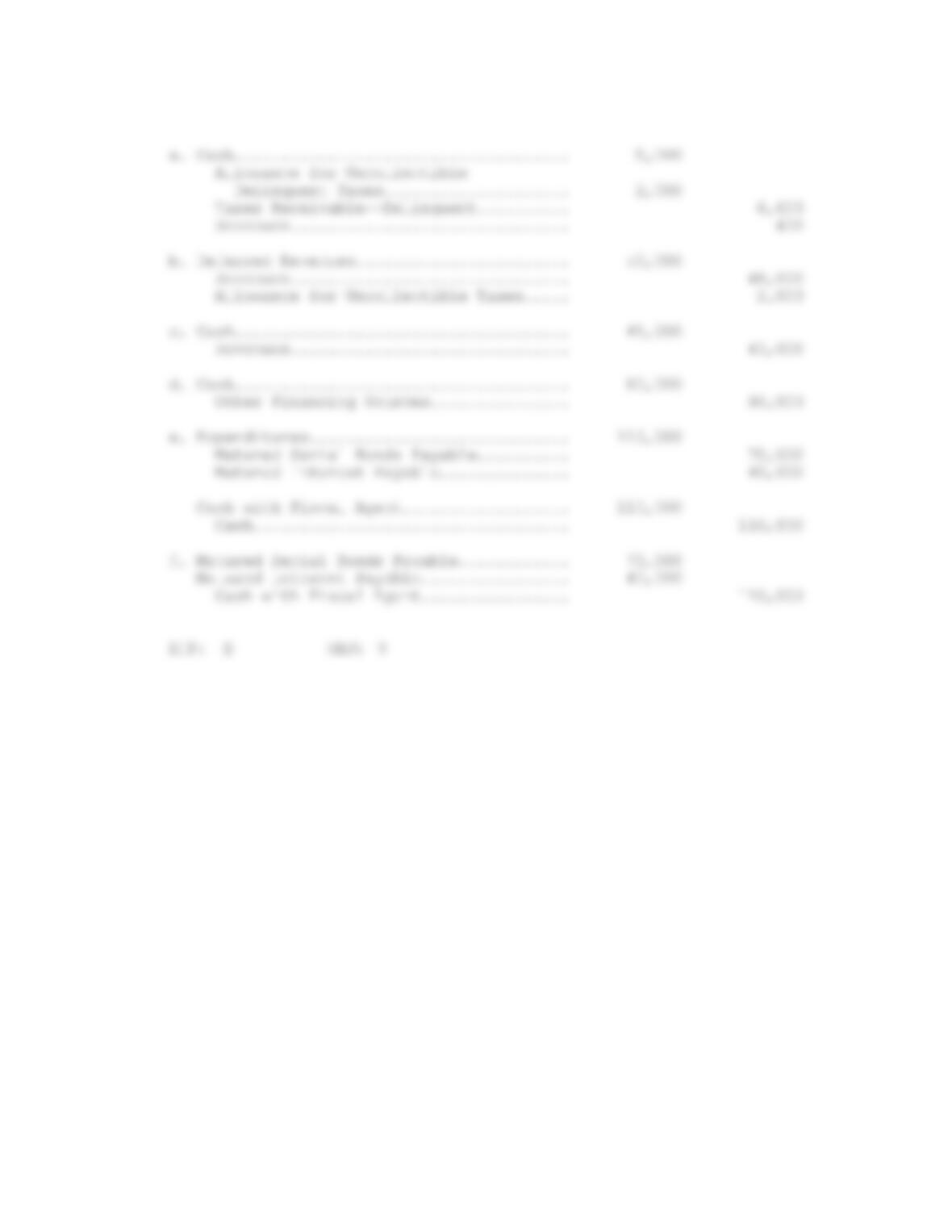
A portion of the property tax levied was directly earmarked
for, and previously recorded in, the Debt Service fund. Of
these property taxes, $6,600 was previously reclassified as
delinquent. From the delinquent taxes, $5,000 is now
collected, with the balance considered uncollectible. An
allowance for uncollectible delinquent of $2,000 existed.
b.
Previously deferred property taxes amounting to $50,000 will
be subjected to collection during the current year. A 4%
allowance is to be created to cover uncollectible amounts.
c.
The state has remitted $45,000 as the municipality’s portion
of a shared sales tax. No receivable had previously been
recorded. The amount is to be used for debt service and is to
be recorded directly in that fund.
d.
The General Fund transferred $80,000 to the Debt Service Fund,
$70,000 for serial bond principal retirement, and $10,000 for
interest payment.
e.
A check for $110,000 is sent by the Debt Service Fund to the
fiscal agent who handles the principal and interest payments.
The amount covers $70,000 for matured bond principal and
$40,000 for interest due.
f.
The fiscal agent later reports that all payments for matured
principal and interest mentioned in item e above have been
made.
Chapter 10
10–45
ANS:
31. The following are selected activities for the Monterey City Natural Gas
Company, a governmental entity:
a.
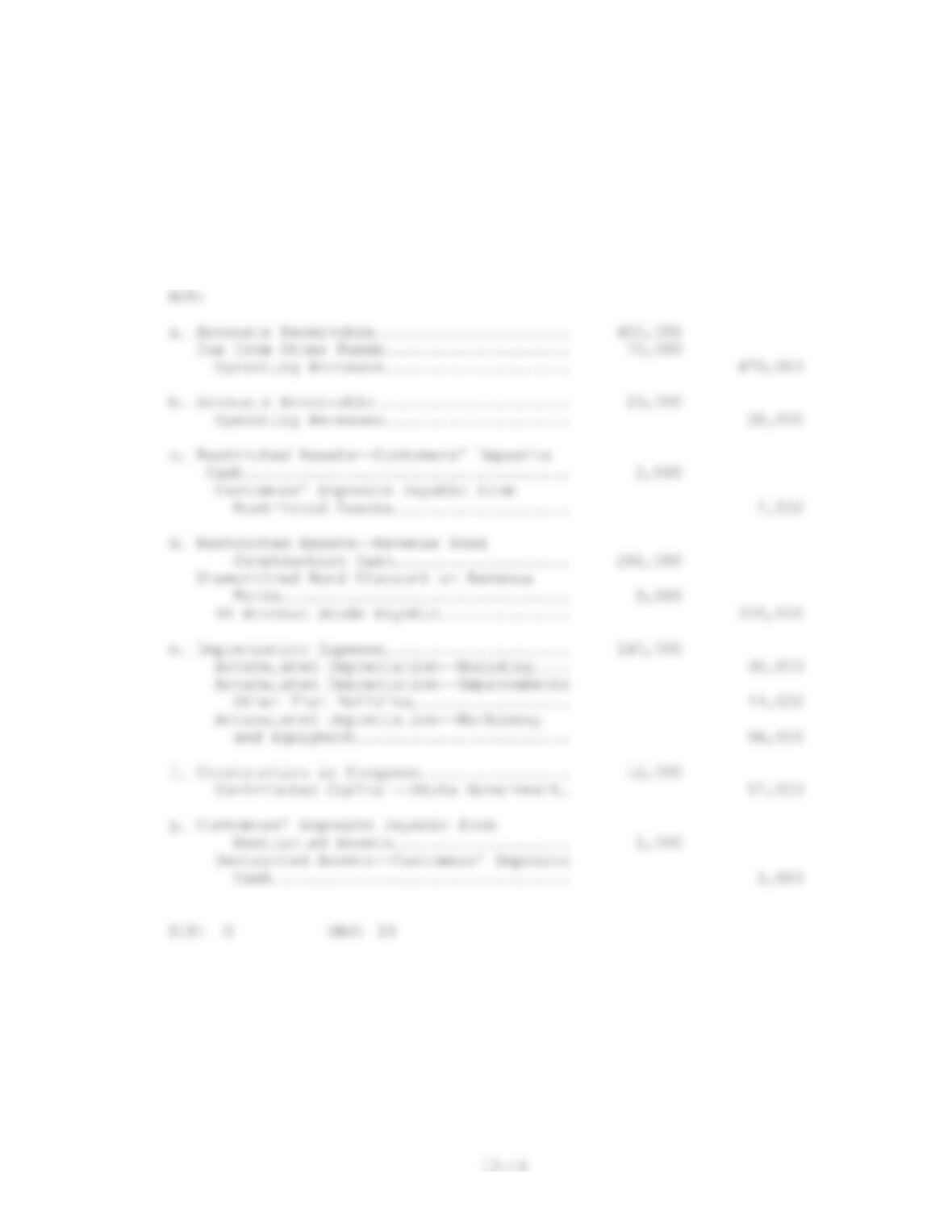
Billing for the year:
To outside customers……………….. $400,000
To other Monterey City funds………… 70,000
b.
Service provided to outside customers but not billed by year
end totaled $28,000.
c.
During the year, $2,500 was collected from new customers as a
refundable connection fee.
d.
The utility sold $300,000 of 6% revenue bonds at 97 on an
interest payment date. Proceeds are earmarked for
construction.
e.
Depreciation for the year was as follows:
Buildings…………………………. $30,000
Improvements other than buildings……. 14,000
Machinery and equipment…………….. 96,000
f.
The utility recognized $52,000 of construction in progress on
a project totally financed by the state on behalf of the
utility.
Chapter 10
g.
The utility refunded $1,000 of deposits to customers who had
moved.
Required:
Prepare journal entries to record the activities.
Chapter 10
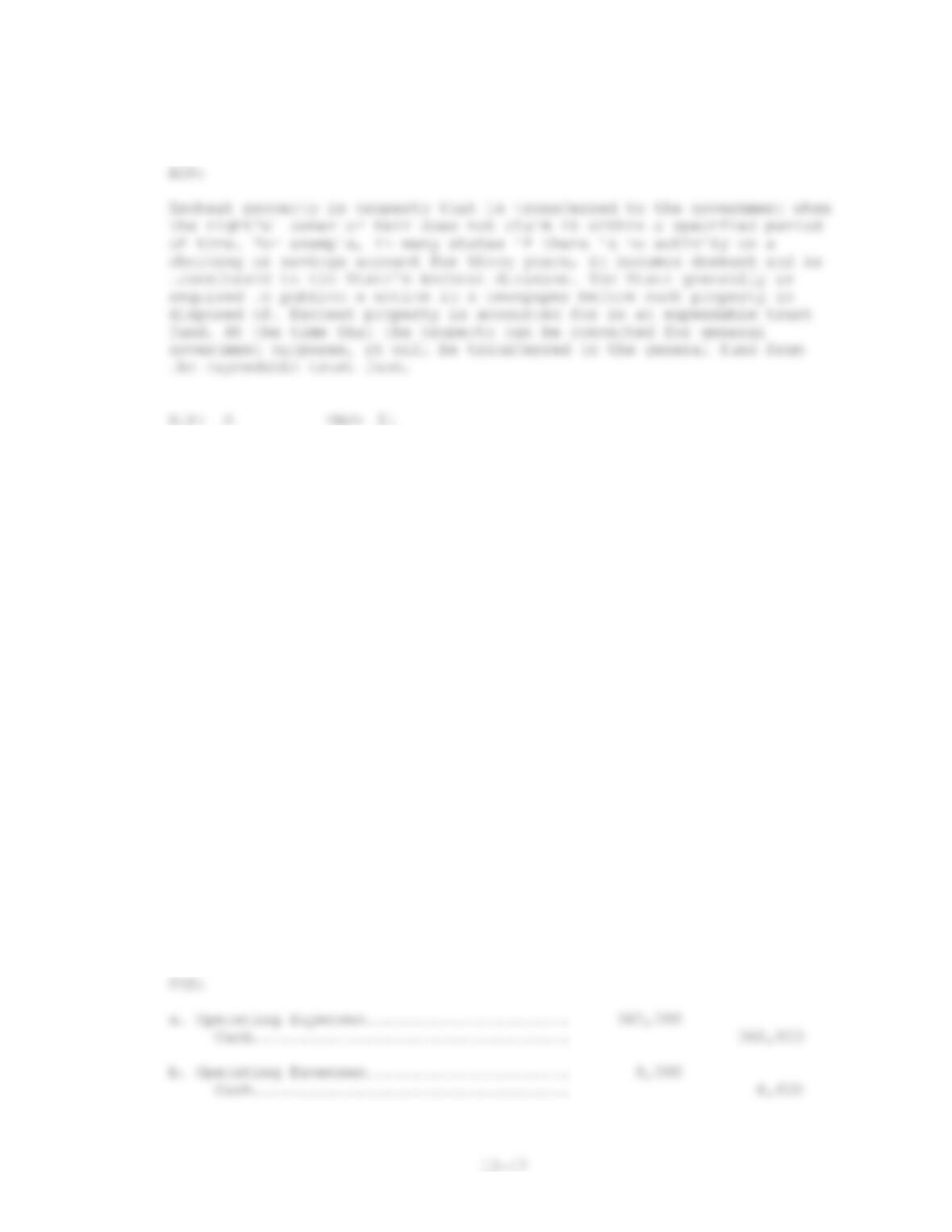
32. What is escheat property and how do we account for it?
33. The City of Light Falls operates a centralized garage and charges the
other departments on a per-mile basis for the purchase and maintenance
of most city-owned vehicles.
Required:
Make journal entries to record the following selection of transactions
concerning the motorpool during the following year:
a.
Salaries of $360,000 were paid during the year.
b.
A bill from the Water and Sewer Enterprise Fund for $8,000 was
received and paid.
c.
Eight new vehicles costing $24,000 each were purchased for
cash.
d.
Billing to other city funds were as follows:
General Fund…………………………………. $550,000
Utility Fund…………………………………. 130,000
Special Revenue Fund………………………….. 20,000
e.
All of the billings in (d) except $50,000 from the Utility
Fund were paid.
f.
Depreciation expense on the motorpool assets was $225,000 for
the year.
34. A Nonexpendable Trust Fund was established to help pay for Little
League baseball. A total of $100,000 was donated to Babe City. The
earnings, not the principal, from the donation could be used to fund
baseball.
Required:
Make the entries and identify the fund into which the following
transactions should be made:
a.
The donation is received and invested immediately in a mutual
stock fund.
b.
Cash dividends of $8,500 were received from the mutual fund
and made available for spending.
c.
During the first baseball season, $8,300 was spent from the
fund.
d.
The closing entries were made.
10–49
35. What reporting is required for the accounting for employee Pension
Trust Funds.
36. Consider the following transactions:
a.
The Cline County Tax Agency Fund was established to account
for the county’s responsibility of collecting Brent City and
Cline County property taxes. The levies for 20X1 were $800,000
for the County General Fund and $400,000 for the City General
Fund.
b.
Collections were $750,000.
c.
The county is entitled to a fee of 1% of taxes collected for
Brent City and Cline County sends the city the net amount due.
Liabilities to all funds and units were recorded to date.
Chapter 10
10–50
d.
All moneys collected to date were released to each government
unit.
Required:
Prepare the general journal entries required to record the following
transactions in Cline County Tax Agency Fund.
37. Place a check mark in the appropriate column to indicate in which of
the following funds and accounts groups the given accounts would
commonly be found:
Funds
Debt Capital
Account Title General Service Projects Enterprise
(1) Cash _______ _______ _______ _______
(2) Buildings _______ _______ _______ _______
(3) Improvements other
than buildings _______ _______ _______ _______
(4) Depreciation expense _______ _______ _______ _______
(5) Construction in process _______ _______ _______ _______
(6) Amount available in
Debt Service Fund _______ _______ _______ _______
(7) Vouchers payable _______ _______ _______ _______
(8) Matured bonds payable _______ _______ _______ _______
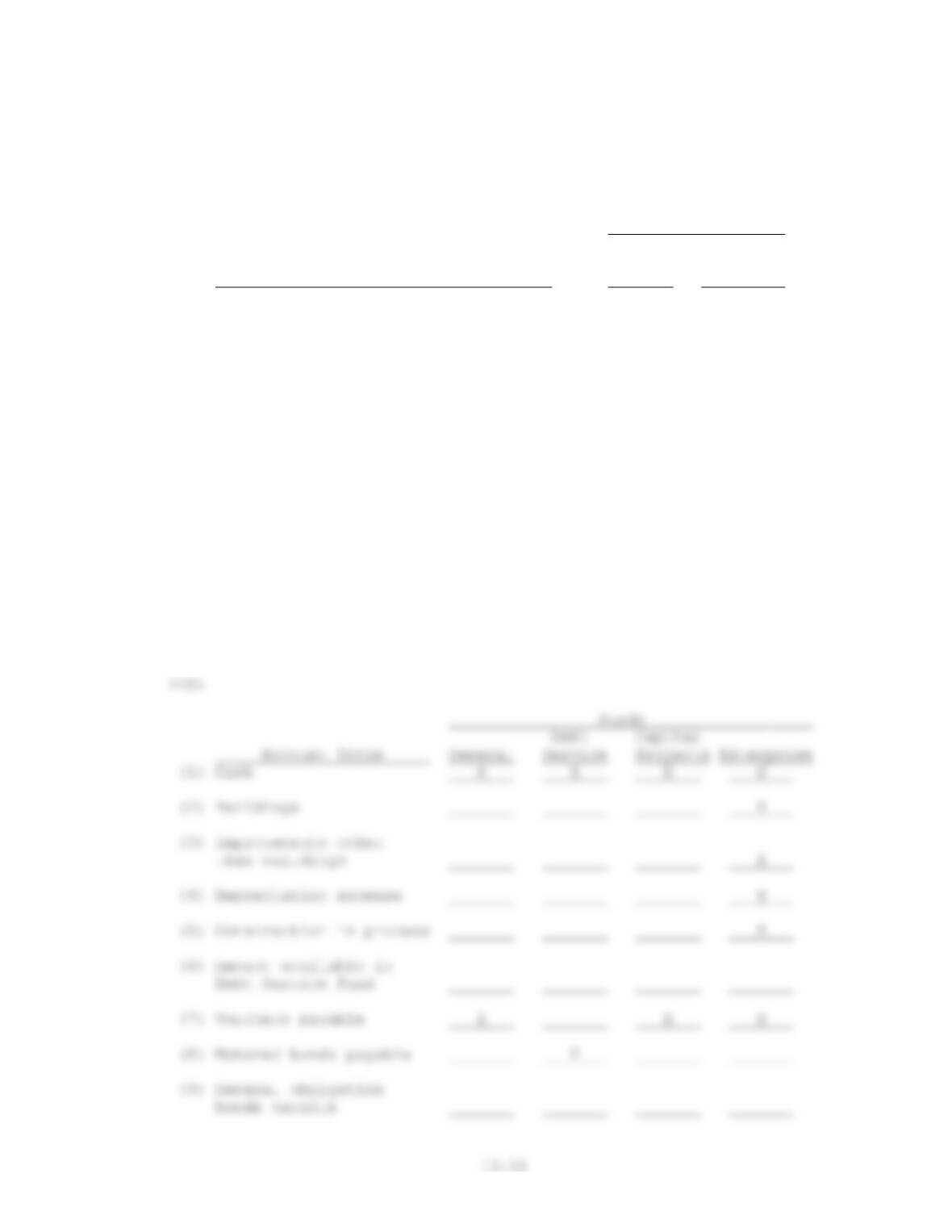
Chapter 10
(9) General obligation
bonds payable _______ _______ _______ _______
(10) Fund balance–reserved
for encumbrances _______ _______ _______ _______
Account Groups
General General
Fixed Long-term
Account Title Assets Debt
(1) Cash _______ _______
(2) Buildings _______ _______
(3) Improvements other than buildings _______ _______
(4) Depreciation expense _______ _______
(5) Construction in process _______ _______
(6) Amount available in Debt Service Fund _______ _______
(7) Vouchers payable _______ _______
(8) Matured bonds payable _______ _______
(9) General obligation bonds payable _______ _______
(10) Fund balance–reserved for encumbrances _______ _______
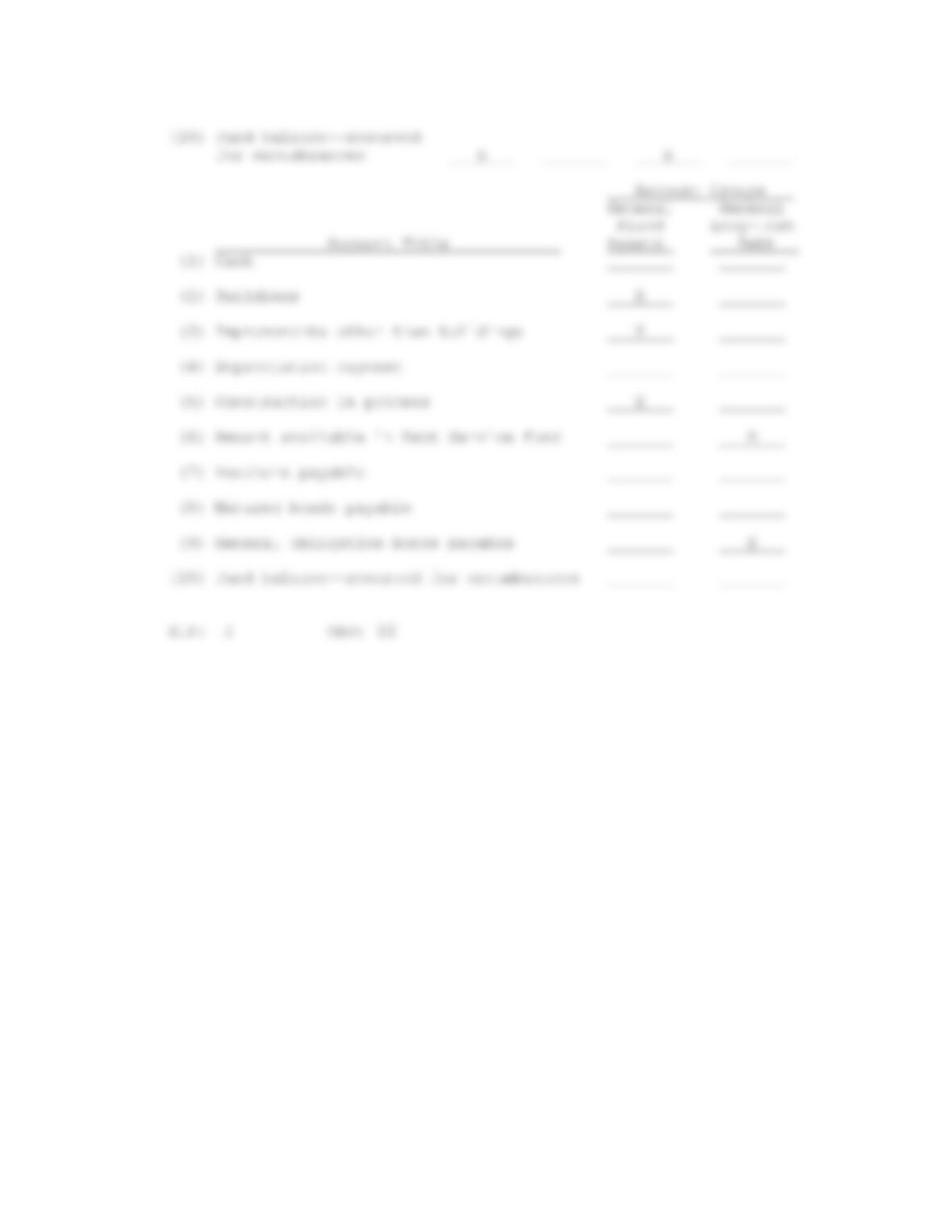
Chapter 10
10–52
38. Consider the following transactions:
a.
The city government approved a $1,500,000 addition to the
library to be financed by a $1,000,000 general obligation bond
issue and a $500,000 state grant. The city anticipated that
the proceeds from both the bond sale and the grant would be
received in 20X1. It is also estimated that 40% of the project
will be completed by year end.
b.
The bonds are sold at 101.
c.
The grant is approved by the state for payment.
d.
A contract for the project is signed to build the addition for
$1,440,000.
e.
The architect’s bill is received for $15,000 and paid without
an encumbrance.
f.
One-half of the grant is received from the state.
g.
A progress billing for $576,000 is received from the
contractor.
h.
The closing entries for 20X1 are made.
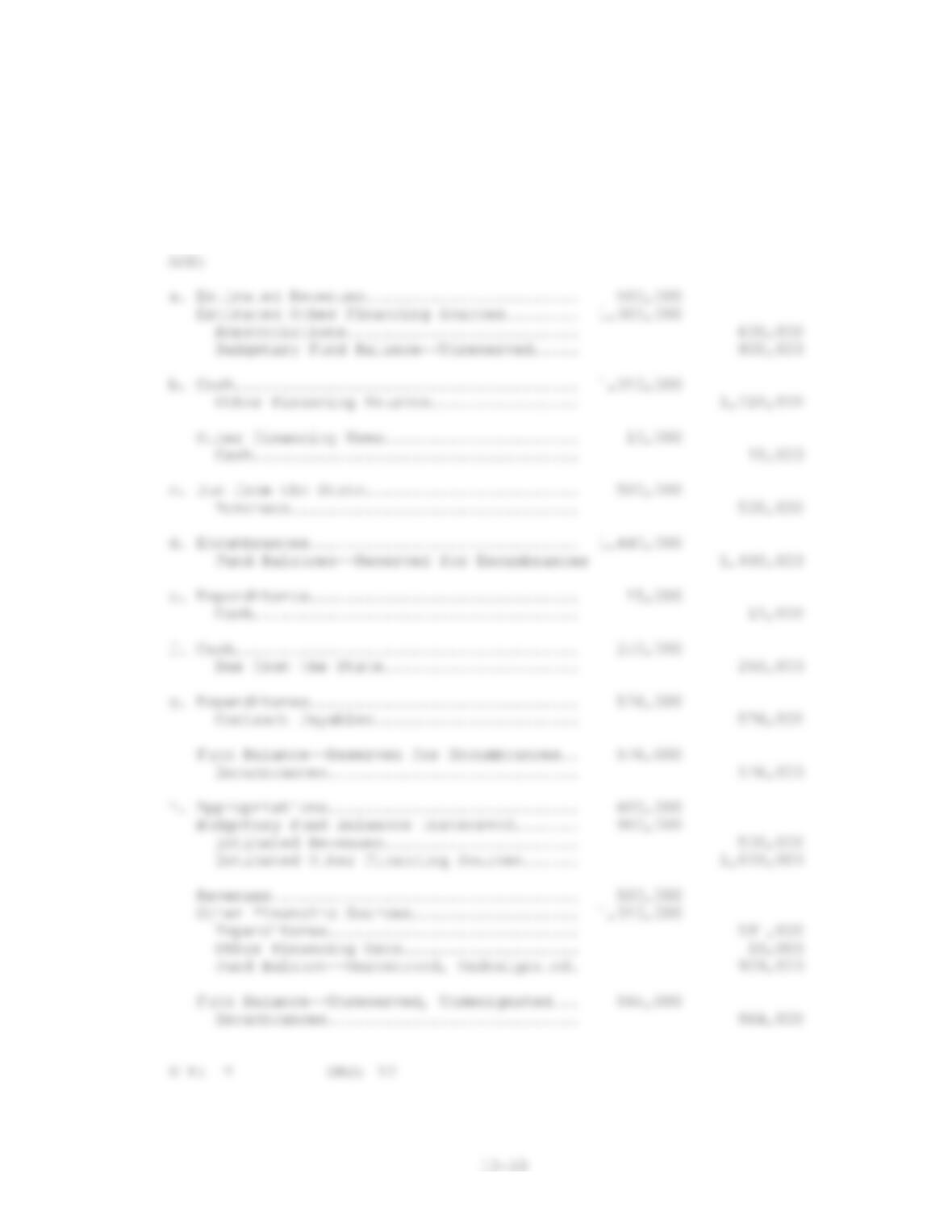
Chapter 10
Required:
Make the necessary journal entries to record the transactions in the
Capital Project Fund of Chatham during 20X1. Budgetary accounts are
used.
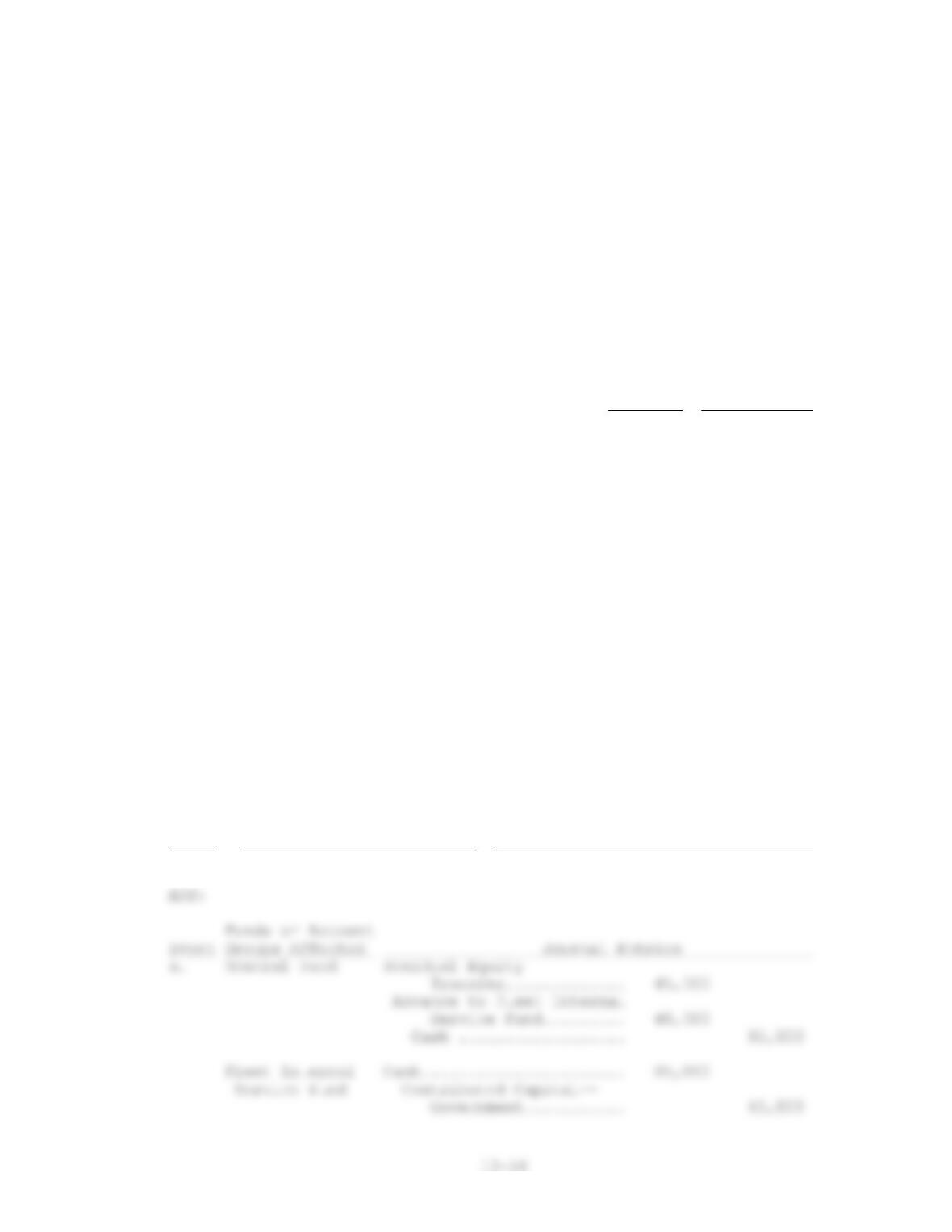
Chapter 10
39. The following selected events occurred in Hershey City’s Internal
Service Fund for its automobile fleet:
a.
An automobile fleet Internal Service Fund was established. The
General Fund provided $85,000 for its working capital. Of this
amount, $40,000 is to be repaid in equal annual installments
over a five–year period. The remaining $45,000 is a
contribution that will not be repaid.
b.
In prior years, accounting for fleet activities was conducted
in the General Fund. The following fixed assets previously
used for this activity are transferred to the Fleet Internal
Service Fund. The market value amounts represent original cost
less an estimate of accumulated depreciation if depreciation
would have been recorded since they were acquired.
Cost Market Value
Building……………………………. $220,000 $180,000
Machinery and equipment………………. $430,000 $350,000
c. Billings for services to other funds are as follows:
To the General Fund………………….. $608,000
To an Enterprise Fund………………… $112,000
d.
A one-year insurance policy is purchased. By year end, one–
half of the $18,000 premium payment has expired.
e. Depreciation for the period:
Building……………………………. $ 4,500
Machinery and equipment………………. $65,000
f.
Invoices for various goods and services received totaled
$127,000.
Required:
Omitting explanations, prepare journal entries for all funds and groups
affected, using the following format:
Funds or Account
Event Groups Affected Journal Entries
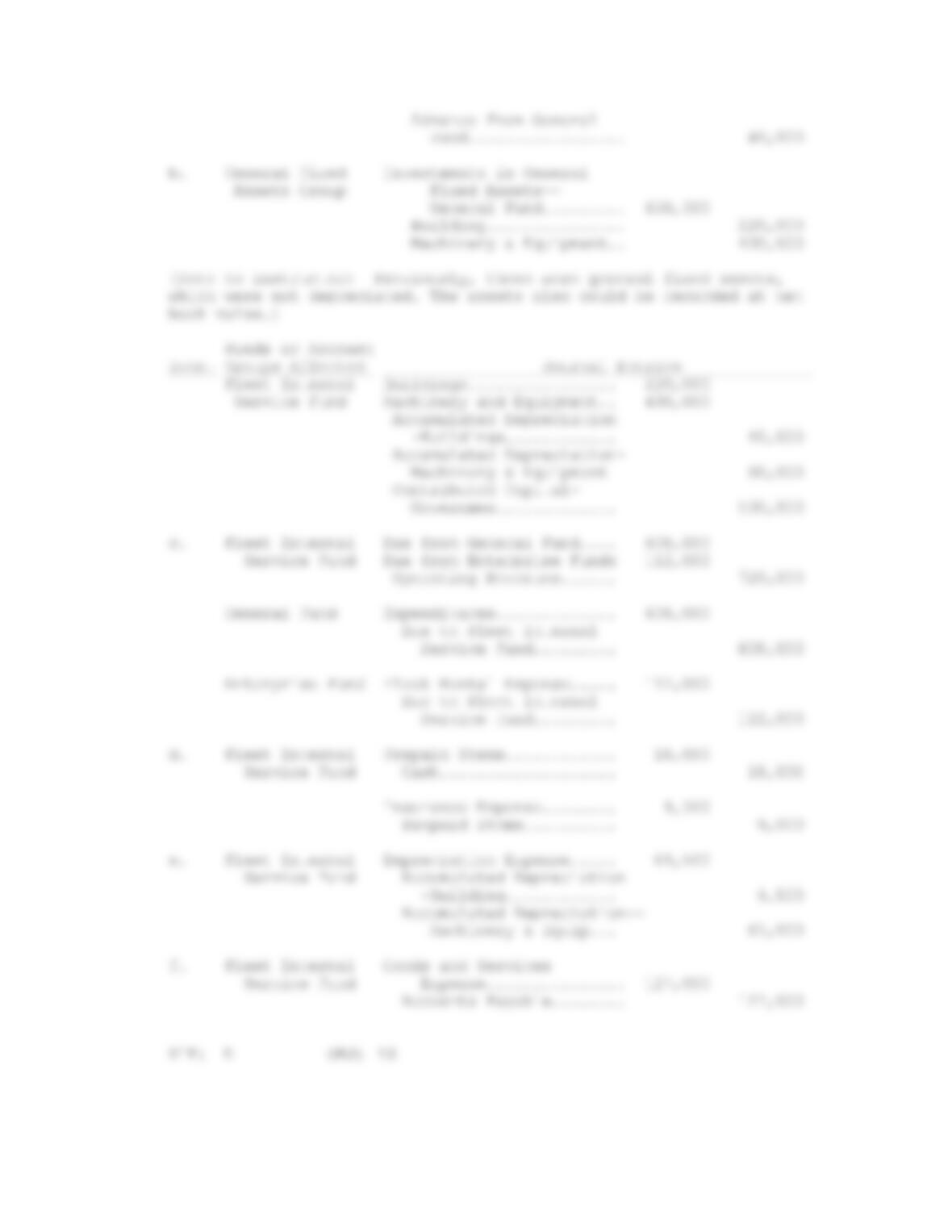
Chapter 10
10–55

Chapter 10
10–56
40. For each of the following items, either the journal entry for the
original event or the journal entry involving only periodic adjustments
to the fund balance accounts for a city’s Pension Trust Fund is
provided.
Required:
Prepare the missing journal entry or indicate that no entry would be
made. Omit explanations.
Journal Entries in the Pension Trust Fund:
For the Original Event: For the Fund Balance Accounts:
a. Cash…………… 60,000 a.
Operating
Revenues……… 60,000
To record cash contributions
received, two-thirds from
city, one-third from employees.
b. Cash…………… 10,000 b.
Operating
Revenues……… 10,000
To record earnings received,
allocated to:
City Contri–
butions…… 6,000
Employees con–
tributions….. 3,000
Benefit
reserve…… 1,000
c. c. Fund balance–
Benefit and
Disability
Reserve……. 14,000
Fund Balance–
Unreserved,
Undesignated 14,000
To adjust fund balances
for cash payments to
retired employees.
d. d. Fund Balance–
Employer
Contributions.. 4,000
Fund Balance–
Employee
Contributions.. 2,000
Fund Balance–
Benefit and Dis–
ability Reserve 6,000
To adjust fund balances
for transfers because of
employee retirements.
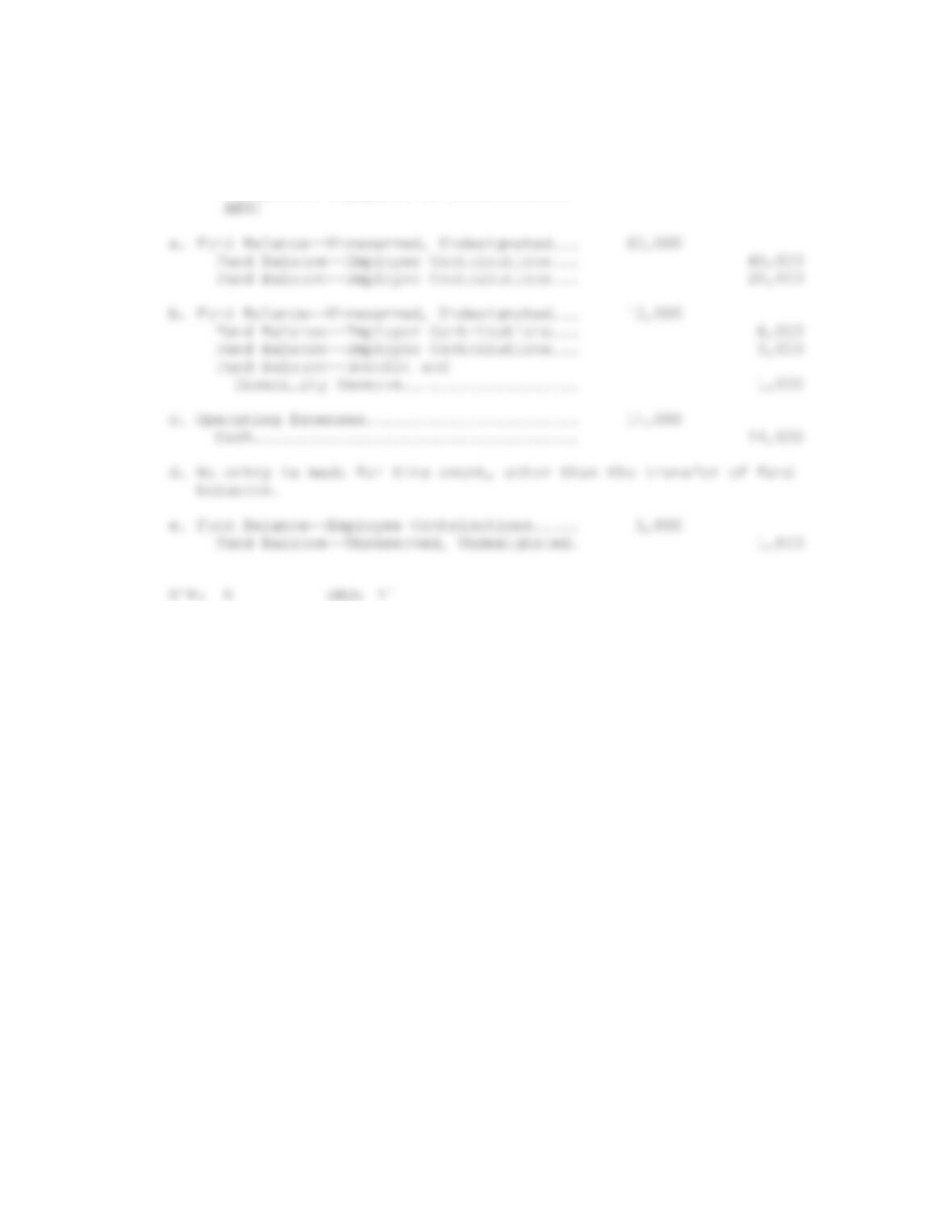
Chapter 10
10–57
e. Operating Expenses. 1,800 e.
Cash…………. 1,800
To record payments to
employees who resigned and
requested repayment of contributions
41. The following selected events occurred in the City of Canterbury.
a.
On December 31, 20X7, $250,000 was transferred from the
General Fund to establish a central garage to service the
city’s vehicles. Of this amount, $150,000 was spent on January
2, 20X8, to acquire a building with an estimated life of 25
years, $30,000 was spent for the acquisition of land, and
$60,000 was paid for equipment with an estimated life of 10
years.
b.
During the six months of operation to June 30, 20X8, the
garage billed the General Fund for $24,000 and Enterprise
Funds for $50,000. Except for $8,000 still due from Enterprise
Funds, the balance is collected.
c.
Canceled checks revealed the following payments for garage
activities:
Salaries (ignore deductions and taxes)………….. $31,000
Parts and supplies (perpetual system)…………… 19,000
Service provided by the city-owned utility………. 2,000
Total payments……………………………… $52,000
=======
d.
At fiscal year end, the following adjustments were related to
garage operations:
Inventory of parts and supplies on hand……. $7,000
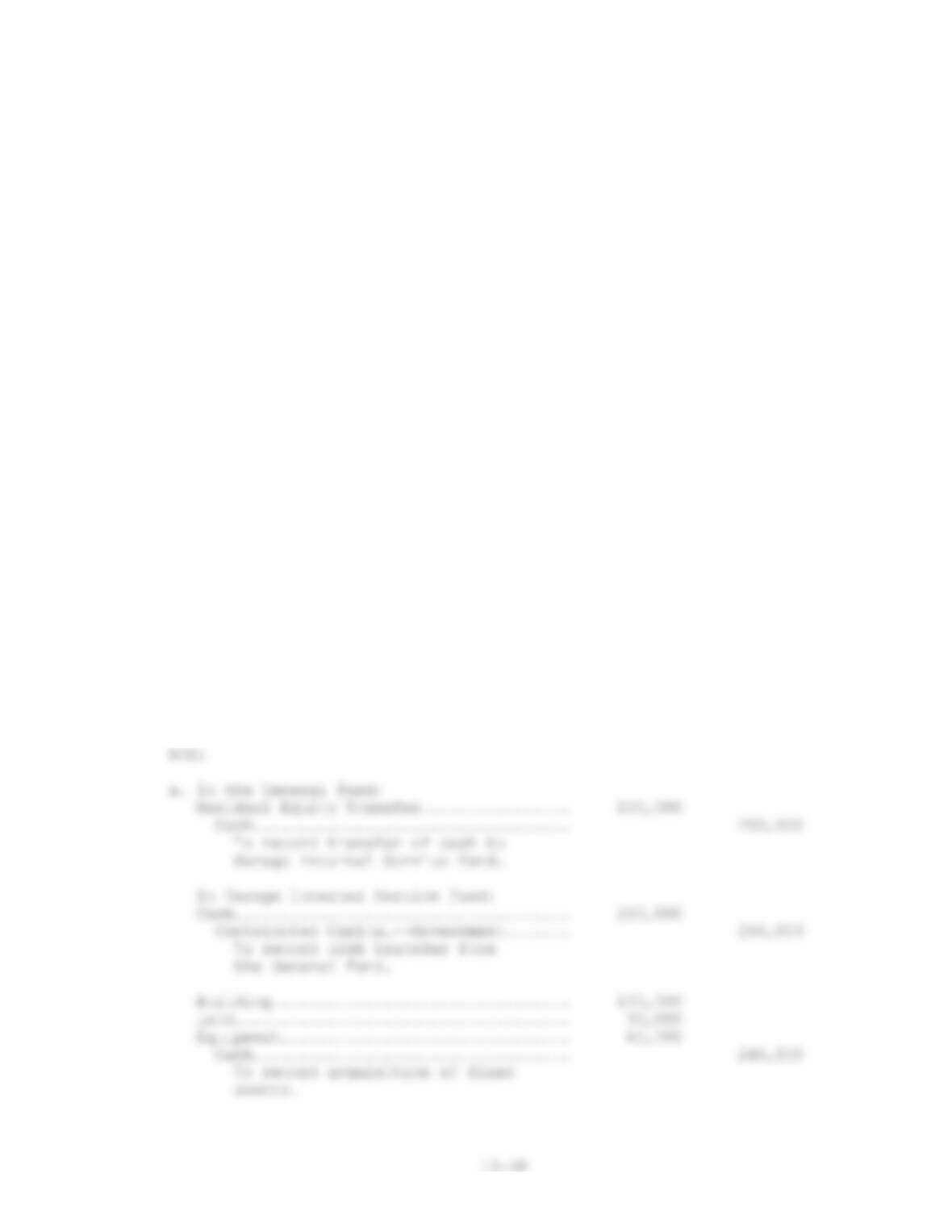
Chapter 10
Depreciation……………………………. To be computed.
e.
On July 1, 20X7, the city issued 10-year, $400,000, 8% general
obligation serial bonds at 101 to finance the construction of
a public health center for the aging. The premium on the bond
sale is transferred to the Debt Service Fund for interest
payment. Each $40,000 serial is redeemable on June 30, along
with annual interest on the outstanding bond face value. The
project is estimated to cost $430,000 and will be completed in
less than one year. The General Fund will transfer resources,
if needed, to cover the total cost. The city uses budgetary
accounts for these projects.
f.
During the fiscal year, construction of the public health
center was completed at a cost of $426,000, of which $400,000
was paid, the remainder is payable after one year under a
retained percentage contract arrangement. The $26,000
deficiency was transferred from the General Fund.
g.
On June 28, 20X8, $68,000 is transferred from the General Fund
to be applied to the payment of the first $40,000 bond serial
mentioned in e., plus interest. On this date, the Debt Service
Fund records the maturing bonds and interest.
h.
On June 30, the payment for the matured bond serial and
interest is made.
Required:
For each event, prepare the necessary journal entries for all funds and
account groups involved during the fiscal year ended June 30, 20X8.
Indicate the fund or group in which the entries are made.
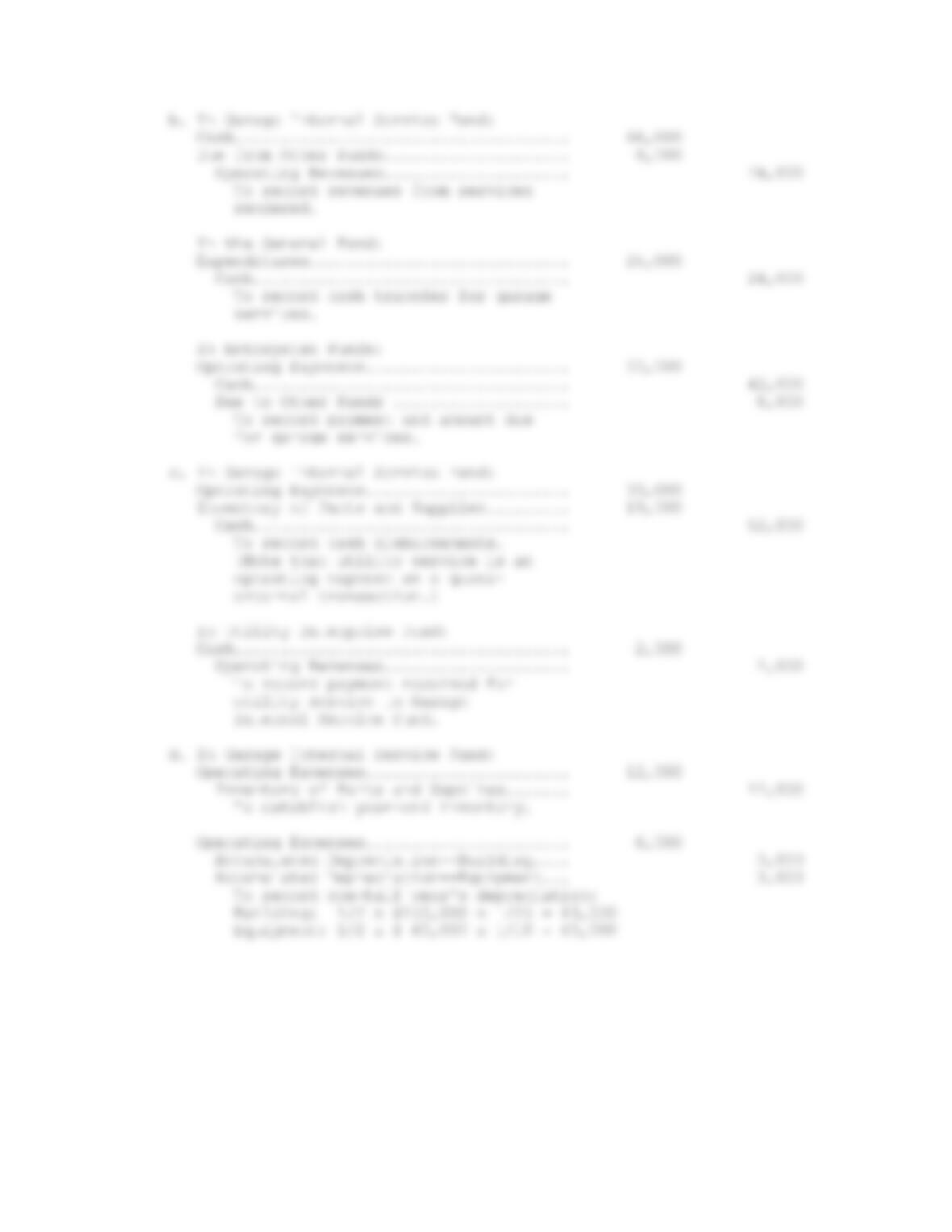
Chapter 10
10–59
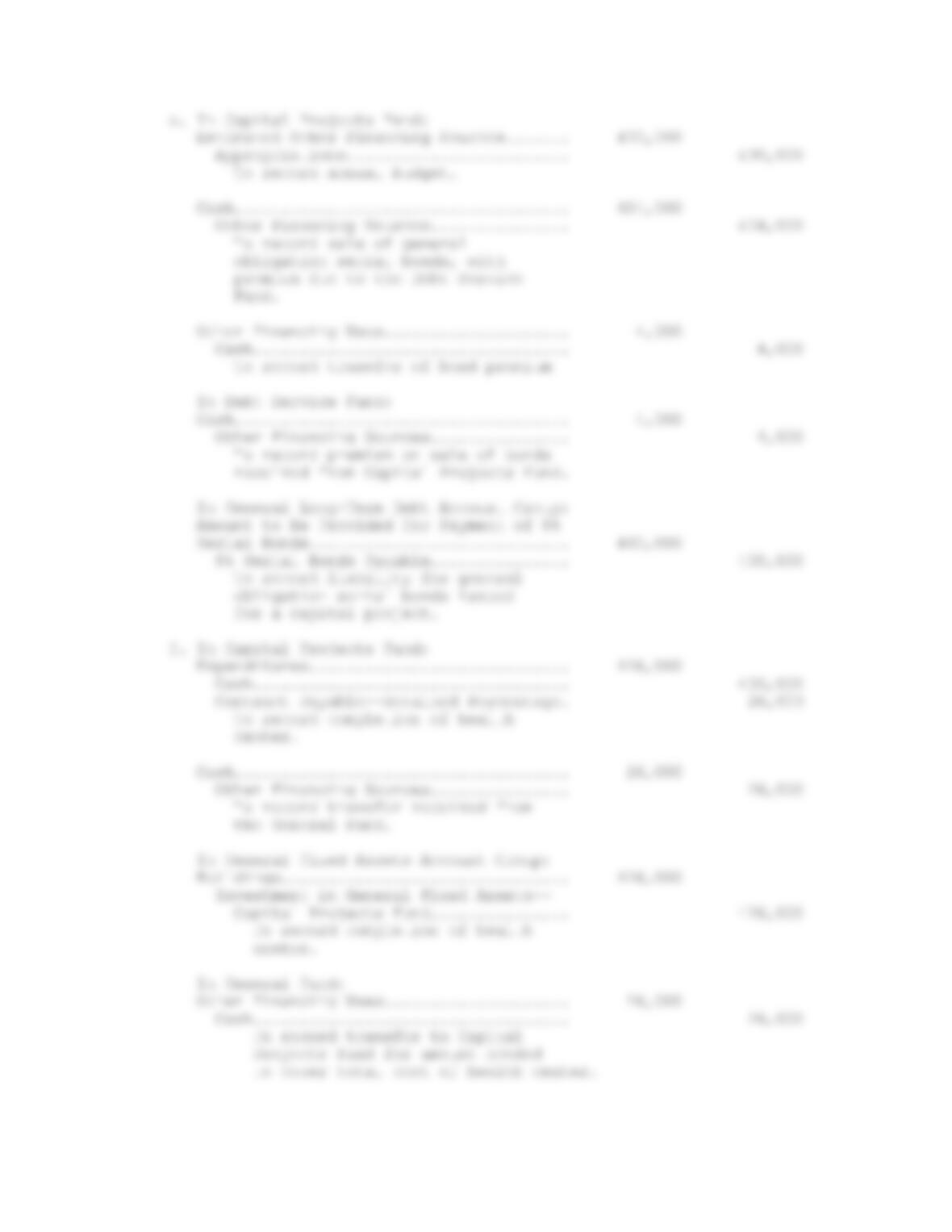
Chapter 10
10–60
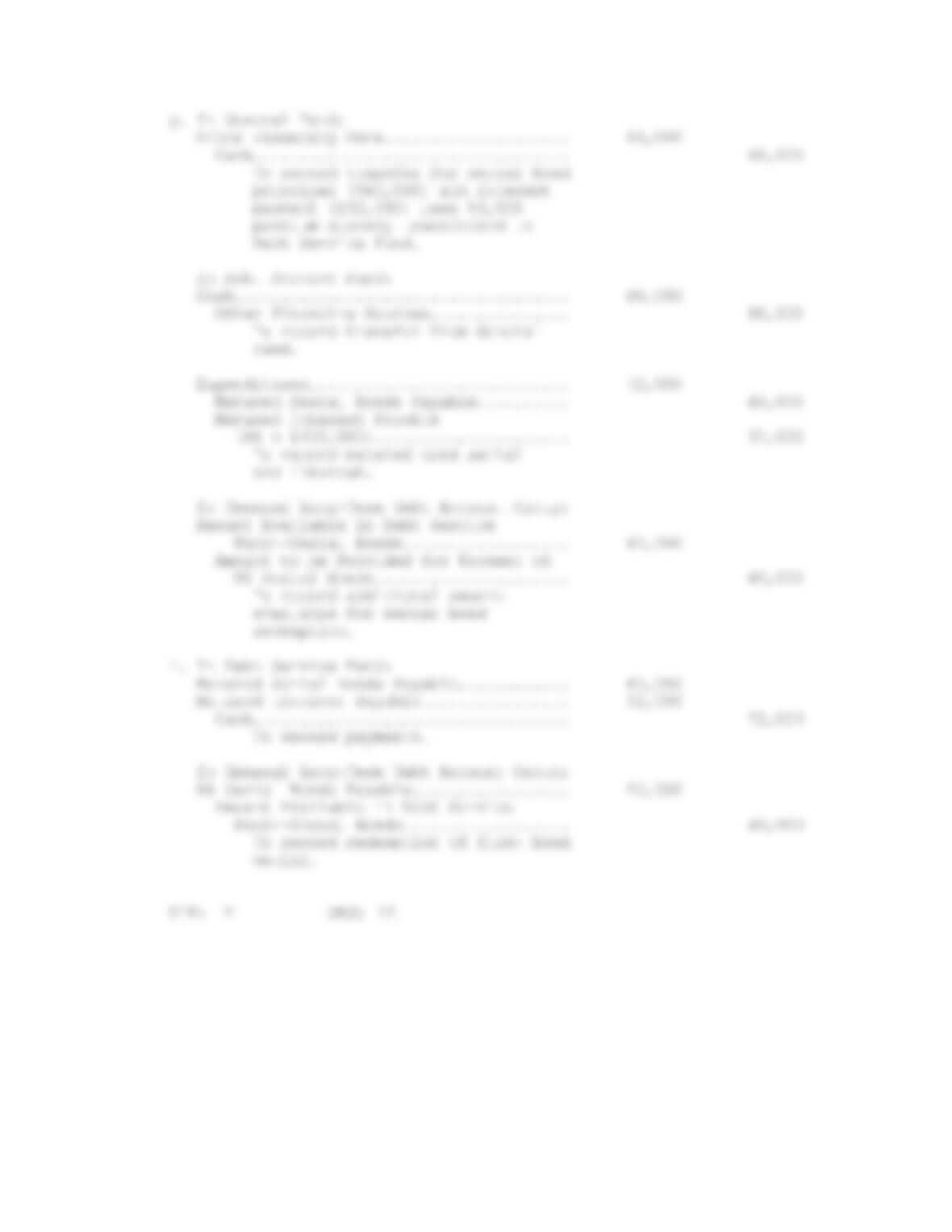
Chapter 10
10–61
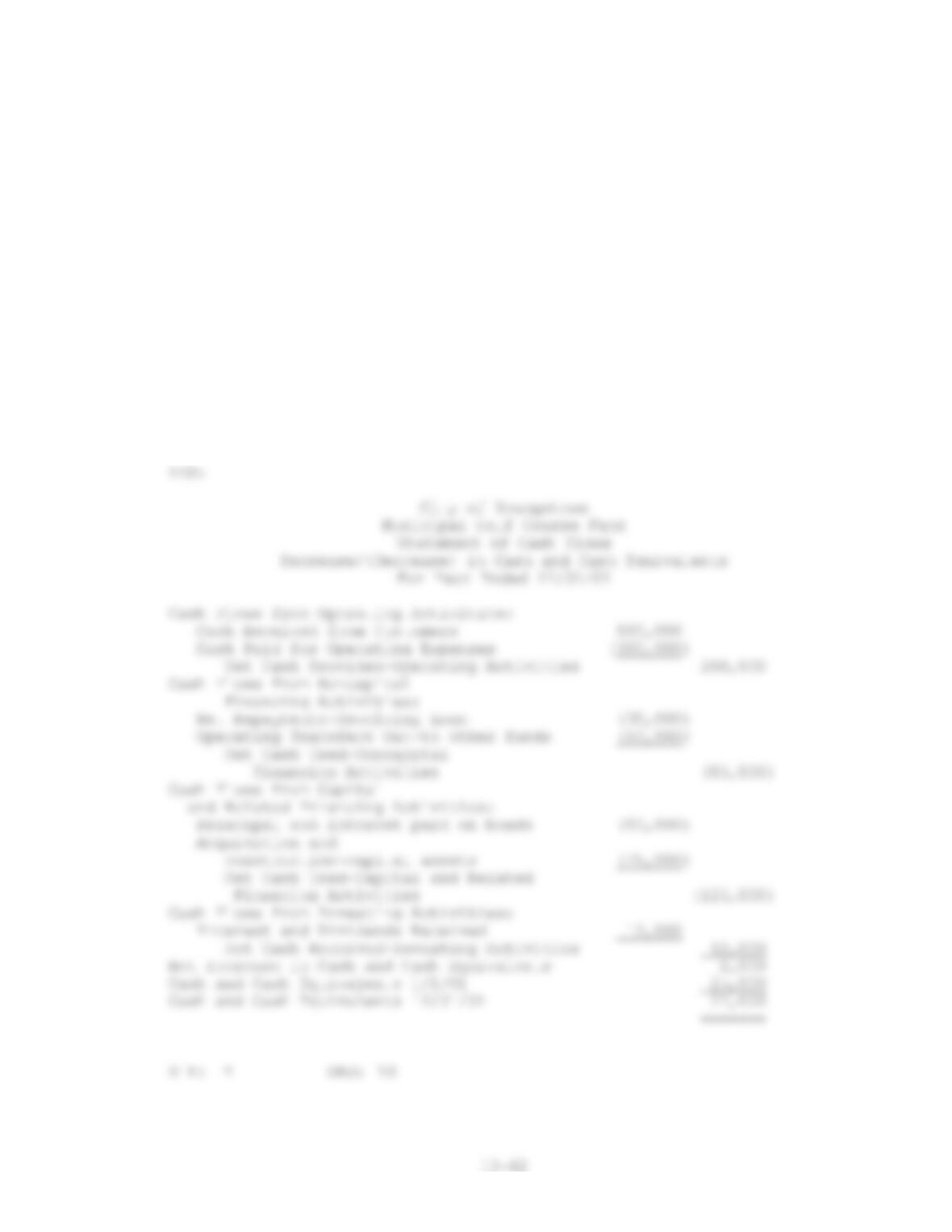
Chapter 10
42. Given the following information for the City of Youngstown Municipal
Golf Course:
Cash Balance 1/1/01 $ 25,000
User Fees-Green Fees 375,000
Net Repayment-Revolving Loan 35,000
Operating Transfer Out-General Fund
(property taxes) 50,000
User Fees-League Fees and outings 100,000
User Fees-Memberships 25,000
Cash Expenses Paid to suppliers 95,000
Interest/Dividends Received 12,000
Acquisition/Improvement to Clubhouse 75,000
Cash Expenses Paid to employees 105,000
Cash Expenses Paid Maintenance and Upkeep 100,000
Principal and Interest Payments on Bond 50,000
Prepare a cash flow statement for this enterprise fund.