Chapter 10 – Liabilities: Current, Installment Notes, and Contingencies
122. The Young Company has the following assets and liabilities:
ASSETS
Cash
$35,000
Accounts receivable
15,000
Inventory
30,000
Equipment
50,000
LIABILITIES
Current portion of long-term debt
10,000
Accounts payable
2,000
Long-term debt
25,000
Determine the quick ratio (rounded to one decimal point).
a.
6.7
b.
13.0
c.
4.2
d.
3.5
($10,000 + $2,000) = $50,000 / $12,000 = 4.2
123. Which of the following is the most desirable quick ratio?
a.
1.20
b.
1.00
c.
0.95
d.
0.50
Chapter 10 – Liabilities: Current, Installment Notes, and Contingencies
124. If a company borrows money from a bank as an installment note, the interest portion of each annual payment will
a.
equal the interest rate on the note times the carrying amount of the note at the beginning of the period
b.
remain constant over the term of the note
c.
equal the interest rate on the note times the face amount
d.
increase over the term of the note
125. On the first day of the fiscal year, Hawthorne Company obtained an $88,000, 7-year, 5% installment note from Sea
Side Bank. The note requires annual payments of $15,208, with the first payment occurring on the last day of the fiscal
year. The first payment consists of interest of $4,400 and principal repayment of $10,808. The journal entry Hawthorne
would record to make the first annual payment due on the note would include a
a.
debit to cash for $15,208
b.
credit to notes payable for $10,808
c.
debit to interest expense for $4,400
d.
debit to notes payable for $15,208
the note would include a debit to Interest Expense for $4,400.
126. On January 1, Gemstone Company obtained a $165,000, 10-year, 7% installment note from Guarantee Bank. The
note requires annual payments of $23,492, with the first payment occurring on the last day of the fiscal year. The first
payment consists of interest of $11,550 and principal repayment of $11,942. The journal entry to record the payment of
the first annual amount due on the note would include a
a.
debit to cash for $11,942
b.
credit to interest payable for $11,550
c.
debit to notes payable for $11,942
d.
debit to interest expense for $23,492
Chapter 10 – Liabilities: Current, Installment Notes, and Contingencies
127. On January 1, Gemstone Company obtained a $165,000, 10-year, 7% installment note from Guarantee Bank. The
note requires annual payments of $23,492, with the first payment occurring on the last day of the fiscal year. The first
payment consists of interest of $11,550 and principal repayment of $11,942. The journal entry to record the issuance of
the installment note for cash on January 1 would include a
a.
debit to interest expense for $11,550
b.
credit to interest payable for $11,550
c.
credit to notes payable for $165,000
d.
debit to notes payable for $165,000
128. On January 1, Zero Company obtained a $52,000, 4-year, 6.5% installment note from Regional Bank. The note
requires annual payments consisting of principal and interest of $15,179, beginning on December 31 of the current year.
The December 31, Year 1 carrying amount in the allocation of periodic payments table for this installment note will be
equal to:
a.
$27,635
b.
$40,201
c.
$36,821
d.
$39,000
Chapter 10 – Liabilities: Current, Installment Notes, and Contingencies
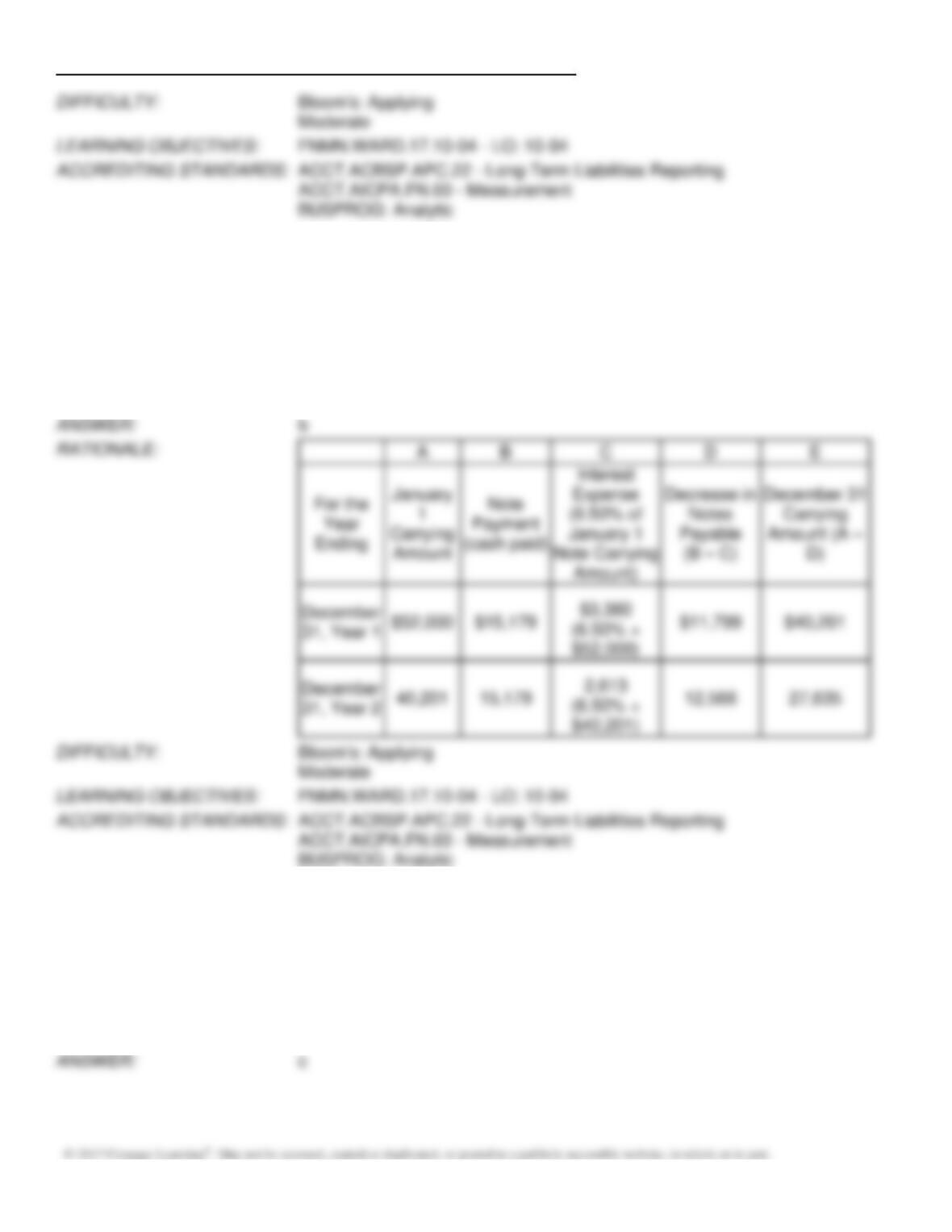
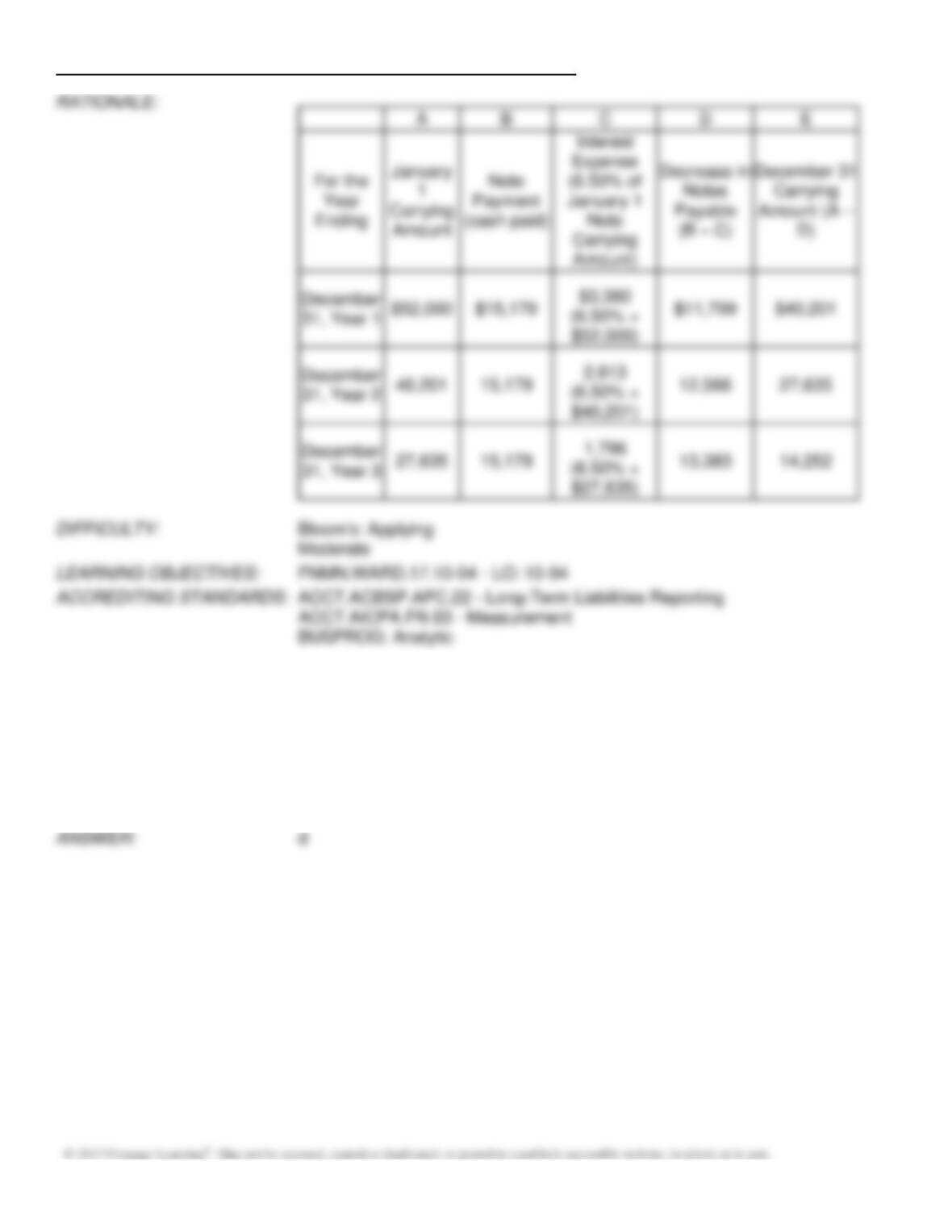
129. On January 1, Year 1, Zero Company obtained a $52,000, 4-year, 6.5% installment note from Regional Bank. The
note requires annual payments of $15,179, beginning on December 31, Year 1. The December 31, Year 2 carrying amount
in the allocation of periodic payments table for this installment note will be equal to
a.
$26,000
b.
$27,635
c.
$21,642
d.
$28,402
130. On January 1, Year 1, Zero Company obtained a $52,000, 4-year, 6.5% installment note from Regional Bank. The
note requires annual payments of $15,179, beginning on December 31, Year 1. The December 31, Year 3 carrying amount
in the allocation of periodic payments table for this installment note will be equal to
a.
$0
b.
$13,000
c.
$14,252
d.
$6,463
Chapter 10 – Liabilities: Current, Installment Notes, and Contingencies
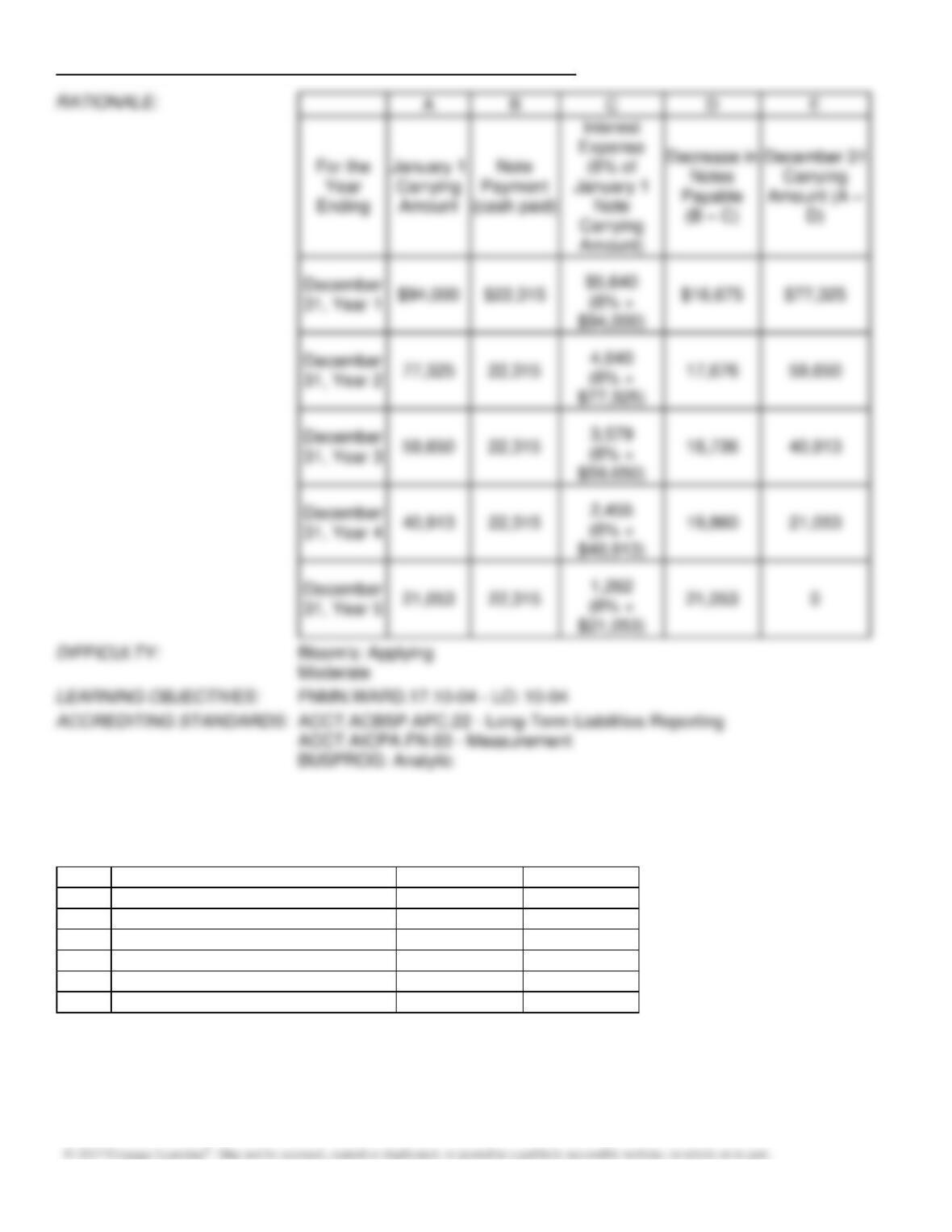
131. An installment note payable for a principal amount of $94,000 at 6% interest requires Lawson Company to repay the
principal and interest in equal annual payments of $22,315 beginning December 31, of the first year, for each of the next
five years. After the final payment, the carrying amount on the note will be
a.
$1,263
b.
$21,053
c.
$22,315
d.
$0
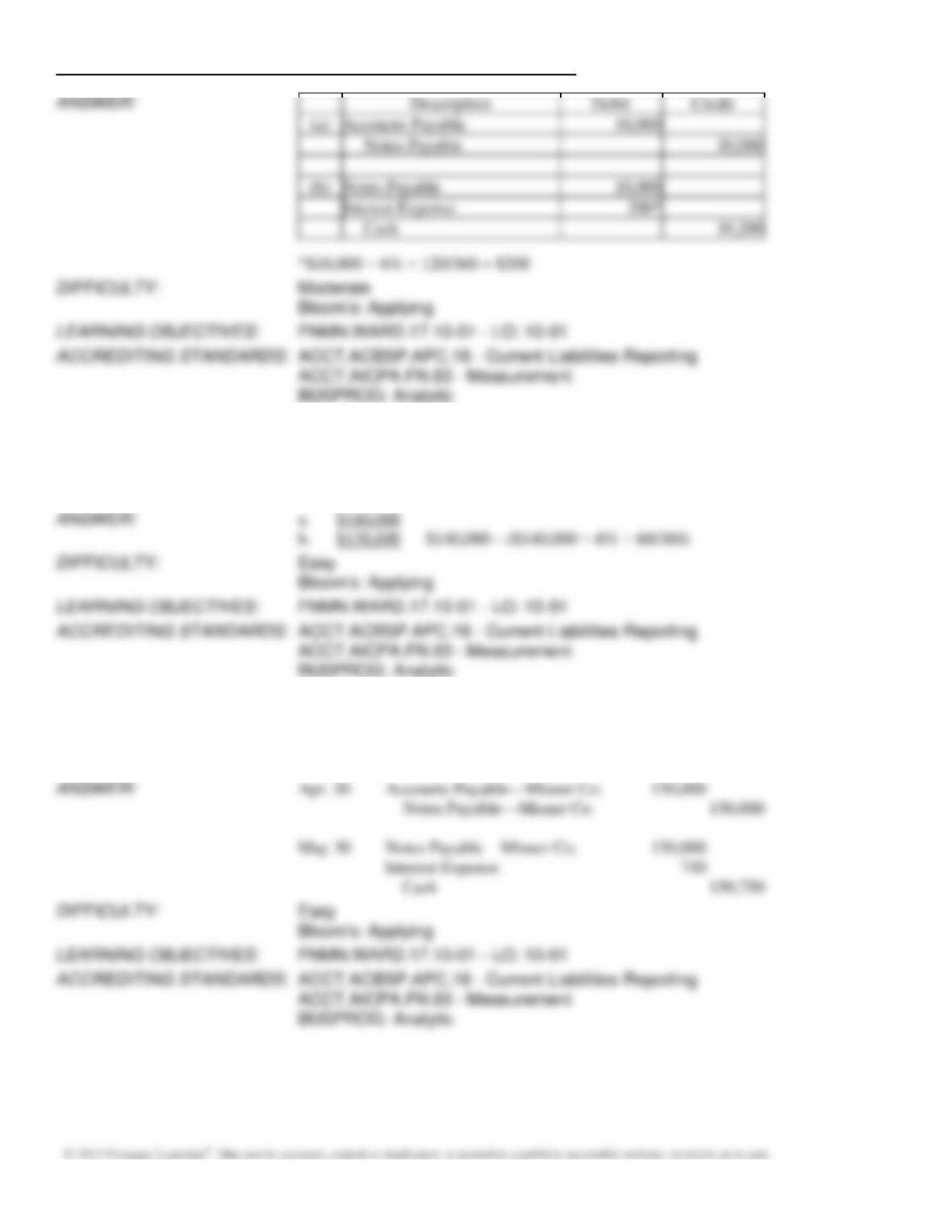
Chapter 10 – Liabilities: Current, Installment Notes, and Contingencies
132. A business issued a 120-day, 6% note for $10,000 to a creditor on account. The company uses a 360-day year for
interest calculations. Journalize the entries to record (a) the issuance of the note and (b) the payment of the note at
maturity, including interest.
Description
Debit
Credit
(a)
(b)
LEARNING OBJECTIVES:
Chapter 10 – Liabilities: Current, Installment Notes, and Contingencies
Accounts Payable
Notes Payable
133. On August 1, Batson Company issued a 60-day note with a face amount of $140,000 to Jergens Company for
merchandise inventory. (Assume a 360-day year is used for interest calculations.)
a.
Determine the proceeds of the note assuming the note carries an interest rate of 6%.
b.
Determine the proceeds of the note assuming the note is discounted at 6%.
a.
b.
$138,600 $140,000 – ($140,000 × 6% × 60/360)
134. Journalize the following, assuming a 360-day year is used for interest calculations:
Apr. 30
Issued a $150,000, 30-day, 6% note dated April 30 to Misner Co. on account.
May 30
Paid Misner Co. the amount owed on the note dated April 30.
Apr. 30
Accounts Payable—Misner Co.
May 30
Notes Payable—Misner Co.
Interest Expense
Chapter 10 – Liabilities: Current, Installment Notes, and Contingencies
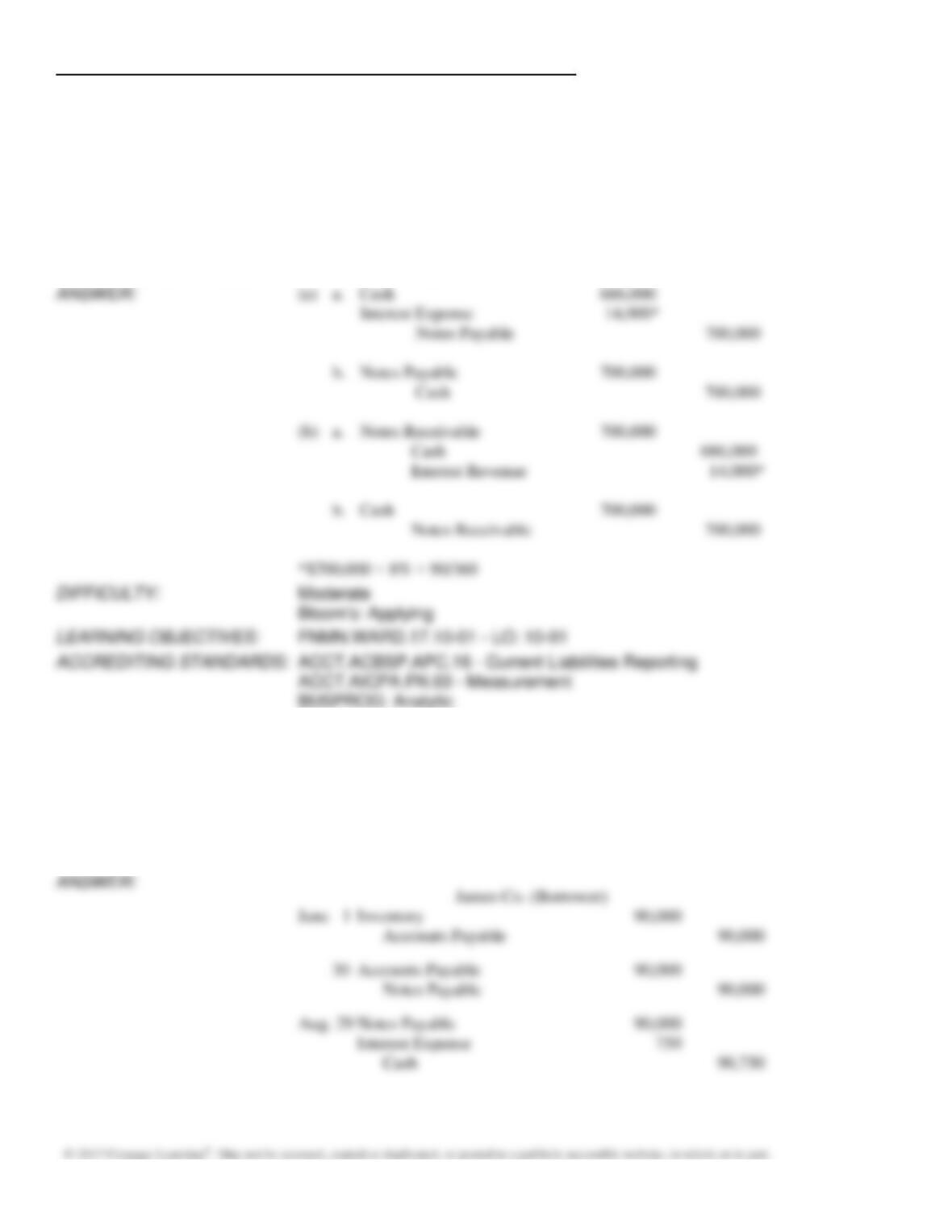
135. Roseland Design borrowed $700,000 on a 90-day note from CorpOne Funding Company. CorpOne discounts the
note at 8%. (Assume a 360-day year is used for interest calculations.)
(a)
Journalize Roseland’s entries to record:
a.
The issuance of the note.
b.
The payment of the note at maturity.
(b)
Journalize CorpOne’s entries to record:
a.
The receipt of the note.
b.
The receipt of the payment of the note at maturity.
Interest Expense
Notes Payable
Notes Payable
Cash
Notes Receivable
Cash
Interest Revenue
Notes Receivable
*$700,000 × 8% × 90/360
136. Journalize the following entries on the books of the borrower and creditor. Label accordingly. (Assume a 360-day
year is used for interest calculations.)
Jun. 1
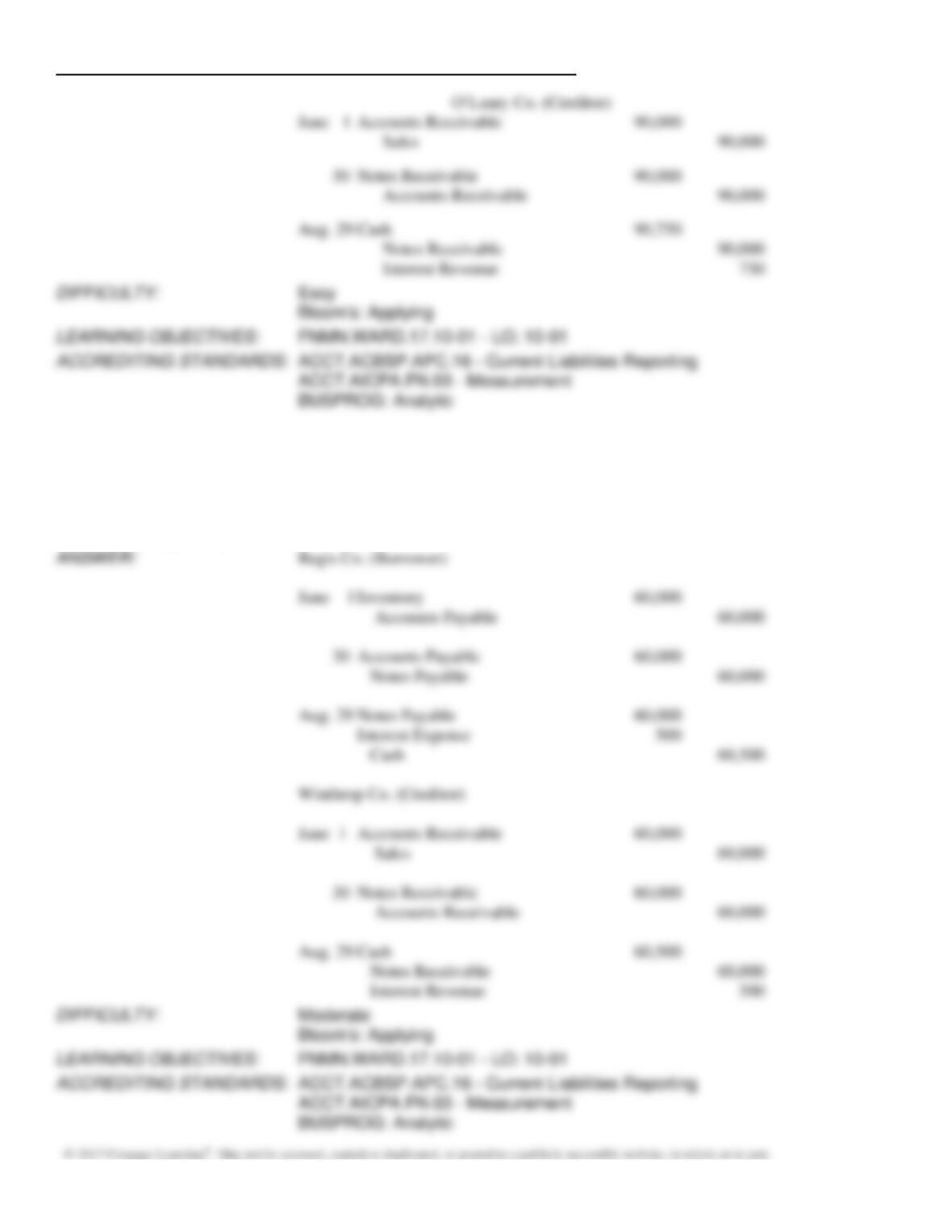
James Co. purchased merchandise on account from O’Leary Co., $90,000, terms n/30.
Jun. 30
James Co. issued a 60-day, 5% note for $90,000 on account.
Aug. 29
James Co. paid the amount due.
June 1
Accounts Payable
30
Accounts Payable
Notes Payable
Aug. 29
Notes Payable
Interest Expense
Cash
Chapter 10 – Liabilities: Current, Installment Notes, and Contingencies
June 1
Accounts Receivable
Sales
30
Notes Receivable
Accounts Receivable
Aug. 29
Notes Receivable
Interest Revenue
137. Journalize the following entries on the books of the borrower and creditor. Label accordingly. (Assume a 360-day
year is used for interest calculations.)
Jun. 1
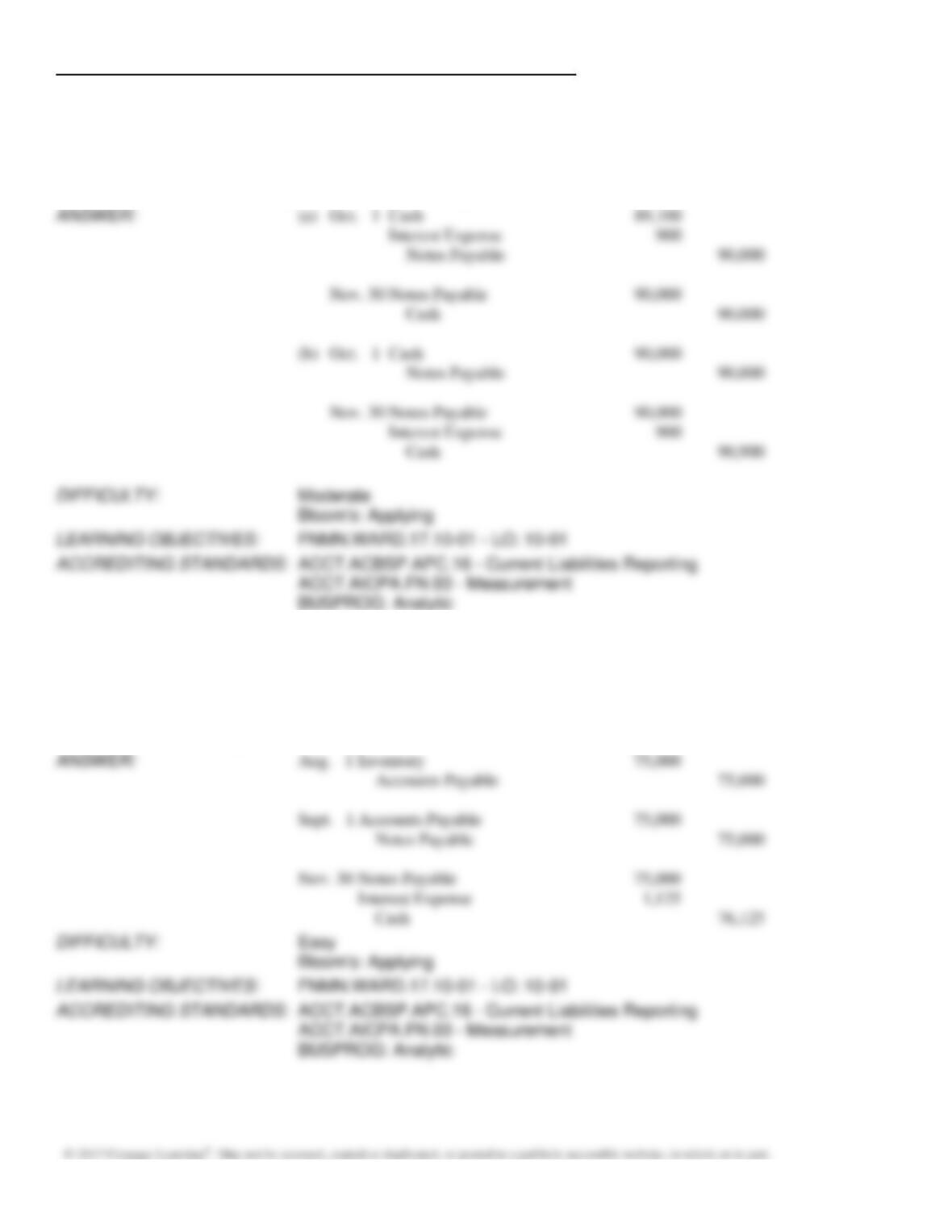
Regis Co. purchased merchandise on account from Winthrop Co., $60,000, terms n/30.
Jun. 30
Regis Co. issued a 60-day, 5% note for $60,000 on account.
Aug. 29
Regis Co. paid the amount due.
Regis Co. (Borrower)
June 1
30
Accounts Payable
Aug. 29
Notes Payable
Interest Expense
Winthrop Co. (Creditor)
June 1
Accounts Receivable
30
Notes Receivable
Accounts Receivable
Aug. 29
Chapter 10 – Liabilities: Current, Installment Notes, and Contingencies
138. On October 1, Ramos Co. signed a $90,000, 60-day discounted note at the bank. The discount rate was 6%, and the
note was paid on November 30. (Assume a 360-day year is used for interest calculations.)
(a)
Journalize the entries for October 1 and November 30.
(b)
Assume that Ramos Co. signed a 6% interest-bearing note. Journalize the entries for October 1 and November 30.
(a)
Oct. 1
Cash
Interest Expense
Nov. 30
Notes Payable
(b)
Oct. 1
Cash
Nov. 30
Notes Payable
Interest Expense
Cash
139. Journalize the following entries on the books of Winston Co. for August 1, September 1, and November 30. (Assume
a 360-day year is used for interest calculations.)
Aug. 1
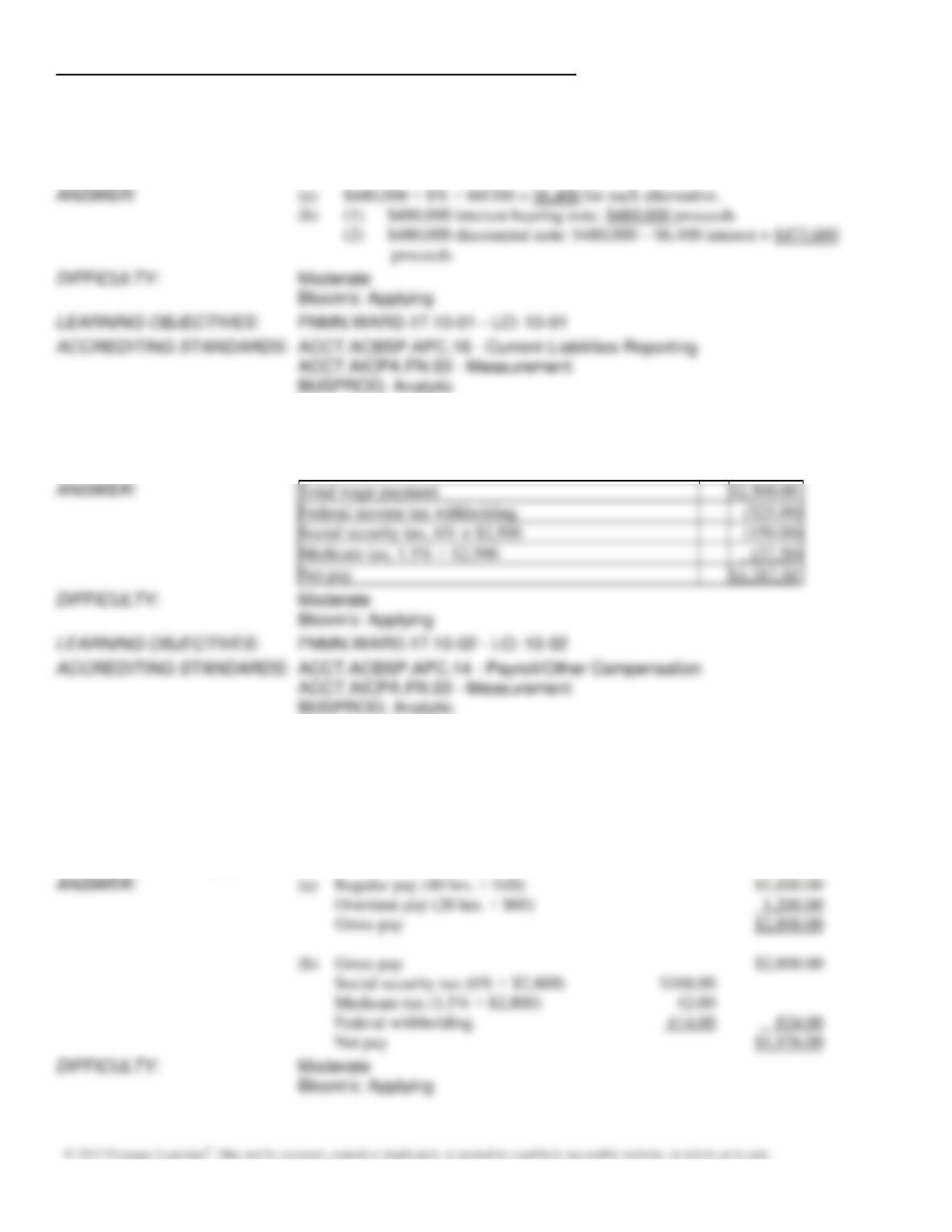
Winston Co. purchased merchandise for $75,000 on account from Bagley Co., terms n/30.
Sept. 1
Winston Co. issued a 90-day, 6% note for $75,000 on account.
Nov. 30
Winston Co. paid the amount due.
Aug. 1
Inventory
Accounts Payable
Sept. 1
Accounts Payable
Notes Payable
Nov. 30
Notes Payable
Interest Expense
Cash
Chapter 10 – Liabilities: Current, Installment Notes, and Contingencies
140. A borrower has two alternatives for a loan: (a) issue a $480,000, 60-day, 8% note or (2) issue a $480,000, 60-day
note that the creditor discounts at 8%. (Assume a 360-day year is used for interest calculations.)
(a)
Calculate the amount of the interest expense for each option.
(b)
Determine the proceeds received by the borrower in each situation.
(a)
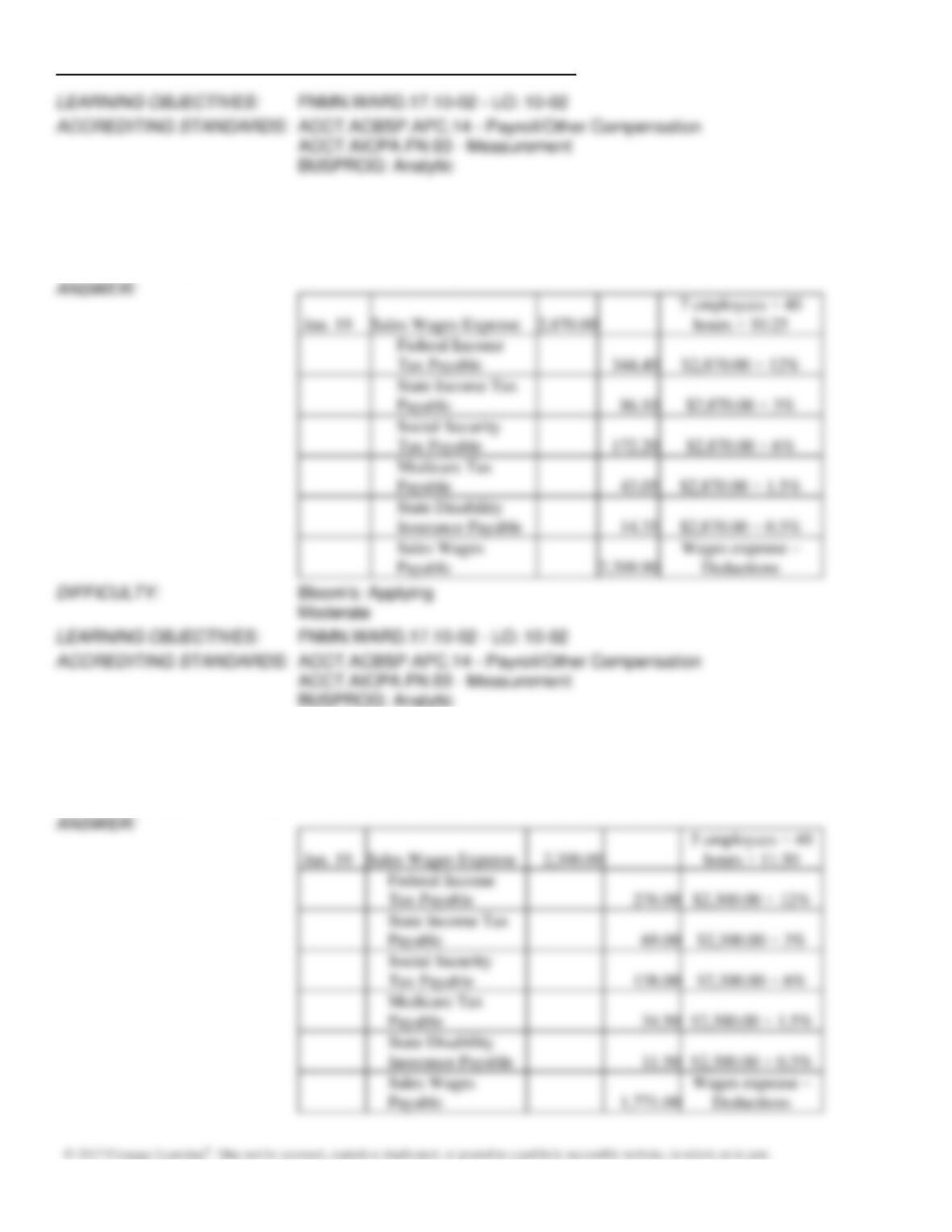
$480,000 × 8% × 60/360 = $6,400 for each alternative.
(b)
(1)
$480,000 interest-bearing note: $480,000 proceeds
proceeds
141. Baker Green’s weekly gross earnings for the week ending December 7 were $2,500, and her federal income tax
withholding was $525. Assuming the social security rate is 6% and Medicare is 1.5%, and all earnings are subject to
FICA taxes, what is Green’s net pay?
Total wage payment
$2,500.00
Federal income tax withholding
Social security tax, 6% × $2,500
Medicare tax, 1.5% × $2,500
$1,787.50
142. An employee earns $40 per hour and 1.5 times that rate for all hours in excess of 40 hours per week. Assume that
the employee worked 60 hours during the week, and that the gross pay prior to the current week totaled $58,000. Assume
further that the social security tax rate was 6.0%, the Medicare tax rate was 1.5%, and the federal income tax to be
withheld was $614.
(a) Determine the gross pay for the week.
(b) Determine the net pay for the week.
(a)
Regular pay (40 hrs. × $40)
Overtime pay (20 hrs. × $60)
Gross pay
(b)
Gross pay
Social security tax (6% × $2,800)
Medicare tax (1.5% × $2,800)
Federal withholding
Chapter 10 – Liabilities: Current, Installment Notes, and Contingencies
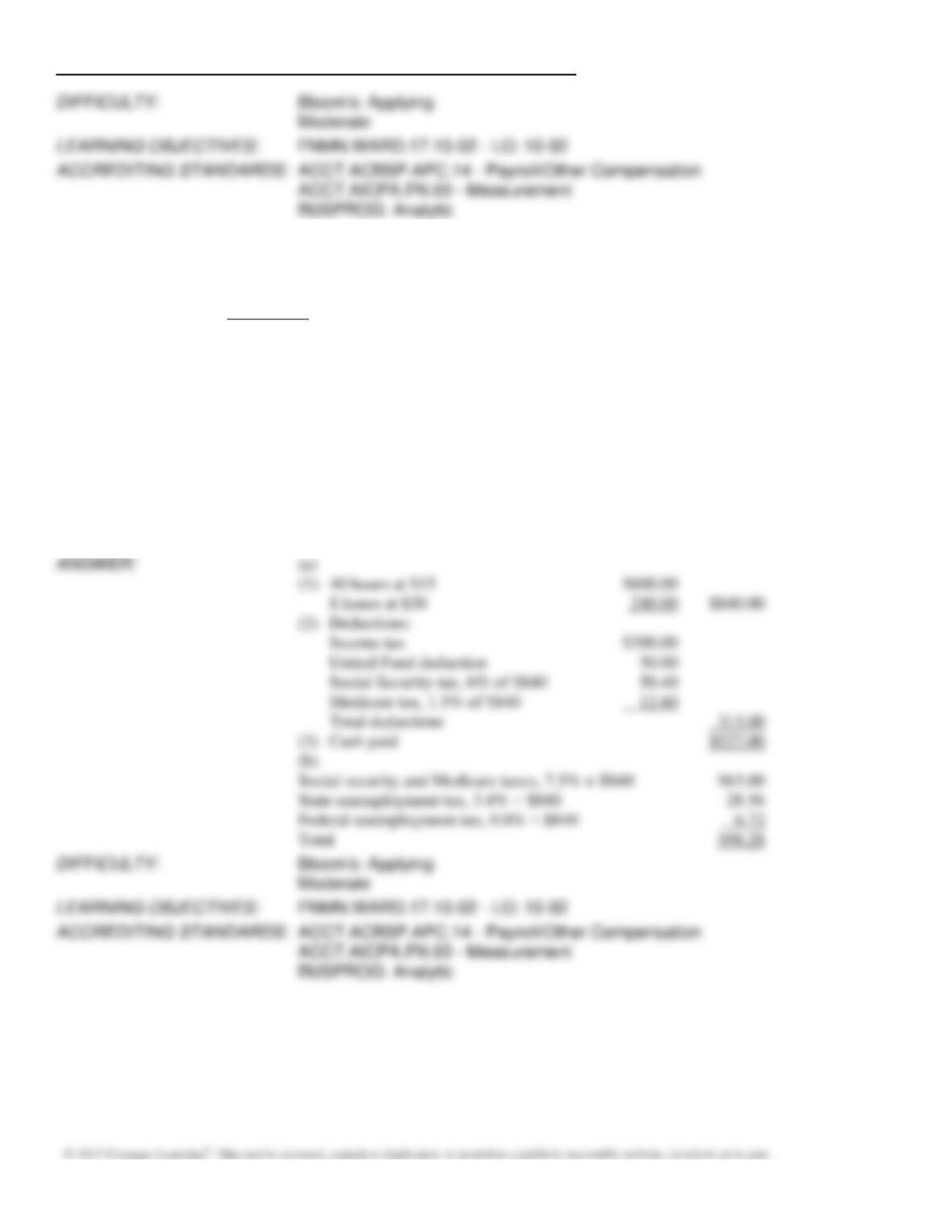
143. Dixon Sales has seven sales employees that receive weekly paychecks. Each earns $10.25 per hour and each has
worked 40 hours in the pay period. Each employee pays 12% of gross in federal income tax, 3% of gross in state income
tax, 6% of gross in social security tax, 1.5% of gross in Medicare tax, and 0.5% of gross in state disability insurance.
Journalize the recognition of the pay period ending January 19 which will be paid to the employees January 26.
144. Mobile Sales has five sales employees which receive weekly paychecks. Each earns $11.50 per hour and each has
worked 40 hours in the pay period. Each employee pays 12% of gross in federal income tax, 3% of gross in state income
tax, 6% of gross in social security tax, 1.5% of gross in Medicare tax, and 0.5% of gross in state disability insurance.
Journalize the pay period ending January 19 which will be paid to the employees January 26.
Chapter 10 – Liabilities: Current, Installment Notes, and Contingencies
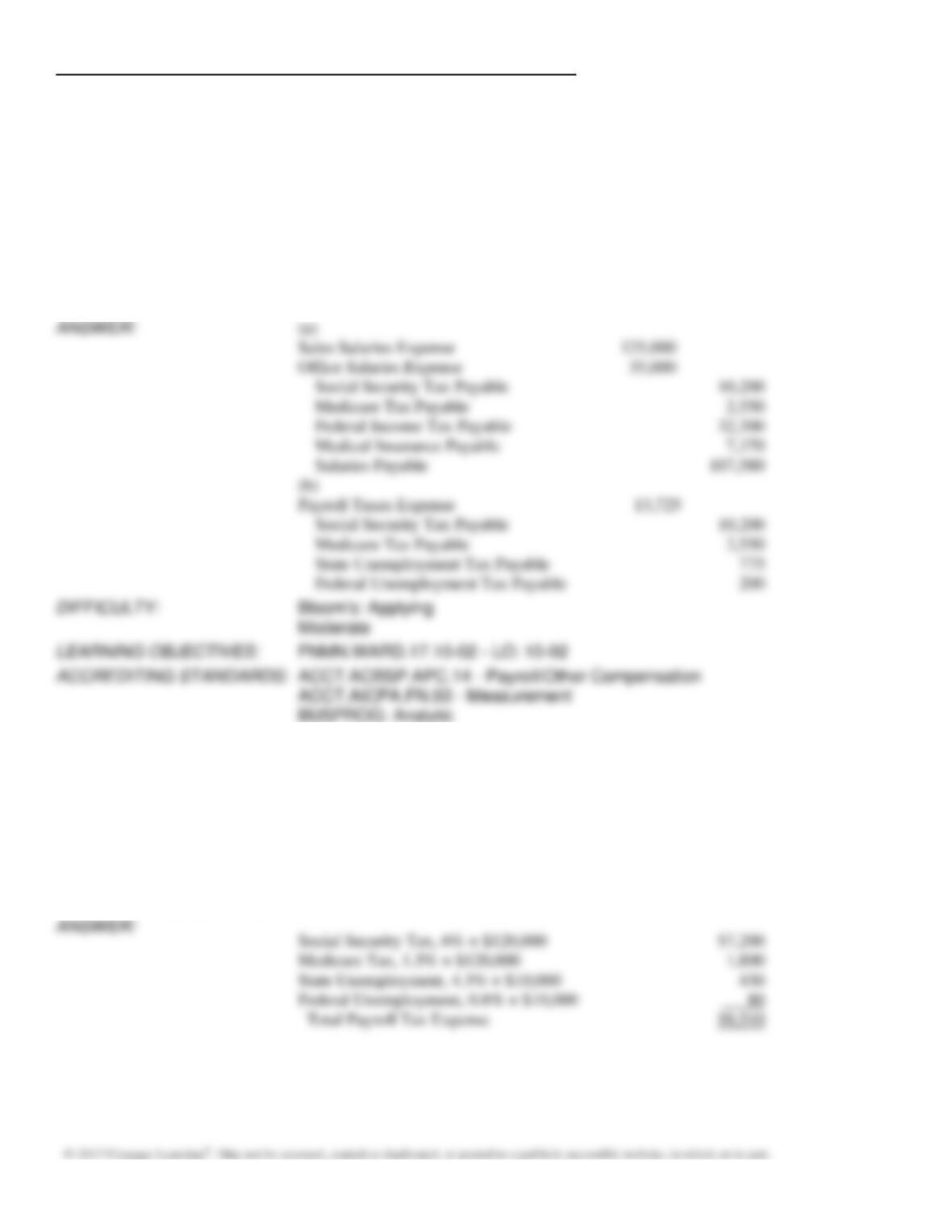
145. The following information is for employee Ella Dodd for the week ended March 15.
Total hours worked: 48
Rate: $15 per hour, with double time for all hours in excess of 40
Federal income tax withheld: $200
United Fund deduction: $50
Cumulative earnings prior to current week: $6,400
Tax rates:
Social security: 6% with no maximum earnings.
Medicare tax: 1.5% on all earnings.
State unemployment: 3.4% with no maximum earnings; on employer
Federal unemployment: 0.8% with no maximum earnings; on employer
(a)
Determine (1) total earnings, (2) total deductions, and (3) cash paid.
(b)
Determine each of the employer’s payroll taxes related to the earnings of Ella Dodd for the
week ended March 15.
(1)
8 hours at $30
(2)
Deductions:
United Fund deduction
Social Security tax, 6% of $840
Medicare tax, 1.5% of $840
Total deductions
(3)
Cash paid
Social security and Medicare taxes, 7.5% × $840
State unemployment tax, 3.4% × $840
Federal unemployment tax, 0.8% × $840
Total
Chapter 10 – Liabilities: Current, Installment Notes, and Contingencies
146. The summary of the payroll for the monthly pay period ending July 15 indicated the following:
Sales salaries
$125,000
Federal income tax withheld
32,300
Office salaries
35,000
Medical insurance withheld
7,370
Social security tax withheld
10,200
Medicare tax withheld
2,550
Journalize the entries to record (a) the payroll and (b) the employer’s payroll tax expense for the month. The state
unemployment tax rate is 3.1%, and the federal unemployment tax rate is 0.8%. Only $25,000 of salaries are subject to
unemployment taxes.
Sales Salaries Expense
Office Salaries Expense
Social Security Tax Payable
Medicare Tax Payable
Federal Income Tax Payable
Medical Insurance Payable
Salaries Payable
Payroll Taxes Expense
State Unemployment Tax Payable
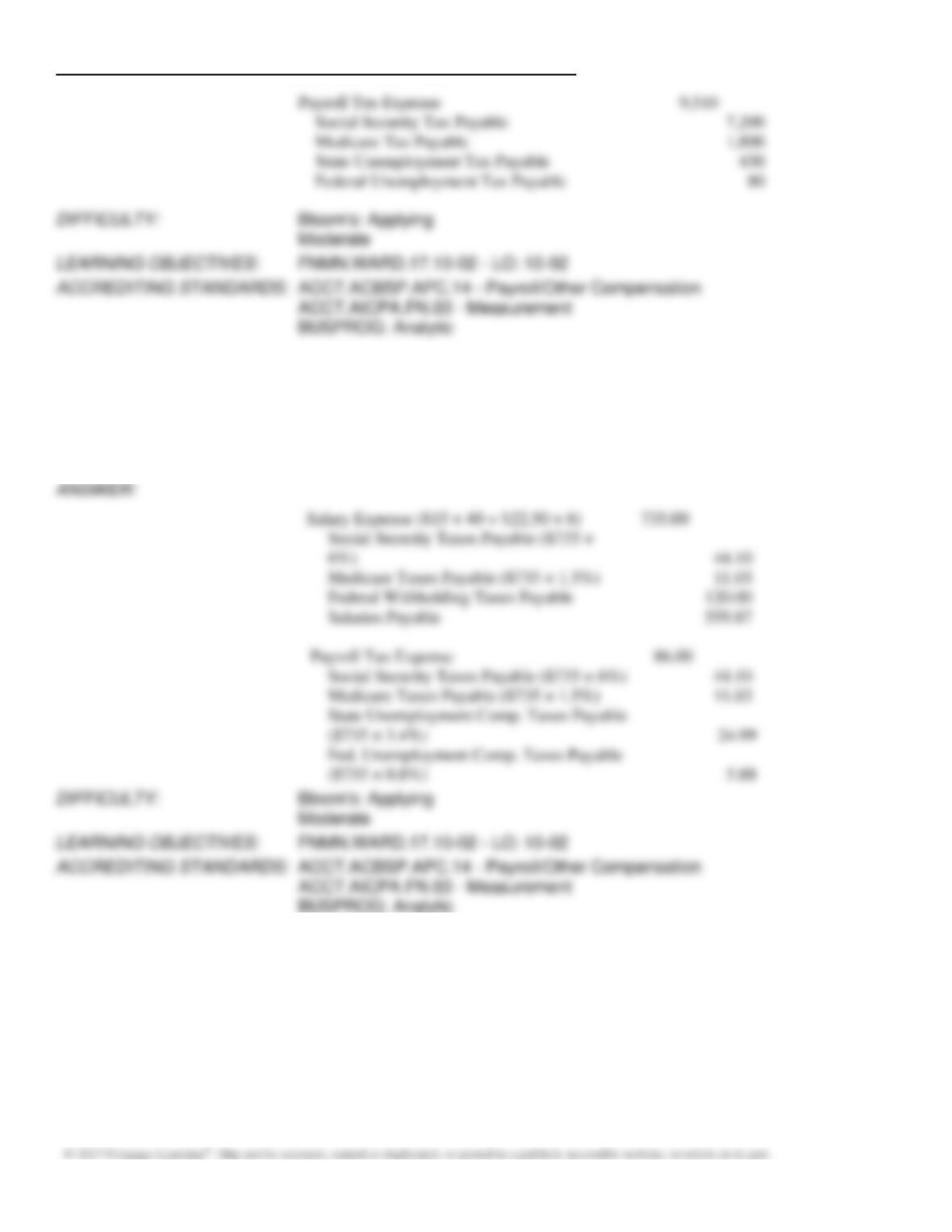
147. Excel Products Inc. pays its employees semimonthly. The summary of the payroll for December 31, indicated the
following:
Salary expense
$120,000
Federal income tax withheld
20,000
Payroll is subject to social security tax of 6% and Medicare tax of 1.5%, with no maximum earnings; $10,000 is subject to
state unemployment tax of 4.3% and federal unemployment tax of 0.8%. Prepare the journal entries for payroll tax
expense if the employees are paid on December 31 of the current year.
Social Security Tax, 6% × $120,000
Medicare Tax, 1.5% × $120,000
State Unemployment, 4.3% × $10,000
Federal Unemployment, 0.8% × $10,000
Chapter 10 – Liabilities: Current, Installment Notes, and Contingencies
148. An employee receives an hourly rate of $15, with time and a half for all hours worked in excess of 40 during the
week. Payroll data for the current week are as follows: hours worked, 46; federal income tax withheld, $120; all earnings
are subject to social security tax; Social security tax rate, 6%; and Medicare tax rate, 1.5%; state unemployment
compensation tax, 3.4% on the first $7,000; federal unemployment compensation tax, 0.8% on the first $7,000. Prepare
the journal entries to record the salaries expense and the employer payroll tax expense. If required, round your answers to
the nearest cent.
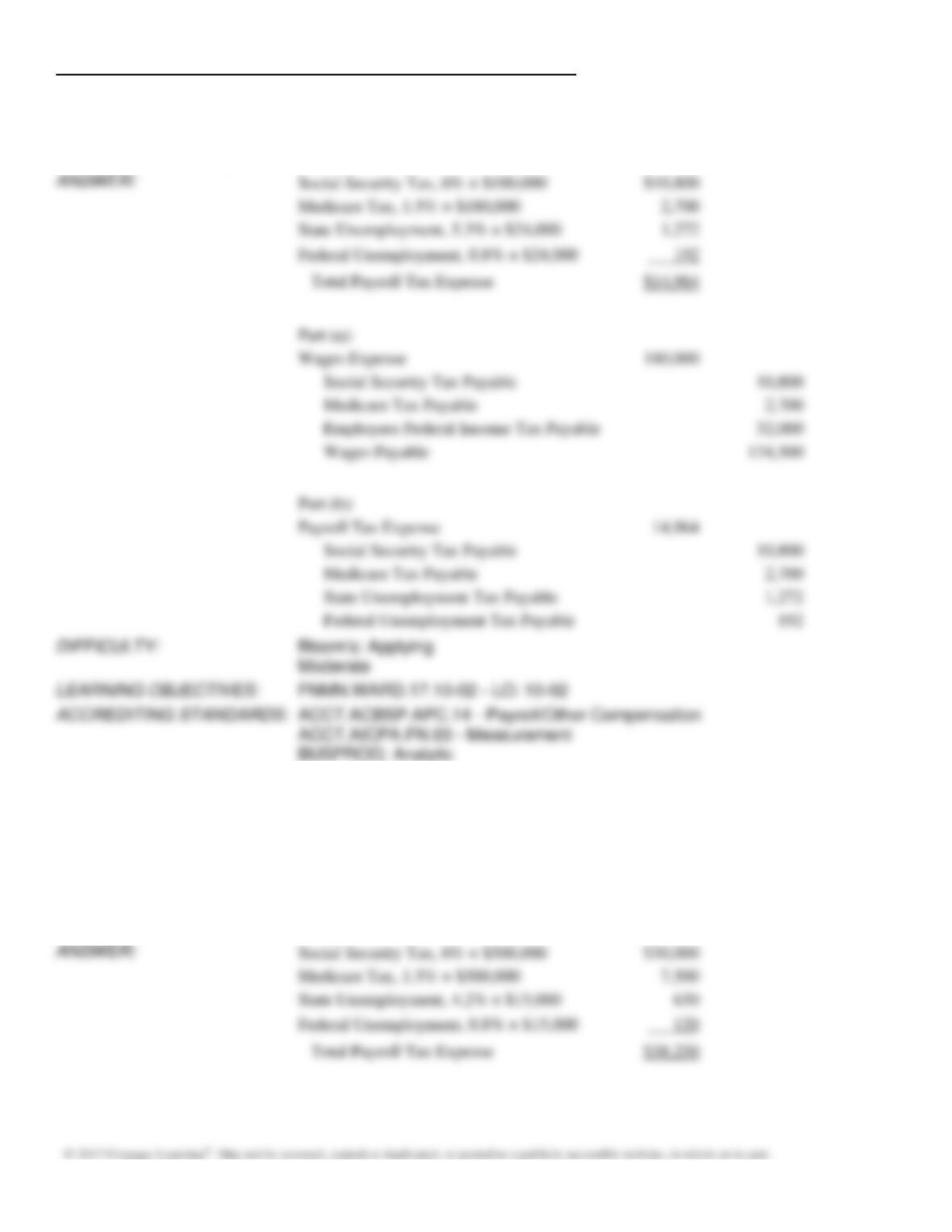
149. Townson Company had gross wages of $180,000 during the week ended December 10. All earnings are subject to
social security tax, while the amount of wages subject to federal and state unemployment taxes was $24,000. Tax rates
are as follows:
Social security
6.0%
Medicare
1.5%
State unemployment
5.3%
Federal unemployment
0.8%
The total amount withheld from employee wages for federal income taxes was $32,000.
Payroll Tax Expense
9,510
Social Security Tax Payable
Medicare Tax Payable
State Unemployment Tax Payable
Federal Unemployment Tax Payable
Chapter 10 – Liabilities: Current, Installment Notes, and Contingencies
(a)
Journalize the entry to record the payroll for the week of December 10. If required, round your
answers to the nearest cent.
(b)
Journalize the entry to record the payroll tax expense incurred for the week of December 10. If
required, round your answers to the nearest cent.
150. According to a summary of the payroll of Scotland Company, salaries for the period were $500,000. Federal income
tax withheld was $98,000. Also, $15,000 was subject to state (4.2%) and federal (0.8%) unemployment taxes. All
earnings are subject to social security tax of 6.0% and Medicare tax of 1.5%.
(a)
Journalize the entry to record the accrual of payroll. If required, round your answers to the nearest
cent.
(b)
Journalize the entry to record the accrual of payroll taxes. If required, round your answers to the
nearest cent.
Chapter 10 – Liabilities: Current, Installment Notes, and Contingencies
151. The payroll register of Seaside Architecture Company indicates $970 of social security and $257 of Medicare tax
withheld on total salaries of $16,500 for the period. Federal withholding for the period totaled $4,235. Prepare the
journal entry for the period’s payroll.