62) Neocolonialism
A) peaked near the end of the nineteenth century.
B) allows core states to continue exploiting periphery states.
C) is still relevant in Africa, but not in other parts of the Southern Hemisphere.
D) has in general been anticapitalist.
63) Antarctica
A) is owned by the United Nations.
B) has a small but thriving native population.
C) is the coldest place in the Northern Hemisphere.
D) has been carved like a territorial pie into claims by various states.
64) Which of the following spends more on military spending than all the other countries
combined?
A) China
B) India
C) England plus France plus Germany
D) Unites States
E) Russia
65) The Domino theory
A) was rejected by President Eisenhower, a former general.
B) was the rationale behind stopping the spread of communism.
C) was applied to Greece and Turkey, but not to Berlin.
D) was confined to the Eurasian landmass.
66) Which of the following countries is NOT a member of the United Nations Security Council?
A) Japan
B) Britain
C) China
D) Russia
E) France
67) Which of the following organizations is an international military alliance?
A) North American Free Trade Agreement
B) Organization of Petroleum Exporting Countries
C) North Atlantic Treaty Organization
D) European Union
E) Association of Southeast Asian Nations
68) The process of determining the boundaries of districts for the purpose of electing political
officials is called
A) reapportionment.
B) gerrymandering.
C) redistricting.
D) confabulation.
69) This was NOT an independent country in 1989.
A) Poland
B) Hungary
C) Slovakia
D) Bulgaria
E) Austria
70) Lakes form a prominent part of the boundaries between all the following, except
A) USA & Canada.
B) France & Switzerland.
C) Zambia & Zimbabwe.
D) Kenya & Uganda.
71) Mountains define most of the boundaries between all the following, except
A) Italy & Switzerland.
B) France & Spain.
C) US & Mexico.
D) India & Nepal.
E) Austria & Switzerland.
72) This part of the former Yugoslavia saw a horrific civil war between Serbs and ethnic
Albanians.
A) Slovenian
B) Bosnia
C) Croatia
D) Kosovo
E) Macedonia
73) Which country most extensively colonized South America?
A) Portugal
B) Britain
C) Holland
D) Spain
E) the United States
74) Hundreds of thousands of Palestinians became refugees as a result of
A) the creation and territorial expansion of Israel.
B) the Iraq War.
C) the Arab Spring.
D) gerrymandering and redistricting.
75) The West Bank and Gaza Strip are called the “Occupied Territories” because they are
A) parts of Israel occupied by Palestinians.
B) parts of Israel under attack by Palestinians.
C) controlled by the British as part of the British Mandate.
D) remnants of Palestine occupied by Israel.
E) both parts of Israel occupied by Palestinians and under attack by Palestinians.
76) Three trillion dollars — $3,000,000,000,000 — represents
A) the economic cost of the Iraq and Afghanistan Wars.
B) the amount spent supporting human and children’s rights in the world’s periphery.
C) the cost to the USA of attaining the number one ranking in the Global Peace Index.
D) the amount lost to government corruption around the world every year..
77) All of the following were European states in the 1980s. Which continues as a European state
today?
A) Hungary
B) East Germany
C) Yugoslavia
D) Czechoslovakia
78) In their attempt to secede from ________, only Russia (illegally) supports and recognizes the
newly independent state of Crimea.
A) Georgia
B) Moldova
C) Ukraine
D) Kaliningrad
E) Serbia
79) In the shifting map of Europe and regional allegiances, closer political-economic ties
between Europe and ________ have heightened tensions between Russia and EU/NATO
countries.
A) Georgia and Ukraine
B) Armenia and Azerbaijan
C) Serbia and Montenegro
D) Slovenia and Slovakia
E) Kaliningrad and Kamchatka
80) From its origins around modern-day Moscow in 1462, the territory of the Russian land
empire and Soviet Union had expanded to fill in the entire area between all of the following
bodies of water except
A) the Mediterranean Sea.
B) the Baltic Sea.
C) the Arctic Ocean.
D) the Pacific Ocean.
E) the Black Sea.
81) In practice, the USSR operated as a
A) unitary state.
B) republic.
C) monarchy.
D) federation.
82) Popular European revolutions of the late 18th to mid-19th centuries transformed numerous
monarchies into
A) republics.
B) empires.
C) confederations.
D) nations.
E) supranational organizations.
83) For his work on characterizing the state based on such factors as climate, terrain and the
relationship between population and territory, ________ is often considered the first political
geographer.
A) Aristotle
B) Friedrich Ratzel
C) Halford Mackinder
D) Louis Althussser
E) Montesquieu
84) In the U.S. and many European countries, one of the most prominent expressions of
sectionalism today are the political tensions between
A) cities and suburbs.
B) eastern states and western states.
C) the Sunbelt and the Snowbelt.
D) documented and undocumented immigrants.
E) Great Lake states and states of the U.S. Southwest.
85) By assimilating local elites and selected individuals into the norms of global capitalist and
corporate culture, former colonies like Kenya still find themselves under the domination of the
core in a process known as
A) Neocolonialism.
B) Totalitarianism.
C) Authoritarianism.
D) Orientalism.
E) Sectionalism.
86) Of the following, the United States is best characterized as a(n)
A) Republic.
B) Oligarchy.
C) Theocracy.
D) Monarchy.
87) Before it split off from India in 1947 to become part of Pakistan, it was East Bengal. In 1971,
it split off from Pakistan to become the independent state of
A) Bangladesh.
B) Burma.
C) Bermuda.
D) Brunei.
E) Bhutan.
88) With a few small exceptions, the countries of the European Union share all of the following
except
A) a European Union Constitution.
B) a common currency.
C) an EU parliament.
D) an EU court system.
E) free movement of goods, services and people across their boundaries.
89) For a citizen of a country outside of the United States, who wishes to migrate to the USA in
order to live and work, he/she must apply for and get ________ from the U.S. government.
A) a job
B) a passport
C) a yellow card
D) a sponsoring family or organization
E) Lawful Permanent Residence
1) Borders between countries are always exclusionary.
2) Decolonization marks the end of core domination of the periphery.
3) Among other things, boundaries help eliminate stereotypes.
4) Straight-line boundaries between states suggest that the boundary was based on natural
features, such as rivers or mountains.
5) The basic area units of analysis in human geography for comparing statistics are de jure
territories.
6) Very few of the world’s state boundaries describe de jure spaces.
7) Kurds living outside of Kurdistan are still part of the Kurdish nation.
8) Nationalists believe that the nation to which they belong has a right to determine its own
affairs.
9) Most countries of the world are simultaneously multinational and nation-states.
10) The United States is NOT a good example of a nation state.
11) In both federal and unitary states, power is dispersed throughout the country.
12) The United States was an influential member of the League of Nations.
13) The Arab-Israeli conflict goes back to the time of Jesus and the Romans.
14) The root cause of the Arab-Israeli conflict is the fundamental differences between Islam and
Judaism.
15) Gerrymandering is a political tool for ensuring an equitable balance between territory and
political representation.
16) Despite efforts to end the practice, gerrymandering in the U.S. continues through the present.
17) Inclusionary boundaries tend to be more permeable than exclusionary boundaries.
18) People of different nations can be citizens of the same state, but citizens of different states
cannot be of the same nation.
19) Neocolonial relationships exist only between former colonies and their former colonizers.
20) Ratzel’s model of geopolitics has the State acting like a biological organism.
21) Boundaries tend to eliminate spatial differentiation.
22) Nationalism is currently confined to a relatively small area of the globe.
23) The Commonwealth of Independent States formed primarily for economic reasons.
24) Ironically, India’s violent war of independence has been followed by a peaceful postcolonial
history.
25) When partitioning Africa, the European colonial powers generally attempted to respect pre-
existing political affiliations and alliances.
26) The Heartland theory recognizes North America as the world’s “heartland.”
27) With the exception of Tunisia, the promise and hope of the Arab Spring has gone largely
unfulfilled.
28) The European Union retains economic barriers between member countries.
29) Most citizens of the United States are affected by three or more levels of government.
30) Gerrymandering, while common prior to 1900, is no longer an issue today.
31) Natural barriers are often based on formal boundaries.
32) By definition, de jure spaces do not have formal boundaries.
33) The United Nations currently recognizes over 65 nearly “pure” nation-states.
34) Lenin sought to suppress all nationalist feelings within the Soviet Union.
35) Once colonization has begun, the periphery becomes a market for goods from the core.
36) The Domino theory held that a certain amount of communist expansion was tolerable, but it
should not be allowed to go too far.
37) In 1998, the United Nations adopted a treaty to establish the International Criminal Court
(ICC) as a way of bringing war criminals to trial. The United States voted against this treaty.
38) Palestinians and Israelis have been in conflict since the establishment of Israel in the first
century.
39) Prior to 1948-49, there was no Israel, only Palestine.
40) Sectionalism is a helpful way of characterizing and understanding the competition between
cities—and how they can be played off of each other—for a major league sports franchise or
major employer.
41) In the U.S. system of democratic rule, one does not need to receive the most votes in the
entire country to become President.
42) Studies show that corruption—and perceptions of corruption—are highest in countries with
the large percentages of very poor people or people in highly insecure situations.
43) According to our text, by 2008, the financial cost to the people of the United States from the
war in Iraq was about $3 trillion, when all the costs associated with the war are included.
44) The majority of the U.S. population would like to see an increase in military spending.
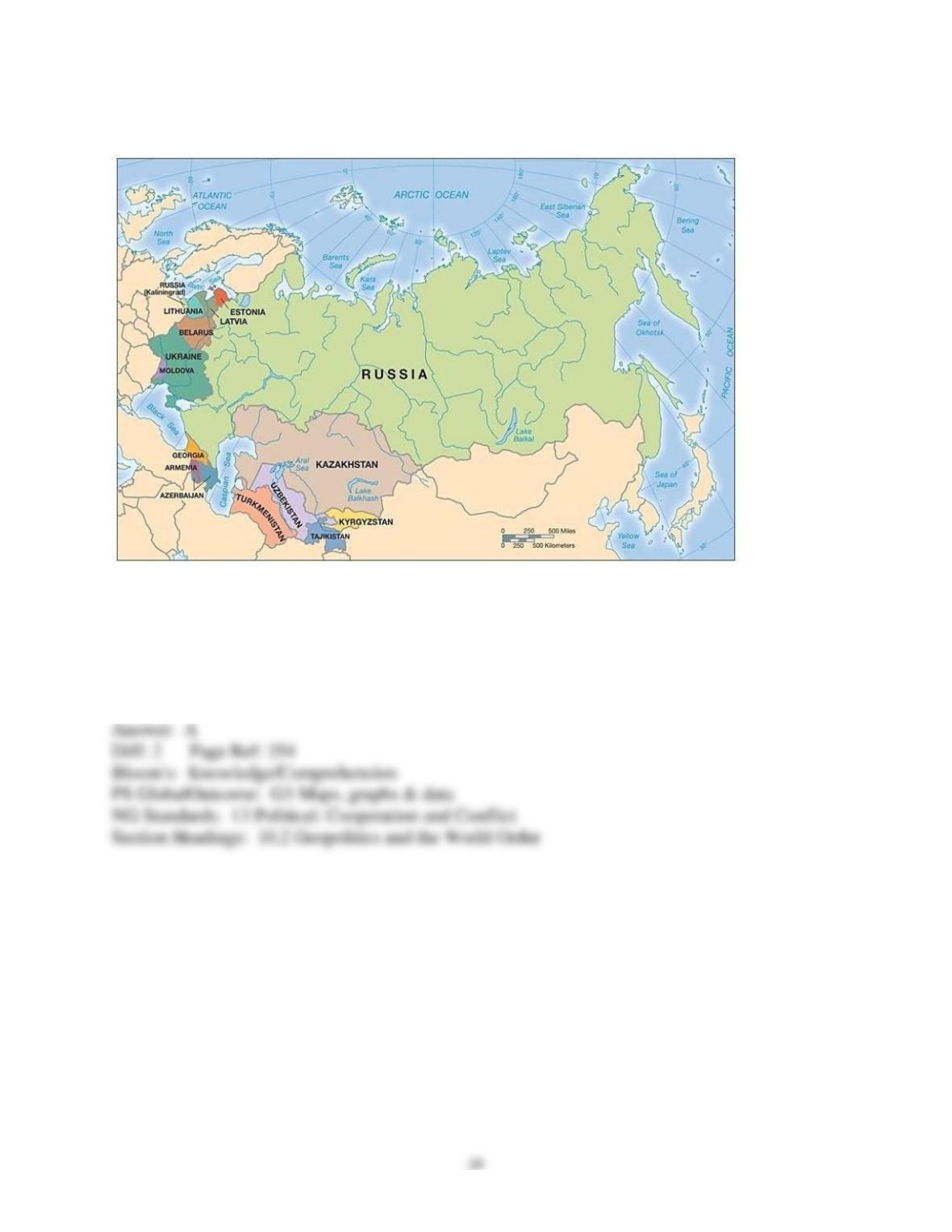
10.3 Questions with Images
1) The shaded and labeled countries in the above map represent
A) the republics of the former USSR.
B) the Commonwealth of Independent States.
C) the Russian Federation.
D) the European Union.
E) the countries behind the Iron Curtain.
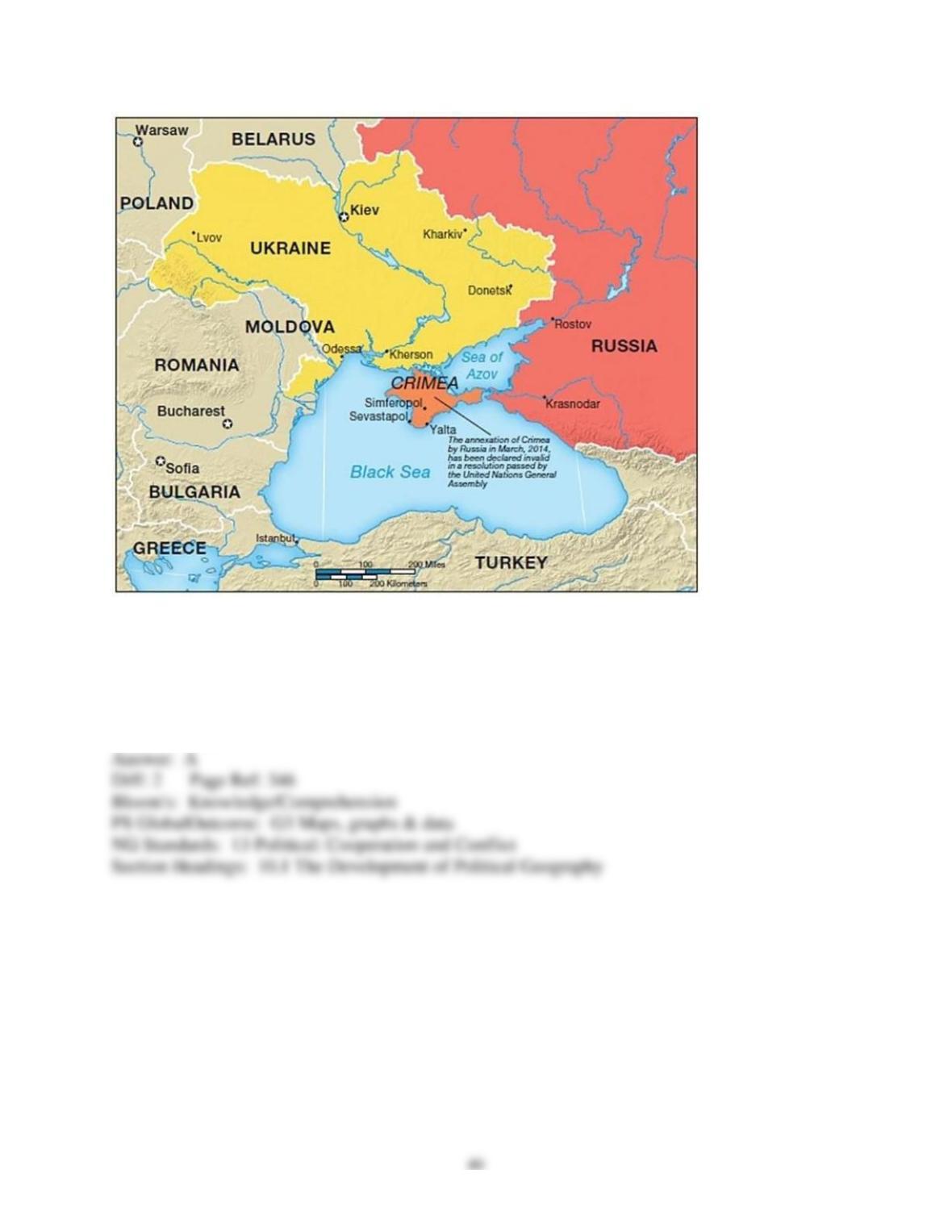
2) The separation of Crimea from Ukraine and its annexation to Russia is an example of
A) irredentism
B) confederation
C) regionalism.
D) nationalism.
E) sectionalism.