
Chapter 10: Atomic Physics
TRUE/FALSE
1. The photoelectric effect occurs when electrons are emitted when light strikes the surface of
a metal.
2. A photon is quantum of electromagnetic radiation.
3. An excited atom can lose energy by emitting an electron.
4. An atom can be excited into a higher energy state by absorbing a photon.
5. In an energy level transition from the n = 2 state to the n =1 state for a hydrogen atom a
photon will be emitted.
6. In the Bohr model of the hydrogen atom both the energy and orbital angular momentum of
the electron are quantized.
7. The uncertainty principle states that a particle cannot be precisely localized.
8. Electrons in atoms move about the nucleus in well defined circular orbits.
9. The early Solvay Conferences had a great effect upon the development of quantum
mechanics.
10. The element helium was discovered by studying the sun’s spectrum.

11. The ground state is the lowest energy level in an atom.
12. The highest energy level in an atom corresponds to n = 1.
13. An x ray can be emitted when an electron undergoes an energy level transition.
14. A 100 eV electron and a 100 eV proton have equal de Broglie wavelengths.
15. In a blackbody, the energy of the oscillating atoms is quantized.
16. The peak of the radiation curve of a blackbody moves upward toward higher intensity as its
temperature increases.
17. The peak of the radiation curve of a blackbody moves toward larger wavelength as its
temperature increases.
18. The energy of an oscillating atom in a blackbody can be a any value within a certain limited
range.
19. Perfect absorbers of electromagnetic radiation are also perfect emitters.
20. There is a direct correlation between the absorption and emission spectra of a particular gas.
21. Two different gases may have the same emission line spectrum.

22. As the intensity of light is increased in a photoelectric effect experiment, the energy of the
emitted electrons increases.
23. When the frequency of the light is increased in a photoelectric effect experiment, the energy
of the emitted electrons increases.
24. Photocopiers make use of the photoelectric effect.
25. Characteristic peaks occur in an x ray spectrum of an atom because electrons in the atom
make transitions to lower energy levels after being bombarded with high energy electrons.
26. The characteristic peaks in an x ray spectrum of an atom occur because of rapid deceleration
of the bombarding electrons.
27. The chemical composition of stars can be determined from lines in their spectra.
28. At any instant in time, it is possible to specify simultaneously the position and the
momentum of a particle to arbitrarily high precision.
29. A laser emits monochromatic and coherent light.
30. Light being amplified by stimulated emission of radiation is the principle of the
photoelectric effect.
31. A laser can be used for very accurate measurements of distances between objects.
32. UPC price scanners at supermarket checkouts use laser holography to read the bar codes
because the packages are three dimensional.
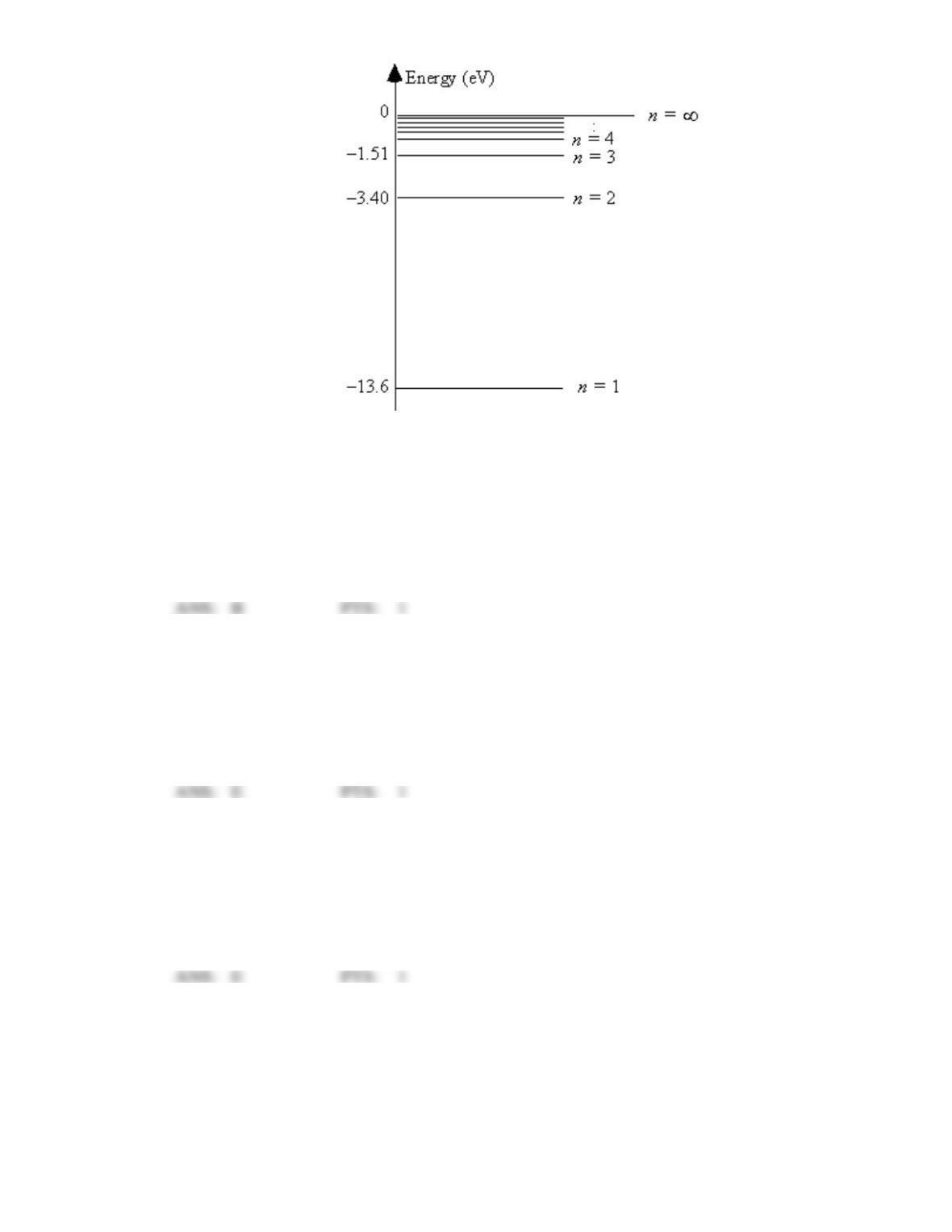
33. The energy of a photon emitted in a transition from the n = 3 state to the n = 2 state is 1.9
eV.
34. The energy of the most energetically possible photon emitted is 10.2 eV.
35. The ionization energy of hydrogen is 13.6 eV.
36. The smallest energy of an absorbed photon that will raise a hydrogen atom from its ground
state to its first excited state is 13.6 eV.
37. If an electron acquires more than the ionization energy, the electron will return to the ground
state.
38. The aurora borealis is an example of atoms and molecules in the atmosphere absorbing
photons and exciting the atoms and molecules to emit spectra.

39. The fact that two electrons cannot occupy the same quantum state at the same time is the
Heisenberg exclusion principle.
40. When the speed of an electron is increased the de Broglie wavelength is decreased.
MULTIPLE CHOICE
1. Electrons emitted when light strikes the surface of a metal is
a.
photon emission
b.
photon absorption
c.
the photoelectric effect
d.
a laser
e.
an emission spectrum
2. A quantum of electromagnetic radiation is a
a.
wave function
b.
photon
c.
de Broglie wave
d.
laser
e.
hologram
3. What does it mean for something to be “quantized?”
a.
It can have only certain discrete values.
b.
It can have only integer values.
c.
It can have values only between certain limits.
d.
none of the above
4. What is the symbol used for Planck’s constant?
a.
p
c.
h
b.
d.
none of the above
5. The energy associated with a photon of blue light is ________________ the energy
associated with a photon of red light.
a.
greater than
c.
equal to
b.
less than
d.
unrelated to

6. An excited atom can lose energy by
a.
emitting a photon
b.
absorbing a photon
c.
undergoing the photoelectric effect
d.
increasing its de Broglie wavelength
e.
the uncertainty principle
7. An atom can be excited into a higher energy state by
a.
emitting a photon
b.
absorbing a photon
c.
undergoing the photoelectric effect
d.
decreasing its de Broglie wavelength
e.
the uncertainty principle
8. In the Bohr model of the hydrogen atom
a.
energy is quantized
b.
the electron’s angular momentum is quantized
c.
the emission spectrum is quantized
d.
the absorption spectrum is quantized.
e.
all of the above
9. The fact that a particle cannot be precisely localized is the
a.
photoelectric effect
b.
uncertainty principle
c.
principle of a hologram
d.
principle of a laser
e.
reason why photons are emitted
10. What is “excluded” by the Pauli exclusion principle?
a.
certain values of angular momentum
b.
precise values of both position and momentum
c.
electrons in the same quantum state
d.
none of the above
11. The lowest energy level in an atom is its
a.
ionization level
b.
emission level
c.
absorption level
d.
photon level

e.
ground state
12. The highest energy level in an atom is its
a.
ionization level
b.
emission level
c.
absorption level
d.
photon level
e.
ground state
13. If the speed of an electron increases, its de Broglie wavelength
a.
increases
c.
stays the same
b.
decreases
d.
may increase or decrease
14. Electron diffraction shows
a.
that electrons behave like waves
b.
the photoelectric effect
c.
characteristic x ray spectra
d.
that electrons in atoms have only certain allowed energies
15. A three dimensional image made using a laser is a(n)
a.
emission spectrum
b.
absorption spectrum
c.
wave function
d.
hologram
e.
photoelectric effect
16. Which of these is not involved in the operation of lasers?
a.
stimulated emission
c.
metastable state
b.
population inversion
d.
blackbody radiation
17. What is coherent light?
a.
light of a single wavelength
b.
light that is all in phase
c.
light that is polarized in one direction
d.
none of the above
18. The quantity that is quantized in the oscillating atoms of a blackbody is
a.
angular momentum

b.
energy
c.
the emission spectrum
d.
the absorption spectrum
e.
the wave function
19. The person who first explained the blackbody spectrum was
a.
Max Planck
b.
Albert Einstein
c.
Neils Bohr
d.
Erwin Schroedinger
e.
Werner Heisenberg
20. What quantities are plotted on a blackbody radiation curve?
a.
total radiated energy vs. temperature
b.
radiation intensity vs. wavelength
c.
wavelength of peak emission vs. temperature
d.
none of the above
21. The person who first explained the photoelectric effect was
a.
Max Planck
b.
Albert Einstein
c.
Neils Bohr
d.
Erwin Schroedinger
e.
Werner Heisenberg
22. Which of the following devices make use of the photoelectric effect?
a.
digital cameras
b.
photocopiers
c.
laser printers
d.
solar cells
e.
all of the above
23. The person who first explained the discrete hydrogen atom spectrum was
a.
Max Planck
b.
Albert Einstein
c.
Neils Bohr
d.
Erwin Schroedinger
e.
Werner Heisenberg
24. What is meant by a line spectrum?

a.
a spectrum which is straight
b.
a spectrum made of bright lines in certain places, separated by dark gaps
c.
a spectrum made by a hot filament stretched into a straight line
d.
none of the above
25. The spectra of different elements can be distinguished because
a.
they have the same spectral lines, but the lines are of different intensities
b.
they have spectral lines in different positions
c.
every element has one unique spectral line
d.
none of the above
26. The person who expounded the uncertainty principle was
a.
Max Planck
b.
Albert Einstein
c.
Neils Bohr
d.
Erwin Schroedinger
e.
Werner Heisenberg.
27. The person who developed the concept of a wave function was
a.
Max Planck
b.
Albert Einstein
c.
Neils Bohr
d.
Erwin Schroedinger
e.
Werner Heisenberg
28. When the intensity of the light is increased in a photoelectric effect experiment, the energy
of the emitted electrons
a.
increases
b.
decreases
c.
stays the same
d.
becomes more quantized
e.
becomes less quantized
29. When the frequency of the light is increased in a photoelectric effect experiment, the energy
of the emitted electrons
a.
increases
b.
decreases
c.
stays the same
d.
becomes more quantized
e.
becomes less quantized

30. The characteristic peaks in an x ray spectrum of an atom occur because
a.
of photon absorption
b.
of the photoelectric effect
c.
electrons in the atom make transitions to lower energy levels
d.
of the uncertainty principle
e.
of rapid deceleration of the bombarding electrons
31. The continuous part of an x ray spectrum of an atom occurs because
a.
of photon absorption
b.
of the photoelectric effect
c.
electrons in the atom make transitions to lower energy levels
d.
of the uncertainty principle
e.
of rapid deceleration of the bombarding electrons
32. In a laser
a.
light is amplified by stimulated emission of radiation
b.
the emitted light is monochromatic
c.
the emitted light is coherent
d.
there is a population inversion of electrons in atoms
e.
all of the above
33. Lasers are used
a.
to produce holograms
b.
in surgery
c.
to measure distances between objects accurately
d.
in DVD and compact disc players
e.
all of the above
34. The aurora borealis (northern lights) are caused by
a.
sunlight reflecting from polar ice
b.
emissions from atoms and molecules in the upper atmosphere excited by electrons
from the sun
c.
thunderstorms
d.
an unknown process
NARREND
35. The energy of a photon emitted in a transition from the n = 3 state to the n = 2 state is
a.
1.5 eV
b.
1.9 eV
c.
3.4 eV
d.
10.2 eV
e.
13.6 eV
36. The energy of the most energetically possible photon emitted is
a.
1.5 eV
b.
1.9 eV
c.
3.4 eV
d.
10.2 eV
e.
13.6 eV
37. The ionization energy of hydrogen is
a.
1.5 eV
b.
1.9 eV
c.
3.4 eV
d.
10.2 eV
e.
13.6 eV
38. The smallest energy of an absorbed photon that will raise a hydrogen atom from its ground
state to its first excited state is
a.
1.5 eV
b.
1.9 eV
c.
3.4 eV