Chapter 10
Derivatives: Risk Management with Speculation,
Hedging, and Risk Transfer
Note: In the sixth edition of Global Investments, the exchange rate quotation symbols differ from previous
editions. We adopted the convention that the first currency is the quoted currency in terms of units
of the second currency.
For example, €:$ = 1.4 indicates that one euro is priced at 1.4 dollars. In previous editions we used
the reversed convention $/€ = 1.4, meaning 1.4 dollars per euro.
All problems in this test bank still use the old convention and have not been adapted to reflect the
new quotation symbols used in the 6th edition.
◼ Questions and Problems
1. A Swiss portfolio manager has a significant portion of the portfolio invested in dollar-denominated
assets. The money manager is worried about the political situation surrounding the next U.S.
presidential election and fears a potential drop in the value of the dollar. The manager decides to
sell the dollars forward against Swiss francs.
a. Give some reasons why the Swiss money manager should use futures rather than forward
currency contracts?
b. Give some reasons why the Swiss money manager should use forward currency contracts rather
than futures?
Chapter 10 Derivatives: Risk Management with Speculation, Hedging, and Risk Transfer 117
2. Why are futures contracts commonly believed to be less subject to default risk than forward
contracts?
3. Let’s consider a Swiss franc futures contract traded in the United States. On February 18 (a Friday),
the March contract closed at 0.7049 dollar per Swiss franc. The size of the contract is 125,000 Swiss
francs. The initial margin is $2,600 per contract and the maintenance margin is $1,600. Assume that
you buy one March contract on February 19 at 0.7049 $/SFr and you deposit, in cash, an initial
margin of $2,600. Listed below are the futures quotations (settlement prices) observed on three
successive days:
Feb. 18
Feb. 20
Feb. 21
Feb. 22
0.7049
0.7009
0.6949
0.7089
What are the cash flows associated with the marking-to–market procedure?
4. A German investor holds a portfolio of British stocks. The market value of the portfolio is £20 million,
with a
of 1.5 relative to the FTSE index. In November, the spot value of the FTSE index is 4,000.
The dividend yield, euro interest rates, and pound interest rates are all equal to 4% (flat yield curves).
a. The German investor fears a drop in the British stock market (but not in the British pound).
The size of FTSE stock index contracts is 10 pounds times the FTSE index. There are futures
contracts quoted with December delivery. Calculate the futures price of the index.
b. How many contracts should you buy or sell to hedge the British stock market risk?
118 Solnik/McLeavey • Global Investments, Sixth Edition
c. You believe that the capital asset pricing model (CAPM) applies to British stocks. The expected
stock market return is 10%. What is the expected return on this portfolio before and after
hedging?
d. You now fear a depreciation of the British pound relative to the euro. Will the strategies above
protect you against this depreciation? (Assume that the margin on the futures contract is
deposited in euros.)
e. The forward exchange rate is equal to 1.4 € per £. How many pounds should you sell forward?
5. You hold a portfolio made of French stocks and worth €10 million. The beta (
) of this portfolio
relative to the CAC index is 1.5. The interest rate for the euro is 4% for all maturities and the annual
dividend yield is 2%. The spot value of the CAC index on January 1, 2000, is 5,000. A CAC contract
has a size of €10 for each index point.
a. What should be the future price of the CAC contract with a three-month maturity?
b. You fear a fall in the French stock market. What should be your hedge ratio? How many
contracts do you buy/sell?
Chapter 10 Derivatives: Risk Management with Speculation, Hedging, and Risk Transfer 119
6. To capitalize on your expectation of a 10% gold price appreciation, you consider buying futures or
option contracts to speculate. The spot price of gold is $400. Near-delivery futures contracts are
quoted at $410 per ounce with a margin of $1,000 per contract of 100 ounces. Call options on gold
are quoted with the same delivery date. A call with an exercise price of $400 costs $20 per ounce.
The rate of return on your speculation will be the return on your invested capital, which is the initial
margin for futures and the option premium for options.
a. Based on your expectation of a 10% rise in gold price, what is your expected return at maturity
on futures contracts?
b. Based on your expectation of a 10% rise in gold price, what is your expected return at maturity
on option contracts?
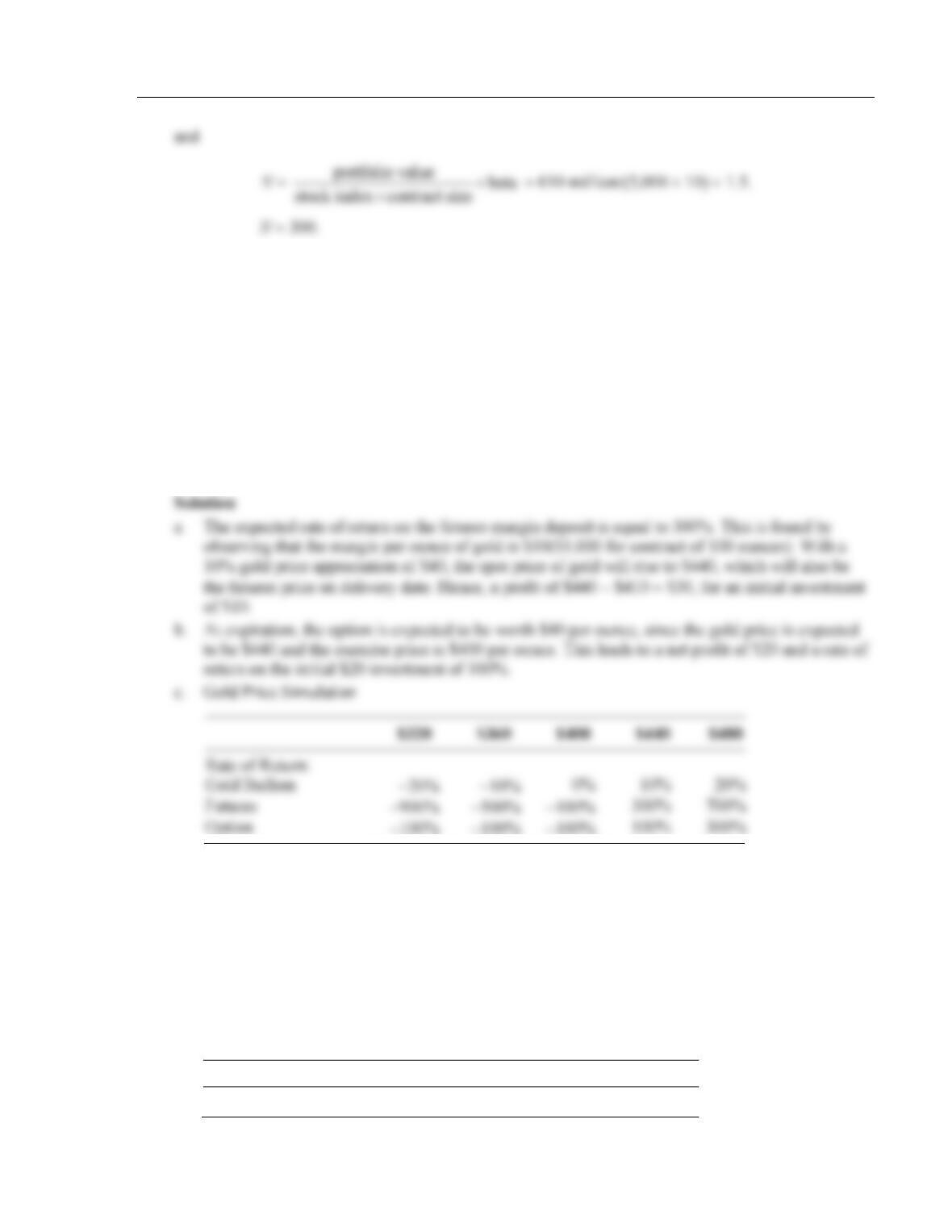
c. Simulate the return of the two investments for various movements in the price of gold.
7. In Hong Kong, the size of a futures contract on the Hang Seng stock index is HK $50 times the index.
The margin (initial and maintenance) is set at HK $32,500. You predict a drop in the Hong Kong
stock market following some economic problems in China and decide to sell one June futures
contract on April 1. The current futures price is 7,200. The contract expires on the second-to-last
business day of the delivery month (expiration date: June 27). Today is April 1, and the current spot
value of the stock market index is 7,140.
a. Why is the spot value of the index lower than the futures value of the index?
b. Indicate the cash flows that affect your position if the following prices are subsequently
observed:
April 1
April 2
April 3
April 4
Hang Seng Futures
7,200
7,300
7,250
6,900
120 Solnik/McLeavey • Global Investments, Sixth Edition
8. Derive a theoretical price for each of the following futures contracts quoted in the United States and
indicate why and how the market price should deviate from this theoretical value. In each case,
consider one unit of underlying asset. The contract expires in exactly three months, and the
annualized interest rate on three-month dollar London InterBank Offered Rate (LIBOR) is 12%.
All interest rates quoted are annualized.
Contract
Useful Information
a. Gold Futures:
Spot gold price = $300 per ounce; cost of storage =
$0.50 per ounce per month
b. Currency Futures:
$/€ spot exchange rate = 1.10 dollars per euro;
3-month euro interest rate = 4%
c. Eurodollar Futures: (3-month
$ LIBOR):
6-month $ LIBOR interest rate = 10%
d. Stock Index Futures:
Current value of stock index = 1,200; annual
dividend yield = 2%
Cash Flow
Chapter 10 Derivatives: Risk Management with Speculation, Hedging, and Risk Transfer 121
9. You wish to establish the theoretical futures price on a Euribor contract quoted on the London
International Financial Futures Exchange (LIFFE) in London. The futures contract is for a 90-day
Euribor rate at expiration of the futures contract. You look at the current term structure of Euribor
interest rates. Following the standard conventions for short-term rates, all interest rates are quoted as
annualized linear rates. In other words, the interest paid for a maturity of T days is equal to the
annualized rate quoted, divided by 360 and multiplied by T. The observed rates are as follows:
60-Day
90-Day
150-Day
180-Day
Euribor Rate
4.125%
4.250%
4.500%
4.550%
a. What should be the Euribor futures price quoted today with an expiration date in exactly
90 days?
b. What should be the Euribor futures price quoted today with an expiration date in exactly
60 days?
122 Solnik/McLeavey • Global Investments, Sixth Edition
Solution
10. You specialize in arbitrage between the futures and the cash market on the Paris Bourse. The CAC
stock index is made up of 40 leading stocks. The futures price of the CAC contract with delivery in a
month is 2,120. The size of the contract is €10 times the index. The spot value of the index is given as
2,000. Actually, there are transaction costs in the cash market; the bid–ask spread is around 40 points.
You can buy a basket of stocks representing the index for 2,020 and sell the same basket for 1,980.
Transaction costs on the futures contracts are assumed to be negligible. During the next month, the
stocks in the index will pay dividends amounting to 5 per index. These dividends have already been
announced, so there is no uncertainty about this cash flow. The current one-month interest rate in
euros is 61/2 − 5/8%.
a. Do you detect any arbitrage opportunity?
b. What profit could you make per contract?
c. What is the theoretical value of the futures bid and ask prices?
Chapter 10 Derivatives: Risk Management with Speculation, Hedging, and Risk Transfer 123
11. A few years ago when the French franc (FF) still existed, the MATIF futures exchange in Paris had a
very active market for the French government bond contract. The underlying asset is a notional long-
term government bond with a yield of 10%. The size of the contract is FF 500,000 of nominal value.
Futures prices are quoted in percentage of the nominal value. On April 1, the French term structure of
interest rate is flat. The bond futures price for delivery in June is equal to 106.21%. The three French
government bonds that can be used for delivery have the following characteristics:
Market Price
Duration
Conversion Factor
Bond A
107.46%
7.00
101.1771%
Bond B
105.57%
7.90
98.1441%
Bond C
106.32%
8.80
99.3104%
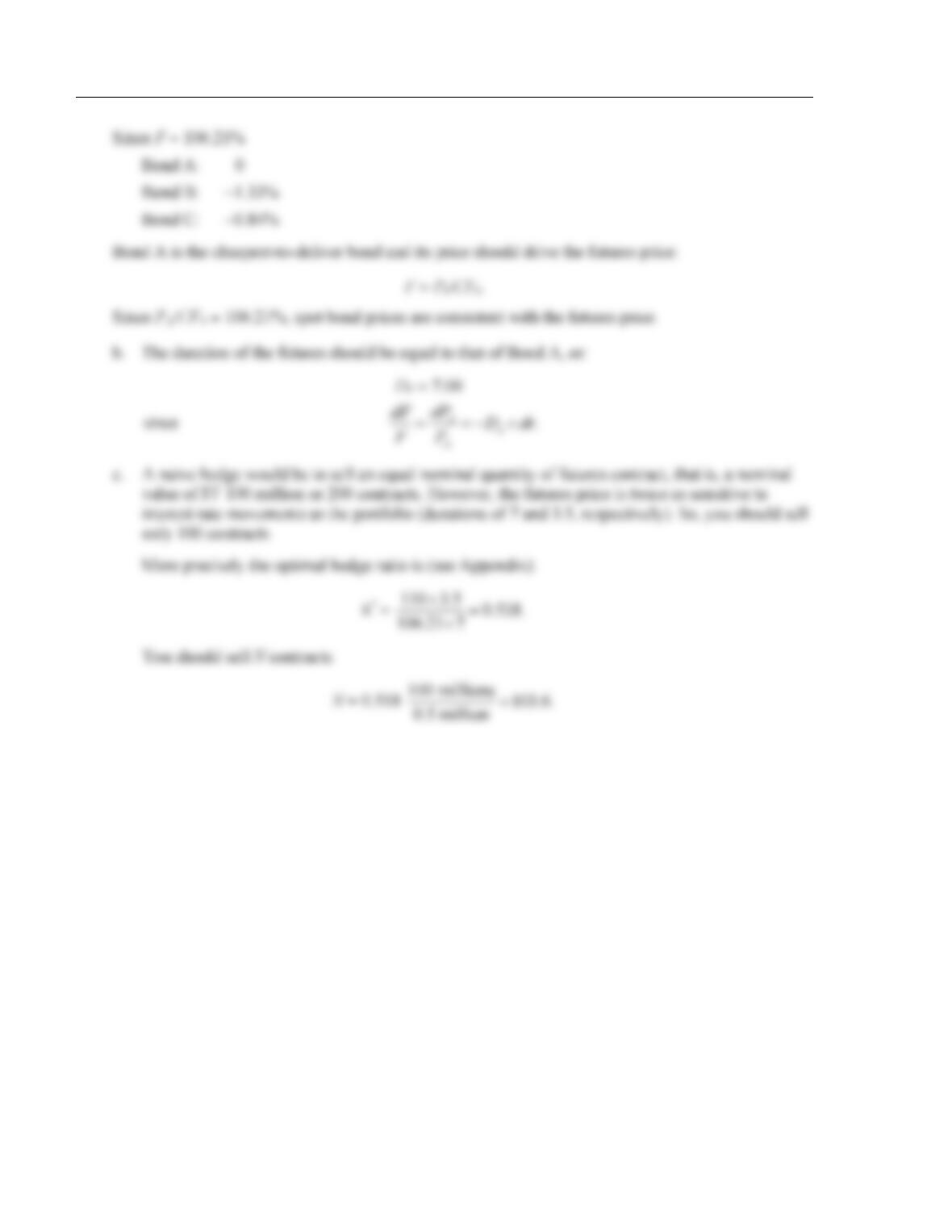
a. Is the futures price consistent with the spot bond prices? (Find the bond cheapest to deliver.)
b. Estimate the interest rate sensitivity (duration) of the futures price.
c. You are an insurance company with a portfolio of French government bonds. The portfolio has a
nominal value of FF 100 million and a market value of FF 110 million. Its average duration is
3.5. You are worried that social unrest in France could lead to an increase in French interest rates.
Rather than selling the bonds, you wish to temporarily hedge the French interest rate risk. How
many futures contracts would you sell and why?
Note to the instructor: The section on optimal hedge ratios for bond portfolios has been
removed from the 5th edition. We include a brief summary of the theoretical derivations
given at the end of the solution.
124 Solnik/McLeavey • Global Investments, Sixth Edition
Appendix: Theoretical Derivations
Theoretical value of the futures price:
The theoretical value of the futures price is derived by arbitrage between the futures and the cheapest-
to–deliver bond. Assume that the futures price is “too high.” Then an arbitrageur could buy a
deliverable bond “B” at a price PB on the cash market and simultaneously sell the futures at F. Bond B
has a conversion factor CFB. The carrying cost of this position is the difference between the short-
term interest rate paid to finance the purchase of the bond and the long-term interest rate (yield)
received while holding the bond. Let’s assume that the yield curve is flat, so that there is no carrying
cost in this arbitrage (basis equals zero).
At delivery the arbitrageur will make a profit equal to:
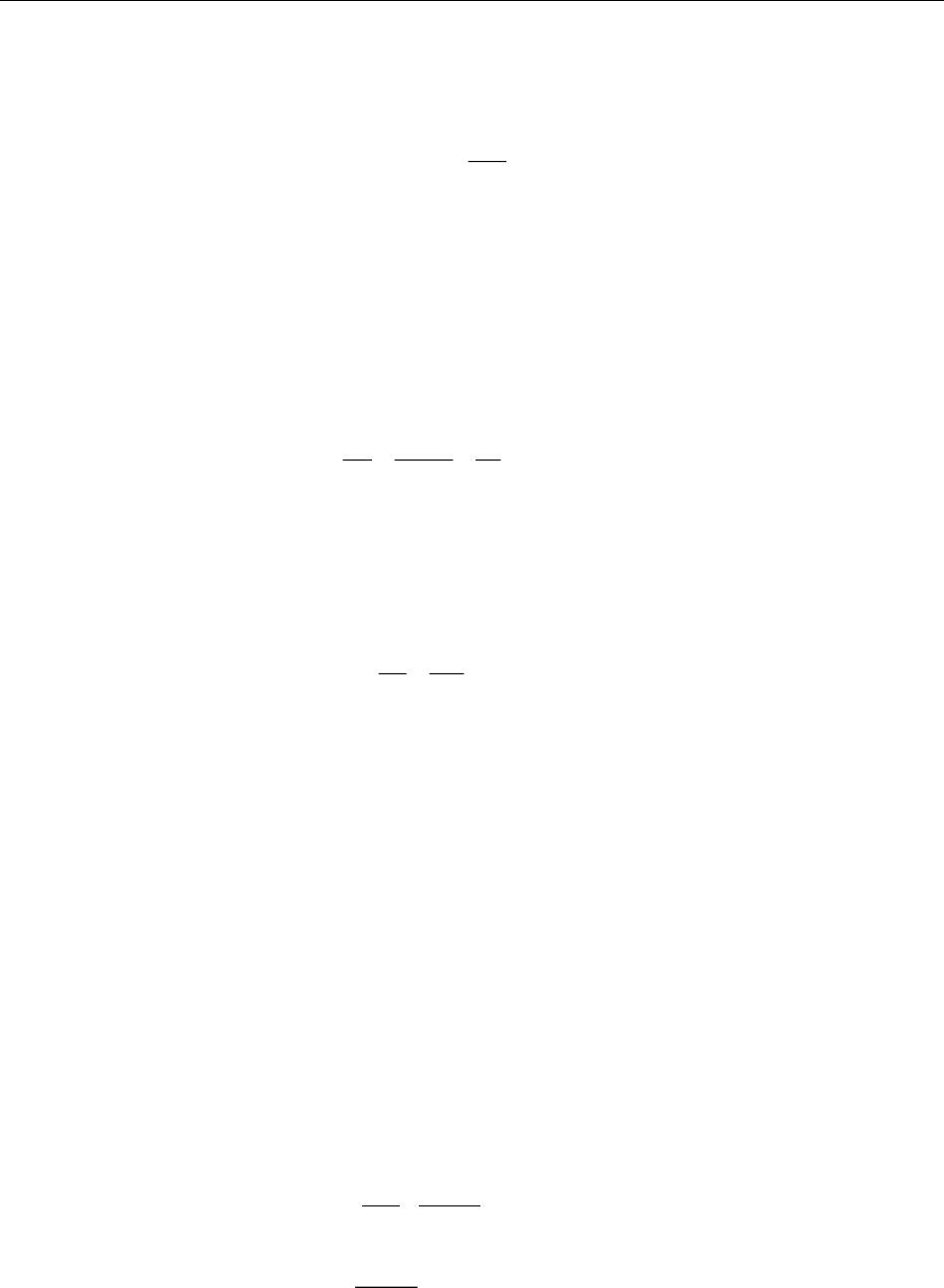
F CFB − PB.
Chapter 10 Derivatives: Risk Management with Speculation, Hedging, and Risk Transfer 125
Of course, the arbitrageur will choose the bond (Bond B) that maximizes this profit (i.e., the
cheapest-to-deliver bond). By arbitrage this riskless profit must be zero (it will be negative for
deliverable bonds that are not the cheapest-to-deliver). So, the futures price should be equal to:
.
B
B
P
FCF
=
The price of the cheapest-to-deliver bond (Bond B) drives the futures prices (the conversion factor is
a constant).
Optimal hedge ratio:
Let’s assume that we wish to hedge the interest rate risk of a portfolio with a value V (here
FF 110 million), consisting of a nominal value Q (here FF 100 million) times an average spot bond
price S % (here 110%). The duration equation for the portfolio for a small variation dr in the market
yield is:
S
dV Q dS dS D dr
V Q S S
= = = −
or
.
S
dV D Q S dr= −
The duration equation for the futures price is driven by the equation duration for the cheapest-to–
deliver bond (remember that the conversion factor is a constant):
B
B
B
dP
dF D dr
FP
= = −
hence
.
B
dF D F dr= −
We hedge by selling N futures contracts with a fixed size (here FF 0.5 million). For a small variation
dr in the market yield, the futures position will generate a gain of:
Gain =
.
B
N size dF N size D F dr− =
The net result on the hedged portfolio is:
( ) .
S B B S
D Q S dr N size D F dr N size D F D Q S dr− + = −
The optimal number of contracts that will immunize the hedged portfolio to small variations in
market yield is such that:
0
BS
N size D F D Q S − =
or
.
S
B
DS
Q
NSize D F
=
The optimal hedge ratio is
*.
S
B
DS
hDF
=
126 Solnik/McLeavey • Global Investments, Sixth Edition
12. An American investor wants to invest in a diversified portfolio of Japanese stocks but can invest only
a rather small sum. The investor also worries about fiscal and transaction cost considerations. Why
would futures contracts on the Nikkei index be an attractive alternative?
13. A money manager holds $50 million worth of top-quality international bonds denominated in dollars.
Their face value is $40 million, and most issues are highly illiquid. She fears a rise in U.S. interest
rates and decides to hedge, using U.S. Treasury bond futures. Why would it be difficult to achieve a
perfect hedge (list the various reasons)?
14. A manager holds a diversified portfolio of British stocks worth £5 million. He has short-term fears
about the market but feels that it is a sound long-term investment. He is a firm believer in betas, and
his portfolio’s
is equal to 0.8. What are the alternatives open to temporarily reduce the risk on his
British portfolio?
Chapter 10 Derivatives: Risk Management with Speculation, Hedging, and Risk Transfer 127
15. You are the treasurer of a major Japanese construction company. Today is January 15. You expect to
receive €10 million at the end of March, as payment from a client on some construction work in
France. You know that you will need this sum somewhere else in Europe at the end of June. Meanwhile,
you wish to invest these €10 million for three months. The current three-month interest rate in euros
is 4%, but you are worried that it will quickly drop. Listed below are Euribor futures quotations on
EUREX:
Maturity (month-end) Price
February
96.02%
March
96.08%
June
96.20%
September
96.25%
a. Knowing that Euribor contracts have a size of €1 million, what should you do to freeze a lending
rate when you will receive the money?
b. At the end of March, when you receive the money, the three-month Euribor is equal to 3%.
How much money (number of euros) have you gained by engaging in the above transaction
(as opposed to doing nothing on January 15)?
Solution
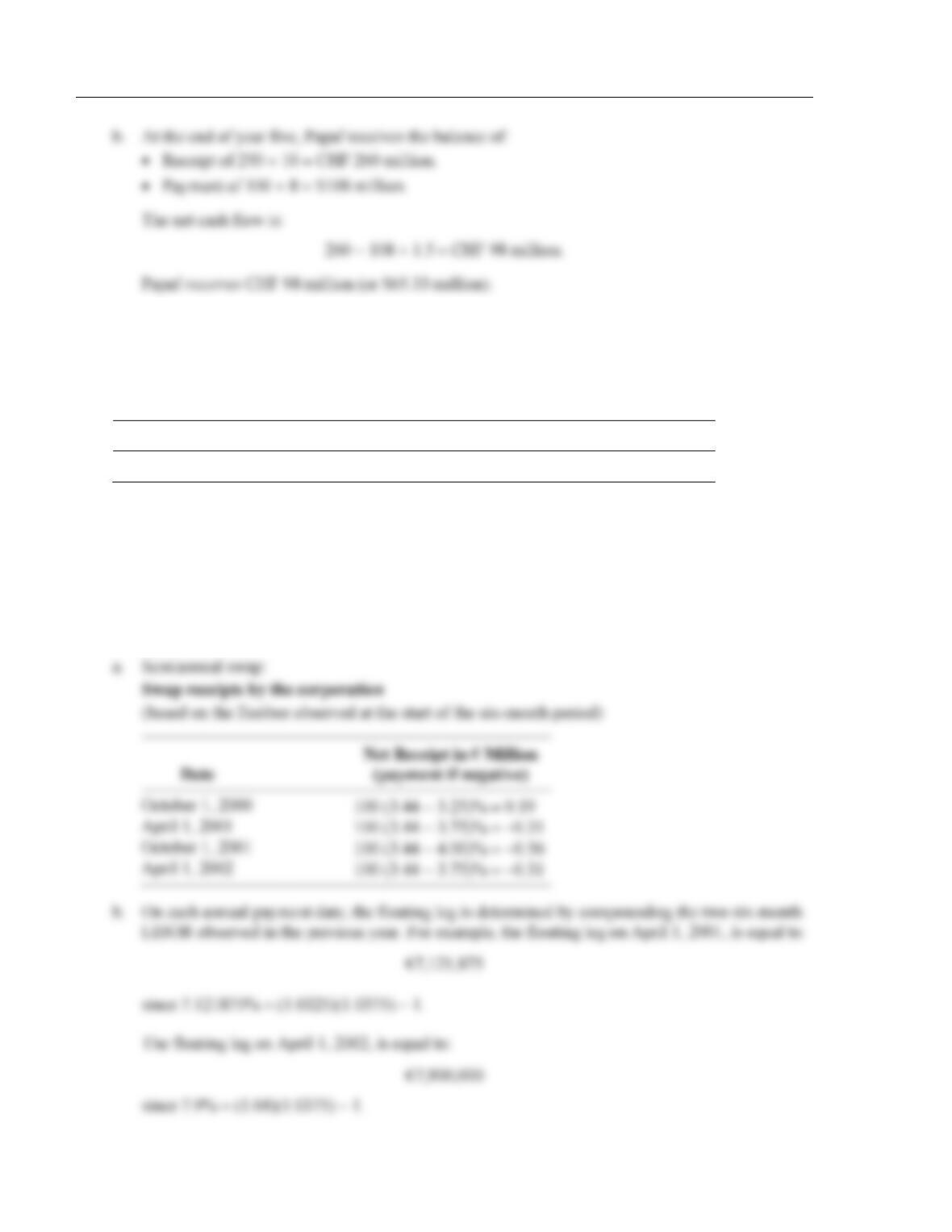
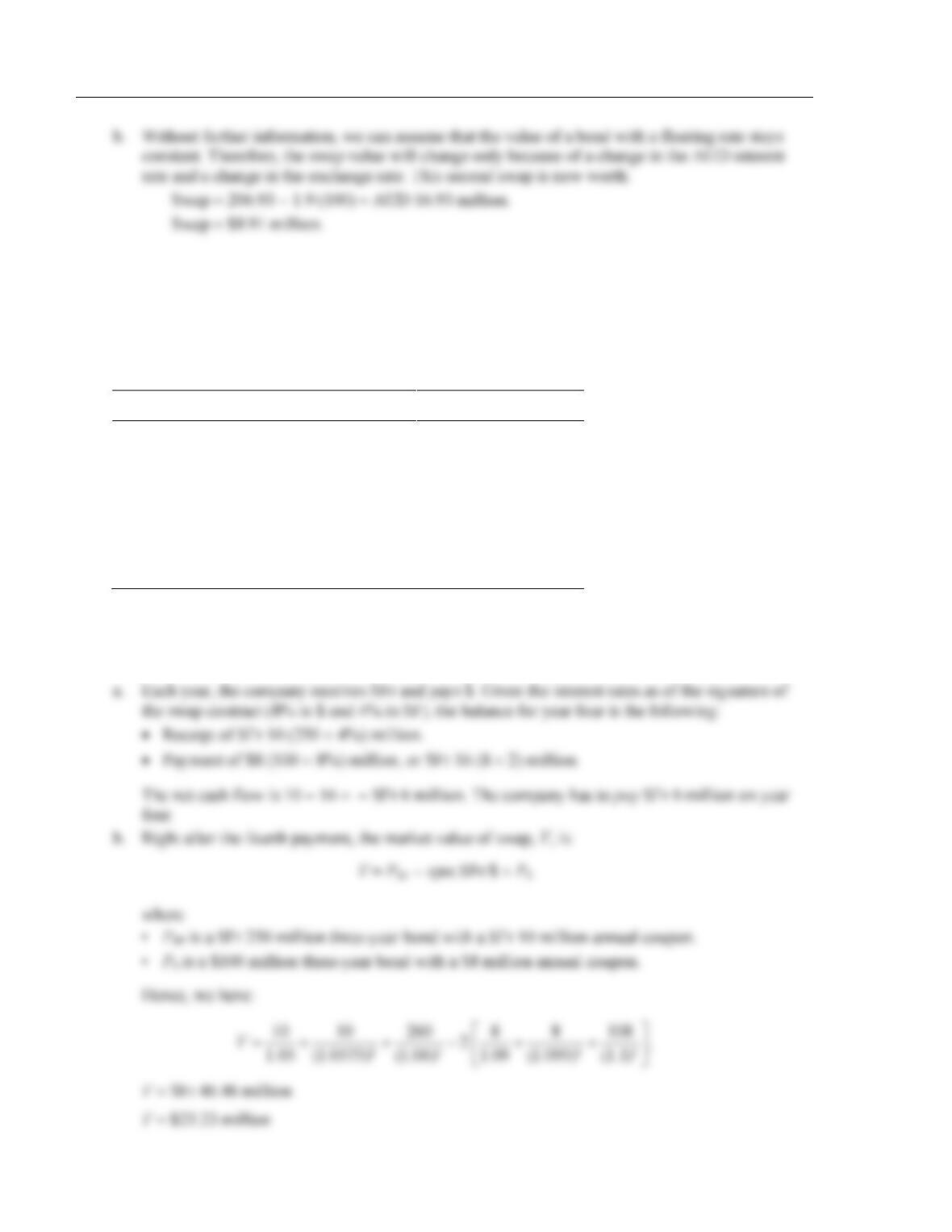
16. A dollar-Swiss franc swap with a maturity of five years was contracted by Papaf Inc. three years ago.
Papaf swapped $100 million for CHF 250 million. The swap payments were annual, based on market
interest rates of 8% in dollars and 4% in CHF. In other words, Papaf Inc. contracted to pay dollars
and receive CHF. The current spot exchange rate is 2 CHF/$, and the current interest rates are 6% in
CHF and 10% in $ (the term structures are flat).
a. What is the swap payment at the end of year three? Does Papaf pay or receive?
b. On the final date of the swap, the spot exchange rate is 1.5 CHF/$.
What is the final swap payment at the end of year five?
Solution
128 Solnik/McLeavey • Global Investments, Sixth Edition
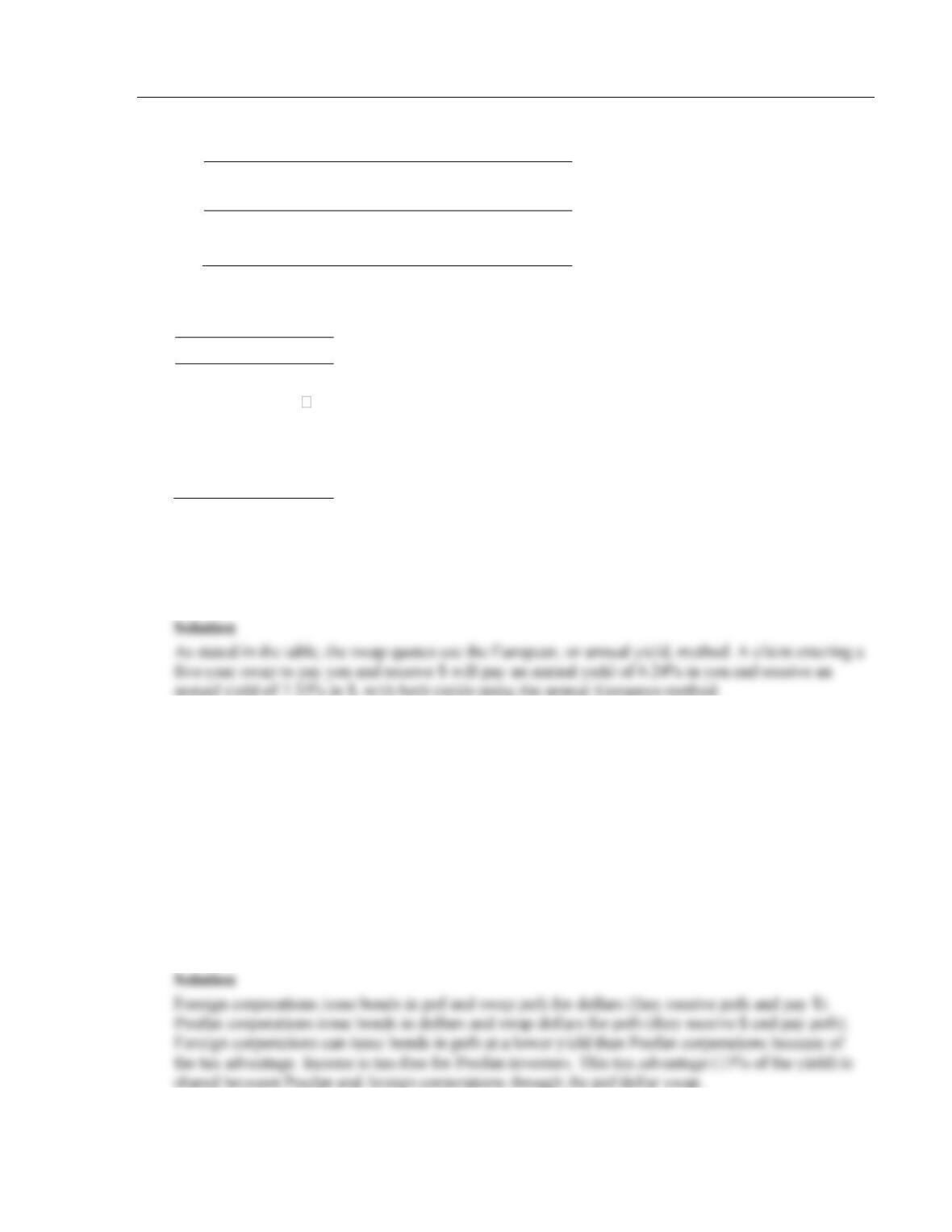
17. An Italian corporation enters into a two-year interest rate swap in euros on April 1, 2000. The swap is
based on a principal of €100 million, and the corporation will receive 7% fixed and pay six-month
Euribor. Swap payments are semiannual. The 7% fixed rate is quoted as an annual rate using the
European method, so the implied semiannual coupon is 3.44% [since (1.0344)2 = 1.07]. Two years
later, the swap is finally settled, and the following Euribor rates have been observed:
Apr. 1, 2000
Oct. 1, 2000
Apr. 1, 2001
Oct. 1, 2001
Apr. 1, 2002
6.5%
7.5%
8%
7.5%
6%
a. What have the swap payments or receipts for the corporation been on each swap payment date?
b. The same Italian corporation also entered another two-year interest rate swap in euros on April 1,
2000. The swap is based on a principal of €100 million, and the corporation contracted to receive
7% fixed and pay six-month Euribor. On this swap, the payments are annual. Hence, the two
successive six-month Euribor are compounded. Assuming that the Euribor rates given in the
previous problem have been observed, what have the two annual swap payments been?
Solution
Chapter 10 Derivatives: Risk Management with Speculation, Hedging, and Risk Transfer 129
The swap receipts by the corporation are
Date
Swap Receipts in € Million
(payment if negative)
April 1, 2001
100 (7 − 7.1219)% = − 0.1219
April 1, 2002
100 (7 − 7.9)% = − 0.9
18. A swap dealer provides the following quotations for a yen/$ currency swap. The quotes are for a yen
fixed rate against the U.S. Treasury yield flat, with annual payments.
Years Fixed (ann.)
2
6.00 − 6.08
3
6.12 −
6.21
4
6.14 − 6.23
5
6.15 − 6.24
7
6.18 − 6.28
A client wishes to enter a five-year swap, paying yen and receiving $. The current yield on five-year
U.S. Treasury bonds is 7.20%, using the semiannual method, which amounts to 7.33%, using the
annual European method.
What will the exact terms of the swap be if the client accepts these quotations?
19. Pouf is a rapidly growing and pleasant country in the Austral hemisphere. Its inhabitants are called
Poufans, and its currency is the pof. The bond market is fairly active with many issues by Poufan
companies, but there are no foreign investors or issuers. The current yield on pof bonds is 10%.
Poufan investors have to pay a 15% tax on interest income received. The newly elected Poufan
government wishes to internationalize its bond market and attract foreign issuers. To do so, it decides
to remove any taxation of income on bonds issued by foreign corporations in Pouf. Several changes
take place after the enactment of this tax provision:
• Several well-known foreign corporations issue pof-denominated bonds in the Poufan bond market.
• Several well-known Poufan corporations issue international bonds denominated in U.S. dollars.
• Several dollar/pof swaps are arranged.
Try to provide a sensible explanation for this phenomenon.
130 Solnik/McLeavey • Global Investments, Sixth Edition
20. A Dutch institutional investor has decided to bet on a drop in U.S. dollar bond yields. It engages in a
leveraged strategy, borrowing $100 million at LIBOR plus 0.25% and investing the proceeds in
attractive, newly issued, long-term dollar international bonds. Suddenly, the investor becomes worried
that bond yields have hit bottom and will rise because of inflationary pressures. The investor wishes
to keep the specific international bonds that have been selected, partly because of their attractiveness
and partly because of their lack of market liquidity. What kind of swap could be arranged to hedge
this U.S. dollar bond yield risk?
21. A small German bank has the following portfolio of loans in U.S. dollars, valued at market value:
Assets
Liabilities
$50 million of a five-year FRN at
LIBOR plus 0.5%
$10 million of a five-year loan at a fixed
rate of 9%
The German bank fears a long-term depreciation of the U.S. dollar relative to the euro and believes in
stable U.S. interest rates.
a. What is its currency exposure?
b. What type of swap arrangements should it contract?
c. What should the principal of the swaps be?
22. A five-year currency swap involves two AAA borrowers and has been set at current market interest
rates. The swap is for US$100 million against AUD 200 million at the current spot exchange rate of
AUD/$ 2.00. The interest rates are 10% in U.S. dollars and 7% in Australian dollars, or annual swaps
of US$10 million for AUD 14 million. A year later, the interest rates have dropped to 8% in U.S.
dollars and 6% in Australian dollars, and the exchange rate is now AUD/$ 1.9.
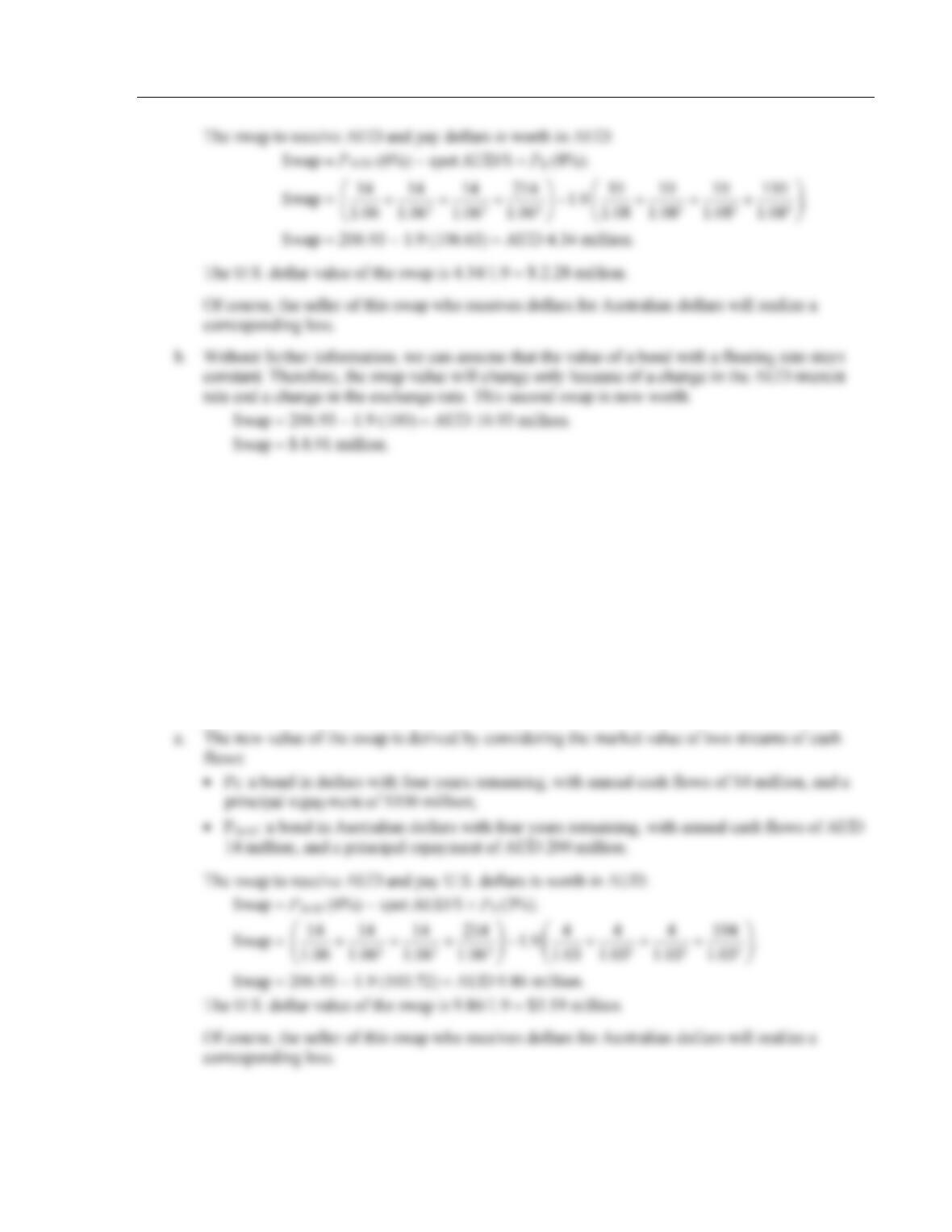
a. What should the market value of the swap be in the secondary market?
Assume now that the swap is instead a currency–interest rate swap whereby the dollar interest is set
at LIBOR.
b. What would the market value of the currency–interest rate swap be if these conditions prevailed a
year later?
Chapter 10 Derivatives: Risk Management with Speculation, Hedging, and Risk Transfer 131
23. A five-year currency swap involves two AAA borrowers and has been set at current market interest
rates. The swap is for US$100 million against AUD 200 million at the current spot exchange rate of
AUD/$ 2.00. The interest rates are 4% in U.S. dollars and 7% in Australian dollars, or annual swaps
of $4 million for AUD 14 million. A year later, the interest rates have dropped to 3% in U.S. dollars
and 6% in Australian dollars, and the exchange rate is now AUD/$ 1.9.
a. What should the market value of the swap be in the secondary market?
Assume now that the swap is instead a currency–interest rate swap whereby the dollar interest is set
at LIBOR.
b. What would the market value of the currency–interest rate swap be if these conditions prevailed a
year later?
Solution
132 Solnik/McLeavey • Global Investments, Sixth Edition
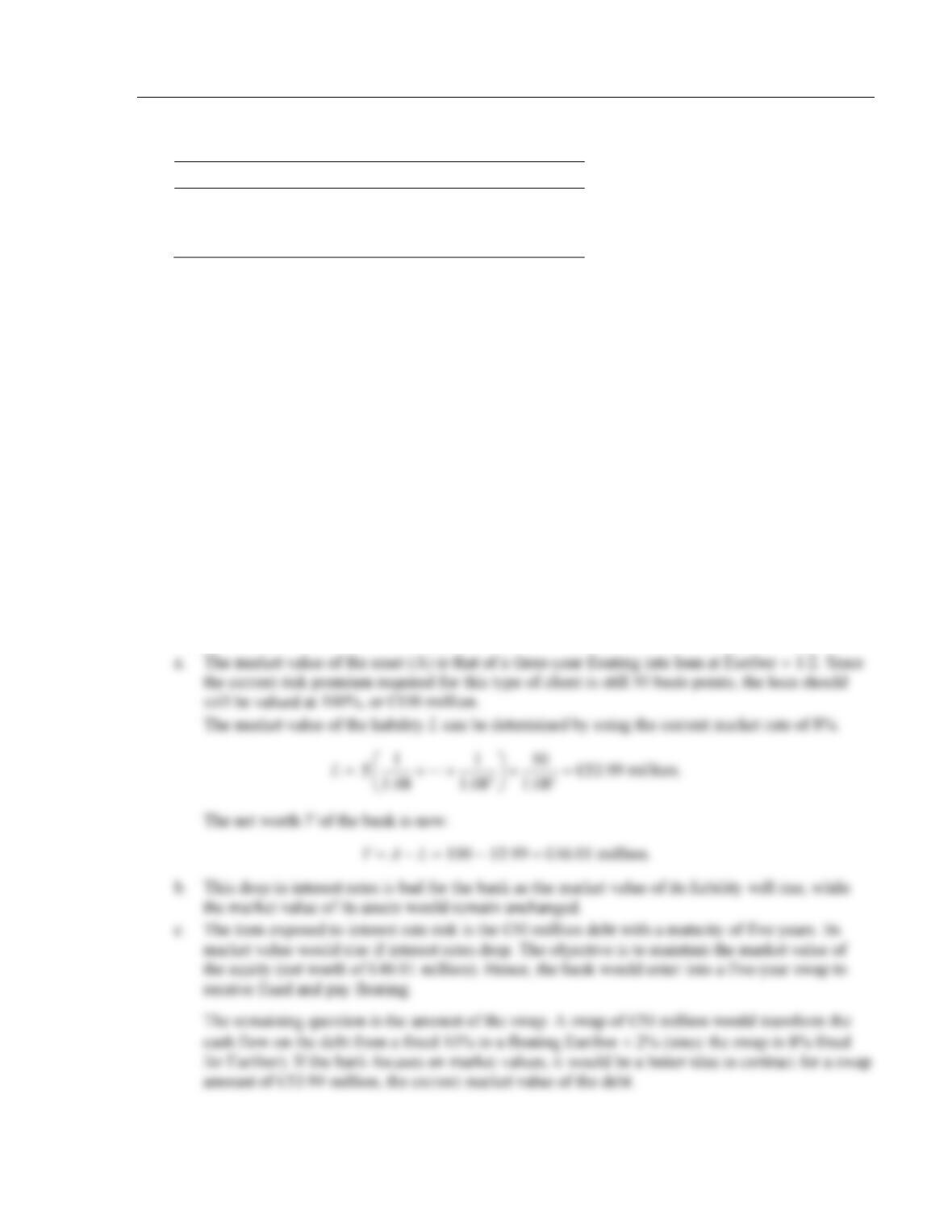
24. Four years ago, a Swiss firm contracted a currency swap of US$100 million for 250 million Swiss
francs (SFr), with a maturity of seven years. The swap fixed rates are 8% in dollars and 4% in francs,
and swap payments are annual. The Swiss firm contracted to pay dollars and receive francs. The
market conditions are now (exactly four years later) as follows:
Spot exchange rate: 2.00 Swiss francs/U.S. dollar.
Term structure of zero swap rates:
Maturity Years
U.S. Dollar % (ann.)
Swiss Franc % (ann.)
1
9
5
2
9.5
5.75
3
10
6
4
10.25
6.25
5
10.75
6.5
6
11
7
7
11.5
7.5
a. What should the swap payment (receipt) be at the end of the fourth year, that is, today?
b. Right after this payment, what is the swap market value for the Swiss firm?
Solution
Chapter 10 Derivatives: Risk Management with Speculation, Hedging, and Risk Transfer 133
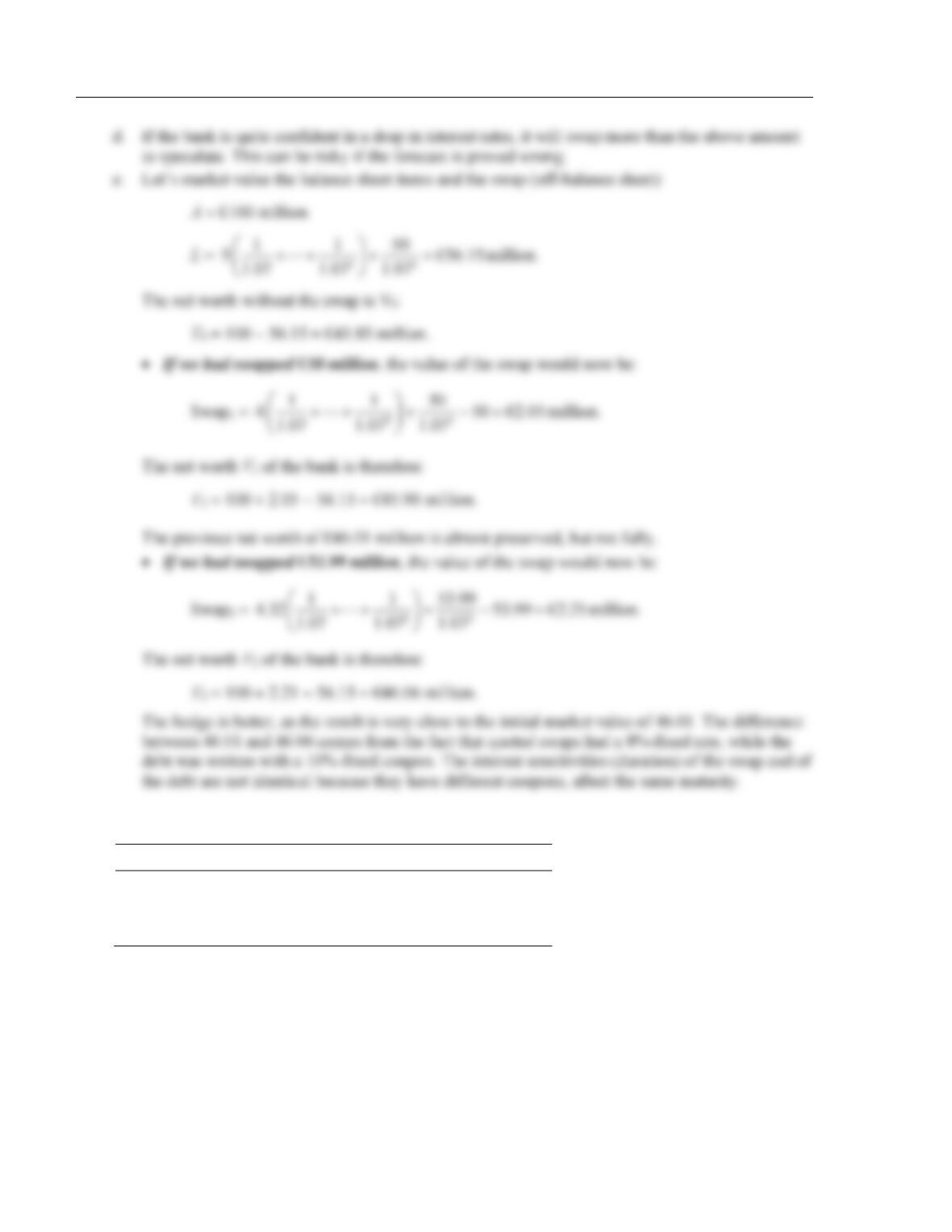
25. A small French bank has the following balance sheet, based on historical (nominal) values.
Assets
Liabilities
Loan of 100 million:
Debt of 50 million:
3 years, @ 3−month Euribor + ½
5−year maturity, @ 10%
Net worth: 50 million
All assets and liabilities are denominated in euros. The net worth is calculated as the difference
between the value of assets and liabilities. The current interest rate term structure in euro is flat at 8%.
The risk premium over Euribor required on the loan to a client remains at 50 basis points.
a. Value the balance sheet based on market value.
b. The bank anticipates a sharp drop in French interest rates. Would this drop be good for the bank?
The current market conditions for interest rate swaps with a maturity of three or five years are 8%
against Euribor.
c. Assume that the bank simply wishes to immunize its market value against any movements in
interest rates (drop or rise). What swap would you make to hedge this interest rate risk?
d. Assume that the bank is quite confident in its interest rate prediction (a drop). What would you
suggest?
The next day, all interest rates drop to 7%.
e. Value the balance sheet again, assuming that the floating rate debt remains at 100% and that the
bank has undertaken the swap that you recommended. How much did the bank save by
undertaking this swap?
Solution
134 Solnik/McLeavey • Global Investments, Sixth Edition
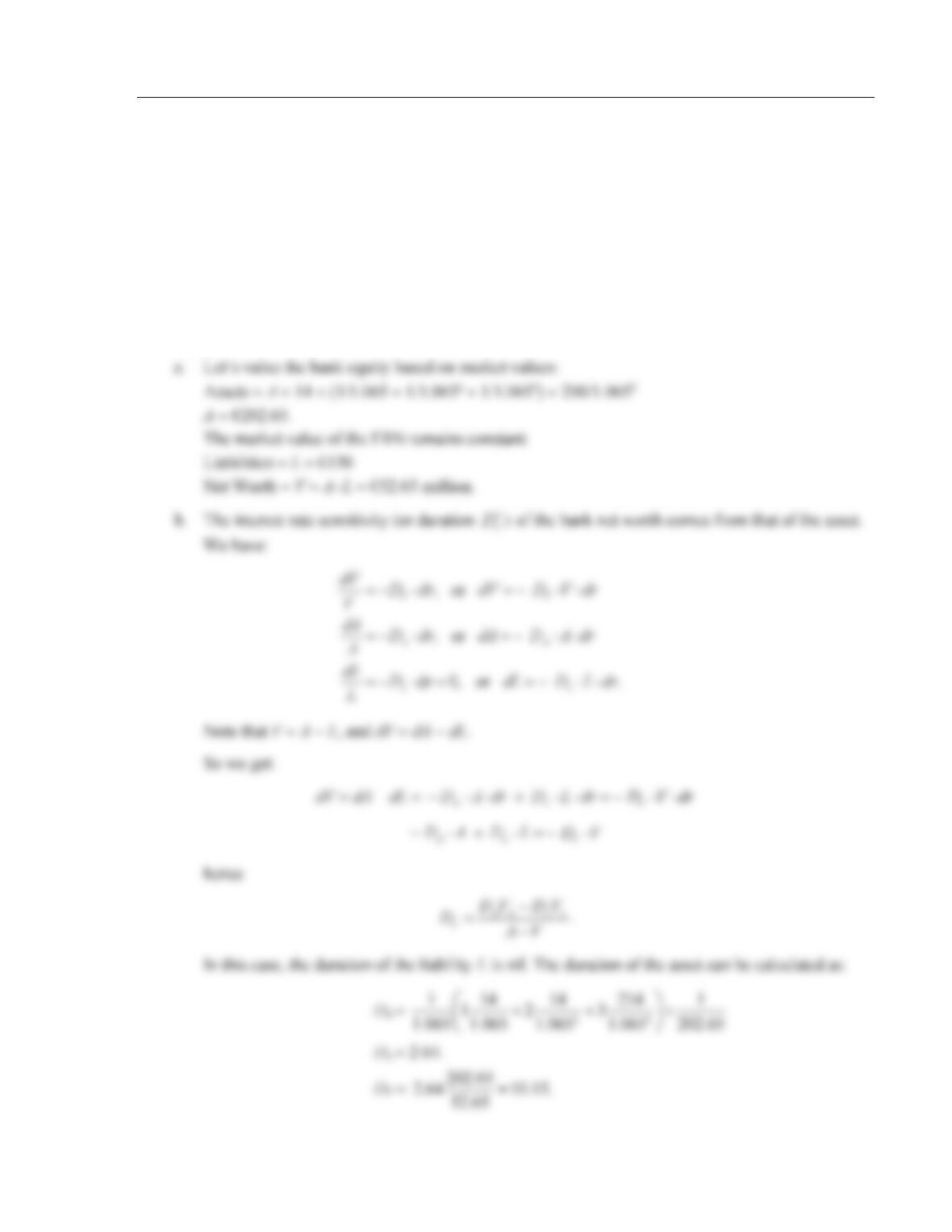
26. A small Dutch bank has the following balance sheet (in euros), based on historical or nominal values.
Assets
Liabilities
Loan of 200 million:
FRN borrowing of 150 million:
3 years, @ 7%
@ 3-month Euribor, 5-year maturity
Net worth: 50 million
All assets and liabilities are denominated in euros. The bank borrows short-term on the Euro-currency
market. The bank and its client are AAA quality. The net worth is calculated as the difference
between the value of assets and liabilities. The current euro term structure for AAA borrowers is flat
at 6.5%.
a. Value the balance sheet based on market value.
b. Compute the interest-rate sensitivity (duration) of the asset. Infer the interest rate sensitivity of
the net worth of the bank. For example, how much would stockholders lose if euro interest rates
moved up by 0.10%? (Assume that the interest rate sensitivity of an floating-rate note (FRN) is
zero, as the coupon is reset to the market interest rate.)
Chapter 10 Derivatives: Risk Management with Speculation, Hedging, and Risk Transfer 135
c. The bank fears a rise in all euro interest rates. The current market conditions for interest rate
swaps in euros are as follows:
• With a maturity of three years are: 6.5% against Euribor.
• With a maturity of five years are: 6.75% against Euribor.
What would you do to hedge this interest rate risk?
d. The next day, all interest rates move up to 8%. Value again the balance sheet, assuming that the
floating-rate debt remains at 100% and that the bank has undertaken the swap that you
recommended. Is the hedge perfect? Why?
Solution