CHAPTER 10: FORWARD AND FUTURES HEDGING, SPREAD, AND TARGET STRATEGIES
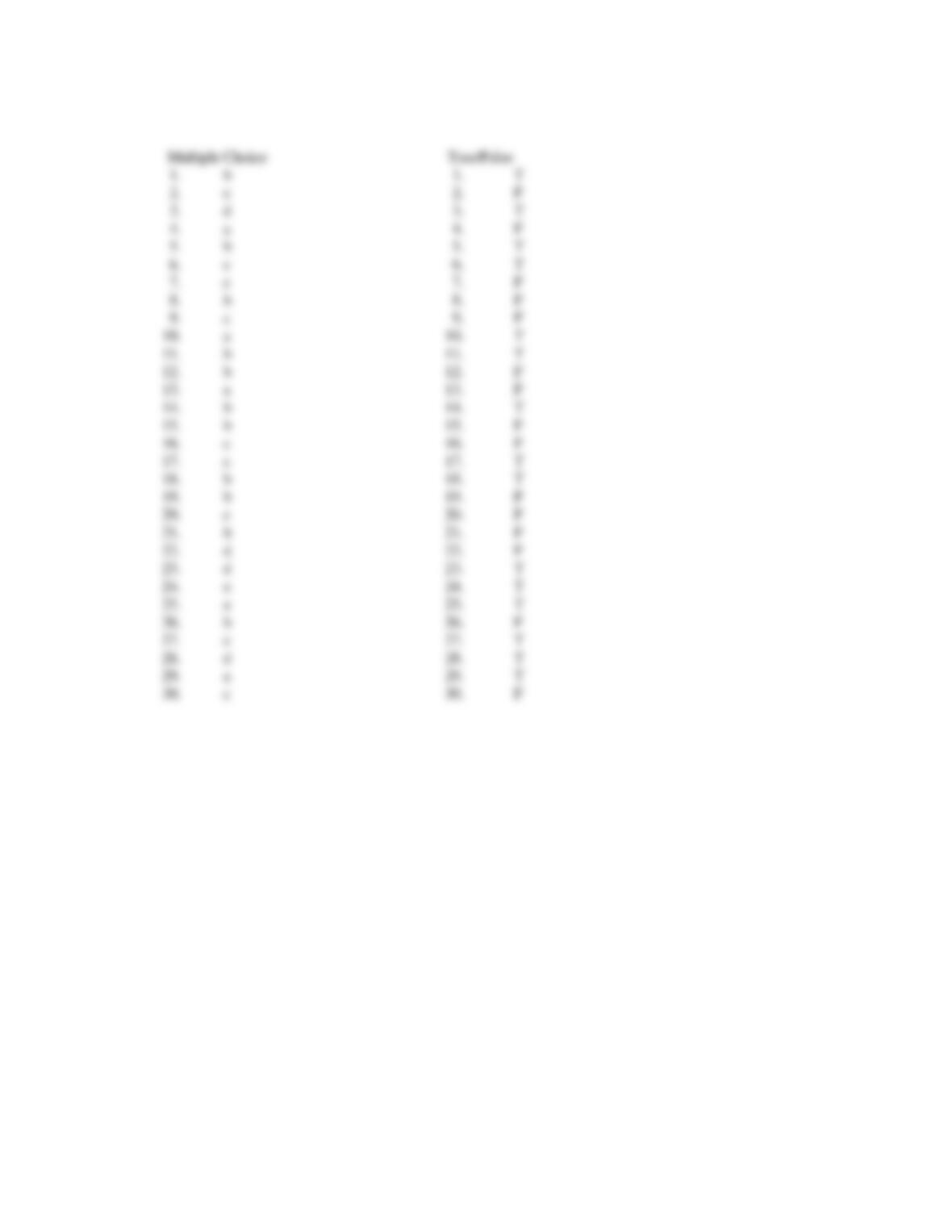
MULTIPLE CHOICE TEST QUESTIONS
1. A short hedge is one in which
a. the margin requirement is waived
b. the hedger is short futures
c. the hedger is short in the spot market
d. the futures price is lower than the spot price
e. none of the above
2. An anticipatory hedge is one in which
a. the basis is expected to fall
b. the hedger expects to make a profit on the futures
c. the spot position will be taken in the future
d. all of the above
e. none of the above
3. A strengthening of the basis means
a. the spot price rises more than the futures price
b. the futures price falls more than the spot price
c. a short hedger benefits
d. all of the above
e. none of the above
4. A hedge in which the asset underlying the futures is not the asset being hedged is
a. a cross hedge
b. an optimal hedge
c. a basis hedge
d. a minimum variance hedge
e. none of the above
5. When the futures expires before the hedge is terminated and the hedger moves into the next futures expiration,
it is called
a. spreading the hedge
b. rolling the hedge forward
c. optimally weighting the hedge
d. all of the above
e. none of the above
6. The duration of the futures contract used in the price sensitivity hedge ratio is
a. the duration of the spot bond being hedged using the futures price instead of the spot price
b. the duration of the deliverable bond using the spot price
c. the duration of the deliverable bond using the futures price
d. the duration of the overall bond portfolio
e. none of the above
7. Which technique can be used to compute the minimum variance hedge ratio?
a. duration analysis
b. present value
c. regression
d. all of the above
e. none of the above
8. Which of the following measures is used in the price sensitivity hedge ratio for bond futures?
a. beta
b. duration
c. correlation
d. variance
e. none of the above
9. Suppose you buy an asset at $50 and sell a futures contract at $53. What is your profit at expiration if the asset
price goes to $49? (Ignore carrying costs)
a. –$1
b. –$4
c. $3
d. $4
e. none of the above
10. Suppose you buy an asset at $70 and sell a futures contract at $72. What is your profit if, prior to expiration,
you sell the asset at $75 and the futures price is $78?
a. –$1
b. $2
c. $1
d. –$6
e. none of the above
11. Which of the following is not a reason for firms to hedge?
a. Firms can hedge less expensively than can their shareholders
b. Shareholders cannot tolerate mark-to-market losses
c. Hedging by corporations can have tax advantages
d. Shareholders are not always aware of their firms’ risks
e. none of the above
12. Find the profit if the investor buys a July futures at 75, sells an October futures at 78 and then reverses the July
futures at 72 and the October futures at 77.
a. –3
b. –2
c. 2
d. 1
e. none of the above
13. Determine the optimal hedge ratio for Treasury bonds worth $1,000,000 with a modified duration of 12.45 if
the futures contract has a price of $90,000 and a modified duration of 8.5 years.
a. 16.27
b. 15.93
c. 7.42
d. 11.11
e. none of the above
14. What is the profit on a hedge if bonds are purchased at $150,000, two futures contracts are sold at $72,500
each, then the bonds are sold at $147,500 and the futures are repurchased at $74,000 each?
a. –$2,500
b. –$5,500
c. –$500
d. –$3,000
e. none of the above
15. Find the optimal stock index futures hedge ratio if the portfolio is worth $1,200,000, the beta is 1.15 and the
S&P 500 futures price is 450.70 with a multiplier of 250.
a. 10.65
b. 12.25
c. 6123.80
d. 5325.05
e. none of the above
16. In which of the following situations would you use a short hedge?
a. the planned purchase of a stock
b. the planned purchase of commercial paper
c. the planned issuance of bonds
d. the planned repurchase of stock to cover a short position
e. none of the above
17. You hold a stock portfolio worth $15 million with a beta of 1.05. You would like to lower the beta to 0.90
using S&P 500 futures, which have a price of 460.20 and a multiplier of 250. What transaction should you do?
Round off to the nearest whole contract.
a. sell 130 contracts
b. sell 9,778 contracts
c. sell 20 contracts
d. buy 50,000 contracts
e. sell 50,000 contracts
18. You hold a bond portfolio worth $10 million and a modified duration of 8.5. What futures transaction would
you do to raise the duration to 10 if the futures price is $93,000 and its implied modified duration is 9.25?
Round up to the nearest whole contract.
a. buy 109 contracts
b. buy 17 contracts
c. buy 669 contracts
d. sell 100 contracts
e. sell 669 contracts
19. Which of the following statements about the use of futures in tactical asset allocation is correct?
a. Implementing tactical asset allocation using futures is a form of market timing.
b. Futures can be used to synthetically buy or sell stocks but you cannot simultaneously adjust the beta
or duration
c. A difference between the portfolio held and the index on which the futures is based will generate a
gain for the investor.
d. The use of futures in tactical asset allocation will generate cash from the synthetic sale, which is then
used in the synthetic purchase.
e. None of the above
20. Though a cross hedge has somewhat higher risk than an ordinary hedge, it will reduce risk if which of the
following occurs?
a. futures prices are more volatile than spot prices
b. the spot and futures contracts are correctly priced at the onset
c. spot and futures prices are positively correlated
d. futures prices are less volatile than spot prices
e. none of the above
21. Which of the following correctly expresses the profit on a hedge?
a. the basis when the hedge is closed
b. the change in the basis
c. the spot profit minus the futures profit
d. the futures profit minus the spot profit
e. none of the above
22. What happens to the basis through the contract‘s life?
a. it initially decreases, then increases
b. it initially increases, then decreases
c. it remains relatively steady
d. it moves toward zero
e. none of the above
23. Find the profit if the investor enters an intramarket spread transaction by selling a September futures at $4.5,
buys an December futures at $7.5 and then reverses the September futures at $5.5 and the December futures at
$9.5.
a. –3
b. –2
c. 2
d. 1
e. none of the above
24. Quantity risk is
a. the difficulty in measuring the volatility
b. the uncertainty about the size of the spot position
c. the risk of mismatching the futures maturity to the spot maturity
d. the possibility of regression error
e. none of the above
25. The relationship between the spot yield and the yield implied by the futures price is called
a. the yield beta
b. the price sensitivity
c. the tail
d. the hedge ratio
e. none of the above
26. All of the following are futures contract choice decisions related to hedging, except
a. which future underlying asset
b. which strike price
c. which futures contract expiration
d. whether to go long or short
e. all of the above are futures contract choice decisions
27. Hedging with futures contracts entails all of the following risks, except
a. marking to market may require large cash outflows
b. changes in margin requirements
c. basis risk
d. quantity risk
e. all of the above are potential risks
28. Based on the minimum variance hedge ratio approach, what is the optimal number of futures contracts to
deploy, given the following information. The correlation coefficient between changes in the underlying
instrument’s price and changes in the futures contract price is 0.95, the standard deviation of the changes in
the underlying position’s value is 300%, and the standard deviation of the changes in the futures contract’s
price is 11.4%.
a. long 35 futures contracts
b. long 25 futures contracts
c. long 15 futures contracts
d. short 25 futures contracts
e. short 15 futures contracts
29. Based on the minimum variance hedge ratio approach what is the hedging effectiveness, given the following
information. The correlation coefficient between changes in the underlying instrument’s price and changes in
the futures contract price is 0.70, the standard deviation of the changes in the underlying position’s value is
40%, and the standard deviation of the changes in the futures contract’s price is 50%. (Select the closest
answer.)
a. 50%
b. 45%
c. 40%
d. 35%
e. 30%
30. Based on the price sensitivity hedge ratio approach, what is the optimal number of futures contracts to deploy,
given the following information. The yield beta is 0.65, the present value of a basis point change for the
underlying bond portfolio is $33,000, and the present value of a basis point change for the bond futures
contract is $325. (Select the closest answer.)
a. long 100 futures contracts
b. long 55 futures contracts
c. short 66 futures contracts
d. short 22 futures contracts
e. short 11 futures contracts
CHAPTER 10: FORWARD AND FUTURES HEDGING, SPREAD, AND TARGET STRATEGIES
TRUE/FALSE TEST QUESTIONS
T F 1. When a hedge is said to be a short hedge or a long hedge, it means that the position is short
or long in futures.
T F 2. A hedge that is expected to earn a net profit is called an anticipatory hedge.
T F 3. A short hedger wants the basis to strengthen.
T F 4. A hedge reduces risk because the futures price is less volatile than the spot price.
T F 5. A hedge that involves the use of a futures contract on an instrument that is different from
the instrument being hedged is called a cross hedge.
T F 6. The liquidity of the futures contract used in a hedge is very important to the hedger.
T F 7. A hedger should select a contract that expires the same month as the date on which the
hedge is terminated.
T F 8. An individual who plans to take a foreign vacation could hedge the risk of converting into
the foreign currency by selling foreign currency futures.
T F 9. In the real-world, financial decisions are irrelevant, so there is really no reason for firms to
hedge.
T F 10. An optimal hedge ratio is one in which the change in the futures price equals the change in
the spot price.
T F 11. The price sensitivity hedge ratio uses the durations of the spot and futures positions.
T F 12. The implied duration of a futures contract is the duration of the underlying bond measured
as if one owned the bond today.
T F 13. The measure of hedging effectiveness in a minimum variance hedge is the size of profit on
the hedge.
T F 14. The price sensitivity hedge ratio would be more appropriate for interest rate futures hedges
than for commodity futures hedges.
T F 15. The minimum variance hedge ratio uses current information while the price sensitivity
hedge ratio uses past information.
T F 16. If you plan to issue a liability in the future, you are currently short in the spot market.
T F 17. A firm that expects to borrow in the future would use a short hedge to protect against
interest rate changes.
T F 18. Since it states that systematic risk cannot be eliminated, modern portfolio theory does not
allow for stock index futures contracts.
T F 19. An investor who expects to purchase stock at a later date would use a short hedge to protect
against stock price movements.
T F 20. A hedge of a specific stock‘s price with stock index futures will reduce both systematic and
unsystematic risk.
T F 21. The basis is the ratio of the futures price to the spot price.
T F 22. Although a hedge might not be perfect, it should be partially effective if the spot and futures
prices move in opposite directions.
T F 23. When the target duration is set at zero, the correct number of futures contracts to use is the
same as is obtained from the price sensitivity hedge ratio.
T F 24. Hedging can be viewed as a form of speculation, inasmuch as it involves taking a position
that something bad will happen.
T F 25. The risk of the basis is usually less than the risk of the spot position.
T F 26. Based on the price sensitivity hedge ratio, if the yield beta increases (assumed to be
positive), then the optimal number of futures contracts increases. Assume the durations are
positive.
T F 27. Based on the price sensitivity hedge ratio, if the modified duration of the futures contract
increases (assumed to be positive), then the optimal number of futures contracts increases.
Assume the durations are positive.
T F 28. A foreign currency long hedge with a $/¥ futures contract will be a foreign currency short
hedge with a ¥/$ futures contract.
T F 29. If the target beta exceeds the underlying’s beta, then the manager will go long the futures
contract.
T F 30. Alpha capture seeks to achieve excess returns from identifying underpriced securities while
eliminating unsystematic risk.
CHAPTER 10