Page 1
1.
The relation between an individual’s consumption bundle and her satisfaction is called a
_____ function.
A)
demand
B)
production
C)
consumption
D)
utility
2.
To say that you can’t have too much of a good thing means that for any good that you
enjoy (for example, pizza):
A)
higher consumption will always lead to higher utility.
B)
higher consumption will cause utility to decrease at an increasing rate.
C)
higher consumption will increase utility, but only up to a point; after that utility
will start to decrease.
D)
it is valid to measure utility in utils.
3.
Economists identify the satisfaction a person derives from the consumption of goods
and services as:
A)
happiness.
B)
usefulness.
C)
utility.
D)
pleasure.
4.
The utility of a good is determined by how much _____ a particular consumer obtains
from it.
A)
satisfaction
B)
usefulness
C)
cost
D)
need fulfillment
5.
Economists describe the satisfaction consumers receive from consuming goods and
services as:
A)
utility.
B)
income effects.
C)
budget constraints.
D)
substitution effects.
Page 2
6.
Utility is the:
A)
difference between a firm’s total revenue and its total economic cost.
B)
good not adequately provided by a free market and usually provided by the
government.
C)
satisfaction consumers derive from their consumption of goods and services.
D)
lowest price that buyers are willing to pay for a given quantity of a good.
7.
For economists, the satisfaction an individual derives from the consumption of goods
and services is best described as:
A)
happiness.
B)
usefulness.
C)
utility.
D)
opportunity cost.
8.
In economics, the ability of pumpkin pie to satisfy a want is referred to as its:
A)
utility.
B)
usefulness.
C)
worthiness.
D)
necessity.
9.
Utility is most closely related to:
A)
usefulness.
B)
satisfaction.
C)
requirement.
D)
necessity.
10.
How much _____ Susan obtains from eating green beans is a measure of the utility of
green beans for her.
A)
efficiency
B)
usefulness
C)
cost
D)
satisfaction
11.
Which of the following goods is MOST likely to display increasing marginal utility over
some range?
A)
chicken during the 1920s, when it was considered a luxury good
B)
paint, because you need enough to paint at least one entire room
C)
lobsters, which are so expensive that you must eat two to get your money’s worth
D)
peanut butter and jelly sandwiches
Page 3
12.
The marginal utility of coffee consumption for Steve is the change in _____ generated
by consuming an additional cup of coffee.
A)
total utility
B)
total consumption
C)
total demand
D)
price
13.
Xavier notices that the marginal utility of working with a tutor seems to fall with each
hour the tutor helps him study. If Xavier keeps the tutor until his grade actually begins
to fall, his marginal utility for the last hour of tutoring will be:
A)
negative.
B)
positive, but rising more slowly.
C)
zero.
D)
immeasurable.
14.
On a sparsely populated island, high-speed Internet service would have a _____
marginal utility than in New York City, while in New York City quiet evenings would
carry a _____ marginal utility than on a deserted island.
A)
lower; higher
B)
higher; lower
C)
lower; lower
D)
higher; higher
15.
Suppose bad weather and pollution dramatically reduce the supply of crawfish in
Louisiana next year. This would most likely lead to _____ in the marginal utility of
crawfish consumption.
A)
an increase
B)
a decrease
C)
no change
D)
substitution and income effects
16.
An individual gets 5 units of utility from one slice of pizza and 9 units of utility from
two slices of pizza. The principle of diminishing marginal utility implies that the total
utility from three slices of pizza will be _____ units of utility.
A)
exactly 12
B)
less than 13
C)
less than 9
D)
more than 14
Page 4
17.
Which of the following best describes the principle of diminishing marginal utility? As
an individual consumes more of a good:
A)
the total utility obtained will eventually fall.
B)
the total utility obtained will eventually become negative.
C)
the addition to total utility obtained from the nth unit of the good will be less than
that obtained from the immediately preceding unit of the good.
D)
the marginal utility will eventually become negative.
18.
The principle of diminishing marginal utility means that when Sarah eats pizza, her
satisfaction from the second slice of pizza is probably _____ that from the first.
A)
greater than
B)
equal to
C)
less than
D)
not comparable to
19.
The amount by which total utility changes when an additional unit of a good is
consumed is called _____ utility.
A)
average
B)
additional
C)
maximum
D)
marginal
20.
The amount by which an additional unit of a good or service changes a consumer’s total
satisfaction, all other things unchanged, is _____ utility.
A)
marginal
B)
maximum
C)
average
D)
required
21.
Assume that the marginal utilities for the first three units of a good consumed are 200,
150, and 125, respectively. The total utility for the first unit is:
A)
125.
B)
150.
C)
200.
D)
350.

Page 5
22.
Assume that the marginal utilities for the first three units of a good consumed are 200,
150, and 125, respectively. The total utility when two units are consumed is:
A)
150.
B)
200.
C)
350.
D)
475.
Use the following to answer questions 23-29:
23.
(Table: The Utility of Pecan Rolls) Look at the table The Utility of Pecan Rolls. The
marginal utility for the second roll is:
A)
35.
B)
15.
C)
10.
D)
5.
24.
(Table: The Utility of Pecan Rolls) Look at the table The Utility of Pecan Rolls. The
marginal utility for the fifth roll is:
A)
15.
B)
10.
C)
5.
D)
0.
25.
(Table: The Utility of Pecan Rolls) Look at the table The Utility of Pecan Rolls. The
marginal utility for the sixth roll is:
A)
–5.
B)
0.
C)
5.
D)
–10.
26.
(Table: The Utility of Pecan Rolls) Look at the table The Utility of Pecan Rolls. Total
utility is maximized at the _____ roll.
A)
first
B)
second
C)
fourth
D)
sixth
Page 6
27.
(Table: The Utility of Pecan Rolls) Look at the table The Utility of Pecan Rolls.
Marginal utility is zero for the _____ roll.
A)
first
B)
second
C)
third
D)
fifth
28.
(Table: The Utility of Pecan Rolls) Look at the table The Utility of Pecan Rolls.
Marginal utility becomes negative at the _____ roll.
A)
first
B)
second
C)
fifth
D)
sixth
29.
(Table: The Utility of Pecan Rolls) Look at the table The Utility of Pecan Rolls.
Marginal utility begins to diminish at the _____ roll.
A)
second
B)
third
C)
fifth
D)
sixth
30.
When total utility is at a maximum, marginal utility is:
A)
rising.
B)
at its average value.
C)
at a maximum.
D)
zero.
31.
The law of diminishing marginal utility indicates that the slope of the marginal utility
curve eventually becomes:
A)
negative.
B)
vertical.
C)
horizontal.
D)
positive.
Page 7
32.
The principle of diminishing marginal utility:
A)
refers to the tendency of total utility to increase until an individual’s budget is no
longer constrained.
B)
refers to the tendency of marginal utility to decline as the amount of consumption
of a good or service increases.
C)
indicates that if a good is inferior, less of it will be purchased when income falls.
D)
assumes all goods are normal.
33.
Which of the following statements is TRUE if the principle of diminishing marginal
utility applies?
A)
When a customer at the Pie Palace continues to eat more pie, each additional piece
gives more marginal utility.
B)
When a customer at the Pie Palace continues to eat more, each additional piece of
pie gives less marginal utility.
C)
The marginal utility of a piece of pie is maximized when the total utility of pie is
zero.
D)
The total utility of pie is at a maximum while the marginal utility of pie is still
increasing.
34.
If total utility is rising as more salsa is consumed, we can definitely say that marginal
utility is:
A)
falling.
B)
constant.
C)
rising.
D)
greater than zero.
35.
Freddy has eaten three corn dogs at the county fair, and if he eats another, he will get
sick on the roller coaster. Knowing this, and ignoring any impact that price might have
on his decision, we can say that at the fourth corn dog the:
A)
total utility is less than zero.
B)
marginal utility is less than zero.
C)
total utility curve is still increasing.
D)
marginal utility curve is still increasing.
Page 8
Use the following to answer questions 36-37:
36.
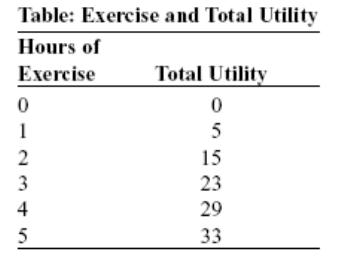
(Table: Exercise and Utility) Look at the table Exercise and Total Utility. Marginal
utility:
A)
initially decreases but eventually increases as more exercise is consumed.
B)
always decreases as more exercise is consumed.
C)
initially increases but eventually decreases as more exercise is consumed.
D)
initially increases but eventually stays constant as more exercise is consumed.
37.
(Table: Exercise and Utility) Look at the table Exercise and Total Utility. The principle
of diminishing marginal utility is seen:
A)
nowhere, as marginal utility is always increasing.
B)
immediately, from the first hour and beyond.
C)
between the first and second hours.
D)
after more than two hours of exercise.
38.
When an individual continues to eat more turkey, if the principle of diminishing
marginal utility applies, each additional serving yields:
A)
more marginal utility.
B)
less marginal utility.
C)
the same amount of marginal utility.
D)
total utility at a maximum while the marginal utility is still increasing.
39.
If total utility is at a maximum, marginal utility is:
A)
rising.
B)
at its average value.
C)
at a maximum.
D)
zero.

Page 9
40.
The amount by which total utility rises when an additional slice of pie is consumed is
called:
A)
average utility.
B)
the law of diminishing returns.
C)
incremental utility.
D)
marginal utility.
41.
As you consume more turkey relative to mashed potatoes, the _____ of turkey
eventually decreases.
A)
price
B)
usefulness
C)
marginal utility
D)
demand
42.
The amount by which total utility _____ when an additional unit of a good is consumed
is _____.
A)
changes; average utility
B)
increases; the income effect.
C)
decreases; maximum utility
D)
changes; marginal utility
Use the following to answer questions 43-48:
43.
(Table: The Utility of Macaroni and Cheese) Look at the table The Utility of Macaroni
and Cheese. Carmen loves macaroni and cheese for Thanksgiving. The marginal utility
she derives from the second serving she eats is:
A)
35.
B)
15.
C)
10.
D)
5.
Page 10
44.
(Table: The Utility of Macaroni and Cheese) Look at the table The Utility of Macaroni
and Cheese. Carmen loves macaroni and cheese for Thanksgiving. The marginal utility
she derives from the fifth serving she eats is:
A)
15.
B)
10.
C)
5.
D)
0.
45.
(Table: The Utility of Macaroni and Cheese) Look at the table The Utility of Macaroni
and Cheese. Carmen loves macaroni and cheese for Thanksgiving. The marginal utility
she derives from the sixth serving she eats is:
A)
–25.
B)
0.
C)
25.
D)
–15.
46.
(Table: The Utility of Macaroni and Cheese) Look at the table The Utility of Macaroni
and Cheese. Carmen loves macaroni and cheese for Thanksgiving. Carmen’s total utility
is maximized when she eats the _____ serving.
A)
first
B)
second
C)
fifth
D)
sixth
47.
(Table: The Utility of Macaroni and Cheese) Look at the table The Utility of Macaroni
and Cheese. Carmen loves macaroni and cheese for Thanksgiving. Carmen’s marginal
utility from eating macaroni and cheese is zero for the _____ serving.
A)
first
B)
second
C)
third
D)
fifth
48.
(Table: The Utility of Macaroni and Cheese) Look at the table The Utility of Macaroni
and Cheese. Carmen loves macaroni and cheese for Thanksgiving. Carmen’s marginal
utility from eating macaroni becomes negative at the _____ serving.
A)
first
B)
second
C)
fifth
D)
sixth
Page 11
49.
The marginal utility of eating sweet potatoes is the:
A)
change in total utility from consuming an additional serving.
B)
total utility divided by the number of servings consumed.
C)
change in total utility divided by the number of servings consumed.
D)
total utility divided by the change in the number of servings consumed.
50.
Assuming that diminishing marginal utility applies to both pomegranates and bananas, if
Vanessa buys more pomegranates and fewer bananas, the _____ of pomegranates will
_____, and the _____ of bananas will _____.
A)
marginal utility; fall; marginal utility; rise
B)
marginal utility; rise; marginal utility; fall
C)
total utility; fall; marginal utility; rise
D)
marginal utility; rise; total utility; rise
51.
Assuming that diminishing marginal utility applies to both goods, if a consumer buys
more plastic bins and fewer door hooks, the _____ of plastic bins will _____, and the
_____ of door hooks will _____.
A)
marginal utility; fall; marginal utility; rise
B)
marginal utility; rise; marginal utility; fall
C)
total utility; fall; marginal utility; rise
D)
marginal utility; rise; total utility; rise
52.
Abdul spends all of his income on food (F) and shelter (S). His budget line is given by
the equation 5F + 20S = 100. Which of the following consumption bundles is part of his
consumption possibilities?
A)
8 units of F and 3 units of S
B)
14 units of F and 2 units of S
C)
0 units of F and 6 units of S
D)
20 units of F and 15 units of S
Page 12
Use the following to answer questions 53-57:
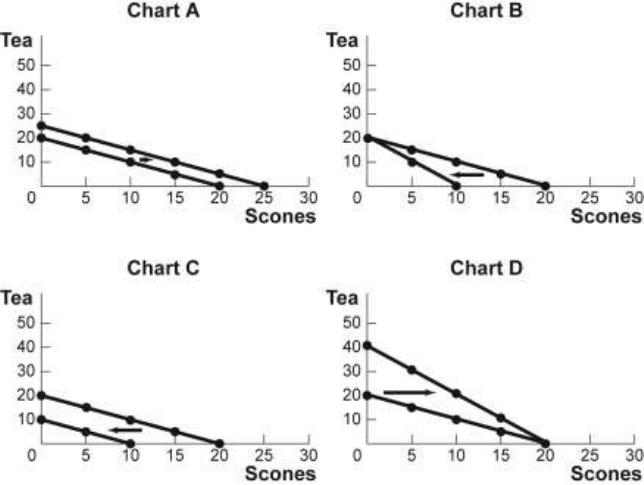
Figure: Budget Lines for Tea and Scones
53.
(Figure: Budget Lines for Tea and Scones) Look at the figure Budget Lines for Tea and
Scones. For months now, Agnes has had $20 per month to spend on tea and scones. The
price of each cup of tea and each scone is $1. Which of the charts shows what will
happen to her budget line if her income increases to $25?
A)
A
B)
B
C)
C
D)
D
54.
(Figure: Budget Lines for Tea and Scones) Look at the figure Budget Lines for Tea and
Scones. For months now, Agnes has had $20 per month to spend on tea and scones. The
price of each cup of tea and each scone has been $1. Which of the charts shows what
will happen to her budget line if her income decreases to $10?
A)
A
B)
B
C)
C
D)
D
Page 13
55.
(Figure: Budget Lines for Tea and Scones) Look at the figure Budget Lines for Tea and
Scones. For months now, Agnes has had $20 per month to spend on tea and scones. The
price of each cup of tea and each scone has been $1. Which of the charts shows what
will happen to her budget line if the price of a cup of tea falls to $0.50?
A)
A
B)
B
C)
C
D)
D
56.
(Figure: Budget Lines for Tea and Scones) Look at the figure Budget Lines for Tea and
Scones. For months now, Agnes has had $20 per month to spend on tea and scones. The
price of each cup of tea and each scone has been $1. Which of the charts shows what
will happen to her budget line if the price of a scone rises to $2?
A)
A
B)
B
C)
C
D)
D
57.
(Figure: Budget Lines for Tea and Scones) Look at the figure Budget Lines for Tea and
Scones. For months now, Agnes has had $20 per month to spend on tea and scones. The
price of each cup of tea and each scone has been $1. Which of the charts shows what
will happen to her budget line if the price of both a cup of tea and a scone increase to
$2?
A)
A
B)
B
C)
C
D)
D
58.
Faruq spends all of his income on tacos and milkshakes. His income is $100, the price
of tacos is $10, and the price of milkshakes is $2. Put tacos on the horizontal axis and
milkshakes on the vertical axis. The horizontal intercept for Faruq’s budget line is _____
tacos.
A)
50
B)
10
C)
5
D)
100
Page 14
59.
Faruq spends all of his income on tacos and milkshakes. His income is $100, the price
of tacos is $10, and the price of milkshakes is $2. Put tacos on the horizontal axis and
milkshakes on the vertical axis. The slope of Faruq’s budget line is equal to:
A)
–1/5.
B)
–5.
C)
1/5.
D)
5.
60.
Faruq spends all of his income on tacos and milkshakes. His income is $100, the price
of tacos is $10, and the price of milkshakes is $2. Put tacos on the horizontal axis and
milkshakes on the vertical axis. If Faruq spends all of his income, the opportunity cost
of one taco equals _____ milkshakes.
A)
2
B)
10
C)
5
D)
1/5
61.
Faruq spends all of his income on tacos and milkshakes. His income is $100, the price
of tacos is $10, and the price of milkshakes is $2. If Faruq purchases 10 milkshakes, he
can purchase _____ tacos.
A)
10
B)
50
C)
8
D)
18
62.
Faruq spends all of his income on tacos and milkshakes. His income is $100, the price
of tacos is $10, and the price of milkshakes is $2. If Faruq spends all of his income, the
opportunity cost of one milkshake is equal to _____ tacos.
A)
2
B)
10
C)
5
D)
1/5
63.
Chuck spends all of his income on tacos and milkshakes. His income is $100, the price
of tacos is $10, and the price of milkshakes is $2. If the price of each good doubles and
Chuck’s income doubles:
A)
Chuck’s budget line will be unaffected.
B)
Chuck’s budget line will shift out.
C)
Chuck’s budget line will shift in.
D)
Chuck will be able to buy more of both goods.
Page 15
64.
Chuck spends all of his income on tacos and milkshakes. His income is $100, the price
of tacos is $10, and the price of milkshakes is $2. Put tacos on the horizontal axis and
milkshakes on the vertical axis. The vertical for Chuck’s budget line is _____
milkshakes.
A)
50
B)
10
C)
5
D)
100
65.
Joe’s budget line reflects the _____ available to Joe if he spends _____ of his income.
A)
consumption bundles; all
B)
consumption bundles; part
C)
utility; all
D)
utility; part
Use the following to answer questions 66-71:
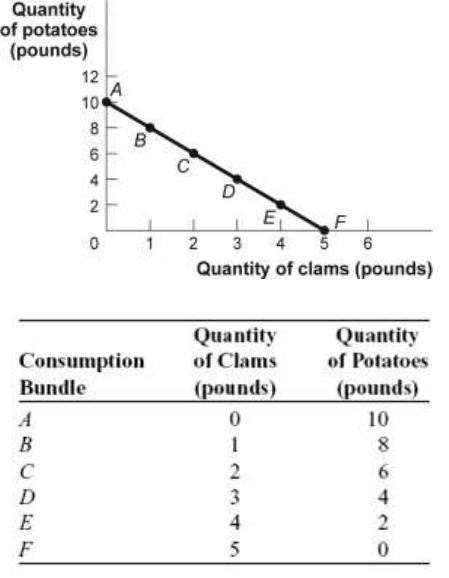
Figure and Table: The Budget Line
Page 16
66.
(Figure and Table: The Budget Line) Look at the figure and table The Budget Line.
_____ in the price of clams would rotate the budget line along the _____ axis _____ the
origin.
A)
An increase; horizontal; toward
B)
A decrease; horizontal; toward
C)
An increase; vertical; toward
D)
A decrease; vertical; away from
67.
(Figure and Table: The Budget Line) Look at the figure and table The Budget Line.
_____ in the price of potatoes would rotate the budget line along the _____ axis _____
the origin.
A)
An increase; horizontal; away from
B)
A decrease; horizontal; toward
C)
An increase; vertical; toward
D)
A decrease; vertical; toward
68.
(Figure and Table: The Budget Line) Look at the figure and table The Budget Line.
_____ in the price of clams would rotate the budget line along the _____ axis _____ the
origin.
A)
An increase; horizontal; away from
B)
A decrease; horizontal; away from
C)
An increase; vertical; toward
D)
A decrease; vertical; away from
69.
(Figure and Table: The Budget Line) Look at the figure and table The Budget Line.
_____ in the price of potatoes would rotate the budget line along the _____ axis _____
the origin.
A)
An increase; horizontal; away from
B)
A decrease; horizontal; toward
C)
An increase; vertical; away from
D)
A decrease; vertical; away from
70.
(Figure and Table: The Budget Line) Look at the figure and table The Budget Line. An
increase in income would:
A)
rotate the budget line along the horizontal axis.
B)
shift the budget line to the left.
C)
rotate the budget line along the vertical axis.
D)
shift the budget line to the right.
Page 17
71.
(Figure and Table: The Budget Line) Look at the figure and table The Budget Line. A
decrease in income would:
A)
rotate the budget line along the horizontal axis.
B)
shift the budget line to the left.
C)
rotate the budget line along the vertical axis.
D)
shift the budget line to the right.
72.
A consumer’s spending is restricted because of:
A)
marginal utility.
B)
total utility.
C)
a budget constraint.
D)
utility maximization.
73.
Whatever the relevant time, Molly’s spending will be _____ by her _____.
A)
unlimited; marginal utility
B)
limited; marginal utility
C)
limited; budget
D)
unlimited; budget
Use the following to answer questions 74-79:
Scenario: Tom’s Budget Constraint
Tom is trying to decide how to allocate his $50 budget for music downloads and online movie
streaming when the price of a music download is $1 and the price of a movie is $5.
74.
(Scenario: Tom’s Budget Constraint) Read the scenario Tom’s Budget Constraint. The
combination _____ music downloads and _____ movies lies ON Tom’s budget line.
A)
50; 10
B)
50; no
C)
no; 5
D)
100; 5
75.
(Scenario: Tom’s Budget Constraint) Read the scenario Tom’s Budget Constraint. The
combination _____ music downloads and _____ movies lies INSIDE Tom’s budget line.
(Tom can afford this combination, but he will not be spending the entire $50.)
A)
50; 10
B)
50; no
C)
no; 5
D)
100; 5
Page 18
76.
(Scenario: Tom’s Budget Constraint) Read the scenario Tom’s Budget Constraint. The
combination _____ music downloads and _____ movies lies OUTSIDE Tom’s budget
line. (Tom cannot afford this combination.)
A)
50; 10
B)
50; no
C)
no; 5
D)
20; 5
77.
(Scenario: Tom’s Budget Constraint) Read the scenario Tom’s Budget Constraint. If we
measure music downloads on the horizontal axis and movies on the vertical axis, the
vertical intercept of Tom’s budget line is:
A)
10.
B)
5.
C)
2.
D)
1/2.
78.
(Scenario: Tom’s Budget Constraint) Read the scenario Tom’s Budget Constraint. If we
measure music downloads on the horizontal axis and movies on the vertical axis, the
horizontal intercept of Tom’s budget line is:
A)
100.
B)
50.
C)
20.
D)
1/2.
79.
(Scenario: Tom’s Budget Constraint) Read the scenario Tom’s Budget Constraint. If we
measure music downloads on the horizontal axis and movies on the vertical axis, the
slope of Tom’s budget line is:
A)
–10.
B)
–1/5.
C)
–2.
D)
–1/2.
80.
The slope of a budget line for a consumer buying two goods is equal to the _____ of the
price of the good on the _____ axis divided by the price of the good on the _____ axis.
A)
positive; vertical; horizontal
B)
negative; horizontal; vertical
C)
positive; horizontal; vertical
D)
negative; vertical; horizontal
Page 19
81.
A line representing all possible combinations of two commodities that a consumer can
purchase at a particular time, given the market prices of the commodities and the
consumer’s income, is:
A)
a budget line.
B)
a consumption line.
C)
an income consumption curve.
D)
an indifference curve.
82.
An increase in a consumer’s income will do all of the following EXCEPT:
A)
shift the budget line away from the origin.
B)
increase the horizontal intercept.
C)
increase the vertical intercept.
D)
change the slope of the budget line.
83.
A decrease in a consumer’s income will do all of the following EXCEPT:
A)
shift the budget line away from the origin.
B)
decrease the horizontal intercept.
C)
decrease the vertical intercept.
D)
reduce the individual’s consumption possibilities.
Page 20
Use the following to answer questions 84-89:
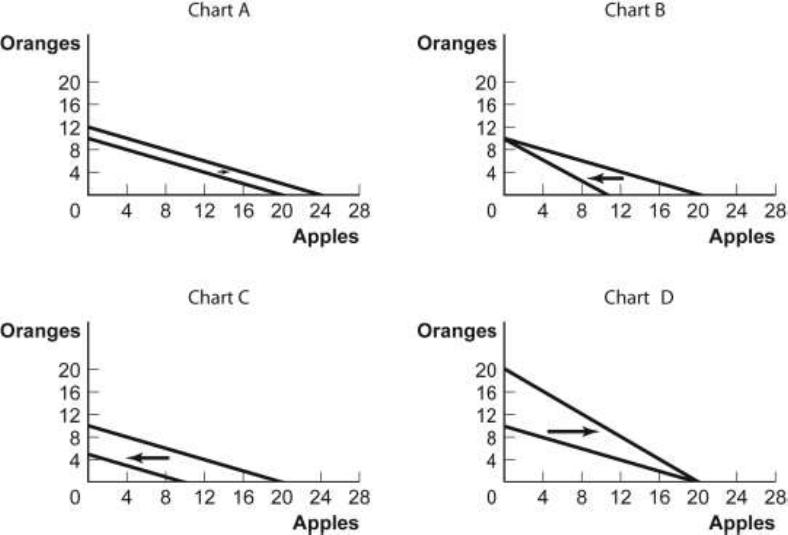
Figure: Budget Lines for Oranges and Apples
84.
(Figure: Budget Lines for Oranges and Apples) Look at the figure Budget Lines for
Oranges and Apples. For some time, Antonio has had $5 per month to spend on oranges
and apples. The price of an orange is $0.50 and the price of an apple is $0.25. Which of
the charts shows what will happen to his budget line if his income increases to $6?
A)
A
B)
B
C)
C
D)
D
85.
(Figure: Budget Lines for Oranges and Apples) Look at the figure Budget Lines for
Oranges and Apples. For some time, Antonio has had $5 per month to spend on oranges
and apples. The price of an orange is $0.50 and the price of an apple is $0.25. Which of
the charts shows what will happen to his budget line if his income decreases to $2.50?
A)
A
B)
B
C)
C
D)
D
Page 21
86.
(Figure: Budget Lines for Oranges and Apples) Look at the figure Budget Lines for
Oranges and Apples. For some time, Antonio has had $5 per month to spend on oranges
and apples. The price of an orange is $0.50 and the price of an apple is $0.25. Which of
the charts shows what will happen to his budget line if the price of an orange falls to
$0.25?
A)
A
B)
B
C)
C
D)
D
87.
(Figure: Budget Lines for Oranges and Apples) Look at the figures Budget Lines for
Oranges and Apples. For some time, Antonio has $5 per month to spend on oranges and
apples. The price of an orange is $0.50 and the price of an apple is $0.25. Which of the
charts shows what will happen to his budget line if the price of an apple rises to $0.50?
A)
A
B)
B
C)
C
D)
D
88.
(Figure: Budget Lines for Oranges and Apples) Look at the figures Budget Lines for
Oranges and Apples. For some time, Antonio has had $5 per month to spend on oranges
and apples. The price of an orange is $0.50 and the price of an apple is $0.25. Which of
the charts shows what will happen to his budget line if the price of an orange rises to
$1.00 and the price of an apple rises to $0.50?
A)
A
B)
B
C)
C
D)
D
89.
(Figure: Budget Lines for Oranges and Apples) Look at the figure Budget Lines for
Oranges and Apples. For some time, Antonio has had $5 per month to spend on oranges
and apples. The price of an orange is $0.50 and the price of an apple is $0.25. Which of
the charts shows what will happen to his budget line if the prices of the two goods fall
by 20%?
A)
A
B)
B
C)
C
D)
D
Page 22
90.
Adam has a monthly income of $20 that can be spent on books (B) and pencils (P). The
price of a book is $5 and the price of a pencil is $0.50. The equation for Adam’s daily
budget constraint can be written as:
A)
5(B) + 0.50(P) 20
B)
0.50(B) + 5(P) 20
C)
20(B) + 0.50(P) 5
D)
0.50(B) + 20(P) 5
91.
Adam has a monthly income of $20 that can be spent on books (B) and pencils (P). The
price of a book is $5 and the price of a pencil is $0.50. Which of the following bundles
of books and pencils is UNAFFORDABLE?
A)
4 books and no pencils
B)
2 books and 30 pencils
C)
1 book and 20 pencils
D)
2 books and 20 pencils
92.
Adam has a monthly income of $20 that can be spent on books (B) and pencils (P). The
price of a book is $5 and the price of a pencil is $0.50. Which of the following bundles
of books and pencils is affordable but does not use all of Adam’s income?
A)
1 book and 30 pencils
B)
no books and 40 pencils
C)
2 books and 20 pencils
D)
1 book and 10 pencils
93.
Adam has a monthly income of $20 that can be spent on books (B) and pencils (P). The
price of a book is $5 and the price of a pencil is $0.50. Which of the following bundles
of books and pencils lies ON Adam’s budget line?
A)
3 books and 5 pencils
B)
1 book and 40 pencils
C)
2 books and 20 pencils
D)
no books and 20 pencils
94.
The price of popcorn is $0.50 per box and the price of peanuts is $0.25 per bag. You
have $10 to spend on both goods. The maximum number of boxes of popcorn that you
can purchase is:
A)
5.
B)
10.
C)
20.
D)
40.
Page 23
95.
The price of popcorn is $0.50 per box and the price of peanuts is $0.25 per bag. You
have $5 to spend on both goods. The maximum number of boxes of popcorn that you
can purchase is:
A)
5.
B)
10.
C)
20.
D)
40.
96.
The price of popcorn is $0.50 per box and the price of peanuts is $0.25 per bag. You
have $10 to spend on both goods. The maximum number of bags of peanuts that you
can purchase is:
A)
5.
B)
10.
C)
20.
D)
40.
97.
The price of popcorn is $0.50 per box and the price of peanuts is $0.25 per bag. You
have $5 to spend on both goods. The maximum number of bags of peanuts that you can
purchase is:
A)
5.
B)
10.
C)
20.
D)
40.
98.
The price of popcorn is $0.50 per box and the price of peanuts is $0.25 per bag. You
have $10 to spend. You decide to purchase 8 bags of peanuts. The maximum number of
boxes of popcorn that you can purchase is:
A)
4.
B)
8.
C)
10.
D)
16.
99.
The price of popcorn is $0.50 per box and the price of peanuts is $0.25 per bag. You
have $10 to spend. You decide to purchase 20 bags of peanuts. The maximum number
of boxes of popcorn that you can purchase is:
A)
8.
B)
10.
C)
12.
D)
16.
Page 24
100.
The price of popcorn is $0.50 per box and the price of peanuts is $0.25 per bag. You
have $5 to spend. You decide to purchase 8 boxes of popcorn. The maximum number of
bags of peanuts that you can purchase is:
A)
4.
B)
8.
C)
10.
D)
12.
101.
The price of popcorn is $0.50 per box and the price of peanuts is $0.25 per bag. You
have $5 to spend. You decide to purchase 6 boxes of popcorn. The maximum number of
bags of peanuts that you can purchase is:
A)
4.
B)
8.
C)
10.
D)
12.
102.
For Domingo, the optimum consumption bundle is the one that _____ his _____, given
his budget constraint.
A)
minimizes; utility
B)
maximizes; utility
C)
maximizes; opportunity cost
D)
minimizes; opportunity cost
Use the following to answer questions 103-108:
Table: Utility from Oranges and Star Fruit
Pounds of Oranges
Total Utility from
Oranges
Pounds of Star
Fruit
Total Utility
0
0
0
0
1
24
1
70
2
44
2
130
3
60
3
180
4
72
4
220
5
80
5
250
6
84
6
270
7
84
7
280
Page 25
103.
(Table: Utility from Oranges and Star Fruit) Look at the table Utility from Oranges and
Star Fruit. Oranges cost $2 per pound and star fruit costs $5 per pound. Calvin has $26
to spend. If Calvin spends all of his money on oranges, how many pounds of oranges
can he buy?
A)
6
B)
7
C)
9
D)
13
104.
(Table: Utility from Oranges and Star Fruit) Look at the table Utility from Oranges and
Star Fruit. Oranges cost $2 per pound and star fruit costs $5 per pound. Calvin has $26
to spend. If Calvin spends all of his money on star fruit and if he can buy only whole
pounds of it, how many pounds of star fruit can he buy?
A)
7
B)
6
C)
5
D)
4
105.
(Table: Utility from Oranges and Star Fruit) Look at the table Utility from Oranges and
Star Fruit. Oranges cost $2 per pound and star fruit costs $5 per pound. Calvin has $26
to spend. If Calvin buys 2 pounds of star fruit, how many pounds of oranges can he
buy?
A)
6
B)
7
C)
8
D)
9
106.
(Table: Utility from Oranges and Star Fruit) Look at the table Utility from Oranges and
Star Fruit. Oranges cost $2 per pound and star fruit costs $5 per pound. Calvin has $26
to spend. If Calvin buys 4 pounds of star fruit, how many pounds of oranges can he
buy?
A)
2
B)
3
C)
4
D)
7
Page 26
107.
(Table: Utility from Oranges and Star Fruit) Look at the table Utility from Oranges and
Star Fruit. Oranges cost $2 per pound and star fruit costs $5 per pound. Calvin has $26
to spend. If Calvin buys 4 pounds of star fruit and 3 pounds of oranges, how much is his
total utility?
A)
72
B)
180
C)
280
D)
364
108.
(Table: Utility from Oranges and Star Fruit) Look at the table Utility from Oranges and
Star Fruit. Oranges cost $2 per pound and star fruit costs $5 per pound. The table shows
Calvin’s total utility from eating various amounts of oranges and star fruits. If Calvin has
$26, he should eat _____ oranges and _____ pounds of star fruit, and he will have
_____ left over.
A)
no; 5; $1 left over
B)
8; 2; no money
C)
3; 4; no money
D)
4; 5; no money
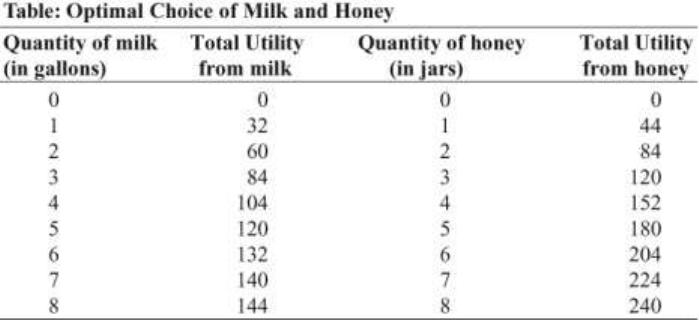
Use the following to answer questions 109-116:
109.
(Table: Optimal Choice of Milk and Honey) Look at the table Optimal Choice of Milk
and Honey. The price of milk is $2 per gallon, and the price of honey is $4 per jar. Hal’s
income is $16. If he spends all of his income on milk, the most he can buy is _____
gallons, and his total utility will be _____.
A)
4; 104
B)
6; 12
C)
8; 144
D)
8; 4
Page 27
110.
(Table: Optimal Choice of Milk and Honey) Look at the table Optimal Choice of Milk
and Honey. The price of milk is $2 per gallon, and the price of honey is $4 per jar. Hal’s
income is $16. If he spends all of his income on honey, the most he can buy is _____
jars, and his total utility will be _____.
A)
4; 152
B)
4; 22
C)
6; 204
D)
8; 240
111.
(Table: Optimal Choice of Milk and Honey) Look at the table Optimal Choice of Milk
and Honey. The price of milk is $2 per gallon, and the price of honey is $4 per jar. Hal’s
income is $16. Assuming that Hal spends all of his income on honey and milk, if he
buys 3 jars of honey, he can buy _____ gallons of milk .
A)
4
B)
3
C)
2
D)
1
112.
(Table: Optimal Choice of Milk and Honey) Look at the table Optimal Choice of Milk
and Honey. The price of milk is $2 per gallon, and the price of honey is $4 per jar. Hal’s
income is $16. If he buys 3 jars of honey and 2 gallons of milk, his total utility will be:
A)
7,200.
B)
180.
C)
120.
D)
60.
113.
(Table: Optimal Choice of Milk and Honey) Look at the table Optimal Choice of Milk
and Honey. The price of milk is $2 per gallon, and the price of honey is $4 per jar. Hal’s
income is $16. Assuming that Hal spends all of his income on honey and milk, if he
buys 2 jars of honey, he can buy _____ gallons of milk.
A)
4
B)
3
C)
2
D)
1
Page 28
114.
(Table: Optimal Choice of Milk and Honey) Look at the table Optimal Choice of Milk
and Honey. The price of milk is $2 per gallon, and the price of honey is $4 per jar. Hal’s
income is $16. If he buys 2 jars of honey and 4 gallons of milk, his total utility will be:
A)
8.
B)
84.
C)
104.
D)
188.
115.
(Table: Optimal Choice of Milk and Honey) Look at the table Optimal Choice of Milk
and Honey. The price of milk is $2 per gallon, and the price of honey is $4 per jar. Hal’s
income is $16. Assuming that Hal spends all of his income on honey and milk, if he
buys 1 jar of honey, he can buy _____ gallons of milk, and his total utility will be
_____.
A)
6; 176
B)
4; 132
C)
3; 44
D)
2; 60
116.
(Table: Optimal Choice of Milk and Honey) Look at the table Optimal Choice of Milk
and Honey. The price of milk is $2 per gallon, and the price of honey is $4 per jar. Hal’s
income is $16. Assuming that Hal spends all of his income on honey and milk, the
combination of milk and honey that will maximize his total utility is _____ jars of
honey and _____ gallons of milk.
A)
8; 8
B)
3; 2
C)
2; 4
D)
1; 6
117.
Which of the following statements is TRUE?
A)
A budget constraint limits what a poor consumer can spend, but there is no similar
constraint on rich people.
B)
Utility maximization requires seeking the most utility from a given budget.
C)
In consumer choice theory, we assume all goods and services are inferior.
D)
The slope of the budget constraint depends on how much of each good is
consumed.
Page 29
118.
Emilio finds a new job that doubles his income. He adjusts his consumption. From this
we know that for every normal good Emilio buys, his:
A)
marginal utility per dollar will rise.
B)
marginal utility per dollar will fall.
C)
marginal utility per dollar will stay constant.
D)
total utility will fall.
119.
You go to an all-you-can-eat buffet. If you maximize utility, the marginal utility of the
last bite that you eat will be:
A)
equal to the price of the buffet.
B)
as high as possible.
C)
zero.
D)
dependent on how much you like the buffet.
120.
How much utility is gained by spending an additional dollar on coffee pots?
A)
the average utility of coffee pots divided by the price of coffee pots
B)
MUPots / PPots
C)
TUPots / PPots
D)
MUCoffee / PCoffee
121.
Which of the following best describes the amount of utility that is gained by spending
an additional dollar on yogurt?
A)
the average utility of yogurt divided by the price of yogurt
B)
the marginal utility of one tub of yogurt divided by the price of yogurt
C)
the total utility of a tub of yogurt divided by the price of yogurt
D)
the value equal to the price of a related good.
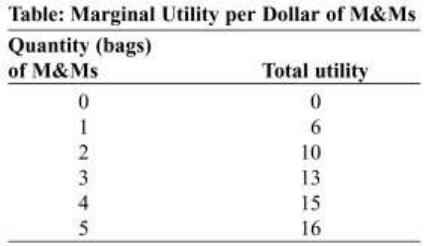
Use the following to answer questions 122-128:
Page 30
122.
(Table: Marginal Utility per Dollar of M&Ms) Look at the table Marginal Utility per
Dollar of M&Ms. The price of M&Ms is $2 per bag. The marginal utility per dollar of
the first bag of M&Ms is:
A)
12.
B)
6.
C)
3.
D)
2.
123.
(Table: Marginal Utility per Dollar of M&Ms) Look at the table Marginal Utility per
Dollar of M&Ms. The price of M&Ms is $2 per bag. The marginal utility per dollar of
the second bag of M&Ms is:
A)
16.
B)
10.
C)
5.
D)
2.
124.
(Table: Marginal Utility per Dollar of M&Ms) Look at the table Marginal Utility per
Dollar of M&Ms. The price of M&Ms is $2 per bag. The marginal utility per dollar of
the third bag of M&Ms is:
A)
1.
B)
1.5.
C)
3.
D)
13.
125.
(Table: Marginal Utility per Dollar of M&Ms) Look at the table Marginal Utility per
Dollar of M&Ms. The price of M&Ms is $2 per bag. The marginal utility per dollar of
the fourth bag of M&Ms is:
A)
1.
B)
2.
C)
7.5.
D)
15.
126.
(Table: Marginal Utility per Dollar of M&Ms) Look at the table Marginal Utility per
Dollar of M&Ms. The price of M&Ms is $2 per bag. The marginal utility per dollar of
the fifth bag of M&Ms is:
A)
0.
B)
0.5.
C)
1.
D)
8.
Page 31
127.
(Table: Marginal Utility per Dollar of M&Ms) Look at the table Marginal Utility per
Dollar of M&Ms. The price of M&Ms is $2 per bag. If the price of M&Ms increases to
$3 per bag, the marginal utility per dollar for each bag of M&Ms will:
A)
increase.
B)
decrease.
C)
remain constant.
D)
fluctuate randomly.
128.
(Table: Marginal Utility per Dollar of M&Ms) Look at the table Marginal Utility per
Dollar of M&Ms. The price of M&Ms is $2 per bag. If the price of M&Ms decreases to
$1 per bag, the marginal utility per dollar for each bag of M&Ms will:
A)
increase.
B)
decrease.
C)
remain constant.
D)
fluctuate randomly.
129.
Jenny believes that spending one hour studying for economics will increase her grade by
20 points. Studying for a second hour will increase her grade by 10 points. She also
believes that studying for an hour for history will increase her grade by 15 points, but
spending a second hour will increase her grade by only 5 points. Jenny has two hours to
study. If Jenny wants to maximize her scores, what should she do?
A)
study 1 hour for economics and 1 hour for history
B)
study 2 hours for economics and not study for history
C)
not study for economics and study 2 hours for history
D)
study 1 hour for economics and not study for history
130.
Assume that Maia spends all of her income on halvah (H) and pomegranates (P) and is
purchasing the optimal consumption bundle. If MUH / MUP = 3 and the price of halvah
is $12, then the price of pomegranates is:
A)
$36.
B)
$4.
C)
$12.
D)
$3.
Page 32
131.
Brad spends all of his income on cameras and coffee. He is purchasing the consumption
bundle that maximizes his utility given his budget constraint. At the optimal
consumption bundle, which of the following statements is CORRECT?
A)
If cameras cost more than coffee, then the marginal utility of cameras is less than
that of coffee.
B)
If cameras cost less than coffee, then the marginal utility of cameras is more than
that of coffee.
C)
If cameras cost the same as coffee, then the marginal utility of cameras is equal to
that of coffee.
D)
The prices of cameras and coffee and their marginal utilities are unrelated.
132.
Suzy knows she has maximized her utility because she is on her budget constraint and:
A)
her consumption of cameras equals her consumption of coffee.
B)
what she spends on cameras equals what she spends on coffee.
C)
MUCameras / PCameras = MUCoffee / PCoffee.
D)
MUCameras = MUCoffee.
133.
Sasha buys a warm soda and a slice of cold pizza. The marginal utility from a soda is
40, and the price of the soda is $1. The marginal utility from a slice of pizza is 80. Since
Sasha always chooses the utility-maximizing choice, we know the price of a slice of
pizza must be:
A)
$20.
B)
$2.
C)
$1.
D)
$0.50.
134.
Benny spends all of his money buying wine and cheese. Diminishing marginal utility
applies to both goods. The marginal utility of the last bottle of wine he bought is 60, and
the marginal utility of the last block of cheese he bought is 30. The price of wine is $3,
and the price of cheese is $2. Benny:
A)
is buying wine and cheese in the utility-maximizing amounts.
B)
should buy more wine and less cheese.
C)
should buy more cheese and less wine.
D)
is spending too much money on wine and cheese.
Page 33
135.
Suppose Ivy buys only two things, books and coffee, and receives the same satisfaction
from the last book bought as she did from the last coffee bought. Books cost twice as
much as coffee, and she has spent all of her money. Diminishing marginal utility applies
to both goods. If she is trying to maximize her utility:
A)
Ivy should buy more books and less coffee.
B)
Ivy should buy more coffee and fewer books.
C)
Ivy should buy more coffee and more books.
D)
Ivy is making the right choice.
136.
Melika spends all of her income on magazines and carry-out lunches. The price of a
magazine is $5, and the price of a carry-out lunch is $7. At the current consumption
bundle, the marginal utility of magazines is 10, and the marginal utility of carry-out
lunches is 21. Assuming that diminishing marginal utility applies to both goods, to
maximize utility given her income, Melika should:
A)
consume more carry-out lunches and fewer magazines.
B)
consume more magazines and fewer carry-out lunches.
C)
continue to consume the current bundle.
D)
consume equal amounts of magazines and carry-out lunches.
137.
Joseph is consuming three units of pizza and two units of soda. The price of pizza is $5
and the price of soda is $1. If he is consuming the optimal consumption bundle and his
marginal utility of the third unit of pizza is 50, his marginal utility of the second soda is:
A)
50.
B)
10.
C)
5.
D)
impossible to determine unless you know Joseph’s income.
138.
Juan spends all of his income on baseball cards and candy. At his current consumption
bundle, the marginal utility of baseball cards is 20 and the marginal utility of candy is
10. Assuming that diminishing marginal utility applies to both goods, if the price of
baseball cards is $10 and the price of candy is $2, Juan should:
A)
consume more baseball cards and less candy.
B)
consume more candy and fewer baseball cards.
C)
continue to consume the current bundle.
D)
consume equal amounts of baseball cards and candy.
139.
At the optimal consumption bundle:
A)
the marginal utility of all goods consumed is equal.
B)
the marginal utility per dollar spent is equal for all goods consumed.
C)
the price of all goods consumed is equal.
D)
total utility from all goods consumed is equal.
Page 34
140.
Diego spends all of his income on milkshakes and french fries. At his current
consumption levels the marginal utility of one milkshake and the marginal utility of one
order of french fries are equal. According to the optimal consumption rule:
A)
Diego is maximizing his utility.
B)
Diego is maximizing his utility only if one milkshake and one order of french fries
have the same price.
C)
Diego should buy more milkshakes and fewer fries if a milkshake costs more than
an order of fries.
D)
Diego will maximize his utility by specializing in consumption and buying either
milkshakes or fries but not both.
141.
Assume that diminishing marginal utility applies to both coffee and football tickets and
that the consumer is spending all of her income. If a consumer purchases a combination
of coffee and football tickets such that MUCoffee / PCoffee = 20 and MUFootball tickets / PFootball
tickets = 10, to maximize utility, the consumer should buy _____ coffee and _____
football tickets.
A)
less; more
B)
more; fewer
C)
more; more
D)
less; fewer
142.
Assume that diminishing marginal utility applies to both dish soap and floor wax and
that Minh is spending all of her income. If Minh purchases a combination of dish soap
and floor wax such that MUDish soap / PDish soap = 50 and MUFloor wax / PFloor wax = 30, to
maximize utility, Minh should buy _____ soap and _____ floor wax.
A)
less; less
B)
more; more
C)
more; less
D)
less; more
143.
Assume that diminishing marginal utility applies to both slippers and tutus and that
Natasha is spending all of her income. If Natasha purchases a combination of ballet
slippers and tutus such that MUSlippers / PSlippers = 20 and MUTutus / PTutus = 5, to maximize
utility, Natasha should buy _____ slippers and _____ tutus.
A)
more; fewer
B)
fewer; more
C)
more; more
D)
fewer; fewer
Page 35
144.
Assume that diminishing marginal utility applies to both textbooks and concert tickets
and that Sun is spending all of his income. If Sun purchases a combination of textbooks
and concert tickets such that MUTextbooks / PTextbooks= 100 and MUTickets / PTickets = 80, to
maximize utility, Sun should buy _____ textbooks and _____ tickets.
A)
fewer; fewer
B)
more; fewer
C)
fewer; more.
D)
more; more
145.
If, for Adam, the marginal utility of ties is greater than the marginal utility of shirts, to
maximize utility, Adam should:
A)
buy more ties and fewer shirts.
B)
buy more shirts and fewer ties.
C)
buy the same amount of each.
D)
determine the price of ties and the price of shirts before he decides how many of
each to buy.
146.
If a consumer derives more utility by spending an additional $1 on good X rather than
on good Y:
A)
MUx / Px > MUy / Py.
B)
MUx / Px = MUy / Py.
C)
MUx / Px < MUy / Py.
D)
Px / MUx > Py / MUy.
147.
Sally devotes all of her income to the consumption of apples and Reese’s Peanut Butter
Cups. At her current level of consumption the marginal utility of an apple is 6 and the
marginal utility of a Reese’s Peanut Butter Cup is 8. Assume that diminishing marginal
utility applies to both apples and Reese’s Peanut Butter Cups. Suppose the price of an
apple is $0.20 and the price of a Reese’s Peanut Butter Cup is $0.25. To maximize her
total utility, assuming that the goods are divisible, she would:
A)
consume more Reese’s Peanut Butter Cups and fewer apples.
B)
consume less of both goods.
C)
consume more apples and fewer Reese’s Peanut Butter Cups.
D)
There is not enough information to justify a change in her current level of
consumption.
Page 36
148.
Sally devotes all of her income to the consumption of apples and Reese’s Peanut Butter
Cups. At her current level of consumption the marginal utility of an apple is 6 and the
marginal utility of a Reese’s Peanut Butter Cup is 8. Assume that diminishing marginal
utility applies to both apples and Reese’s Peanut Butter Cups. Suppose the price of an
apple is $0.10, while the price of a Reese’s Peanut Butter Cup is $0.25. To maximize her
total utility, assuming that the goods are divisible, she would:
A)
consume more Reese’s Peanut Butter Cups and fewer apples.
B)
consume less of both goods.
C)
consume more apples and fewer Reese’s Peanut Butter Cups.
D)
There is not enough information to justify a change in her current level of
consumption.
149.
Assume that Siri is consuming the utility-maximizing quantities of pork and chicken.
We can conclude that:
A)
the price of pork equals the price of chicken.
B)
the marginal utility of pork equals the marginal utility of chicken.
C)
the ratio of the marginal utility to price is the same for pork as it is for chicken.
D)
Siri is consuming the same amount of pork and chicken.
150.
Smedley, a careful utility maximizer, consumes peanut butter and ice cream. Assume
that both peanut butter and ice cream are normal goods. He had just achieved the
utility-maximizing solution in his consumption of the two goods when the price of ice
cream increased. As he adjusted to this event, he consumed _____ peanut butter and
_____ ice cream.
A)
more; more
B)
less; less
C)
more; less
D)
less; more
151.
Smedley, a careful utility maximizer, consumes peanut butter and broccoli. Assume that
both peanut butter and broccoli are normal goods. He had just achieved the
utility-maximizing solution in his consumption of the two goods when the price of
broccoli increased. As he adjusted to this event, he consumed _____ peanut butter and
_____ broccoli.
A)
more; less
B)
less; less
C)
more; more
D)
less; more
Page 37
152.
Jill, a careful utility maximizer, consumes peanut butter and ice cream. Assume that
both peanut butter and ice cream are normal goods. She had just achieved the
utility-maximizing solution in her consumption of the two goods when the price of
peanut butter increased. As she adjusted to this event, the marginal utility of peanut
butter _____ and that of ice cream _____.
A)
rose; rose
B)
fell; fell
C)
fell; rose
D)
rose; fell
153.
Kawamura, a careful utility maximizer, consumes peanut butter and ice cream. Assume
that both peanut butter and ice cream are normal goods and that diminishing marginal
utility applies to both goods. He had just achieved the utility-maximizing solution in his
consumption of the two goods when the price of peanut butter fells. As he adjusted to
this event, the marginal utility of peanut butter _____ and the marginal utility of ice
cream _____.
A)
rose; rose
B)
fell; fell
C)
fell; rose
D)
rose; fell
154.
Marge has spent her entire budget on milk and cookies. The last glass of milk provided
Marge with 10 additional utils and the last cookie provided her with 25 additional utils.
The price of a cookie is twice the price of a glass of milk. Assuming that diminishing
marginal utility applies to both goods, Marge should consume _____ milk and _____
cookies.
A)
more; fewer
B)
less; more
C)
more; more
D)
less; fewer
155.
Nancy is consuming her optimal consumption bundle of burritos and margaritas. The
marginal utility of her last burrito was 75 utils, and each burrito costs $3. Her marginal
utility of her last margarita was 100 utils. What is the price of a margarita?
A)
$1
B)
$2
C)
$3
D)
$4
Page 38
156.
The optimal consumption rule for all goods requires:
A)
the marginal utility of all goods consumed divided by the price to be equal to the
budget constraint.
B)
the marginal utility of all goods consumed to exceed the total utility of all goods.
C)
the marginal utility of all goods consumed divided by the respective price to be
equal.
D)
the prices of all goods to be equal.
157.
Faced with two goods to buy, diamonds and silver, a utility-maximizing individual will
buy according to the statement that:
A)
the price of diamonds equals the price of silver.
B)
marginal utility of diamonds equals marginal utility of silver.
C)
the price of diamonds divided by marginal utility of silver equals the price of silver
divided by marginal utility of diamonds.
D)
marginal utility of diamonds divided by price of diamonds equals marginal utility
of silver divided by price of silver.
158.
Tori devotes all of her income to the consumption of peanut butter and jelly. She has
just discovered that at her current level of consumption the marginal utility of a jar of
peanut butter is 5 and the marginal utility of a jar of jelly is 7. Which of the following
statements is TRUE?
A)
To maximize her total utility, Tori should consume more of both goods.
B)
To maximize her total utility, Tori should consume less of both goods.
C)
To maximize her total utility, Tori should consume more peanut butter and less
jelly.
D)
There is not enough information provided to justify a change in Tori’s level of
consumption.
159.
Antonio derives more utility from spending an additional dollar on boots than on gloves.
We can assume that:
A)
the marginal utility per dollar spent on boots is greater than the marginal utility per
dollar spent on gloves.
B)
the marginal utility per dollar spent on boots is equal to the marginal utility per
dollar spent on gloves.
C)
the marginal utility per dollar spent on boots is less than the marginal utility per
dollar spent on gloves.
D)
boots cost less than gloves.
Page 39
160.
If Paloma is consuming the utility-maximizing quantities of pizza and soda pop:
A)
the price of pizza equals the price of soda pop.
B)
the marginal utility of pizza is equal to the marginal utility of soda pop.
C)
the ratio of the marginal utility to price is the same for pizza and for soda pop.
D)
the total utility of pizza is equal to the total utility of soda pop.
161.
Steven consumes staples and paper clips. He is maximizing his utility in consumption of
both goods. The price of staples falls. After the change in price Steven should consume
_____ staples and _____ paper clips.
A)
more; more
B)
more; fewer
C)
fewer; fewer
D)
fewer; more
162.
Steven consumes staples and paper clips. He is maximizing his utility in consumption of
both goods. The price of staples rises. After the change in price Steven should consume
_____ staples and _____ paper clips.
A)
more; fewer
B)
more; more
C)
fewer; more
D)
fewer; fewer
163.
Steven consumes staples and paper clips. He is maximizing his utility in consumption of
both goods. The price of paper clips rises. Assuming that diminishing marginal utility
applies to both goods, as he adjusts to this event, the marginal utility of staples will
_____, and the marginal utility of paper clips will _____.
A)
rise; fall
B)
fall; rise
C)
rise; rise
D)
fall; fall
164.
Steven consumes staples and paper clips. He is maximizing his utility in consumption of
both goods. The price of staples falls. Assuming that diminishing marginal utility
applies to both goods, as he adjusts to this event, the marginal utility of staples will
_____, and the marginal utility of paper clips will _____.
A)
rise; fall
B)
rise; rise
C)
fall; fall
D)
fall; rise
Page 40
165.
John consumes pizza and pasta, both normal goods. He is maximizing his utility in
consumption of both goods. The price of pasta rises. Assuming that diminishing
marginal utility applies to both goods, as he adjusts to this event, the marginal utility of
pizza will _____, and the marginal utility of pasta will _____.
A)
rise; rise
B)
fall; fall
C)
fall; rise
D)
rise; fall
166.
Wolfgang really likes rutabagas and likes broccoli as well. The price of each good is
$0.60 per pound and Wolfgang is maximizing utility. At the point of maximal utility the
marginal utility of:
A)
rutabagas and broccoli are the same.
B)
rutabagas is greater than the marginal utility of broccoli.
C)
broccoli is greater than the marginal utility of rutabagas.
D)
both goods is zero.
167.
Wolfgang really likes rutabagas and likes broccoli fairly well. Suppose the price of each
good is $0.60 per pound and Wolfgang is maximizing utility, consuming 5 pounds of
rutabagas and 0.5 pound of broccoli per month. At the point of maximal utility, the
marginal utility of:
A)
the two goods is the same.
B)
rutabagas is greater than that of broccoli.
C)
broccoli is greater than that of rutabagas.
D)
both goods is zero.
Page 41
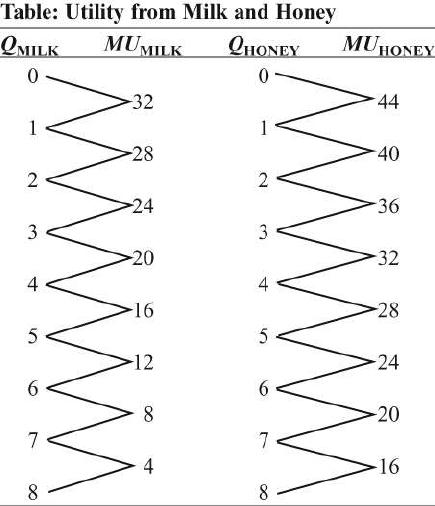
Use the following to answer question 168:
168.
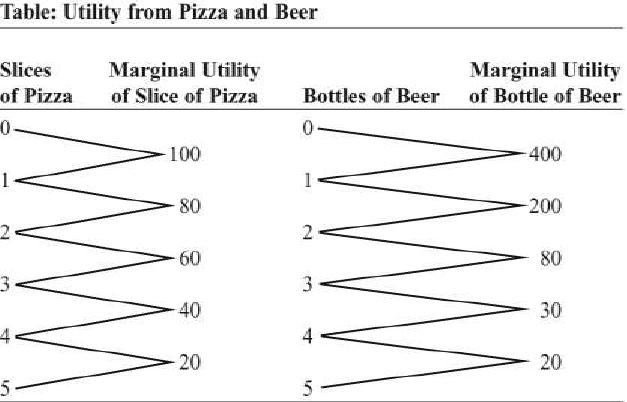
(Table: Utility from Milk and Honey) Look at the table Utility from Milk and Honey.
The price of milk is $2 and the price of honey is $4. If Max’s income is $16, he buys
_____ bottle(s) of milk and _____ jar(s) of honey.
A)
1; 1
B)
4; 2
C)
5; 4
D)
6; no
Page 42
Use the following to answer question 169:
169.
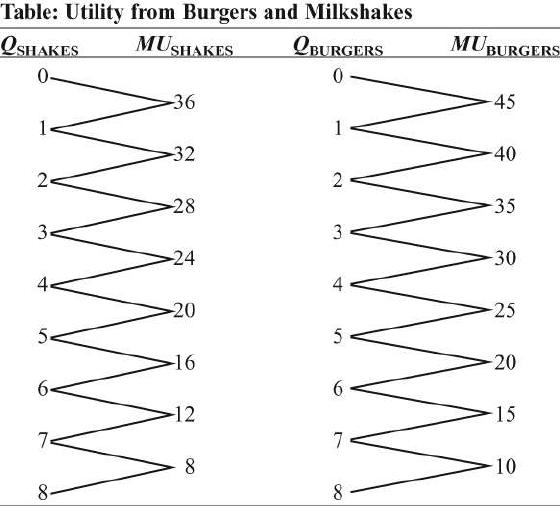
(Table: Utility from Pizza and Beer) Look at the table Utility from Pizza and Beer. At
All-Sports Bar, a bottle of beer costs $4; a slice of pizza costs $2. Denard has $10 to
spend on beer and pizza. To maximize his utility, Denard will consume _____ slice(s) of
pizza and _____ bottle(s) of beer.
A)
5; no
B)
3; 1
C)
1; 2
D)
4; 3
Page 43
Use the following to answer questions 170-171:
170.
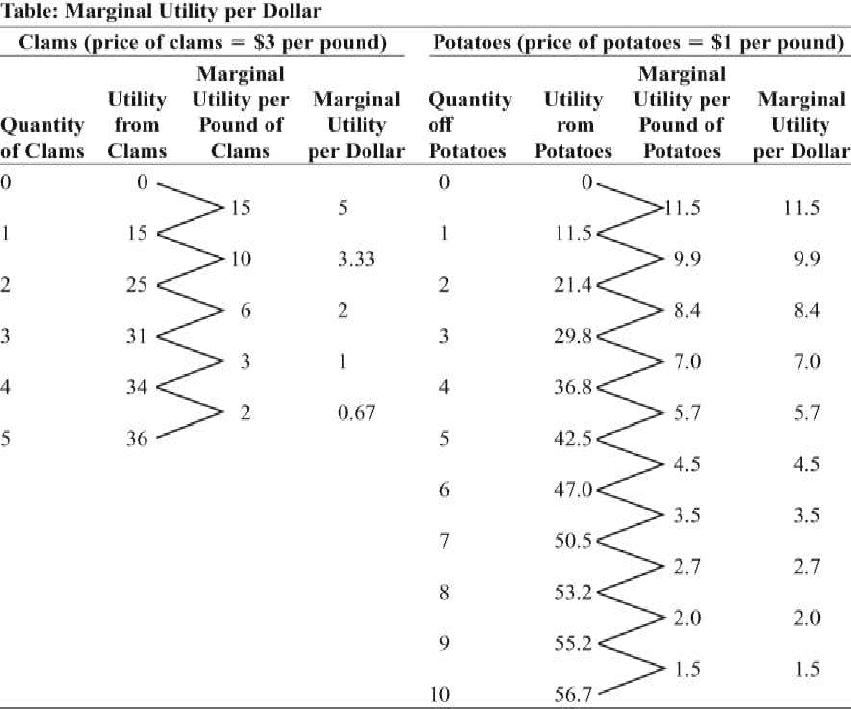
(Table: Utility from Burgers and Milkshakes) Look at the table Utility from Burgers and
Milkshakes. David’s marginal utilities for milkshakes and burgers are given in the table.
The price of milkshakes is $2, and the price of burgers is $5. If David’s income is $22,
to maximize his utility, he buys _____ shake(s) and _____ burger(s).
A)
1; 1
B)
6; no
C)
5; 1
D)
6; 2
171.
(Table: Utility from Burgers and Milkshakes) Look at the table Utility from Burgers and
Milkshakes. David’s marginal utilities for milkshakes and burgers are given in the table.
The price of milkshakes is $2, and the price of burgers is $5. If David’s income is $10,
to maximize his utility, he buys _____ shake(s) and _____ burger(s).
A)
1; 1
B)
no; 2
C)
5; no
D)
2; 1
Page 44
Use the following to answer question 172:
172.
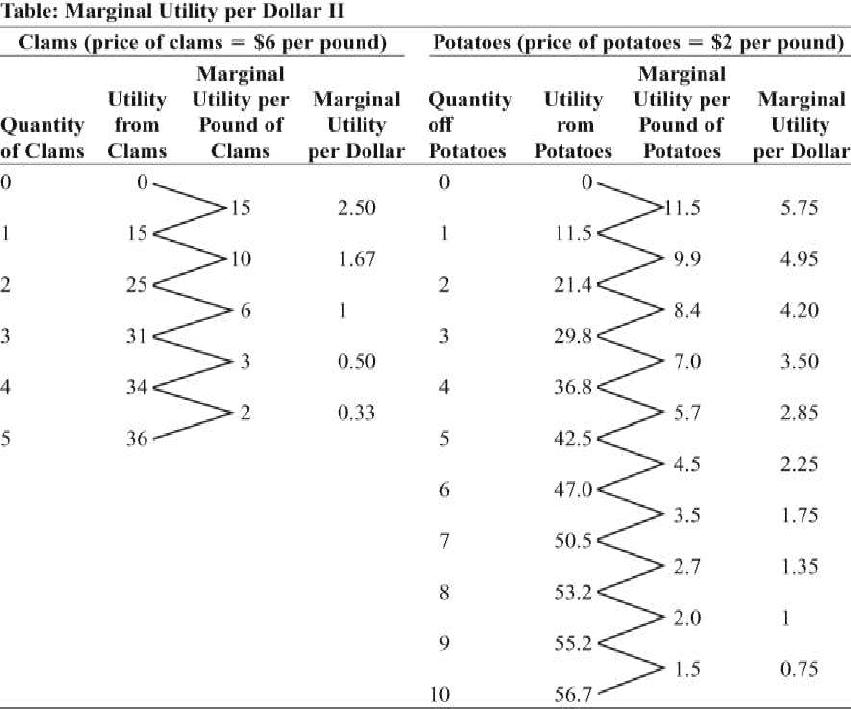
(Table: Marginal Utility per Dollar) Look at the table Marginal Utility per Dollar. If
Damian has $9 to spend on potatoes and clams, then the utility-maximizing combination
is _____ pounds of clams and _____ pounds of potatoes.
A)
no; 9
B)
2; 2
C)
1; 6
D)
2; 3
Page 45
Use the following to answer question 173:
173.
(Table: Marginal Utility per Dollar II) Look at the table Marginal Utility per Dollar II. If
Manuel has $18 to spend on potatoes and clams, then the utility-maximizing
combination is _____ pounds of clams and _____ pounds of potatoes.
A)
5; 3
B)
4; 6
C)
1; 6
D)
3; 9
Page 46
Use the following to answer question 174:
174.
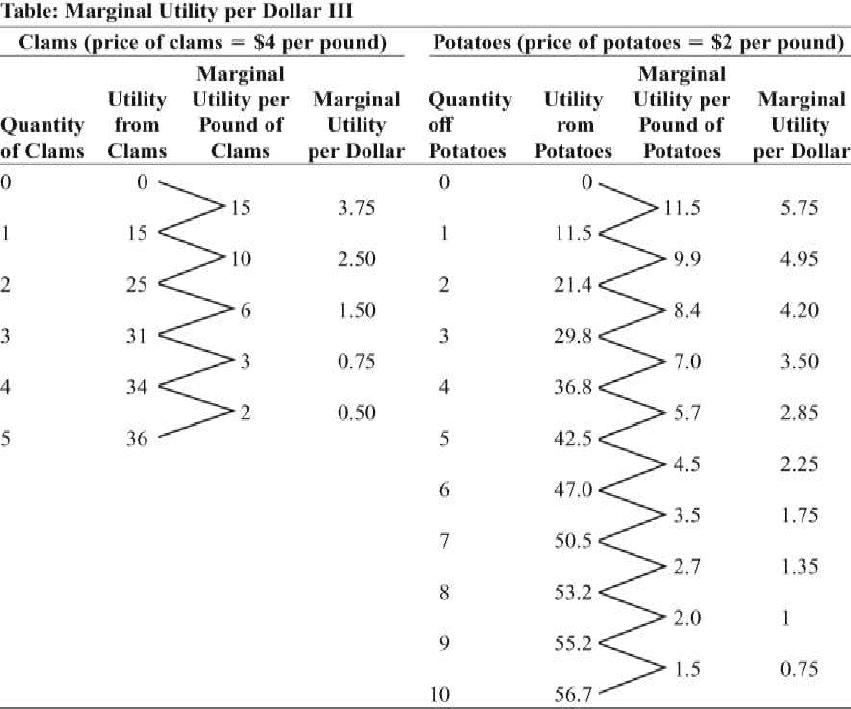
(Table: Marginal Utility per Dollar III) Look at the table Marginal Utility per Dollar III.
If Liyun has $20 to spend on potatoes and clams, then the utility-maximizing
combination is _____ pounds of clams and _____ pounds of potatoes.
A)
2; 6
B)
3; 4
C)
1; 8
D)
3; 9
Page 47
Use the following to answer question 175:
175.
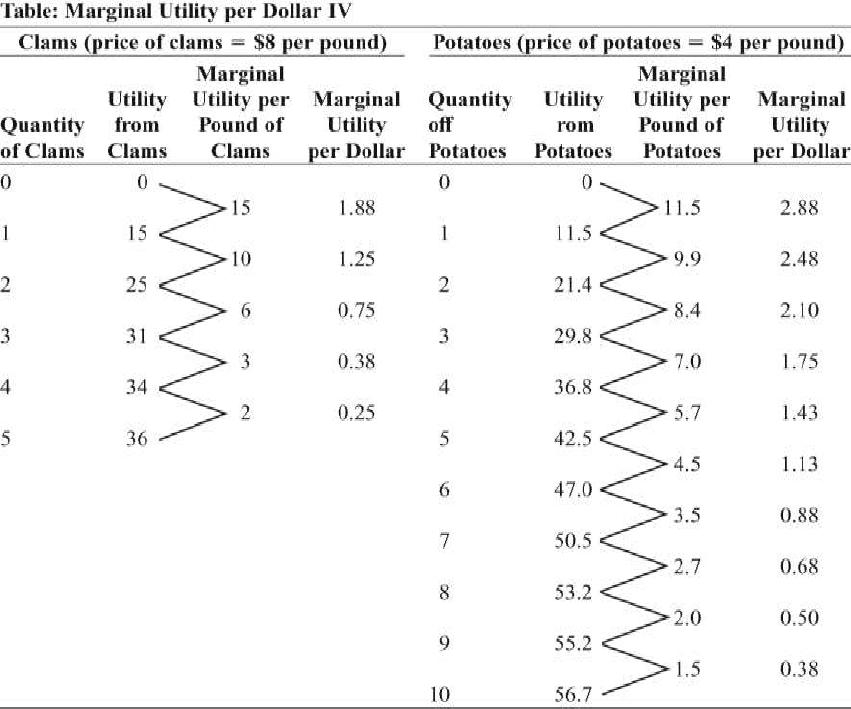
(Table: Marginal Utility per Dollar IV) Look at the table Marginal Utility per Dollar IV.
If Ashyra has $40 to spend on potatoes and clams, then the utility-maximizing
combination is _____ pounds of clams and _____ pounds of potatoes.
A)
3; 4
B)
2; 5
C)
1; 8
D)
2; 6
Page 48
Use the following to answer questions 176-183:
176.
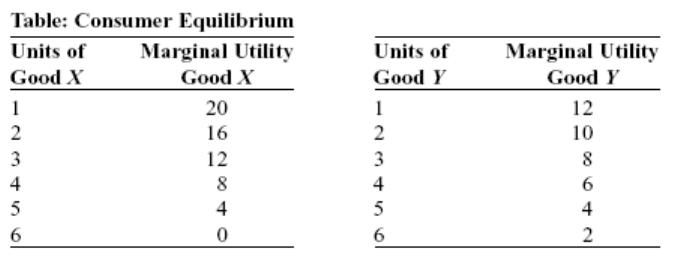
(Table: Consumer Equilibrium) Look at the table Consumer Equilibrium. Assume that
the price of both goods is $1 per unit, that you consume three units of good X and three
units of good Y, and that you are spending all of your income. To maximize utility,
assuming that the goods are divisible, you would consume _____ of X and _____ of Y.
A)
less; less
B)
more; more
C)
less; more
D)
more; less
177.
(Table: Consumer Equilibrium) Look at the table Consumer Equilibrium. Assume that
the price of both goods is $1 per unit, that you consume four units of good X and two
units of good Y, and that you are spending all of your income. To maximize utility,
assuming that the goods are divisible, you would consume _____ of X and _____ of Y.
A)
less; more
B)
more; more
C)
less; less
D)
more; less
178.
(Table: Consumer Equilibrium) Look at the table Consumer Equilibrium. Assume that
the price of good X is $2 per unit and the price of good Y is $1 per unit, that you
consume three units of good X and three units of good Y, and that you are spending all
of your income. To maximize utility, assuming that the goods are divisible, you would
consume _____ of X and _____ of Y.
A)
less; less
B)
more; more
C)
less; more
D)
more; less
Page 49
179.
(Table: Consumer Equilibrium) Look again at the table Consumer Equilibrium. Assume
that the price of good X is $1 per unit and the price of good Y is $2 per unit and you
consume 4 units of good X and 2 units of good Y, and you are spending all of your
income. To maximize utility, assuming that the goods are divisible, you would consume
_____ of X and _____ of Y.
A)
less; less
B)
more; more
C)
less; more
D)
more; less
180.
(Table: Consumer Equilibrium) Look at the table Consumer Equilibrium. Assume that
goods X and Y both cost $1 per unit and you have $4 to spend on both goods. To
maximize utility, you would consume _____ unit(s) of X and _____ unit(s) of Y.
A)
no; 4
B)
1; 3
C)
2; 2
D)
3; 1
181.
(Table: Consumer Equilibrium) Look at the table Consumer Equilibrium. Assume that
goods X and Y both cost $1 per unit and you have $7 to spend on both goods. To
maximize utility, you would consume _____ units of X and _____ units of Y.
A)
2; 5
B)
3; 4
C)
4; 3
D)
5; 2
182.
(Table: Consumer Equilibrium) Look at the table Consumer Equilibrium. Assume that
the price of good X is $5 per unit, the price of good Y is $1 per unit, and you have $10 to
spend on both goods. To maximize utility, you would consume _____ unit(s) of X and
_____ unit(s) of Y.
A)
no; 1
B)
1; 5
C)
4; 6
D)
5; 5
Page 50
183.
(Table: Consumer Equilibrium) Look at the table Consumer Equilibrium. Assume that
the price of good X is $2 per unit, the price of good Y is $1 per unit, and you have $10 to
spend on both goods. To maximize utility, you would consume _____ units of X and
_____ units of Y.
A)
3; 4
B)
2; 3
C)
2; 6
D)
5; no
184.
Choices that maximize total utility generally produce demand curves that are:
A)
horizontal.
B)
upward-sloping.
C)
downward-sloping.
D)
straight lines.
185.
If the price of coffee cups falls and the consumer decides to buy more coffee cups solely
because they are less expensive, this describes the:
A)
income effect.
B)
substitution effect.
C)
consumer surplus effect.
D)
marginal-maximizing rule.
186.
The substitution effect of a price change is described by the statement that:
A)
when the price of canning jars falls, consumers have more real income with the
same nominal income and will buy more canning jars.
B)
when the price of canning jars falls, consumers will substitute these lower-priced
canning jars for higher-priced goods.
C)
the substitution effect is the change in the number of canning jars purchased when
the price of spatulas changes.
D)
the substitution effect shows how a change in income will affect the quantity of a
good purchased.
187.
Market demand is found by:
A)
adding the individual quantities demanded at each price.
B)
adding the individual prices at each quantity demanded.
C)
multiplying the individual quantities demanded at each price.
D)
multiplying the individual prices at each quantity demanded.
Page 51
188.
According to the substitution effect, which of the following best describes why a
decrease in the price of LED light bulbs leads to an increase in the quantity of LED light
bulbs demanded?
A)
Buyers have more real income.
B)
Buyers always purchase fewer substitute goods for LED light bulbs.
C)
Buyers tend to purchase more of the now less expensive LED light bulbs.
D)
Buyers tend to purchase more complementary goods to LED light bulbs.
189.
The substitution effect always entails a change in consumption in the _____ direction as
(of) the change in _____.
A)
same; marginal utility
B)
same; price
C)
opposite; price
D)
opposite; the budget
190.
According to the substitution effect, a decrease in the price of a product leads to an
increase in the quantity of the product demanded because buyers:
A)
have more real income.
B)
purchase fewer substitute goods.
C)
purchase more of the now less expensive good.
D)
purchase more complementary goods.
191.
The substitution effect always involves a change in consumption in the _____ direction
as (to) the _____ change.
A)
same; budget
B)
same; price
C)
opposite; price
D)
opposite; budget
192.
If, because of a price change, both the income and substitution effects are strong for a
normal good, this segment of the demand curve must be:
A)
unit-elastic.
B)
vertical.
C)
relatively price-elastic.
D)
horizontal.
Page 52
193.
A Giffen good is one in which the _____ curve is _____ sloped.
A)
supply; negatively
B)
demand; negatively
C)
supply; positively
D)
demand; positively
194.
Jane is a utility-maximizing consumer who is spending her entire budget on the optimal
quantity of wallets and eyeglasses. The price of wallets falls. Jane will _____ her
consumption of wallets if wallets are a(n) _____ good and (because) the income effect
_____ the substitution effect.
A)
decrease; inferior; is weaker than
B)
increase; inferior; is stronger than
C)
increase; normal; reinforces
D)
decrease; normal; reinforces
195.
Which of the following best describes the income effect of a price increase?
A)
The price of bacon increases, so Michelle buys more sausage.
B)
The price of corn chips increases, so Michelle buys potato chips.
C)
The tuition at the public university increases, so Michelle attends a community
college.
D)
Michelle’s apartment rent increases, so she cancels her subscription to a monthly
magazine.
196.
The demand curve for a normal good will always slope downward because:
A)
the substitution effect and the income effect reinforce each other, and the
substitution effect always displays an inverse relation between price and quantity
demanded.
B)
the substitution effect and the income effect reinforce each other, and the income
effect always displays an inverse relation between price and quantity demanded.
C)
even though the substitution effect and the income effect move in opposite
directions, the substitution effect dominates, and it always displays an inverse
relation between price and quantity demanded.
D)
even though the substitution effect and the income effect move in opposite
directions, the income effect dominates, and it always displays an inverse relation
between price and quantity demanded.
Page 53
197.
For most goods, demand curves slope downward because:
A)
marginal utility rises as quantity demanded increases.
B)
the substitution effect constitutes almost the entire effect of a price change, and this
effect always causes quantity demanded and price to be inversely related.
C)
the income effect constitutes almost the entire effect of a price change, and this
effect always causes quantity demanded and price to be inversely related.
D)
the income and substitution effects work in opposite directions.
198.
The income effect of a price change is the effect on consumption changes as a result of a
change in:
A)
income when all prices change in the same proportion.
B)
purchasing power caused by a change in the price of the good.
C)
income caused by a change in the price of labor.
D)
income sufficient to offset the effect of a price change.
199.
The income effects of a change in price are most important for goods that:
A)
take up a substantial share of a consumer’s spending.
B)
are very inexpensive.
C)
are imported.
D)
are normal.
200.
Which of the following statements is FALSE?
A)
A Giffen good must be an inferior good.
B)
A Giffen good must be such that the income effect and the substitution effect move
in opposite directions, and the income effect outweighs the substitution effect.
C)
A Giffen good must be such that the substitution effect outweighs the income
effect for an inferior good.
D)
A Giffen good must have an upward-sloping demand curve.
201.
Assume that as the price of cauliflower falls, the income effect causes consumers to buy
fewer heads of cauliflower. We can conclude that cauliflower is:
A)
an inferior good.
B)
nasty tasting.
C)
a normal good.
D)
expensive.
Page 54
202.
The income effect refers to a change in:
A)
income because of a change in business investment.
B)
money or nominal income because of a change in wages.
C)
the quantity demanded of a good because of an implicit change in the buyer’s
income caused by a change in the price of a good or service.
D)
the quantity demanded of a good because of a change in the buyer’s money income.
203.
Which of the following statements is FALSE?
A)
The income effect of normal goods counters the substitution effect, so the demand
curve slopes upward.
B)
The income effect and the substitution effect reinforce each other when the price of
a normal good changes.
C)
The income effect represents the decrease in quantity demanded caused by the
implicit change in income due to a fall in the price of an inferior good but not of a
normal good.
D)
The substitution effect reflects the change in quantity demanded solely because of a
change in the relative price of a good.
204.
When the price of an inferior good falls, the substitution effect contributes to _____ in
the quantity demanded, and the income effect _____ the substitution effect.
A)
a decrease; reinforces
B)
an increase; reinforces
C)
an increase; opposes
D)
a decrease; opposes
Use the following to answer questions 205-206:
Table: Utility from Candy Bars and Sodas
Units of
Candy Bars
MUCandy
Units of
Sodas
MUSodas
1
8
1
10
2
7
2
8
3
6
3
6
4
5
4
4
5
4
5
3
6
3
6
2
7
2
7
1
8
1
8
0
Page 55
205.
(Table: Utility from Candy Bars and Sodas) Look at the table Utility from Candy Bars
and Sodas. If Stan consumes two candy bars and two sodas, his total utility will be
_____ utils.
A)
15
B)
33
C)
18
D)
78
206.
(Table: Utility from Candy Bars and Sodas) Look at the table Utility from Candy Bars
and Sodas. Stan’s daily income is $11, the price of a candy bar is $2, and the price of a
soda is $1. Given this budget constraint, Stan will receive the most utils from consuming
_____ candy bar(s) and _____ sodas.
A)
3; 5
B)
1; 4
C)
5; 6
D)
2; 7
207.
The assumption that a rational consumer seeks to maximize his or her utility implies that
utility is measurable according to some objective scale.
A)
True
B)
False
208.
Gehrig’s utility from the consumption of mangoes is measured by the level of
satisfaction he gets from only the first mango he buys and eats.
A)
True
B)
False
209.
The marginal utility of a good is used to describe any good (such as a mushroom brush
or a shrimp deveiner) that has only limited usefulness.
A)
True
B)
False
210.
If Joe drinks iced tea while he is mowing his yard, he will probably derive a lower
marginal utility from the sixth glass of tea than from the first glass.
A)
True
B)
False
Page 56
211.
Mary, an avid gardener, plans to spend 8 hours working in her garden. It takes her 45
minutes to prune a bush and 30 minutes to fertilize a tree. If she prunes eight bushes, she
will still have enough time to fertilize six trees.
A)
True
B)
False
212.
A person’s consumption possibilities include all points on the budget line as well as all
points below the budget line.
A)
True
B)
False
213.
The optimal consumption bundle is the combination of goods that lies above the budget
constraint.
A)
True
B)
False
214.
Professor Makrung spends his entire weekly income of $700 on economics books (E)
and coffee (C). The price of an economics book (PE) is $50 and the price of a cup of
coffee (PC) is $2. If the professor buys 10 economics books and 50 cups of coffee per
week, he finds that MUE = 75 and MUC = 3. This implies that a consumption bundle
consisting of 10 economics books and 50 cups of coffee per week maximizes the
professor’s utility.
A)
True
B)
False
215.
Mikaela is buying a new motorcycle. She has narrowed her choices to a BMW Classic
Montauk or a Honda Valkyrie Rune. She likes the Honda exactly twice as much, but it
costs about 40% more. If both bikes are in her budget, she should buy the Honda.
A)
True
B)
False
216.
If the price of laundry detergent equals the price of dishwashing powder, then a
utility-maximizing consumer will always buy equal amounts of laundry detergent and
dishwashing powder.
A)
True
B)
False
Page 57
217.
At Frankie’s Buy-the-Slice Pizza, Bill eats three slices of pizza and then realizes that he
enjoyed the second slice more than the third. Even though the price per slice is just $1,
the utility-maximizing decision is to quit eating now, since Bill has reached diminishing
marginal utility.
A)
True
B)
False
218.
At Frankie’s Buy-the-Slice Pizza, Brian eats eight slices of pizza, explaining that at only
$2 per slice, the utility-maximizing decision is to eat until your marginal utility per
dollar is zero. Brian’s explanation is correct.
A)
True
B)
False
219.
If the marginal utility of hot dogs exceeds the marginal utility of french fries, then the
consumer should always increase the consumption of hot dogs and decrease the
consumption of french fries.
A)
True
B)
False
220.
If the price of pecan rolls is $2, the price of a gyro is $6, and the marginal utility of the
last pecan roll consumed is 12, then the marginal utility of the last gyro consumed for a
consumer purchasing the optimal consumption bundle of pecan rolls and gyros is 36.
A)
True
B)
False
221.
Suppose Sirach knows that the price of doughnuts is $3 and the price of cupcakes is $4.
He also believes that the next doughnut he consumes will increase his total utility by 6
utils and the next cupcake will increase his total utility by 10 utils. Assuming he has
enough money to buy either, Sirach should buy a doughnut next.
A)
True
B)
False
222.
At the optimal consumption bundle, the marginal utility of each good purchased is
always the same.
A)
True
B)
False
Page 58
223.
The optimal consumption rule implies that if Pascal is maximizing his utility by
spending all of his income on concert tickets and cab rides, with prices equal to PTickets
and PRides, respectively, then it must be the case that MUTickets / MURides = PTickets / PRides.
A)
True
B)
False
224.
For most goods, the income effect has no significant effect on individual consumption.
A)
True
B)
False
225.
If the substitution effect and the income effect of a price change move in opposite
directions for a particular good, then the good must be an inferior good.
A)
True
B)
False
226.
When the price of Spam (an inferior good) decreased, Dale bought more Spam. For
Dale, the income and substitution effects moved in the same direction.
A)
True
B)
False
227.
For a Giffen good, the income effect works in the opposite direction from the
substitution effect, and the income effect is larger than the substitution effect.
A)
True
B)
False
228.
Many people have severe food allergies such that even one bite of something might send
a person to the emergency room. For a person with a severe allergy to nuts, for example,
describe the total utility function from eating nuts.
229.
Explain the difference between the total utility and marginal utility of eating pizza.
230.
You have an economics test tomorrow and you think that you might need to stay up all
night to study for it. Your professor argues against pulling this all-nighter because he
thinks there is a point where more studying (and less sleeping) can actually do more
harm than good. Using the concepts of total and marginal utility, explain your
professor’s position.
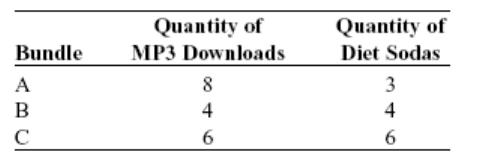
Page 59
231.
James spends his daily income of $50 on protein shakes (PS) and energy bars (EB).
Protein shakes are priced at $5 each, and energy bars are priced at $4 each. Provide the
equation for his budget constraint. If he spends half of his income on each item, how
many units of each will he consume?
Use the following to answer question 232:
Table: MP3 Music Downloads
232.
(Table: MP3 Music Downloads) Jen spends her daily income of $28 on MP3 music
downloads and jumbo diet sodas. One MP3 music download costs $2, and one jumbo
diet soda costs $4. The table provided shows three consumption bundles. Identify the
bundle that is unaffordable, the one that lies on her budget line, and the one that is
affordable but does not use all of her income.
233.
Ladan has $500 each semester to spend on textbooks and sandwiches. Textbooks are
$100 each and sandwiches are $5 each. Assume that diminishing marginal utility applies
to both goods. She has purchased 3 textbooks this semester and 40 sandwiches. She tells
you that her marginal utility from the next textbook is about 100 utils and the marginal
utility from the next sandwich is about 15 utils. Has Ladan successfully maximized her
utility this semester? Should she adjust her spending next semester?
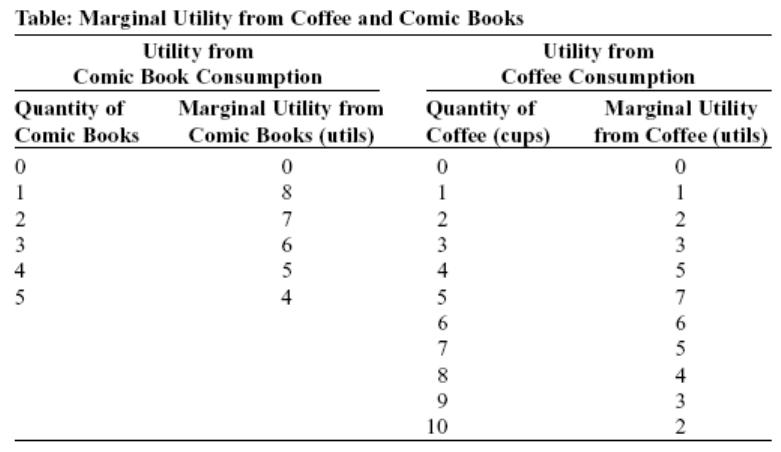
Page 60
Use the following to answer question 234:
234.
(Table: Marginal Utility from Coffee and Comic Books) Look at the table Marginal
Utility from Coffee and Comic Books. Your eccentric professor has a daily budget of
$40, and he spends it entirely on coffee and comic books. The table shows the marginal
utility he receives from consuming different quantities of coffee and comic books. Each
comic book is priced at $8, and each cup of coffee is priced at $4. To maximize his total
utility, how many cups of coffee should he buy, and how many comic books should he
buy? How many utils of total utility will he enjoy?
235.
The rising price of gasoline has caused your parents to use public transportation rather
than drive to work. They have also decided to cancel a cross-country trip for a family
reunion. Are there substitution and income effects here? Explain.
236.
Two consumers, Eric and Eli, have the same preferences for good X, a normal good.
The only difference is that for Eli there would be no income effect if the price of good X
changed. For Eric, there are both income and substitution effects for a price change.
What does this tell you about Eric’s and Eli’s demand for good X? Explain.
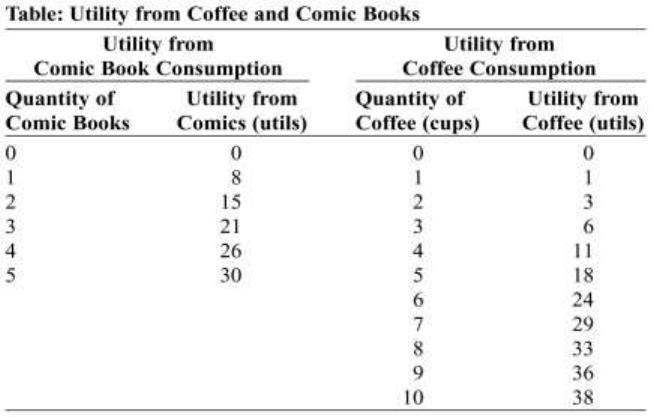
Page 61
Use the following to answer question 237:
237.
(Table: Utility from Coffee and Comic Books) Look at the table Utility from Coffee and
Comic Books. Your eccentric professor has a daily budget of $40, and he spends it
entirely on coffee and comic books. Each comic book is priced at $8 and each cup of
coffee is priced at $4. To maximize his utility, how many cups of coffee and how many
comic books should he buy? How many total utils will he enjoy?
238.
It is said that consumers maximize utility because they are:
A)
rational.
B)
demand-constrained.
C)
inferior.
D)
comfortable.
239.
The satisfaction that a consumer gets from the consumption of a bundle of goods and
services is:
A)
utility.
B)
rationalization.
C)
budget constraints.
D)
income.
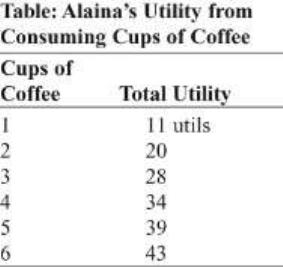
Page 62
Use the following to answer questions 240-242:
240.
(Table: Alaina’s Utility from Consuming Cups of Coffee) Look at the table Alaina’s
Utility from Consuming Cups of Coffee. Given the information in the table, Alaina’s
total utility from drinking coffee:
A)
decreases as she consumes additional coffee.
B)
increases at a decreasing rate as she consumes more coffee.
C)
stays constant as she consumes more coffee.
D)
equals zero.
241.
(Table: Alaina’s Utility from Consuming Cups of Coffee) Look at the table Alaina’s
Utility from Consuming Cups of Coffee. Alaina’s marginal utility from consuming her
sixth cup of coffee is _____ utils.
A)
43
B)
82
C)
4
D)
no
242.
(Table: Alaina’s Utility from Consuming Cups of Coffee) Look at the table Alaina’s
Utility from Consuming Cups of Coffee. Diminishing marginal utility:
A)
is not present in Alaina’s consumption of coffee, since her total utility keeps
increasing.
B)
is present in Alaina’s consumption of coffee, since her total utility increases at a
decreasing rate with each cup consumed.
C)
is equal to zero.
D)
is not present, since Alaina exhibits increasing marginal utility.
Page 63
243.
If marginal utility is diminishing, the marginal utility curve is _____, since each
additional unit of the good consumed yields _____ satisfaction.
A)
downward-sloping; less
B)
upward-sloping; more
C)
downward-sloping; more
D)
upward-sloping; less
244.
George has a weekly income (I) of $50, which he uses to purchase doughnuts (D) and
coffee (C). If the price of a doughnut is $1 and the price of coffee is $2.50, his budget
constraint can be expressed as:
A)
D = 50 + 2.50C.
B)
D = 50 – 25C.
C)
D = 50 – 0.25C.
D)
D = 50 – 2.50C.
245.
George has a weekly income (I) of $50, which he uses to purchase doughnuts (D) and
coffee (C). If the price of a doughnut is $1 and the price of coffee is $2.50, which of the
following consumption bundles lies BEYOND George’s budget constraint?
A)
10C and 25D
B)
15C and 15D
C)
5C and 10D
D)
5C and 5D
246.
George has a weekly income (I) of $50, which he uses to purchase doughnuts (D) and
coffee (C). The price of a doughnut is $1 and the price of coffee is $2.50. Suppose
George’s income increases to $100 and the prices of both doughnuts and coffee remain
unchanged. Given this income change, one would expect George’s budget line:
A)
to shift to the right.
B)
to shift to the left.
C)
to rotate around the coffee axis point.
D)
not to be affected.
247.
George has a weekly income (I) of $50, which he uses to purchase doughnuts (D) and
coffee (C). The price of a doughnut is $1 and the price of coffee is $2.50. Suppose
George’s income drops to $25 and the prices of doughnuts and coffee each fall to
one-half their initial prices. One would expect George’s budget line to:
A)
shift to the right.
B)
shift to the left.
C)
rotate around one of the axes, but one cannot tell which one.
D)
stay the same.
Page 64
248.
Tonya’s budget constraint for gasoline (G) and clothes (C) each month can be expressed
by the equation G = 100 – 2C. If the price of clothing is $10, the price of gasoline is
_____ and the total amount of income spent on both clothing and gasoline each month is
_____.
A)
$5; $500
B)
$2; $100
C)
$1; $500
D)
$2; $1,000
249.
Tonya’s budget constraint for gasoline (G) and clothes (C) each month can be expressed
with the equation G = 100 – 2C. If the price of clothing is $10, which of the following
consumption bundles is NOT feasible for Tonya?
A)
50 units of clothing and 100 units of gasoline
B)
50 units of clothing and 0 units of gasoline
C)
0 units of clothing and 100 units of gasoline
D)
10 units of clothing and 5 units of gasoline
250.
Tonya’s budget constraint for gasoline (G) and clothes (C) each month can be expressed
with the equation G = 100 – 2C. If the price of clothing is $10, which of the following
consumption bundles lies INSIDE Tonya’s budget line?
A)
50 units of clothing and 100 units of gasoline
B)
50 units of clothing and 0 units of gasoline
C)
0 units of clothing and 100 units of gasoline
D)
10 units of clothing and 5 units of gasoline
251.
Consumption bundles that Mei CANNOT afford because the bundles cost more than her
income are _____ the budget line.
A)
within
B)
beyond
C)
on
D)
at the corner of
252.
The consumption bundles that Mei CAN afford but that do not use up her entire income
lie _____ the budget line.
A)
within
B)
beyond
C)
on
D)
at the corner of
Page 65
253.
The marginal decision on how to allocate an additional dollar allows consumers to:
A)
maximize utility.
B)
maximize wealth.
C)
spend their entire budget.
D)
minimize their budget constraint.
254.
Jie consumes three heads of broccoli and six bowls of rice each week. The price of a
head of broccoli is $2 and the price of rice is $4 per bowl. Jie’s marginal utility from the
last head of broccoli consumed is 4 utils and her marginal utility from her last bowl of
rice is 8 utils. If Jie wants to maximize her utility, she should:
A)
increase her broccoli consumption and decrease her rice consumption.
B)
increase her rice consumption and decrease her broccoli consumption.
C)
not change her consumption of either broccoli or rice.
D)
stop consuming both goods.
255.
Sam always tries to maximize his utility in his consumption of popcorn and soft drinks.
Both of these goods are subject to diminishing marginal utility. Suppose the prices of
these goods, along with Sam’s income, stay the same, but Sam decides to decrease his
consumption of popcorn. Holding everything else constant, this means that Sam must
_____ his consumption of soft drinks, and his marginal utility per dollar spent on
popcorn will be _____ than it used to be.
A)
increase; greater
B)
decrease; greater.
C)
increase; less
D)
decrease; less
256.
When a consumer maximizes utility, the marginal utility per dollar spent must be the
same for all goods and services in the consumption bundle. This is referred to as:
A)
the law of demand.
B)
the optimal consumption rule.
C)
the budget constraint.
D)
consumption possibilities.
257.
A consumer is attempting to maximize utility in her consumption of goods A and B. If
her income and the price of good A do not change but the marginal utility of good B is
constant and the price of good B decreases, this will _____ utility per dollar spent on
good B.
A)
decrease the marginal
B)
not affect the marginal
C)
decrease the total
D)
increase the marginal
Page 66
258.
A decrease in the price of a good, holding income and the prices of all other goods
constant, is associated with:
A)
a positive substitution effect, since consumers increase their consumption of the
good as the marginal utility per dollar of the good increases.
B)
a negative substitution effect, since consumers decrease their consumption of the
good as the marginal utility per dollar spent of the good decreases.
C)
the consumer purchasing fewer of all goods in the consumption bundle.
D)
a shift inward of the budget line.
259.
Consumption of more of a good that has become cheaper in place of a good that has
become relatively more expensive is the:
A)
income effect.
B)
substitution effect.
C)
budget constraint.
D)
inferior effect.
260.
The income effect will play a greater role in a consumer’s spending if the good:
A)
accounts for a substantial share of the consumer’s spending.
B)
accounts for a small share of the consumer’s spending.
C)
is not subject to a budget constraint.
D)
is not something the consumer needs.
261.
Housing tends to take up a substantial share of a consumer’s spending. An increase in
the price of housing will result in:
A)
both an income and substitution effect to decrease the quantity demanded of
housing.
B)
both an income and substitution effect to increase the quantity demanded of
housing.
C)
the income effect of increasing the quantity demanded of housing and the
substitution effect of decreasing the quantity demanded of housing.
D)
the income effect of decreasing the quantity demanded of housing and the
substitution effect of increasing the quantity demanded of housing.
262.
If the price of a good changes so that the income effect and the substitution effect
reinforce one another, this means the good is:
A)
inferior.
B)
always on the budget line.
C)
normal.
D)
not likely to be bought.
Page 67
Use the following to answer questions 263-266:
Table: Denise’s Consumption of Coffee and Gasoline
Assume Denise’s spending on coffee and gasoline is $200 each month and that all of the consumption bundles in
the table are on her budget line.
Consumption
Bundle
Quantity of Coffee in
Consumption Bundle
Total Utility from
Coffee Consumption
Quantity of Gasoline
in Consumption
Bundle
Total Utility from
Gasoline in
Consumption Bundle
A
200
140 utils
0
0 utils
B
150
120 utils
25
40 utils
C
100
90 utils
50
55 utils
D
50
50 utils
75
65 utils
E
0
0 utils
100
70 utils
263.
(Table: Denise’s Consumption of Coffee and Gasoline) Look at the table Denise’s
Consumption of Coffee and Gasoline. Given the information provided, the price of each
cup of coffee is _____ and the price of each gallon of gasoline is _____.
A)
$2; $2
B)
$3; $6
C)
$1; $2
D)
$3; $3
264.
(Table: Denise’s Consumption of Coffee and Gasoline) Look at the table Denise’s
Consumption of Coffee and Gasoline. Denise will maximize her utility by consuming
bundle:
A)
A.
B)
B.
C)
C.
D)
D.
265.
(Table: Denise’s Consumption of Coffee and Gasoline) Look at the table Denise’s
Consumption of Coffee and Gasoline. When Denise maximizes her utility, her marginal
utility per dollar spent per gallon on gasoline equals _____ utils per dollar.
A)
0.6
B)
0.8
C)
0.5
D)
1.6
Page 68
266.
(Table: Denise’s Consumption of Coffee and Gasoline) Look at the table Denise’s
Consumption of Coffee and Gasoline. Suppose Denise initially chooses consumption
bundle A. She can increase her total utility by:
A)
consuming more gasoline and less coffee.
B)
consuming more coffee and less gasoline.
C)
not consuming more coffee or gasoline.
D)
consuming more coffee and more gasoline.
Page 70
Page 71
Page 72
Page 73
Page 74
Page 75