Chapter 10 – Liabilities: Current, Installment Notes, and Contingencies
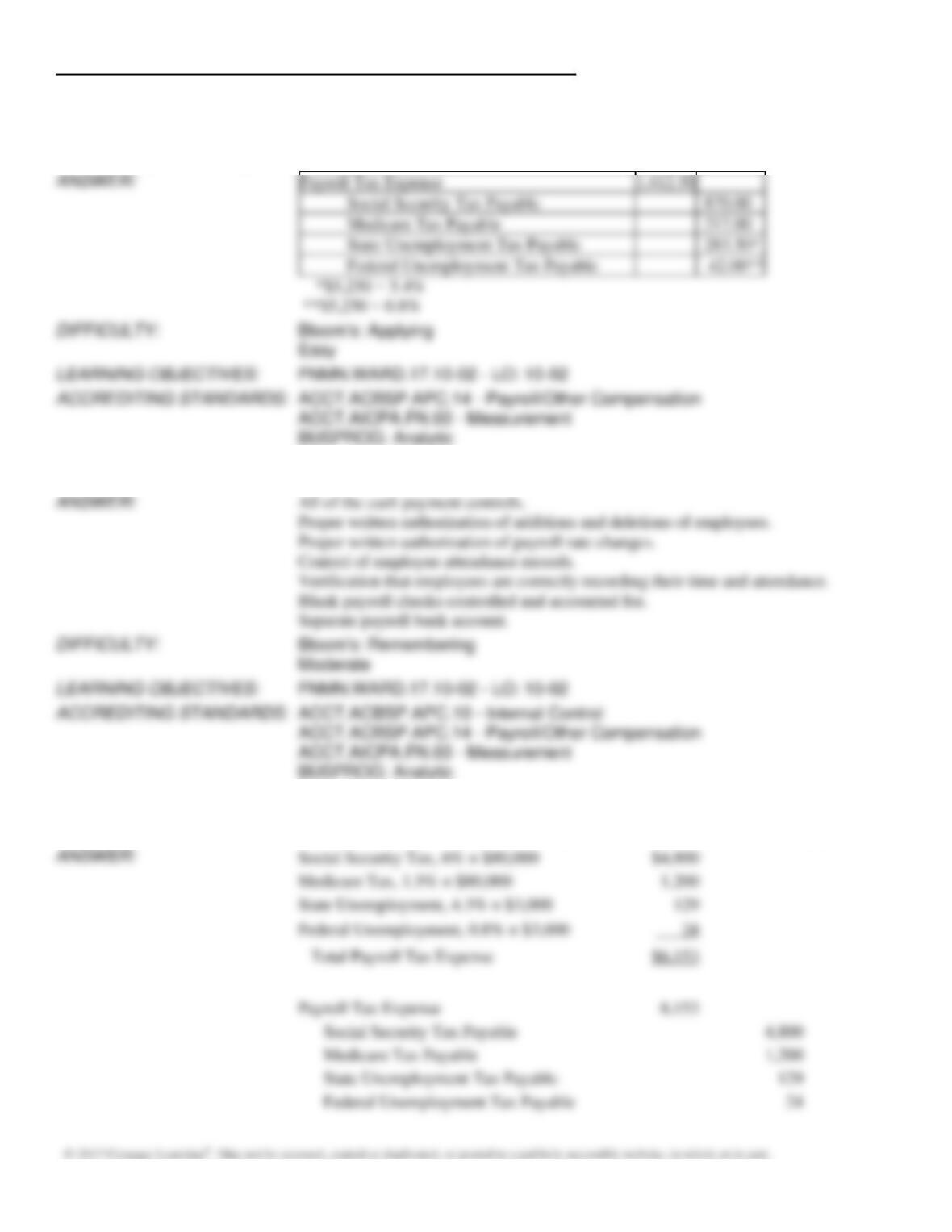
152. The payroll register of Seaside Architecture Company indicates $870 of social security and $217 of Medicare tax
withheld on total salaries of $14,500 for the period. Assume earnings subject to state and federal unemployment
compensation taxes are $5,250 at the federal rate of 0.8% and state rate of 5.4%. Prepare the journal entry to record the
payroll tax expense for the period.
153. List five internal controls that relate directly to payroll.
154. The payroll summary for December 31 for Waters Co. revealed total earnings of $80,000. All earnings are subject to
social security tax of 6.0% and Medicare tax of 1.5%. Journalize the entry to record the accrual of employer payroll taxes.
Chapter 10 – Liabilities: Current, Installment Notes, and Contingencies
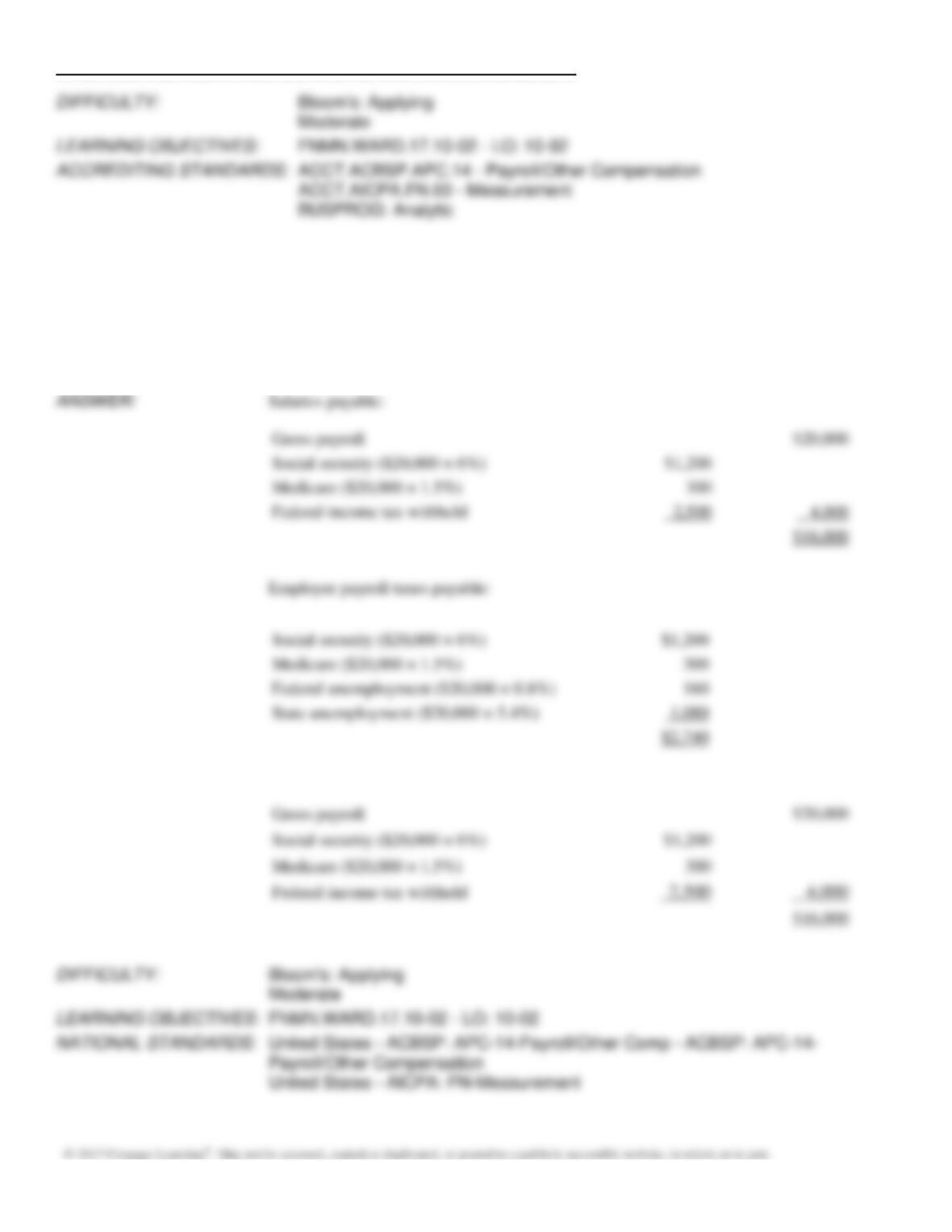
155. Perez Company has the following information for the pay period of January 15–31.
Gross payroll
$20,000
Federal income tax withheld
$2,500
Social security rate
6%
Federal unemployment tax rate
0.8%
Medicare rate
1.5%
State unemployment tax rate
5.4%
Assuming no employees are subject to ceilings for their earnings, calculate salaries payable and employer payroll taxes
payable.
Chapter 10 – Liabilities: Current, Installment Notes, and Contingencies
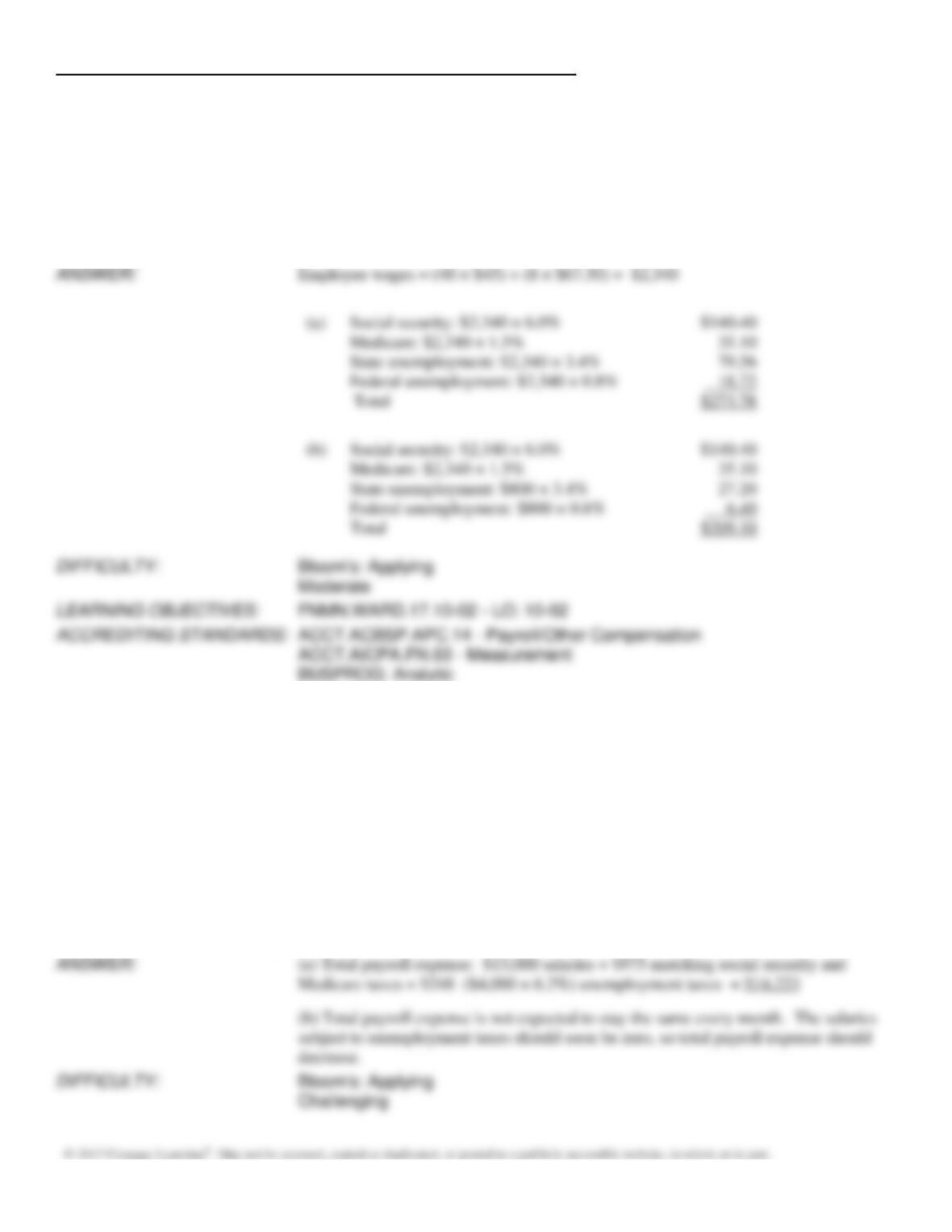
156. An employee receives an hourly rate of $45, with time and a half for all hours worked in excess of 40 during the
week. Payroll data for the current week are as follows: hours worked, 48; federal income tax withheld, $950; Social
security tax rate, 6.0%; and Medicare tax rate, 1.5%; state unemployment compensation tax, 3.4% on the first $7,000;
federal unemployment compensation tax, 0.8% on the first $7,000.
Calculate the employer’s payroll tax expense if:
(a) this is the first payroll of the year and the employee has no cumulative earnings for the year to date.
(b) the employee’s cumulative earnings for the year prior to this week equal $6,200.
157. The following totals for the month of February were taken from the payroll register of Arcon Company:
Salaries expense
$13,000
Social security and Medicare taxes withheld
975
Income taxes withheld
2,600
Retirement savings
500
Salaries subject to federal and state unemployment taxes of 6.2%
4,000
(a) How much is the total payroll expense for Arcon Company for this payroll?
(b) Assume that the monthly salaries expense remains the same for the entire year and no employees are hired or fired
during that time. Based on what you learned in this chapter about payroll taxes, do you expect the total payroll expense to
stay the same every month? Explain.
Chapter 10 – Liabilities: Current, Installment Notes, and Contingencies
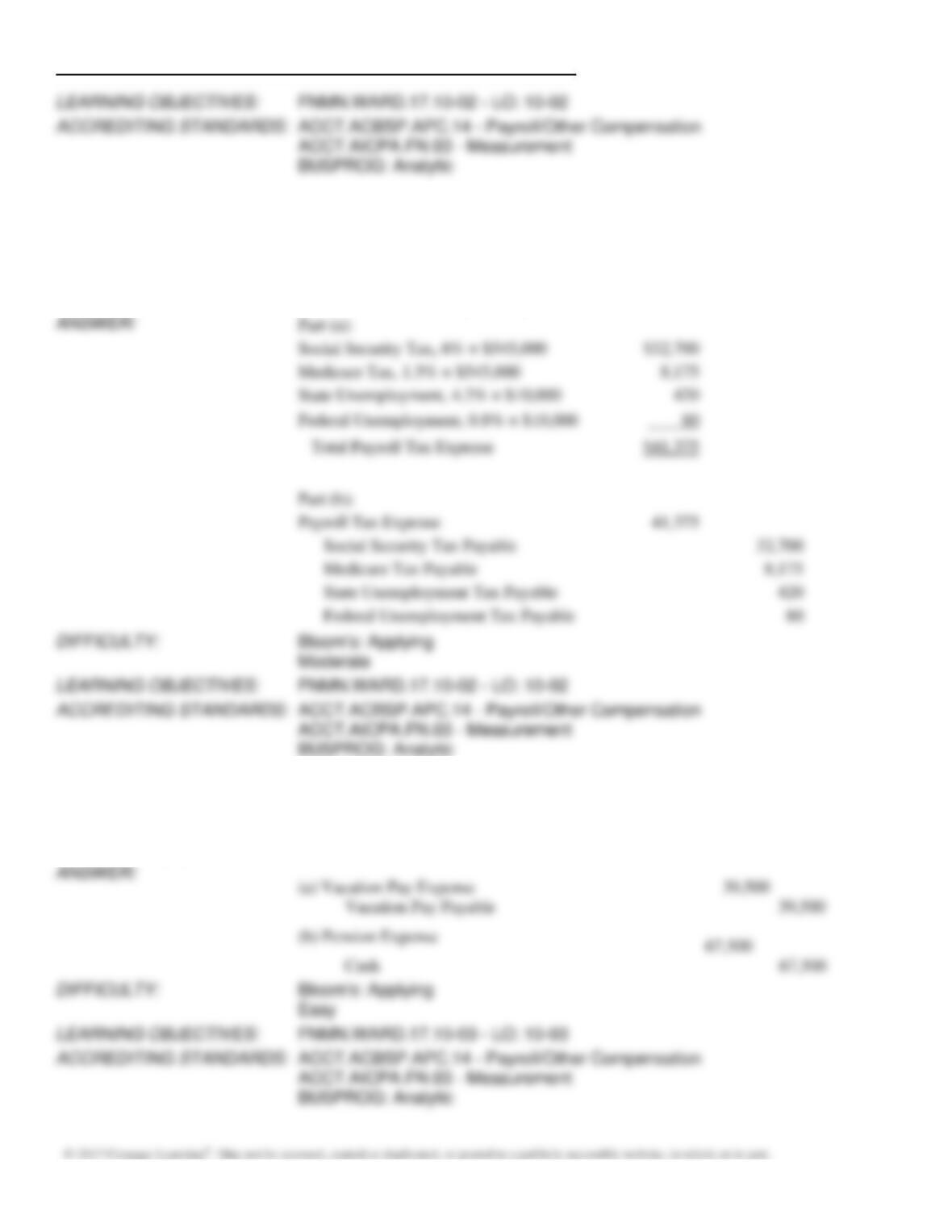
158. According to a summary of the payroll of Sinclair Company, $545,000 was subject to the 6.0% social security tax
and the 1.5% Medicare tax. Also, $10,000 was subject to state and federal unemployment taxes.
(a)
Calculate the employer’s payroll taxes using the following rates: State unemployment, 4.2%; Federal
unemployment, 0.8%.
(b)
Journalize the entry to record the accrual of the employer’s payroll taxes.
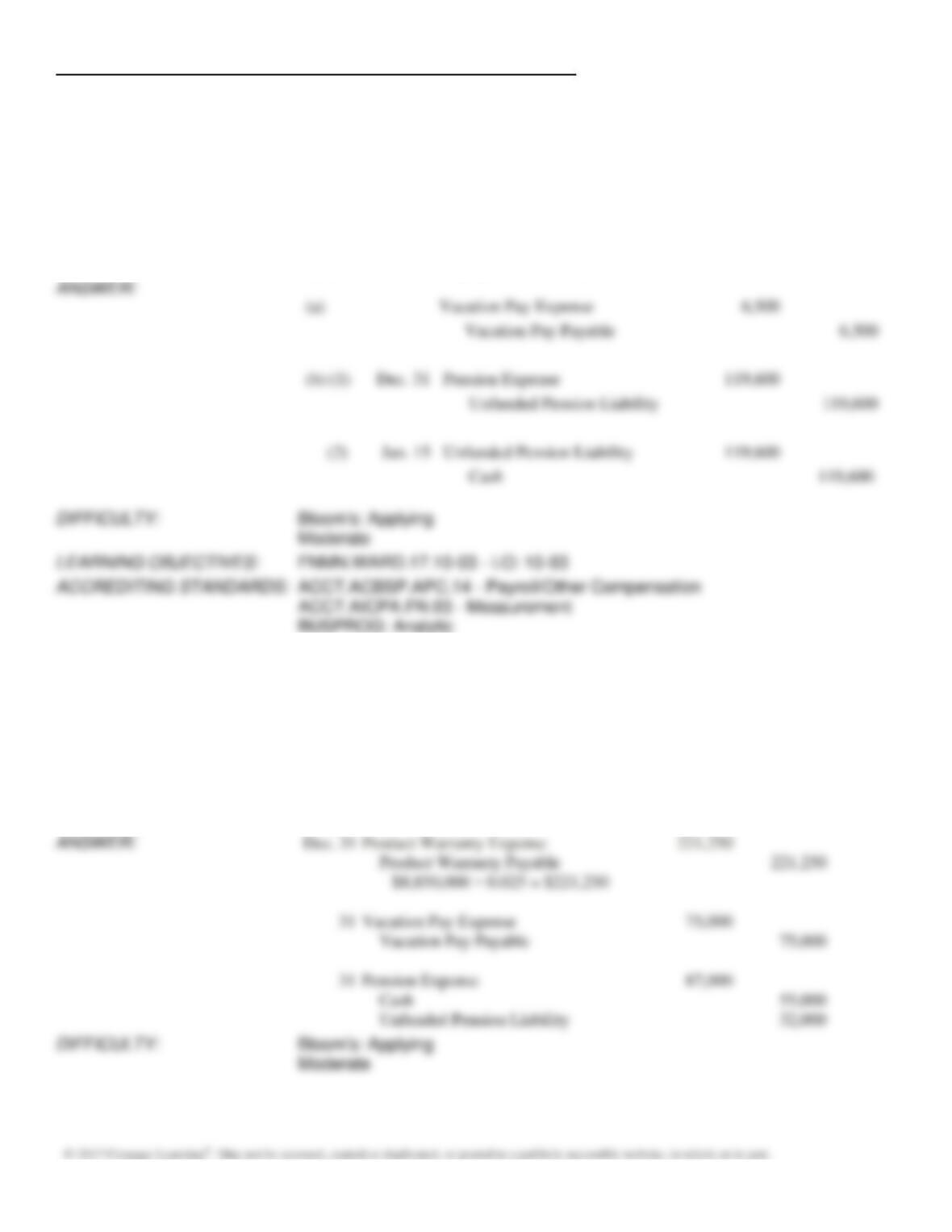
159. Martin Services Company provides its employees vacation benefits and a defined contribution pension
plan. Employees earned vacation pay of $39,500 for the period. The pension plan requires a contribution to the plan
administrator equal to 9% of employee salaries. Salaries were $750,000 during the period. Provide the journal entries for
(a) the vacation pay and (b) the pension benefit.
(a) Vacation Pay Expense
Vacation Pay Payable
Cash
Chapter 10 – Liabilities: Current, Installment Notes, and Contingencies
160. Below are two independent sets of transactions for Welcott Company:
(a) Welcott provides its employees with varying amounts of vacation per year, depending on the length of
employment. The estimated amount of the current year’s vacation pay is $78,000. Journalize the adjusting entry required
on January 31, the end of the first month of the year, to record the accrued vacation pay.
(b) Welcott maintains a defined contribution pension plan for its employees. The plan requires quarterly installments to
be paid to the funding agent, Northern Trust, by the fifteenth of the month following the end of each quarter. Assuming
that the pension cost is $119,600 for the quarter ended December 31, journalize entries to record (1) the accrued pension
liability on December 31 and (2) the payment to the funding agent on January 15.
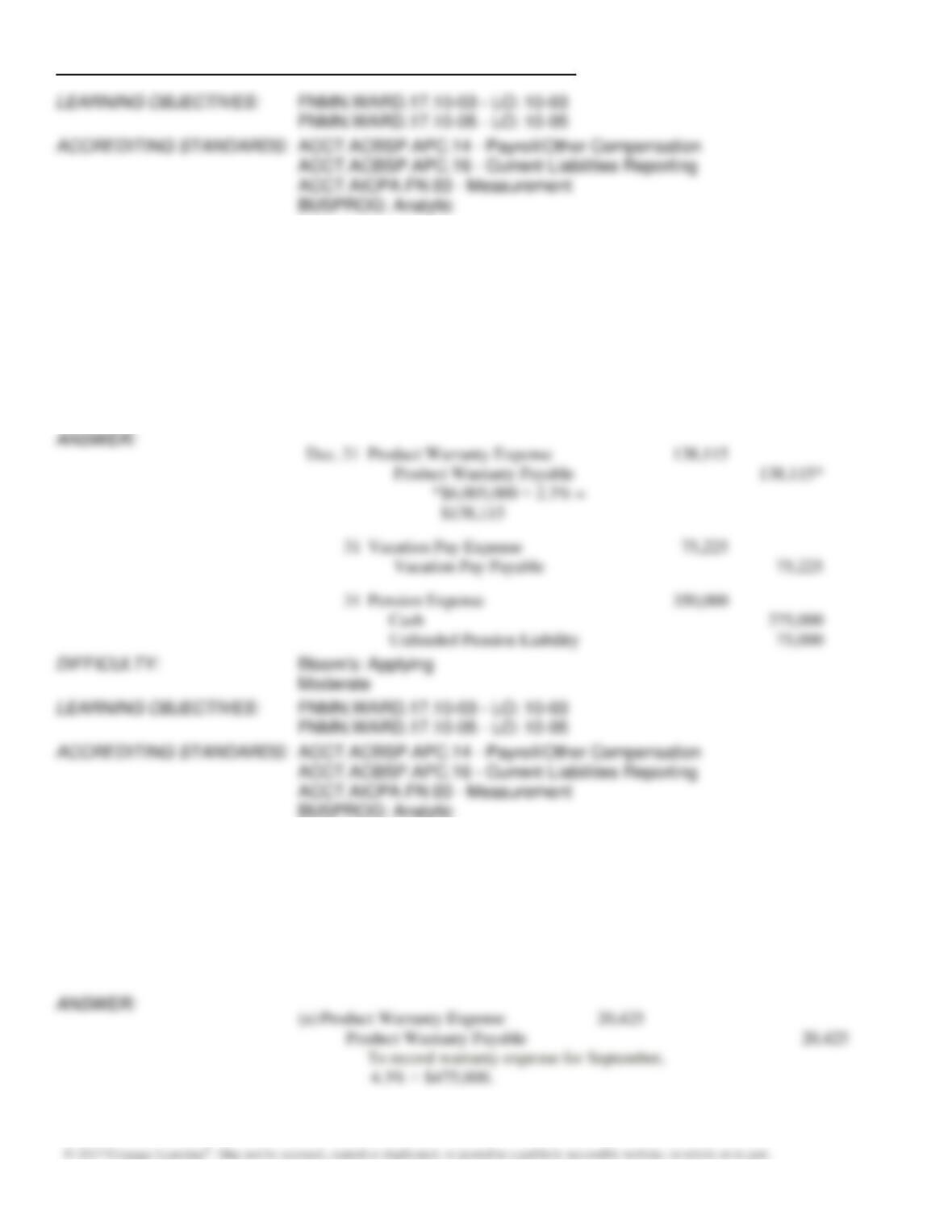
161. Journalize the following transactions for Riley Corporation:
Dec. 31
The accrued product warranty expense for the year is estimated to be 2.5% of
sales. Sales for the year totaled $8,850,000.
31
The accrued vacation pay for the year is estimated to be $75,000.
31
Paid First Insurance Co. $55,000 as fund trustee for the pension plan. The annual
pension cost is $87,000.
Product Warranty Payable
$8,850,000 × 0.025 = $221,250
Vacation Pay Expense
Vacation Pay Payable
Pension Expense
Cash
Unfunded Pension Liability
Chapter 10 – Liabilities: Current, Installment Notes, and Contingencies
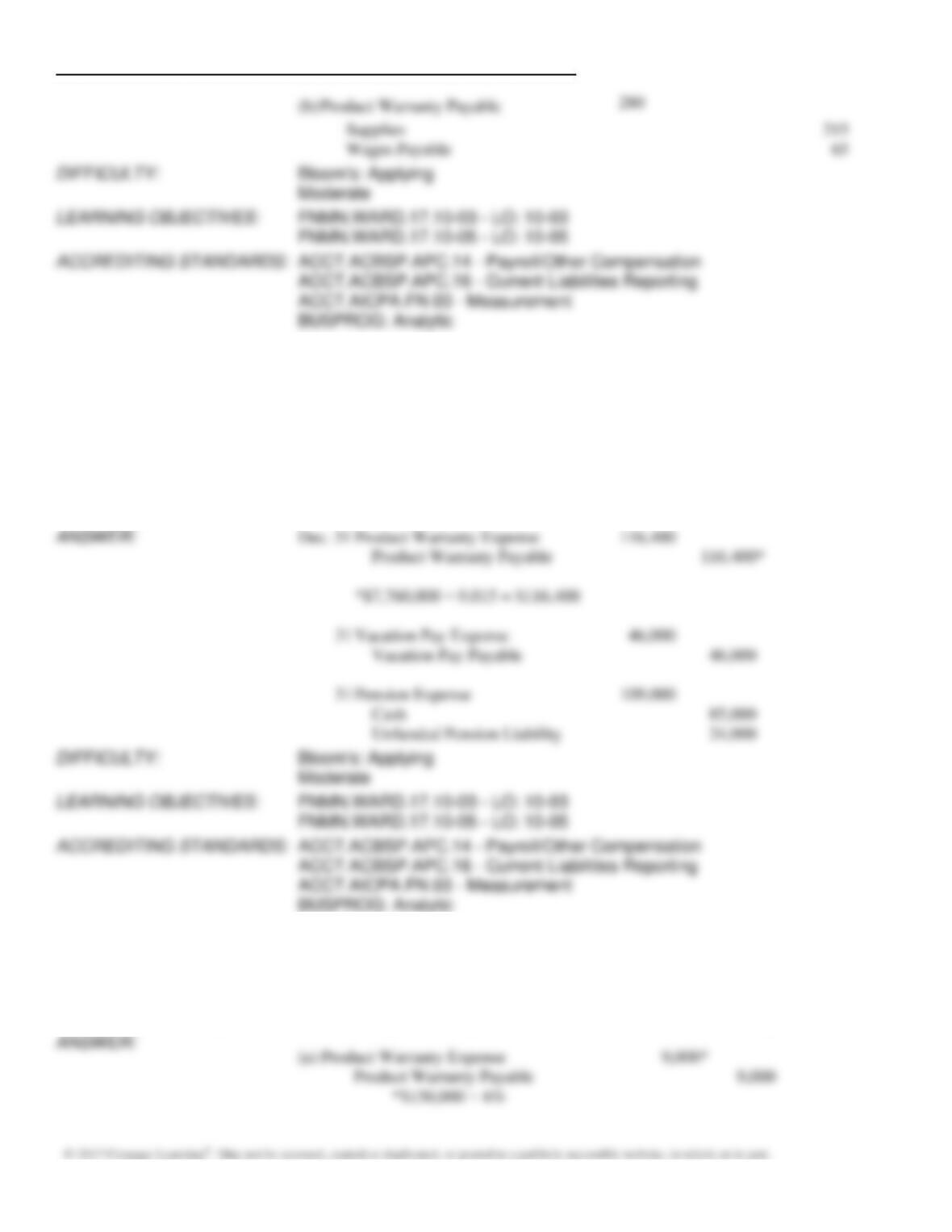
162. Kelly Howard has the following transactions. Prepare the journal entries.
Dec. 31
The accrued product warranty expense for the year is estimated to be 2.3% of sales. Sales for the
year totaled $6,005,000.
31
The accrued vacation pay for the year is estimated to be $75,225.
31
Paid Reliable Insurance Co. $275,000 as fund trustee for the pension plan. The annual pension
cost is $350,000.
Product Warranty Expense
Product Warranty Payable
*$6,005,000 × 2.3% =
$138,115
Vacation Pay Expense
Vacation Pay Payable
Pension Expense
Cash
Unfunded Pension Liability
163. Nelson Industries warrants its products for one year. The estimated product warranty is 4.3% of sales. Sales were
$475,000 for September. In October, a customer received warranty repairs requiring $215 of parts and $65 of labor.
(a)
Journalize the adjusting entry required at September 30, the end of the first month of
the current year, to record the estimated product warranty expense.
(b)
Journalize the entry to record the warranty work provided in October.
(a)
Product Warranty Expense
Product Warranty Payable
To record warranty expense for September,
Chapter 10 – Liabilities: Current, Installment Notes, and Contingencies
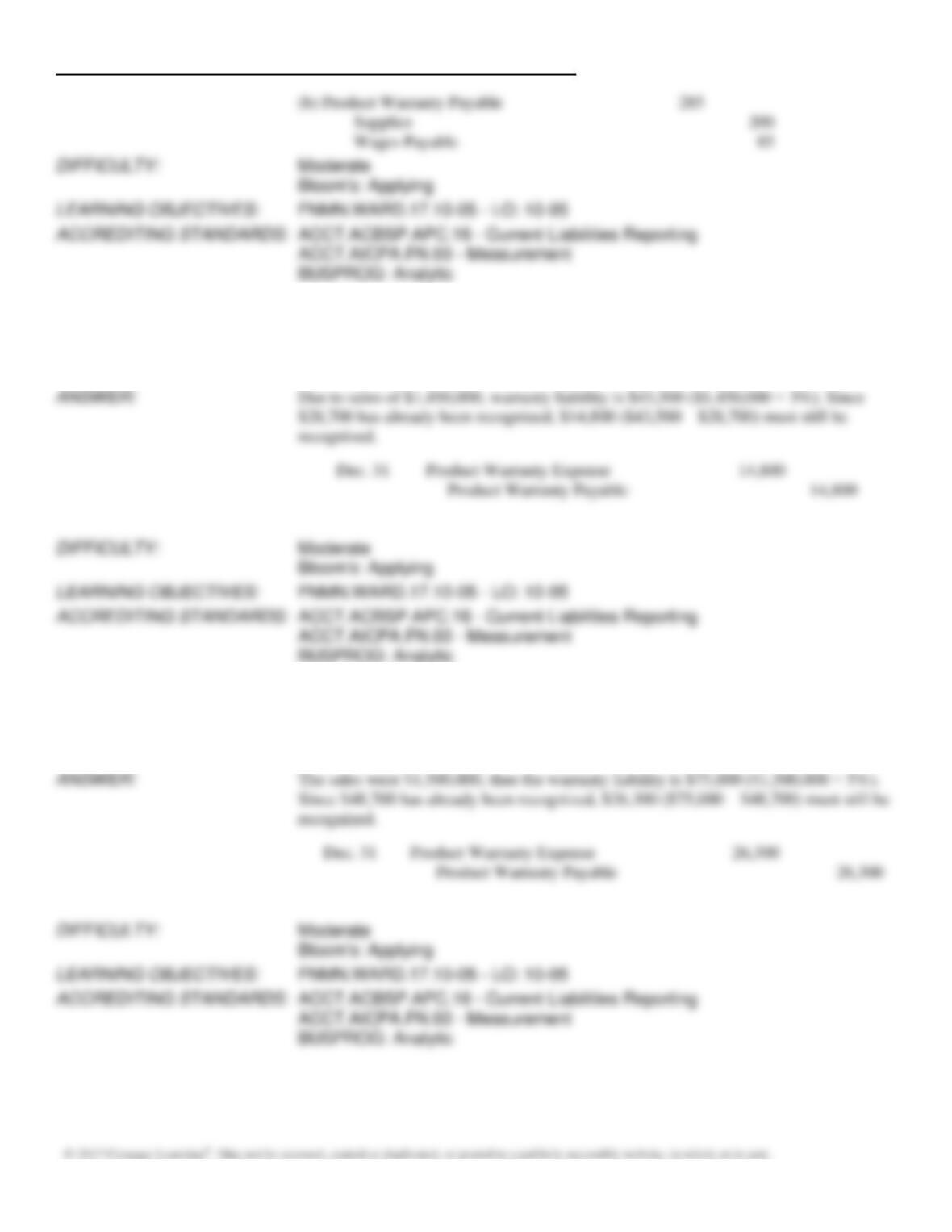
164. Journalize the following transactions:
Dec. 31
The accrued product warranty expense for the year is estimated to be 1.5% of
sales. Sales for the year totaled $7,760,000.
31
The accrued vacation pay for the year is estimated to be $46,000.
31
Paid Reliable Insurance Co. $85,000 as fund trustee for the pension plan. The annual
pension cost is $109,000.
Product Warranty Expense
Product Warranty Payable
*$7,760,000 × 0.015 = $116,400
Vacation Pay Expense
Vacation Pay Payable
Pension Expense
Cash
Unfunded Pension Liability
165. Ecco Company sold $150,000 of kitchen appliances with six-month warranties during September. The cost to repair
defects under the warranty is estimated at 6% of the sales price. On October 15, a customer required a $200 part
replacement, plus $85 labor under the warranty.
Provide the journal entry for (a) the estimated expense on September 30 and (b) the October 15 warranty work.
(a) Product Warranty Expense
9,000*
Supplies
Wages Payable
Chapter 10 – Liabilities: Current, Installment Notes, and Contingencies
166. Florida Keys Construction installs swimming pools. It calculates that warranty obligations are 3% of sales. For the
year just ending, Florida Keys’ sales were $1,450,000. Previous quarterly entries debiting Product Warranty Expense
totaled $28,700. Determine the estimated warranty expense for the year and make the journal entry necessary to bring the
account to the needed balance.
167. Aqua Construction installs swimming pools. It calculates that warranty obligations are 5% of sales. For the year just
ending, Aqua’s sales were $1,500,000. Previous quarterly entries debiting Product Warranty Expense totaled $48,700.
Determine the estimated warranty expense for the year and make the journal entry necessary to bring the account to the
needed balance.
Chapter 10 – Liabilities: Current, Installment Notes, and Contingencies
168. Lamar Industries warrants its products for one year. The estimated product warranty expense is 3% of sales. Sales
for June were $190,000. In July, a customer received warranty repairs requiring $185 of parts and $50 of labor.
(a)
Journalize the adjusting entry required at June 30, the end of the first month of the
current year, to record the estimated product warranty expense.
(b)
Journalize the entry to record the warranty work provided in July.
(a)
Product Warranty Expense
Product Warranty Payable
To record warranty expense for June,
3% × $190,000.
(b)
Product Warranty Payable
Supplies
Wages Payable
169. Several months ago, Jones Company experienced a spill of hazardous materials into the White River from one of its
plants. As a result, the Environmental Protection Agency (EPA) fined the company $405,000. The company contested
the fine. In addition, an employee is seeking $180,000 damages related to the spill. Finally, a homeowner has sued the
company for $260,000. Although the homeowner lives 30 miles downstream from the plant, he believes that the spill has
reduced his home’s resale value by $260,000.
Jones’ legal counsel believes the following will happen in relationship to these incidents:
(a)
It is probable that the EPA fine will stand.
(b)
An out–of court-settlement for $165,000 has recently been reached with the employee,
with the final papers to be signed next week.
(c)
Counsel believes that the homeowner’s case is weak and will be decided in favor of
Jones Company.
(d)
Other litigation related to the spill is possible, but the damage amounts are uncertain.
(1)
Based on this information, journalize the contingent liabilities associated with the
spill. Use the account “Damage Awards and Fines” to recognize the expense for the
period.
(2)
Prepare any note disclosure related to the spill.
(1)
Damage Awards and Fines
EPA Fines Payable
405,000
Litigation Claims Payable
165,000
statement under “Other expenses.”
Chapter 10 – Liabilities: Current, Installment Notes, and Contingencies
170. Several months ago, Maximilien Company experienced a spill of radioactive materials into the Missouri River from
one of its plants. As a result, the Environmental Protection Agency (EPA) fined the company $1,750,000. The company
contested the fine. In addition, an employee is seeking $975,000 damages related to the spill. Finally, a homeowner has
sued the company for $580,000. Although the homeowner lives 15 miles downstream from the plant, he believes that the
spill has reduced his home’s resale value by $580,000.
Maximilien’s legal counsel believes the following will happen in relationship to these incidents:
(a)
It is probable that the EPA fine will stand.
(b)
An out–of-court settlement for $650,000 has recently been reached with the employee,
with the final papers to be signed next week.
(c)
Counsel believes that the homeowner’s case is weak and will be decided in favor of
Maximilien Company.
(d)
Other litigation related to the spill is possible, but the damage amounts are uncertain.
(1)
Based on this information, prepare the journal entries for the contingent liabilities
associated with the spill. Use the account “Environmental Awards and Fines” to
recognize the expense for the period.
(2)
Prepare any note disclosure related to the spill.
(1)
Damage Awards and Fines
EPA Fines Payable
Litigation Claims Payable
Chapter 10 – Liabilities: Current, Installment Notes, and Contingencies
171. Hadley Industries warrants its products for one year. The estimated product warranty expense is 4% of
sales. Assume that sales were $210,000 for June. In July, a customer received warranty repairs requiring $205 of parts
and $75 of labor.
(a)
Journalize the adjusting entry required at June 30, the end of the first month of the
current year, to record the estimated product warranty expense.
(b)
Journalize the entry to record the warranty work provided in July.
(a)
Product Warranty Expense
8,400
Product Warranty Payable
8,400
4% × $210,000.
(b)
Product Warranty Payable
280
Supplies
Wages Payable
Chapter 10 – Liabilities: Current, Installment Notes, and Contingencies
172. The current assets and current liabilities for Kolbie Company and Newton Company are as follows:
Kolbie Company
( in millions)
For the Year Ending
December 31
Newton Company
(in millions)
For the Year Ending
December 31
Current assets:
Cash and cash equivalents
$ 8,352
$ 8,546
Short-term investments
6,034
752
Accounts receivable
3,029
5,152
Inventories
446
660
Other current assets*
2,195
2,829
Total current assets
$20,056
$17,939
Current liabilities:
Accounts payable
$4,970
$10,430
Accrued and other current liabilities
3,329
6,361
Total current liabilities
$8,299
$16,791
*These represent prepaid expenses and other non-quick current assets.
(a) Determine the quick ratio for both companies. Round to two decimal places.
(b) Interpret the quick ratio difference between the two companies.
(a) Quick ratio = Quick assets/Current liabilities
Kolbie Co.:
Quick ratio = ($8,352 + $6,034 + $3,029)/$8,299 = 2.10
Newton Co.:
Quick ratio = ($8,546 + $752 + $5,152)/$16,791 = 0.86
Chapter 10 – Liabilities: Current, Installment Notes, and Contingencies
173. The Core Company had the following assets and liabilities as of December 31:
ASSETS
Cash
$58,000
Accounts receivable
25,000
Inventory
20,000
Equipment
50,000
LIABILITIES
Current portion of long-term debt
20,000
Accounts payable
12,000
Long-term debt
25,000
Calculate the current ratio, working capital, and quick ratio. Round ratios to one decimal place.
174. Use the following information and calculate the quick ratio for Davis Company and for Bender Inc.
(a)
Calculate the quick ratio for each company. Round ratios to two decimal places.
(b)
Comment on which one is more able to meet current liabilities.
Davis Co.
Bender Inc.
Account
Dr.
Cr.
Dr.
Cr.
Cash
$ 321
$ 425
Cash equivalents
88
95
Current notes receivable
56
46
Accounts receivable
603
307
Prepaid expenses
55
85
Inventory
714
898
Fixed assets
920
755
Accumulated depreciation—Fixed assets
$ 415
$ 225
Accounts payable
260
198
Current accrued liabilities
213
149
Mortgage payable
917
824
Capital
952
1,215
Total
$2,757
$2,757
$2,611
$2,611
Bender Inc. Quick ratio: $873 ÷ $347 = 2.52
(b)
Bender Inc. is more liquid.
Chapter 10 – Liabilities: Current, Installment Notes, and Contingencies
175. For Company A and Company B:
(a)
Calculate the quick ratio for each company. Round ratios to two decimal places.
(b)
Comment on which one is more able to meet current liabilities.
Company A
Company B
Account
Dr.
Cr.
Dr.
Cr.
Cash
$21
$25
Cash equivalents
8
10
Trade notes receivable
7
6
Accounts receivable
6
7
Prepaid expenses
5
5
Inventory
14
8
Fixed assets
20
55
Accumulated depreciation—Fixed assets
$ 5
$25
Accounts payable
26
8
Current accrued liabilities
13
19
Mortgage payable
17
24
Capital
20
40
Total
$81
$81
$116
$116
(a)
Company A Quick ratio: $42 ÷ $39 = 1.08
Company B Quick ratio: $48 ÷ $27 = 1.78
(b)
Company B is more liquid.
176. On January 1, Yeargan Company obtained a $125,000, 7-year 5% installment note from Farmers Bank. The note
requires annual payments of $21,602, with the first payment occurring on the last day of the fiscal year. The first payment
consists of $6,250 interest and principal repayment of $15,352.
Journalize the following entries:
(a) Issued the installment note for cash on January 1.
(b) Paid the first annual payment on the note.
Chapter 10 – Liabilities: Current, Installment Notes, and Contingencies
DIFFICULTY:
Bloom’s: Applying
LEARNING OBJECTIVES:
FNMN.WARD.17.10-04 – LO: 10–04
Match each payroll item that follows to the one item (a–f) that best describes its characteristics.
a.
Amount is limited, withheld from employee only
b.
Amount is limited, withheld from employee and matched by employer
c.
Amount is limited, paid by employer only
d.
Amount is not limited, withheld from employee only
e.
Amount is not limited, withheld from employee and matched by employer
f.
Amount is not limited, paid by employer only
DIFFICULTY:
Bloom’s: Remembering
Easy
LEARNING OBJECTIVES:
FNMN.WARD.17.10-02 – LO: 10–02
ACCREDITING STANDARDS:
ACCT.ACBSP.APC.14 – Payroll/Other Compensation
ACCT.AICPA.BB.03 – Legal
ACCT.AICPA.FN.03 – Measurement
BUSPROG: Analytic
177. Federal income tax
178. FICA – Social security
179. FICA – Medicare
180. Federal unemployment compensation tax (FUTA)
181. State unemployment compensation tax (SUTA)

Chapter 10 – Liabilities: Current, Installment Notes, and Contingencies
Use the following key (a–d) to identify the proper treatment of each contingent liability.
a.
Record only
b.
Record and disclose
c.
Disclose only
d.
Do not record or disclose
DIFFICULTY:
Bloom’s: Remembering
Easy
LEARNING OBJECTIVES:
FNMN.WARD.17.10-05 – LO: 10–05
ACCREDITING STANDARDS:
ACCT.ACBSP.APC.16 – Current Liabilities Reporting
ACCT.AICPA.FN.03 – Measurement
BUSPROG: Analytic
182. Event is reasonably possible and amount is estimable
183. Event is reasonably possible but amount is not estimable
184. Event is probable and amount is estimable
185. Event is probable but amount is not estimable
186. Event is remote and amount is estimable
187. Event is remote and amount is not estimable
Match the following terms or phrases in (a–g) with the explanations in 1–8. Terms or phrases may be used more than
once.
a.
Current ratio
b.
Working capital
c.
Quick assets
d.
Quick ratio
e.
Record an accrual and disclose in the notes to the financial statements
f.
Disclose only in notes to financial statements
g.
No disclosure needed in notes to financial statements
DIFFICULTY:
Bloom’s: Remembering
Moderate
LEARNING OBJECTIVES:
FNMN.WARD.17.10-05 – LO: 10–05
FNMN.WARD.17.10-ADM – LO: 10–ADM
ACCREDITING STANDARDS:
ACCT.ACBSP.APC.16 – Current Liabilities Reporting
ACCT.ACBSP.APC.23 – Financial Statement Analysis
ACCT.AICPA.FN.03 – Measurement
BUSPROG: Analytic
Chapter 10 – Liabilities: Current, Installment Notes, and Contingencies
188. Current assets/Current liabilities
189. Remote contingent liability
190. Current assets – Current liabilities
191. Cash + Temporary investments + Accounts receivable
192. (Cash + Temporary investments + Accounts receivable)/Current liabilities
193. Probable likelihood and estimable liability
194. Probable likelihood of a liability but cannot be estimated
195. Reasonably possible likelihood of a liability
196. Measures the “instant” debt-paying ability of a company