
The Essential Cosmic Perspective, 8e (Bennett et al.)
Chapter 10 Other Planetary Systems: The New Science of Distant Worlds
10.1 Multiple Choice Questions
1) What is the chief difficulty in attempting to detect planets around other stars?
A) Even the largest planets are thousands of times smaller than their host stars.
B) Planets do not emit visible light, and they are typically at least a billion times fainter than
their host stars.
C) Planets do not glow in the infrared, so infrared telescopes cannot be used to study them,
either.
D) As viewed from Earth, planets often hide behind their stars and cannot be seen.
E) all of the above
2) What are the two primary methods by which planets have been found around other stars in our
galaxy?
I) Direct images in visible and infrared light
II) Indirectly by detecting the motion of the host star
III) Indirectly by measuring the drop in brightness of the host star when the planet crosses our
line of sight
A) I and II
B) I and III
C) II and III
3) The Doppler method of discovering extrasolar planets works best for
A) high mass planets far from their host star.
B) low mass planets far from their host star.
C) low mass planets close to their host star.
D) high mass planets close to their host star.
E) planets that have been ejected from their systems.
4) Statistical evidence suggests that at least ________ percent of all stars have at least one planet.
A) 30
B) 40
C) 50
D) 60
E) 70

5) Which of the following methods has led to the most confirmed discoveries of massive planets
orbiting near their parent stars?
A) detecting the starlight reflected off the planet
B) detecting the infrared light emitted by the planet
C) detecting the gravitational effect of an orbiting planet by looking for the Doppler shifts in the
star’s spectrum
D) detecting the shift of the star’s position against the sky due to the planet’s gravitational pull
E) detecting a planet ejected from a binary star system
6) Which of the following methods has led to the most discoveries of extrasolar planet
candidates?
A) detecting the dip in measured brightness as the planet crosses our line of sight to the star
B) detecting the infrared light emitted by the planet
C) detecting the gravitational effect of an orbiting planet by looking for the Doppler shifts in the
star’s spectrum
D) detecting the shift of the star’s position against the sky due to the planet’s gravitational pull
E) detecting a planet ejected from a binary star system
7) The Doppler method can be used to measure the orbital period of a planet by
A) measuring the speed at which the star orbits the mutual center-of-mass of the star and planet.
B) measuring the time it takes for the star’s line-of-sight velocity to cycle from peak to peak.
C) measuring the asymmetries in the velocity curve.
D) measuring the amount by which the starlight is reduced when the planet transits.
8) The Doppler method can be used to estimate the semimajor axis of a planet’s orbit by
A) measuring the speed at which the star orbits the mutual center-of-mass of the star and planet,
and using Newton’s theory of gravity.
B) measuring the time it takes for the star’s line-of-sight velocity to cycle from peak to peak, and
using Newton’s version of Kepler’s Third law.
C) measuring the asymmetries in the velocity curve.
D) measuring the amount by which the starlight is reduced when the planet transits.
9) The Doppler method can be used to measure the eccentricity of a planet’s orbit by
A) measuring the speed at which the star orbits the mutual center-of-mass of the star and planet,
and using Newton’s theory of gravity.
B) measuring the time it takes for the star’s line-of-sight velocity to cycle from peak to peak, and
using Newton’s version of Kepler’s Third law.
C) measuring the asymmetries in the velocity curve.
D) measuring the amount by which the starlight is reduced when the planet transits.

10) Planets detected via the Doppler method have been mostly
A) Earth-mass, in Earth-like orbits.
B) Jupiter-mass, in Jupiter-like orbits.
C) Jupiter-mass, in very close orbits.
D) Earth-mass, in very close orbits.
E) a wide range of masses, in edge-on orbits.
11) What is astrometry?
A) measuring distances to stars
B) searching for planets around stars
C) measuring the positions of stars on the sky
D) measuring the velocities of stars via the Doppler effect
E) using metric units for distance (e.g., meters rather than light-years)
12) The astrometric method of planet detection works best for
A) large planets around nearby stars.
B) massive planets around nearby stars.
C) large planets around distant stars.
D) massive planets around distant stars.
E) planets in edge-on orbits.
13) The transit method of planet detection works best for
A) big planets in edge-on orbits around small stars.
B) big planets in face-on orbits around small stars.
C) small planets in edge-on orbits around big stars.
D) small planets in face-on orbits around big stars.
E) Earth-like planets in any orbit.
14) The depth of the dip in a star’s brightness due to the transit of a planet depends most directly
on
A) the planet’s mass.
B) the planet’s density.
C) the planet’s size.
D) the size of the planet’s orbit.
E) the eccentricity of the planet’s orbit.

15) Which planet search technique is currently best suited to finding Earth-like planets?
A) Doppler
B) astrometric
C) transit
D) gravitational lensing
E) combining all of the above
16) Which two quantities need to be measured in order to determine the density of an extrasolar
planet?
A) mass and composition
B) orbital period and mass
C) radius and orbital period
D) radius and composition
E) mass and radius
17) What type of observation can astronomers use to measure the composition of an extrasolar
planet’s atmosphere?
A) comparisons of a star’s spectrum when the planet is in transit versus when it is eclipsed
B) measurements of the host star’s velocity throughout an orbital cycle
C) measurement of how frequently the planet blocks the host star’s light
D) combination of a transit observation and a Doppler shift measurement
18) What is the most accurate way to measure the surface temperature of an extrasolar planet?
A) estimate the temperature based on the planet’s mass
B) measure the drop in total infrared light when the planet passes behind the star
C) identify the planet’s peak wavelength of emission
D) identify the composition of the planet’s atmosphere through spectroscopy
E) calculate the size of the planet by the amount of light it blocks during transit
19) Most extrasolar planets discovered using the Doppler method
A) are more massive than Earth and orbit very far from the star.
B) are more massive than Earth and orbit very close to the star.
C) are less massive than Earth and orbit very far from the star.
D) are less massive than Earth and orbit very close to the star.
E) are found around neutron stars.

20) What must be true about the orbit of a planet discovered by the transit method?
A) The planet must be closer to its star than Mercury is to the Sun.
B) As seen from Earth, the planet’s orbit must be nearly perpendicular to our line of sight.
C) As seen from Earth, the planet’s orbit must be nearly parallel to our line of sight.
D) The planet’s orbit must be very close to circular.
E) The planet’s orbit must be very eccentric.
21) The reason that most extrasolar planets discovered by the Doppler method are found close to
their parent stars is
A) they transit more frequently, and have thus been more likely to be detected in the short time
we have been searching for them.
B) more of the starlight is blocked by the planet when it transits the star.
C) the wavelength shift of the star’s spectrum is larger.
D) the closer to a star, the hotter and therefore brighter the planet is.
E) planets that are close to a star are heated up and therefore larger.
22) The reason that most extrasolar planets discovered by the transit method are found close to
their parent stars is
A) they transit more frequently and are more likely to be detected in the short time we have been
searching for them.
B) more of the starlight is blocked by the planet when it transits the star.
C) the wavelength shift of the star’s spectrum is larger.
D) the closer to a star, the hotter and therefore brighter the planet is.
E) planets that are close to a star are heated up and therefore larger.
23) Statistical evidence suggests that about ________ percent of all stars have an approximately
Earth-sized planet orbiting in a region around the star where water could exist as a liquid on the
planet’s surface.
A) 10
B) 20
C) 30
D) 40
24)
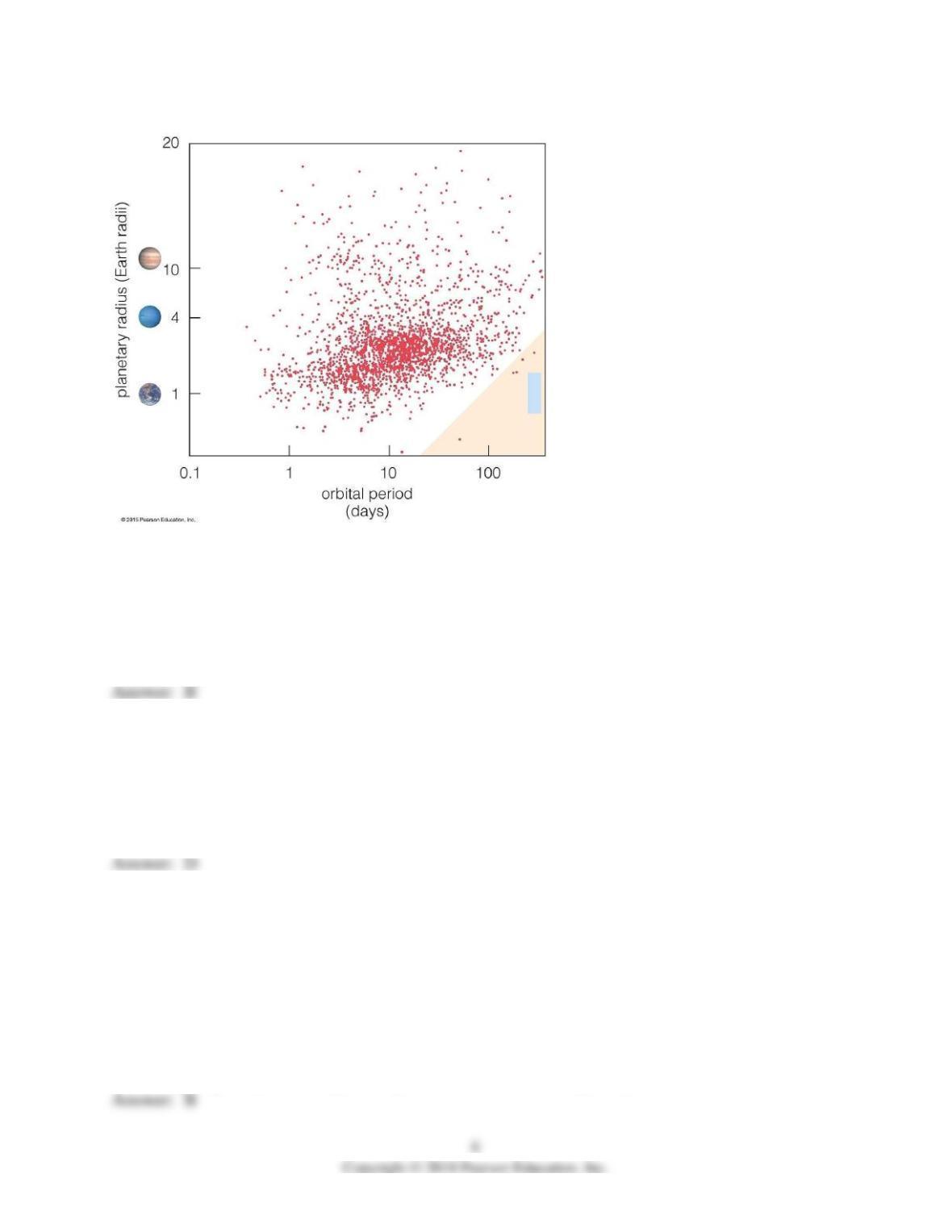
This figure shows the orbital periods and radii of all planet candidates identified from Kepler
data as of early 2013. Which of the following size planets were most detected?
A) planets less than 1 Earth radius in size
B) planets between 1 Earth radius and 4 Earth radii in size
C) planets between 4 Earth radii and 10 Earth radii in size
D) planets greater than 10 Earth radii in size
25) Extrasolar planets have been discovered with average densities similar to
A) styrofoam.
B) water.
C) iron.
D) all of the above
E) none of the above
26) The planet HAT-P-32b has more than twice the radius of Jupiter, yet is only the same mass.
It orbits its star more than a factor of ten closer than Mercury’s orbit around the Sun. Which is
the most plausible explanation for its large size?
A) The mass measurement is mistaken, and it is actually about 10 times more massive than
Jupiter.
B) Planets that are close to a star are puffed up and therefore larger.
C) It is made of elements other than hydrogen and helium which do not compress under their
own gravity.
D) The hydrogen and helium gas compressed under their own gravity.

27) The planet COROT-14b is only slightly larger than Jupiter, but is several times more
massive. Which is the most plausible explanation for its similar size to Jupiter?
A) The mass measurement is mistaken, and it is actually about 10 times more massive than
Jupiter.
B) Planets that are close to a star are puffed up and therefore larger.
C) It is made of elements other than hydrogen and helium which do not compress under their
own gravity.
D) The hydrogen and helium gas compressed under their own gravity to a higher density than
Jupiter.
28) Why are many of the newly detected extrasolar planets called “hot Jupiters”?
A) Their masses and composition are similar to what we would expect if Jupiter were hotter.
B) The planets tend to be detected around more massive, hotter stars than our Sun.
C) Their masses are similar to Jupiter but they are very close to the central star and therefore hot.
D) Their masses are similar to Jupiter but their composition is similar to Mercury.
E) The discovery of new planets is very exciting.
29) How do we think the “hot Jupiters” around other stars were formed?
A) They formed as gas giants close to the star in the same orbits that they are seen today.
B) They formed as dense, rocky planets close to the star in the same orbits that they are seen
today.
C) They formed as gas giants beyond the frost line and then migrated inwards.
D) Many planets were formed around the star but coalesced into a single planet close in.
30) Which of the following is a consequence of the discovery of hot Jupiters for the nebular
theory of solar system formation?
A) It has been discarded.
B) It has been modified to allow for the formation of gas giants within the frost line.
C) It has been modified to allow for planets to migrate inwards or outwards due to gravitational
interactions.
D) Its status is unclear and awaits further observations that will determine whether hot Jupiters
are dense Earth like planets or gas giants.

31) What might happen to the planets in a solar system where the central star did not have a
strong wind?
A) One planet would grow to dominate all the others and gravitationally eject them out of the
system.
B) All planets would continue to grow to large sizes but their orbits would be unchanged.
C) The gas in the solar nebula would create a drag on the planets and their orbits would migrate
inwards.
D) The gas in the solar nebula would create a drag on the planets and their orbits would migrate
outwards.
E) Nothing; the star does not affect the process of planet formation.
32) How does the theory of planetary migration in disks possibly account for the highly eccentric
orbits discovered for some extrasolar planets?
A) When migrating planets collide, they would move onto more eccentric orbits.
B) When migrating planets pass close enough for a gravitational encounter, one may be flung
from the system while the other is shifted to a highly elliptical orbit.
C) A migrating planet would create waves in the planet forming disk, which would in turn lead
to the formation of planets on highly elliptical orbits.
D) When a planet migrates onto the surface of the star, the additional stellar mass would disrupt
the orbits of the remaining planets.
33) What could happen in planetary systems where the nebular gas is quickly disbursed?
A) No terrestrial planets would form.
B) Large ice-rich planetesimals would not be able to gather hydrogen and helium and become
gas giants.
C) The only planets would be more massive than Jupiter.
D) Many planets would be destroyed by migration onto the central star.
34) A transiting extrasolar planet is observed to block 1% of its host star’s light. How does the
size of this planet compare to the host star?
A) The planet’s radius is 0.1% of the host star’s radius.
B) The planet’s radius is 1% of the host star’s radius.
C) The planet’s radius is 10% of the host star’s radius.
D) The planet is the same size as the host star.
Answer: C
10.2 True/False Questions
1) Astronomers have discovered more extrasolar planets around other stars than the number of
planets in our own solar system.

2) Most of the planets discovered around other stars have masses comparable to the terrestrial
planets in our own solar system.
3) The Doppler method for planet detection has found Earth-like planets around nearby Sun-like
stars.
4) A planet’s size can be determined by observing its transit across a star.
5) A planet’s density can be determined solely by observing it pass in front of its parent star.
6) Once a planet forms in a disk-like nebula around a star, its orbit is fixed and will never
change.
7) Most extrasolar planets discovered so far have densities similar to Styrofoam.
8) Unless the planet transits its star, planetary masses measured using the Doppler method are
lower limits to the possible planetary mass.
9) The majority of extrasolar planets are estimated to be gas giants.
10) Only Earth-size terrestrial planets and Jupiter-size gas giants have been discovered in other
planetary systems.
10.3 Process of Science Questions
1) Predictions for Extrasolar Planets: What predictions does the solar nebula theory make
regarding possible planetary systems surrounding other stars? Discuss at least two such
predictions that have been strongly confirmed by observations. Explain how the detection of “hot
Jupiter” extrasolar planets seemed to be a striking inconsistency with the solar nebula theory. Do
you think astronomers were justified in modifying the solar nebula theory in the face of such
evidence as opposed to discarding the theory altogether?
2) Discoveries force theory revisions: The discovery of “hot Jupiters” forced scientists to revise
the nebular theory of solar system formation. Think of a hypothetical discovery that would force
further revisions of the theory of planet formation, and explain why this observation would
contradict the theory.
3) Kepler’s Impact: In four years of operation, the Kepler satellite discovered nearly three times
as many extrasolar planet candidates as had been discovered in the previous 15 years (since the
first discovery of an extrasolar planet). Discuss how these observations changed our
understanding of the population of planets and of planet formation.
10.4 Short Answer Questions
1) Why is it so difficult to make a direct image of a planet around another star?
2) Briefly describe the three most commonly used methods of indirect planet detection.
3) The star Rho Cancri B has about the same mass as our Sun, and the planet discovered around
it orbits somewhat closer than Mercury orbits our Sun. The mass of the planet is estimated to be
1.1 times the mass of Jupiter. Why, according to our theory of solar system formation, is it
surprising to find a planet the size of Rho Cancri B’s planet orbiting at this distance?
4) Describe the impact the discovery of extrasolar planets has had on understanding the origin of
our own solar system.
10.5 Mastering Astronomy Reading Quiz
1) What is an “extrasolar planet”?
A) a planet that orbits a star that is not our own Sun
B) a planet that is larger than the Sun
C) a planet that is extra large compared to what we’d expect
D) a planet that is considered an “extra,” in that it was not needed for the formation of its solar
system
2) Direct detection of an extrasolar planet means ________.
A) acquiring images or spectra of the planet
B) sending a space probe to the planet
C) observing the planet’s effect on its host star
D) seeing the planet with the naked eye
3) Indirect detection of an extrasolar planet means ________.
A) acquiring images or spectra of the planet
B) sending a space probe to the planet
C) observing the planet’s effect on its host star
D) seeing the planet with the naked eye
4) In order to be able to directly see the Sun’s motion due to Jupiter’s gravity, an observer at a
distance of 10 light-years would need to be able to measure changes in its position of ________.
A) 0.0005 arcsecond
B) 0.005 arcsecond
C) 0.05 arcsecond
D) 0.5 arcsecond

5) A star with planets orbiting in a plane that is not face-on to our line-of-sight exhibit a Doppler
effect due to ________.
A) the light emitted by the moving planets
B) the light reflecting from the moving planets
C) the planet’s mass shifting the path of light from the star
D) the planet gravitationally tugging the star
6) What is a so-called “hot Jupiter”?
A) a planet with a mass similar to Jupiter but composition similar to Mercury
B) a planet with a mass and composition similar to what we would expect if Jupiter were hotter
C) a planet with a mass similar to Jupiter but very close to the central star and therefore hot
D) a Jupiter mass planet orbiting a star that is more massive and hotter than the Sun
7) As of the time of the publication of the textbook, how many planets have been discovered
using the Doppler method?
A) 7
B) 70
C) 700
D) 7000
8) What is the transit method of finding extrasolar planets?
A) measuring the spectrum of the star for a periodic variation in its Doppler shift
B) monitoring a star to detect periodic dips in its brightness from the planet passing in front of
the star
C) monitoring a star to detect periodic dips in its brightness from the planet passing behind the
star
D) observing a star during the rare occasion of another star passing directly in front of it; slight
changes in how the light is bent by gravity can indicate the presence of planets around the closer
star
9) As of the time of the publication of the textbook, how many planet candidates have been
discovered using the transit method?
A) about 10
B) a few hundred
C) a few thousand
D) tens of thousands

10) In essence, the Kepler mission searched for extrasolar planets by ________.
A) observing a star carefully enough to notice that it is experiencing a gravitational tug caused by
an unseen planet
B) obtaining high-resolution photographs of other star systems
C) identifying spectral lines that look like what we expect to see from a planet rather than a star
D) monitoring stars for slight dimming that might occur as unseen planets pass in front of them
11) How can astronomers measure the period of a planet’s orbit?
A) by timing the cycle of small changes in a stars position on the sky
B) by measuring the time between peaks in the star’s velocity curve
C) by measuring the time between repeated transits
D) all of the above
12) What must be true in order for astronomers to be able to use the Doppler method to
determine a planet’s true mass?
A) The planet’s orbit must be seen nearly face on.
B) The planet’s orbit must be viewed nearly edge on.
C) The planet must have a very eccentric orbit.
D) The planet must have a very low mass.
13) Using the transit method, how many times must a dip in the brightness of a star be observed
before it can qualify as an actual planet detection?
A) 1 time
B) 2 times
C) 3 times
D) 4 times
14) How can astronomers measure the composition of an extrasolar planet’s atmosphere?
A) by measuring the composition of the host star; the planet must have formed from the same
initial material
B) by measuring the Doppler shift of the host star
C) by measuring how brightly the planet glows in infrared light
D) by comparing spectra from when the planet is in transit with spectra taken at other times
15) What was so surprising about the first extrasolar planets discovered?
A) They were Jupiter-like planets orbiting very close to their stars.
B) They had very large eccentricities.
C) The systems only had one planet.
D) Their masses were similar to Earth’s mass.

16) Which of the following scenarios would allow an astronomer to measure the density of an
extrasolar planet?
A) The planet orbits so close to its star that it is puffed up and much larger than normal.
B) The mass of the planet can be measured using the Doppler method, and the planet also transits
its star.
C) The composition of the planet is determined using spectroscopy.
D) The minimum mass of the planet can be determined using the Doppler method.
17) Measured densities of extrasolar planets range from ________.
A) styrofoam to iron
B) styrofoam to water
C) water to iron
18) According to the nebular theory, where should jovian planets form?
A) at the inner edge of the planet forming disk, where even metal and rock evaporate
B) within the inner few AU of the disk, where only rocks and metals can condense
C) in the cold outer regions of the disk, where rocks, metals, and ices can condense
19) What mechanism explains the presence of “hot Jupiters” around other stars?
A) planetary migration caused by gravitational interactions with other planets, or with material in
the disk
B) rapid formation of the gas giant from evaporated rock and metal at the inner disk edge
C) evaporation of the disk by the stellar wind removes gas that was holding the planet at a large
distance from its star
D) gravitational attraction by terrestrial planets attract the giant planets inward
10.6 Mastering Astronomy Concept Quiz
1) Which of the following statements is not true about the planets so far discovered around other
stars?
A) Photographs reveal that most of them have atmospheres much like that of Jupiter.
B) Most of them are more massive than Earth.
C) Many of them orbit closer to their star than Jupiter orbits the Sun.
D) Many of them have been discovered by observing Doppler shifts in the spectra of the stars
they orbit.

2) Which new idea has been added into our theory of solar system formation as a result of the
discoveries of extrasolar planets?
A) Planets can migrate from the orbits in which they are born.
B) In addition to the categories of terrestrial and jovian, there must be an “in-between” category
of planet that has the mass of a jovian planet but the composition of a terrestrial planet.
C) In some star systems, it is possible for jovian planets to form in the inner solar system and
terrestrial planets to form in the outer solar system.
D) Some of the “exceptions to the rules” in our own solar system are likely to have been the
result of giant impacts.
3) You observe a star very similar to our own Sun in size and mass. This star moves very slightly
back and forth in the sky once every 4 months, and you attribute this motion to the effect of an
orbiting planet. What can you conclude about the orbiting planet?
A) The planet must be closer to the star than Earth is to the Sun.
B) The planet must have a mass about the same as the mass of Jupiter.
C) The planet must be farther from the star than Neptune is from the Sun.
D) You do not have enough information to say anything at all about the planet.
4) What mechanism likely accounts for whether a large icy planetesimal becomes a “water
world” or a gas giant?
A) the timing of when the stellar wind blows away the remaining gas of the planet forming
nebula
B) the migration of larger planets through the disk
C) the amount of heavy metals initially present in the disk
D) the presence of other planets to make its orbit highly eccentric
5) A star is seen to have two transiting planets. Planet 1 transits every 3 months, and Planet 2
transits every 15 months. What can we infer about their orbits?
A) Planet 2’s semimajor axis is larger than Planet 1’s.
B) Planet 1’s semimajor axis is larger than Planet 2’s.
C) Planet 2’s orbit is more eccentric than Planet 1’s.
D) Planet 1’s orbit is more eccentric than Planet 2’s.
6) Consider a star with 2 planets. The mass of planet A is the same as the mass of planet B. The
orbit of Planet A is on average, closer to the star than the orbit of Planet B. Which of the
following statements is true?
A) Planet A is, on average, moving faster than Planet B.
B) Planet A is, on average, moving slower than Planet B.
C) The relative orbital speeds depend on the masses of the planets.
D) Planet A moves with the same speed as Planet B.

7) Two stars with about the same mass are found to have transiting planets with similar semi-
major axes. Star 1 exhibits a Doppler shift twice as large as Star 2. What can we determine about
these two systems?
A) The planet around Star 1 is more massive than the planet around Star 2.
B) The planet around Star 2 is more massive than the planet around Star 1.
C) The planet around Star 1 has a thicker atmosphere than the planet around Star 2.
D) The planet around Star 2 has a thicker atmosphere than the planet around Star 1.
8) Based on statistical analysis of the extrasolar planets discovered so far, about 70% of stars
have at least one planet. How many planets can astronomers reasonably claim exist in the Milky
Way Galaxy?
A) at least 8
B) at least 3000
C) at least 70 billion
D) at least 1 trillion