Chapter 10 Test Bank KEY
1. The authors suggest that unions developed primarily in response to
2. Approximately what percentage of U.S. workers were union members in 2014?
3. Of the countries listed in the text, union membership as a percent of the labor force in 2013 was
greatest in
4. Which one of the following is generally not associated with relatively high levels of unionization?
10-2
5. As of 2014, which of the following U.S. industries was less than 10% unionized?
6. As of 2014, which of the following U.S. industries was more than 30% unionized?
7. White-collar workers
8. Women are much less likely to be union members than men. This is
9. Lower-paid workers potentially have more to gain from unionization. This fact explains why
10. Unions are most prevalent in the
10-4
11. Of the following, union membership is highest in
12. In which industry is the relatively high extent of unionism and union membership growth explained
by the favorable legislative climate of the 1960s and 1970s?
13. Which of the following is affiliated with Change to Win?
14. An example of a union federation is the
15. The level of union organization that is most likely to lobby congress for legislation that prohibits the
hiring of permanent strikebreakers is the
16. The level of union organization that is most likely to “organize the unorganized” is the
10-6
17. Which of the following is not a major responsibility of a national union?
18. The local union has primary responsibility for
19. Negotiating a contract with a firm and using that contract as a basis for demands made of other
employers is an example of
20. Negotiating a contract with a group of firms in an industry is an example of
21. If there are many employers in a localized market, multiemployer bargaining
22. Pattern bargaining is widely used in which industry?
23. Compared to the 1950s, current union membership as a percent of the labor force in the U.S. is
24. As a percentage of the U.S. labor force, union membership peaked in the 1940s at approximately
25. Union membership as a percentage of the labor force in the U.S.
26. Which one of the following hypotheses is not generally given as an explanation of the change in
relative union membership?
10-9
27. “The industry mix of national output has changed from manufacturing to services.” This fact is most
consistent with the
28. Over the last few decades, the composition of the labor force has changed to include a greater
proportion of women and younger workers. This fact is most consistent with the
29. Over the last few decades, industrial production has shifted from the Northeast and Midwest to the
South and Southwest regions of the U.S. This fact is most consistent with the
30. According to research by Neumann and Rissman, many government programs provide “union-like”
services, which has contributed to the decline of unionization. Their findings illustrate the
31. Studies by Farber and by Freeman suggest that
32. In response to declines in membership, unions have recently
33. Economists typically believe that the goal of a union is to
34. The “monopoly union” model assumes that the union
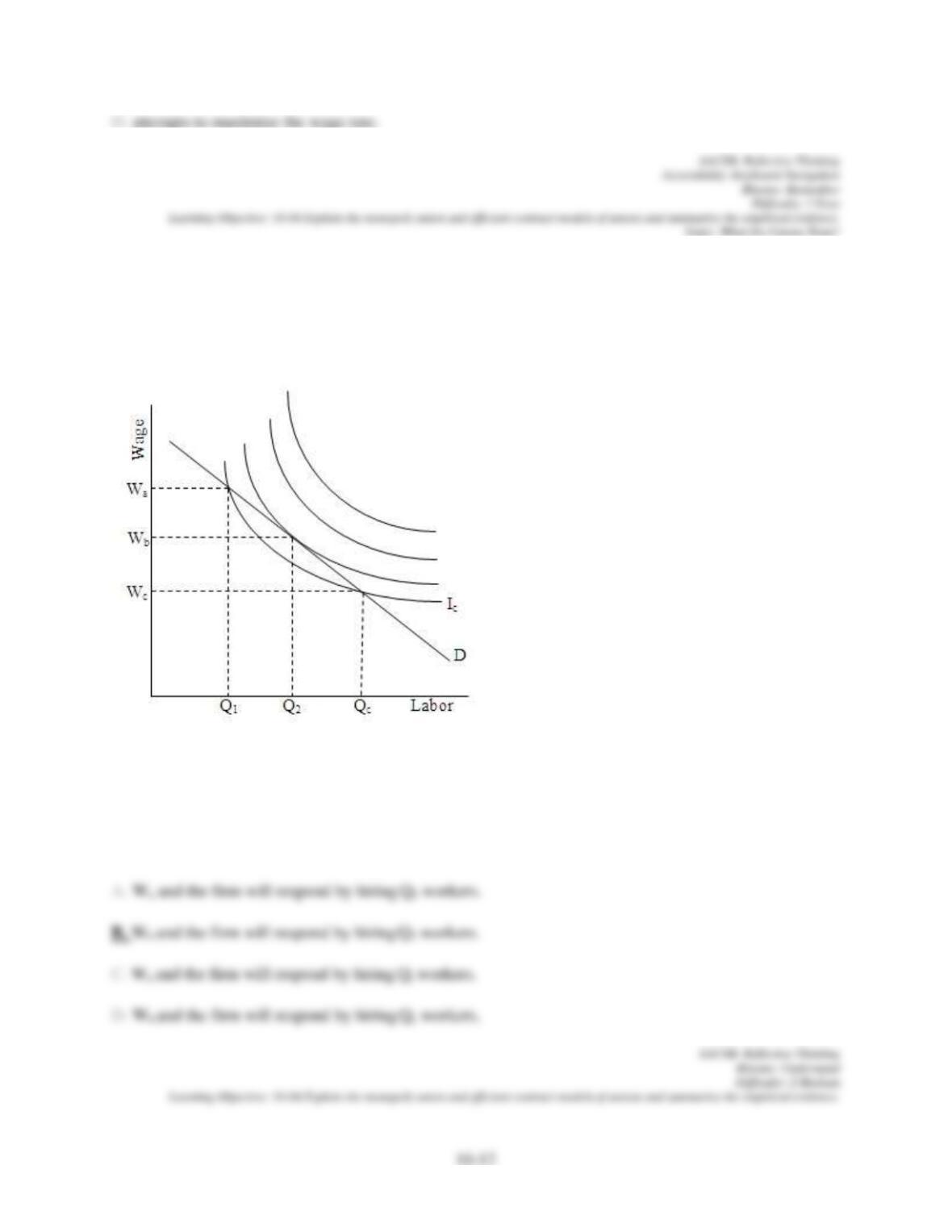
35. Refer to the following graph, in which Wc is the competitive wage and Ic is the union’s utility level at
the competitive wage and employment level.
If this market is best represented by the “monopoly union” model, the union will bargain for
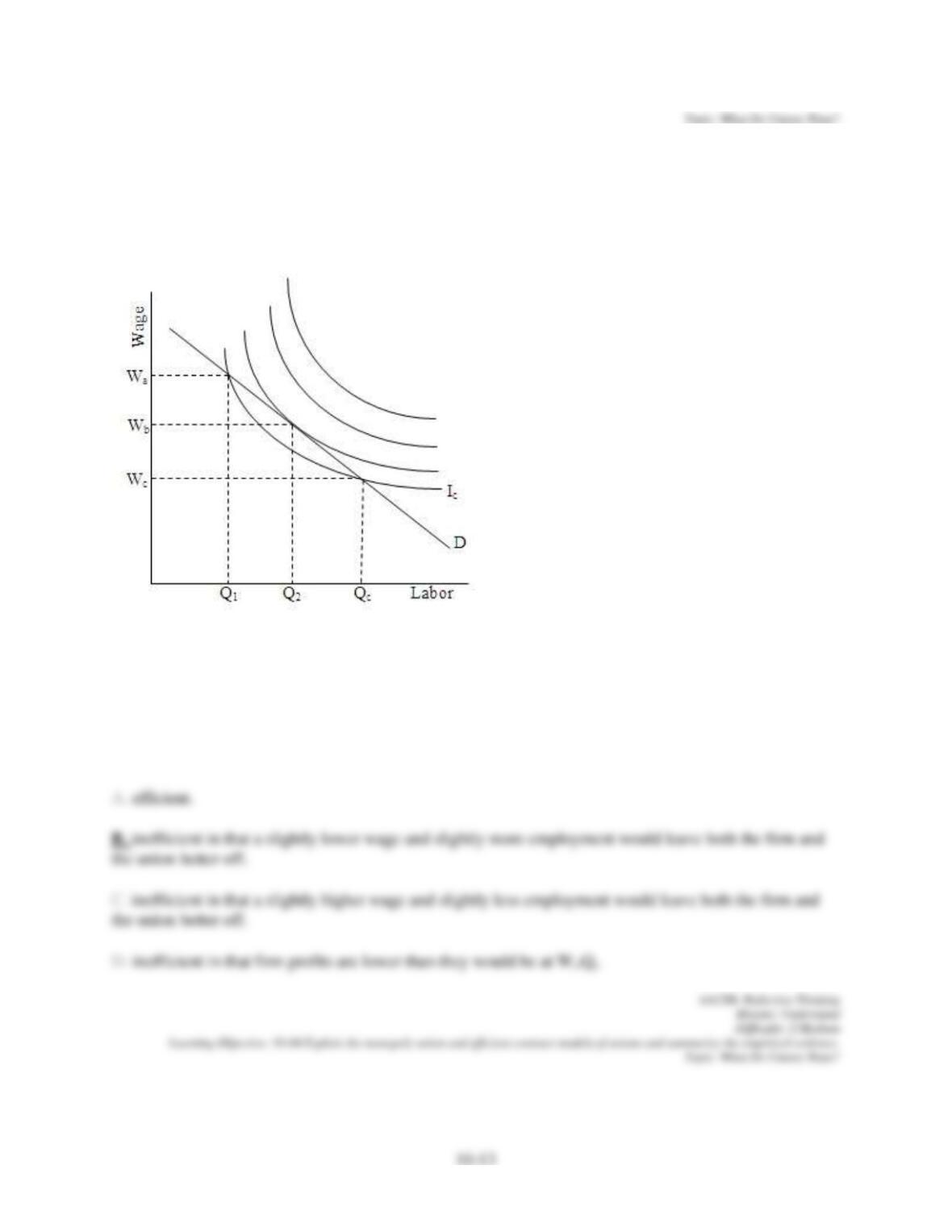
36. Refer to the following graph, in which Wc is the competitive wage and Ic is the union’s utility level at
the competitive wage and employment level.
The wage/employment combination given by Wb/Q2 is