Chapter 10: Property, Plant, and Equipment: Acquisition and Subsequent Investments
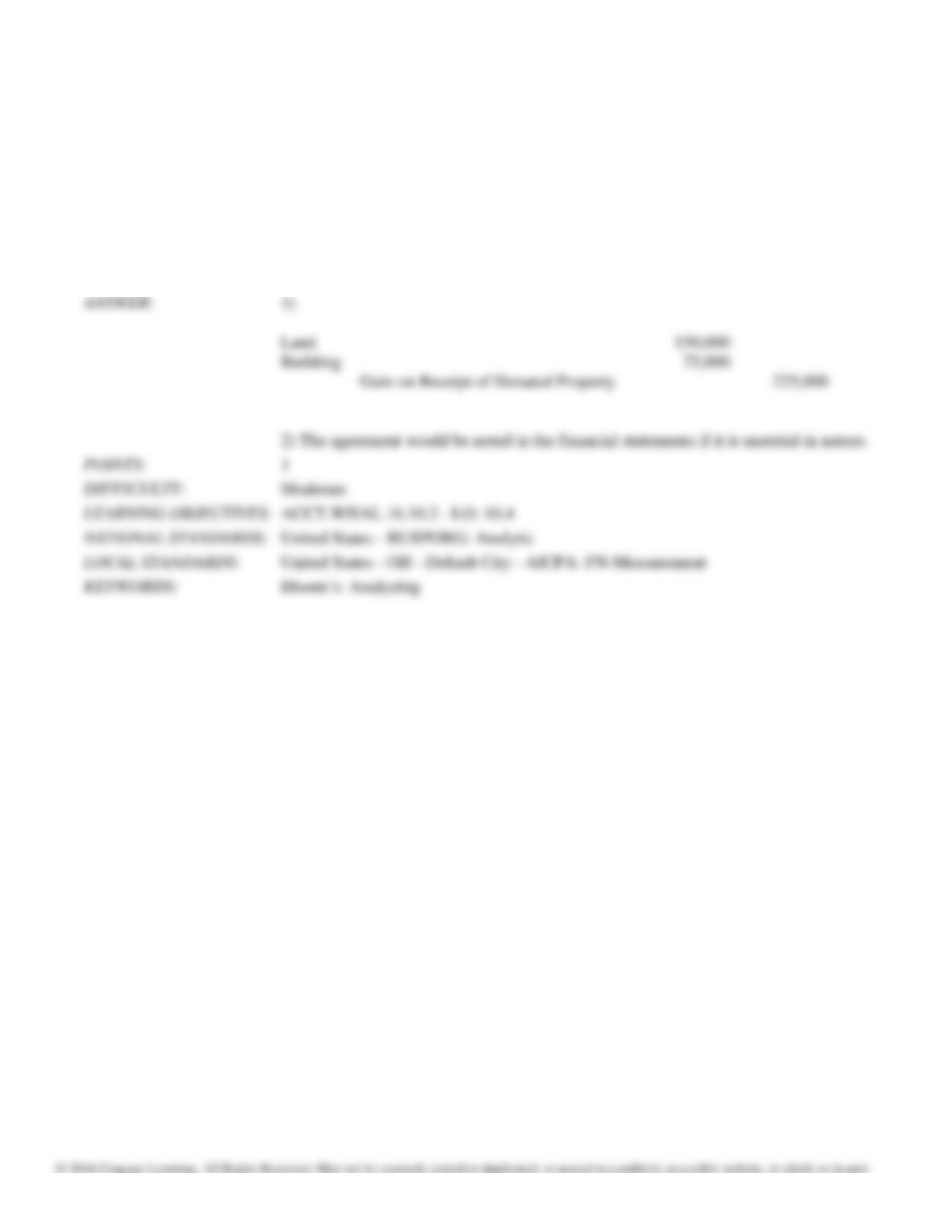
85. A farmer donated a large tract of land and a building to a community group for use as a recreation center. The
agreement provided that the recreation center employ 50 people for 10 years. The land was appraised for $150,000
and the building at $75,000.
Required:
1) Prepare the journal entry to record the acquisition of the land and building.
2) How should the 10 year agreement be reported in the financial statements?
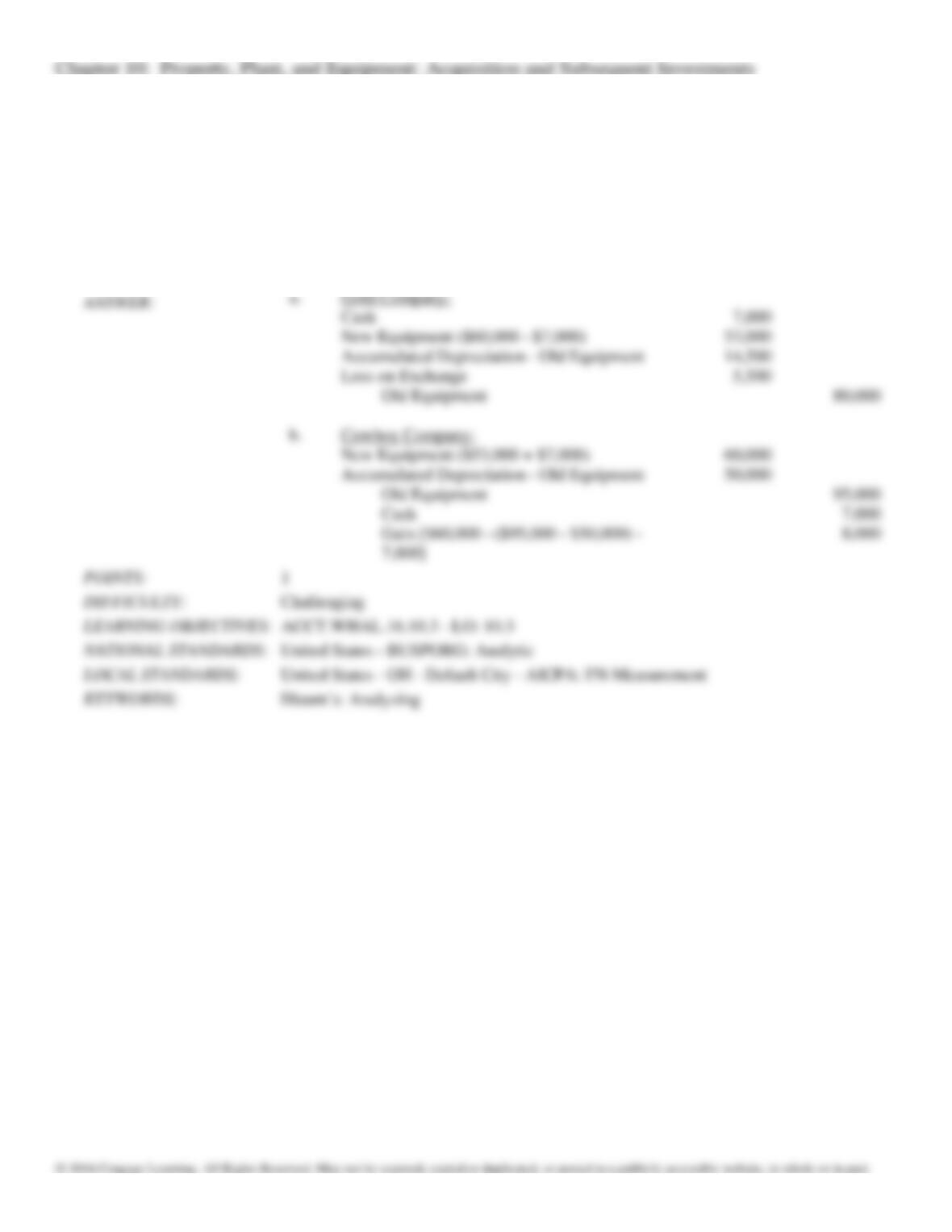
86. On August 1, Gold Company exchanged a machine for a similar machine owned by Cowboy Company and also
received $7,000 cash from Cowboy Company. Gold’s machine had an original cost of $80,000, accumulated
depreciation to date of $14,500, and a fair market value of $60,000. Cowboy’s machine had an original cost of
$95,000 and a book value of $45,000 and a fair value of $53,000.
Required:
a.
Prepare the necessary journal entry by Gold Company to record this transaction.
b.
Prepare the necessary journal entry by Cowboy Company to record this transaction.
1
Challenging
ACCT.WHAL.16.10.3 – LO: 10.3
United States – BUSPORG: Analytic
United States – OH – Default City – AICPA: FN-Measurement
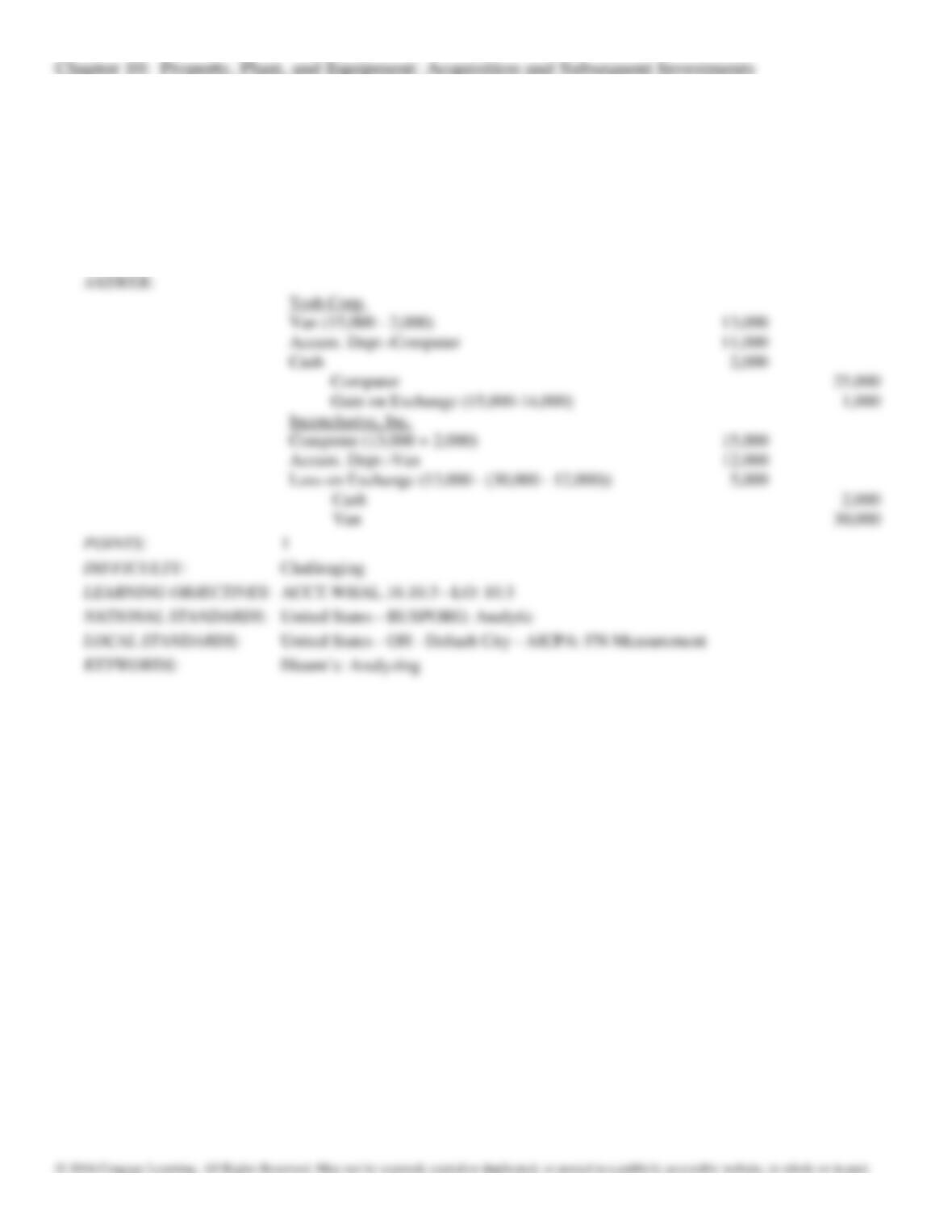
87. Tosh Corp. has agreed to exchange an old computer system for a van from Inconclusive, Inc. In addition, Inconclusive
will pay Tosh $2,000. The computer originally cost Tosh $25,000 and its current book value is $14,000. The van’s
original cost was $30,000 and its accumulated depreciation is $12,000. The appraised value of the computer is
$15,000, and the appraised value of the van is $13,000.
Required:
Prepare the journal entries to record the exchange on both companies’ books.
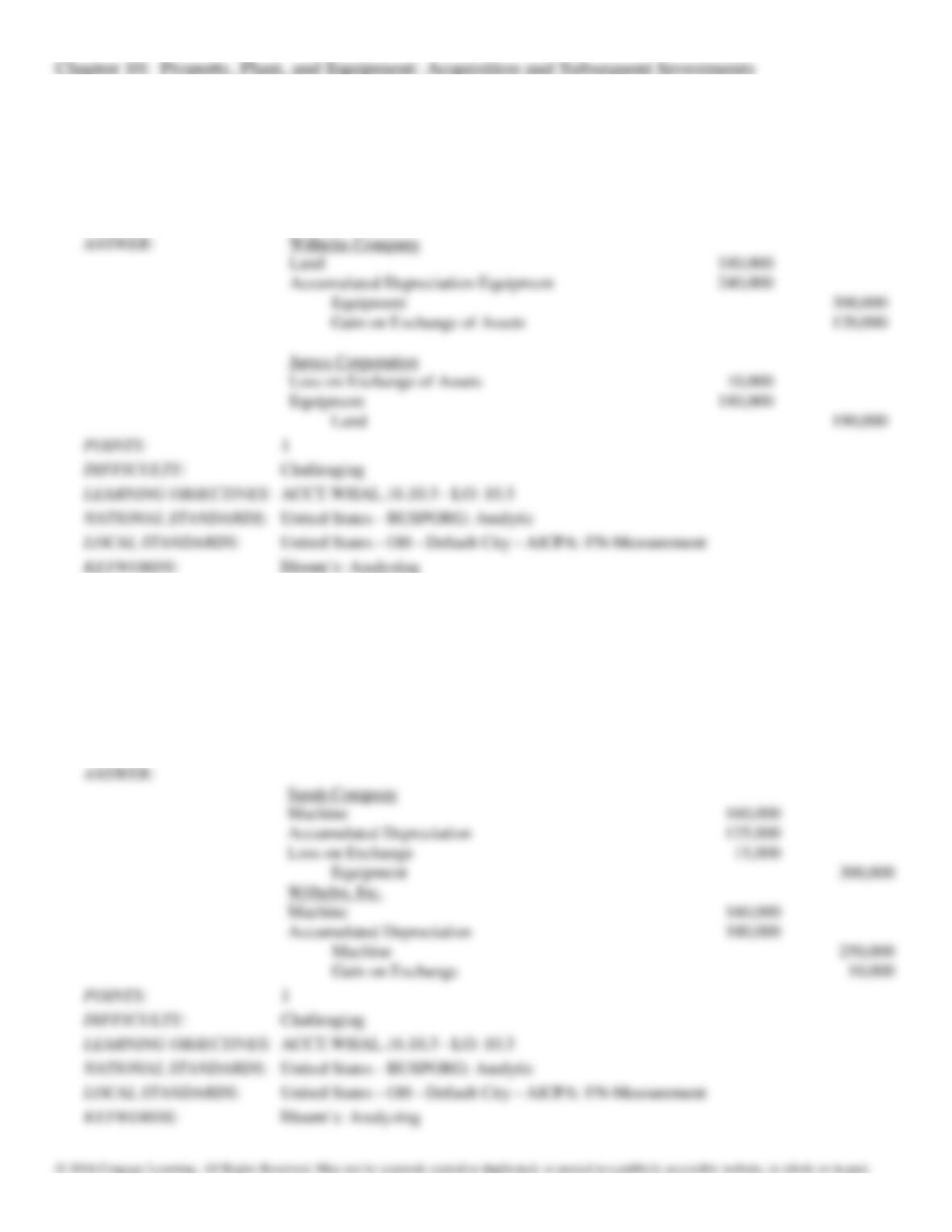
88. Wilhelm Company exchanged a piece of equipment with a cost of $300,000 and accumulated depreciation of
$240,000 for land owned by James Corporation. No cash was exchanged. James’ land had an original cost of
$190,000. At the date of exchange, both assets had a fair market value of $180,000.
Required:
Prepare the journal entry that each company should record.
89. Sarah Company is exchanging a special machine for a similar machine from Wilhelm, Inc. Sarah’s equipment
originally cost $300,000 and has accumulated depreciation of $125,000. Wilhelm’s machine cost $250,000 and has a
book value of $150,000. No cash will be exchanged because the fair value of both machines is $160,000. Each
company expects their cash flows will increase after the exchange.
Required:
Prepare the journal entry for each company.
90. Robertson Company exchanged a machine for some land. The machine had cost $17,000, was 70% depreciated, and
could be sold for $4,500. Robertson paid $950 in addition to giving up the machine.
Required:
a.
Compute the amount at which the land should be recorded and the amount of gain or loss
on the exchange.
b.
Assume, instead, that Robertson exchanged the machine for a new, more efficient machine
with a fair value of $4,700, while still paying $950 as before. Compute the gain or loss that
would be recorded on the sale of the old machine by Roberto.
1
ACCT.WHAL.16.10.3 – LO: 10.3
United States – BUSPORG: Analytic
91. Mathison Company exchanged a worn-out tractor that had cost $30,000 and was half depreciated for a new tractor
with a fair value of $12,000. Mathison paid an additional $4,500 cash. The transaction lacked commercial substance.
Required:
Compute the amount at which Mathison should record the new tractor.
($30,000 − $15,000) + $4,500 = $19,500
Challenging
ACCT.WHAL.16.10.3 – LO: 10.3
United States – OH – Default City – AICPA: FN-Measurement
92. Assuming that the effects of interest capitalization are material, calculate the amount of interest costs to be capitalized
by Matthew Corporation in 2016 in relation to the following separate events:
a.
On January 1, Matthew began construction for a new storage building for its own use.
Expenditures incurred evenly throughout the year totaled $900,000. Matthew borrowed
$1,000,000 specifically for construction of the storage building at an annual interest rate of
6%.
b.
Inventories costing $200,000 were routinely manufactured during the year. Matthew
borrowed $200,000 at 8% to finance inventory-related costs.
c.
On September 1, Matthew began construction of a custom-designed machine to the
specifications of a customer. As of December 31, $200,000 of materials, labor, and
overhead have been assigned to the machine. Those costs were incurred evenly throughout
the period September 1 through December 31. To finance construction, $230,000 was
borrowed at a 9% interest rate.
b.
93. On January 3, 2016, Mercury Company began self-constructing an asset that qualified for interest capitalization. On
January 5, Mercury borrowed $300,000 on an 8% construction loan. In addition, Mercury had $400,000 of 6% notes
payable and $600,000 of 9% bonds payable outstanding. By December 31, expenditures (occurring evenly throughout
the year) of $900,000 had been made on the asset. Investment of unused funds during the year yielded $1,200 of
interest revenue.
Required:
Compute the amount of interest that should be capitalized during 2016.
94. Christopher Company borrowed $6 million at 11% on January 1, 2016, to build a new building. The building is
expected to take 18 months to complete. Christopher invests the money from the project until it is needed for
construction. He is currently earning 10%. The following is the expenditures as they relate to the construction of the
building.
January 1 $1,500,000
April 1 $1,850,000
October 1 $1,100,000
December 31 $1,000,000
Required:
1) Compute the amount of interest expense Christopher would capitalize.
2) Compute the amount of interest revenue Christopher would recognize.
95. Culiver, Inc. is constructing a building that qualifies for interest capitalization. The following information is available:
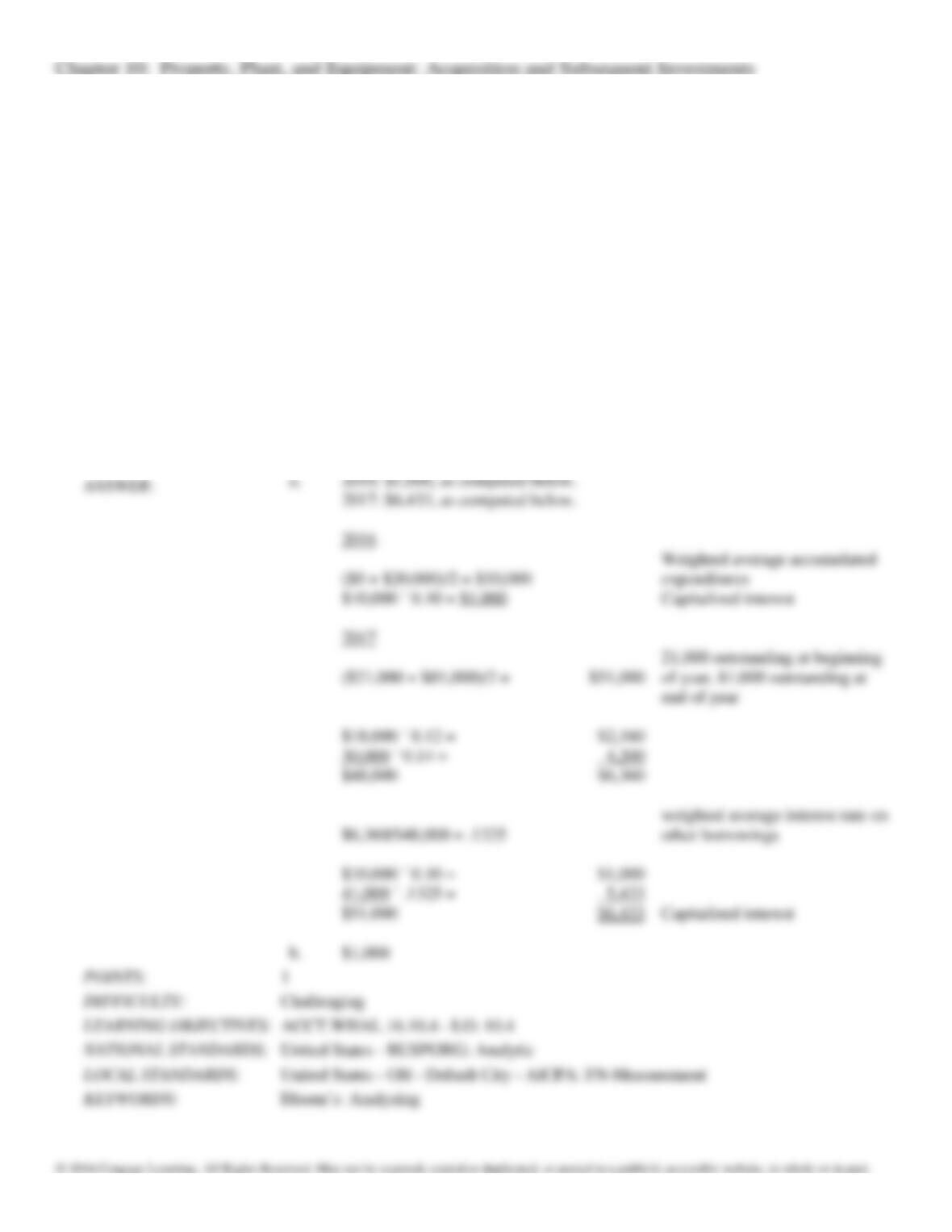
Capitalization period: January 1, 2016-December 31, 2017 Expenditures on project (incurred evenly):
2016
$20,000
2017
$60,000
Amounts borrowed and outstanding (all debt incurred January 1, 2016):
$10,000
at 10% (specifically for the construction project)
$18,000
at 12% (general debt)
$30,000
at 14% (general debt)
Required:
a.
Compute the amount of interest that should be capitalized in 2016 and 2017. (Round
interest rates to the nearest hundredths, e.g., 07.62%.)
b.
Assume that in 2016 unused borrowed funds were invested and earned interest revenue
amounting to $600. How much interest should be capitalized to the asset account in 2017?
1
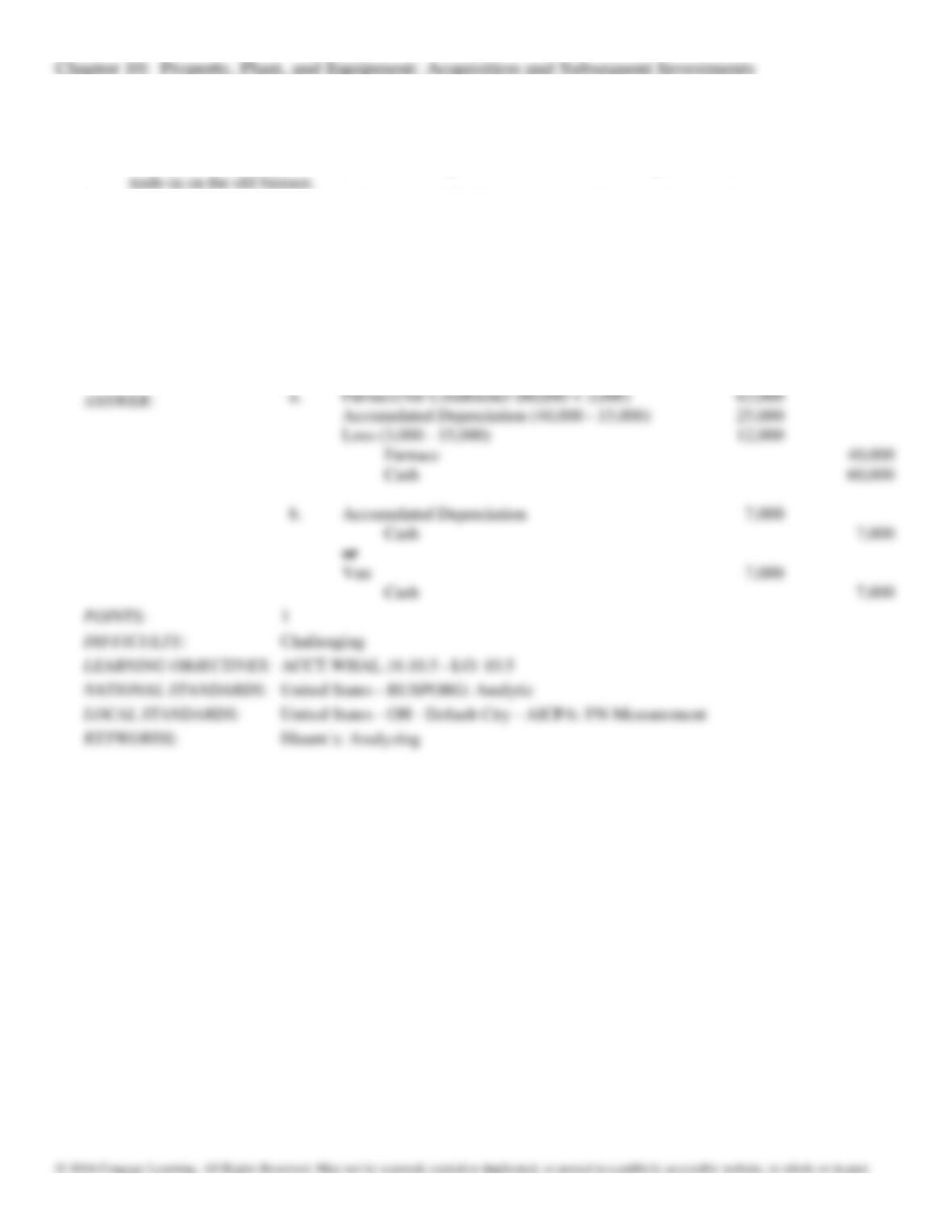
96. Roberts Company is making significant improvements to some of its assets, as follows.
1.
It is replacing the old furnace that cost $40,000 and has a $15,000 book value with a new
furnace/air conditioner combination. Roberts spent $60,000 in cash and was given a $3,000
2.
The delivery van is being updated with a new $7,000 engine that will increase the useful
life of the van by 2 years. The van originally cost $35,000 and has accumulated
depreciation of $25,000.
Required:
a.
Record the appropriate journal entry for replacing the furnace.
b.
When recording the transaction associated with the van there is a choice between two
methods. Provide the journal entries for each method.
97.
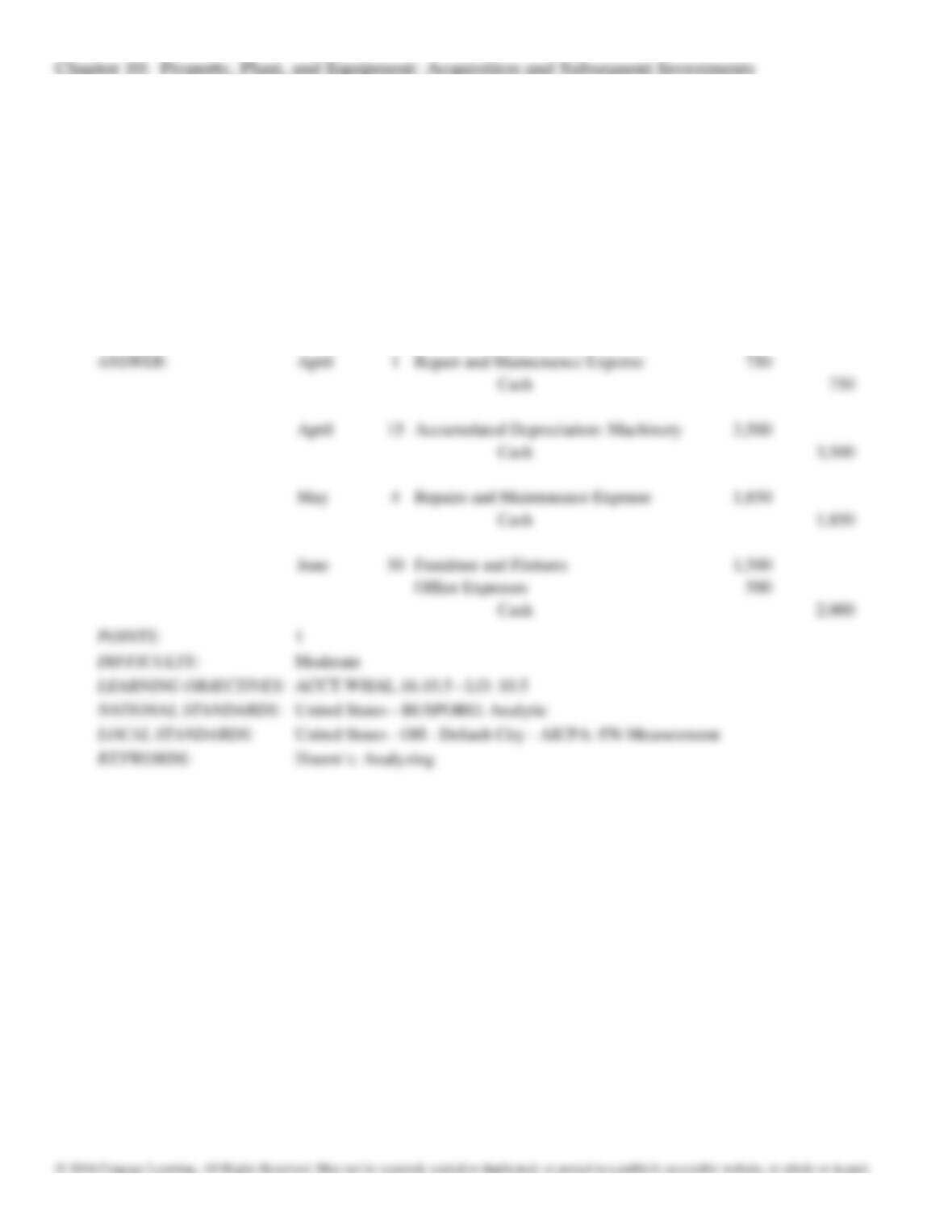
The following events occurred for Rams Machinery during the second quarter of 2016:
April
1
Trucks needed new brakes at a cost of $750.
April
15
Replaced engine on large machine at a cost of $3,500, the replacement will
improve capacity
May
4
A freak hurricane damages some equipment. Repairs cost $1,850
June
30
Office improvements of carpet cost $1,500, painting cost $500.
Required:
Prepare the journal entries for the preceding transactions.
1
Moderate
ACCT.WHAL.16.10.5 – LO: 10.5
United States – BUSPORG: Analytic
United States – OH – Default City – AICPA: FN-Measurement
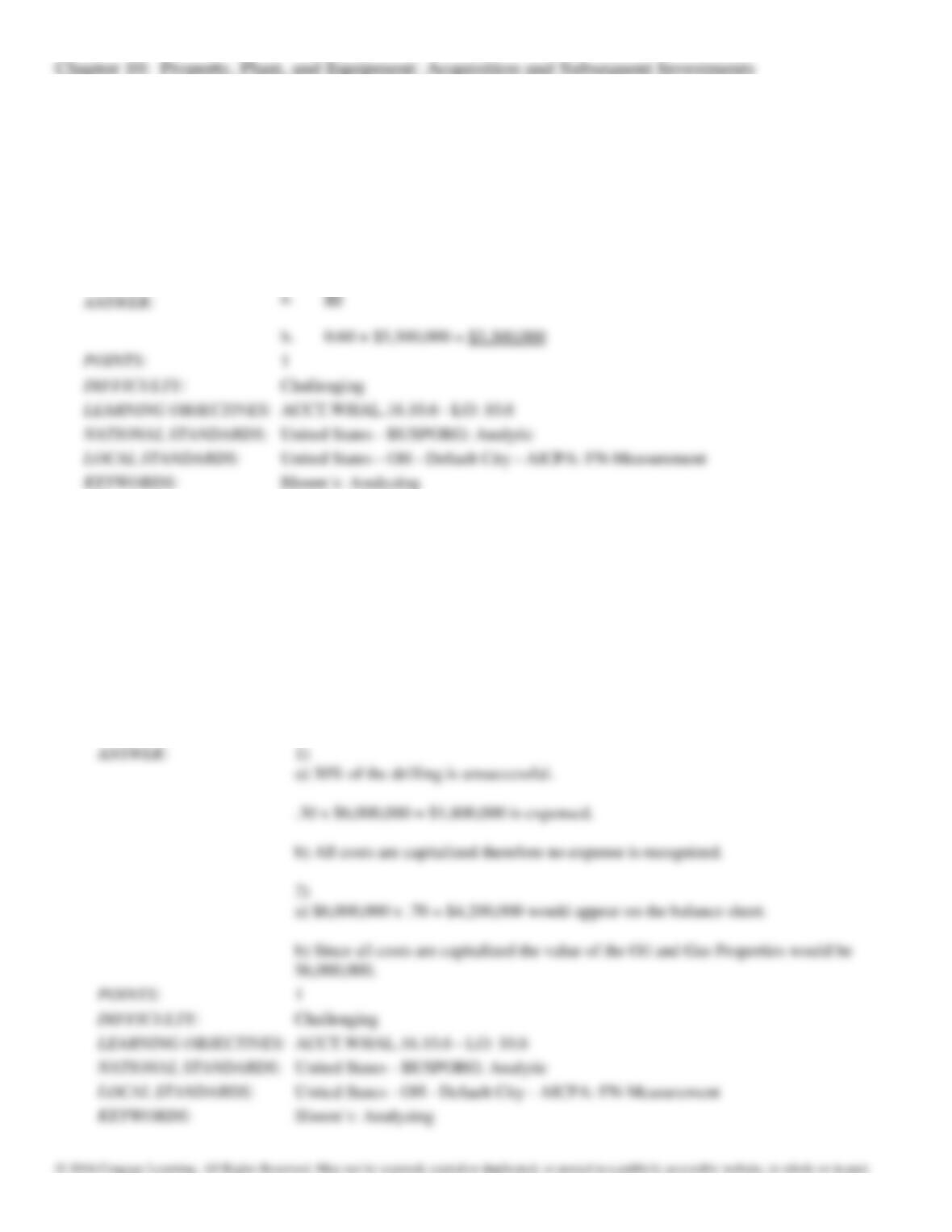
98. In 2016, Hart Co. invested $5,500,000 in oil well exploration activities. Sixty percent of the drilling was successful
and resulted in commercial quantities of oil being found.
Required:
a.
Indicate the amount of drilling expense Hart Co. would recognize in 2016 if the full-cost
method is in use.
b.
Indicate the cost that would be reported on the balance sheet as oil and gas properties if the
successful-efforts method is in use.
$0
b.
99. In 2016 Jones Company spends $6 million drilling oil wells. Seventy percent of the drilling is successful and results in
commercial quantities of oil being found.
Required:
1) How much drilling expense should the company recognize under:
a) successful-efforts method
b) full-cost method
2) What value is reported on the balance sheet for the Oil and Gas Properties under:
a) successful-efforts method
b) full-cost method
$6,000,000.
1
Challenging
ACCT.WHAL.16.10.6 – LO: 10.6
United States – OH – Default City – AICPA: FN-Measurement
100. What three characteristics must an asset have in order for it to be classified as property, plant and equipment?
101. What are several advantages of recording property, plant, and equipment at historical cost?
102. List five acquisition costs that can be included in the cost of land.
103. List five costs that can be included as part of a newly-constructed building.
104. What is a nonmonetary exchange? How is it recorded on the books?
105. When a company constructs an asset for use in its operations there are two alternatives for a company to include
overhead costs in the cost of the asset. What are the two alternatives?
106. Interest can be capitalized only for qualifying assets. Provide examples of assets that do not qualify for interest
capitalization.
107. How can the future economic benefit of a capital expenditure be increased?
108. What is the successful-efforts method of capitalization?
109. What is the full-cost method of capitalization?
110. Why is it important to allocate a lump-sum purchase amount among the individual assets acquired?
111. Costs that are incurred after acquiring a piece of property, plant, or equipment are for a variety of reasons, ranging
from routine repairs to major overhauls and improvements. The accountant’s problem is to determine how these costs
should be recorded.
Required:
Identify the two categories of expenditures in which these costs can be classified, and explain how the accountant
determines which classification is appropriate.
112. Describe the IFRS treatment of increases in the market value of property, plant, and equipment held during the year.
Compare that treatment to U.S. GAAP requirements.
113. You are evaluating two recent transactions involving exchanges of equipment by your company. In one case,
the exchange has commercial substance. In the second case, the exchange lacks commercial substance. Explain the
differences in accounting for these two situations.
114. Discuss when the interest capitalization period begins and ends for assets constructed for a company’s own use.