Chapter 10: Fixed Assets and Intangible Assets
126.
On December 31, Strike Company has decided to discard one of its batting cages. The equipment had an initial
cost of $310,000 and has accumulated depreciation of $260,000. Depreciation has been recorded up to the end of
the year. Which of the following will be included in the entry to record the disposal?
a.
Gain on Disposal of Asset Cr., $50,000
b.
Loss on Disposal of Asset Dr., $260,000
c.
Accumulated Depreciation Dr., $310,000
d.
Equipment Cr., $310,000
127.
On December 31, Strike Company sold one of its batting cages for $50,000. The equipment had an original
cost of $310,000 and has accumulated depreciation of $260,000. Depreciation has been recorded up to the end
of the
year. What is the amount of the gain or loss on this transaction?
a.
no gain or loss
b.
loss of $50,000
c.
gain of $50,000
d.
cannot be determined
128.
On December 31, Strike Company sold one of its batting cages for $20,000. The equipment had an initial cost
of $310,000 and had accumulated depreciation of $260,000. Depreciation has been recorded up to the end of
the
year. What is the amount of the gain or loss on this transaction?
a.
gain of $20,000
b.
loss of $30,000
c.
gain of $20,000
d.
loss of $30,000
Chapter 10: Fixed Assets and Intangible Assets
129.
On December 31, Strike Company sold one of its batting cages for $55,000. The equipment had an initial cost
of $310,000 and has accumulated depreciation of $260,000. Depreciation has been taken up to the end of the
year.
What is the amount of the gain or loss on this transaction?
a.
loss of $55,000
b.
loss of $5,000
c.
gain of $5,000
d.
gain of $55,000
130.
On December 31, Strike Company traded-in one of its batting cages for another one that has a cost of $500,000.
Strike receives a trade-in allowance of $11,000. The old equipment had an initial cost of $215,000 and has
accumulated depreciation of $185,000. Depreciation has been recorded up to the end of the year. The difference
will be paid in cash. What is the amount of the gain or loss on this transaction?
a.
loss of $11,000
b.
no loss or gain will be recorded
c.
loss of $19,000
d.
gain of $11,000
131.
Machinery was purchased on January 1 for $51,000. The machinery has an estimated life of 7 years and an
estimated salvage value of $9,000. Double-declining-balance depreciation for the second year would be
(round
calculations to the nearest dollar):
a. $6,000
b. $10,500
c. $10,929
d. $10,408
Chapter 10: Fixed Assets and Intangible Assets
132.
When a company replaces a component of property, plant, and equipment, which statement below does not account
for one of the steps in the process?
a.
The asset cost of the replaced component is credited.
b.
Book value of the replaced component is written off to depreciation expense.
c.
The identifiable direct costs associated with the new component are expensed in the current period.
d.
The identifiable direct costs associated with the new component are capitalized.
133.
What is the cost of the land, based upon the following data?
Land purchase price
$178,000
Broker’s commission
15,000
Payment for the demolition
and removal of existing building
5,000
Cash received from the sale of materials
salvaged from the demolished building
2,000
Chapter 10: Fixed Assets and Intangible Assets
134.
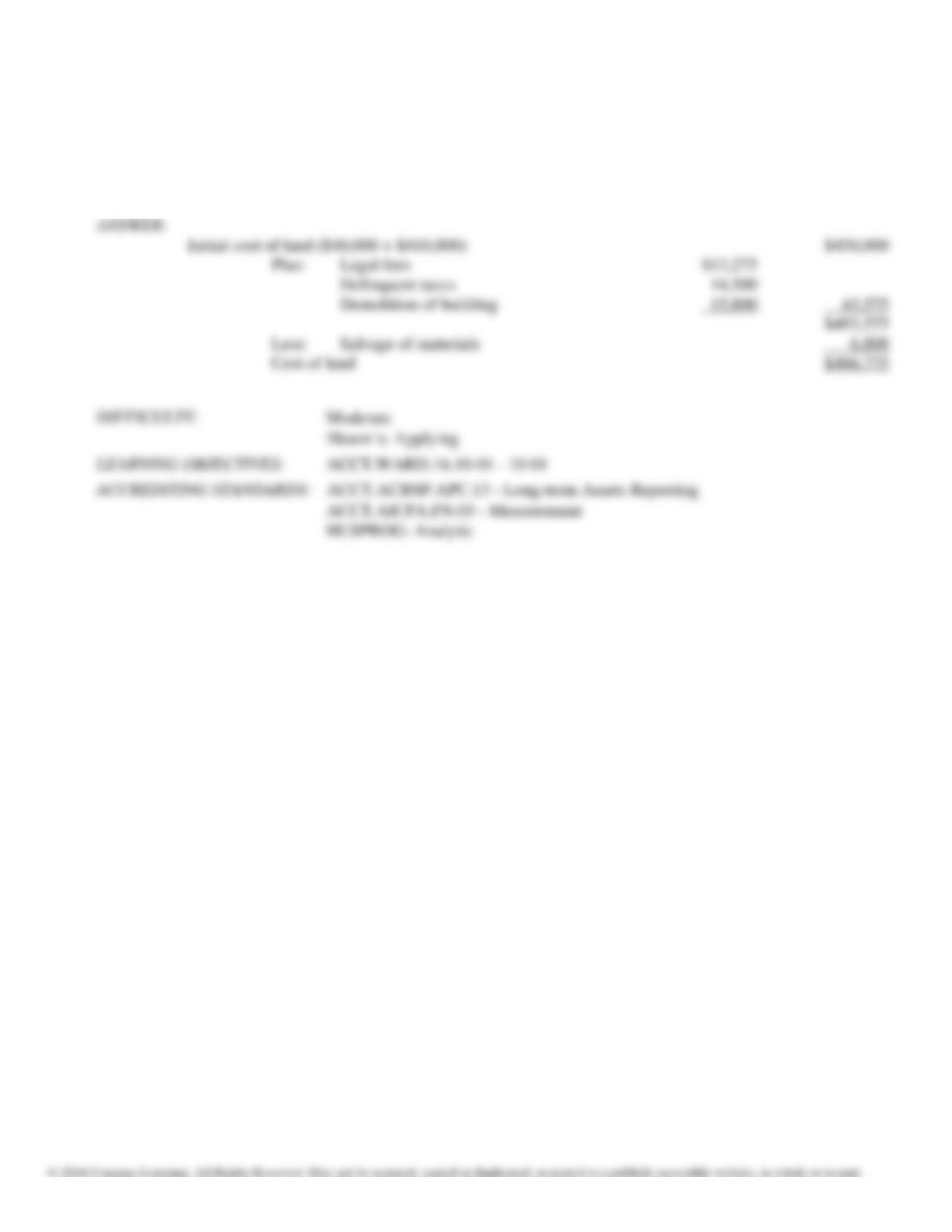
Falcon Company acquired an adjacent lot to construct a new warehouse, paying $40,000 and giving a short–
term
note for $410,000. Legal fees paid were $13,275, delinquent taxes assessed were $14,500, and fees paid
to remove
an old building from the land were $15,800. Materials salvaged from the demolition of the building
were sold for $6,800. A contractor was paid $890,000 to construct the new warehouse. Determine the cost of
the land to be
reported on the balance sheet and show your work.
Chapter 10: Fixed Assets and Intangible Assets
135.
Identify each of the following expenditures as chargeable to (a) Land, (b) Land Improvements, (c) Buildings,
(d)
Machinery and Equipment, or (e) other account.
(1)
Cost of paving parking area for employees and customers
(2)
Insurance during construction of building
(3)
Interest incurred on loan during construction of building
(4)
Fee paid for installation of equipment
(5)
Special foundation for new equipment acquired
(6)
Insurance on new equipment while in transit
(7)
Freight charges on new equipment
(8)
Cost of repairing vandalism damage to equipment during installation
(9)
Sales tax on new equipment
(10)
Cost incurred in repairing damage resulting from installation of new equipment
(11)
Cost of land fill for building site
(12)
Cost of lubricating oil purchased for periodic oil changes for equipment
(13)
Parking lot lighting
(14)
Installing a fence around the parking lot
(15)
Repainting the trim on a building
(16)
Special assessment paid to city for extension of water main to property
(17)
Cost of razing and removing the old building on property acquired for a building site
(18)
Delinquent real estate taxes assumed by purchaser on property acquired for a building site
(19)
Attorney’s fee for title search
(20)
Architect’s fee for building plans and supervision of construction
Chapter 10: Fixed Assets and Intangible Assets
136.
A number of major structural repairs completed at the beginning of the current fiscal year at a cost of $1,000,000
are expected to extend the life of a building 10 years beyond the original estimate. The original cost of the
building
was $6,552,000, and it has been depreciated by the straight-line method for 25 years. Estimated residual
value is
negligible and has been ignored. The related accumulated depreciation account after the depreciation
adjustment at
the end of the preceding fiscal year is $4,550,000.
(a)
What has the amount of annual depreciation been in past years?
(b)
What was the original life estimate of the building?
(c)
To what account should the $1,000,000 be debited?
(d)
What is the book value of the building after the extraordinary repairs have been made?
(e)
What is the expected remaining life of the building after the extraordinary repairs have
been
made?
(f)
What is the amount of straight-line depreciation for the current year, assuming that the
repairs were completed at the very beginning of the current year? Round to the nearest
dollar.
Chapter 10: Fixed Assets and Intangible Assets
137.
Journalize each of the following transactions:
(a)
A wing costing $2,345,000 was added to the building. A new mortgage was issued for
the
cost.
(b)
Equipment was upgraded to increase its capacity to produce widgets. The upgrade cost of
$11,500 was paid in cash.
(c)
A major overhaul costing $8,000 on a machine increased the useful life by 4 years.
The
payment was made in cash.
138.
On April 15, Compton Co. paid $2,800 to upgrade a delivery truck and $125 for an oil change. Journalize
the
entries for the upgrade to delivery truck and oil change expenditures.
Chapter 10: Fixed Assets and Intangible Assets
139.
XYZ Co. incurred the following costs related to the office building used in operating its sports supply company:
a.
Replaced a broken window.
b.
Replaced the roof that had been on the building 23 years.
c.
Serviced all the air conditioners before summer started.
d.
Replaced the air conditioners in the customer service areas.
e.
Added a warehouse to the back of the building.
f.
Repainted the interior walls.
g.
Installed window shutters on all windows.
Classify each of the costs as a capital expenditure or revenue expenditure. For those costs identified as capital
expenditures, classify each as an additional or replacement component.
140.
Comment on the validity of the following statements. “As an asset loses its ability to provide services, cash
needs
to be set aside to replace it. Depreciation accomplishes this goal.”
Chapter 10: Fixed Assets and Intangible Assets
141.
Computer equipment was acquired at the beginning of the year at a cost of $65,000 that has an estimated
residual
value of $3,800 and an estimated useful life of 8 years. Determine the (a) depreciable cost, (b) straight–
line rate,
and (c) annual straight-line depreciation.
142.
The double-declining balance rate for calculating depreciation expense is determined by doubling the straight-
line
rate. Assuming that an asset has a useful life of 25 years, determine the rate to be used if using the double–
declining-balance method.
143.
Copy equipment was acquired at the beginning of the year at a cost of $72,000 that has an estimated residual value
of $9,000 and an estimated useful life of 5 years. It is estimated that the machine will output an estimated
1,000,000 copies. This year, 315,000 copies were made. Determine the (a) depreciable cost, (b) depreciation rate,
and (c) the units-of-output depreciation for the year.
Chapter 10: Fixed Assets and Intangible Assets
144.
A machine costing $57,000 with a 6-year life and $54,000 depreciable cost was purchased January 1. Compute
the
yearly depreciation expense using straight-line depreciation.
145.
A machine costing $185,000 with a 5-year life and $20,000 residual value was purchased January 2.
Compute
depreciation for each of the five years, using the double-declining-balance method.
146.
Computer equipment was acquired at the beginning of the year at a cost of $63,000 that has an estimated
residual
value of $3,000 and an estimated useful life of 5 years. Determine the (a) depreciable cost (b) double–
declining-balance rate, and (c) double-declining-balance depreciation for the first year.
Chapter 10: Fixed Assets and Intangible Assets
147.
Convert each of the following estimates of useful life to a straight-line depreciation rate, stated as a percentage.
(1)
2 years
(2)
8 years
(3)
10 years
(4)
20 years
(5)
25 years
(6)
40 years
(7)
50 years
Chapter 10: Fixed Assets and Intangible Assets
148.
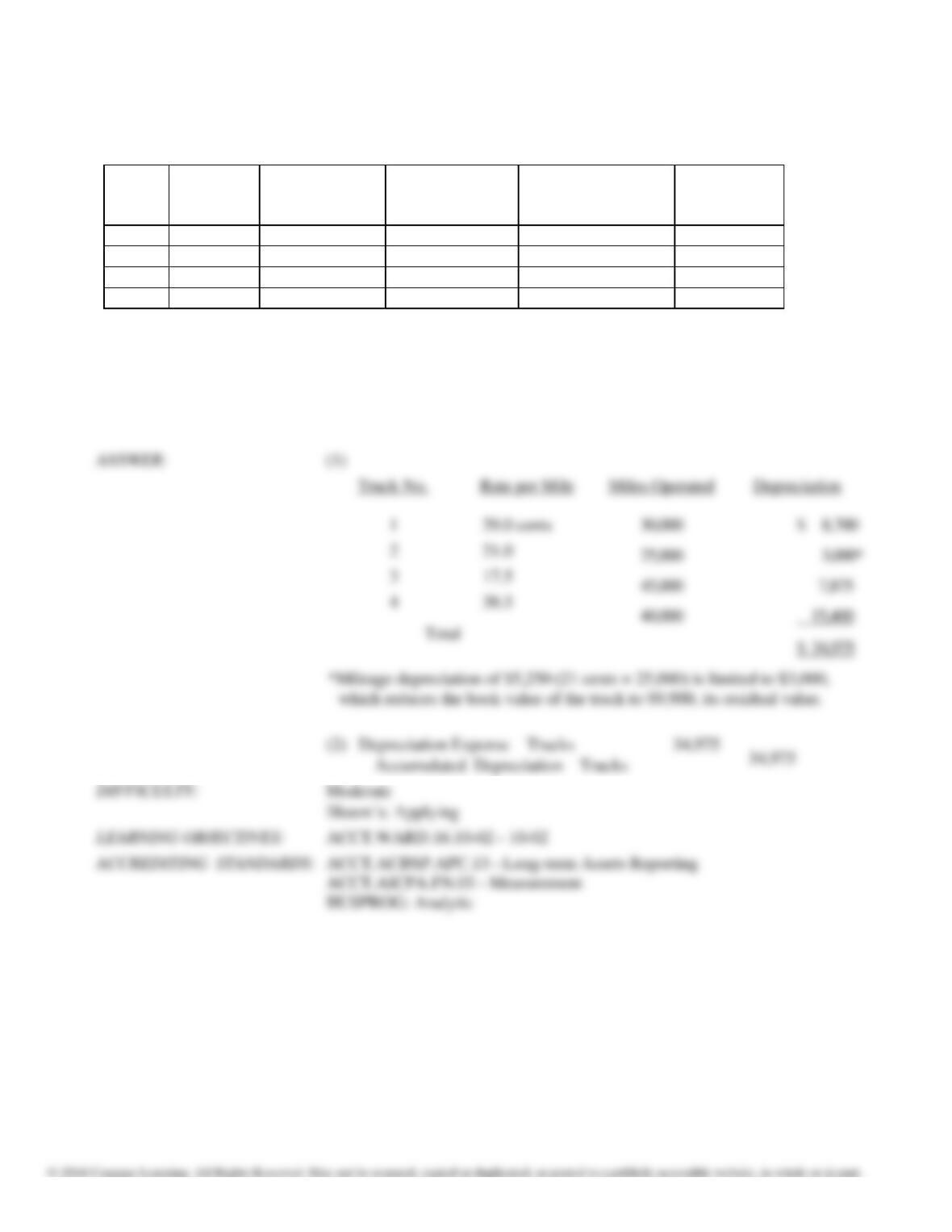
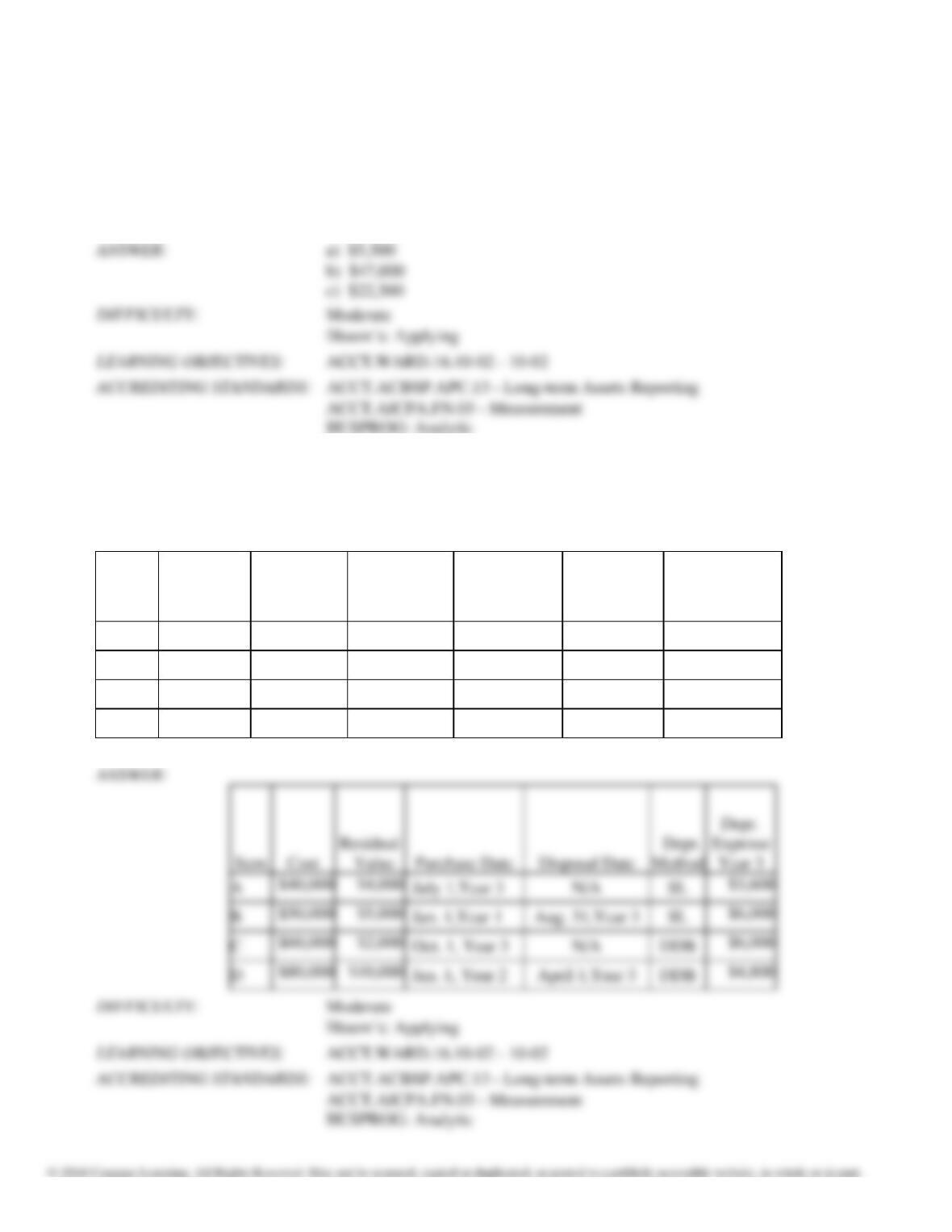
Prior to adjustment at the end of the year, the balance in Trucks is $300,900 and the balance in Accumulated
Depreciation—Trucks is $88,200. Details of the subsidiary ledger are as follows:
Truck
No.
Cost
Estimated
Residual Value
Estimated
Useful Life
Accumulated
Depreciation at
Beginning of Year
Miles
Operated
During Year
1
$100,000
$13,000
300,000
—
30,000
2
72,900
9,900
300,000
$60,000
25,000
3
38,000
3,000
200,000
8,050
45,000
4
90,000
13,000
200,000
20,150
40,000
Required:
(1)
Based on the units-of-output method, determine the depreciation rates per mile and the
amount to be credited to the accumulated depreciation section of each of the
subsidiary
accounts for the miles operated during the current year.
(2)
Journalize the entry to record depreciation for the year.
Chapter 10: Fixed Assets and Intangible Assets
149.
An asset was purchased for $58,000 and originally estimated to have a useful life of 10 years with a residual value
of $3,000. After two years of straight-line depreciation, it was determined that the remaining useful life of the
asset
was only 2 years with a residual value of $2,000.
a)
Determine the amount of the annual depreciation for the first two years.
b)
Determine the book value at the end of Year 2.
c)
Determine the depreciation expense for each of the remaining years after revision.
150.
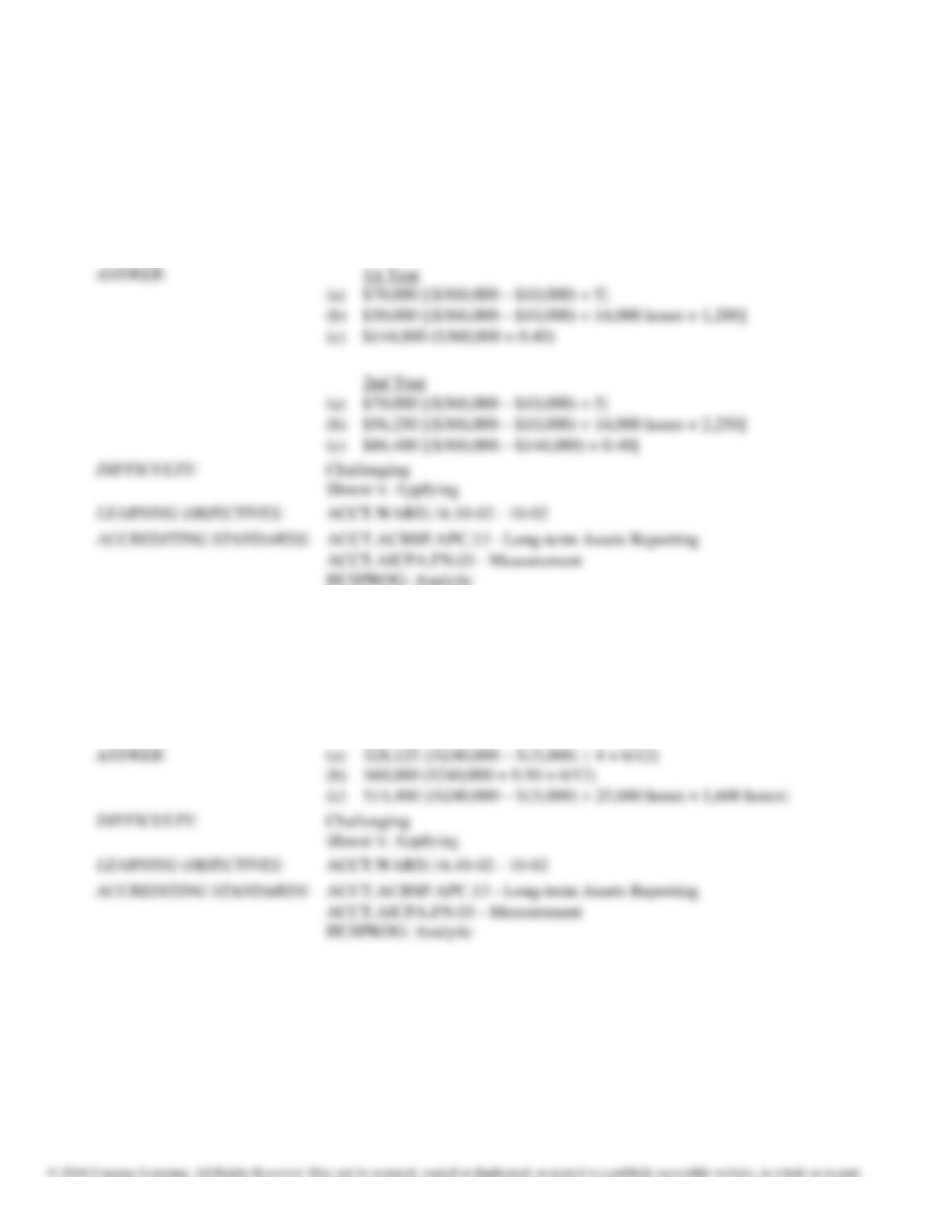
For each of the following fixed assets, determine the depreciation expense for Year 3:
Disposal date is N/A if asset is still in use.
Method: SL = straight line; DDB = double declining balance
Assume the estimated life is 5 years for each asset.
Item
Cost
Residual
Value
Purchase Date
Disposal date
Depr.
Method
Depr.
Expense
Year 3
A
$40,000
$4,000
July 1,Year 3
N/A
SL
B
$50,000
$5,000
Jan. 1, Year 1
Aug. 31,Year 3
SL
C
$60,000
$2,000
Oc.t 1, Year 3
N/A
DDB
D
$80,000
$10,000
Jan. 1, Year 2
April 1, Year 3
DDB
Chapter 10: Fixed Assets and Intangible Assets
151.
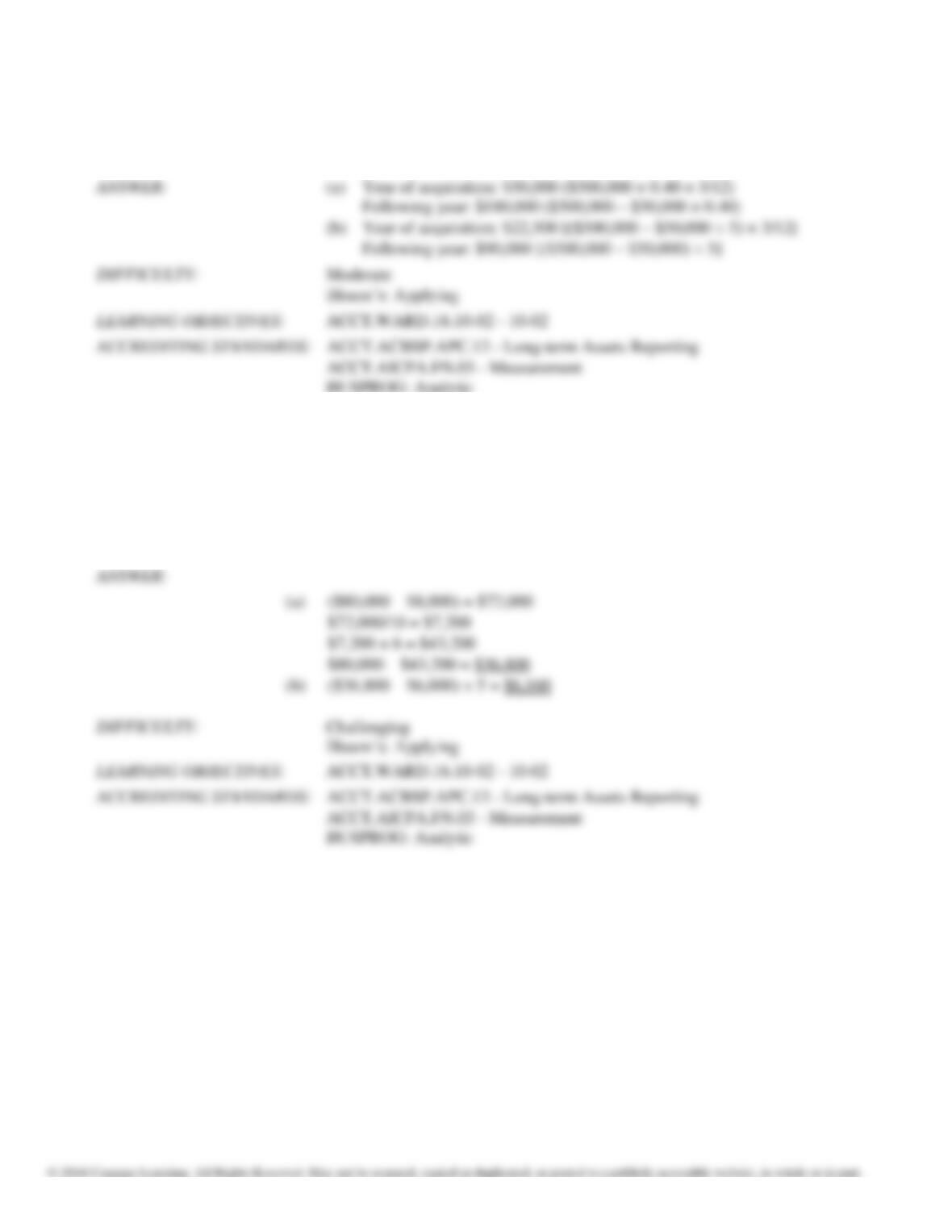
Equipment purchased at the beginning of the fiscal year for $360,000 is expected to have a useful life of 5 years, or
14,000 operating hours, and a residual value of $10,000. Compute the depreciation for the first and second years of
use by each of the following methods:
(a)
straight-line
(b)
units-of-output (1,200 hours first year; 2,250 hours second year)
(c)
double-declining-balance
152.
Machinery is purchased on July 1 of the current fiscal year for $240,000. It is expected to have a useful life of 4
years, or 25,000 operating hours, and a residual value of $15,000. Compute the depreciation for the last six
months
of the current fiscal year ending December 31 by each of the following methods:
(a)
straight-line
(b)
double-declining-balance
(c)
units-of-output (used for 1,600 hours during the current year)
Chapter 10: Fixed Assets and Intangible Assets
153.
Determine the depreciation, for the year of acquisition and for the following year, of a fixed asset acquired on
October 1 for $500,000, with an estimated life of 5 years, and residual value of $50,000, using (a) the double
declining-balance method and (b) the straight-line method. Assume a fiscal year ending December 31.
154.
Equipment costing $80,000 with a useful life of 10 years and a residual value of $8,000 has been depreciated for
6
years by the straight-line method. Assume a fiscal year ending December 31.
(a)
What is the book value at the end of the sixth year of use?
(b)
If early in the seventh year it is estimated that the remaining useful life is 5 years
(instead of 4) and the residual value is $6,000, what is the amount of depreciation
for
the seventh year?
Chapter 10: Fixed Assets and Intangible Assets
155.
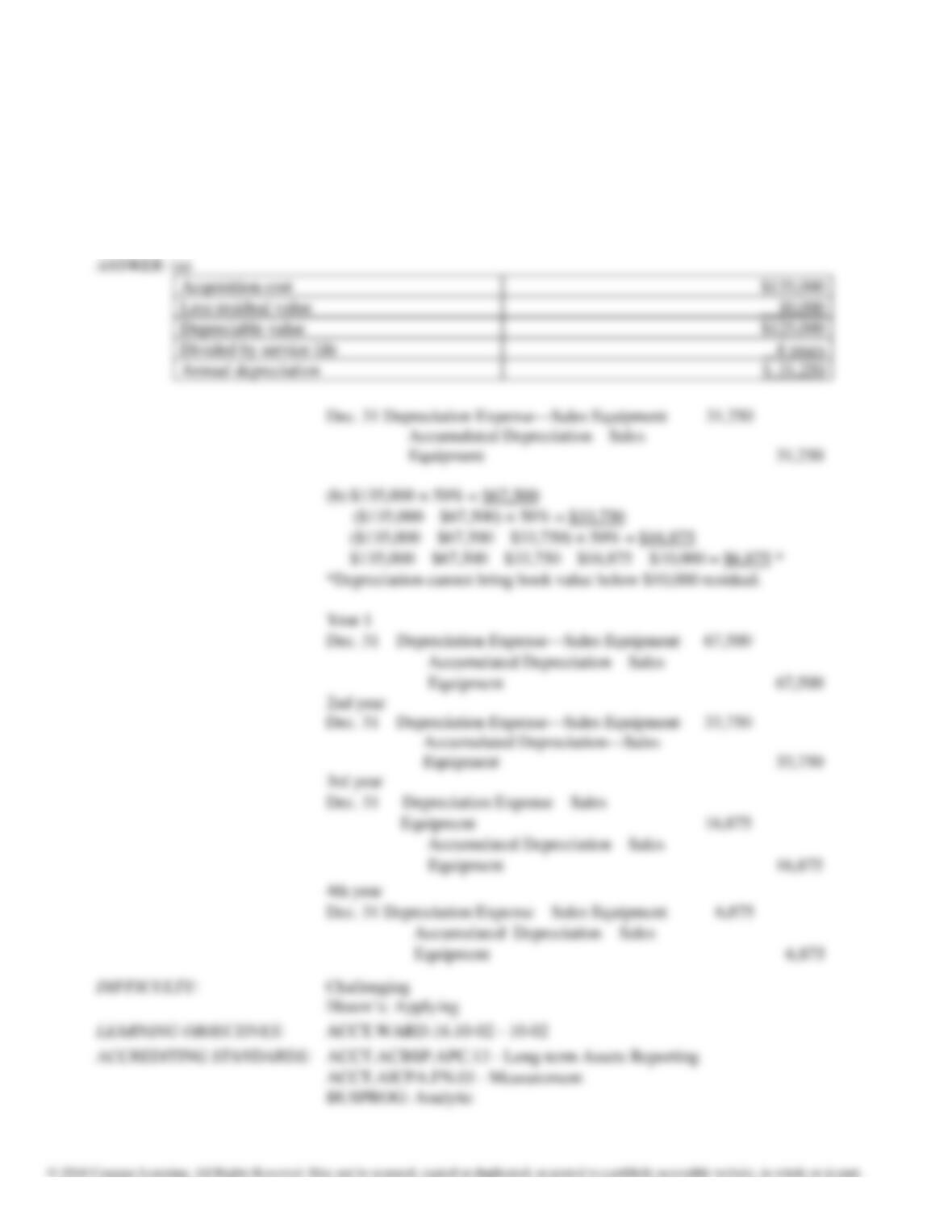
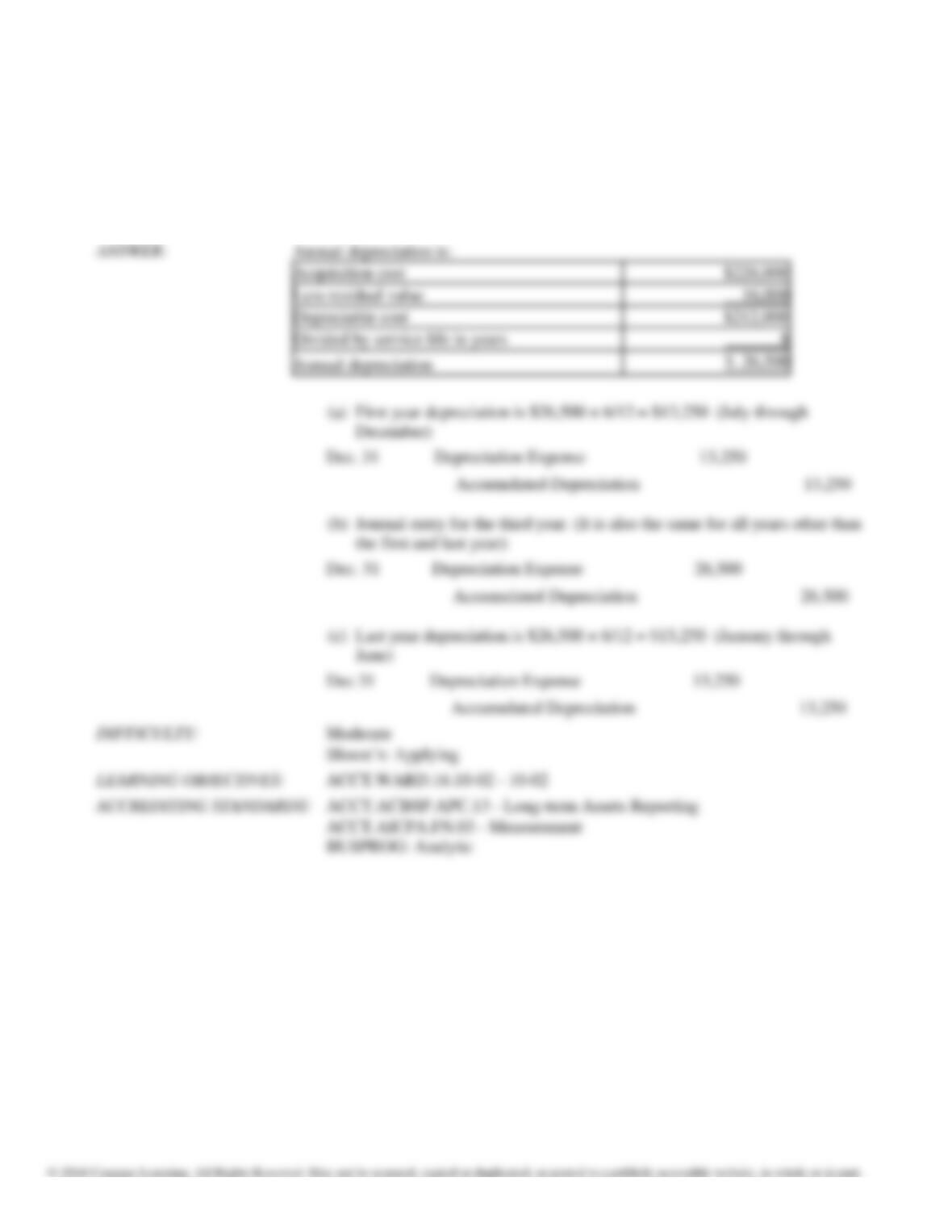
Golden Sales has bought $135,000 in fixed assets on January 1st associated with sales equipment. The residual
value of these assets is estimated at $10,000 at the end of their 4-year service life. Golden Sales managers want to
evaluate the options of depreciation.
(a)
Compute the annual straight-line depreciation and provide the sample depreciation journal entry to be
posted
at the end of each of the years.
(b)
Write the journal entries for each year of the service life for these assets using the double-declining
balance
method.
Chapter 10: Fixed Assets and Intangible Assets
156.
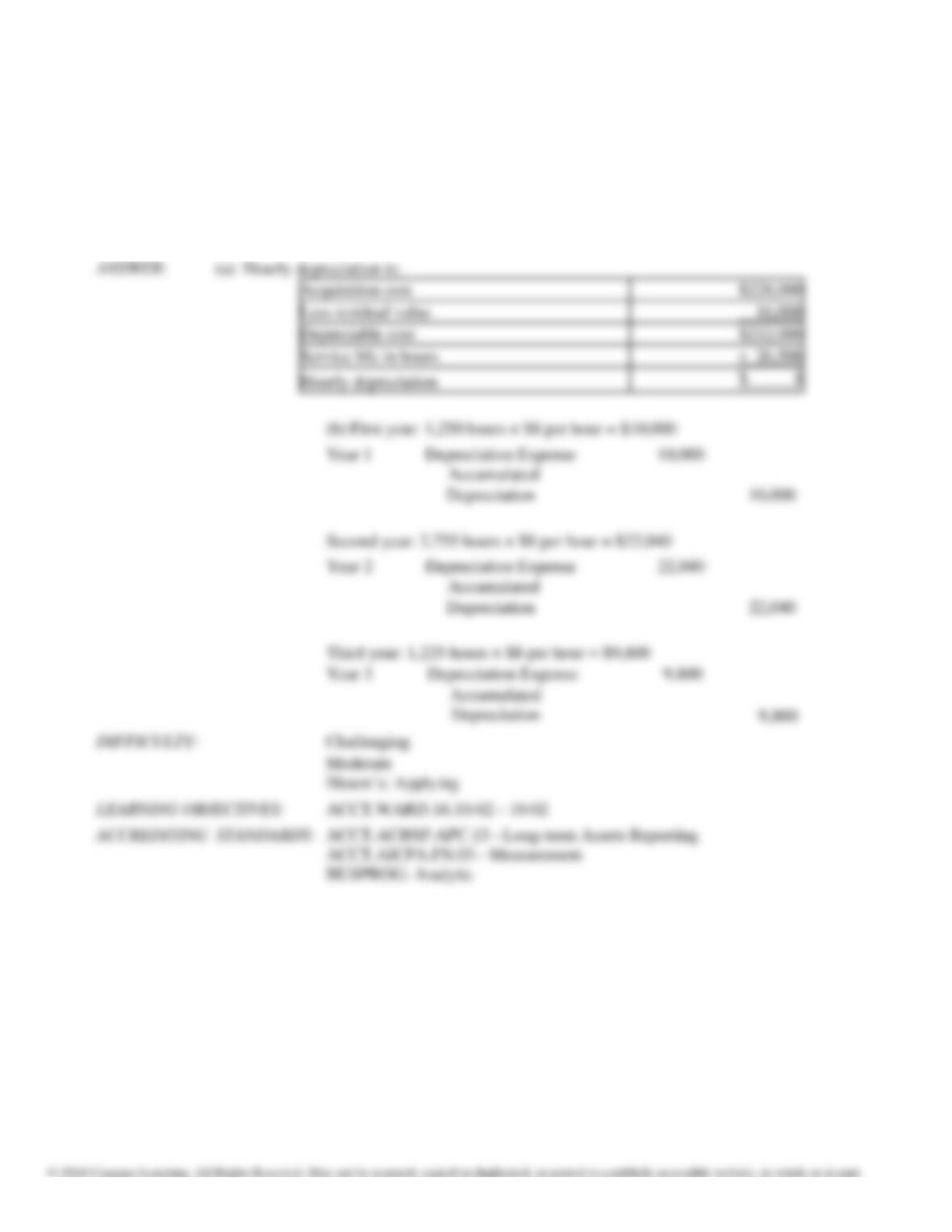
On July 1, Harding Construction purchases a bulldozer for $228,000. The equipment has a 8-year life with
a
residual value of $16,000. Harding uses straight-line depreciation.
(a) Calculate the depreciation expense and provide the journal entry for the first year ending December 31.
(b)
Calculate the third year’s depreciation expense and provide the journal entry for the third year ending
December 31.
(c)
Calculate the last year’s depreciation expense and provide the journal entry for the last year.
Chapter 10: Fixed Assets and Intangible Assets
157.
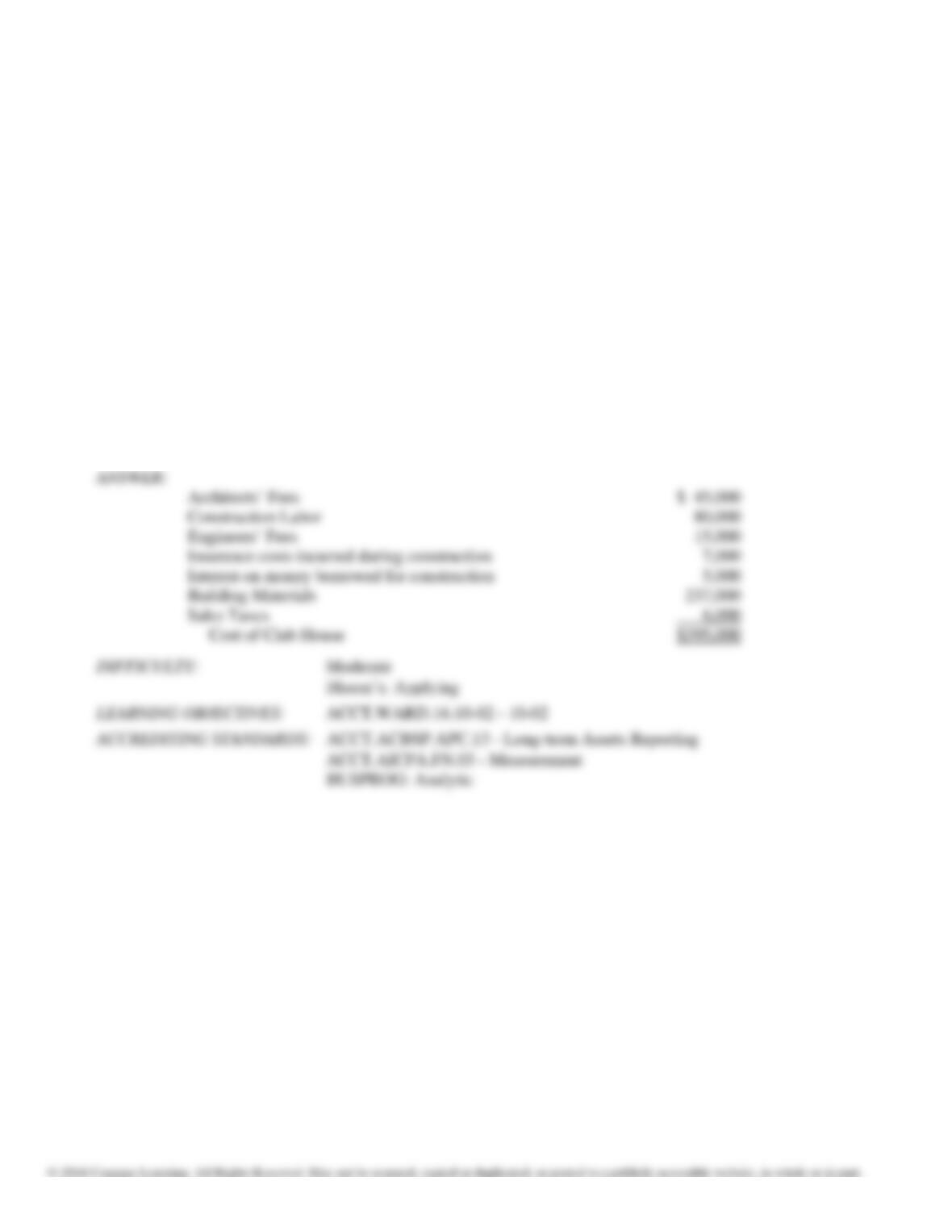
On July 1, Hartford Construction purchases a bulldozer for $228,000. The equipment has a 9-year life with a
residual value of $16,000. Hartford uses the units-of-output method depreciation, and the bulldozer is expected
to
yield 26,500 operating hours.
(a)
Calculate the depreciation expense per hour of operation.
(b)
The bulldozer is operated 1,250 hours in the first year, 2,755 hours in the second year, and 1,225 hours in
the
third year of operations. Journalize the depreciation expense for each year.
Chapter 10: Fixed Assets and Intangible Assets
158.
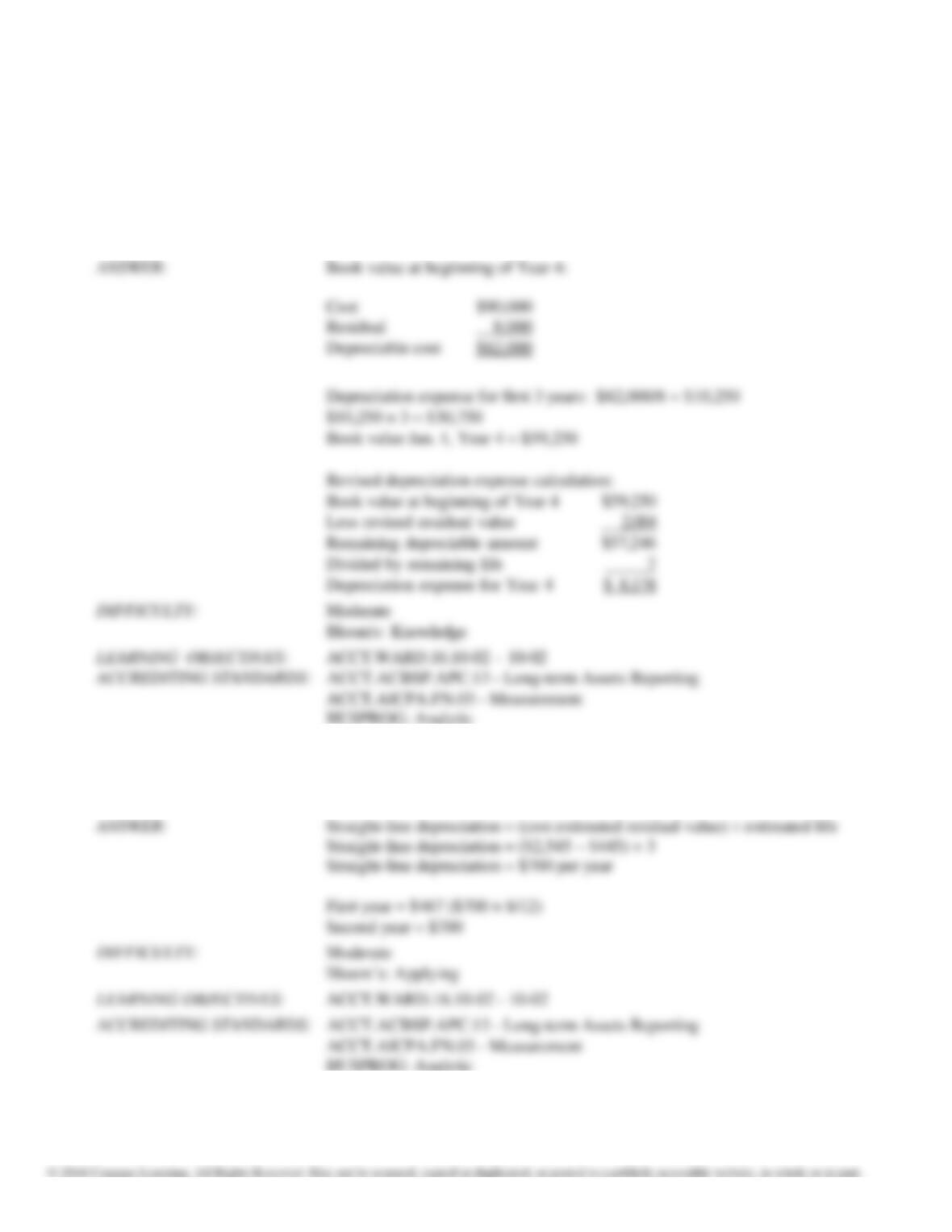
Eagle Country Club has acquired a lot to construct a clubhouse. Eagle had the following costs related to
the
construction:
Architects’ fees
$ 45,000
Construction labor
80,000
Engineers’ fees
15,000
Fences around building
9,000
Grading and leveling
10,000
Insurance costs incurred during construction
7,000
Interest on money borrowed for construction
5,000
Land
73,000
Building Materials
237,000
Sales taxes
6,000
Trees and shrubs
6,000
Determine the cost of the club house to be reported on the balance sheet.
Chapter 10: Fixed Assets and Intangible Assets
159.
Equipment was purchased on January 5, year 1, at a cost of $90,000. The equipment had an estimated useful
life
of 8 years and an estimated residual value of $8,000.
After using the equipment for 3 years, the useful life was revised to a total of 10 years and the residual value was
reduced to $2,004.
Determine the straight-line depreciation expense for the Year 4 and following years.
160.
A copy machine acquired on May 1 with a cost of $2,545 has an estimated useful life of 3 years. Assuming that
it
will have a residual value of $445, determine the depreciation for the first and second year by the straight-line
method. Round your answers to the nearest whole dollar.