Chapter 10 – The Blood Vessels and Blood Pressure
True
51. Arterioles have no significant parasympathetic innervation, with the exception of the abundant parasympathetic
vasodilator supply to the arterioles of the genitalia.
a.
True
b.
False
True
52. Vasopressin is primarily involved in maintaining water balance by regulating the amount of water the kidneys retain
for the body during urine formation.
a.
True
b.
False
True
53. Discontinuous capillaries form large channels known as sinusoids that are 100 times wider than traditional capillaries.
a.
True
b.
False
False
54. On average, the hydrostatic pressure is 37 mm Hg at the arteriolar end of a tissue capillary.
a.
True
b.
False
True
55. Transport of absorbed fat is a function of the lymphatic system.
a.
True
b.
False
True
56. An increased concentration of plasma proteins is a cause of edema.
a.
True
b.
False
False
57. Elephantiasis is caused by a bacterial infection.
a.
True
b.
False
False
58. Veins have a large radius, so they offer little resistance to flow.
a.
True
b.
False
True
59. Reflex venous vasoconstriction can completely compensate for gravitational effects without skeletal muscle activity.
a.
True
b.
False
False
60. Venous valves play a role in counteracting the gravitational effects of upright posture by helping minimize the
backflow of blood and by temporarily supporting portions of the column of blood when the skeletal muscles are relaxed.
a.
True
b.
False
True
61. Arteriolar radius is extrinsically controlled by the hormones vasopressin and angiotensin II, which are potent
vasoconstrictors.
a.
True
b.
False
True
62. Right atrial volume receptors and hypothalamic osmoreceptors are primarily important in water and salt balance in the
body.
a.
True
b.
False
False
63. Secondary hypotension results from insufficient compensatory responses to the gravitational shifts in blood when a
person moves from a horizontal to a vertical position.
a.
True
b.
False
False
64. Increased thirst is stimulated by the initial fall in plasma/blood volume that occurs with hemorrhage.
a.
True
b.
False
True
65. Following severe loss of blood, the resultant reduction in circulating blood volume leads to an increase in venous
return and stroke volume, a subsequent fall in cardiac output, and a rise in mean arterial blood pressure.
a.
True
b.
False
False
shock
66. After only __________ minutes without O2, permanent brain damage occurs.
67. The flow rate of blood through a vessel is __________ proportional to the pressure gradient.
68. When a small artery reaches the organ it is supplying, it branches into numerous __________.
69. Arterioles branch further within the organs into __________, the smallest of vessels, across which all exchanges are
made with surrounding cells.
70. As the major arteries branch into medium-size vessels approaching the organs, the vessel wall becomes relatively less
__________ and more __________.
71. When blood pressure is 120/80, pulse pressure is __________ mm Hg.
72. The sounds heard when determining blood pressure are known as __________ sounds.
73. Unlike arteries, arteriolar walls contain little __________ connective tissue.
74. Arteriolar smooth muscle normally displays a state of partial constriction known as __________, which establishes a
baseline of arteriolar resistance.
75. Local chemical influences on arteriolar radius include local __________ changes and __________ release.
76. Local physical influences on arteriolar radius include how much the vessel is __________, the extent of __________
stress, and local application of heat or cold.
77. The main region of the brain that adjusts sympathetic output to the arterioles is the cardiovascular control center in the
__________ of the brain stem.
78. Capillaries consist of only a(n) __________ layer of flat __________ cells.
79. The endothelial cells in brain capillaries are joined by __________ junctions so that pores are nonexistent.
80. Capillaries typically branch either directly from an arteriole or from a thoroughfare channel known as a(n)
__________.
81. Exchanges between blood and surrounding tissues across capillary walls are accomplished in two ways: passive
__________ and __________ flow.
82. Lymph percolates through lymph __________, which contain special __________ that destroy bacteria picked up
from the interstitial fluid.
83. At the microcirculatory level, capillaries drain into __________, which progressively converge to form small
__________ that exit the organ.
84. The term venous return refers to the volume of blood per __________ entering each __________ from the veins.
85. __________ veins occur when the venous valves become incompetent and can no longer support the column of blood
above them.
86. The heart functions as a(n) __________ to facilitate cardiac filling.
87. Mean arterial pressure is the main driving force for propelling blood to the __________.
88. In the long term, blood volume depends on salt and water balance, which are hormonally controlled by the
__________ system and __________, respectively.
89. The efferent pathway of the cardiovascular control center is the ___________ nervous system.
90. About 90% of hypertension is of unknown cause and termed __________ hypertension.
Chapter 10 – The Blood Vessels and Blood Pressure
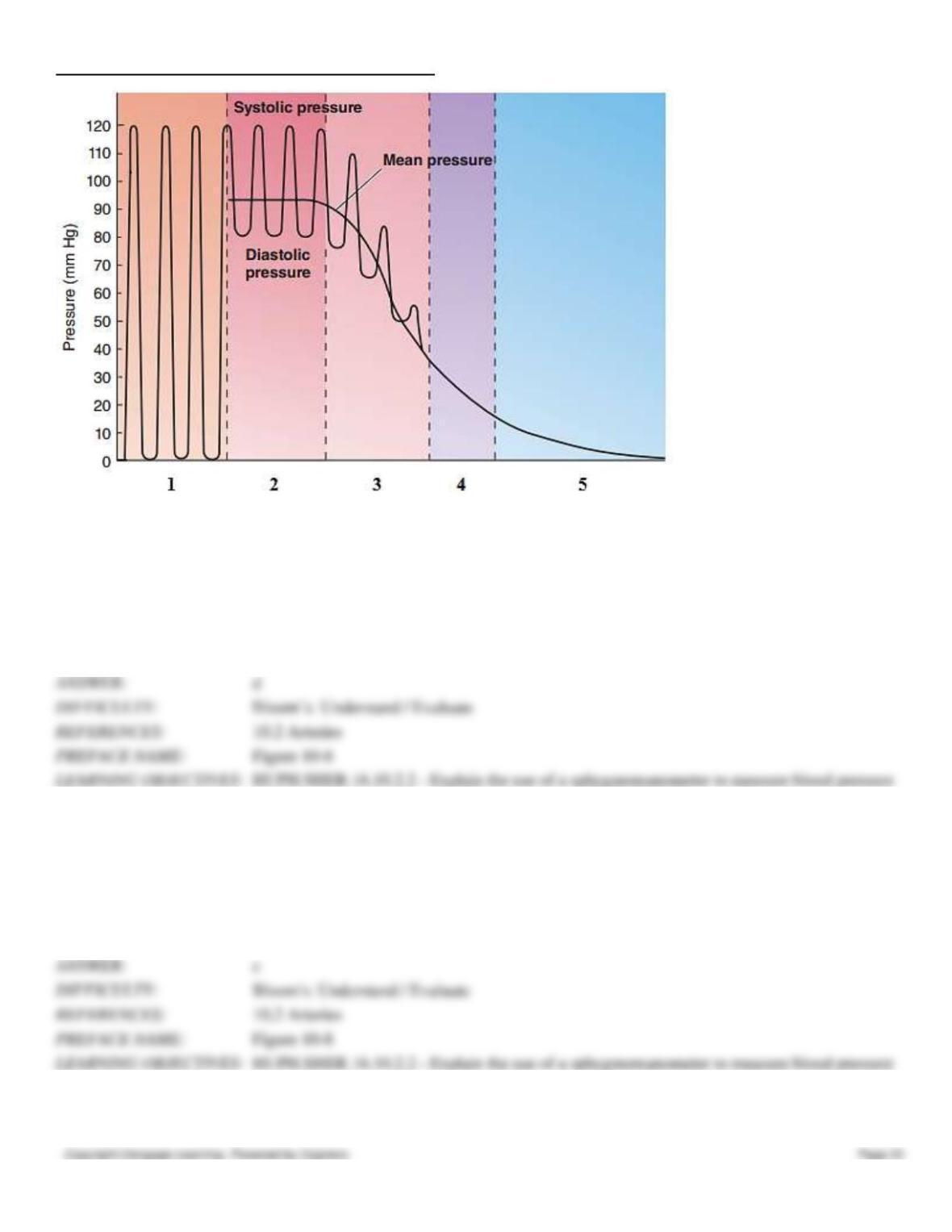
Use the figure above (Figure 10–8) to answer the corresponding questions.
91. Which number in the figure represents the blood pressures experienced by the capillaries?
a.
1
b.
2
c.
3
d.
4
e.
5
d
92. Which number in the figure represents the blood pressures experienced by the arterioles?
a.
1
b.
2
c.
3
d.
4
e.
5
93. Which number in the figure represents the pressures experienced by the left ventricle?
Chapter 10 – The Blood Vessels and Blood Pressure
a.
1
b.
2
c.
3
d.
4
e.
5
94. Which number in the figure represents the blood pressures experienced by the veins and venules?
a.
1
b.
2
c.
3
d.
4
e.
5
95. Which number in the figure represents the pressures experienced by the arteries?
a.
1
b.
2
c.
3
d.
4
e.
5
b
96. Discuss viscosity and how it relates to blood.
97. Explain the difference between vasoconstriction and vasodilation.
98. Explain the meaning of flow in terms of the bloodstream.
99. Describe the effect of sympathetic activity on venous return.
100. Describe short-term and long-term control measures of blood pressure.