Chapter 10: Property, Plant, and Equipment: Acquisition and Subsequent Investments
50. When exchanging nonmonetary assets
a.
boot must be associated with the transaction in order to recognize a gain or loss.
b.
recognized gain or loss can occur depending on the fair value of the asset surrendered and the fair value of the
asset received.
c.
a loss can be recognized only when the fair value of the asset received plus boot is greater than the book value
of the asset surrendered.
d.
recognized gain or loss can occur depending on the book value of the asset surrendered and the fair value of
the asset surrendered.
d
1
Moderate
ACCT.WHAL.16.10.3 – LO: 10.3
United States – BUSPROG: Reflective Thinking – BUSPROG: Analytic
United States – OH – Default City – AICPA: FN-Decision Modeling
51. Richards, Inc. exchanged a piece of equipment with an original cost of $82,000, accumulated depreciation to date of
$40,000, and a fair value of $46,000 for a similar piece of equipment. Cash flows are not expected to change
significantly. The newly acquired equipment had a book value of $40,000 and a fair market value of $41,000. At
what value should Richard record the newly-acquired equipment?
a.
$40,000
b.
41,000
c.
$42,000
d.
$46,000
d
1
Challenging
ACCT.WHAL.16.10.3 – LO: 10.3
United States – BUSPORG: Analytic
United States – OH – Default City – AICPA: FN-Measurement
Chapter 10: Property, Plant, and Equipment: Acquisition and Subsequent Investments
52. On May 15, 2016, January Company acquired a new forklift in exchange for an old forklift that it had acquired in
2006. The old forklift was purchased for $20,000 and had a book value of $5,000. On the date of the exchange, the
old forklift had a market value of $6,000. In addition, Retread paid $18,000 cash for the new forklift, which had a list
price of $25,000. It is expected that future cash flows will not change. At what amount should Retread record the new
forklift for financial accounting purposes?
a.
$23,000
b.
$24,000
c.
$20,000
d.
$25,000
b
1
Challenging
ACCT.WHAL.16.10.3 – LO: 10.3
United States – BUSPORG: Analytic
United States – OH – Default City – AICPA: FN-Measurement
53. Romney Company exchanged one business automobile for a replacement automobile. The old automobile had an
original cost of $40,000, a book value of $16,000, and a fair value of $24,000 when exchanged. In addition, Romney
paid $9,000 cash to acquire the replacement automobile. The list price of the replacement automobile was $45,000.
The replacement will help generate significantly greater cash flows in the business. At what amount should the
replacement automobile be recorded for financial accounting purposes?
a.
$24,000
b.
$30,000
c.
$33,000
d.
$35,000
c
1
Challenging
ACCT.WHAL.16.10.3 – LO: 10.3
United States – BUSPORG: Analytic
United States – OH – Default City – AICPA: FN-Measurement
Chapter 10: Property, Plant, and Equipment: Acquisition and Subsequent Investments
54. Reba Company received $60,000 in cash and used equipment with a fair value of $160,000 from Fargo Corporation in
exchange for Reba’s existing equipment, which had a fair value of $210,000 and an undepreciated cost of $170,000
recorded on its books. The transaction was undertaken because Reba was revising its market strategy and planned to
reduce the use of this type of equipment in its production. How much gain should Reba recognize on this exchange
and at what value should the acquired equipment be recorded, respectively?
a.
Gain – $10,000 and Equipment – $150,000
b.
Gain – $10,000 and Equipment – $160,000
c.
Gain – $40,000 and Equipment – $150,000
d.
Gain – $40,000 and Equipment – $160,000
c
1
Moderate
ACCT.WHAL.16.10.3 – LO: 10.3
United States – BUSPORG: Analytic
United States – OH – Default City – AICPA: FN-Measurement
55. Robertson traded in an old plant asset for a newer model that would be more productive and efficient. Data relative to
the old and new plant assets follow:
Old Plant Asset
Original cost
$10,000
Accumulated depreciation of
7,000
Fair value
2,000
New Plant Asset
List price
13,000
Robertson paid $10,500 cash in the trade. What should be the cost of the new plant asset for financial accounting
purposes?
a.
$12,000
b.
$12,500
c.
$13,500
d.
$13,000
b
1
Moderate
ACCT.WHAL.16.10.3 – LO: 10.3
United States – BUSPORG: Analytic
United States – OH – Default City – AICPA: FN-Measurement
56. Kelly Company exchanged inventory items that cost $47,000 and normally sold for $75,000 for a new delivery truck
with a list price of $77,000. The delivery truck should be recorded on Kelly’s books at
a.
$47,000
b.
$75,000
c.
$77,000
d.
$79,000
b
1
Moderate
ACCT.WHAL.16.10.3 – LO: 10.3
United States – BUSPORG: Analytic
Exhibit 10-1
Two construction companies, Dakota and Carolina, are in the construction business. Each owns a tract of land being held
for development, but each company believes that the other’s land is better suited to enhance the success of each planned
development. Accordingly, they agree to exchange their land and have the following information:
Dakota’s
Carolina’s
Land
Land
Cost and book value
$400,000
$250,000
Fair value based upon appraisal
$500,000
$450,000
The exchange of land was made, and based on the difference in appraised fair value, Carolina paid $50,000 cash to
Dakota.
57. Refer to Exhibit 10-1. For financial reporting purposes, Dakota should recognize a gain on this exchange in the
amount of
a.
$0
b.
$50,000
c.
$100,000
d.
$200,000
c
1
Challenging
ACCT.WHAL.16.10.3 – LO: 10.3
United States – BUSPORG: Analytic
United States – OH – Default City – AICPA: FN-Measurement
58. Refer to Exhibit 10-1. For financial reporting purposes, Carolina should recognize a gain on this exchange in the
amount of
a.
$ 0
b.
$50,000
c.
$100,000
d.
$200,000
d
1
Challenging
ACCT.WHAL.16.10.3 – LO: 10.3
United States – BUSPORG: Analytic
59. Refer to Exhibit 10-1. After the exchange, Dakota should record its newly acquired land on its books at
a.
$300,000
b.
$400,000
c.
$450,000
d.
$500,000
c
1
ACCT.WHAL.16.10.3 – LO: 10.3
United States – BUSPORG: Analytic
United States – OH – Default City – AICPA: FN-Measurement
60. Refer to Exhibit 10-1. After the exchange, Carolina should record its newly acquired land on its books at
a.
$300,000
b.
$400,000
c.
$450,000
d.
$500,000
d
1
Challenging
ACCT.WHAL.16.10.3 – LO: 10.3
United States – BUSPROG – BUSPROG: Analytic
United States – Ohio – Default City – AICPA – FN-Decision Modeling
Bloom’s: Analyzing
61. Which one of the following statements is true?
a.
If a plant asset is self-constructed for less than it would cost to purchase, a profit should be recorded upon the
completion of the construction.
b.
When property, plant, or equipment is acquired through donation, no entry is recorded.
c.
Development stage enterprises need not report losses before sales are made.
d.
Interest cannot be capitalized if a loan is taken when an asset is substantially complete and ready for its
intended use.
d
1
Moderate
ACCT.WHAL.16.10.2 – LO: 10.4
ACCT.WHAL.16.10.4 – LO: 10.4
United States – BUSPROG: Reflective Thinking – BUSPROG: Analytic
United States – OH – Default City – AICPA: FN-Decision Modeling
62. All of the following are arguments in favor of including only the incremental fixed overhead costs in the cost of a self-
constructed asset, except that the
a.
cost of the asset is the additional cost incurred to produce it.
b.
overhead would be incurred whether or not the construction took place.
c.
asset cost will more closely approximate the cost of a purchased asset.
d.
decision to construct the asset should be based on the total incremental cost and not include allocated fixed
overhead.
c
1
Moderate
ACCT.WHAL.16.10.4 – LO: 10.4
United States – BUSPROG: Reflective Thinking – BUSPROG: Analytic
United States – OH – Default City – AICPA: FN-Decision Modeling
Chapter 10: Property, Plant, and Equipment: Acquisition and Subsequent Investments
63. According to GAAP, interest cost incurred to finance construction of an asset must be capitalized in which of the
following situations?
a.
when the asset is inventory that is routinely manufactured in large quantities on a repetitive basis
b.
when an asset is used in other than the earning activities of the firm
c.
when an asset is ready for its intended use
d.
when an asset is being constructed for a firm’s own use
d
1
Moderate
ACCT.WHAL.16.10.4 – LO: 10.4
United States – BUSPROG: Reflective Thinking – BUSPROG: Analytic
64. On January 1, 2016, Randolf Company signed a contract to have Rory Associates construct a manufacturing facility at
a cost of $14,000,000. It was estimated that it would take three years to complete the project. Also on January 1, 2016,
to finance the construction cost, Randolf borrowed $14,000,000 payable in seven annual installments of $2,000,000
plus interest at the rate of 9%. During 2016, Randolf made progress payments totaling $5,000,000 under the contract,
and the average amount of accumulated expenditures was $3,000,000 for the year. The excess borrowed funds were
invested in short-term securities, from which Randolf realized investment income of $330,000. What amount should
Randolf report as capitalized interest at December 31, 2016?
a.
$ 0
b.
$ 270,000
c.
$ 510,000
d.
$1,260,000
b
1
Challenging
ACCT.WHAL.16.10.4 – LO: 10.4
United States – BUSPORG: Analytic
United States – OH – Default City – AICPA: FN-Measurement
Chapter 10: Property, Plant, and Equipment: Acquisition and Subsequent Investments
65. On January 1, 2017, Tolvin Company signed a contract to have Bob’s Builders construct a office building at a cost of
$30,000,000. It was estimated that it would take four years to complete the project. Also on January 1, 2017, to
finance the construction cost, Tolvin borrowed $20,000,000 payable in five annual installments of $4,000,000 plus
interest at the rate of 8%. During 2017, Tolvin made progress payments totaling $5,000,000 under the contract, and
the average amount of accumulated expenditures was $6,000,000 for the year. The excess borrowed funds were
invested in short-term securities, from which Tolvin realized investment income of $650,000. What amount should
Tolvin report as capitalized interest at December 31, 2017?
a.
$ 400,000
b.
$ 480,000
c.
$ 650,000
d.
$1,600,000
b
1
Moderate
ACCT.WHAL.16.10.4 – LO: 10.4
United States – BUSPROG – BUSPROG: Analytic
United States – Ohio – Default City – AICPA – FN-Decision Modeling
Bloom’s: Analyzing
66. On January 1, 2016, Basker Research signed a contract to have Bob’s Builders construct a laboratory building at a cost
of $20,000,000. It was estimated that it would take four years to complete the project. Also on January 1, 2017, to
finance the construction cost, Tolvin borrowed $20,000,000 payable in five annual installments of $4,000,000 plus
interest at the rate of 7%. During 2017, Tolvin made the following construction-related expenditures:
Date
Amount
3/1
$600,000
7/1
$700,000
11/1
$900,000
What amount should Tolvin report as capitalized interest at December 31, 2017?
a.
$ 70,000
b.
$ 84,000
c.
$ 152,000
d.
$1,400,000
a
1
Moderate
ACCT.WHAL.16.10.4 – LO: 10.4
United States – BUSPROG – BUSPROG: Analytic
United States – Ohio – Default City – AICPA – FN-Decision Modeling
Bloom’s: Analyzing
Chapter 10: Property, Plant, and Equipment: Acquisition and Subsequent Investments
67. On January 1, 2016, Olvert Corp. signed a contract to have Bob’s Builders construct a distribution center at a cost of
$10,000,000. It was estimated that it would take two years to complete the project. Also on January 1, 2017, to
finance the construction cost, Tolvin borrowed $10,000,000 payable in five annual installments of $4,000,000 plus
interest at the rate of 6%. During 2017, Tolvin made the following construction-related expenditures:
Date
Amount
2/1
$2,200,000
5/1
$1,700,000
8/1
$ 700,000
11/1
$ 400,000
What amount should Tolvin report as capitalized interest at December 31, 2017?
a.
$621,000
b.
$300,000
c.
$207,000
d.
$150,000
c
1
Moderate
ACCT.WHAL.16.10.4 – LO: 10.4
United States – BUSPROG – BUSPROG: Analytic
United States – Ohio – Default City – AICPA – FN-Decision Modeling
Bloom’s: Analyzing
68. Which of the following costs incurred subsequent to the acquisition of a machine would be appropriately accounted
for by debiting the accumulated depreciation account related to the machine?
a.
the cost of cleaning and lubricating the machine.
b.
The cost of overhauling and extending the life of the machine.
c.
the cost of moving the machine to another manufacturing plant.
d.
the cost of a new attachment to the machine that provides for more output per unit of time.
b
1
Moderate
ACCT.WHAL.16.10.5 – LO: 10.5
United States – BUSPROG: Reflective Thinking – BUSPROG: Analytic
United States – OH – Default City – AICPA: FN-Decision Modeling
69. Under GAAP, which one of the following types of costs should not be capitalized?
a.
rearrangements
b.
routine maintenance
c.
replacements
d.
Additions
b
1
Easy
ACCT.WHAL.16.10.5 – LO: 10.5
United States – BUSPROG: Reflective Thinking – BUSPROG: Analytic
United States – OH – Default City – AICPA: FN-Decision Modeling
70. An improvement made to a machine increased its production capacity by 25% without extending the machine’s useful
life. The cost of the improvement should be
a.
recorded as an expense.
b.
debited to Accumulated Depreciation.
c.
capitalized in the machine account.
d.
allocated between Accumulated Depreciation and the machine account.
c
1
ACCT.WHAL.16.10.5 – LO: 10.5
United States – BUSPROG: Reflective Thinking – BUSPROG: Analytic
United States – OH – Default City – AICPA: FN-Decision Modeling
71. Which of the following events is most appropriately recorded as a reduction to accumulated depreciation?
a.
an addition that increases the anticipated benefits of the old asset
b.
an improvement that extends an asset’s useful life
c.
an improvement that increases the asset’s expected benefits beyond that originally expected
d.
a replacement of a better asset for the one currently used
b
1
Moderate
ACCT.WHAL.16.10.5 – LO: 10.5
United States – BUSPROG: Reflective Thinking – BUSPROG: Analytic
United States – OH – Default City – AICPA: FN-Decision Modeling
72. On January 1, 2011, Barton Sinks purchased a metal-bending machine for $4,000,000 with an expected useful life of
10 years with no residual value. The machine is depreciated on a straight-line basis. On January 1, 2016, the company
overhauled the machine at a cost of $1,000,000. This extended the expected useful life by 3 years? What is
depreciation expense on the machine for 2016, still assuming zero residual value?
a.
$600,000
b.
$525,000
c.
$500,000
d.
$375,000
d
1
Challenging
ACCT.WHAL.16.10.5 – LO: 10.5
United States – BUSPROG – BUSPROG: Analytic
United States – Ohio – Default City – AICPA – FN-Decision Modeling
Bloom’s: Understanding
73. In 2016, Go Oil Company incurred costs of $8 million drilling oil wells. Thirty percent of the drilling resulted in oil
being found. The rest of the drilling was unsuccessful. If Go uses the successful-efforts method of accounting, the oil
and gas properties will be valued on the December 31, 2016 balance sheet at
a.
$8,000,000.
b.
$4,900,000.
c.
$4,200,000.
d.
$2,400,000.
d
1
Moderate
ACCT.WHAL.16.10.6 – LO: 10.6
United States – BUSPORG: Analytic
United States – OH – Default City – AICPA: FN-Measurement
74. Two alternative methods of accounting for the cost of oil and gas properties have been widely used. The method that
capitalizes all costs associated with all wells is the
a.
successful-efforts method.
b.
full-cost method.
c.
variable-cost method.
d.
specific-cost method.
b
1
Easy
ACCT.WHAL.16.10.6 – LO: 10.6
United States – BUSPROG: Reflective Thinking – BUSPROG: Analytic
75. Concerning current accounting for oil and gas properties, which statement is true?
a.
The successful-efforts method must be used.
b.
The reserve-recognition method must be used.
c.
Either the successful-efforts method or the full-cost method may be used.
d.
The full-cost method must be used.
c
1
ACCT.WHAL.16.10.6 – LO: 10.6
United States – BUSPROG: Reflective Thinking – BUSPROG: Analytic
United States – OH – Default City – AICPA: FN-Decision Modeling
76. The costs of drilling an unsuccessful well are expensed under
a.
the successful-efforts method.
b.
the full-cost method.
c.
both the successful-efforts method and the full-cost method.
d.
neither the successful-efforts method nor the full-cost method.
a
1
Easy
ACCT.WHAL.16.10.6 – LO: 10.6
United States – BUSPROG: Reflective Thinking – BUSPROG: Analytic
United States – OH – Default City – AICPA: FN-Decision Modeling
77. Costs incurred by Mills Company that relate to its property, plant, and equipment assets might be recorded in one of
the five following accounts:
a.
an expense account
b.
Accumulated Depreciation
c.
Land
d.
Building
e.
Equipment
Required:
For each of the costs identified below, indicate the type of account in which the cost should be recorded by placing the
appropriate letter in the space provided.
____
1.
The legal fees associated with the acquisition of land.
____
2.
The cost of replacing the engine in a truck when the cost of the old engine is not
known.
____
3.
The cost of replacing an oil furnace with an electric furnace (book value of the oil
furnace is known).
____
4.
The cost of a new addition to a warehouse that will be used to store inventory.
____
5.
The cost of renovating a recently purchased ten-year-old office building.
____
6.
The materials and labor costs incurred in installing a new piece of equipment.
____
7.
The costs of tuning, lubricating, and tire rotation on a fleet of delivery trucks.
____
8.
The additional costs in the construction of a building due to a small fire that
occurred during the construction period.
1.
c
5.
2.
b
6.
3.
e
7.
4.
d
8.
78. During 2014, the Tidel Company completed the following transactions related to its property, plant, and equipment
accounts:
a.
On March 18, Tidel paid $480,000 for land, buildings, and equipment in a lump-sum
purchase. An appraisal that cost Tidel $10,000 revealed fair market values of $200,000 for
the land, $150,000 for the buildings, and $150,000 for the equipment.
b.
On August 11, Tidel issued 20,000 shares of its $10 par value common stock in exchange
for some equipment. The equipment’s fair market value is estimated at $360,000 by an
outside appraisal. On the date of the exchange, the stock was being actively traded at $17
per share on a major stock exchange.
Required:
Prepare the necessary journal entry to properly record each transaction.
79. During 2014, Red Company acquired a new piece of equipment for its manufacturing process. In order to purchase the
equipment, Red made a down payment of $50,000 and issued a $200,000 five-year, 7% note. The annual payment of
principal and interest was to be $48,778. The market rate of interest for obligations of this kind is 12%. The present
value factor for an ordinary annuity of 5 years at 12% is 3.604776.
Required:
a.
Prepare the journal entry to record the acquisition.
b.
Assume that the equipment had an established cash price of $220,000. Prepare the journal
entry to record the transaction under this additional assumption.
80. Several expenditures are listed below:
Yes
No
a.
Landscaping
______
______
b.
Compensation for injury to construction worker
______
______
c.
Cost of overhaul before initial use
______
______
d.
Cost of tearing down a building on newly acquired land
______
______
e.
Land held as a plant site for future use
______
______
f.
Fully depreciated assets still being used
______
______
g.
Leasehold improvements
______
______
h.
Deposits on machinery not yet received
______
______
Required:
Indicate whether or not each expenditure would be included in the cost of property, plant, and equipment.
Yes
a.
X
b
X
c.
X
d.
X
e
X
f.
X
g.
X
h
X
1
Challenging
ACCT.WHAL.16.10.2 – LO: 10.4
United States – BUSPROG: Reflective Thinking – BUSPROG: Analytic
United States – OH – Default City – AICPA: FN-Decision Modeling
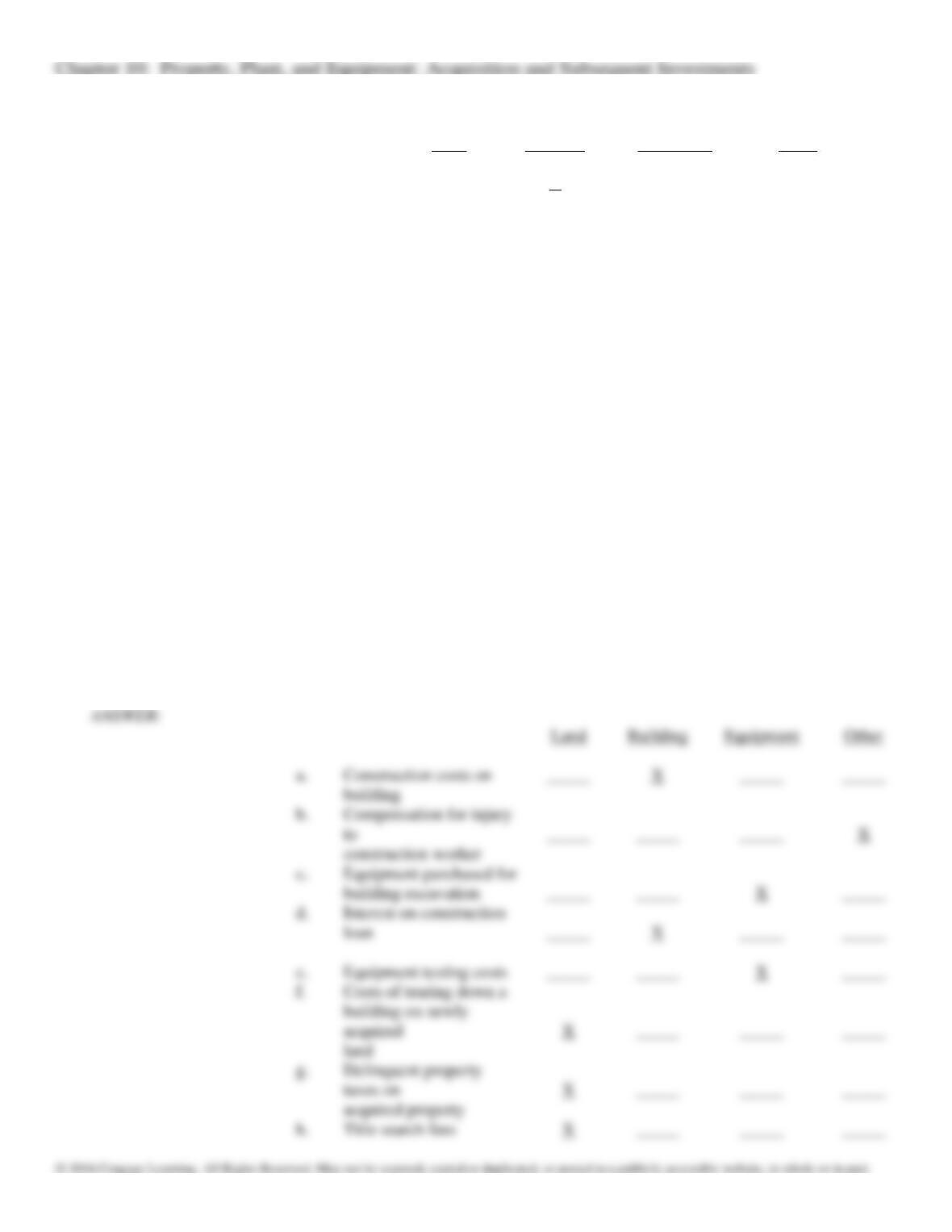
81. Several expenditures are listed below:
Land
Building
Equipment
Other
a.
Construction costs on building
______
X
______
______
b.
Compensation for injury to
construction worker
______
______
______
______
c.
Equipment purchased for
building excavation
______
______
______
______
d.
Interest on construction loan
______
______
______
______
e.
Equipment testing costs
______
______
______
______
f.
Costs of tearing down a
building on newly acquired
land
______
______
______
______
g.
Delinquent property taxes on
acquired property
______
______
______
______
h.
Title search fees
______
______
______
______
Required:
If the expenditure would be capitalized to land, buildings, equipment, or other, so indicate with an “X.” An example
is given.
Construction costs on
building
Equipment purchased for
building excavation
_____
X
e.
Equipment testing costs
_____
X
taxes on
h.
Title search fees
_____
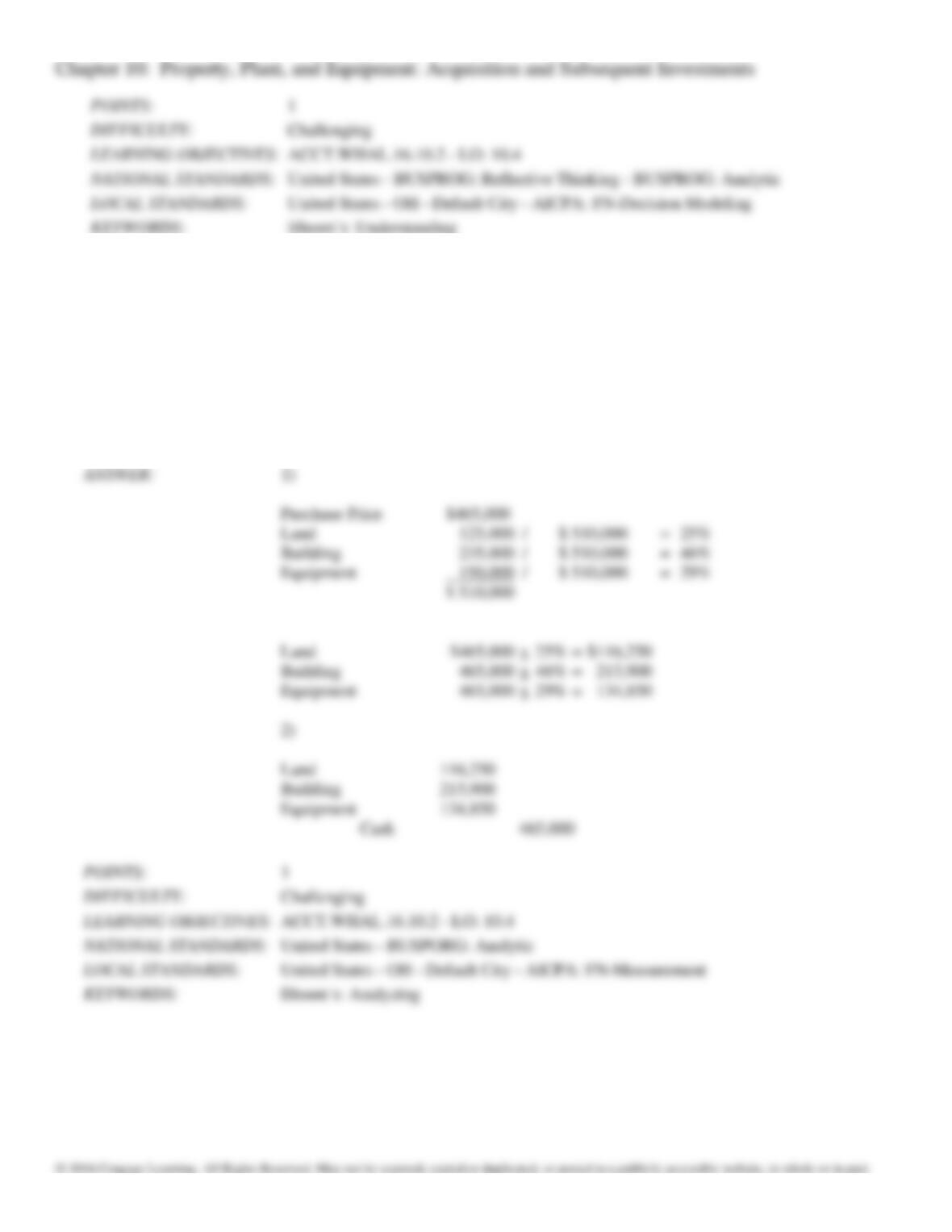
82. The Nathan Jacob’s Company paid $450,000 to acquire land, building, and equipment. At the time of the acquisition
Nathan paid $15,000 to have the property appraised. The following values were determined from the appraisal: land,
$125,000; building, $235,000; and equipment, $150,000.
Required:
1) What cost should Nathan Jacob’s assign to the land, buildings, and equipment, respectively? (round percentages to
whole percents)
2) Provide the journal entry to record the acquisition on the books of Nathan Jacob’s.
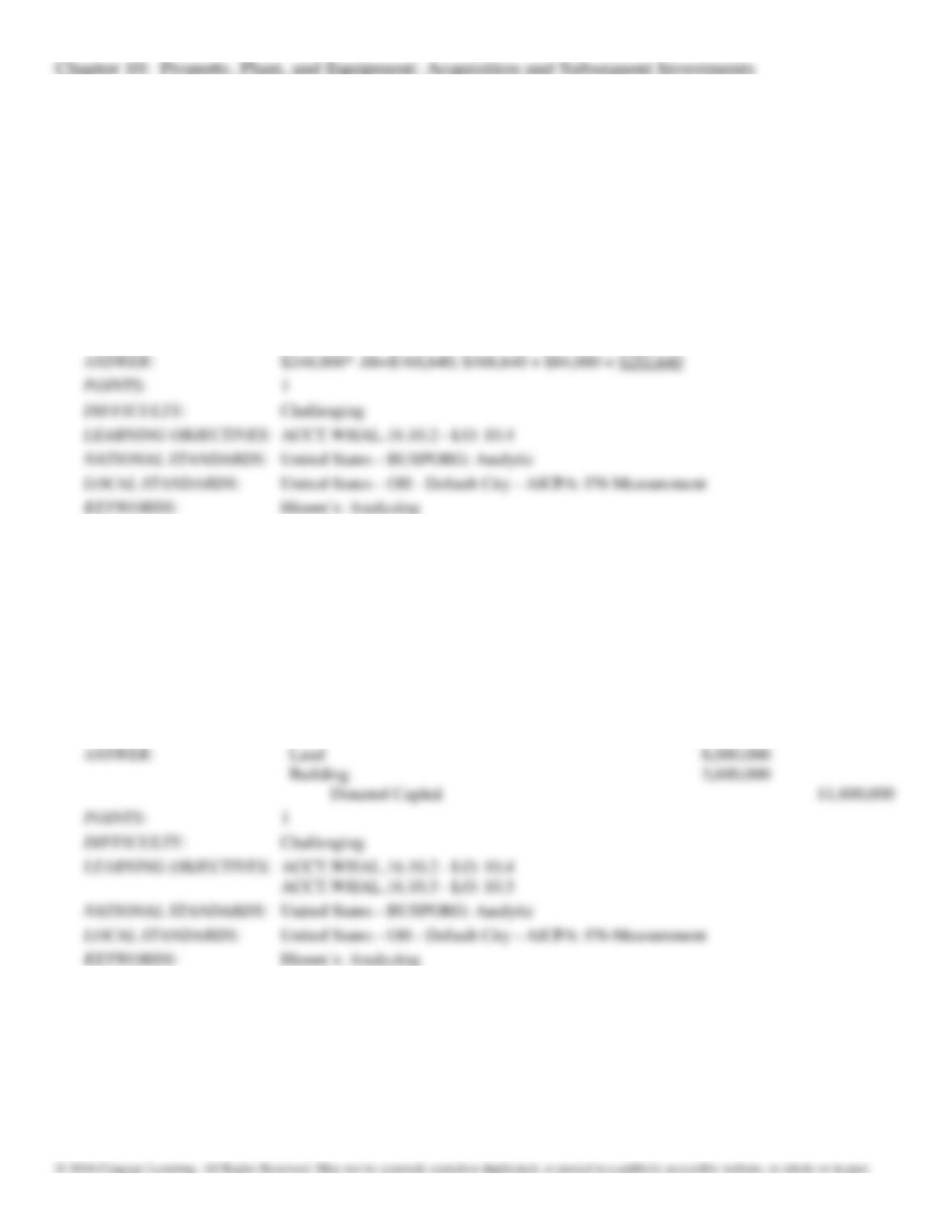
83. Jones Delivery Services bought a truck by paying $84,000 cash down and signing a $248,000 non-interest-bearing
note due in five years for the balance. Current interest rates were 8%. Actuarial information for five periods at 8%
follows:
Amount of 1
1.469
Present value of 1
0.680
Amount of annuity of 1
5.867
Present value of annuity of 1
3.993
Required:
Compute the amount that should be charged to the asset account.
$248,000* .68=$168,640; $168,640 + $84,000 = $252,640
1
Challenging
ACCT.WHAL.16.10.2 – LO: 10.4
United States – BUSPORG: Analytic
United States – OH – Default City – AICPA: FN-Measurement
84. Minor Corp. has agreed to expand its operations by opening a manufacturing plant in Bel Air, Maryland. In return, Bel
Air will donate an abandoned building and the 5 acres on which it sits to Minor. The land originally cost $1,000,000
and the building $3,000,000. The building’s current book value is $380,000, and current appraisals are: land
$8,000,000 and building $3,600,000. Minor has also agreed to provide 100 jobs for the next 5 years to Bel Airs’ city
residents. Minor estimates that the wages to these residents will amount to $4,000,000.
Required:
Prepare the journal entry to record this acquisition on Minor’s books.