Chapter 10: Long-Term Liabilities
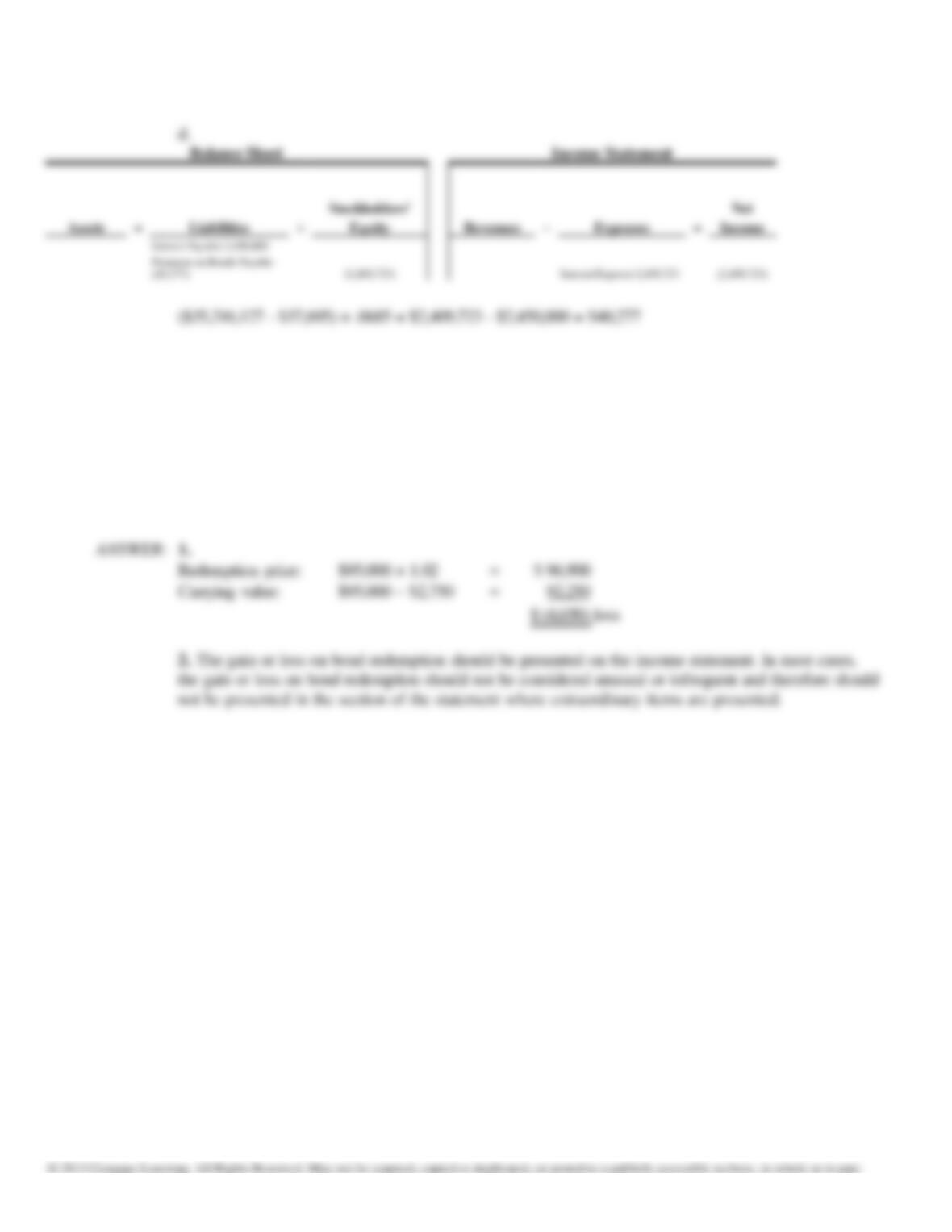
165. Improv Corporation issued $95,000 face value bonds at a discount of $5,000. The bonds contain a call price of 102.
Improv decides to redeem the bonds early when the unamortized discount is $2,750.
REQUIRED:
1. Calculate Improv Corporation’s gain or loss on the early redemption of the bonds.
2. Describe how the gain or loss would be reported on the income statement and in the notes to the financial
statements.
Chapter 10: Long-Term Liabilities
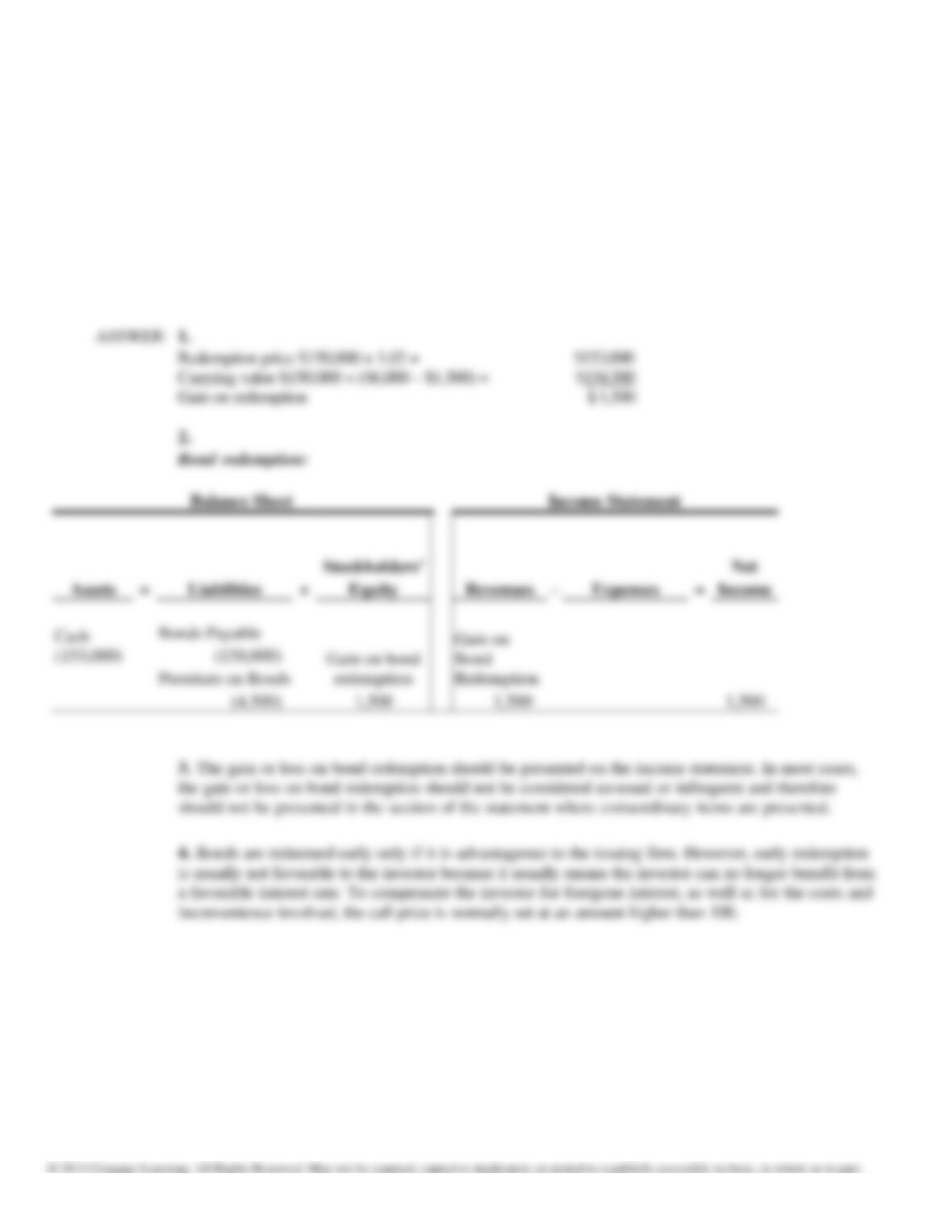
166. Burger Barn Company issued $150,000 face value bonds at a premium of $6,000. The bonds contain a call
provision of 102. Burger Barn decides to redeem the bonds due to a significant decline in interest rates. On that
date, Burger Barn had amortized only $1,500 of the premium.
REQUIRED:
1. Calculate the gain or loss on early redemption of the bonds.
2. Identify the accounting equation effects reflecting the bond redemption.
3. Where should the gain or loss should be presented on the financial statements?
4. Why is the call price is normally higher than 100?
Chapter 10: Long-Term Liabilities
Grenada Corporation
Use the note on Disclosure of Leases for the Grenada Corporation to answer the questions that follow.
The Corporation leases office, warehouse and showroom space, retail stores and office equipment under operating
leases, which expire no later than 2029. The Corporation normalizes fixed escalations in rental expense under its
operating leases. Minimum annual rentals under non–cancelable operating leases, excluding operating cost
escalations and contingent rental amounts based upon retail sales, are payable as follows:
Fiscal year ending March 31,
2016
11,121,000
2017
10,161,000
2018
9,063,000
2019
8,814,000
Thereafter
46,681,000
Rent expense was $12,551,000; $8,911,000; and $5,768,000 for the years ended March 31, 2014, 2013,and 2012
respectively.
167. Review the information for Grenada Corporation.
REQUIRED:
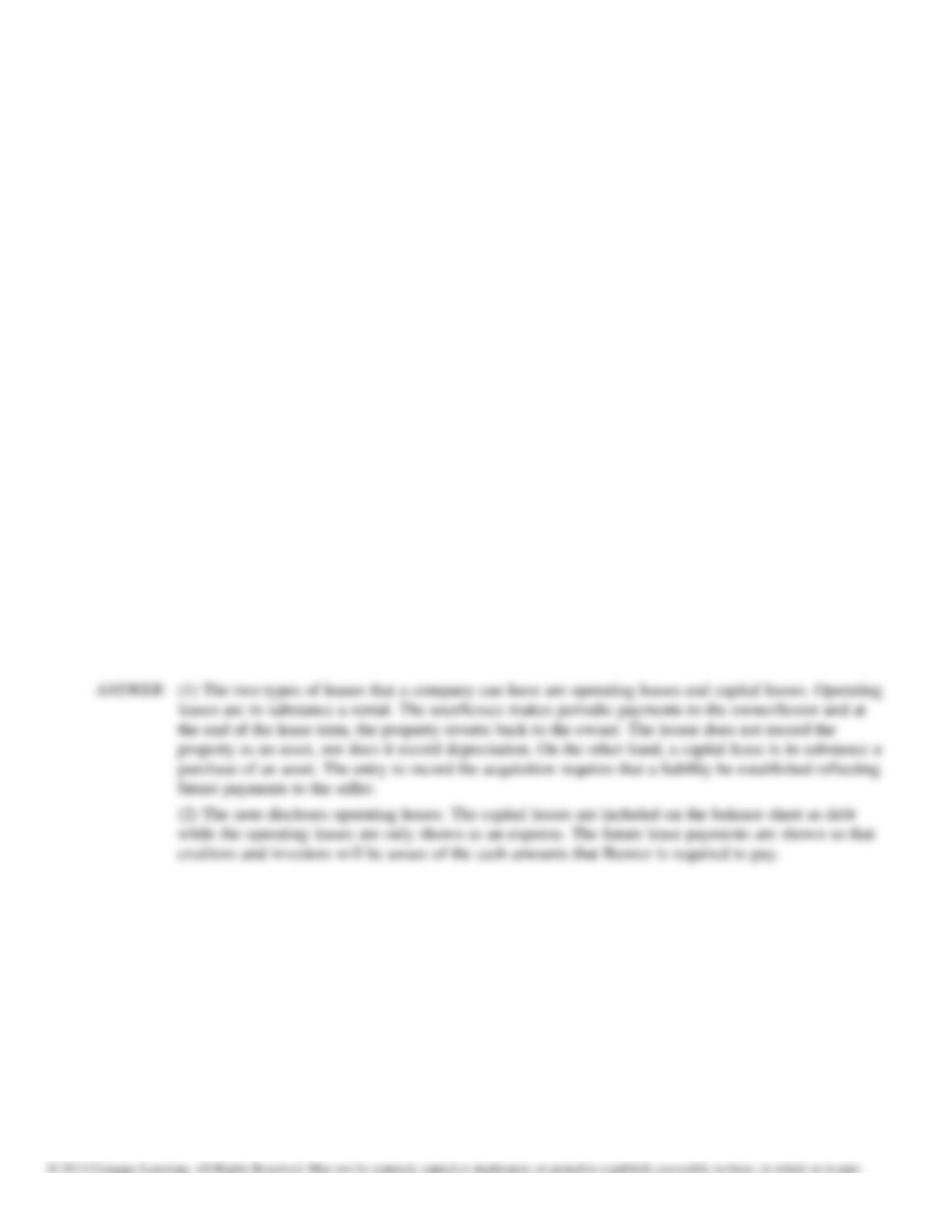
(1) What are the two types of leases that a company can have? Describe each briefly.
(2) Does the note disclosure show evidence of the two types of leases?
Chapter 10: Long-Term Liabilities
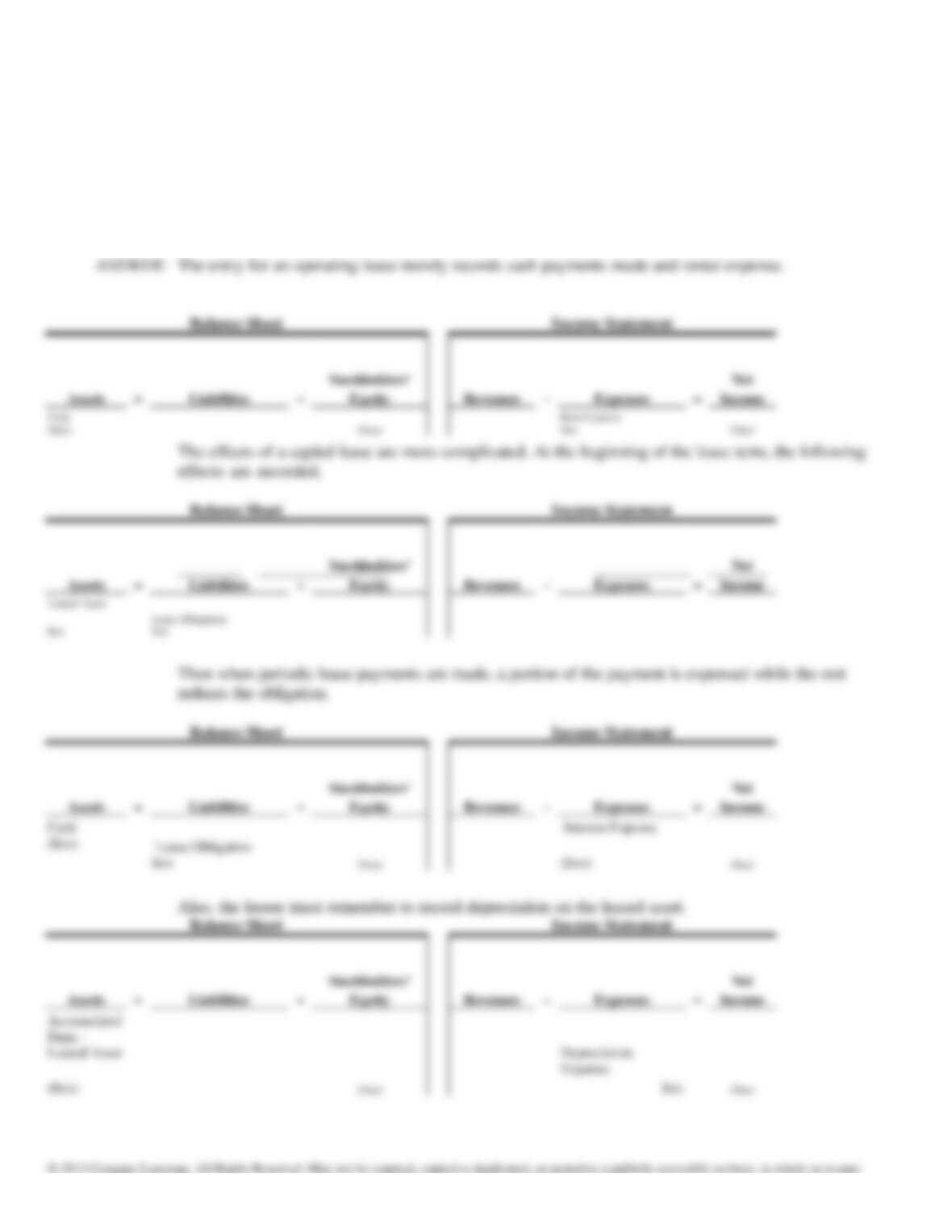
168. Review the information for Grenada Corporation.
REQUIRED:
Determine the effect on the accounting equation when recording each type of lease described in the previous
question.
Chapter 10: Long-Term Liabilities
169. Review the information for Grenada Corporation.
REQUIRED:
The note disclosure mentions contingent rent payments. What do you think this means with regard to Grenada
Corporation?
170. Wet Paint Company signed a ten-year lease agreement on January 1, 2015. The lease requires payments of
$65,000 per year every December 31. Wet Paint estimates that the leased property has a life of 11 years. The
interest rate that applies to the lease is 12%.
REQUIRED:
1. Should Wet Paint Company treat the lease as an operating lease or a capital lease?
2. If a balance sheet is presented on January 1, 2015, what amounts related to the lease will appear on the balance
sheet?
3. Assume that the leased asset is depreciated using the straight-line method and the lease is amortized using the
effective interest method. Identify the accounting equation effects for Wet Paint’s transactions on December 31,
2015?
Chapter 10: Long-Term Liabilities
(in millions)
2016
2015
Deferred income taxes
$ 442
$ 358
Total assets
22,417
20,834
Total current liabilities
8,429
9,321
Total stockholders’ equity
11,366
9,316
Padagonian Company
Use the deferred tax account that appears in the financial statements of Padagonian Company to answer the
related questions.
December 31,
171. [APPENDIX] Review the information for Padagonian Company.
REQUIRED:
(1) Where will the Deferred Income Taxes account most likely appear on a classified balance sheet?
(2) What percent is deferred income taxes of long-term liabilities for the two years?
2016 __________ 2015 ___________
(3) What percent is deferred income taxes of total liabilities for the two years?
2016 __________ 2015 ___________
Chapter 10: Long-Term Liabilities
172. [APPENDIX] Review the information for Padagonian Company.
REQUIRED:
(1) In your opinion, are deferred income taxes an appreciable portion of both long-term liabilities and total liabilities?
Why?
(2) What difference between accounting income and taxable income produces the Deferred Income Taxes
account?
(3) Will Padagonian eventually pay the deferred tax liability? When?
173. [APPENDIX] How do most changes in long-term liabilities on the balance sheet appear on the cash flow
statement?
Chapter 10: Long-Term Liabilities
174. [APPENDIX] Describe briefly how each of the following long-term liabilities arises; i.e., what kind of transaction
produces the resulting long-term liability? You may want to include the appropriate accounts to increase or decrease
(ignore amounts) in your description.
a) Long-Term Debt
b) Deferred Income Taxes
175. [APPENDIX] On January 1, 2014, Hart Company purchased an asset for $137,500. For financial accounting
purposes, the asset will be depreciated on a straight-line basis over five years with no residual value at the end of
that time. For tax purposes, the asset will be depreciated as follows: 2014, $45,000; 2015, $35,000; 2016, $25,000;
2017, $20,000; and 2018, $12,500. Assume that the company is subject to a 35% tax rate.
REQUIRED:
1. What is the amount of deferred tax at December 31, 2014?
2. Does the deferred tax represent an asset or a liability?
3. What is the amount of deferred tax at December 31, 2018?
176. One of your friends is majoring in Aeronautics. In this industry, leases are very important and he is interested in
knowing a little bit about how international accounting standards will affect the industry as compared to current
U.S. GAAP treatments for leasing. How would you explain the differences in their applications?
Chapter 10: Long-Term Liabilities
177. A friend of yours has asked you whether off-balance-sheet financing means that the amounts are immaterial and
therefore are not reported. In a short paragraph, tell him what off-balance-sheet financing is and why firms engage
in off-balance-sheet transactions?
Match the following bond and long-term liability related terms to the appropriate definition.
a. Long–term liability
b. Face value
c. Debenture bonds
d. Serial bonds
e. Callable bonds
f. Face rate of interest
g. Market rate of interest
h. Bond issue price
i. Premium
j. Discount
k. Effective interest method of amortization
l. Carrying value
m. Gain or loss on redemption
178. The principal amount of the bond as stated on the bond certificate.
179. Bonds that are backed by the general creditworthiness of the issuer and are not backed by specific collateral.
180. An obligation that will not be satisfied within one year.
181. The excess of the issue price over the face value of bonds. It occurs when the face rate on the bonds exceeds the
market rate.
182. Bonds that do not all have the same due date. A portion of the bonds comes due each time period.

Chapter 10: Long-Term Liabilities
183. The excess of the face value of bonds over the issue price. It occurs when the market rate on the bonds exceeds
the face rate.
184. Bonds that may be redeemed or retired before their specified due date.
185. The process of transferring a portion of premium or discount to interest
expense. This method transfers an amount resulting in a constant effective
interest rate.
186. The interest rate stated on the bond certificate. It is also called the nominal or coupon rate.
187. The face value of a bond plus the amount of unamortized premium or minus the amount of unamortized discount.
188. The interest rate that bondholders could obtain by investing in other bonds that are similar to the issuing firm’s bonds.
189. The difference between the carrying value and the redemption price at the time bonds are redeemed. This amount is
presented as an income statement account.
190. The total of the present value of the cash flows produced by a bond. It is calculated as the present value of the
annuity of interest payments plus the present value of the principal.
191. All of the following are considered to be long-term liabilities for Parsons Company except:
a. Bonds issued this year (due in 10 years).
b. The third year payments for a three-year lease signed this year.
c. The current year portion of Deferred taxes.
d. The principal of a note payable signed this year, but due in five years.
Chapter 10: Long-Term Liabilities
192. Which of the following statements is false with respect to bonds?
a. Firms issue bonds in very large single issues.
b. Bonds must be held until maturity by the initial investor.
c. The denomination of the bond is usually referred to as the face value.
d. Bonds that are not backed by specific collateral of the issuing company are known as debenture bonds.
193. A bond with a face value of $10,000 is issued at a discount of $800 on January 1, 2014. The face rate of interest on
the bond is 7%.
REQUIRED:
1. Was the market rate at the time of issuance greater than 7% or less than 7%?
2. If a balance sheet is presented on January 1, 2014, how will the bonds appear on the balance sheet?
3. If a balance sheet is presented on December 31, 2014, will the amount for the bonds be higher or lower than on
January 1, 2014?
Chapter 10: Long-Term Liabilities
194. Improv Corporation decides to redeem its $100,000 face value bonds when the carrying value is $107,019.48. The
bonds are redeemed on December 31, 2015, at 102.
REQUIRED:
1. Calculate Improv Corporation’s gain or loss on the early redemption of the bonds.
2. Identify the accounting equation effects to be recorded at the time of bond redemption.

Chapter 10: Long-Term Liabilities
195. Connor Martin Corporation’s balance sheet showed the following amounts: Current Liabilities, $10,000; Bonds
Payable, $3,000; Lease Obligations, $4,000; and Notes Payable, $600. Total stockholders’ equity was $12,000. The
debt-to–equity ratio is:
a. 0.83.
b. 1.47.
c. 1.42.
d. 0.63.
196. Frank Crawford Corporation’s balance sheet showed the following amounts: Current Liabilities, $15,000; Bonds
Payable, $8,000; Lease Obligations, $9,000; and Notes Payable, $5,600. Total stockholders’ equity was $17,000.
The debt-to-equity ratio is:
a. 0.88.
b. 1.18.
c. 0.71.
d. 2.21.
197. When using the indirect method for preparing the statement of cash flows, all of the following will appear in the
operating activities section except:
a. Increase in deferred tax
b. Depreciation expense on leased assets.
c. Interest expense.
d. An increase in long–term liabilities.
198. Cash interest payment is computed annually when a bond is issued for other than its face value. For a bond issued
at a discount, how will this component change as the bond approaches maturity?
a. Decrease
b. Increase
c. Remain constant
d. Not enough information given to decide.
199. Interest expense is computed annually when a bond is issued for other than its face value. For a bond issued at a
discount, how will this component change as the bond approaches maturity?
a. Decrease
b. Increase
c. Remain constant
d. Not enough information given to decide.

Chapter 10: Long-Term Liabilities
200. Amortized discount is computed annually when a bond is issued for other than its face value. For a bond issued at a
discount, how will this component change as the bond approaches maturity?
a. Decrease
b. Increase
c. Remain constant
d. Not enough information given to decide.
201. Carrying value is computed annually when a bond is issued for other than its face value. For a bond issued at a
discount, how will this component change as the bond approaches maturity?
a. Decrease
b. Increase
c. Remain constant
d. Not enough information given to decide.
202. Cash interest is computed annually when a bond is issued for other than its face value. For a bond issued at a
premium, how will this component change as the bond approaches maturity?
a. Decrease
b. Increase
c. Remain constant
d. Not enough information given to decide.
203. Interest expense is computed annually when a bond is issued for other than its face value. For a bond issued at a
premium, how will this component change as the bond approaches maturity?
a. Decrease
b. Increase
c. Remain constant
d. Not enough information given to decide.
204. Amortized premium is computed annually when a bond is issued for other than its face value. For a bond issued at a
premium, how will this component change as the bond approaches maturity?
a. Decrease
b. Increase
c. Remain constant
d. Not enough information given to decide.

Chapter 10: Long-Term Liabilities
205. Carrying value is computed annually when a bond is issued for other than its face value. For a bond issued at a
premium, how will this component change as the bond approaches maturity?
a. Decrease
b. Increase
c. Remain constant
d. Not enough information given to decide.