
CHAPTER 10—PARTNERSHIP DISTRIBUTIONS,
DISPOSITIONS OF PARTNERSHIP INTERESTS, AND
PARTNERSHIP TERMINATIONS Key
1. The entity theory of partnerships predominates in the Subchapter K Code sections dealing with the tax
consequences of cash and property distributions made by partnerships to partners.
2. A partner never recognizes loss upon the receipt of a current distribution from a partnership.
3. A partnership that distributes an asset the FMV of which exceeds its inside basis must recognize gain equal to
the excess.
4. Current cash distributions from partnerships are nontaxable unless they exceed the partner’s basis in the
partnership.
5. When a partner’s basis in his partnership interest is less than the partnership’s basis in a distributed asset, the
partner’s basis in his partnership interest is allocated among the assets according to their relative fair market
values.
6. Proportionate liquidating distributions of noncash partnership assets cannot result in recognized gain, but may
result in the recipient partner recognizing loss.
7. If a partner receives a property distribution consisting of partnership inventory, and in a subsequent year sells
the distributed property at a gain, such gain must always be recognized as ordinary income.

8. A retiring partner who receives a liquidating distribution of cash as payment for her share of partnership
substantially appreciated inventory must recognize ordinary income equal to the excess of the FMV of her
proportionate share of the inventory over her proportionate share of the inside basis of the inventory.
9. If a liquidating distribution results in a capital gain or loss to the recipient partner, the partnership must make
a positive or negative adjustment to the basis of its remaining capital or § 1231 assets equal to such gain or
loss.
10. Section 751 assets (“hot” assets) include (but are not limited to) amounts due from the performance of
services that have not previously been reported as income and recapture of depreciation.
11. The tax effects are identical whether a partner sells his or her interest to another partner, the partnership, or a
person who has not been a partner, assuming the amount of cash to be received is the same.
12. When a general partner’s capital interest in a service partnership is retired, liquidating distributions can
include payment for goodwill and unrealized receivables if the partnership agreement so specifies.
13. The seller of a partnership interest may recognize ordinary gain on the sale, but will never recognize
ordinary loss.
14. The purchaser of a partnership interest takes an outside basis in the interest equal to his proportionate share
of the inside basis of partnership assets plus any amount of partnership debt apportionable to the purchased
interest.
15. The exchange of partnership interest can usually qualify for the like-kind exchange rules, provided all
requirements of the like-kind exchange provisions are met and proper elections are made at the partnership
level.
16. When an interest in a partnership with appreciated assets is sold and no § 754 election is made, the new
partner’s outside basis exceeds his inside basis due to the applicability of the entity concept.
17. The death of a partner closes the partnership taxable year with respect to that partner.
18. Whenever a partnership is dissolved under state law, it is terminated for federal tax purposes.
19. If a partnership satisfies a $50,000 guaranteed payment obligation by distributing property to the partner
with a fair market value of $50,000 and an adjusted basis of $40,000, the partner receiving the payment must
recognize $10,000 of gain.
20. Partner Z received a current distribution from the XYZ Partnership consisting of $3,000 cash and
partnership inventory (FMV $10,000 and basis $7,800). The distribution did not change Z’s profit and loss
sharing ratio. Immediately prior to the distribution, Z’s outside basis in his partnership interest was $11,000.
Because of the distribution Z must:
21. Partner R received a current distribution from the RST Partnership consisting of $20,000 cash, $6,000 of
partnership zero basis accounts receivables, and a capital asset (FMV $7,000 and basis $1,500). The distribution
did not change R’s profit and loss sharing ratio. Immediately prior to the distribution, R’s outside basis in his
partnership interest was $25,000. After the distribution, what basis does R have in the receivables, the capital
asset, and his partnership interest?

22. K owns 25 percent of a partnership K’s basis in the partnership was $12,000 before she received a current
proportionate distribution of equipment with a basis of $14,000 and a liability against it of $6,000 How much is
K’ s basis in the partnership after the distribution^
23. K owns 25 percent of a partnership K’s basis in the partnership was $12,000 before she received a current
proportionate distribution of equipment with a basis of $14,000 and a liability against it of $6,000 By what total
amount would the remaining partners need to reduce their bases’?
24. A partnership’s records show
Inside
Basis
FMV
Cash
$4,000
$4,000
Inventory
16,000
30,000
Land
8,000
10,000
Equipment
72,000
60,000
Total assets
D’s basis in her interest in this partnership is $18,000 She receives 20 percent of all partnership assets as a current distribution D’s basis for the
equipment is
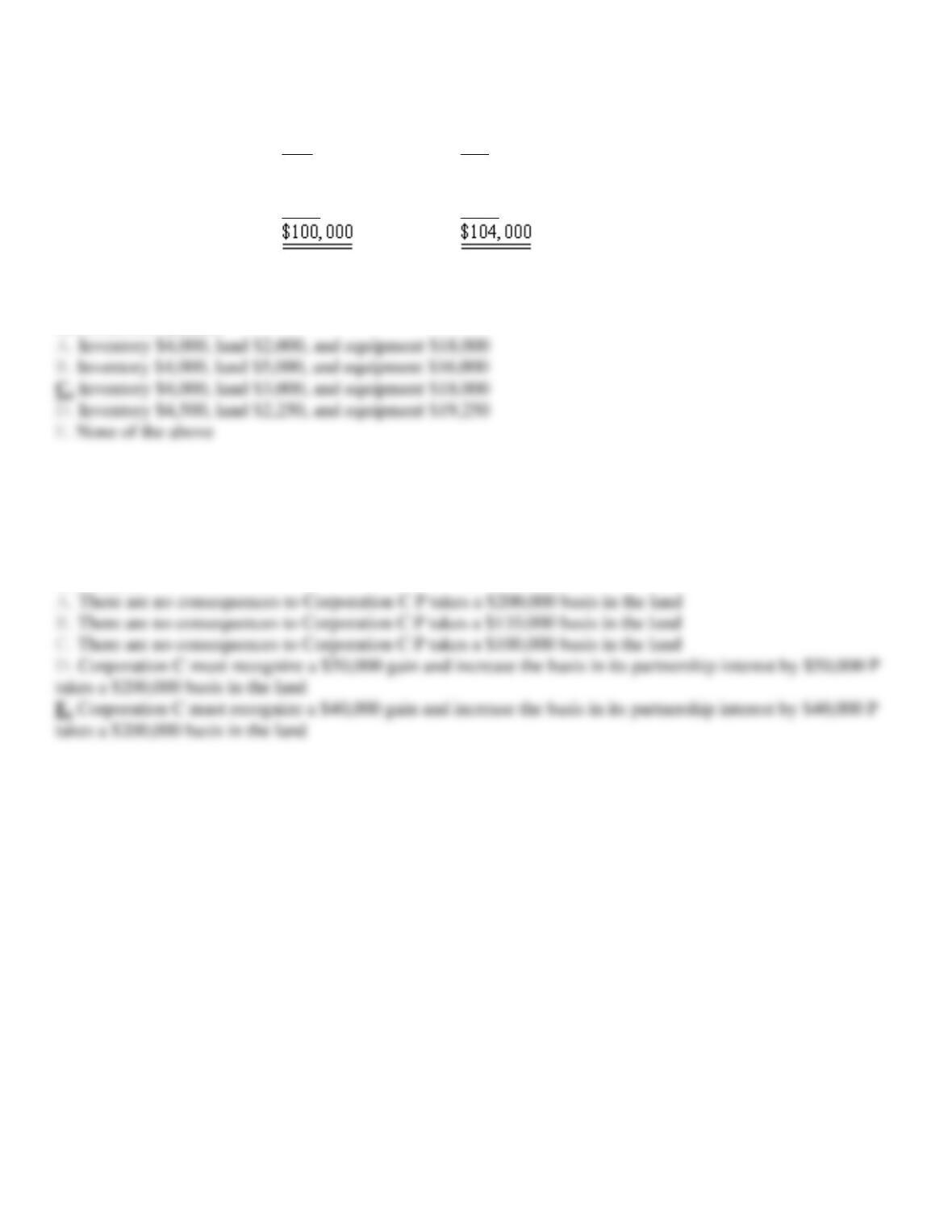
25. A partnership’s records show
Inside
Basis
FMV
Cash
$4,000
$4,000
Inventory
16,000
30,000
Land
20,000
20,000
Equipment
72,000
60,000
Total assets
D’s basis in her 25% interest in this partnership is $26,000 She receives 25 percent of all partnership assets as a liquidating distribution Compute D’s
basis in each distributed asset
26. In 2012, Corporation C contributed land (FMV $100,000 and basis $60,000) to Beta Partnership in
exchange for a 25% interest in Beta In 2012, Beta distributed the land to individual partner P, thereby
terminating P’s 30% interest in Beta Immediately prior to distribution, the land was worth $110,000 and P’s
outside basis in his interest was $200,000 Which of the following is the correct set of tax consequences of the
distribution^
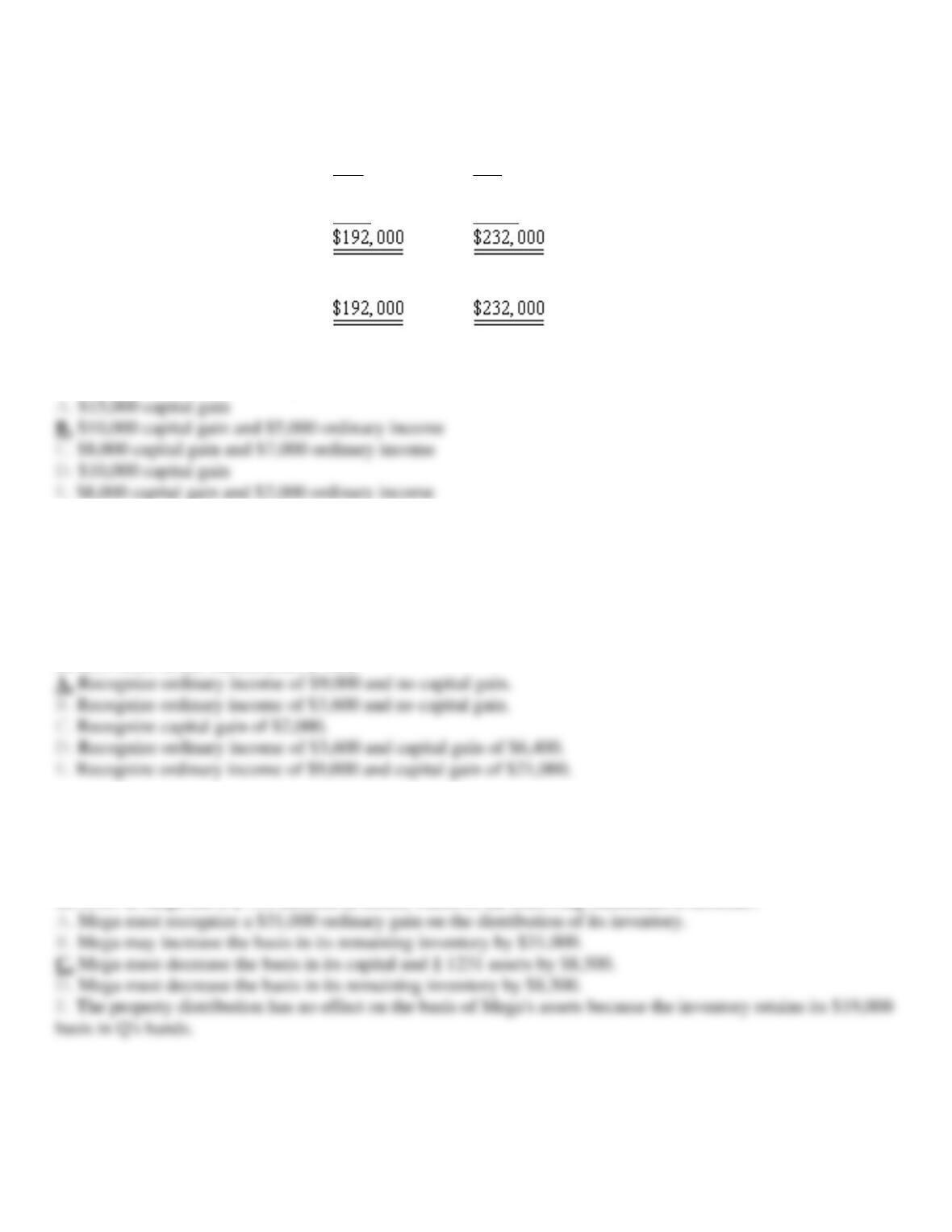
27. Partner L received a $55,000 cash distribution from the KLM Partnership in liquidation of his 25% interest
Immediately prior to distribution, L’s outside basis was $48,000 KLM had the following balance sheet
Inside
Basis
FMV
Cash
$57,000
$57,000
Inventory
45,000
53,000
§ 1231 and capital assets
90,000
122,000
Debt
32,000
32,000
Capital Partner L
40,000
50,000
Others
Because of the distribution, L should recognize
28. Partner E is retiring from the EFGH Partnership. The partnership agreement provides that E will be paid
$64,000 for his 15% net interest in partnership property (excluding goodwill) plus an additional $36,000
retirement bonus. In addition, E will be immediately relieved of any personal liability for partnership debts. The
$100,000 cash will be paid to E in 10 annual $10,000 installments, beginning in the current year. Immediately
prior to his retirement, E’s outside basis in his partnership interest is $28,000; this basis includes $20,000 of
EFGH’s debt. In the current year, E will:
29. Mega Partnership distributed inventory (FMV $50,000 and basis $19,000) to partner Q in complete
liquidation of her interest in Mega. Immediately prior to the distribution, Q’s outside basis in her interest was
$27,500. If Mega has a § 754 election in effect, which of the following statements is accurate?
30. Summa Partnership distributed $10,000 cash and a capital asset (FMV $5,000 and basis $3,400) to partner
D in complete liquidation of her interest in Summa. Immediately prior to the distribution, D’s outside basis in
her interest was $7,500. If Summa has a § 754 election in effect, which of the following statements is accurate?
31. Which of the following statements concerning a § 754 election is accurate?
32. T receives a liquidating distribution of investment land with a partnership basis of $18,000 and a FMV of
$40,000 when her basis in the partnership is $15,000. If a § 754 election is in effect, the bases of the
partnership’s remaining assets will be increased by
33. A partnership is owned by a mother (60%) and her son (40%) Their capital accounts are maintained in the
same ratio The son received his ownership interest as a gift from his mother several years ago Partnership
income for the current year was $50,000 Although the mother performed services valued at $10,000, there was
no entry on the partnership books and she received no cash for her services To avoid a reallocation by the IRS,
what amount of current year income should be allocated to the mother’?
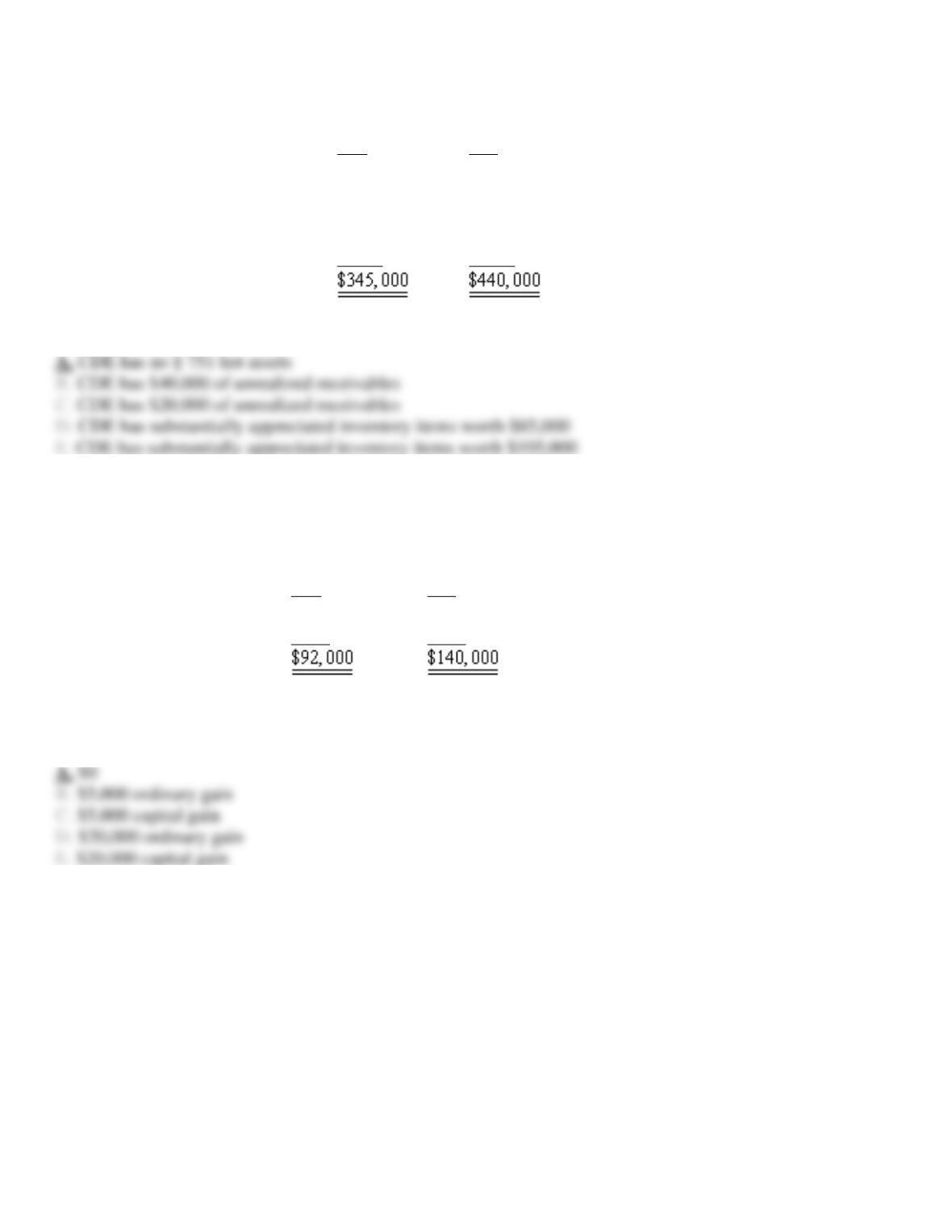
34. CDE Partnership has the following assets on its balance sheet
Inside
Basis
FMV
Cash
$5,000
$5,000
Accounts receivables
20,000
20,000
§ 1231 and capital assets
70,000
85,000
Inventory
90,000
50,000
§ 1231 assets
32,000
32,000
Accumulated depreciation
(40,000)
—
Land
200,000
280,000
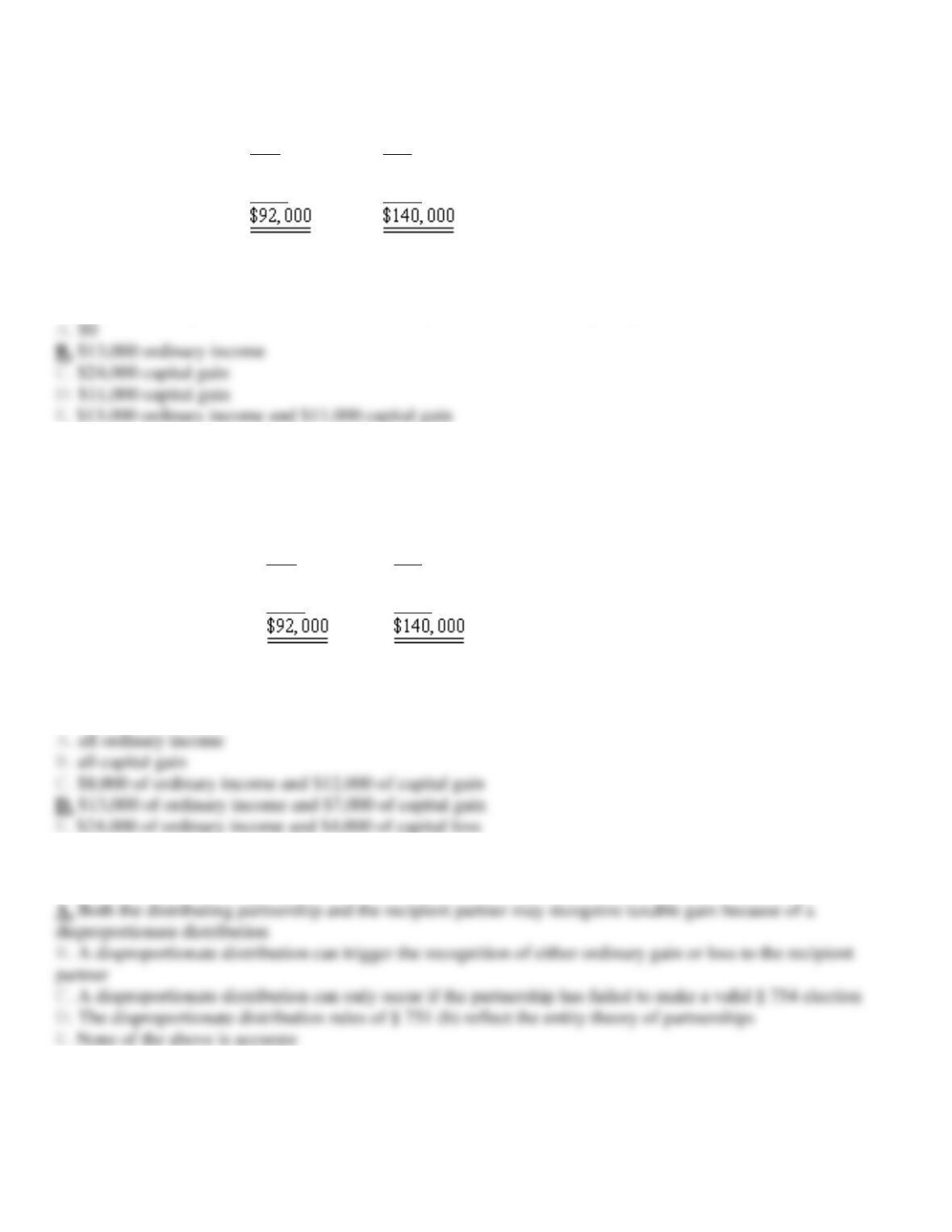
35. Partnership records show
Inside
Basis
FMV
Inventory
$12,000
$28,000
Land
48,000
70,000
Equipment
32,000
42,000
Capital accounts
R is a 50 percent partner The equipment has $10,000 of § 1245 recapture potential R and her partner each received a distribution from the partnership
of a one-half interest in the land If R’s predistribution outside basis was $46,000, R’s recognized gain is
36. Partnership records show
Inside
Basis
FMV
Inventory
$12,000
$28,000
Land
48,000
70,000
Equipment
32,000
42,000
Capital accounts
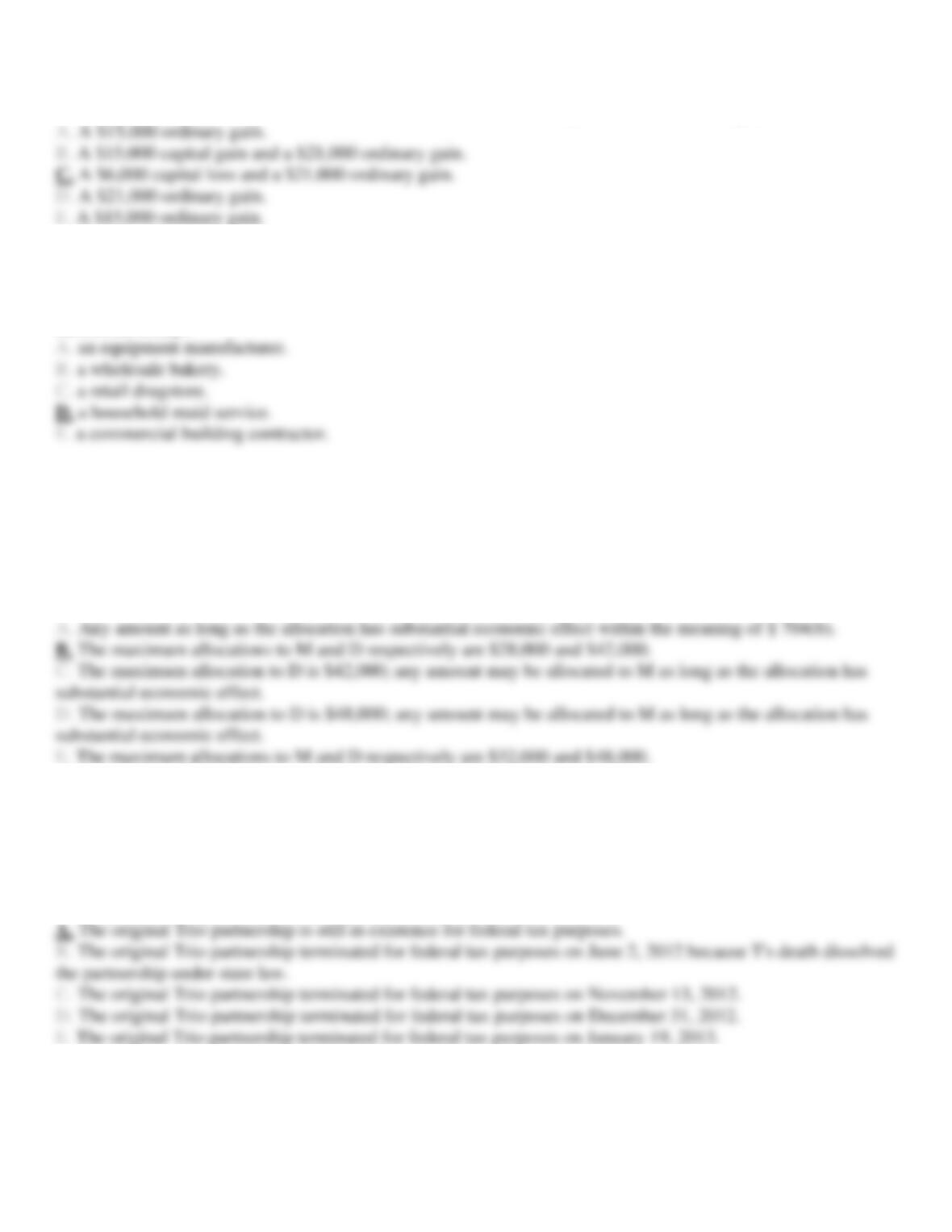
R is a 50 percent partner The equipment has $10,000 of § 1245 recapture potential R’s predistribution outside basis is $46,000 The partnership
liquidates by distributing the land to R and the inventory and equipment to her partner R’ s recognized gain on the liquidation is
37. Partnership records show
Inside
Basis
FMV
Inventory
$12,000
$28,000
Land
48,000
70,000
Equipment
32,000
42,000
Capital accounts
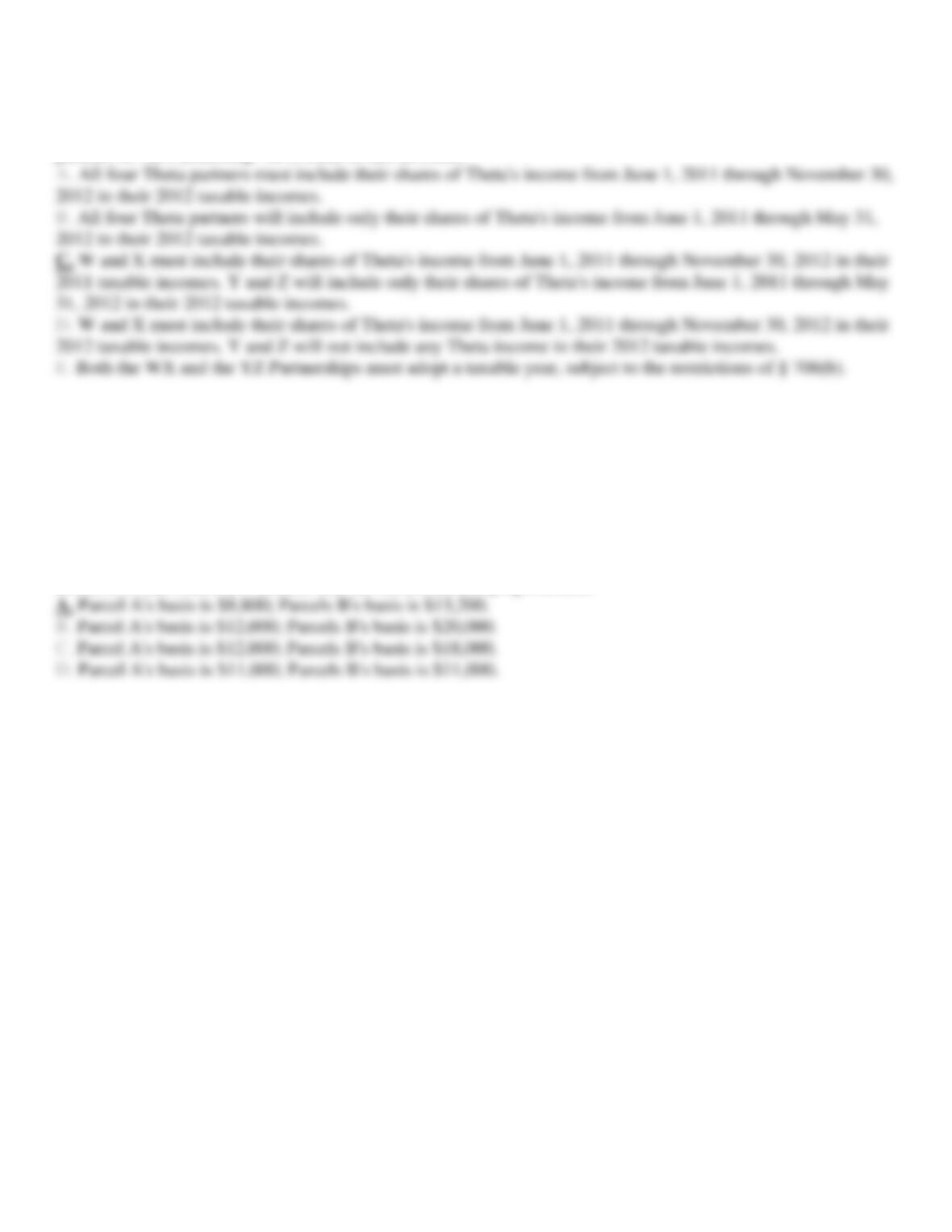
R is a 50 percent partner The equipment has $10,000 of § 1245 recapture potential R sells her entire interest in the partnership for $70,000 Her basis
in the partnership is $50,000 R’s $20,000 recognized gain on the sale is
38. Which of the following statements concerning § 751 (b) disproportionate distributions is accurate’?
39. Corporation J sells its 10% limited interest in the Nelson Partnership for $100,000. J’s outside basis in the
interest is $85,000; no partnership debt is included in this basis. At date of sale, Nelson has inventory worth
$980,000 with an inside basis of $770,000. Based on these facts, Corporation J should recognize:
40. Generally, capital will be considered a material income-producing factor for the following types of
businesses except
41. Individual O owned a sole proprietorship with a net value of $400,000. At the beginning of the current year,
O created a partnership by giving a 20% interest in the business to his best friend M, and a 30% interest in the
business to his daughter D. During the current year, O performed services for the partnership worth $20,000,
although he chose not to bill the partnership for his work. The partnership’s operating income for the year is
$160,000. Based on these facts, the maximum amount of this income allocable to M and D is:
42. Individuals T, U, and V formed the calendar year Trio Partnership in 1981 as equal partners. On June 2,
2012, T died and his interest was inherited by his grandson G, whom U and V welcomed as a new equal partner
in their business. On November 13, 2012, V sold his interest to individual B. On January 19, 2013, B sold this
same interest to Corporation C. Which of the following statements is accurate?
43. Individuals W, X, Y, and Z are all calendar year taxpayers. W and X both own a 15% interest and Y and Z
both own a 35% interest in the Theta Partnership, which has a May 31 fiscal year end. On November 30, 2012,
the Theta Partnership was dissolved into two new partnerships: W and X contributed their interests in Theta to
become equal partners in WX Partnership, while Y and Z contributed their interests in Theta to become equal
partners in YZ Partnership. As a result of this division:
44. M and E are equal partners in the ME Partnership. E decides to leave the partnership and receives a
liquidating distribution of $15,000 cash and two items of inventory. Inventory R has a basis of $1,000 and a fair
market value of $7,000 and inventory S has a basis of $2,000 and a fair market value of $5,000. E’s adjusted
basis for her partnership interest is $40,000. In addition to the cash and inventory, E also receives two parcels of
land that are investments assets. Parcel A has a basis to the partnership of $12,000 and a fair market value of
$16,000. Parcel B has a basis to the partnership of $20,000 and a fair market value of $18,000. What is E’s basis
in Parcel A and Parcel B? Assume that this distribution is proportionate.