232 Chapter 10 Project Cash Flows and Risk
e.
-$12,879
46. Real Time Systems Inc. is considering the development of one of two mutually exclusive new
computer models. Each will require a net investment of $5,000. The cash flow figures for each
project are shown below:
Period
Project A
Project B
1
$2,000
$3,000
2
2,500
2,600
3
2,250
2,900
Model B, which will use a new type of laser disk drive, is considered a high-risk project, while
Model A is of average risk. Real Time adds 2 percentage points to arrive at a risk-adjusted
discount rate when evaluating a high-risk project. The rate used for average risk projects is 12
percent. Which of the following statements regarding the NPVs for Models A and B is most
correct?
a.
NPVA = $380; NPVB = $1,815.
b.
NPVA = $197; NPVB = $1,590.
c.
NPVA = $380; NPVB = $1,590.
d.
NPVA = $5,380; NPVB = $6,590.
e.
None of the above statements is correct.
Chapter 10 Project Cash Flows and Risk 233
47. The Unlimited, a national retailing chain, is considering an investment in one of two mutually
exclusive projects. The discount rate used for Project A is 12 percent. Further, Project A costs
$15,000, and it would be depreciated using MACRS. It is expected to have an after-tax salvage
value of $5,000 at the end of 6 years and to produce after-tax cash flows (including depreciation)
of $4,000 for each of the 6 years. Project B costs $14,815 and would also be depreciated using
MACRS. B is expected to have a zero salvage value at the end of its 6-year life and to produce
after-tax cash flows (including depreciation) of $5,100 each year for 6 years. The Unlimited’s
marginal tax rate is 40 percent. What risk-adjusted discount rate will equate the NPV of Project B
to that of Project A?
a.
15%
b.
16%
c.
18%
d.
20%
e.
12%
234 Chapter 10 Project Cash Flows and Risk
48. Alabama Pulp Company (APC) can control its environmental pollution using either “Project Old
Tech” or “Project New Tech.” Both will do the job, but the actual costs involved with Project
New Tech, which uses unproved, new state-of-the-art technology, could be much higher than the
expected cost levels. The cash outflows associated with Project Old Tech, which uses standard
proven technology, are less risky—they are about as uncertain as the cash flows associated with an
average project. APC’s required rate of return for average risk projects normally is set at 12
percent, and the company adds 3 percent for high risk projects but subtracts 3 percent for low risk
projects. The two projects in question meet the criteria for high and average risk, but the financial
manager is concerned about applying the normal rule to such cost-only projects. You must decide
which project to recommend, and you should recommend the one with the lower PV of costs.
What is the PV of costs of the better project?
Cash Outflows
Years
0
1
2
3
4
Project New Tech
1,500
315
315
315
315
Project Old Tech
600
600
600
600
600
a.
2,521
b.
2,399
c.
2,457
d.
2,543
e.
2,422
Chapter 10 Project Cash Flows and Risk 235
49. Arizona Rock, an all-equity firm, currently has a beta of 1.25, and kRF = 7 percent and kM = 14
percent. Suppose the firm sells 10 percent of its assets (beta = 1.25) and purchases the same
proportion of new assets with a beta of 1.1. What will be the firm’s new overall required rate of
return, and what rate of return must the new assets produce in order to leave the stock price
unchanged?
a.
15.645%; 15.645%
b.
15.75%; 14.7%
c.
15.645%; 14.7%
d.
15.75%; 15.645%
e.
14.75%; 15.75%
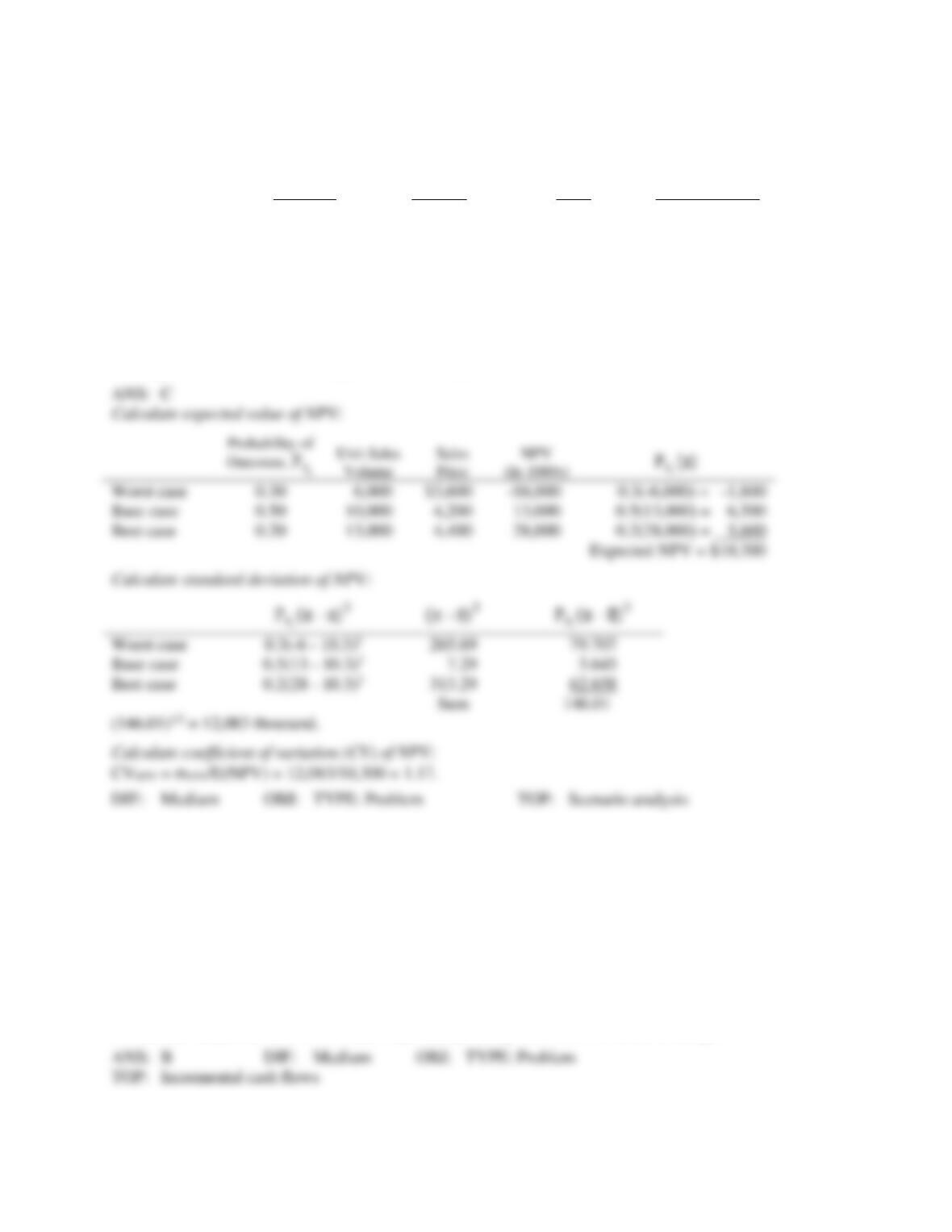
50. Klott Company encounters significant uncertainty with its sales volume and price in its primary
product. The firm uses scenario analysis in order to determine an expected NPV, which it then
uses in its budget. The base case, best case, and worst case scenarios and probabilities are
236 Chapter 10 Project Cash Flows and Risk
provided in the table below. What is Klott’s expected NPV, standard deviation of NPV, and
coefficient of variation of NPV?
Probability of
Outcome
Unit Sales
Volume
Sales
Price
NPV
(In Thousands)
Worst case
0.30
6,000
$3,600
-$6,000
Base case
0.50
10,000
4,200
+13,000
Best case
0.20
13,000
4,400
+28,000
a.
Expected NPV = $35,000; NPV = 17,500; CVNPV = 2.0.
b.
Expected NPV = $35,000; NPV = 11,667; CVNPV = 0.33.
c.
Expected NPV = $10,300; NPV = 12,083; CVNPV = 1.17.
d.
Expected NPV = $13,900; NPV = 8,476; CVNPV = 0.61.
e.
Expected NPV = $10,300; NPV = 13,900; CVNPV = 1.35.
51. Rucker Truck Line (RTL) is evaluating whether the fleet of trucks it owns should be replaced. If
the trucks are replaced, current operating revenues and expenses will not change, except for
depreciation expenses. Annual depreciation will increase from $150,000 to $175,000. Based on
this information, how will the change in depreciation expense affect the incremental operating
cash flows RTL examines when making its capital budgeting decision about replacing the trucks?
RTL’s marginal tax rate is 40 percent.
a.
After-tax operating cash flows will increase by $15,000.
b.
After-tax operating cash flows will increase by $10,000.
c.
After-tax operating cash flows will decrease by $25,000.
d.
After-tax operating cash flows will decrease by $10,000.
e.
Because depreciation is a non-cash expense, operating cash flows should not change.
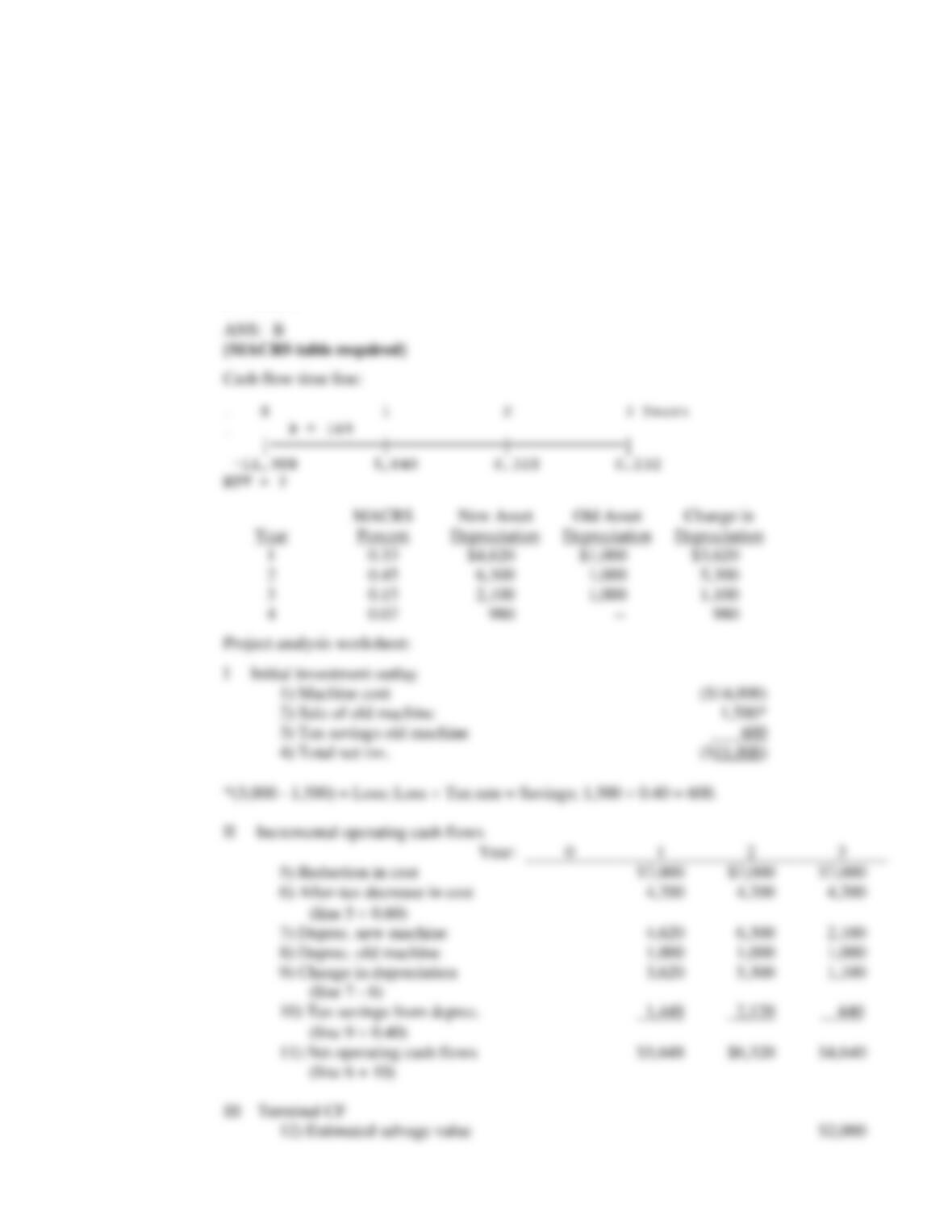
52. Topsider Inc. is considering the purchase of a new leather-cutting machine to replace an existing
machine that has a book value of $3,000 and can be sold for $1,500. The old machine is being
Worst case
0.30
0.3(-6,000) = -1,800
Base case
0.50
Best case
Base case
Best case
146.01
Chapter 10 Project Cash Flows and Risk 237
depreciated on a straight-line basis, and its estimated salvage value 3 years from now is zero. The
new machine will reduce costs (before taxes) by $7,000 per year. The new machine has a 3-year
life, it costs $14,000, and it can be sold for an expected $2,000 at the end of the third year. The
new machine would be depreciated over its 3-year life using the MACRS method. Assuming a 40
percent tax rate and a required rate of return of 16 percent, find the new machine’s NPV.
a.
-$2,822
b.
$1,658
c.
$4,560
d.
$15,374
e.
$9,821
238 Chapter 10 Project Cash Flows and Risk
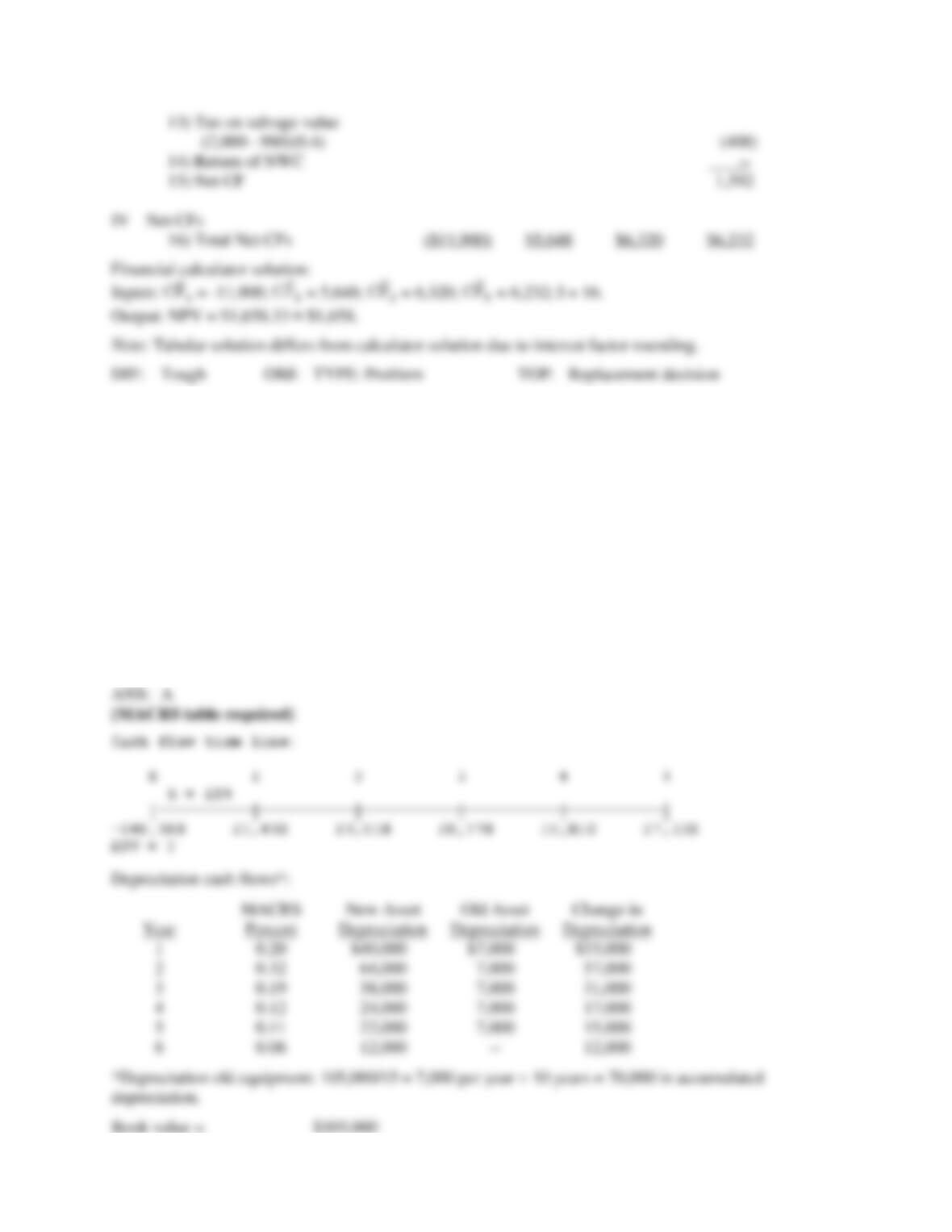
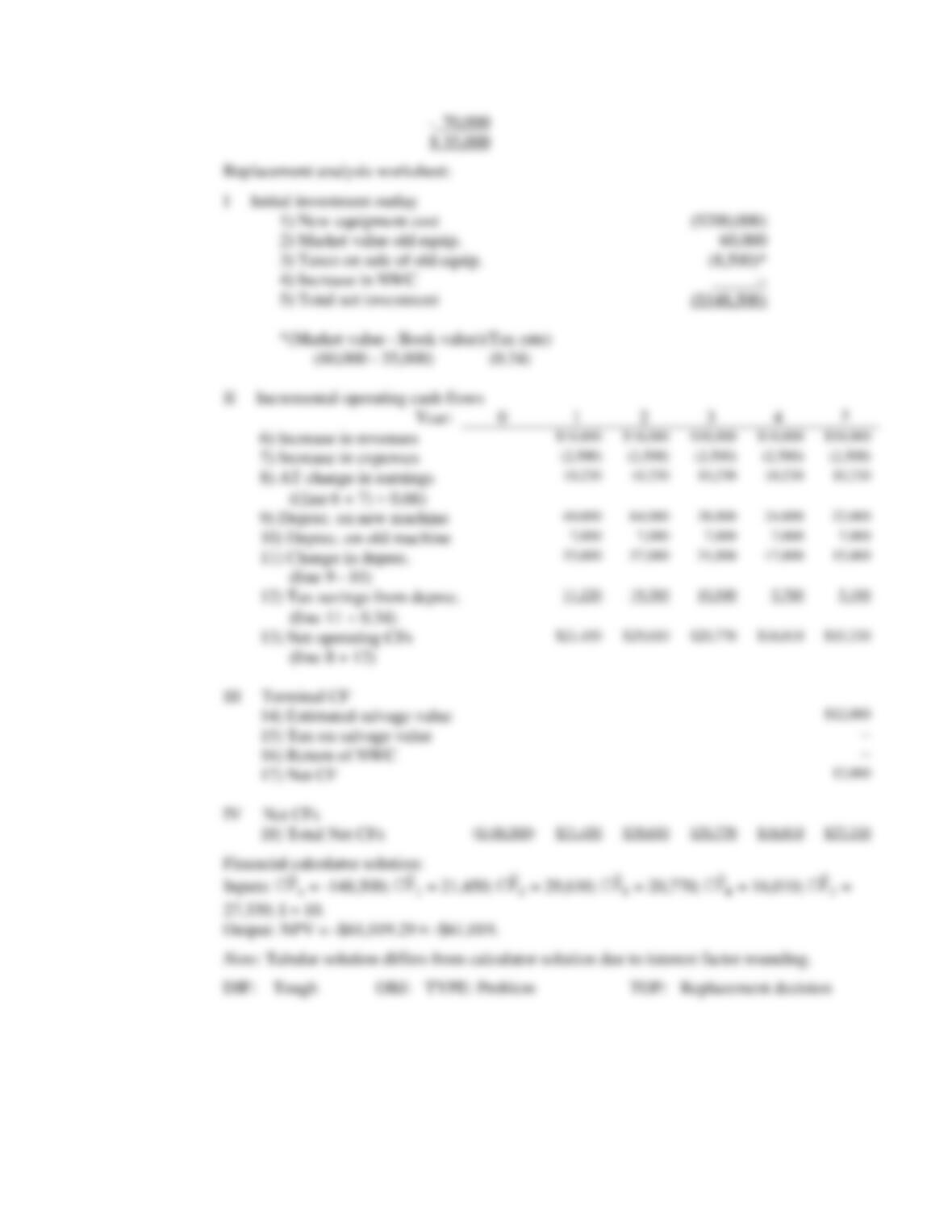
53. Meals on Wings Inc. supplies prepared meals for corporate aircraft (as opposed to public
commercial airlines), and it needs to purchase new broilers. If the broilers are purchased, they
will replace old broilers purchased 10 years ago for $105,000 and which are being depreciated on
a straight line basis to a zero salvage value (15-year depreciable life). The old broilers can be sold
for $60,000. The new broilers will cost $200,000 installed and will be depreciated using MACRS
over their 5-year class life; they will be sold at their book value at the end of the 5th year. The
firm expects to increase its revenues by $18,000 per year if the new broilers are purchased, but
cash expenses will also increase by $2,500 per year. If the firm’s required rate of return is 10
percent and its tax rate is 34 percent, what is the NPV of the broilers?
a.
-$61,019
b.
$17,972
c.
$28,451
d.
-$44,553
e.
$5,021
Chapter 10 Project Cash Flows and Risk 239
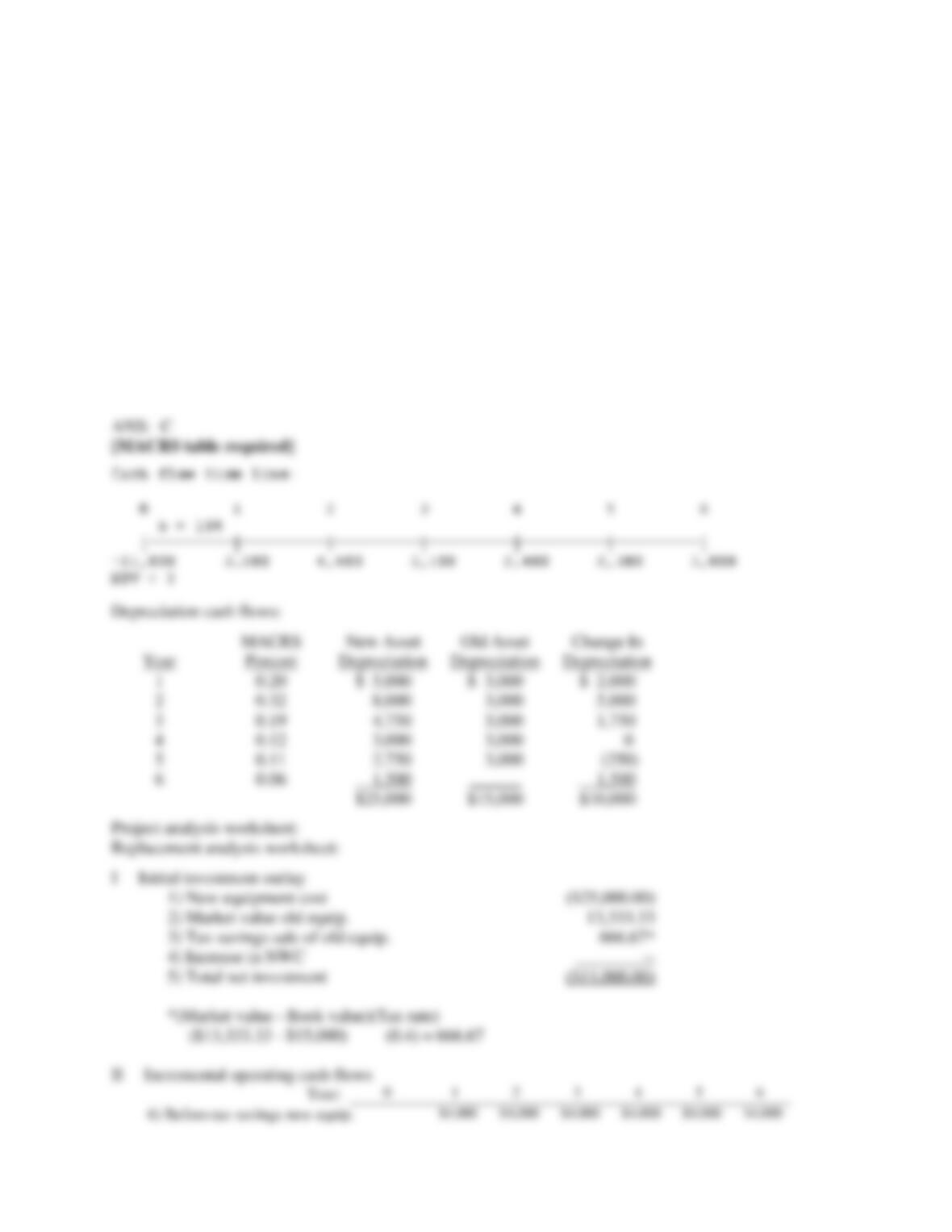
240 Chapter 10 Project Cash Flows and Risk
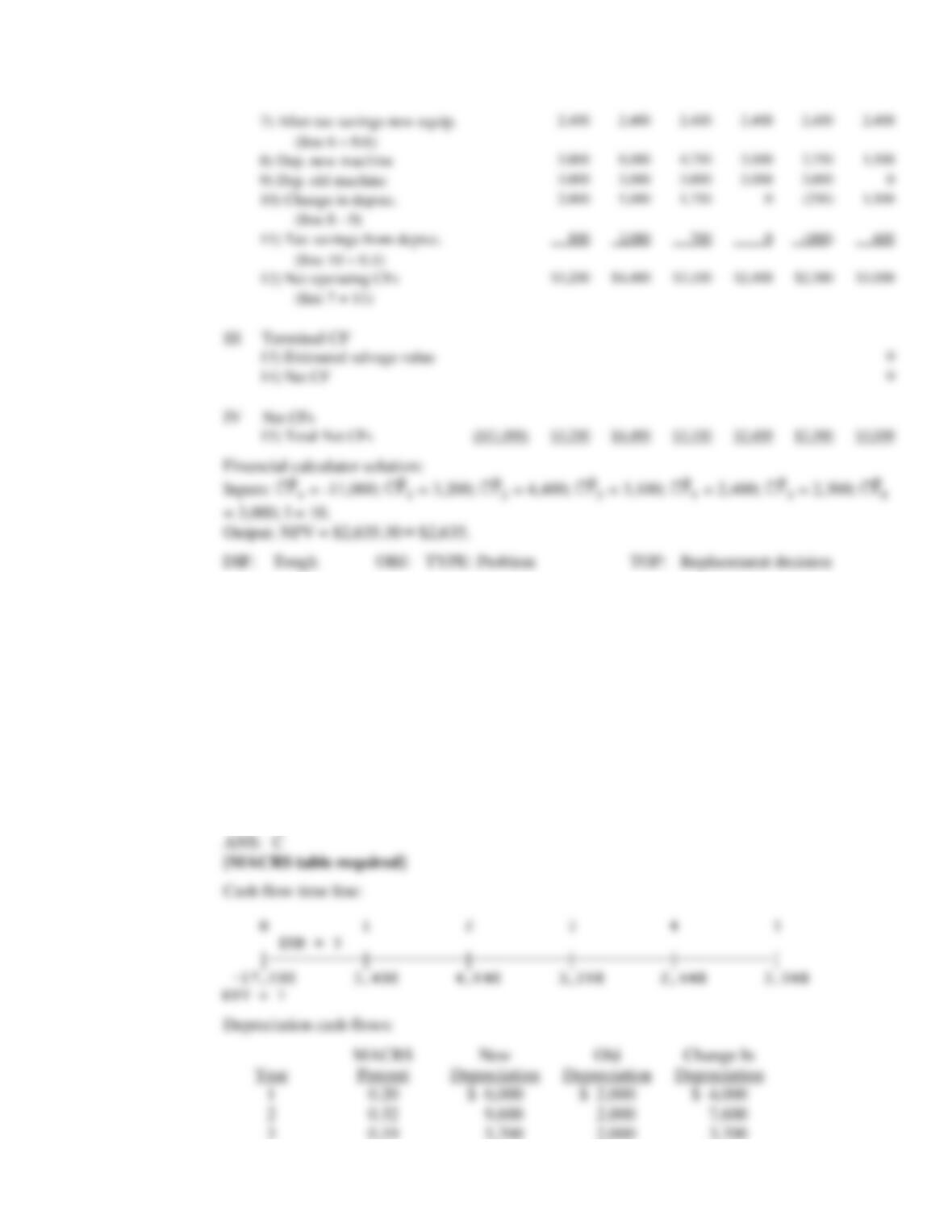
54. Mom’s Cookies Inc. is considering the purchase of a new cookie oven. The original cost of the
old oven was $30,000; it is now 5 years old, and it has a current market value of $13,333.33. The
old oven is being depreciated over a 10-year life towards a zero estimated salvage value on a
straight line basis, resulting in a current book value of $15,000 and an annual depreciation
expense of $3,000. The old oven can be used for 6 more years but has no market value after its
depreciable life is over. Management is contemplating the purchase of a new oven whose cost is
$25,000 and whose estimated salvage value is zero. Expected before-tax cash savings from the
new oven are $4,000 a year over its full MACRS depreciable life. Depreciation is computed using
MACRS over a 5-year life, and the required rate of return is 10 percent. Assume a 40 percent tax
rate. What is the net present value of the new oven?
a.
-$2,418
b.
-$1,731
c.
$1,568
d.
$163
e.
$1,731
Chapter 10 Project Cash Flows and Risk 241
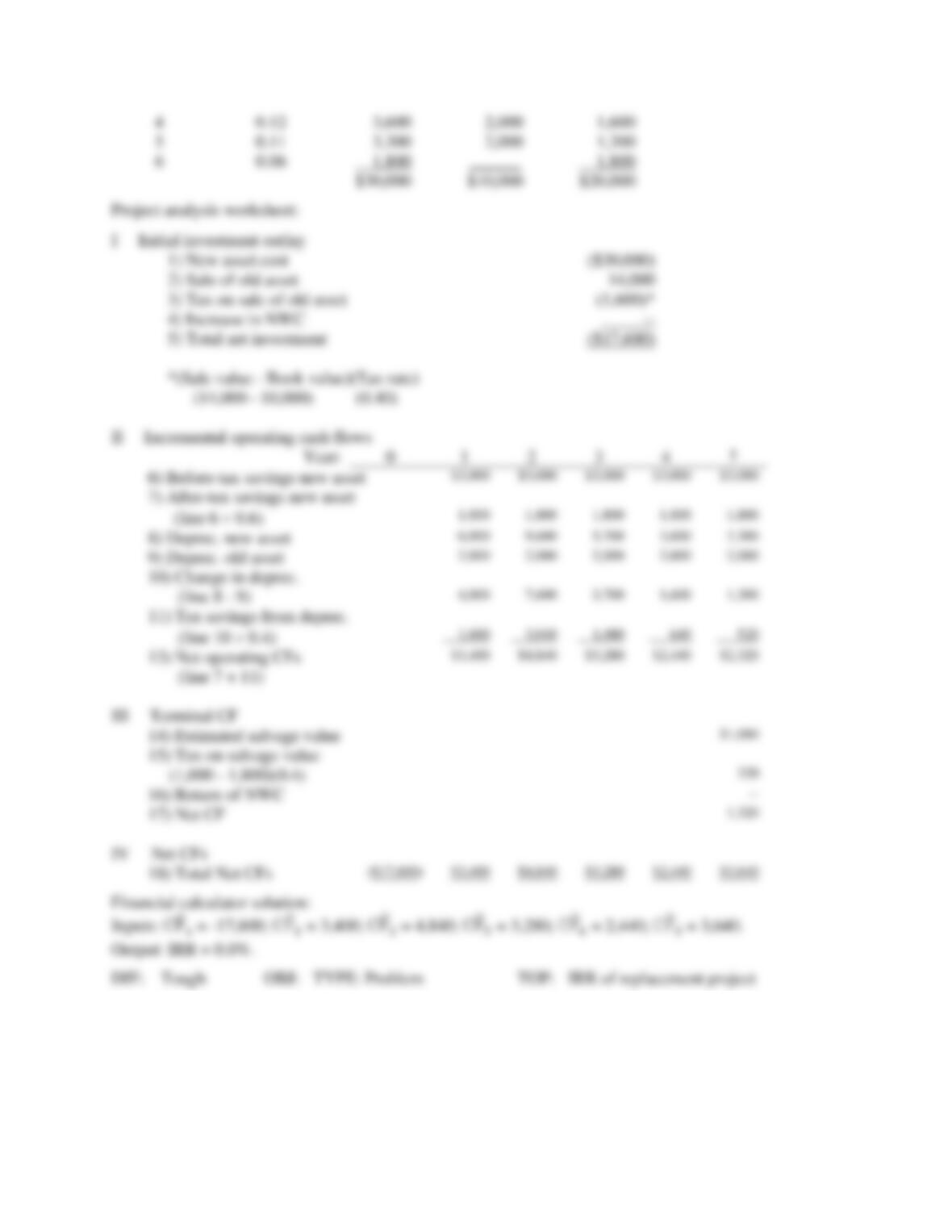
55. Tech Engineering Company is considering the purchase of a new machine to replace an existing
one. The old machine was purchased 5 years ago at a cost of $20,000, and it is being depreciated
on a straight line basis to a zero salvage value over a 10-year life. The current market value of the
old machine is $14,000. The new machine, which falls into the MACRS 5-year class, has an
estimated life of 5 years, it costs $30,000, and Tech plans to sell the machine at the end of the 5th
year for $1,000. The new machine is expected to generate before-tax cash savings of $3,000 per
year. The company’s tax rate is 40 percent. What is the IRR of the proposed project?
a.
4.1%
b.
2.2%
c.
0.0%
d.
-1.5%
e.
-3.3%
242 Chapter 10 Project Cash Flows and Risk
56. California Mining is evaluating the introduction of a new ore production process. Two
alternatives are available. Production Process A has an initial cost of $25,000, a 4-year life, and a
$5,000 net salvage value, and the use of Process A will increase net cash flow by $13,000 per
year for each of the 4 years that the equipment is in use. Production Process B also requires an
initial investment of $25,000, will also last 4 years, and its expected net salvage value is zero, but
Process B will increase net cash flow by $15,247 per year. Management believes that a risk-
adjusted discount rate of 12 percent should be used for Process A. If California Mining is to be
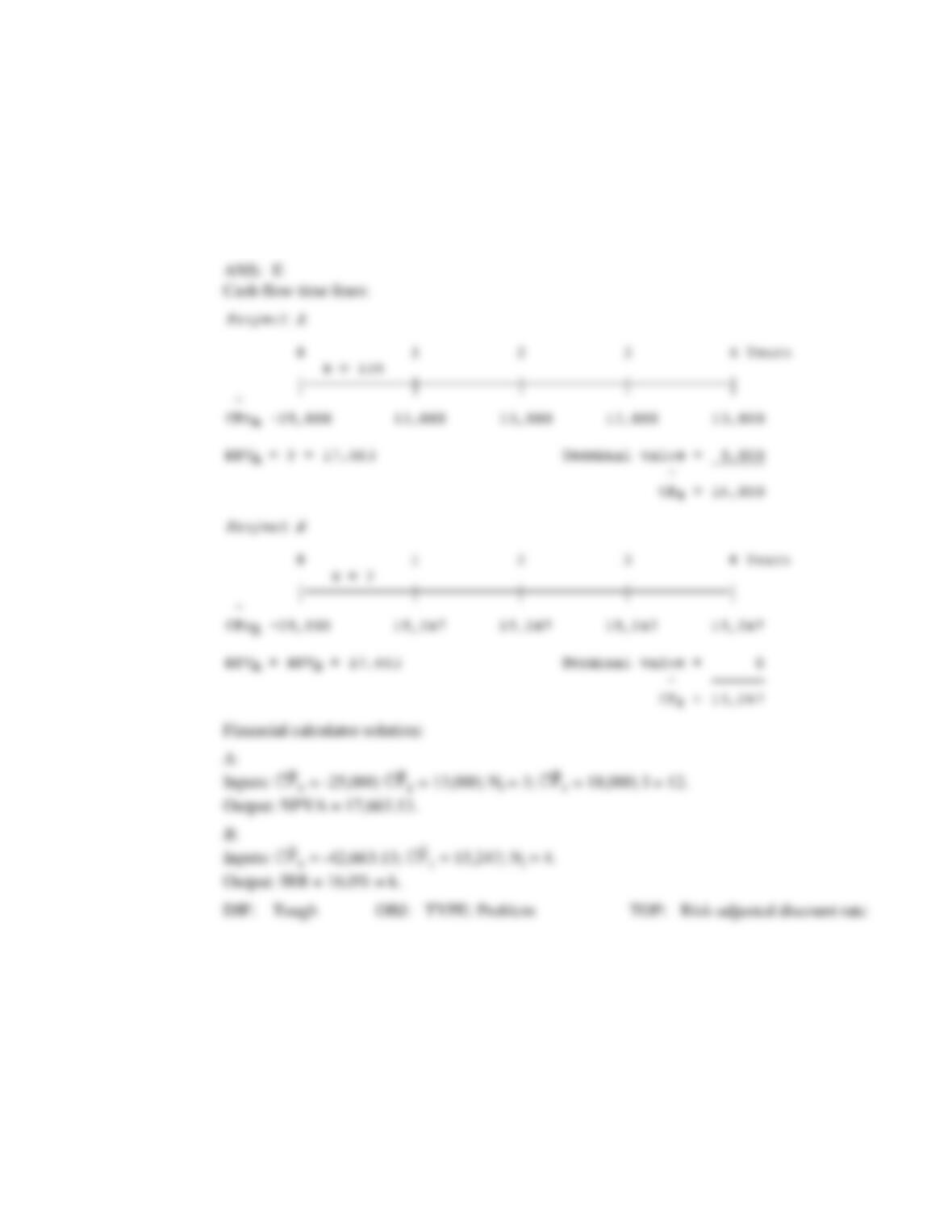
Chapter 10 Project Cash Flows and Risk 243
indifferent between the two processes, what risk-adjusted discount rate must be used to evaluate
B?
a.
8%
b.
10%
c.
12%
d.
14%
e.
16%
Exhibit 10-1
You have been asked by the president of your company to evaluate the proposed acquisition of a
new special-purpose truck. The truck’s basic price is $50,000, and it will cost another $10,000 to
modify it for special use by your firm. The truck falls into the MACRS three-year class, and it
will be sold after three years for $20,000. Use of the truck will require an increase in net working
capital (spare parts inventory) of $2,000. The truck will have no effect on revenues, but it is
expected to save the firm $20,000 per year in before-tax operating costs, mainly labor. The firm’s
marginal tax rate is 40 percent.
244 Chapter 10 Project Cash Flows and Risk
[MACRS table required]
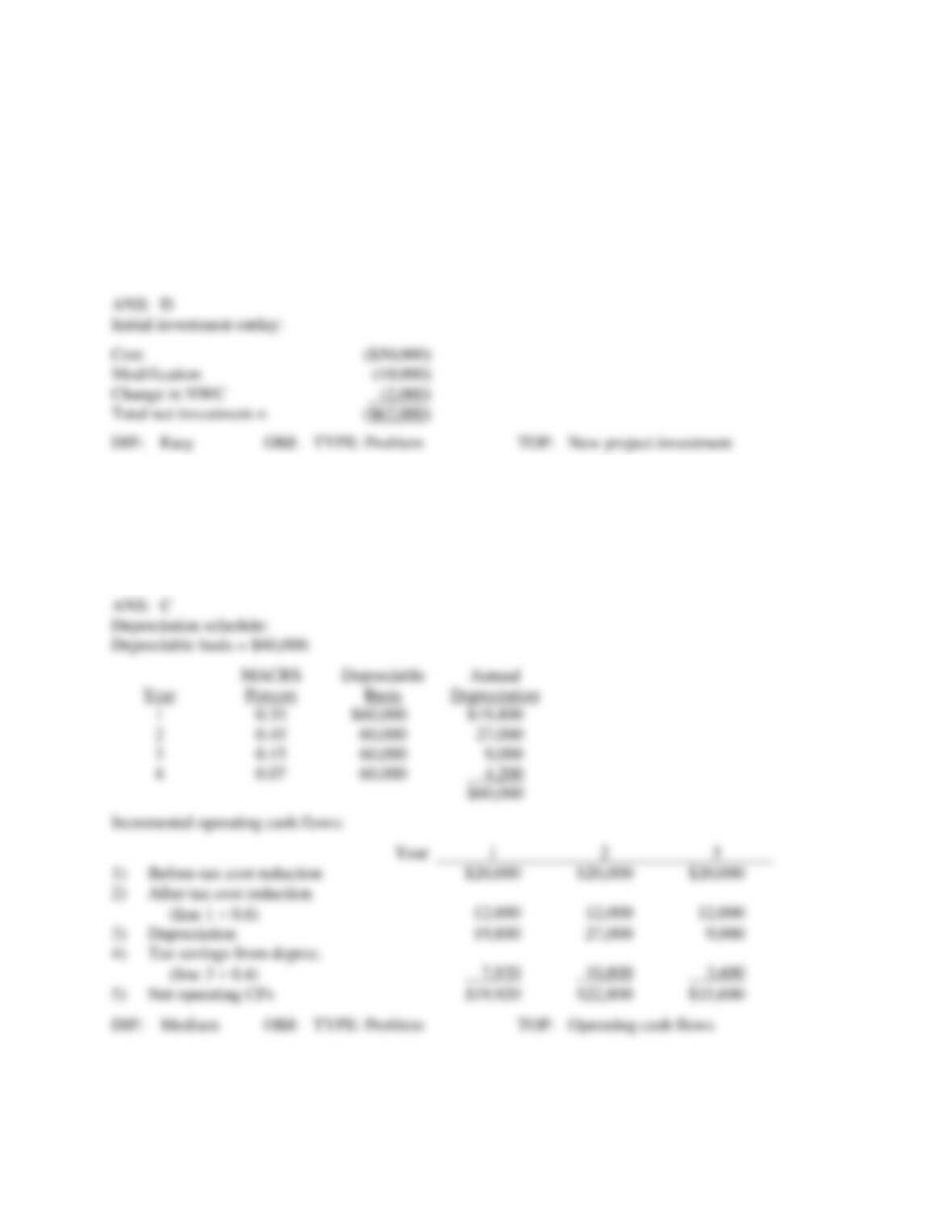
57. Refer to Exhibit 10-1. What is the initial investment outlay for the truck? (That is, what is the
Year 0 net cash flow?)
a.
-$50,000
b.
-$52,600
c.
-$55,800
d.
-$62,000
e.
-$65,000
58. Refer to Exhibit 10-1. What is the incremental operating cash flow in Year 1?
a.
$17,820
b.
$18,254
c.
$19,920
d.
$20,121
e.
$21,737
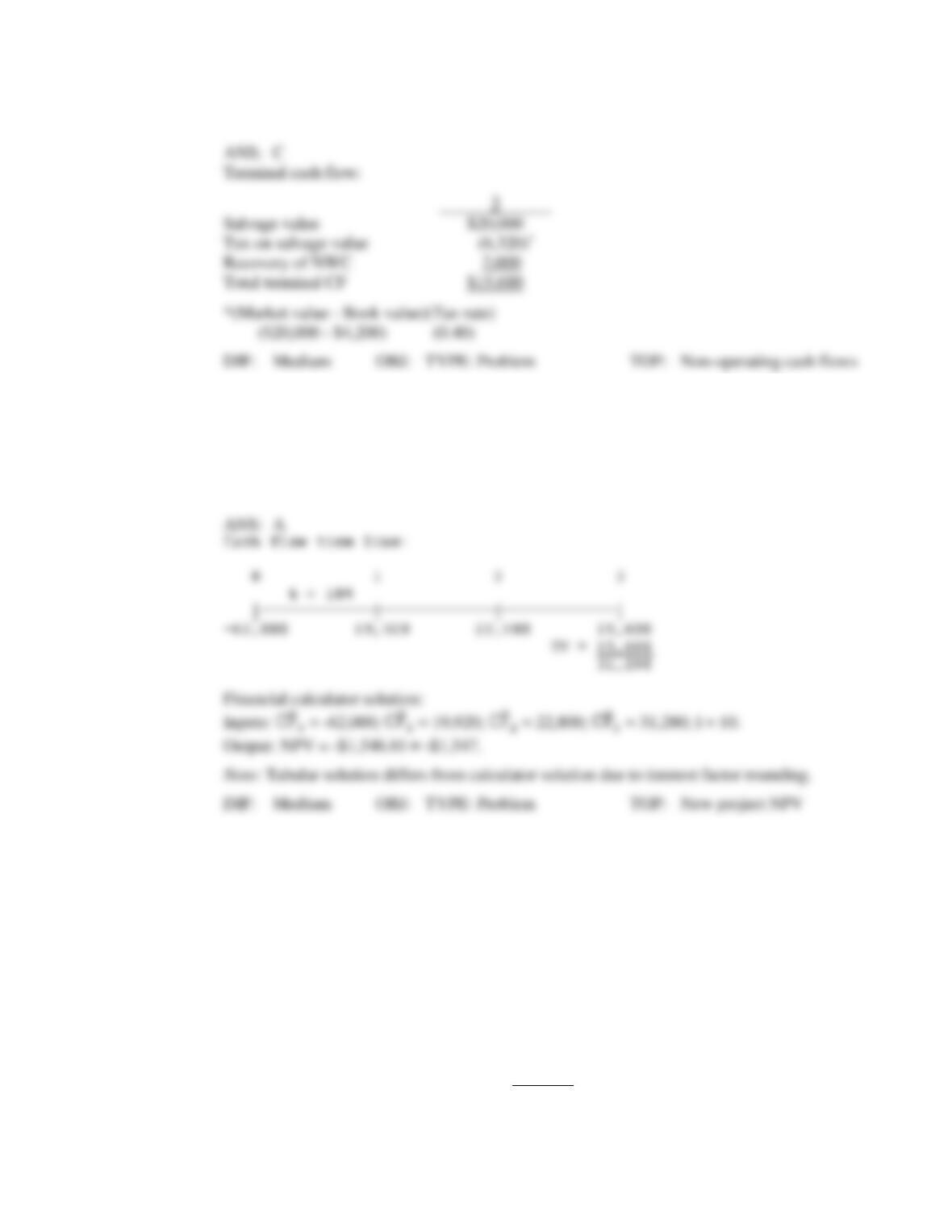
59. Refer to Exhibit 10-1. What is the terminal (nonoperating) cash flow at the end of Year 3?
a.
$10,000
b.
$12,000
c.
$15,680
d.
$16,000
Chapter 10 Project Cash Flows and Risk 245
e.
$18,000
60. Refer to Exhibit 10-1. The truck’s required rate of return is 10 percent. What is its NPV?
a.
-$1,547
b.
-$562
c.
$0
d.
$562
e.
$1,034
Financial Calculator Section
The following question(s) may require the use of a financial calculator.
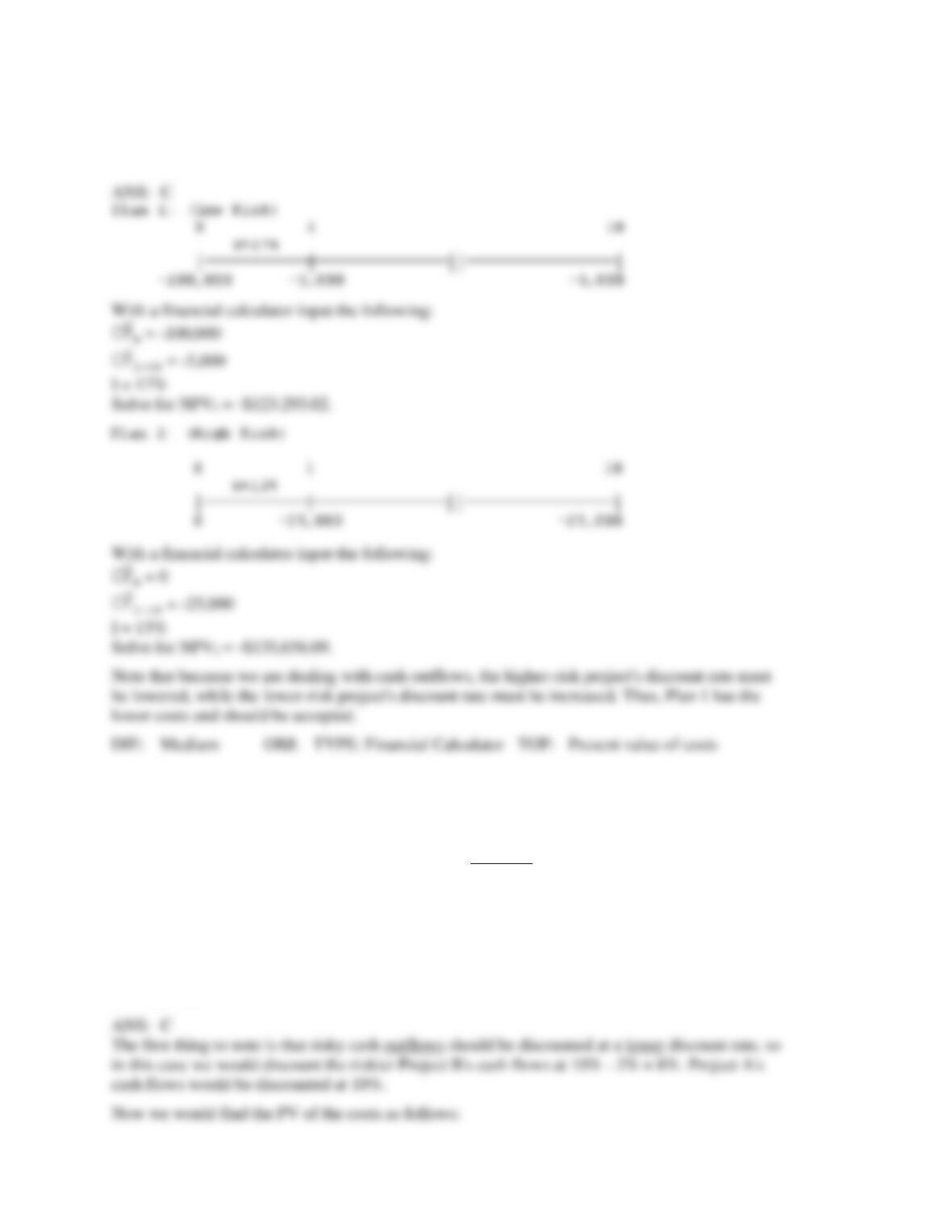
61. Your company must ensure the safety of its work force. Two plans are being considered for the
next 10 years: (1) Install a high electrified fence around the property at a cost of $100,000.
Maintenance and electricity would then cost $5,000 per year over the 10-year life of the fence. (2)
Hire security guards at a cost of $25,000 paid at the end of each year. Because the company plans
to build new headquarters with a “state of the art” security system in 10 years, the plan will only
be in effect until that time. Your company’s required rate of return is 15 percent for average
projects, and that rate is normally adjusted up or down by 2 percentage points for high- and low-
risk projects. Plan 1 is considered to be of low risk because its costs can be predicted quite
accurately. Plan B, on the other hand, is a high-risk project because of the difficulty of predicting
wage rates. What is the proper PV of costs for the better project?
a.
-$104,266.20
b.
-$116,465.09
246 Chapter 10 Project Cash Flows and Risk
c.
-$123,293.02
d.
-$127,131.22
e.
-$135,656.09
62. Mid-State Electric Company must clean up the water released from its generating plant. The
company’s required rate of return is 10 percent for average projects, and that rate is normally
adjusted up or down by 2 percentage points for high- and low-risk projects. Clean-up Plan A,
which is of average risk, has an initial cost of -$1,000 at time 0, and its operating cost will be –
$100 per year for its 10-year life. Plan B, which is a high-risk project, has an initial cost of -$300,
and its annual operating cost over Years 1 to 10 will be -$200. What is the proper PV of costs for
the better project?
a.
-$1,430.04
b.
-$1,525.88
c.
-$1,614.46
d.
-$1,642.02
e.
-$1,728.19
Chapter 10 Project Cash Flows and Risk 247
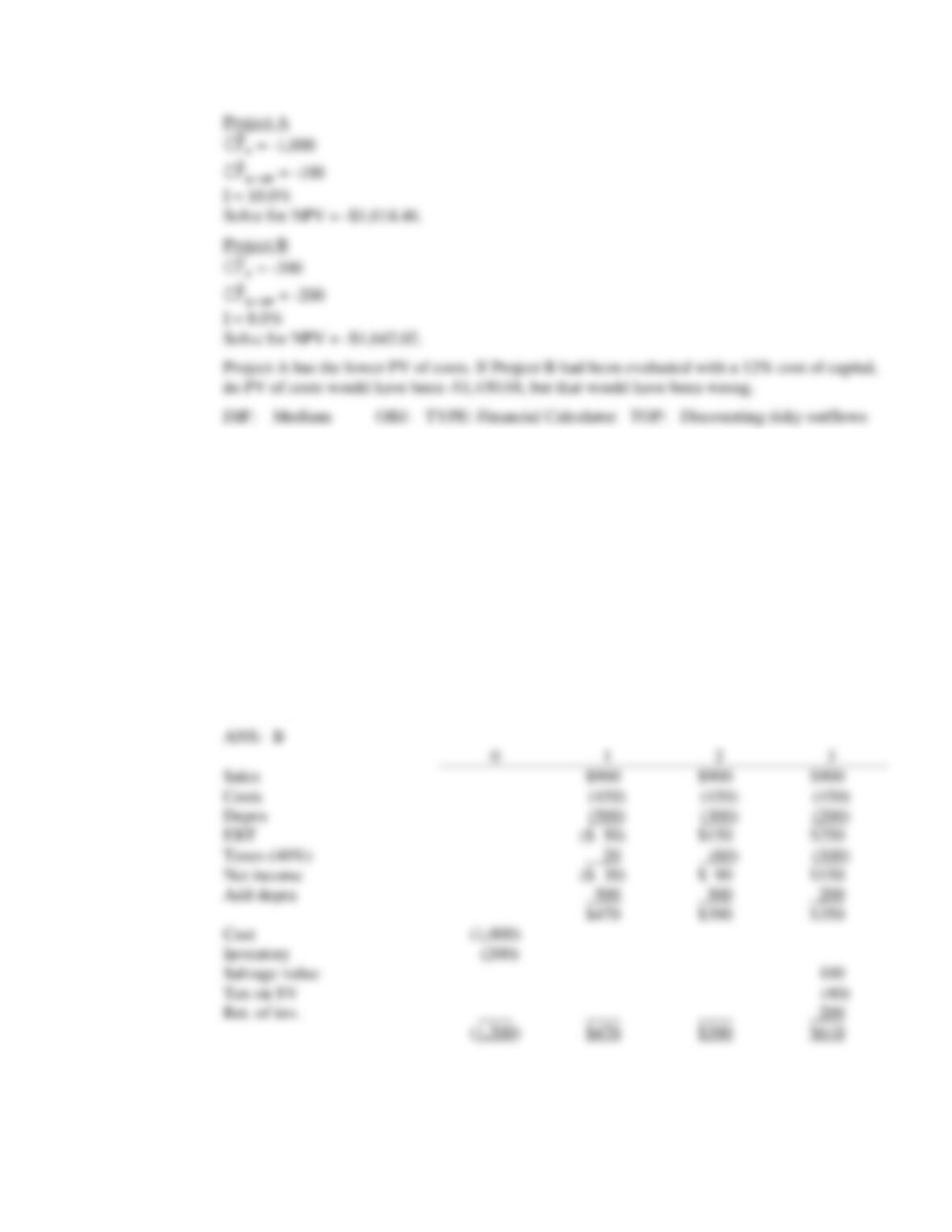
63. Your company is considering a machine that will cost $1,000 at Time 0 and which can be sold
after 3 years for $100. To operate the machine, $200 must be invested at Time 0 in inventories;
these funds will be recovered when the machine is retired at the end of Year 3. The machine will
produce sales revenues of $900/year for 3 years; variable operating costs (excluding depreciation)
will be 50 percent of sales. Operating cash inflows will begin 1 year from today (at Time 1). The
machine will have depreciation expenses of $500, $300, and $200 in Years 1, 2, and 3,
respectively. The company has a 40 percent tax rate, enough taxable income from other assets to
enable it to get a tax refund from this project if the project’s income is negative, and a 10 percent
required rate of return. Inflation is zero. What is the project’s NPV?
a.
$6.24
b.
$7.89
c.
$8.87
d.
$9.15
e.
$10.41
248 Chapter 10 Project Cash Flows and Risk
64. Your company is considering a machine which will cost $50,000 at Time 0 and which can be sold
after 3 years for $10,000. $12,000 must be invested at Time 0 in inventories and receivables;
these funds will be recovered when the operation is closed at the end of Year 3. The facility will
produce sales revenues of $50,000/year for 3 years; variable operating costs (excluding
depreciation) will be 40 percent of sales. No fixed costs will be incurred. Operating cash inflows
will begin 1 year from today (at t = 1). By an act of Congress, the machine will have depreciation
expenses of $40,000, $5,000, and $5,000 in Years 1, 2, and 3 respectively. The company has a 40
percent tax rate, enough taxable income from other assets to enable it to get a tax refund on this
project if the project’s income is negative, and a 15 percent required rate of return. Inflation is
zero. What is the project’s NPV?
a.
$7,673.71
b.
$12,851.75
c.
$17,436.84
d.
$24,989.67
e.
$32,784.25
Chapter 10 Project Cash Flows and Risk 249
65. After a long drought, the manager of Long Branch Farm is considering the installation of an
irrigation system which will cost $100,000. It is estimated that the irrigation system will increase
revenues by $20,500 annually, although operating expenses other than depreciation will also
increase by $5,000. The system will be depreciated using MACRS over its depreciable life (5
years) to a zero salvage value. If the tax rate on ordinary income is 40 percent, what is the
project’s IRR?
a.
12.6%
b.
-1.3%
c.
13.0%
d.
10.2%
e.
-4.8%
250 Chapter 10 Project Cash Flows and Risk