
Elements of Ecology, 9e (Smith)
Chapter 10 Life History
10.1 Short Answer Questions
1) An organism’s ________ is its lifetime pattern of growth, development, and reproduction.
2) Allocation of energy to reproduction reduces the amount of resources available for ________.
3) The objective of reproduction is to maximize the relative ________ of the individual.
4) Natural selection favors the age at maturity that results in the greatest number of ________
produced over the lifetime of an individual.
5) ________ is the number of offspring produced per unit of time.
6) The total energetic costs of reproduction per unit of time are referred to as an individual’s
________.
7) Little parental care is required by ________ offspring, which are able to move about and
forage for themselves shortly after birth.

8) Organisms that invest all their energy into growth, development, and energy storage, followed
by one massive reproductive effort and then death, are called ________.
9) The set of phenotypes expressed by a single genotype across a range of environmental
conditions is referred as the norm of ________.
10) The mating system most prevalent in birds is ________.
11) The type of mating system in which an individual female pairs with two or more males is
known as ________.
12) ________ selection occurs when members of the same sex compete for access to the
opposite sex.
13) Communal courtship grounds, or ________, are areas where males congregate to display to
females.
14) Habitats that are variable in time or short lived will favor ________-strategists.
15) ________-strategists are competitive species with stable populations of long-lived
individuals.

16) The number of seeds produced by a plant is ________ correlated with the size of the seeds.
10.2 Multiple-Choice Questions
1) Reproductive success of an organism is best measured by its
A) fitness.
B) ability to attract a mate.
C) number of offspring that survive to reproduce.
D) life span.
2) A trade-off for having many offspring would be
A) that they would likely be small in size.
B) that they would likely be large in size.
C) that they would require a large amount of parental care.
D) that they would have high survivorship.
3) Which of the following is associated with asexual reproduction?
A) parthenogenesis
B) hermaphrodites
C) monoecious hermaphrodites
D) monogamy
4) An advantage to sexual reproduction is
A) that there is no need to find a mate.
B) the potential for high population growth.
C) that offspring are adapted to the local environment.
D) increased genetic variability.

5) An individual plant that possesses both male and female reproductive organs is known as
A) imperfect.
B) dioecious.
C) perfect.
D) asexual.
6) Human reproductive systems are best described as
A) perfect.
B) dioecious.
C) hermaphroditic.
D) budding.
7) Members of the California sheephead fish species begin their life as females and then become
males. This is referred to as
A) sequential hermaphroditism.
B) dioecious.
C) transgenderism.
D) autogamy.
8) Successful reproduction can result in a
A) lower chance of future mortality.
B) higher chance of future reproduction.
C) lower chance of future reproduction.
D) lower probability of flowering.
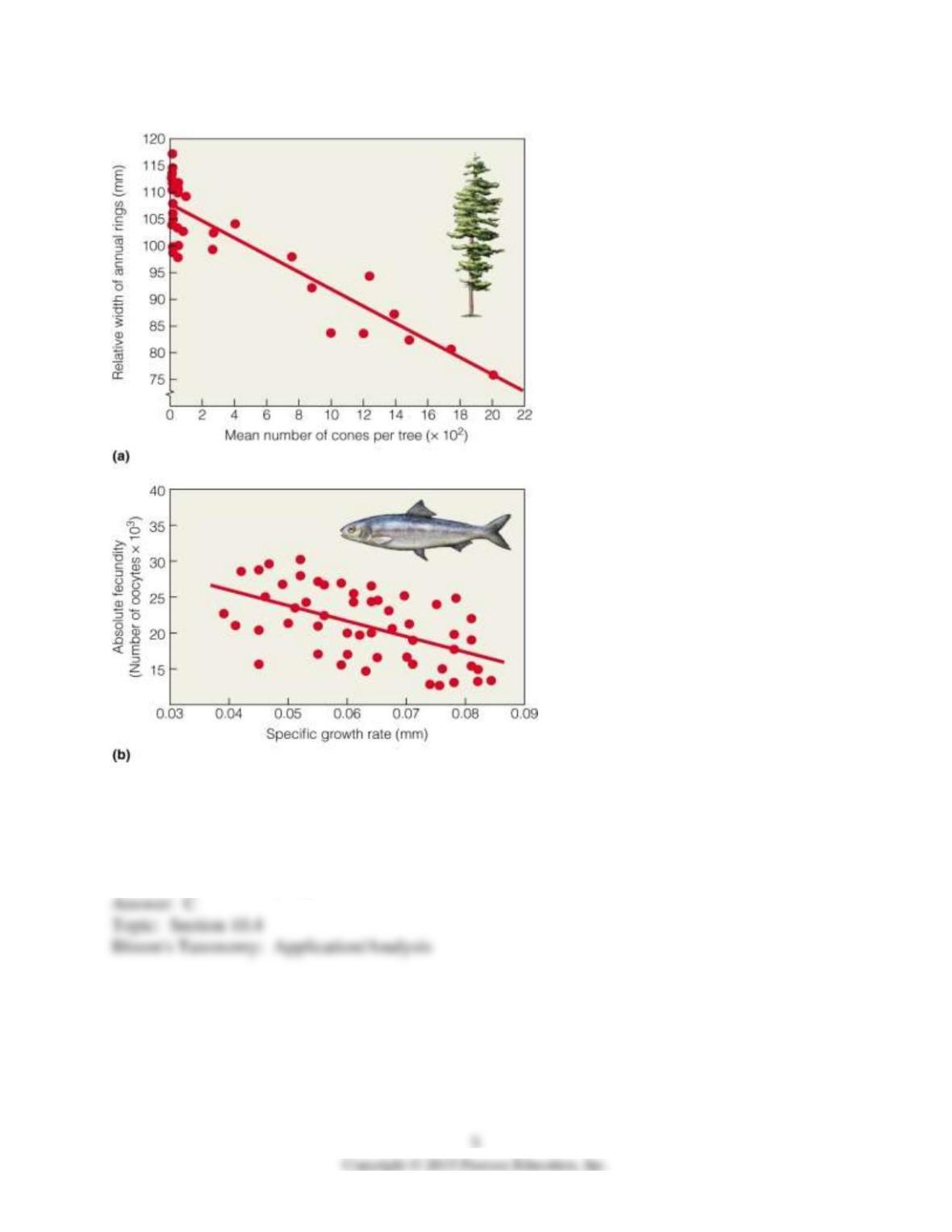
9)
The data in Figure 10.7 support which of the following trade-offs?
A) the size of offspring is correlated with the number of offspring
B) the size of offspring is correlated with the age at maturity
C) the number of offspring is correlated with growth
D) the number of offspring is correlated with survival

10) The behavioral, physiological, and energetic activities involved in current reproduction result
in
A) reduced future survival, fecundity, and growth.
B) reduced future survival and fecundity but increased future growth.
C) reduced future survival but increased future fecundity and growth.
D) increased future survival, fecundity, and growth.
11) Early sexual maturity is predicted to result in
A) lower overall lifetime reproduction.
B) higher overall lifetime reproduction.
C) higher reproduction earlier in life.
D) higher reproduction later in life.
12) In long-lived species of organisms, the primary advantage of delaying reproduction (late
maturity) is
A) increased survivorship.
B) obtaining a higher quality territory.
C) increased number of mates.
D) larger initial body size during the first reproduction event.
13) An animal with high fecundity is predicted to have
A) a lower number of offspring.
B) a lower reproductive effort.
C) a lower survival rate.
D) a higher offspring size.
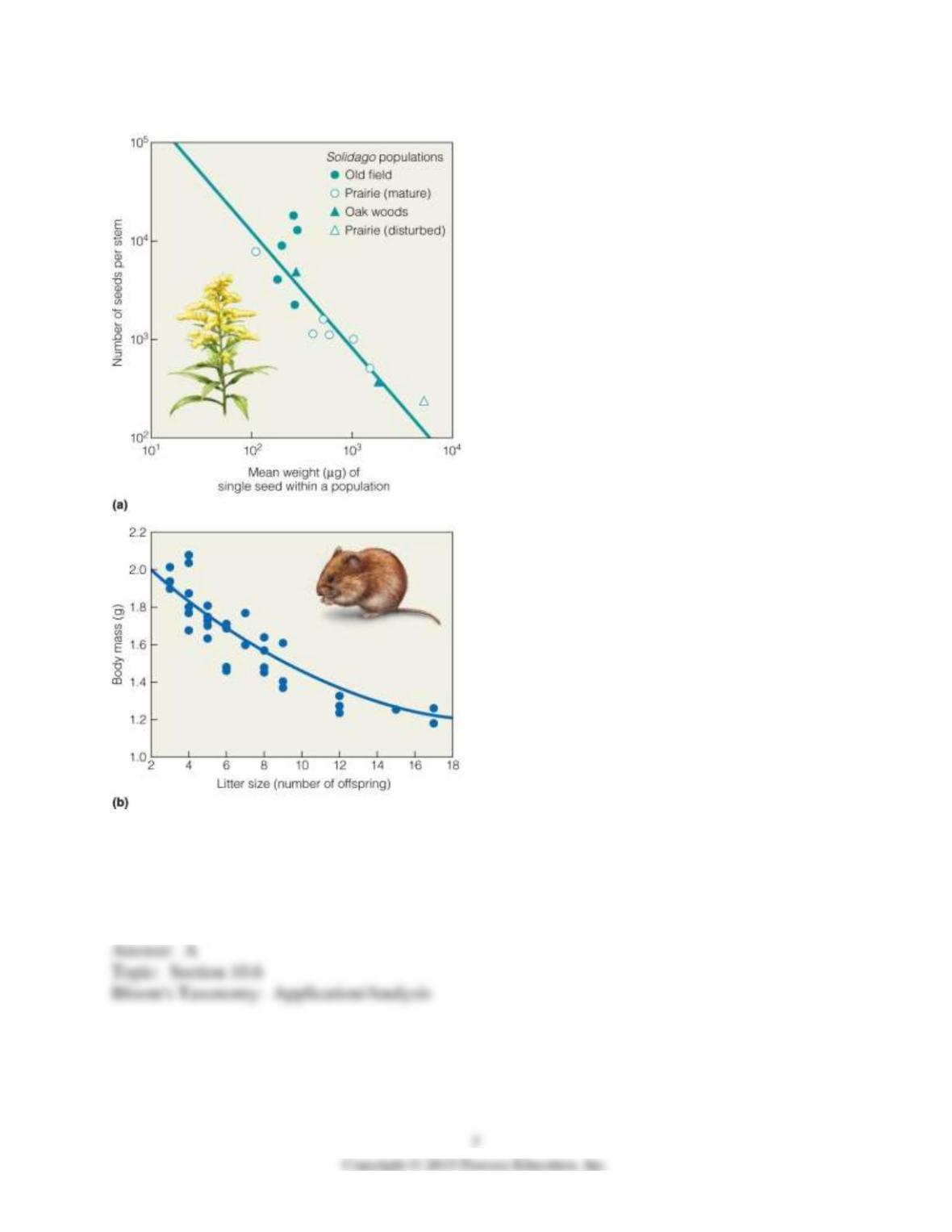
14)
These data support the trade-off that
A) size of offspring is correlated with number of offspring.
B) size of offspring is correlated with size of mother.
C) number of offspring is correlated with survival.
D) habitat type is correlated with size of mother.

15) Guppies were moved from stream A, with a fish that preyed upon adult guppies, to stream B,
with a fish that preyed upon juvenile guppies. After 30 to 60 generations, the guppies responded
to the increased predation on juveniles relative to adults by
A) feeding less frequently.
B) increasing age at maturity.
C) increasing the number of individuals in a school.
D) becoming smaller in body size.
16) Altricial young are relatively
A) independent at birth and require relatively little time for incubation and gestation.
B) independent at birth and require a relatively long time for incubation and gestation.
C) helpless at birth and require relatively little time for incubation and gestation.
D) helpless at birth and require a relatively long time for incubation and gestation.
17) Parental care is best developed among
A) ants and bees.
B) fish.
C) salamanders.
D) snakes and turtles.
18) An insect larva that is immediately ready to move and feed after birth is termed
A) altricial.
B) precocial.
C) semelparous.
D) iteroparous.
19) Pacific salmon migrate upstream and after breeding, soon die. They are termed
A) iteroparous.
B) semelparous.
C) dioecious.
D) monoecious.

20) The reproductive strategy in which relatively few young are produced at repeated intervals
during an individual’s life is referred to as
A) semelparity.
B) iteroparity.
C) altricial.
D) precocial.
21) In which of the following groups of organisms are most species iteroparous?
A) annual plants
B) perennial plants
C) periodical cicadas
D) salmon
22) In the presence of predators, some tadpoles grow larger and more colorful tails to avoid
lethal strikes to the head. This ability to respond to the environment via morphological traits is
known as
A) phenotypic plasticity.
B) outcrossing.
C) dioecious.
D) K-strategy.
23) A sexual system where a male gorilla mates with several females, forming pair bonds with
each of them, is called
A) promiscuity.
B) monogamy.
C) polyandry.
D) polygyny.

24) When one male mates and stays with one female, the relationship is called
A) polygamous.
B) monogamous.
C) monoecious.
D) promiscuous.
25) The mating system in which males and females mate with one or many of the opposite sex
and form no pair bond is known as
A) monogamy.
B) polygyny.
C) polyandry.
D) promiscuity.
26) The preferential selection by a female of a male peacock with the longest tail feathers and the
most eyespots on the tail feathers is an example of
A) polandry.
B) polygyny.
C) intrasexual selection.
D) intersexual selection.
27) Heightened male to male aggression around female mates is likely the result of
A) intersexual selection.
B) intrasexual selection.
C) polygamy.
D) delayed sexual maturity.
28) An individual with a large, high quality territory is likely to have
A) a reduced number of offspring.
B) decreased male-male interactions.
C) increased mating success.
D) reduced resources.

29) A female exhibits two major approaches in choosing a mate, selecting either the phenotypic
characteristics of the mate or the
A) number of other females the male has in his harem.
B) ability of the male to provide resources.
C) number of offspring the male has previously produced.
D) age of the male.
30) Which of the following would be most attractive to a female hummingbird? A mate
protecting a territory with
A) many predators.
B) many nectar feeding animals.
C) many nectar bearing flowers.
D) many other males.
31) An r-strategist is characterized by
A) slow population growth.
B) a slow rate of development.
C) a long life expectancy.
D) density-independent mortality.
32) Small and short-lived plants that rapidly colonize disturbed sites are classified by J. Phillip
Grime as
A) C species.
B) R species.
C) S species.
D) X species.
33) The K in the term K-strategist refers to
A) intrinsic rate of growth.
B) kill rate.
C) fecundity.
D) carrying capacity.

34) According to the latest data, the global human population is predicted to
A) continue to increase exponentially for the next 50 years.
B) peak at 10 billion.
C) decline precipitously to 1 billion.
D) increase at a steady rate for the next 50 years.
35) If infant mortality rates are declining, how can the overall population growth rate slow
down?
A) decreased adult survival
B) increased resource efficiency
C) decreased reproductive output
D) decreased demographic transition
10.3 True/False Questions
1) Extrinsic ecological factors such as the physical environment and the presence of predators or
competitors influence age specific rates of mortality and survivorship.
2) Defending a breeding territory increases an animal’s probability of future survival.
3) Fecundity increases with body weight.
4) As the number of offspring produced increases, the probability of their survival decreases.
5) All species of animals provide parental care.

6) Most species of vertebrates are iteroparous.
7) Semelparity is favored when the external environment imposes high adult mortality relative to
juvenile mortality, and mature individuals are unlikely to survive much longer.
8) The phenotype expressed by a single genotype can be affected by environmental conditions.
9) Polyandry is more common than polygyny.
10) Polygyny is more likely to occur as differences in territory quality increase between
territorial males.
11) Sexual dimorphism occurs when males and females are so similar morphologically that they
are difficult to distinguish.
12) In some species of birds, males with the brightest plumage have the fewest parasites.
13) In polygynous species of animals, males usually choose their mates, and females, because
they are smaller and weaker, must comply.

14) Species that are r-strategists are usually larger than those that are K-strategists.
15) Weedy plants are considered to be K-strategists.
16) Natural selection should favor plants producing small seeds in wet environments and plants
that produce larger seeds in dry environments.
10.4 Essay Questions
1) Explain how current reproduction can affect future survival, growth, and reproduction.
2) Discuss the factors that affect the optimal age and size of an organism at maturity.
3) Using examples, explain why some species provide parental care and others do not, and why
some species require more parental care than others.
4) Contrast semelparous and iteroparous reproductive strategies and explain the trade-offs of
each.
5) Explain why most bird species are monogamous while most mammal species are polygynous.
6) Explain sexual dimorphism from a Darwinian perspective.
7) Describe a lek. Is it a form of monogamy, polygyny, polyandry, or promiscuity?

8) Discuss the differences between r-strategists and K-strategists. Give an example of each.