Chapter 10 – Auditing Cash and Marketable Securities
59. Electronic authorization privileges for cash transactions may be best assigned to individuals based on which
of the following?
a.
Roles and activities falling within appropriate segregation of duties.
b.
Identification cards with picture identification.
c.
Encrypted passwords memorized by employees.
d.
The principle of “absolute knowledge”.
1
AUDT.JOHN.16.134 – Control Risks
United States – AK – AACSB-Analytical skills
60. Which of the following describes documents that accompany customer payments to help the clerk identify
the payments?
a.
Receipts such as register tapes.
b.
Accommodation certificates such as authenticated customer tokens.
c.
Turnaround documents such as remittance advices.
d.
Checks stamped with restrictive endorsements such as customer signatures.
1
AUDT.JOHN.16.134 – Control Risks
United States – AK – AICPA BB-Critical thinking
61. Which of the following best describes kiting?
a.
Theft of cash for personal use and cover-up using the bank statement.
b.
A fraudulent cash scheme to overstate cash assets at year end by manipulating year-end transfers
between cash accounts.
c.
Manipulation of financial reporting by increasing both cash and debt by the same amount.
d.
Colluding to steal cash by wiring money to a fictional vendor and concealing it with customer
payments.
b
1
AUDT.JOHN.16.10-08 – LO: 10-08
United States – BUSPORG: Analytic
United States – AK – AACSB-Analytical skills
United States – AK – AICPA BB-Critical thinking
Obtaining Substantive Evidence about Cash Accounts, Disclosures, and Assertions
62. Which of the following represents a typical substantive audit procedure for cash balances?
a.
Verify material deposits-in-transit to subsequent statements.
b.
Review cash confirms received by the client from the bank.
Chapter 10 – Auditing Cash and Marketable Securities
c.
Foot cutoff bank statements provided by the financial institutions.
d.
Perform kiting techniques to transfer cash between two client accounts.
AUDT.JOHN.16.136 – Substantive Audit Procedures
United States – AK – AICPA BB-Critical thinking
63. How will the auditor most likely utilize the bank reconciliation as evidence in the audit of cash?
a.
The auditor sends the reconciliation to the bank for independent verification.
b.
The auditor performs the reconciliation for the client to record the proper cash balance.
c.
The auditor traces the book balance of the reconciliation to the cutoff bank statement.
d.
The auditor tests deposits-in-transit and outstanding items to other corroborating evidence.
AUDT.JOHN.16.137 – Tests of Controls
United States – AK – AICPA BB-Critical thinking
64. Which of the following is the primary reason the auditor obtains and reviews a cutoff bank statement?
a.
Verify the balance of cash per the bank’s general ledger at the balance sheet date.
b.
Verify the reconciling items on the year-end bank reconciliation.
c.
Test for intentional lapping of bank transfers.
d.
Foot the cutoff bank statement for completeness.
AUDT.JOHN.16.137 – Tests of Controls
United States – AK – AICPA BB-Critical thinking
65. The auditor will send a standard bank confirmation to which of the following?
a.
Financial institutions of customers using the lockbox.
b.
Financial institutions for which the client has a balance greater than $0 at the end of the year.
c.
Financial institutions with which the client has transacted during the year.
d.
Financial institutions used by significant shareholders.
AUDT.JOHN.16.136 – Substantive Audit Procedures
66. The ease with which cash can be stolen is most related to which of the following risks?
Chapter 10 – Auditing Cash and Marketable Securities
a.
Control risk.
b.
Inherent risk.
c.
Detection risk.
d.
Liquidity risk.
AUDT.JOHN.16.135 – Inherent Risks
United States – AK – AICPA BB-Critical thinking
67. Which of the following best describes a fraudulent cash scheme to overstate cash assets at year end by
recording deposits in transit in both the account from which the cash is withdrawn and the account to which it is
transferred?
a.
Lapping of cash.
b.
Kiting of cash.
c.
Embezzlement of cash.
d.
Restrictive endorsements of cash.
AUDT.JOHN.16.138 – Fraud Risks
United States – AK – AICPA BB-Critical thinking
68. The emphasis in verifying petty cash is normally on which of the following?
a.
Year-end balance.
b.
Controls over petty cash.
c.
Transactions for the period.
d.
Balance sheet classification.
AUDT.JOHN.16.137 – Tests of Controls
United States – AK – AICPA BB-Critical thinking
69. When auditing marketable securities, the auditor will do which of the following?
a.
Examine broker’s advices evidencing purchase of securities.
b.
Recompute income.
c.
Foot schedule.
d.
Both A and B.
e.
All of the above.
70. The reported fair market value of securities held by the client can be verified by the auditor through which
of the following procedures?
a.
Comparing the values to those securities held by the auditing firm.
b.
Confirming the fair values with the client as of the close of the year.
c.
Comparing the fair values with the fair values of similar securities.
d.
Comparing the fair values to credible publications and websites.
d
1
AUDT.JOHN.16.139 – Audits of Marketable Securities
United States – AK – AICPA BB-Critical thinking
71. Which of the following items would not normally appear on bank reconciliations?
a.
Balance per bank.
b.
Outstanding deposits list.
c.
Balance per books.
d.
Outstanding checks list.
b
1
AUDT.JOHN.16.137 – Tests of Controls
United States – AK – AICPA BB-Critical thinking
72. Investments in securities are classified as which of the following?
a.
Held-to-maturity.
b.
Trading securities.
c.
Available-for-sale securities.
d.
All of the above.
d
1
AUDT.JOHN.16.139 – Audits of Marketable Securities
United States – AK – AICPA BB-Critical thinking
73. Which of the following is the most relevant assertion with regards to the audit of cash?
a.
Existence
b.
Rights and obligations.
c.
Valuation and allocation.
AUDT.JOHN.16.139 – Audits of Marketable Securities
United States – AK – AICPA BB-Critical thinking
Chapter 10 – Auditing Cash and Marketable Securities
d.
Presentation and disclosure.
1
AUDT.JOHN.16.10-01 – LO: 10-01
Identify the Significant Accounts, Disclosures, and Assertions in Auditing Cash
74. Which of the following would not be used as part of analytical procedures for marketable securities?
a.
Develop expectations about the level of amounts in ending balances.
b.
Develop expectations about the relationship between the balances.
c.
Verify ending balances prior to calculating the percent change.
d.
Review changes in the balances, risk composition, and classification types.
1
AUDT.JOHN.16.139 – Audits of Marketable Securities
United States – AK – AICPA BB-Critical thinking
75. Which of the following would the auditor use to determine the existence of investments?
a.
Footing the schedule of recorded investments.
b.
Confirming or examining recorded investments.
c.
A schedule of investments sold during the year.
d.
Recomputing interest and/or gains and losses.
b
1
AUDT.JOHN.16.10-09 – LO: 10-09
United States – BUSPORG: Analytic
United States – AK – AICPA BB-Critical thinking
Auditing Marketable Securities
76. Which assertion related to investments is tested when the auditor examines the documents for any
restrictions?
a.
Existence.
b.
Rights.
c.
Completeness.
d.
Valuation.
b
77. Which of the following is required by accounting standards for the presentation and disclosure of
investments in marketable securities?
a.
By classification as trading, available-for-sale or held-to maturity.
b.
For an analyst’s determination of liquidity.
c.
For the company’s physical possession of the security versus agent holdings.
d.
For the expected success of the organization of investment.
1
AUDT.JOHN.16.139 – Audits of Marketable Securities
United States – AK – AICPA BB-Critical thinking
78. Which of the following procedures does the auditor typically perform when testing the existence of cash?
a.
Counting cash at the depository institution.
b.
Inquiry of management.
c.
Sending a standard bank confirmation.
d.
Tracing the bank reconciliation to the general ledger.
1
AUDT.JOHN.16.136 – Substantive Audit Procedures
United States – AK – AICPA BB-Critical thinking
79. When testing cash balances at the balance sheet date, the auditor foots the bank reconciliation and traces its
reported book balance to the trial balance and its bank balance to the standard confirmation. Which of the
following assertions is being tested with these procedures?
a.
Rights.
b.
Valuation.
c.
Existence.
d.
All of the above.
d
1
AUDT.JOHN.16.136 – Substantive Audit Procedures
United States – AK – AICPA BB-Critical thinking
80. Assume that an auditor notes a large series of checks that does not clear the bank for an unusually long time
after period end. Which of the following would the auditor likely suspect from this observation?
a.
Vendors are eager to get their payments.
b.
The reconciliation is accurate.
c.
Cash does not exist.
United States – AK – AICPA BB-Critical thinking
Chapter 10 – Auditing Cash and Marketable Securities
d.
The presence of held-checks at period-end.
AUDT.JOHN.16.137 – Tests of Controls
81. The standard bank confirmation includes a designated place for the financial institution to report which of
the following?
a.
Loans and collateral.
b.
A reconciliation of the lockbox.
c.
Cash held on consignment.
d.
Maturity dates for certificates of deposit.
AUDT.JOHN.16.136 – Substantive Audit Procedures
United States – AK – AICPA BB-Critical thinking
82. Which of the following is not a common test of control for marketable securities?
a.
Review the minutes of the board meetings.
b.
Review broker’s advice for accurate recording of security
c.
Inquire of management about its process for reclassifications.
d.
Review reports of internal audits.
AUDT.JOHN.16.139 – Audits of Marketable Securities
United States – AK – AICPA BB-Critical thinking
83. Which of the following would be used by the auditor to address kiting?
a.
Cut-off bank reconciliations.
b.
Bank transfer schedules.
c.
Bank confirmations-account balances.
d.
Bank confirmations-loan guarantees.
AUDT.JOHN.16.136 – Substantive Audit Procedures
United States – AK – AICPA BB-Critical thinking
84. Bank transfer schedules are used by the auditor to address which of the following concerns?
Chapter 10 – Auditing Cash and Marketable Securities
a.
Lapping.
b.
Kiting.
c.
Embezzlement by omitting outstanding checks on reconciliation.
d.
All of the above.
b
1
AUDT.JOHN.16.136 – Substantive Audit Procedures
United States – AK – AICPA BB-Critical thinking
85. The cutoff bank statement is used by the auditor to address which of the following concerns?
a.
Lapping.
b.
Kiting.
c.
Omitting outstanding checks on reconciliations.
d.
All of the above.
1
AUDT.JOHN.16.10-08 – LO: 10-08
United States – BUSPORG: Analytic
United States – AK – AICPA BB-Critical thinking
Obtaining Substantive Evidence about Cash Accounts, Disclosures, and Assertions
86. Which of the following would not be included as part of the documentation related to the substantive
procedures for marketable securities?
a.
A schedule of marketable securities prepared by the client.
b.
Reports of any outside valuation experts.
c.
Calculation of any potential impairments.
d.
Policies over purchase or sale of marketable securities.
d
1
AUDT.JOHN.16.139 – Audits of Marketable Securities
87. Which of the following is not a reason for a client to employ cash management techniques?
a.
Speed the collection and deposit of cash.
b.
Reduce the effect of compensating balances.
c.
Reduce the amount of paperwork.
d.
Automate the cash management process.
88. Which of the following is not a cash management technique frequently used by management?
a.
Imprest funds.
b.
Lockboxes.
c.
Electronic funds transfers.
d.
Cash management agreement with financial institutions.
e.
All of the above.
1
AUDT.JOHN.16.134 – Control Risks
United States – AK – AICPA BB-Critical thinking
89. The auditor prepares a schedule for marketable securities. Which of the following is not one of the items
included related to the value of the securities?
a.
Cost.
b.
Year-end market value.
c.
Carrying value for debt instruments.
d.
Interest and dividends.
1
AUDT.JOHN.16.139 – Audits of Marketable Securities
United States – AK – AICPA BB-Critical thinking
90. Which of the following is not an internal control the auditor would expect to find in place for all cash
processing systems?
a.
Restrictive endorsement of checks.
b.
Independent reconciliation.
c.
Walkthrough.
d.
Prenumbered cash receipt documents.
1
AUDT.JOHN.16.134 – Control Risks
United States – AK – AICPA BB-Critical thinking
91. Which of the following is not a normal edit test as part of computerized control for checks?
a.
Field checks.
b.
Self-checking digits.
AUDT.JOHN.16.134 – Control Risks
United States – AK – AICPA BB-Critical thinking
Chapter 10 – Auditing Cash and Marketable Securities
c.
Cross-references.
d.
Reasonableness tests.
1
AUDT.JOHN.16.134 – Control Risks
United States – AK – AICPA BB-Critical thinking
92. Imprest payroll account
What is an imprest payroll account and why is it used by companies?
period of time.
1
AUDT.JOHN.16.134 – Control Risks
United States – AK – AICPA BB-Critical thinking
93. Lockbox utilization
Describe the cash management technique of a lockbox, including why it is used.
notifies the client of the details.
1
AUDT.JOHN.16.134 – Control Risks
United States – AK – AICPA BB-Critical thinking
94. Cutoff statement
What is a bank cutoff statement and how is it used by an auditor?
95. Auditing marketable securities
List the common substantive procedures used to address the risks relating to fraud in investments:
96. Types of Controls
Identify the types of controls used to minimize potential misstatements of cash.
97. Fraud by kiting
Describe the concept of kiting and identify the best method for the auditor to use to detect kiting.
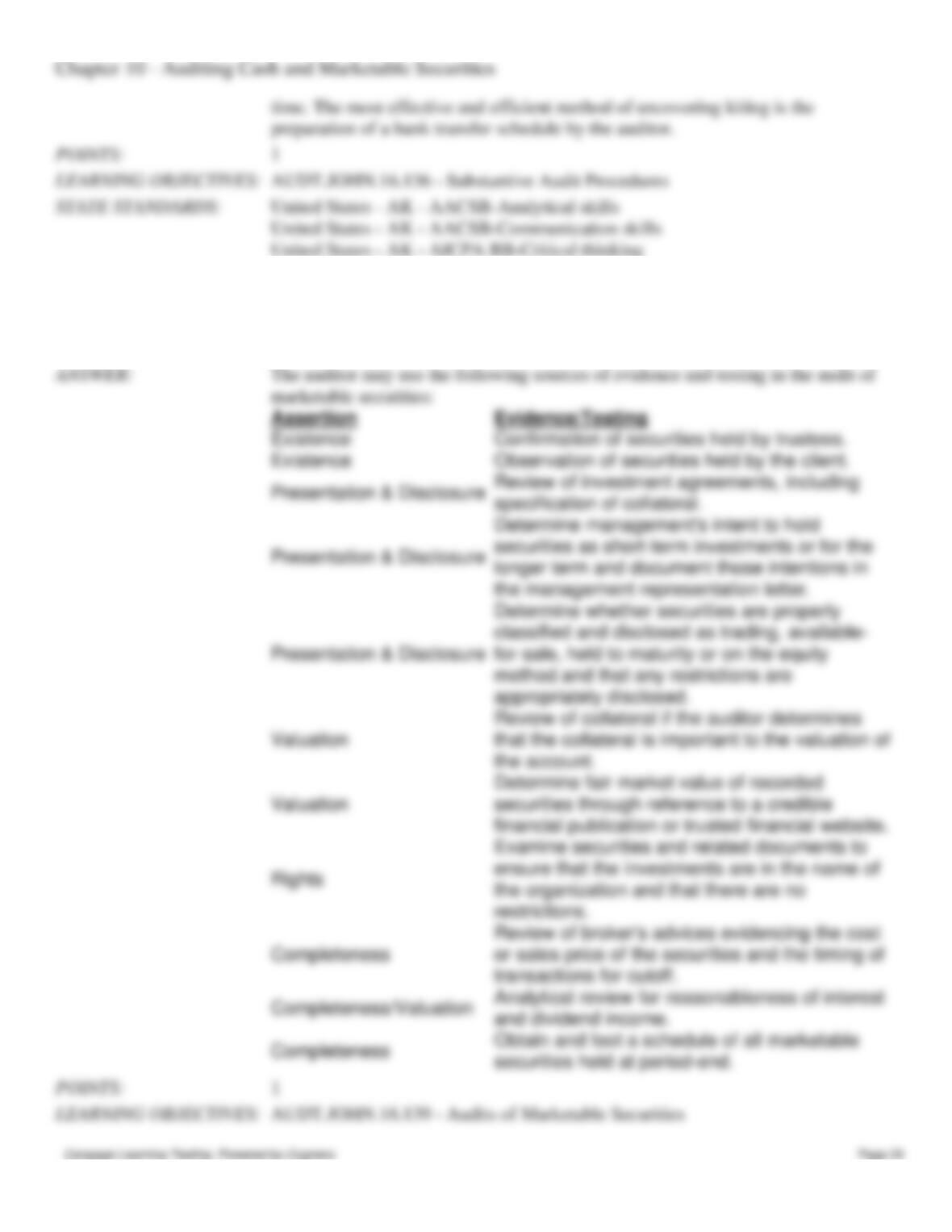
98. Auditing marketable securities – assertions
Identify at least eight sources of evidence and testing the auditor may use in the audit of marketable securities
by major assertion tested.
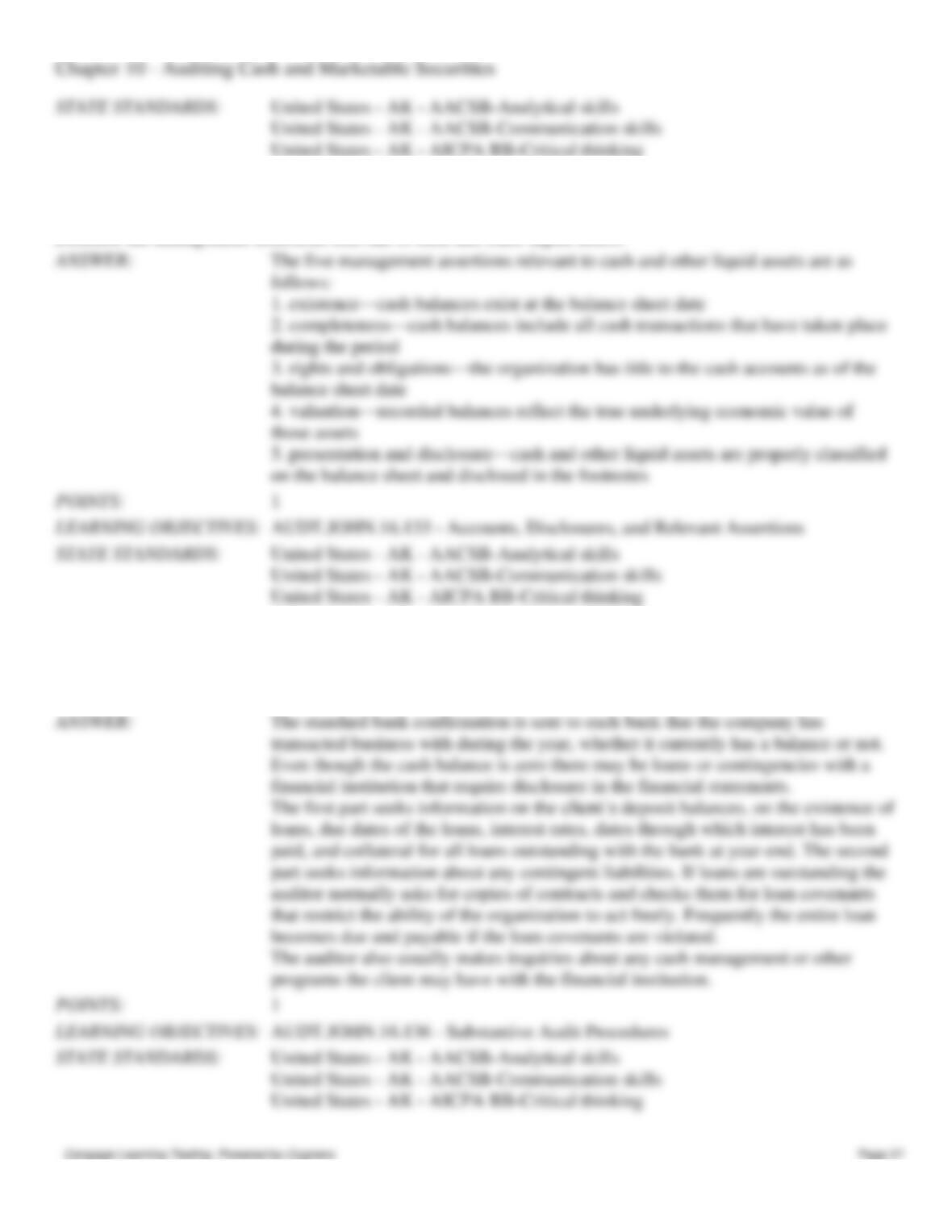
99. Financial Statements Assertions
Describe the management assertions relevant to cash and other liquid assets.
100. Bank confirmations
There are two parts in a standard bank confirmation. Discuss the purposes and what would be requested by each
component and to whom it would be sent.
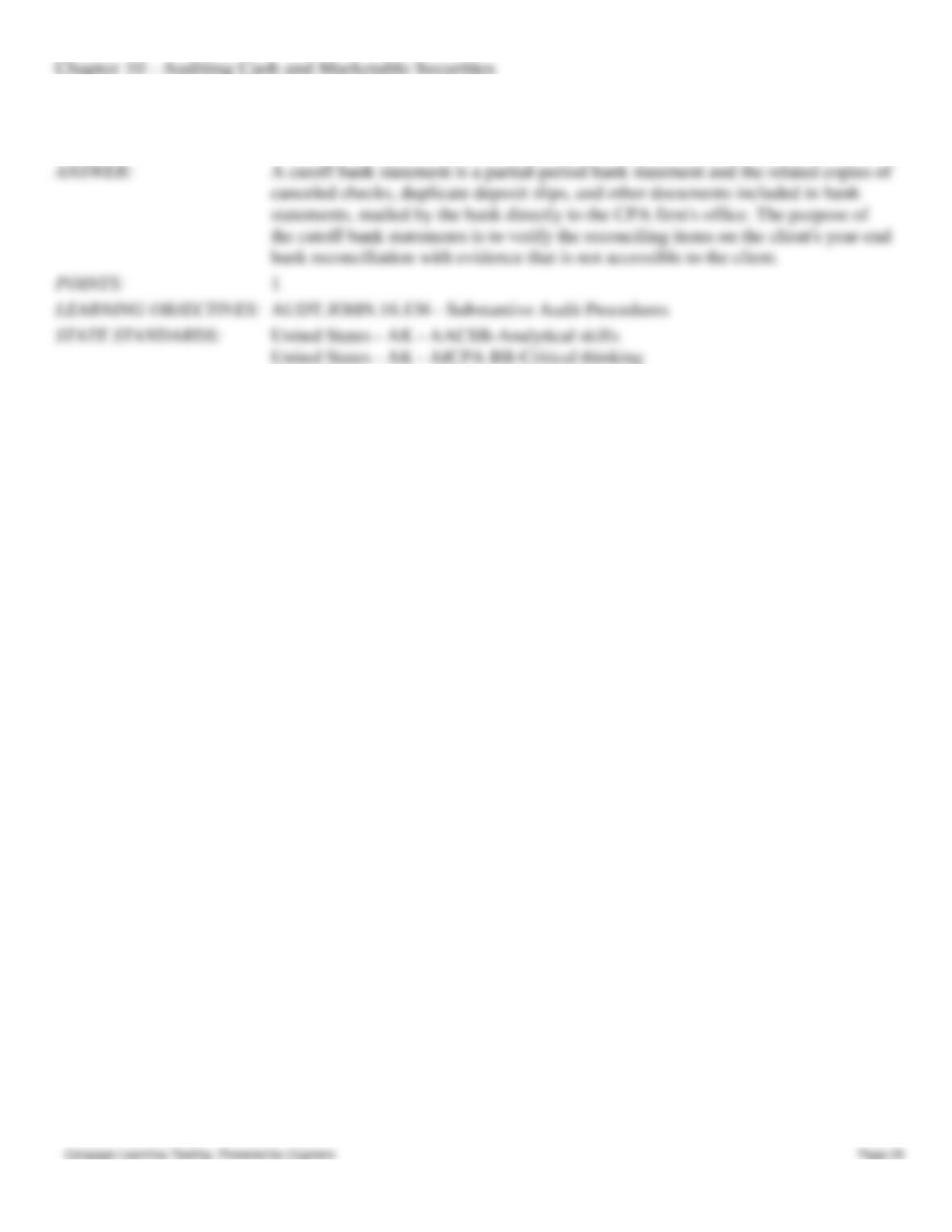
101. Cut-off bank statements
Explain what is meant by a cutoff bank statement, and discuss the purpose of the cutoff bank statement in the
audit of cash.