Chapter 10—Financing: Long-Term Liabilities Key
1. Instructions: Use the present value and future value tables included in Appendix 8 and on the textbook
companion website.
Which of the following statements is FALSE?
2. Instructions: Use the present value and future value tables included in Appendix 8 and on the textbook
companion website.
Assuming an annual interest rate of 10 percent, what factor from the tables would be used to calculate the
present value of a specified payment to be received nine years from today?
3. Instructions: Use the present value and future value tables included in Appendix 8 and on the textbook
companion website.
Assuming an annual interest rate of 8 percent, what factor from the tables would be used to calculate the
amount that should be deposited in a bank today to grow to a specified amount nine years from today?
4. Instructions: Use the present value and future value tables included in Appendix 8 and on the textbook
companion website.
You are purchasing a home. You know the monthly mortgage payment amount that you can afford, and you
want to calculate the corresponding mortgage total amount. The technique you will use is the
5. Instructions: Use the present value and future value tables included in Appendix 8 and on the textbook
companion website.
An investor wants to withdraw $8,000 (including principal) from an investment fund at the end of each year
for 10 years. How should the investor compute the required initial investment at the beginning of the first year if
the fund earns 10 percent compounded annually?
6. Instructions: Use the present value and future value tables included in Appendix 8 and on the textbook
companion website.
For a 10-year bond paying semiannual interest, how many compounding periods are there over the life of the
bond?
7. Instructions: Use the present value and future value tables included in Appendix 8 and on the textbook
companion website.
You have just purchased an automobile for $15,000 and will be financing it at 12 percent interest compounded
monthly for 5 years. Your monthly payment will be
8. Instructions: Use the present value and future value tables included in Appendix 8 and on the textbook
companion website.
If Cheng Corporation can invest $10,000 at 10 percent interest compounded annually, approximately how
many years will it take for the $10,000 to grow to $20,000?
9. Instructions: Use the present value and future value tables included in Appendix 8 and on the textbook
companion website.
Which of the following has the smallest present value?
10. Instructions: Use the present value and future value tables included in Appendix 8 and on the textbook
companion website.
The present value of an annuity of $500 for 10 years at 10 percent interest compounded annually is
11. Instructions: Use the present value and future value tables included in Appendix 8 and on the textbook
companion website.
What is the approximate present value of $500 to be received in 1 year if interest is 8 percent compounded
annually?
12. Instructions: Use the present value and future value tables included in Appendix 8 and on the textbook
companion website.
The present value of $1,000 to be received in 3 years when interest is 12 percent compounded quarterly is
computed by discounting at
13. Instructions: Use the present value and future value tables included in Appendix 8 and on the textbook
companion website.
What is the approximate present value of $100 to be received in 2 years if interest is 10 percent compounded
annually?
14. Instructions: Use the present value and future value tables included in Appendix 8 and on the textbook
companion website.
The present value of $1 discounted for 10 years at 8 percent compounded annually is 0.4632. The present value
of an annuity of $1 discounted for 10 years at 8 percent compounded annually is 6.7101. Given this
information, the present value of $80 to be received in 10 years at 8 percent compounded annually is
15. Instructions: Use the present value and future value tables included in Appendix 8 and on the textbook
companion website.
The present value of $1 discounted for 12 years at 9 percent compounded annually is 0.3555. The present value
of an annuity of $1 discounted for 12 years at 9 percent compounded annually is 7.1607. Given this
information, how much must be invested today so that $100 can be received each year for 12 years if money is
worth 9 percent compounded annually?
16. Instructions: Use the present value and future value tables included in Appendix 8 and on the textbook
companion website.
The present value of $2,500 to be received in 4 years when interest is 12 percent compounded quarterly is
computed by discounting at
17. Instructions: Use the present value and future value tables included in Appendix 8 and on the textbook
companion website.
Which of the following has the smallest present value?
18. Instructions: Use the present value and future value tables included in Appendix 8 and on the textbook
companion website.
Arsenio plans to invest $10,000 at the end of each of the next ten years. Assume that Arsenio will earn interest
at an annual rate of 6 percent compounded annually. The investment at the end of ten years would be (rounded)
19. Instructions: Use the present value and future value tables included in Appendix 8 and on the textbook
companion website.
Assuming an interest rate of 12 percent, an ordinary annuity of eight annual $30,000 payments will grow to
20. Instructions: Use the present value and future value tables included in Appendix 8 and on the textbook
companion website.
The two major categories of liabilities on a typical balance sheet are
21. Instructions: Use the present value and future value tables included in Appendix 8 and on the textbook
companion website.
Which of the following is LEAST likely to be classified as a long-term liability?
22. Instructions: Use the present value and future value tables included in Appendix 8 and on the textbook
companion website.
Which of the following is LEAST likely to be classified as a current liability?
23. Instructions: Use the present value and future value tables included in Appendix 8 and on the textbook
companion website.
Which of the following is NOT true?
24. Instructions: Use the present value and future value tables included in Appendix 8 and on the textbook
companion website.
If no interest payments are made on a note, then the difference between the present value of the cash flows
associated with the note and the face value of the note represents
25. Instructions: Use the present value and future value tables included in Appendix 8 and on the textbook
companion website.
Which of the following is prepared to identify how much of each mortgage payment is interest and how much
is principle reduction?
26. Instructions: Use the present value and future value tables included in Appendix 8 and on the textbook
companion website.
At the end of each year, a mortgage is reported under how many sections of the balance sheet?
27. Instructions: Use the present value and future value tables included in Appendix 8 and on the textbook
companion website.
A 4-month, $6,500 note payable at 9 percent incurs interest (rounded to nearest dollar) of
28. Instructions: Use the present value and future value tables included in Appendix 8 and on the textbook
companion website.
The following entry is made to record the first monthly payment on a $60,000, 9 percent mortgage:
Account
A
450
Account
B
32
Account C
482
Given this entry, the amount of interest included with this payment is
29. Instructions: Use the present value and future value tables included in Appendix 8 and on the textbook
companion website.
A 1-year, $15,000, 12 percent (payable annually) note is signed on April 1. If the note is prematurely repaid on
September 1 of the same year, how much interest expense is incurred?
30. Instructions: Use the present value and future value tables included in Appendix 8 and on the textbook
companion website.
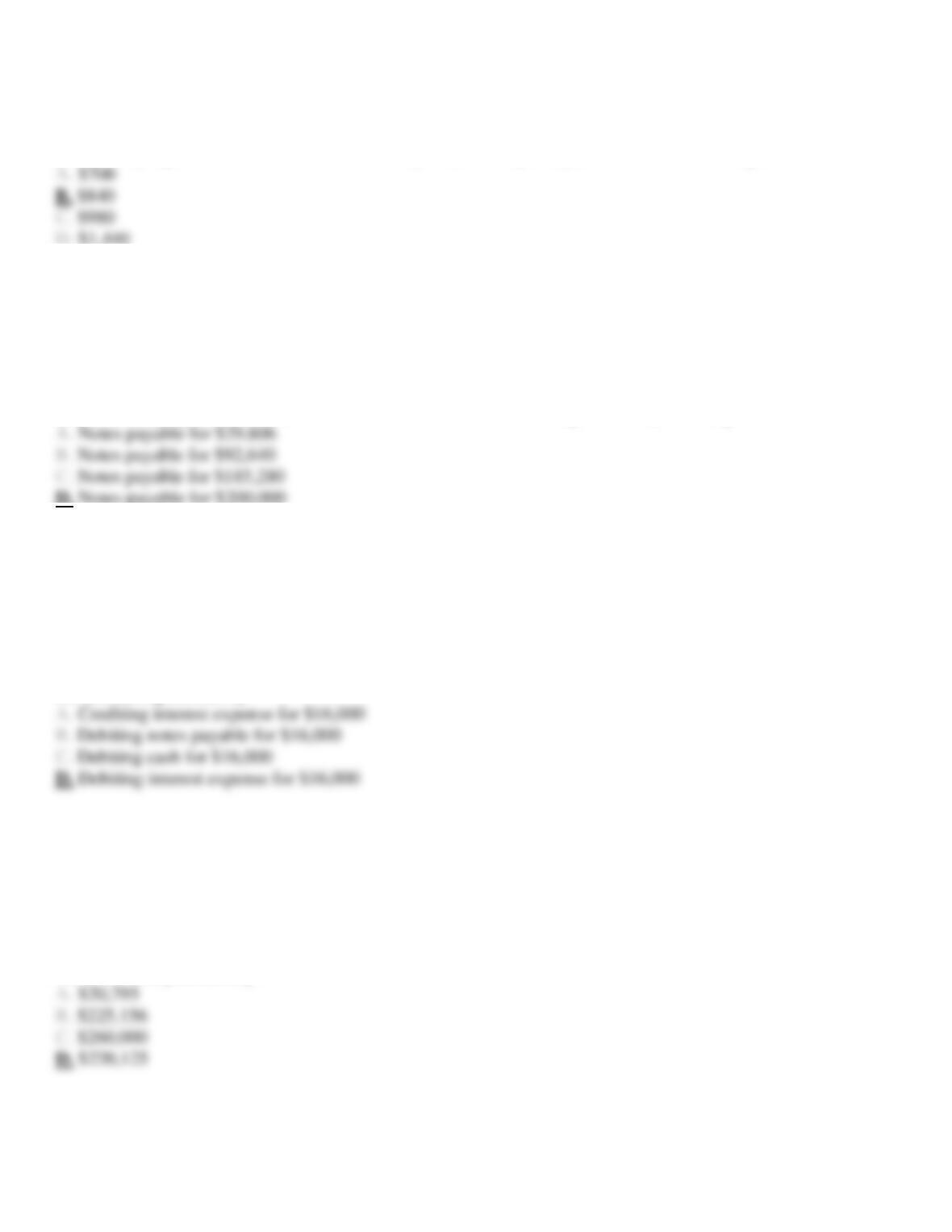
Interest expense on a 6-month, 8 percent, $6,000 note payable would be approximately
31. Instructions: Use the present value and future value tables included in Appendix 8 and on the textbook
companion website.
An $18,000, 8 percent (payable annually), one-year note is accepted by the bank on April 1. If the note is
prematurely repaid on November 1 of the same year (without penalty), how much interest is paid?
32. Instructions: Use the present value and future value tables included in Appendix 8 and on the textbook
companion website.
If equipment is purchased by issuing a 10-year, $200,000 interest bearing note at a stated rate of 8 percent
(payable annually), the transaction would be entered in the accounting records by crediting
33. Instructions: Use the present value and future value tables included in Appendix 8 and on the textbook
companion website.
If equipment is purchased by issuing a 10-year, $200,000 interest bearing note at a stated rate of 8 percent
(payable annually), the first interest payment, assuming it has not been previously accrued, would be entered in
the accounting records by
34. Instructions: Use the present value and future value tables included in Appendix 8 and on the textbook
companion website.
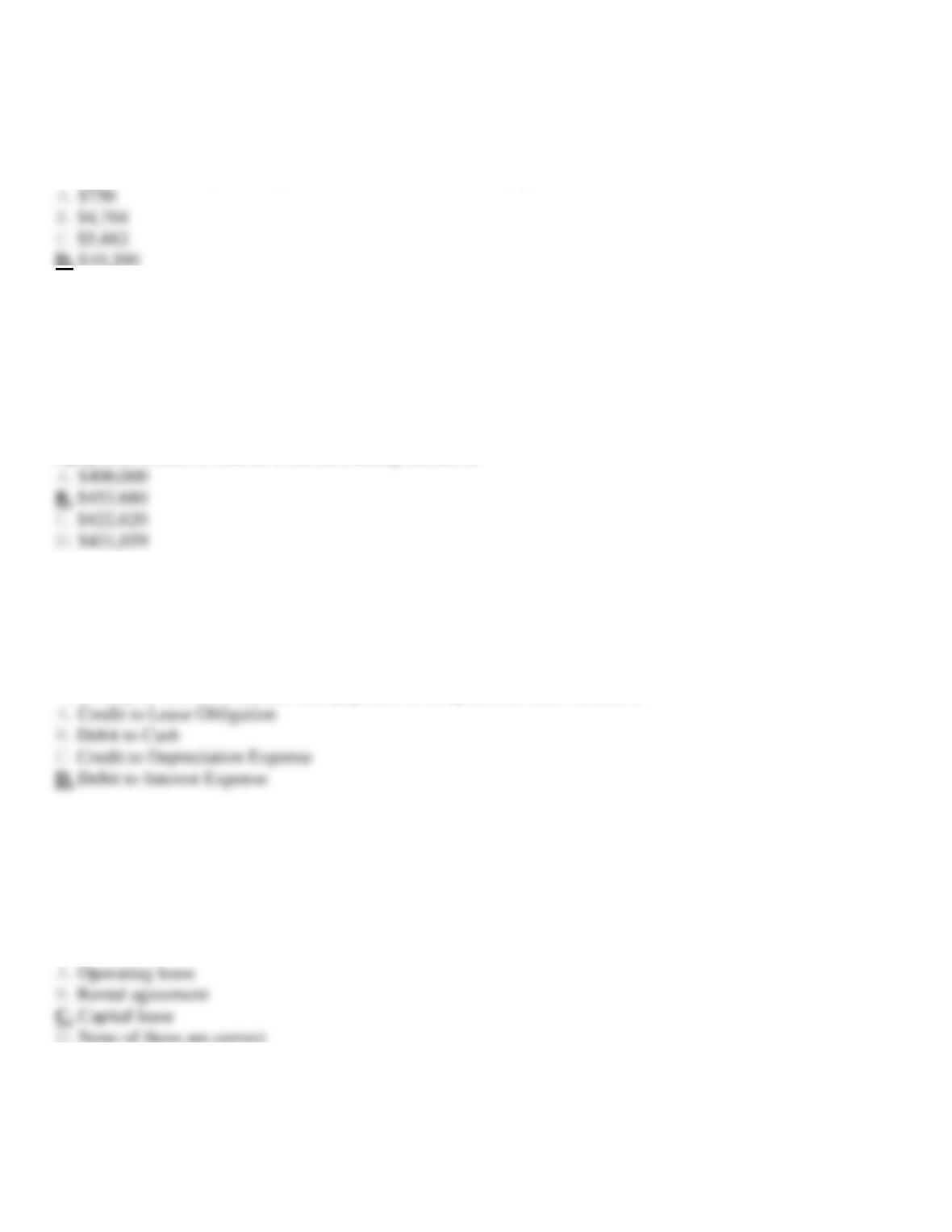
Assume you are going to purchase a house. You have $40,000 to use as a down payment and can afford a
payment of $16,000 per year for 30 years. If interest is 8 percent per year, what is the largest purchase price of
the house that you can buy?
35. Instructions: Use the present value and future value tables included in Appendix 8 and on the textbook
companion website.
Suppose you want to determine the payments you will have to make on a loan for a house. The house will cost
$100,000, and your bank requires a 20 percent down payment. The remainder will be financed at 12 percent
compounded annually for 25 years. What will be the annual payment?
36. Instructions: Use the present value and future value tables included in Appendix 8 and on the textbook
companion website.
Byers Corporation purchased equipment by issuing a 10-year, $400,000 interest-bearing note at a stated rate of
10 percent (payable annually). Given this information and assuming that a market interest rate of 8%, the
equipment would be entered in the accounting records at
37. Instructions: Use the present value and future value tables included in Appendix 8 and on the textbook
companion website.
The entry to record the annual lease payment on a capitalized lease includes a
38. Instructions: Use the present value and future value tables included in Appendix 8 and on the textbook
companion website.
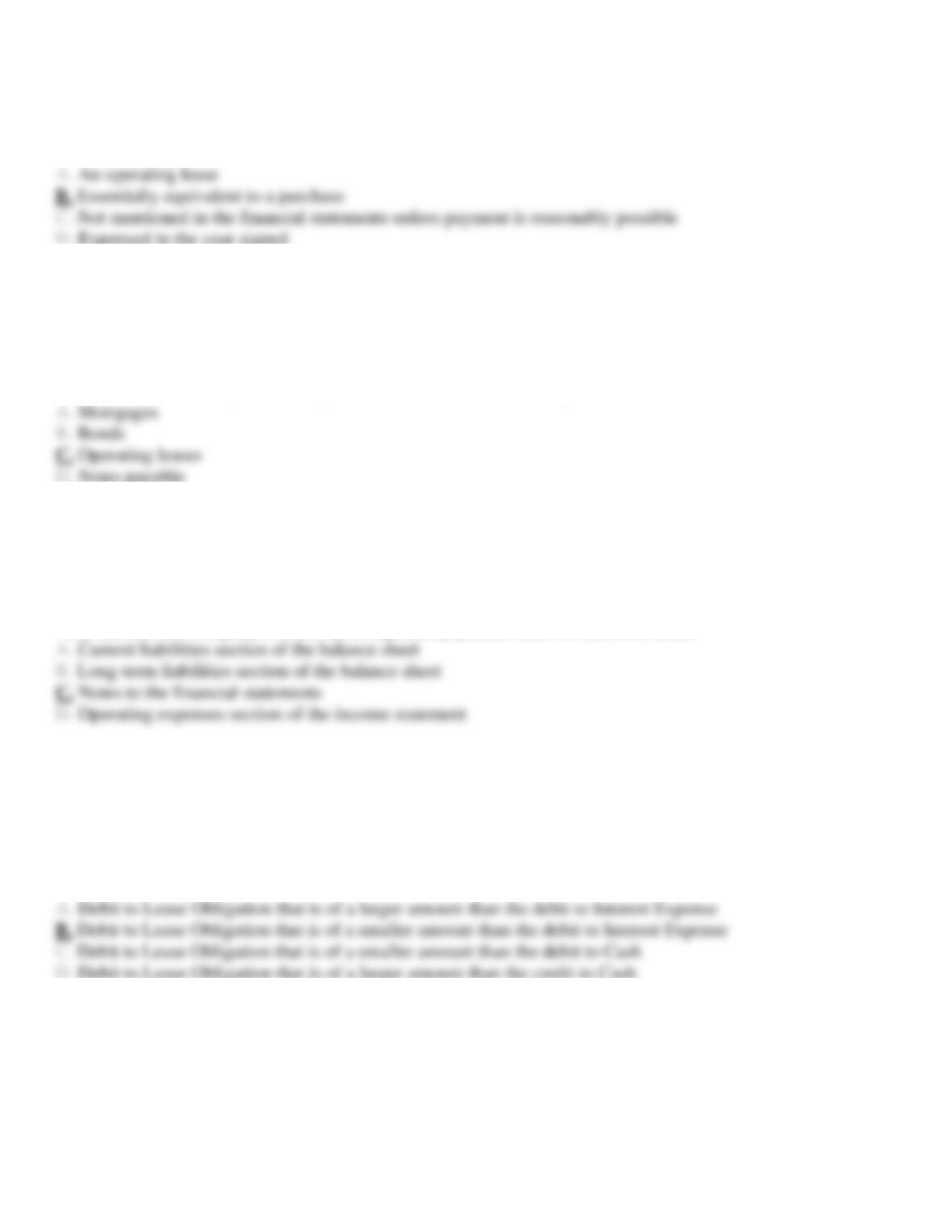
A long-term, noncancelable lease for a period that is equal to the life of the leased asset is accounted for as
a(n)
39. Instructions: Use the present value and future value tables included in Appendix 8 and on the textbook
companion website.
Generally accepted accounting principles specify that a long-term noncancelable lease for a period equal to the
life of the equipment is
40. Instructions: Use the present value and future value tables included in Appendix 8 and on the textbook
companion website.
Which of the following is an example of off-balance-sheet financing?
41. Instructions: Use the present value and future value tables included in Appendix 8 and on the textbook
companion website.
The amount of a company’s future operating lease payments must be disclosed in the
42. Instructions: Use the present value and future value tables included in Appendix 8 and on the textbook
companion website.
A 10-year capital lease requiring payments of $25,000 per year is signed. The entry to record the first payment
would probably include a
43. Instructions: Use the present value and future value tables included in Appendix 8 and on the textbook
companion website.
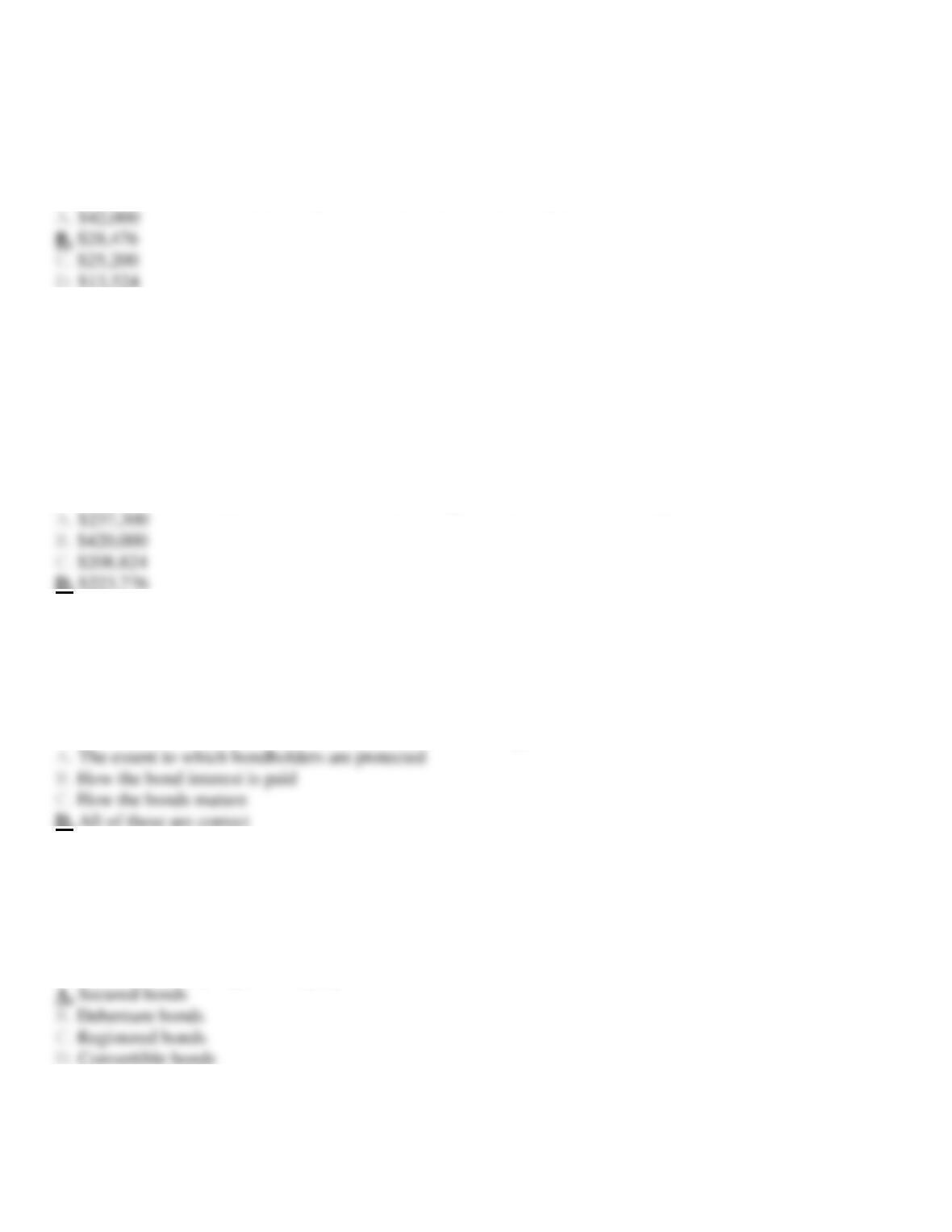
On January 1, Cromwell Corp. leased a mainframe computer from Fairview Company for $42,000 per year
(payable on each December 31) for 10 years. The lease is a capital lease, and the current market rate of interest
is 12 percent. The market value of the computer is $237,300, which is equal to its discounted present value at 12
percent. Given this data, interest expense on the lease for the first year is
44. Instructions: Use the present value and future value tables included in Appendix 8 and on the textbook
companion website.
On January 1, Cromwell Corp. leased a mainframe computer from Fairview Company for $42,000 per year
(payable on each December 31) for 10 years. The lease is a capital lease, and the current market rate of interest
is 12 percent. The market value of the computer is $237,300, which is equal to its discounted present value at 12
percent. Given this data, the amount of the lease obligation at the end of the first year is
45. Instructions: Use the present value and future value tables included in Appendix 8 and on the textbook
companion website.
Which of the following is one of the ways bonds can be categorized?
46. Instructions: Use the present value and future value tables included in Appendix 8 and on the textbook
companion website.
Bonds that have a pledge of company assets are called
47. Instructions: Use the present value and future value tables included in Appendix 8 and on the textbook
companion website.
When a company issues bonds that promise only to pay the face amount at the maturity date, the bonds issued
are called
48. Instructions: Use the present value and future value tables included in Appendix 8 and on the textbook
companion website.
High-risk bonds issued by companies in weak financial condition are called
49. Instructions: Use the present value and future value tables included in Appendix 8 and on the textbook
companion website.
Which of the following is NOT a synonymous term to the others?
50. Instructions: Use the present value and future value tables included in Appendix 8 and on the textbook
companion website.
Debentures are
51. Instructions: Use the present value and future value tables included in Appendix 8 and on the textbook
companion website.
Callable bonds
52. Instructions: Use the present value and future value tables included in Appendix 8 and on the textbook
companion website.
The issuance price of a bond does NOT depend on the
53. Instructions: Use the present value and future value tables included in Appendix 8 and on the textbook
companion website.
The effective interest rate on bonds is higher than the stated rate when bonds sell
54. Instructions: Use the present value and future value tables included in Appendix 8 and on the textbook
companion website.
If the effective interest rate equals the stated interest rate, a bond will sell at
55. Instructions: Use the present value and future value tables included in Appendix 8 and on the textbook
companion website.
Bonds usually sell at a discount when
56. Instructions: Use the present value and future value tables included in Appendix 8 and on the textbook
companion website.
When do bonds usually sell at a premium?
57. Instructions: Use the present value and future value tables included in Appendix 8 and on the textbook
companion website.
The effective interest rate on bonds is lower than the stated rate when bonds sell
58. Instructions: Use the present value and future value tables included in Appendix 8 and on the textbook
companion website.
Bonds usually sell at a premium when
59. Instructions: Use the present value and future value tables included in Appendix 8 and on the textbook
companion website.
To compute the price to pay for a bond, you use
60. Instructions: Use the present value and future value tables included in Appendix 8 and on the textbook
companion website.
The effective interest rate on bonds is also called
61. Instructions: Use the present value and future value tables included in Appendix 8 and on the textbook
companion website.
If the market rate of interest is 12 percent and a company is issuing long-term bonds paying 10 percent, at what
percent would those liabilities have to be discounted, assuming semiannual compounding?
62. Instructions: Use the present value and future value tables included in Appendix 8 and on the textbook
companion website.
Flute Corporation issued $200,000, 10-year, 9 percent bonds at a time when the market rate of interest was 12
percent. These bonds will be issued for
63. Instructions: Use the present value and future value tables included in Appendix 8 and on the textbook
companion website.
Flute Corporation issued $200,000, 10-year, 9 percent bonds at a time when the market rate of interest was 7
percent. These bonds will be issued for
64. Instructions: Use the present value and future value tables included in Appendix 8 and on the textbook
companion website.
Flute Corporation issued $200,000, 10-year, 9 percent bonds at a time when the market rate of interest was 9
percent. These bonds will be issued for
65. Instructions: Use the present value and future value tables included in Appendix 8 and on the textbook
companion website.
LaFluer Corporation issued $400,000 of 15-year bonds on January 1. The bonds pay interest on January 1 and
July 1 with a stated rate of 8 percent. If the market rate of interest at the time the bonds are sold is 6 percent,
what will be the issuance price (approximate) of the bonds?
66. Instructions: Use the present value and future value tables included in Appendix 8 and on the textbook
companion website.
LaFluer Corporation issued $400,000 of 15-year bonds on January 1. The bonds pay interest on January 1 and
July 1 with a stated rate of 8 percent. If the market rate of interest at the time the bonds are sold is 10 percent,
what will be the issuance price (approximate) of the bonds?