
d.
10.2 eV
e.
13.6 eV
39. How small an object can a scanning tunneling microscope “see?”
a.
about the size of a mushroom spore
b.
about the size of a living cell
c.
as small as a single atom
d.
as small as the nucleus of an atom
40. The energy of a photon that ionizes a hydrogen atom from the ground state will be
_________ the energy of a photon that ionizes a different hydrogen atom from the first
excited state (n – 2).
a.
larger than
c.
equal to
b.
smaller than
d.
twice
41. The Balmer series of emission lines from hydrogen lie in the ________ part of the EM
spectrum.
a.
near infrared
c.
visible
b.
infrared
d.
ultraviolet
42. A population inversion is a circumstance within a laser system in which there are ______
atoms with their electrons in an upper excited state than in a specific preferred lower state.
a.
more
c.
the same amount
b.
fewer
d.
ionized
43. The red line in the helium spectrum is closer to orange than the red line in the hydrogen
spectrum, indicating that it has a higher frequency. Therefore, the photons of red light
emitted by helium have __________ energy than those emitted by hydrogen.
a.
lower
c.
the same
b.
higher
d.
more ionization
44. According to the Pauli Exclusion Principle for n = 4, the occupation limit of electrons is:
a.
4
c.
16
b.
8
d.
32
MULTIPLE RESPONSE

1. In which of the following energy level transitions for a hydrogen atom is a photon emitted?
a.
n =1 to n = 2
b.
n =3 to n = 2
c.
n =2 to n = 1
d.
n =1 to n = 4
e.
n =4 to n = 3
2. Which of the following devices use lasers?
a.
DVD players
b.
fiber optics communication systems
c.
photocopiers
d.
UPC price scanners
3. As the temperature of a blackbody increases, the peak of its radiation curve moves
a.
upward toward higher intensity
b.
downward toward lower intensity
c.
toward larger wavelength
d.
toward smaller wavelength
e.
none of the above
4. The mathematical model of quantum mechanics was principally founded by
a.
Max Planck
b.
Albert Einstein
c.
Neils Bohr
d.
Erwin Schroedinger
e.
Werner Heisenberg.
5. Electrons in atoms
a.
orbit the nucleus in well defined circular orbits
b.
radiate electromagnetic energy continuously
c.
act as if spread out in a “cloud” around the nucleus
d.
behave as predicted by quantum mechanics
6. Laser light is ________ and monochromatic, and usually of much ________ intensity than
the light from the light bulb.
a.
coherent
c.
lower
b.
incoherent
d.
higher
COMPLETION

1. The __________ occurs when electrons are emitted when light strikes the surface of a
metal.
2. A quantum of electromagnetic radiation is a __________.
3. An excited atom can lose energy by emitting a __________.
4. An atom can be excited into a higher energy state by absorbing a __________.
5. Two things that are quantized in the Bohr model of the hydrogen atom are __________ and
__________.
6. The __________ states that a particle cannot be precisely localized.
7. The lowest energy level in an atom is its __________.
8. The highest energy level in an atom corresponds to n = _________.

9. In an energy level transition from the n = 2 state to the n =1 state for a hydrogen atom a
photon will be ___________.
10. A __________ is a three dimensional image made using a laser.
11. In a blackbody, the __________ of the oscillating atoms is quantized.
12. The peak of the radiation curve of a blackbody moves upward toward higher intensity as its
temperature __________.
13. The peak of the radiation curve of a blackbody moves toward larger wavelength as its
temperature __________.
14. The person who first explained the blackbody spectrum was __________.
15. When something is restricted to having only certain numerical values, it is said to be
________________.
16. The person who first explained the photoelectric effect was __________.

17. The person who first explained the discrete hydrogen atom spectrum was __________.
18. The person who expounded the uncertainty principle was __________.
19. The principal founders of the mathematical model of quantum mechanics were __________
and __________.
20. The person who developed the concept of a wave function was __________.
21. The person who developed the exclusion principle was __________.
22. When the intensity of light is increased in a photoelectric effect experiment, the energy of
the emitted electrons __________.
23. When the frequency of the light is increased in a photoelectric effect experiment, the energy
of the emitted electrons __________.

24. __________ in an x ray spectrum of an atom occur because electrons in the atom make
transitions to lower energy levels after being bombarded with high energy electrons.
25. __________ in an x ray spectrum of an atom occurs because of rapid deceleration of the
bombarding electrons.
26. Two devices that make use of the wavelike nature of electrons are the ______________ and
the __________.
27. In a laser the emitted light is __________.
NARREND
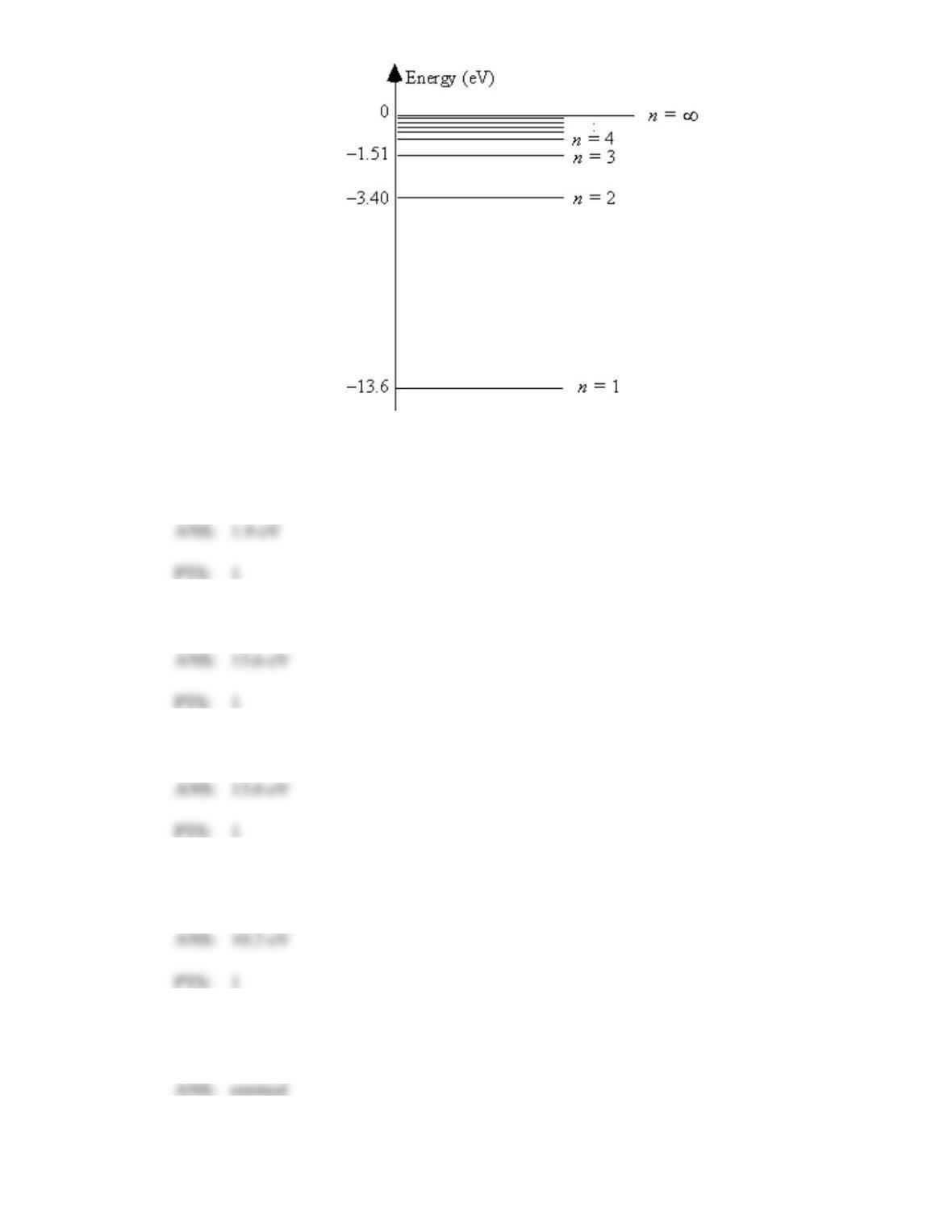
28. The energy of a photon emitted in a transition from the n = 3 state to the n = 2 state is
__________.
29. The energy of the most energetically possible photon emitted is __________.
30. The ionization energy of hydrogen is __________.
31. The smallest energy of an absorbed photon that will raise a hydrogen atom from its ground
state to its first excited state is __________.
32. In the Bohr model of the atom, a photon may be _________ when an electron jumps from a
large, high energy orbit to a smaller, low energy orbit.

33. An atom is said to have been ________ when it absorbs a photon with sufficient energy to
free an electron.
34. A hot luminous solid emits a ______________ spectrum, while a hot luminous gas produces
a ______ spectrum.
35. The energy of a photon is _________ proportional to its frequency and
__________proportional to its wavelength.
36. An electron absorbing an ultraviolet photon will be ejected with a _________ energy than
an electron absorbing a violet photon.
37. Ionization is a process whereby an atom acquires enough energy so that one or more of its
electrons __________ from the nucleus.
MATCHING
Match each item with the correct statement below.
a.
angular momentum
h.
photoelectric effect
b.
de Broglie wavelength
i.
photon
c.
emission spectrum
j.
photon absorption
d.
energy
k.
photon emission
e.
ground state
l.
uncertainty principle
f.
hologram
m.
wave function
g.
laser

1. a quantum of electromagnetic radiation
2. light causing electrons to be released from the surface of a metal
3. one way for an excited atom to lose energy
4. in the Bohr model of the atom this is quantized
5. tells us that particles can’t be precisely localized
6. the lowest energy level in an atom
7. causes an electron to make a transition to a higher energy level
8. light amplification by stimulated emission of radiation
9. a three dimensional image made using a laser
10. oscillating atoms in a blackbody have this quantized
11. the aurora borealis is an example of this
SHORT ANSWER
1. Four different uses of lasers are __________, __________, __________, and __________,
PROBLEM
1. Find the energy of a photon whose frequency is 5 1012 Hz.
2. A photon emitted by an excited atom has an energy of 5 eV. What is its frequency?

3. What is the de Broglie wavelength of an electron traveling 100 m/s?
4. A hydrogen atom emits a photon as it makes a transition from the n = 4 state to the n = 3
state. The energies of these two states are –0.9 eV and –1.5 eV, respectively.
(a) What is the energy of the photon?
(b) What is its frequency?
5. According to the Pauli Exclusion Principle for n = 4, the occupation limit of electrons is: