172. The equity section of a balance sheet at December 31, 2014, is presented below:
Common Stock, $10 par, 10,000 shares issued and outstanding
$100,000
Paid-in Capital in Excess of Par—Common Stock
50,000
Retained Earnings
100,000
Total Stockholders’ Equity
$250,000
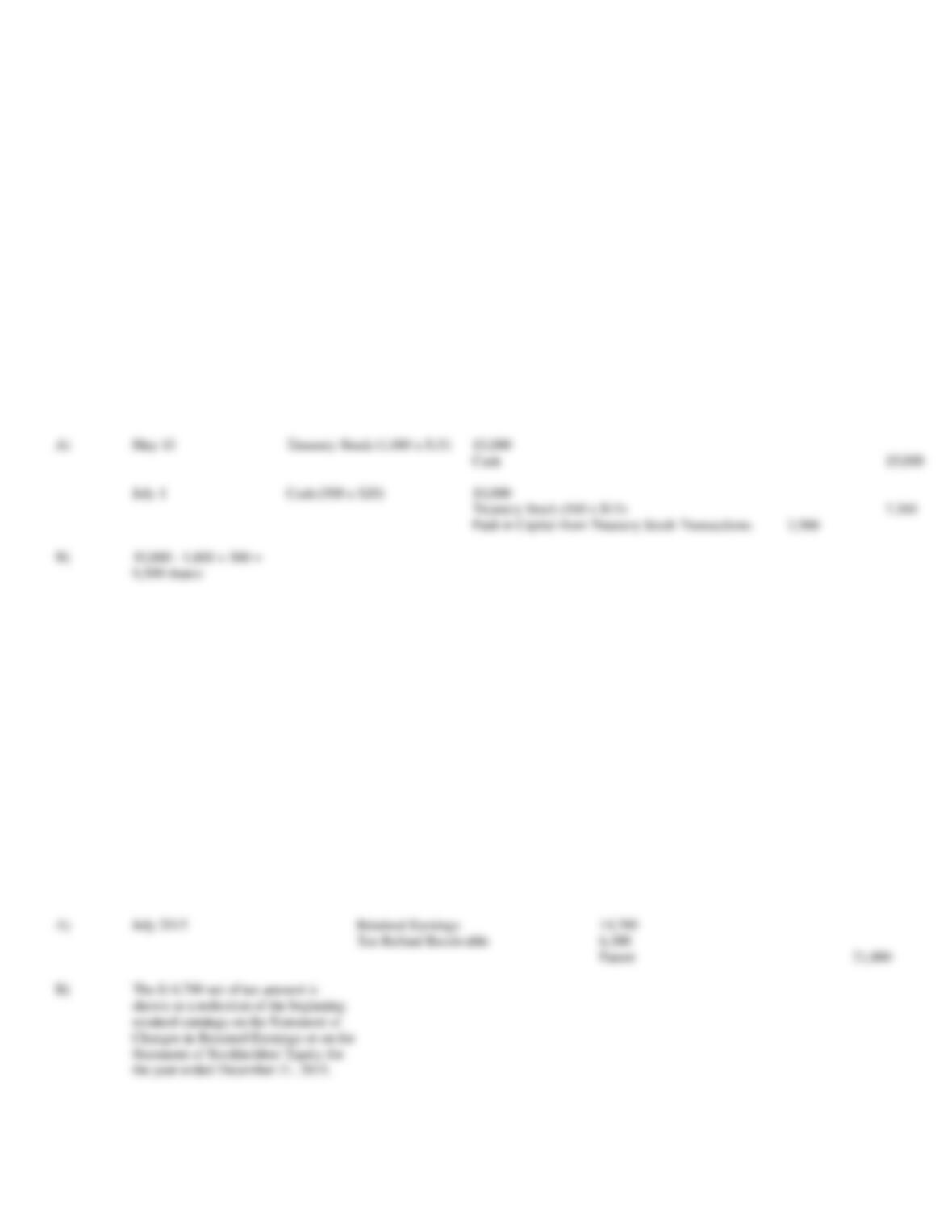
On May 15, 2015, the company reacquired 1,000 shares of its common stock at $15 per share. Then on July 1, 2015, 500 shares of treasury stock
were sold for $20 per share.
A)
What journal entries will be required to record the May 15 and July 1 transactions?
B)
How many shares of the company’s stock are outstanding on July 1, 2015, immediately following the sale of the treasury stock?
173. In July of 2015, the accountant discovered an error affecting the 2014 computation of amortization expense
related to the company’s patent. As a result of this error, 2014 amortization expense was understated by $21,000
and 2014 net income after taxes (which are paid at a rate of 30%) was overstated by $14,700.
A)
What journal entry is needed to record this prior period adjustment?
B)
How is this prior period adjustment reported in the financial statements?
A)
July 2015
Retained Earnings
14,700
Tax Refund Receivable
6,300
Patent
May 15
Treasury Stock (1,000 x $15)
15,000
Cash
July 1
Cash (500 x $20)
10,000
Treasury Stock (500 x $15)
Paid-in Capital from Treasury Stock Transactions
2,500
174. The equity section of a balance sheet at December 31, 2015 is provided below:
5% Preferred Stock, $10 par, 2,000 shares issued and outstanding
$ 20,000
Common Stock, $1 par, 10,000 shares issued and outstanding
10,000
Paid-in Capital in Excess of Par—Common Stock
12,500
Total Capital Stock
42,500
Retained Earnings
74,500
Total Stockholders’ Equity
$117,000
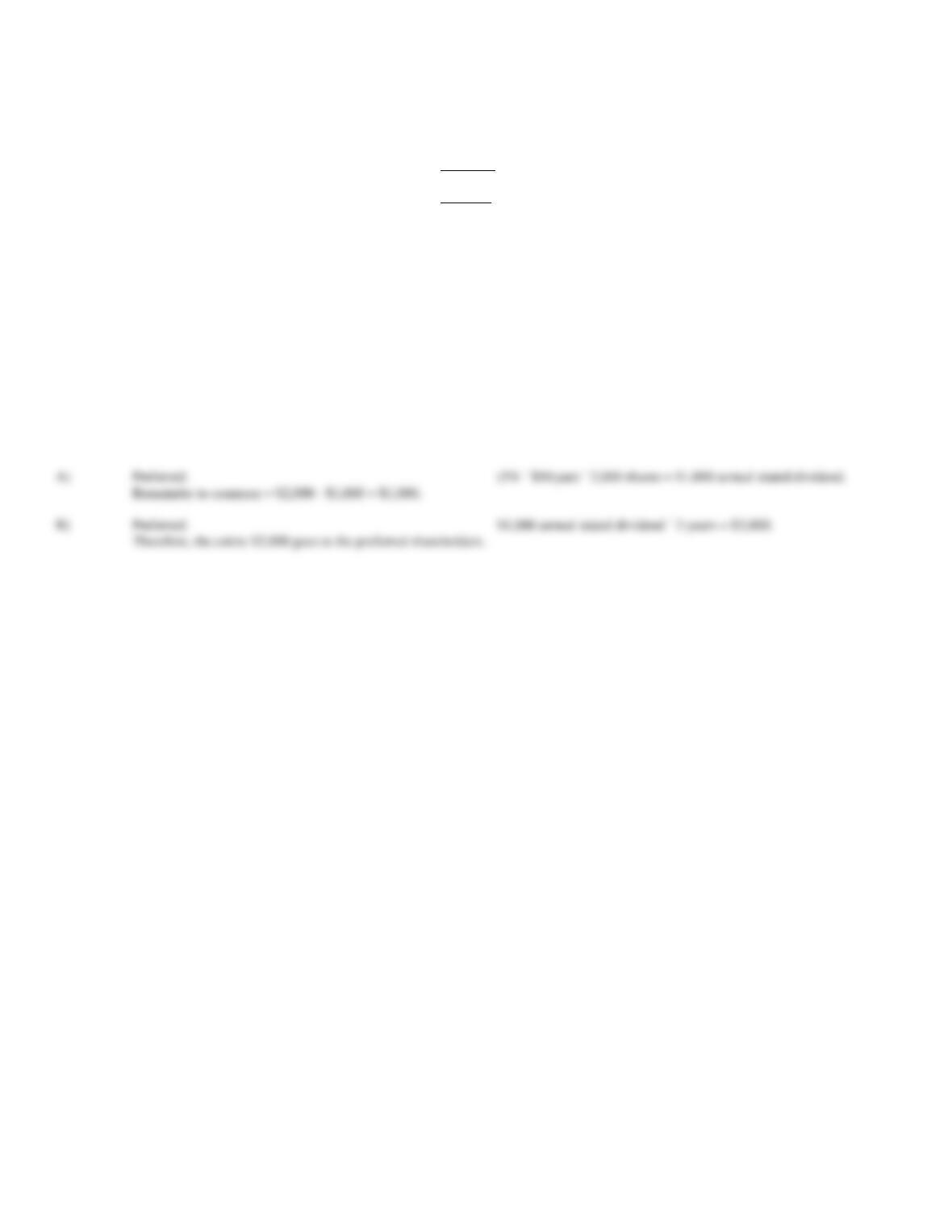
No dividends were paid during 2013 and 2014, but the company plans to issue a cash dividend of $2,000 on December 31, 2015. Determine the total
dividend for each class of stock under each of the following assumptions:
A)
The preferred stock is noncumulative and nonparticipating.
B)
The preferred stock is cumulative and nonparticipating.
Preferred:
Remainder to common = $2,000 – $1,000 = $1,000.
B)
Preferred:
Therefore, the entire $2,000 goes to the preferred shareholders.
175. A regional chain of medical clinics had the following information pertaining to its stockholders’ equity
accounts at December 1, 2015:
Common Stock, $5 par, 100,000 shares authorized, 30,000 shares issued and outstanding
$15,000,000
Paid-in Capital in Excess of Par—Common Stock
12,000,000
Retained Earnings
30,000,000
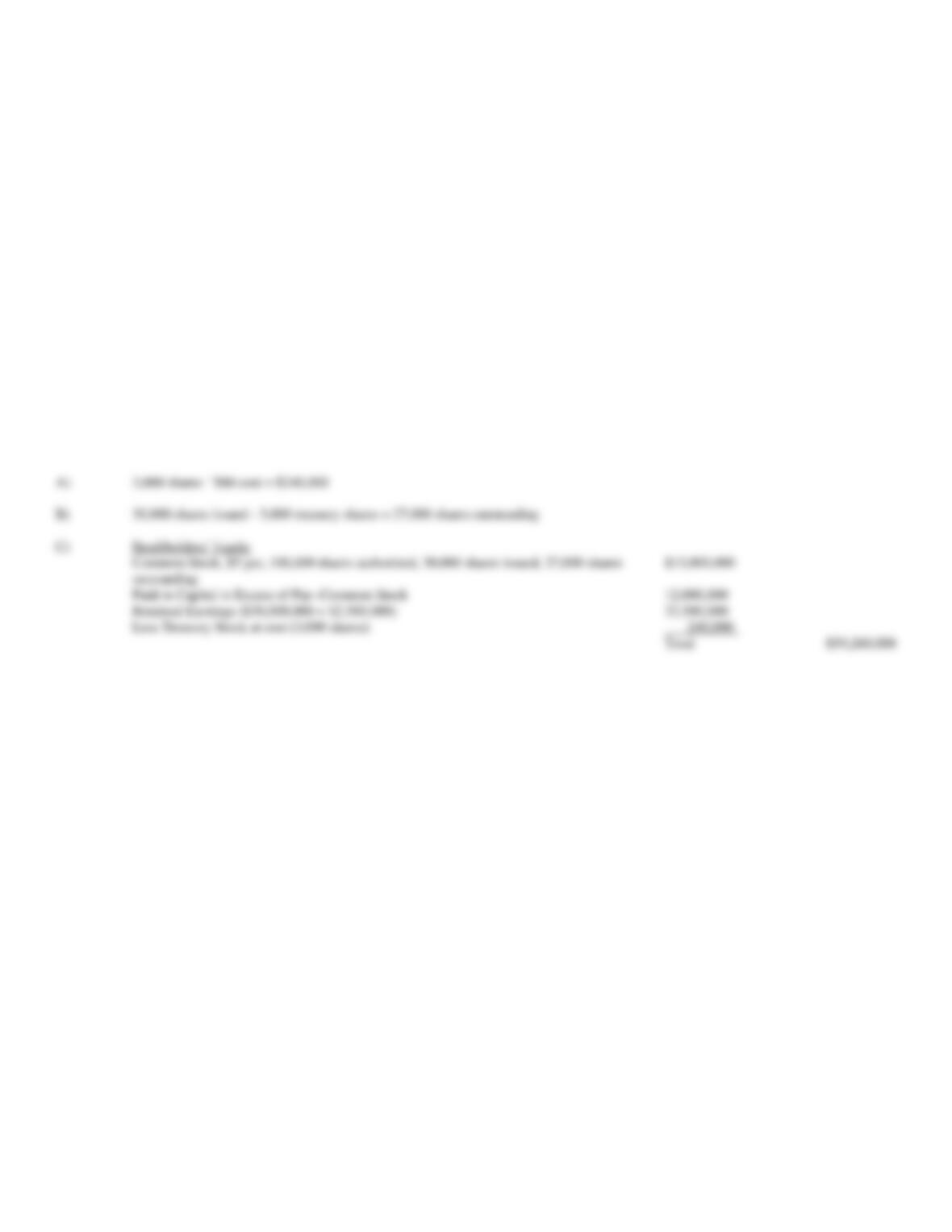
No dividends were paid during 2015. On December 15, 2015, the clinic repurchased 3,000 shares of its common stock for $80 per share. On
December 31, the bookkeeper closed the books, reporting net income of $2,500,000.
A)
What amount will be reported on the balance sheet for Treasury Stock at December 31, 2015.
B)
How many shares of stock are outstanding at December 31, 2015?
C)
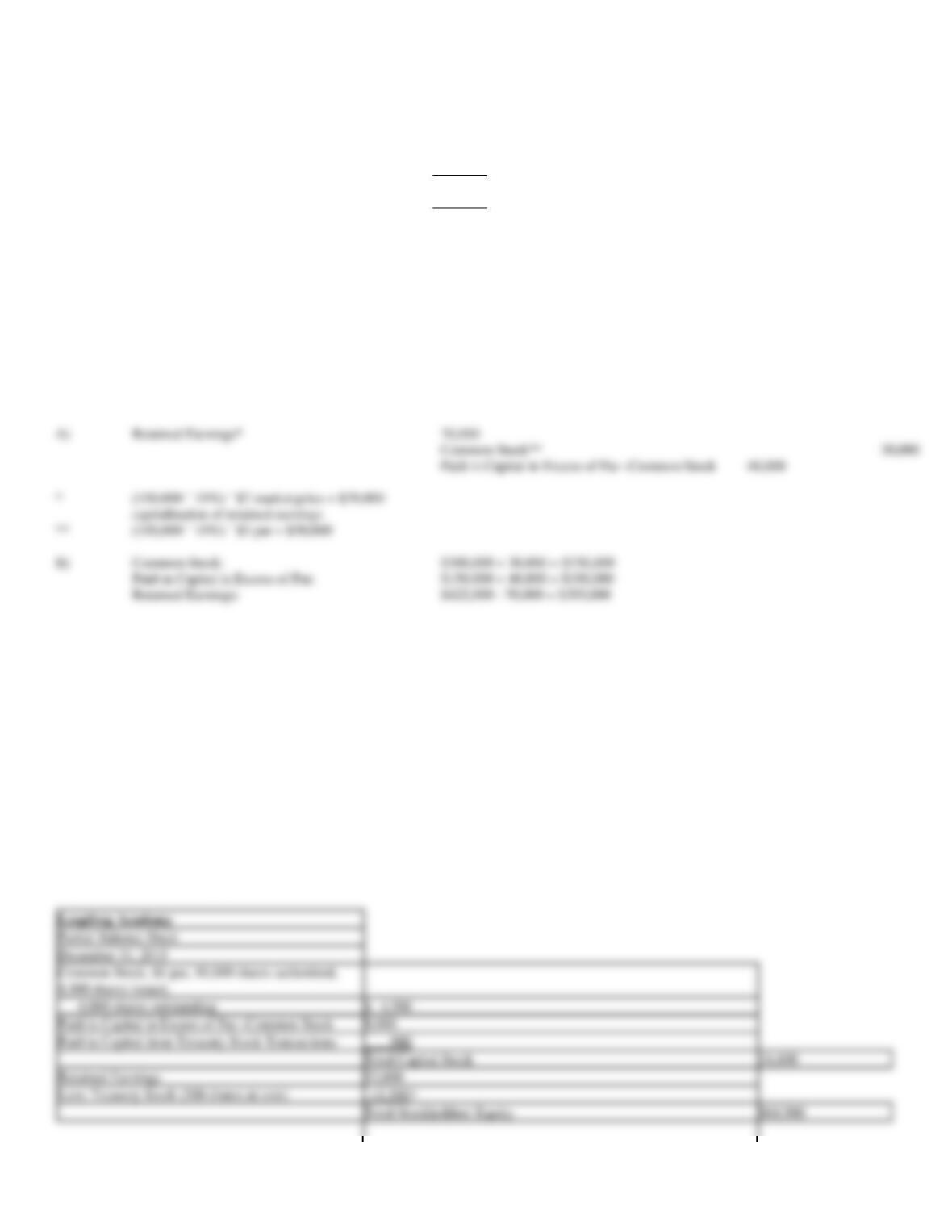
Prepare the stockholders’ equity section of the balance sheet at December 31, 2015.
A)
3,000 shares ´ $80 cost = $240,000
B)
30,000 shares issued – 3,000 treasury shares = 27,000 shares outstanding
C)
Stockholders’ Equity
Paid-in Capital in Excess of Par—Common Stock
12,000,000
Retained Earnings ($30,000,000 + $2,500,000)
32,500,000
Less Treasury Stock at cost (3,000 shares)
240,000
Total
176. A corporation reported the following information at December 31, 2015:
Common Stock, $3 par, 10,000 shares authorized, issued and outstanding
$ 30,000
Paid-in Capital in Excess of Par—Common Stock
80,000
Total Capital Stock
$110,000
Retained Earnings
40,000
Total Stockholders’ Equity
$150,000
A)
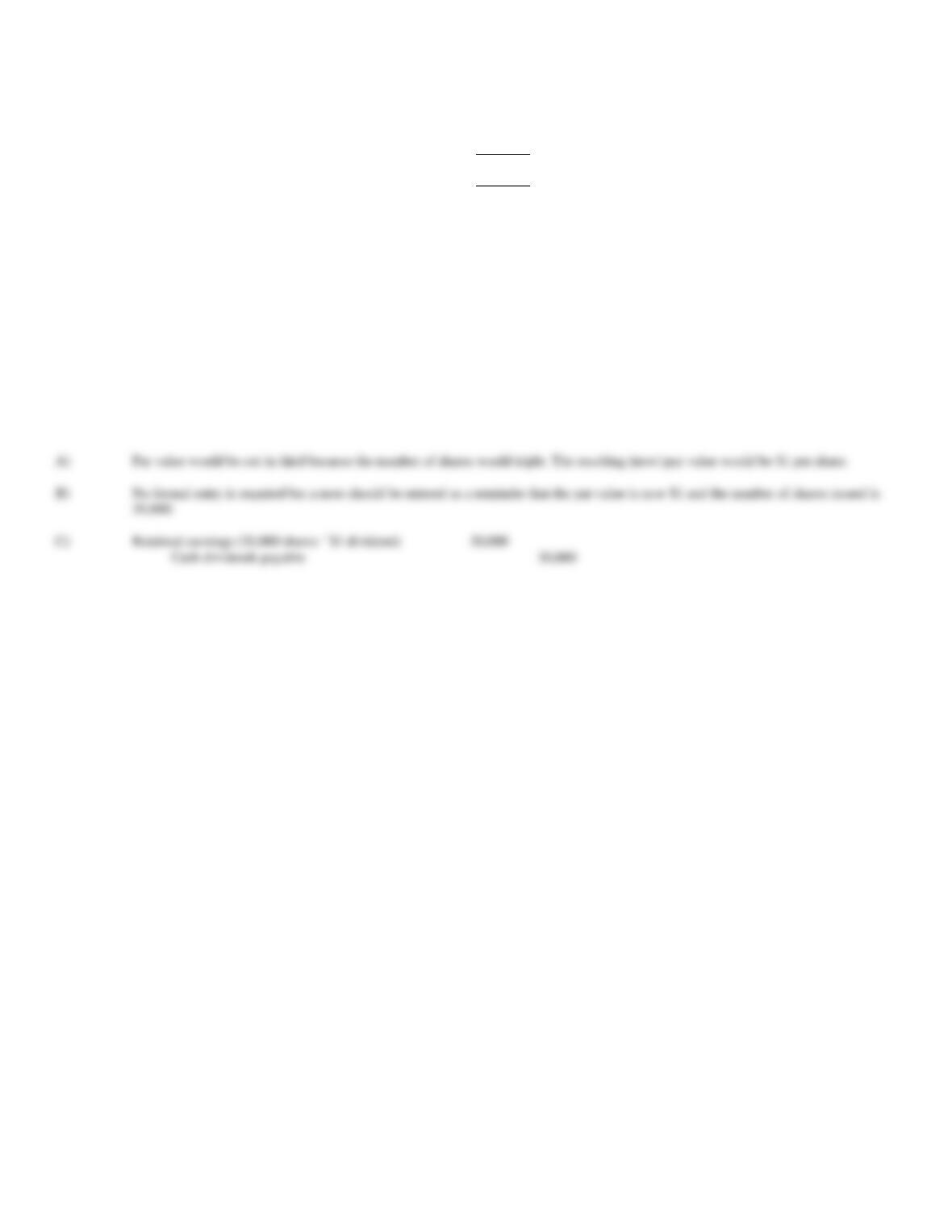
On December 31, 2015, the board of directors issues a 3-for-1 stock split. What impact will the split have on the stock’s par value?
B)
What journal entry is required to record the split?
C)
Record the declaration of a cash dividend of $1 per share on January 10, 2016. The dividend will be paid on January 31, 2016 to
shareholders of record on January 24, 2016.
Par value would be cut in third because the number of shares would triple. The resulting (new) par value would be $1 per share.
B)
No formal entry is required but a note should be entered as a reminder that the par value is now $1 and the number of shares issued is
177. A corporation reported the following information in the stockholders’ equity section of its balance sheet
before its recent stock dividend:
Common Stock, $3 par, 100,000 shares issued and outstanding
$300,000
Paid-in Capital in Excess of Par—Common Stock
150,000
Total Capital Stock
450,000
Retained Earnings
425,000
Total Stockholders’ Equity
$875,000
A)
Record a 10% stock dividend assuming that the market price of its stock was $7 per share on the declaration date.
B)
Following distribution of the stock dividend, what are the updated balances in the common stock and retained earnings accounts?
178. The following information pertains to Leapfrog Academy at December 31, 2015:
Retained Earnings
$52,000
Treasury Stock, at cost (500 shares)
1,500
Paid-in Capital from Treasury Stock Transactions
900
Common Stock, $1 par, 10,000 shares authorized, 4,500 shares issued
4,500
Paid-in Capital in Excess of Par—Common Stock
9,000
Cash Dividends Payable—Common Stock
6,000
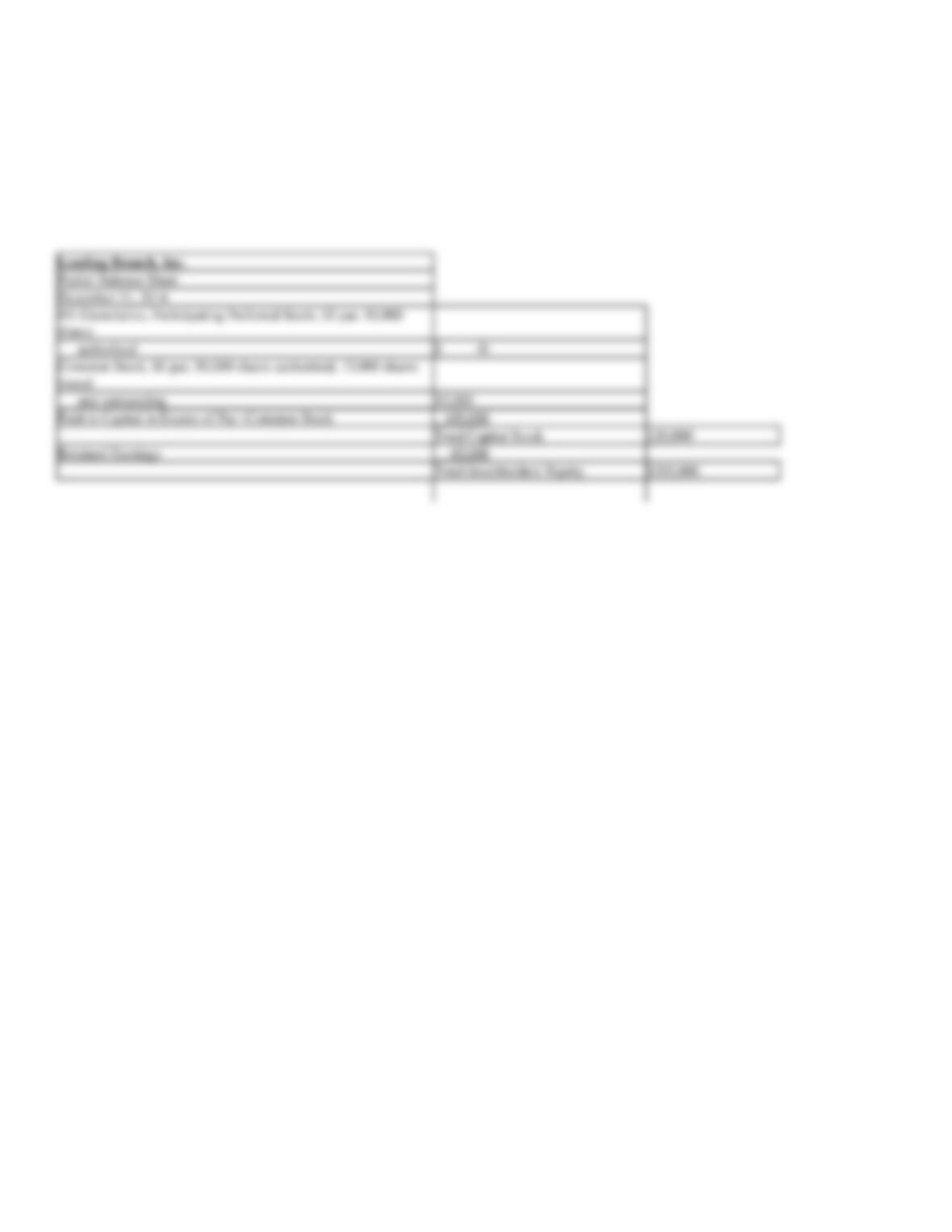
Prepare the stockholders’ equity section of the balance sheet at December 31, 2015.
Partial Balance Sheet
December 31, 2015
4,000 shares outstanding
$ 4,500
Paid-in Capital in Excess of Par—Common Stock
9,000
Paid-in Capital from Treasury Stock Transactions
900
Total Capital Stock
14,400
Retained Earnings*
70,000
Common Stock**
Paid-in Capital in Excess of Par—Common Stock
40,000
(100,000 ´ 10%) ´ $3 par = $30,000
B)
Common Stock:
$300,000 + 30,000 = $330,000
Paid-in Capital in Excess of Par:
$150,000 + 40,000 = $190,000
Retained Earnings:
$425,000 – 70,000 = $355,000
179. Lending Branch, Inc. was incorporated as a new business on May 1, 2014. The company is authorized to
issue 50,000 shares of $1 par common stock and 10,000 shares of 4%, $5 par cumulative, participating
preferred stock. On May 1, 2014, the company issued 15,000 shares of common stock for $8 per share. Net
income for the period ended December 31, 2014 ,was $115,000. Cash dividends in the amount of $30,000 were
declared, but only $25,000 were paid as of year-end.
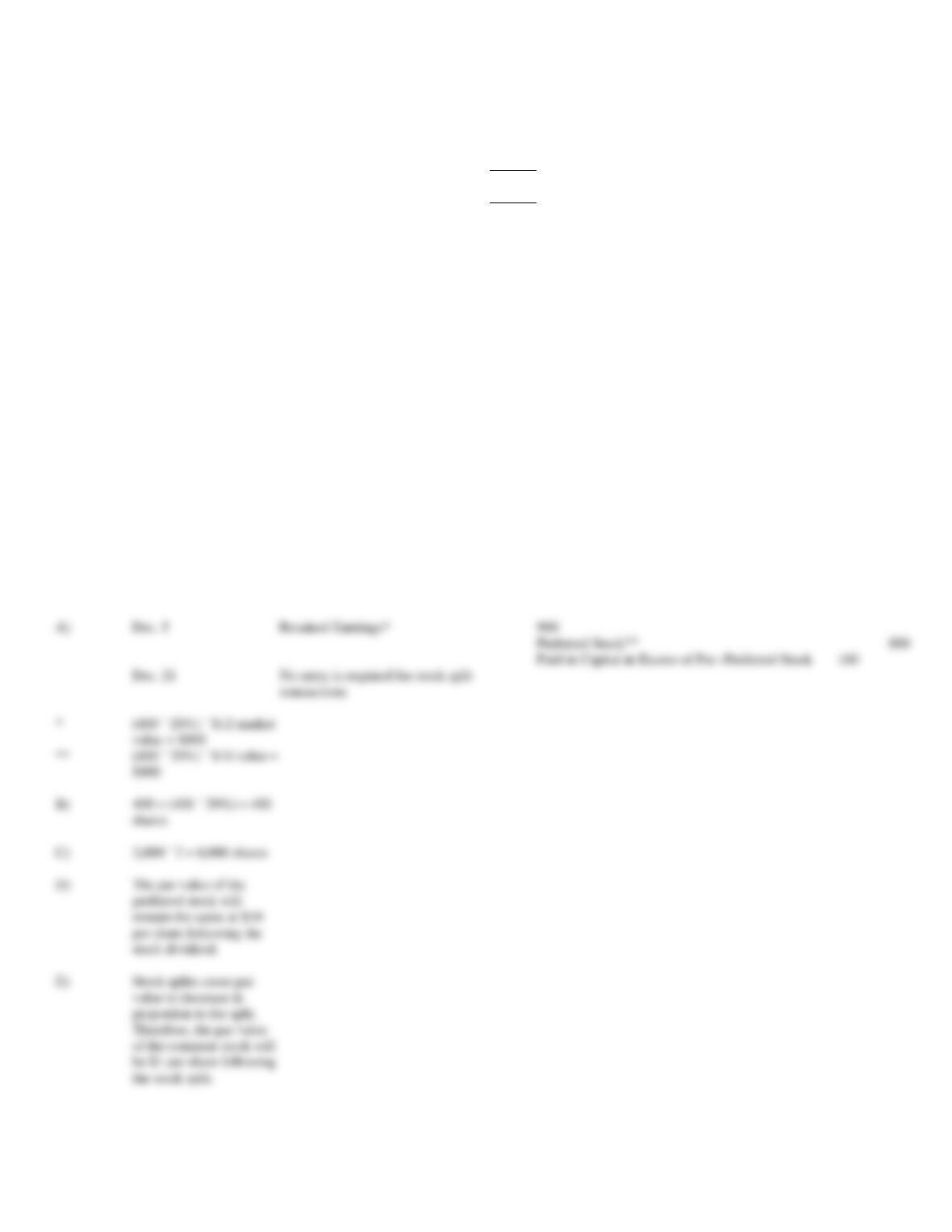
Prepare the stockholders’ equity section of the balance sheet at December 31, 2014.
180. A corporation reported the following amounts on its balance sheet at December 1, 2015:
8% Preferred Stock, $10 par, 400 shares issued and outstanding
$ 4,000
Common Stock, $2 par, 3,000 shares issued and outstanding
6,000
Paid-in Capital in Excess of Par—Common Stock
22,000
Total Capital Stock
32,000
Retained Earnings
48,000
Total Stockholders’ Equity
$80,000
During December of 2015, the following transactions occurred:
December 5
Declared and paid a 20% preferred stock dividend when the market price of the preferred stock was $12 per share.
December 21
Distributed a 2-for-1 stock split of the common stock when the market price of the common stock was $10 per share.
A)
What journal entries are required to record these stock transactions?
B)
How many preferred shares are outstanding at December 31, 2015?
C)
How many common shares are outstanding at December 31, 2015?
D)
What effect did the stock dividend have on the par value of the preferred stock?
E)
What effect did the stock split have on the par value of the common stock?
A)
Dec. 5
Retained Earnings*
Preferred Stock**
Paid-in Capital in Excess of Par—Preferred Stock
C)
3,000 ´ 2 = 6,000 shares
stock dividend.
181. Leather Creations has been in business for two years. On December 31, 2015 (the end of the second year),
the company had the following capital stock account balances immediately prior to a meeting of its board of
directors.:
10% Cumulative, Nonparticipating Preferred Stock, $10 par, 2,000
shares authorized, 1,000 shares issued and outstanding
$10,000
Common Stock, $1 par, 10,000 share authorized, 6,000 shares issued
6,000
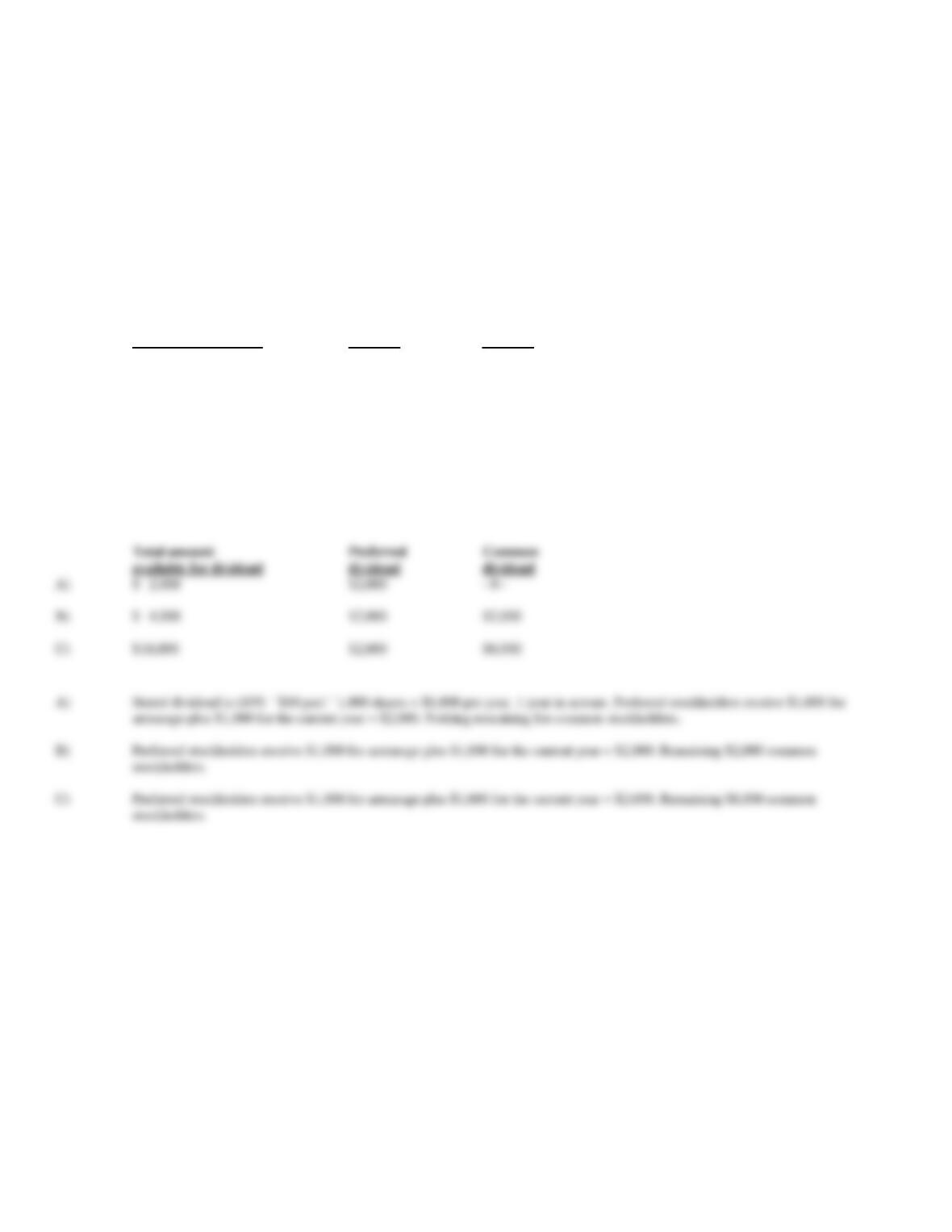
No dividends were paid during 2014. Net income for 2015 is $110,000. At its December 31, 2015 meeting the board declares a cash
dividend. Complete the table below to indicate the amount of dividends that would be distributed to each class of stockholder if the following
amounts of dividends are available:
Total amount
Preferred
Common
available for dividend
dividend
dividend
A)
$ 2,000
B)
$ 4,000
C)
$10,000
available for dividend
dividend
dividend
$ 2,000
$2,000
– 0 –
B)
$ 4,000
$2,000
$2,000

182. A corporation reported the following information at December 31, 2014:
12% Cumulative,
Nonparticipating Preferred Stock,
$10 par, 50,000
shares authorized; callable at
par value
$500,000
Common Stock, $2 par, 30,000
shares authorized
40,000
Paid-in Capital in Excess of Par:
Preferred Stock
50,000
Common Stock
50,000
Total Capital Stock
640,000
Retained Earnings
30,000
Less: Treasury Stock (500
common shares at cost)
5,000
Total Stockholders’ Equity
$665,000
A)
How many shares of preferred stock are issued?
B)
How many shares of common stock are issued?
C)
How many shares of preferred stock are outstanding?
D)
How many shares of common stock are outstanding?
E)
How many of the preferred shares will receive dividends if they are paid?
F)
How many of the common shares will receive dividends if they are paid?
G)
What is the stated dividend per share on the preferred stock?
H)
What is the total amount of dividends to be paid to preferred stockholders this year?
I)
If all of the preferred stock was issued at the same price, what was the issue price per share?
J)
If all of the common stock were issued at the same price, what was the issue price per share?
A)
$500,000 / $10 par = 50,000
B)
$40,000 / $2 par = 20,000
50,000
D)
20,000 – 500 in treasury = 19,500
E)
50,000
F)
19,500
12% ´ $10 par = $1.20/share
H)
$1.20 ´ 50,000 shares = $60,000
I)
($500,000 preferred stock + 50,000 paid-in capital in excess) / 50,000 shares = $11/share
J)
($40,000 preferred stock + 50,000 paid-in capital in excess) / 20,000 shares = $4.50/share
183. The stockholders’ equity section of the balance sheet appears as follows at January 1, 2014:
Common Stock, $2 par, 2,000 shares issued and outstanding
$ 4,000
Paid-in Capital in Excess of Par—Common Stock
1,600
Total Capital Stock
5,600
Retained Earnings
5,400
Total Stockholders’ Equity
$11,000
On March 1, 2014, the company repurchased 800 shares of its common stock at $12 per share but on April 6, 2014, it reissued 600 shares of the
shares at $20 per share.
A)
Prepare the journal entries to record for the March 1 and April 6 transactions.
B)
How many shares of common stock are outstanding at March 31, 2014, and April 30, 2014, respectively?
A)
Mar. 1
Treasury Stock
9,600
Cash
April 6
Cash
12,000
Treasury Stock*
*
600 shares ´ $12 cost = $7,200
184. The stockholders’ equity section of the balance sheet at January 1, 2015, appeared as follows:
Common Stock, $2 par, 50,000 shares authorized, 20,000 shares
issued
$ 40,000
Paid-in Capital in Excess of Par—Common Stock
120,000
Total Capital Stock
160,000
Retained Earnings
300,000
Less: Treasury Stock (10,000 shares at cost)
80,000
Total Stockholders’ Equity
$380,000
On March 1, 2015, the company sold 800 shares of treasury stock at $25 per share.
A)
Prepare the journal entry to record the March 1 transaction.
B)
Is the excess sale price over the cost of the treasury stock reported on the income statement? Why or why not?
Mar. 1
Cash
20,000
Treasury Stock*
Paid-in Capital from Treasury Stock Transactions
13,600
*
800 shares ´ $8 cost =
$6,400
185. Use the Statement of Stockholders’ Equity for Lee’s T.V. Company to answer the questions that follow:
Lee’s T.V. Company
Statement of Stockholders’ Equity
For the Year Ended December 31, 2014
Accumulated
Paid-in
Other Comp-
Common
Capital in
Retained
prehensive
Stock
Excess of Par
Earnings
Income
Total
Balance, January 1, 2014
$57,937
$ 31,924
$19,027
$1,010
$109,898
Exercise of stock options
946
6,965
7,911
Issuance of common stock
12,050
151,823
163,873
Conversion of convertible
bonds
7
93
100
Net income
26,102
26,102
Unrealized holding gains
141
141
Currency translation
adjustment
_______
_______
_______
272
272
Balance, December 31, 2014
$70,940
$190,805
$45,129
$1,423
$308,297
A)
What is the primary reason for the increase in total stockholders’ equity during 2014?
B)
Did the board of directors declare any dividends during 2014? How can you tell?
C)
Did the company repurchase any of its own shares during 2014? How can you tell?
186. On March 31, 2013, Legends Entertainment, Inc. had common stock of $230,000, paid-in capital in excess
of par of $540,000, and retained earnings of $65,000. During the following year, 500 shares of stock were sold
for $60,000, of which $40,000 represented paid-in capital in excess of par. The company reported net income of
$140,000 for the year ended March 31, 2014. Also during the year, $80,000 of dividends were declared and
paid.
Prepare the Statement of Stockholders’ Equity at March 31, 2014.
187. Lakeside Properties, Inc. had 50,000 shares of 5%, $20 par preferred stock and 400,000 shares of $8 par
common stock issued and outstanding at the beginning of 2015. Indicate the effect each of the following items
has directly on retained earnings by writing the amount in the space provided. Use a plus sign (+) in front of the
amount to indicate increases in retained earnings, and use parentheses ( ) around the amount to indicate
decreases in retained earnings. If the transaction results in no direct change in retained earnings, place N/A in
the space.
A)
Issued a 2-for-1 preferred stock split when the market price of
the preferred stock was $44 per share.
B)
Earned net income in the amount of $650,000 for 2015.
C)
Declared and paid the annual stated cash dividend to its preferred
stockholders.
D)
Declared and paid a 10% common stock dividend when the market
price of the common stock was $11 per share.
A)
N/A
B)
+650,000
C)
(50,000)
($20 par ´ 5%) ´ 50,000 shares = $50,000
D)
(440,000)
(400,000 shares ´ 10%) ´ $11 = $440,000
Statement of Stockholders’ Equity
For the Year Ended March 31, 2014
Balance, April 1, 2013
$230,000
$540,000
$ 65,000
$835,000
Net income
140,000
140,000
Dividends
(80,000)
(80,000)
Balance, March 31, 2014
$250,000
$580,000
$125,000
$955,000