Chapter 10: Static and Flexible Budgets
Learning Questions
True /
False
Multiple Choice
Matching
Exercises
Short
Answer
Problems
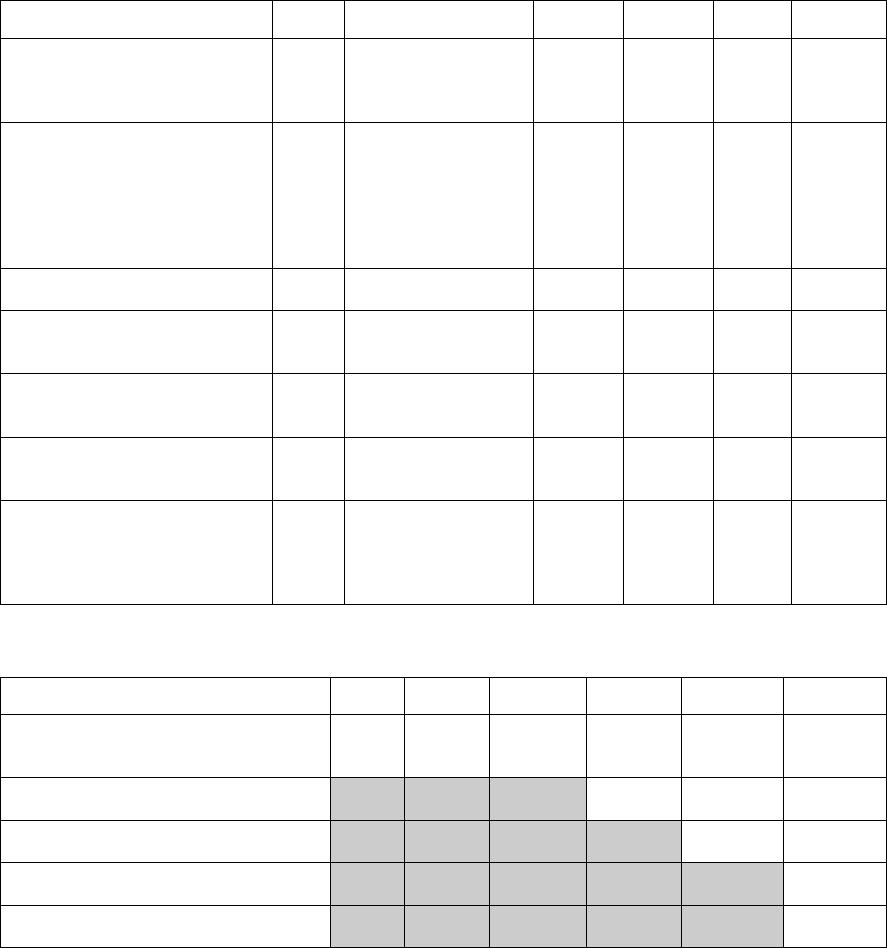
1. What are the relationships
among budgets, long-term
strategies, and short-term
operating plans?
1, 2
39, 40
W: 103,113
1, 2
5, 10
2. What is a master budget, and
how is it prepared?
3-13
1, 2, 7-12, 15-20, 23-
25, 33, 35, 42-52, 84–
87
S: 90, 91, 95, 96
W: 105, 107-111,
116, 118, 119,
122-124
2
1, 3
3
1
3. What are budget variances,
and how are they calculated?
14–17
53–57
2
2, 4
2
2
4. What are the differences
between static and flexible
budgets?
18-20
34, 36, 58-65
S: 97
W: 112, 117
2, 4
4, 6
1, 2, 4
5. How are budgets used to
monitor and motivate
performance?
21–25
37, 38, 41, 66-69
S: 98, 102
W: 114
2
7
4
6. What are other approaches to
budgeting?
26, 27
70–79
S: 101
W: 104, 106, 115
1, 9
7. How is the cash budget
developed? (Appendix 10A)
3-6, 13, 14, 21, 22, 26-
32, 80-83
S: 88, 89, 92-94, 99,
100
W: 120, 121
5
8
3
S: Questions from the study guide
W: Questions from web quizzes on the student web site
Level of Complexity*
True /
False
Multiple
Choice
Matching
Exercises
Short
Answer
Problems
Foundation: Repeat or paraphrase
information; Reason to single correct
solution; Perform computations; etc.
All
All
All
All
1, 3, 6
1-4
Step 1: Identify the problem, relevant
information, and uncertainties
2, 4
4, 7, 9, 10
2, 3
Step 2: Explore interpretations and
connections
2, 5, 8
1, 4
Step 3: Prioritize alternatives and
implement conclusions
Step 4: Envision and direct strategic
innovation
*Based on level in Steps for Better Thinking (Exhibit 1.10, textbook p. 16):
Note: Step 1, 2, 3, and 4 questions in this test bank are intentionally open-ended and subjective, giving students the
opportunity to demonstrate skills such as judgment, reasoning, identification of uncertainties, identification or analysis of
pros and cons, and so on. Therefore, student answers may not exactly match those shown in the solutions.

10-2 Cost Management
True / False
1. A formalized financial plan for organizational operations is called a long-term strategy.
2. Budgeting provides a means for defining managers’ decision rights.
3. A master budget is a comprehensive plan for an upcoming financial period.
4. Master budgets are often summarized in a company’s short-term operating plans.
5. The master budget includes two components: an operating budget and a time budget.
6. An operating budget is the component of a master budget that contains management’s plans for
revenues, production, and operating costs.
7. A financial budget is the master budget component that leads to all budgeted financial statements.
8. The cash budget is included in an organization’s operating budget.
9. Production and inventory budgets form the basis for developing the revenue budget.
10. Managers need information from about current beginning inventories and required ending inventories
to prepare the production budget.
11. In a production budget, beginning inventory plus budgeted production equals sales plus targeted
ending inventory.
12. The ending inventories budget is typically expressed in terms of costs, while the production budget is
typically expressed in units.
13. To prepare a budgeted income statement, managers draw data from the revenue budget, the cost of
goods sold budget, and the cash budget.
14. Differences between budgeted amounts and actual amounts are called budget variances.
15. When an organization’s actual revenues are greater than its budgeted revenues, the difference is
referred to as a favorable variance.
16. Favorable variances are positive amounts; unfavorable variances are negative amounts.
17. If actual activities do not follow plans, a variance is likely to result.
18. A flexible budget reflects a range of operations.
19. Budget variances cannot be calculated from a static budget.
20. Cost-volume-profit analysis is a simplified version of a flexible budget.
21. When evaluating actual results at the end of an accounting period, the static budget provides an
appropriate benchmark for actual operations.
22. Participative budgeting involves customers and managers at all levels in the organization.
23. One disadvantage of participative budgeting is employees’ tendency to set targets too high to impress
management with their motivation.
24. In zero-based budgeting, managers justify budget amounts as if no information about prior budgets
exists.
25. When managers intentionally set budgeted costs too low and budgeted revenues too high, they are
creating budgetary slack.
26. The principles of activity-based costing can be applied to the budgeting process.
27. Kaizen budgeting is designed to improve quality and reduce cost over time.

Chapter 10: Static and Flexible Budgets 10-3
Multiple Choice
Use the following information for the next 2 questions.
Ray Company’s projected sales budget for the next four months is as follows:
Units
January 70,000
February 90,000
March 55,000
April 65,000
Beginning inventory for the year is 27,000 units. Ending inventory for each month should be 30% of the next
month’s sales.
1. How many units should the company produce in January?
a. 106,000
b. 90,000
c. 70,000
d. 78,000
2. How many units need to be available for sale in February?
a. 90,000
b. 106,500
c. 73,500
d. 117,000
Use the following information for the next 4 questions.
(Appendix 10A) Conner Company is a medium-sized toy distributor. Experience has shown that 30% of
sales are collected within the month of sale, 60% is collected the month after the sale, and 10% is collected
two months after the sale. Inventory on hand at the end of a month is to be 70% of the next month’s budgeted
sales. Cost of goods sold is 50% of the selling price. Payment for purchases is made in the month after
purchase. All other costs are paid in the month incurred. Budgeted amounts are as follows:
March April May June July August
Sales $10,000 $20,000 $30,000 $30,000 $50,000 $40,000
Costs:
Wages 1,500 2,000 2,500 1,500
Rent 500 500 500 500
Other 400 500 600 500
3. Cash receipts for the month of May are expected to be
a. $30,000
b. $21,000
c. $29,000
d. $22,000
4. Purchases for the month of May are expected to be
a. $21,000
b. $15,000
c. $30,000
d. $10,500
5. Cash disbursements in July for purchases are expected to be
a. $43,000
b. $16,000
c. $22,000
d. $21,000

10-4 Cost Management
6. Total cash disbursements in August are expected to be
a. $24,000
b. $45,500
c. $21,500
d. $31,000
Use the following information for the next 4 questions.
Horton Company produces and sells two products: round and square tables. In August 20×0, the budget
projected the following for 20×1:
Budgeted Sales Expected Inventories
Units Price Jan. 1, 20×1 Dec. 31, 20×1
Round 5,000 $500 2,000 units 2,500 units
Square 6,000 400 1,000 units 1,500 units
The tables are manufactured using the following direct materials:
Direct Material Round Square
P 2 lbs. 3 lbs.
Q 1 lbs. 2 lbs.
Budgeted data for 20x1 direct materials are:
Direct Purchase Expected Inventories
Material Price Jan. 1, 20×1 Dec. 31, 20×1
P $85 per lb. 2,000 lbs. 2,500 lbs.
Q 55 per lb. 1,000 lbs. 1,500 lbs.
Budgeted data for 20x1 Direct labor and overhead are:
Direct labor:
Round 4 hours per unit at $6 per hour
Square 6 hours per unit at $8 per hour
Overhead: $4 per direct labor hour
7. Total budgeted production of tables in 20×1 is
a. 12,000 units
b. 10,000 units
c. 6,500 units
d. 14,000 units
8. The cost of purchases for direct material P for 20×1 is
a. $2,805,000
b. $2,720,000
c. $2,635,000
d. $2,550,000
9. Direct labor costs for 20×1 are
a. $312,000
b. $444,000
c. $512,000
d. $565,000
10. The cost of ending finished goods inventory of round tables for 20x1 is
a. $662,500
b. $622,500
c. $562,500
d. $530,000
Chapter 10: Static and Flexible Budgets 10-5
Use the following information for the next 2 questions.
Matz Company expects to sell 24,000 units of finished goods over the next 6-month period. The company
has 10,000 units on hand and its managers want to have 14,000 units on hand at the end of the period. To
produce one unit of finished product, two units of direct materials are needed. Matz has 100,000 units of
direct material on hand and has budgeted for an ending inventory of 110,000 units.
11. What is the number of finished units to be produced?
a. 38,000
b. 28,000
c. 20,000
d. 24,000
12. What is the amount of direct material to be purchased (in units)?
a. 38,000
b. 46,000
c. 66,000
d. 18,000
Use the following information for the next 2 questions.
(Appendix 10A) Taft Corporation collects cash from customers as follows: 60% in the month of sale, 20% in
the month after sale, 19% in the second month after sale, and 1% is never collected. Bad debts are written off
annually in December. Budgeted sales are all on credit and amount to:
May $600,000
June 700,000
July 500,000
August 600,000
13. What is the budgeted amount of cash to be collected in July?
a. $560,000
b. $554,000
c. $558,000
d. $551,000
14. What is the budgeted amount of accounts receivable at the end of August?
a. $353,000
b. $340,000
c. $329,000
d. $377,000
Use the following information for the next 5 questions.
Planning Systems, Inc. has forecast the following unit sales and production for the next year, by quarter:
1st 2nd 3rd 4th
Production 150 160 140 100
Sales 120 140 150 120
The firm has beginning inventories as follows:
Finished goods 50 units
Direct material A 100
Direct material B 100
A finished unit requires one unit of material A and two units of material B. There should be enough material
on hand at the end of each quarter to meet 20% of the next quarter’s production needs. There are no work-in–
process inventories.
10-6 Cost Management
15. What is ending finished goods inventory for quarter 2?
a. 50
b. 70
c. 80
d. 100
16. What is the ending inventory for material A for quarter 2?
a. 24
b. 28
c. 30
d. 100
17. How much material A must be purchased in quarter 2?
a. 138
b. 142
c. 156
d. 162
18. What is the ending inventory for material B in quarter 1?
a. 28
b. 32
c. 56
d. 64
19. How much material B must be purchased in quarter 1?
a. 264
b. 196
c. 204
d. 256
20. Sales of $250,000 are forecast for the third quarter. Gross profit is 60% of sales, and beginning
inventory is $165,000. If ending inventory is budgeted as $183,000, what are the budgeted
purchases?
a. $118,000
b. $132,000
c. $168,000
d. $82,000
21. (Appendix 10A) Allen, Inc. has the following disbursements:
* Variable manufacturing costs are $3 per unit. They are paid 40% in the month of purchase
and 60% in the following month. Purchases are made in the month of production.
* Fixed overhead is $2,000, including $500 depreciation. Overhead costs are paid as incurred.
* Selling costs are $1,500 per month plus $1 per unit sold and are paid in the month incurred.
* Production for January, February, and March was 3,000, 2,000, and 1,200 units, respectively.
* Sales for the 3 months were 1,000, 2,500, and 1,000 units, respectively.
What is the amount of cash disbursements for February?
a. $13,300
b. $12,300
c. $12,800
d. $ 7,400

Chapter 10: Static and Flexible Budgets 10-7
22. (Appendix 10A) A firm expects credit sales for the week to amount to $3,000, accounts receivable to
increase by $200, and accounts payable to decrease by $500. Given this information, what will be the
effect on cash?
a. $2,700 increase
b. $2,300 increase
c. $1,700 increase
d. $1,300 increase
23. A firm that manufactures vases has budgeted production for the next four months as follows:
Units Produced
October 40,000
November 50,000
December 30,000
January 40,000
Each vase requires 30 grams of silica. The managers desire an ending inventory sufficient to meet
25% of the next month’s production. There is no beginning inventory of raw material in October.
Budgeted purchases of silica in grams for November would be
a. 450,000
b. 1,650,000
c. 1,350,000
d. 900,000
Use the following information for the next 5 questions.
Kelita, Inc., projects sales for its first three months of operation as follows:
October November December
Credit sales $100,000 $150,000 $200,000
Cash sales 40,000 60,000 50,000
Total Sales $140,000 $210,000 $250,000
Inventory on October 1 is $40,000. Subsequent beginning inventories should be 40% of that month’s cost of
goods sold. Goods are priced at 140% of their cost. 50% of purchases are paid for in the month of purchase;
the balance is paid in the following month. It is expected that 50% of credit sales will be collected in the
month following sale, 30% in the second month following the sale, and the balance the third month. A 5%
discount is given if payment is received in the month following sale.
24. What is the projected cost of goods sold for October?
a. $140,000
b. $220,000
c. $257,000
d. $100,000
25. What is the projected cost of purchases for October?
a. $80,000
b. $93,333
c. $120,000
d. $180,000
26. (Appendix 10A) What are the anticipated cash receipts for October?
a. $-0-
b. $40,000
c. $47,500
d. $66,500
10-8 Cost Management
27. (Appendix 10A) What are the anticipated cash receipts for November?
a. $107,500
b. $105,000
c. $110,000
d. $160,000
28. (Appendix 10A) What are the anticipated cash disbursements for October?
a. $120,000
b. $180,000
c. $140,000
d. $60,000
Use the following information for the next 4 questions.
(Appendix 10A) Gold Company has the following balances at December 31, 20×0: Cash $6,000; accounts
receivable $34,000 ($10,000 from November and $24,000 from December); merchandise inventory $40,000;
and accounts payable $20,000 (for merchandise purchases only). Budgeted sales follow:
January $ 50,000
February 90,000
March 60,000
April 100,000
Other data:
* Sales are 40% cash, 50% collected during the following month, and 10% collected during the
second month after sale. A 3% cash discount is given on cash sales
* Cost of goods sold is 40% of sales
* Ending inventory must be 140% of the next month’s cost of sales
* Purchases are paid 70% in month of purchase and 30% in the following month
* The selling and administrative cost function is: $6,000 + $0.2 × sales. This includes $1,000 for
depreciation
* All costs are paid in the month incurred
* Minimum cash balance requirement is $6,000
29. What is the budgeted cost of purchases for February?
a. $19,200
b. $30,400
c. $15,000
d. $52,800
30. The cash disbursements for purchases in March are
a. $46,400
b. $32,480
c. $38,240
d. $48,720
31. Cash receipts for April will be
a. $38,800
b. $77,800
c. $100,000
d. $68,800
Chapter 10: Static and Flexible Budgets 10-9
32. What will be the ending cash balance for January?
a. $(280)
b. $13,720
c. $19,720
d. $6,000
33. The Phillips Company’s budgeted annual indirect labor cost is: $7,200 + $0.75 per direct labor hour.
Operating budgets for the current month are based on 30,000 hours of budgeted direct labor hours.
Budgeted indirect labor cost is
a. $22,500
b. $29,700
c. $22,000
d. $23,100
34. Steve Company uses the following flexible budget formula for monthly repair cost: total cost = $700
+ $0.40 per machine hour. The annual operating budget calls for 35,000 hours of planned machine
time. Budgeted repair cost is
a. $14,000
b. $14,700
c. $22,400
d. $22,000
35. The actual preparation of a budget usually begins with the
a. Production budget
b. Cash budget
c. Sales budget
d. Direct materials budget
36. An advantage of a flexible budget is that it
a. Allows comparisons of the actual costs with those that should have been incurred
b. Considers only variable costs
c. Allows management freedom in meeting goals
d. Allows comparison of actual costs to master budget costs
37. To overcome possible problems with budgets that are developed only by top level managers, an
alternative is to use
a. Mandatory budgets
b. Authoritative budgets
c. Flexible budgets
d. Participative budgets
38. Zero-based budgeting
a. Requires justification for any new increases in requested amounts
b. Means that managers will have little or no work to prepare their budget requests
c. Requires managers to justify all funds requested
d. Is used as a means of reducing the paperwork involved with the budget process
39. A formalized financial plan for organizational operations in the coming year is best described as a
a. Long-term strategy
b. Short-term operating plan
c. Budget
d. Decision right
10-10 Cost Management
40. Budgets provide a mechanism for defining which of the following for individual managers?
I. Decision rights
II. Behaviors
III. Forecasts
a. I only
b. I and II only
c. I and III only
d. I, II, and III
41. One objective of budgeting is motivating managers to
a. Eliminate variances.
b. Use resources efficiently.
c. Lessen the need for communication.
d. Establish prices for external sales of goods and services.
42. Which of the following is not required to develop a budgeted income statement?
a. Sales forecast
b. Cash budget
c. Production budget
d. Marketing budget
43. Which of the following must managers develop prior to preparing a budgeted income statement?
a. Cash budget
b. Budgeted balance sheet
c. Support department budgets
d. Support department cost allocations
Use the following information for the next 7 questions.
TFS Corporation, a retail company selling hotel furniture, has just completed its master budget for the next
fiscal year. Ending inventory is budgeted at 20% of cost of goods available for sale. Selected data from that
process appear in the table below:
Beginning inventory $ 10,000
Budgeted purchases 25,000
Expected revenue 150,000
Inflows of cash 120,000
Support departments costs 30,000
Total cash outflows 80,000
44. TFS’ budgeted cost of goods sold for the next fiscal year will be
a. $25,000
b. $35,000
c. $21,000
d. $28,000
45. TFS’ budgeted gross profit for the next fiscal year will be
a. $136,000
b. $106,000
c. $125,000
d. $122,000
46. Which of the following amounts is irrelevant in the preparation of TFS’ budgeted income statement?
a. Beginning inventory of $10,000
b. Expected revenue of $150,000
c. Expected inflows of cash of $120,000
d. Budgeted support department costs of $30,000

Chapter 10: Static and Flexible Budgets 10-11
47. Which of the following amounts will be subtracted from gross profit on TFS’ budgeted income
statement?
a. $30,000
b. $80,000
c. $14,000
d. $110,000
48. TFS’ budgeted cost of goods available for sale for the next fiscal year will be
a. $10,000
b. $25,000
c. $15,000
d. $35,000
49. TFS’ budgeted profit before taxes for the next fiscal year will be
a. $106,000
b. $40,000
c. $66,000
d. $92,000
50. TFS’ actual income for the next fiscal year will be
a. Greater than the budgeted income
b. Less than the budgeted income
c. Equal to the budgeted income
d. Undeterminable from the information given
51. On a budgeted income statement, the gross margin is determined by
a. Revenue + cost of goods sold
b. Cost of goods sold + operating costs
c. Revenue – operating costs
d. Revenue – cost of goods sold
52. BNN Corporation expects to operate at a profit in its next fiscal year. Which of the following
statements about its budgeted income statement is true?
a. Operating expenses are expected to be greater than gross profit
b. Operating income is expected to be greater than net income
c. Net income is expected to be greater than operating income
d. Gross profit minus operating expenses will equal net income
Use the following information for the next 5 questions.
At the end of 20x1, SWP Corporation prepared its master budget for 20×2. Selected amounts from that
budget, along with actual results for 20×2, are presented below:
Budgeted Actual
Sales $180,000 $210,000
Research and development cost 25,000 20,000
Interest revenue 7,600 7,000
Cost of goods sold 60,000 65,000
Marketing costs 45,000 45,000
53. SWP’s total budget variance for the data provided is
a. $29,400 favorable
b. $29,400 unfavorable
c. $40,600 favorable
d. $40,600 unfavorable
10-12 Cost Management
54. Which items in the table have favorable variances?
a. Sales and marketing expense
b. Cost of goods sold and sales
c. Sales and research and development expense
d. Sales and interest revenue
55. Which items in the table have unfavorable variances?
a. Marketing expense and cost of goods sold
b. Cost of goods sold and sales
c. Interest revenue and research and development expense
d. Interest revenue and cost of goods sold
56. The research and development cost variance could be explained by
a. Starting too many projects
b. Cost increases due to new information technologies
c. Efficient cost management
d. Higher salaries
57. The variance for cost of goods sold could be explained by
a. Actual sales being greater than the budget
b. Actual sales being less than the budget
c. Price discounts for purchasing in bulk
d. Decreases in raw material prices
58. Which of the following is based on forecasts of specific volumes of products or services?
a. Variance analysis
b. Flexible budgets
c. Static budgets
d. Financial statements
59. In 20×2, OSW Corporation budgeted its sales volume at 10,000 units. Actual volume was 9,800
units. If OSW uses the static budget to calculate variances and assuming that inventory levels are
insignificant, which of the following statements is true?
a. Profits will be less than expected
b. Budgeted variable costs will be overstated compared to actual variable costs
c. Profits will be more than expected due to favorable cost variances
d. Sales managers will not receive a bonus
60. Static budgets
I. Are based on specific volumes of products
II. May hide variances caused by operational inefficiencies
III. Do not include fixed costs
a. I and III only
b. II and III only
c. I and II only
d. I, II, and III
61. A budget that reflects a range of operations is called a
a. Standard budget
b. Activity-based budget
c. Flexible budget
d. Benchmark budget

Chapter 10: Static and Flexible Budgets 10-13
62. Which of the following is a simple version of a flexible budget?
a. A budgeted income statement
b. An activity-based costing analysis
c. A variance analysis
d. A cost-volume-profit analysis
Use the following information for the next 3 questions.
ATR Corporation’s budgeted product costs for the third quarter of 20×2 were based on an expected volume of
1,500 units. The budgeted unit costs appear below:
Direct material $ 1.50
Direct labor 2.25
Variable overhead 4.25
Fixed overhead 3.00
Total $11.00
63. ATR’s total budgeted product cost for the third quarter of 20×2 was
a. $16,500
b. $12,000
c. $4,500
d. None of the above
64. If ATR had a budgeted volume of 2,000 units, the total budgeted product cost for the third quarter of
20×2 would have been
a. $22,000
b. $16,000
c. $20,500
d. None of the above
65. If ATR’s actual volume for the third quarter of 20x2 was 15% above its expected volume
I. Actual total costs will be 15% greater than budgeted total costs
II. Actual cost per unit will be 15% greater than budgeted cost per unit
a. I
b. II
c. I and II
d. None of the above (neither I nor II)
66. Uncontrollable external factors can create challenges in measuring the results for which managers
should be held responsible. Which of the following is the best example of an uncontrollable external
factor for a manager who oversees all of the operations for a business?
a. Production volumes were above normal levels so that overtime was paid to direct labor
employees
b. Poor quality direct materials were purchased so more materials than usual were required in the
manufacturing process
c. Raw materials prices changed because of a change in environmental laws.
d. Utilities costs were higher than normal even though weather and usage were typical for that time
of year
67. Intentionally understating revenues and / or overstating costs during a budgeting process is called
a. Budgetary slack
b. Zero-based budgeting
c. Fraudulent financial reporting
d. Participative budgeting
10-14 Cost Management
68. Under which of the following types of budgeting must managers justify their budget requests each
year as if prior information did not exist?
a. Activity-based
b. Participative
c. Zero-based
d. Flexible
69. The primary disadvantage of zero-based budgeting is
a. Its tendency to motivate managers to create budgetary slack
b. It encourages managers to spend all their budgeted money each year to avoid future cutbacks
c. It ignores the input of managers
d. The time it takes to develop a zero-based budget
70. Which of the following is prepared periodically, reflecting planning changes for a specific future time
frame?
a. Flexible budget
b. Static budget
c. Rolling budget
d. Zero-based budget
71. Which of the following budgeting systems relies on cost pools and cost drivers?
a. Activity-based budgeting
b. Rolling budgeting
c. Zero-based budgeting
d. Static budgeting
72. When an organization implements activity-based budgeting, managers must identify activities for
a. Production
b. Support
c. Both production and support
d. Neither production nor support, so long as cost drivers are clearly specified
73. What feature differentiates Kaizen budgeting from other forms of budgeting?
a. It is used for products with decreasing prices over time
b. It is used only for products made in Japan
c. It is used for products with decreasing quality over time
d. It is normally found in companies also using zero-based budgeting
74. Which of the following is a new type of information technology project management that emphasizes
communication between customers and information technology personnel?
a. Kaizen budgeting
b. Extreme programming
c. Activity-based budgeting
d. Flexible budgeting
75. In an activity-based budgeting system, managers develop budgets for each
a. Cost pool
b. General ledger account
c. Cost driver
d. Activity
76. The main advantage of using a rolling budget is
a. The role of information technology in its preparation
b. Its incorporation of more current information than static or flexible budgets
c. The reduced need for lower-level input
d. The ease of calculating variances compared to static or flexible budgets
Chapter 10: Static and Flexible Budgets 10-15
77. Kaizen budgeting
a. Sets targeted cost reductions over time
b. Sets targeted quality reductions over time
c. Is basically the same as activity-based budgeting
d. Is incompatible with zero-based budgeting
78. Which of the following is a type of budgeting that is used to develop cost and time budgets for
information technology projects?
a. Extreme programming
b. Flexible programming
c. Extreme activity-based budgeting
d. Rolling programming
79. When managers use Kaizen budgeting, which of the following is (are) explicitly embedded in the
budget? I. Cost reduction goals
II. Quality improvement goals
III. Changes in activity cost drivers
a. I and II only
b. I and III only
c. II and III only
d. I, II, and III
80. (Appendix 10A) To prepare a cash budget, managers plan
I. Cash receipts
II. Cash disbursements
III. Short-term borrowing or investments
a. I and II only
b. I and III only
c. II and III only
d. I, II, and III
81. (Appendix 10A) To address the difference between budgeted cash receipts and budgeted cash
disbursements, managers also budget which of the following?
a. Debits and credits
b. Short-term borrowing or investments
c. Dividend payments
d. Net income
82. (Appendix 10A) In a cash budget, operating cash receipts include
a. Repayments of long-term debt.
b. Purchases of plant assets.
c. Cash receipts from accounts receivable collections.
d. Liquidation of investments.
83. (Appendix 10A) Which of the following items is least likely to be included in a cash budget?
a. Accounts receivable collections
b. Cash paid for depreciation
c. Short-term borrowing
d. Long-term debt repayments

10-16 Cost Management
More Difficult Multiple Choice
These multiple choice questions require more complex computations or present information differently than
in the textbook.
Use the following information for the next 4 questions.
TNR Corporation is preparing its budgeted income statement for the month of August. Budgeted sales are
$18,000. Cost of goods sold is twice the amount of operating costs, and operating costs plus cost of goods
sold equals 40% of net income. Return on sales (net income / sales) is anticipated to be 50%. TNR does not
have any nonoperating items on its income statement.
84. TNR’s budgeted gross margin is
a. $3,600
b. $15,600
c. $14,400
d. None of the above
85. TNR’s budgeted operating costs are
a. $3,600
b. $2,400
c. $1,200
d. None of the above
86. TNR’s budgeted operating income will be
a. $9,000
b. $15,600
c. $14,400
d. None of the above
87. TNR’s expected income tax rate is
a. 37.5%
b. 30.0%
c. None of the above (but can be determined)
d. Cannot be determined
Muliple Choice from Study Guide
Use the following information for the next 7 questions.
January February March April
Sales $26,400 $23,100 $33,000 $25,000
Production in units 990 1,440 1,710 1,200
Sales are 30% cash and 70% on account, and 60% of credit sales are collected in the month of the sale. In the
month after the sale, 30% of credit sales are collected. The remainder is collected two months after the sale.
It takes 4 pounds of direct material to produce a finished unit, and direct materials cost $5 per pound. All
direct materials purchases are on account, and are paid as follows: 40% in the month of the purchase, 50% the
following month, and 10% in the second month following the purchase. Ending direct materials inventory for
each month is 40% of the next month’s production needs. January’s beginning materials inventory is 1,080
pounds. Suppose that both accounts receivable and accounts payable are zero at the beginning of January.
s88. (Appendix 10A) Total cash sales for the January – March quarter are
a. $69,135
b. $62,700
c. $24,750
d. $49,500

Chapter 10: Static and Flexible Budgets 10-17
s89. (Appendix 10A) The accounts receivable balance at the end of March is
a. $9,240
b. $17,325
c. $15,477
d. $10,857
s90. The ending direct materials inventory for March is
a. 1,920 pounds
b. 6,960 pounds
c. 2,736 pounds
d. 6,120 pounds
s91. Material purchases for February are
a. 8,496 pounds
b. 6,192 pounds
c. 5,868 pounds
d. 5,328 pounds
s92. (Appendix 10A) Cash payments on account for February are
a. $30,960
b. $12,384
c. $30,120
d. $25,344
s93. (Appendix 10A) The ending balance in accounts payable for March is
a. $30,120
b. $65,832
c. $18,072
d. $21,168
s94. (Appendix 10A) The net change in cash for the period January – March is
a. $4,500 decrease
b. $339 increase
c. $5,811 increase
d. $1,222 decrease
s95. Which of the following partial budget sequences is correct?
a. Sales, overhead, direct labor, income statement
b. Production, direct materials, cash, income statement
c. Direct labor, direct materials, overhead, production
d. Cost of goods sold, income statement, cash
s96. Which of the following correctly describes budgeted direct materials purchases?
a. Production needs + desired ending inventory – beginning inventory
b. Production needs + beginning inventory– desired ending inventory
c. Sales + desired production – beginning inventory
d. Beginning inventory + desired production – desired ending inventory
s97. The difference between a static budget and a flexible budget is that
Static budget is for Flexible budget is for
a. Fixed costs Variable costs
b. Fixed time Several different time periods
c. Single volume level Several different volume levels
d. Long-term Short-term

10-18 Cost Management
s98. When upper-level management prepares a budget with consultations from managers and employees,
the firm has a
a. Participative budget
b. Zero-based budget
c. Flexible budget
d. Activity-based budget
Use the following information for the next 2 questions.
Bynsel, Inc., a retailer, projects the following purchases and sales of its product for the next 4 months:
Month Purchases Sales
1 300 units 200 units
2 400 300
3 300 400
4 400 300
Each unit costs $100, and all purchases are on account. Two-thirds of purchases are paid in the month of the
purchase and one-third are paid in the month following the purchase. Bynsel gets a 3% discount whenever it
pays in the month of the purchase. The selling price per unit is $200. Sales are 60% cash and 40% on
customer credit cards. The bank charges Bynsel a 5% fee for each credit card transaction and transfers the
funds to Bynsel’s checking account on the same day as the credit card sale.
s99. (Appendix 10A) What are cash receipts for the third month?
a. $78,400
b. $58,800
c. $124,000
d. $76,000
s100. (Appendix 10A) What are cash disbursements for the third month?
a. $36,367
b. $23,033
c. $33,333
d. $32,733
s101. Which of the following phrases should not be associated with kaizen budgeting?
a. Participative budgeting
b. Activity-based budgeting
c. Flexible budgeting
d. Budgetary slack
s102. Which of the following phrases should not be associated with participative budgeting?
a. Activity-based budgeting
b. Bottom-up
c. Budgetary slack
d. Top-down
Multiple Choice from Web Quizzes (Available on Student Web Site)
w103. Budgets are used to
I. Forecast future performance
II. Compare to actual operations
III. Communicate an organization’s strategy and targets
a. I only
b. II only
c. I and III only
d. I, II, and III
Chapter 10: Static and Flexible Budgets 10-19
w104. Rolling budgets
I. Are often prepared monthly or quarterly
II. Reflect any changes going forward through a specified future period (usually annually or
longer)
III. Provide managers with more current budget targets than traditional budgets
a. I and II only
b. I and III only
c. I, II, and III
d. II and III only
w105. The revenues budget
a. Estimates overhead costs
b. Matches revenues and expenses
c. Provides estimated selling prices, volumes, and total revenues
d. Only estimates the volume of units sold
w106. Kaizen budgets
a. Are the same as traditional budgets
b. Include cost reduction and quality improvements in the budgeting process
c. Are prepared month by month
d. Do not include revenues
w107. The manufacturing overhead budget
I. Compares revenue to overhead
II. Forecasts overhead costs per unit for cost of goods sold calculations
III. Forecasts total overhead costs
a. I and III only
b. I and II only
c. I, II, and III
d. II and III only
w108. Budget assumptions are gathered from
I. Last year’s budgets
II. Department heads with information about next year’s plans
III. Future expectations
a. I only
b. I and II only
c. I, II, and III
d. II only
w109. The direct manufacturing labor budget
I. Is stated in direct labor hours and cost
II. Is only stated in direct labor cost
III. Includes hours and costs of supervisors
a. I only
b. II only
c. III only
d. I and III only
w110. The cost of goods sold budget
a. Includes beginning inventories
b. Combines manufacturing overhead and support costs into one category
c. Includes revenues
d. Includes cash disbursements
10-20 Cost Management
w111. The budgeted income statement
I. Accumulates information from the supporting budgets
II. Is based only on last year’s income statement
III. Is prepared a few weeks before the actual income statement is prepared for the period
a. I only
b. I and III only
c. II only
d. II and III only
w112. Flexible budgets reflect
I. Operations for actual costs and revenues
II. Operations for costs and revenues for the volume of sales from the master budget
III. Operations for actual volume of sales with budgeted variable costs per unit and budgeted
total fixed costs
a. I only
b. II only
c. III only
d. II and III only
w113. Business strategy is incorporated in budgets through
I. Proposed changes in product emphasis
II. Revenue forecasts for new products
III. Proposed changes in discretionary expenses such as research and development
a. I and II only
b. I and III only
c. I, II, and III
d. II and III only
w114. Participative budgeting
I. Occurs from the bottom up
II. Motivates employees to buy into the budgeting process
III. Provides managers with incentives to build in budgetary slack
a. I only
b. I and II only
c. I, II, and III
d. II only
w115. Activity based budgeting
a. Is the same as traditional budgeting
b. Separates cost into fixed and variable categories
c. Uses more cost pools and cost drivers to determine forecasted costs
d. Is similar to zero-based budgeting
w116. Expected ending inventory volumes and costs need to be calculated to forecast
a. Beginning inventory levels for the budget period
b. Cost of goods sold
c. Revenues
d. Overhead costs
w117. All of the following are potential adjustments to flexible budgets except
a. Actual volumes are used to calculate variable costs
b. Costs are updated for any price changes
c. Fixed costs are adjusted for the effects of actual volumes
d. Costs that are not controllable by managers are eliminated

Chapter 10: Static and Flexible Budgets 10-21
Use the following information for the next 4 questions.
(CPA) The Dilly Company marks up all merchandise at 25% of gross purchase price. All purchases are made
on account with terms of 1/10, (1% discount if paid in 10 days) net/60 (full amount due within 60 days).
Purchase discounts, which are recorded as miscellaneous income, are always taken. Normally, 60% of each
month’s purchases are paid for in the first month after purchase, whereas the other 40% are paid during the
first 10 days of the first month after purchase. Inventories of merchandise at the end of each month are kept
at 30% of the next month’s forecasted cost of good sold.
Terms for sales on account are 2/10 (2% discount if paid within 10 days), net/30 (full amount due in 30 days).
Cash sales are not subject to discount. Fifty percent of each month’s sales on account are collected during the
month of sale, 45% are collected in the succeeding month, and the remainder is usually uncollectible.
Seventy percent of the collections in the month of sale are subject to discount, and 10% of the collections in
the succeeding month are subject to discount (2%).
Forecasted sales data and cost of sales for selected months are as follows:
Sales on
Account (Gross) Cash Sales Cost of Goods sold
December $1,900,000 $400,000 $1,840,000
January 1,500,000 250,000 1,400,000
February 1,700,000 350,000 1,640,000
March 1,600,000 300,000 1,520,000
w118. Assuming that all of the beginning inventory for December is sold, forecasted gross purchases for
January are
a. $1,400,000
b. $1,470,000
c. $1,472,000
d. $1,248,000
e. None of the above
w119. Forecasted ending inventory for the month of December is
a. $420,000
b. $441,600
c. $552,000
d. $395,750
e. None of the above
w120. (Appendix 10A) Forecasted sales discounts to be taken by customers making remittances during
February are
a. $5,250
b. $15,925
c. $30,500
d. $11,900
e. None of the above
w121. (Appendix 10A) Forecasted total collections from customers during February are
a. $1,875,000
b. $1,861,750
c. $1,511,750
d. $1,188,100
e. None of the above

10-22 Cost Management
Use the following information for the next 3 questions.
(CMA) Table Top produces tables sold to discount stores. The table tops are manufactured in the U.S. by
Table Top, but the table legs are manufactured in a plant in Nogales, Mexico. The assembly department
attaches the four purchased table legs to the table top. It takes 20 minutes of labor to assemble a table. The
company follows a policy of producing enough tables to insure that 40% of next month’s sales are in the
finished goods inventory. Table Top also purchases sufficient raw materials to insure that raw materials
inventory is 60% of the following month’s scheduled production. Table Top’s sales budget in units for the
next quarter is as follows:
July 2,300
August 2,500
September 2,100
Table Top’s ending inventories in units for June 30, 20x5 are
Finished goods 1,900
Raw materials (legs) 4,000
w122. The number of tables to be produced during August, 20×5 is
a. 1,400 tables
b. 2,340 tables
c. 1,440 tables
d. 1,900 tables
w123. Assume the required production for August and September is 1,600 and 1,800 units, respectively, and
the July 31, 20×5 raw materials inventory is 4,200 units. The number of table legs to be purchased in
August is
a. 6,520 legs
b. 9,400 legs
c. 2,200 legs
d. 6,400 legs
w124. Assume that Table Top will produce 1,800 units in the month of September 20×5. How many
employees will be required for the assembly department? (Fractional employees are acceptable since
employees can be hired on a part-time basis. Assume a 40 hour work week and a 4 week month.)
a. 15 employees
b. 3.75 employees
c. 600 employees
d. 1.5 employees
Matching
1. A budget cycle is a series of steps that organizations follow to develop and use budgets. It typically
begins by revisiting and possibly revising the organizational vision and core competencies. The steps
in the budgeting cycle are listed below in random order. Number them (1 through 7) according to
their usual sequence in the budget cycle.
____ Develop operating plans
____ Evaluate and reward performance
____ Investigate major differences between actual and budgeted results
____ Monitor actual results compared to budget
____ Reassess vision and core competencies
____ Reconsider long-term strategies
____ Translate strategies and operating plans into master budget

Chapter 10: Static and Flexible Budgets 10-23
2. Several terms related to budgeting are listed below on the right; accompanying definitions are listed
on the left. Match each term with the definition that best describes it. The items in each list may be
used only once.
____ 1. Actual costs minus expected costs, when
actual costs are less
____ 2. Combines financial and operating budgets
____ 3. Contains receipts, disbursements and short-
term borrowings or investments
____ 4. Differences in actual and expected
revenues, when expected revenues are
greater
____ 5. Formalized financial plan for future
operations
____ 6. Intentionally understating revenue targets
and overstating cost targets
____ 7. Management’s plan for revenues,
production and operating costs
____ 8. Management’s plans for capital
expenditures, long-term financing and cash
flows
____ 9. Plans and predictions about next period’s
operating activities
____ 10. Series of steps organizations follow to
develop and use budgets
A. Unfavorable variance
B. Operating budget
C. Master budget
D. Financial budget
E. Favorable variance
F. Cash budget
G. Budgetary slack
H. Budget cycle
I. Budget assumptions
J. Budget
Exercises
1. Canton Corp. plans to produce 30,000 units per month during the company year. Sales are projected
at 25,000 for January, but will increase 5% per month thereafter. How many units are estimated to be
on hand at April 30 if there is no beginning inventory for the year?
2. The Vegan Wagon is part of a chain of restaurants and has been losing money in past months. Part of
the problem has been a decline in sales. However, sales are expected to pick up during the summer
months. In March, for example, the loss was $2,250.
Static Budget Actual
Revenue $80,000 $65,000
Costs:
Cost of ingredients 24,000 22,750
Serving personnel 20,000 19,000
Cashier 4,000 4,000
Administration 12,000 14,000
Corporate cost allocation 8,000 6,500
Utilities 1,500 1,000
Income (Loss) $10,500 $ (2,250)
The restaurant purchases ingredients directly from the chain and is charged in direct proportion to the
number of meals served. Personnel paid by Vegan prepare and serve the food, tend the cash register,
10-24 Cost Management
bus and clean tables, and wash dishes. The staffing levels in Vegan are rarely changed – the existing
crew can handle modest fluctuations in volume. Administrative costs are largely the salaries of the
manager and her staff. The chain allocates corporate costs based on revenue, and the usual charge is
10% of Vegan’s revenue. Utilities are the costs of heating and lighting the restaurant during normal
operating hours and are relatively unaffected by the amount of food prepared.
a. Develop a flexible budget for Vegan Wagon that could be used to evaluate the performance of the
manager.
b. Calculate the variances for Vegan Wagon.
c. Identify the largest variance and list one question that you would ask the manager about that
variance.
3. Seer, Inc. has projected sales of its product for the next 6 months as follows:
July 120 units
August 270
September 300
October 240
November 90
December 210
The product sells for $100 per unit, variable expenses are $30 per unit, and fixed expenses are $1,500
per month. The finished product requires 3 units of raw material and 10 hours of direct labor. The
company tries to maintain an ending inventory of finished goods equal to the next 2 months of sales
and an ending inventory of raw materials equal to half of the current month’s usage.
a. Prepare a production budget for August, September, and October.
b. Prepare a direct labor hours budget for August, September, and October
c. Give a brief explanation of the various budgets that are required by the cost of goods sold budget.
Explain how these budgets are derived from the production budget. Then explain the manner in
which the budgets are used in the budgeted income statement.
4. The county provides free weekly homemaking services for qualified shut-in elderly. The budget
allocations for the program were $123,600 in 20x6 and $149,116 in 20×7. The director of the program
is responsible for providing as many home visits as possible within the budget.
20×6 20×7
Homemaker wages $ 60,000 $ 75,200
Cleaning supplies 8,600 13,416
Transportation 5,000 6,500
Program administration 50,000 54,000
Total Costs $123.600 $149,116
Number of home visits 2,060 2,472
Average Cost per Home Visit $60 $60
The homemakers, who are hourly employees hired as needed, did not receive an increase in wages in
20×6 or 20×7. The prices of cleaning supplies increased about 5% from 20×6 to 20×7.
Transportation is provided by the homemakers, who are reimbursed per mile traveled. Program
administration consists of the salary of the program director and her assistant, plus discretionary
expenditures such as travel to conferences.
a. The county had planned to allocate the same amount in 2007 as was allocated for 2006.
However, actual results for 20×7 were about $30,000 higher than expected. The director of the
program explained that costs had increased because the number of visits was higher. Prepare a
flexible budget for 20×7 using the results for 20×6 as a benchmark.
b. Calculate budget variances.
Chapter 10: Static and Flexible Budgets 10-25
c. How many more home visits could have been made had costs been under control during 20×7?
d. Which variances would you investigate? Explain your reasoning.
More Difficult Exercises
These exercises require more complex computations or present information differently than in the textbook.
5. (Appendix 10A) On October 31, a firm analyzed the balance in its account receivables as follows:
Month of Sale Receivables Balance 10/31
October $40,000
September 24,000
August 20,000
July 5,000
The firm’s typical collection pattern is as follows:
Cash sales 25%
Credit sales:
Month of sale 20
One month following 35
Two months following 15
Uncollectible (written off three months following) 5
Total 100%
What were the original sales for September?
Short Answer
1. Explain “activity–based budgeting.” List three other methods for developing budgets, and explain
why there is no single, correct way to create organizational budgets.
2. In a recent accounting period, Donio Company experienced a $12,000 unfavorable variance for
variable production costs. Explain the meaning of an unfavorable variance. Suggest two possible
reasons why a manufacturing company might experience an unfavorable variable production cost
variance.
3. Master budgets contain both operating components and financial components. List three specific
budgets included in each component.
4. The chief financial officer of a large law firm has advocated the use of flexible budgets. Explain the
nature of flexible budgets, and present one argument in favor of using them.
5. How can budgeting assist an organization to efficiently use its human resources?
6. How are the master budget and flexible budget related?
7. List two methods that organizations could use to minimize budgetary slack.
8. (Appendix 10A) Snow Blowers produces and sells snow blowers. Production levels are high in the
summer and the beginning of fall, and then taper off through the winter. Sales are high in the fall and
in early winter, and then taper off in the spring. Explain why preparing a cash budget might be
particularly important for Snow Blowers.
9. Discuss the similarities and differences between annual budgets and rolling budgets.
10. How are budgets related to organizational strategies?

10-26 Cost Management
Problems
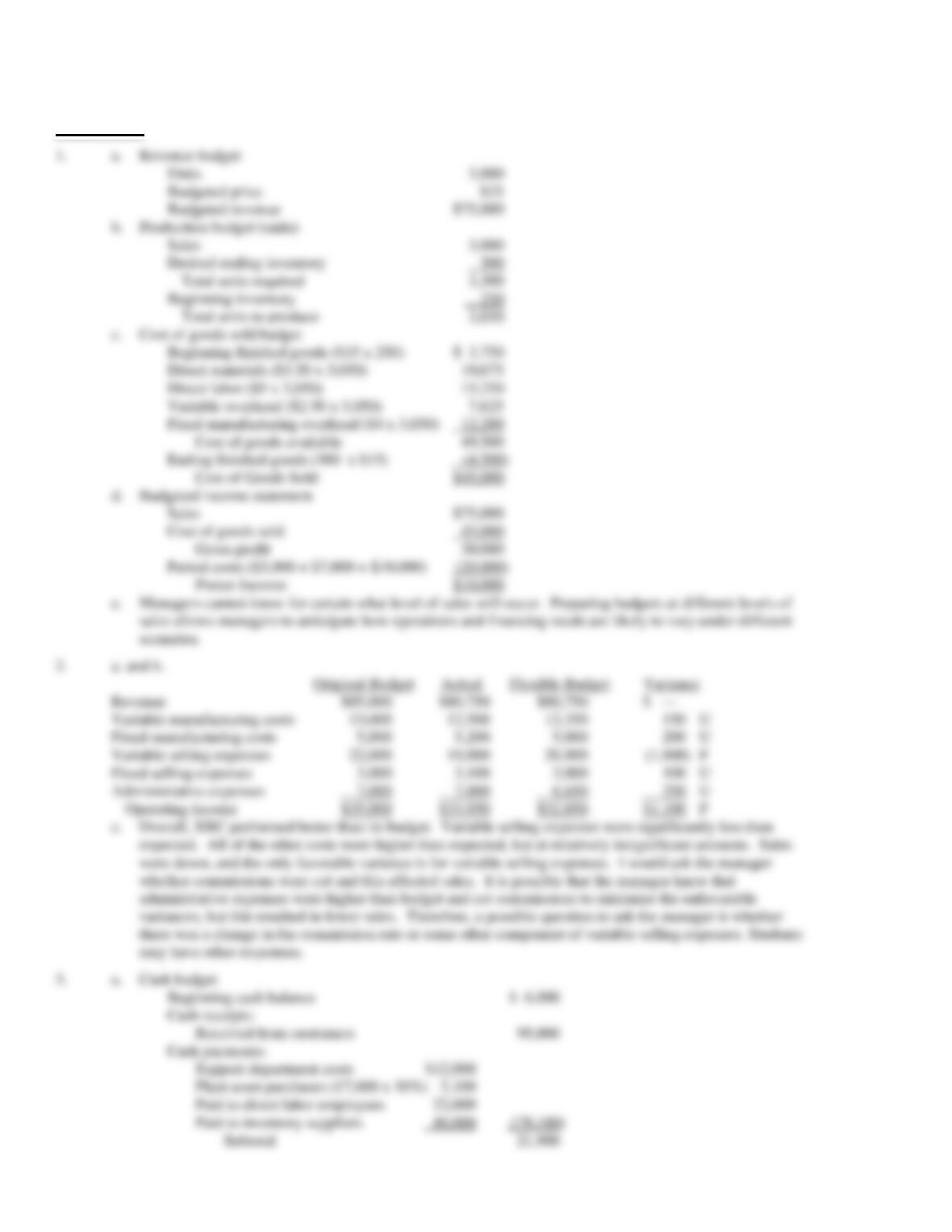
1. SRI Incorporated manufactures and sells shark repellent. Angelica and Vincent, members of the
accounting staff, have collected the data below to assist in the development of operating and financial
budgets for the next fiscal year:
Expected unit sales 3,000
Price per unit $25
Variable product costs per unit:
Materials $3.50
Labor 5.00
Variable overhead 2.50
Fixed product cost:
Manufacturing overhead $12,200 allocated at $4.00 per unit
Period costs (totals):
Research & development $ 3,000
Marketing 7,000
Administration 10,000
SRI had no beginning work in process or raw materials inventories. Beginning finished goods
inventory totaled 250 units at a cost of $15 per unit. SRI’s managers want an ending finished goods
inventory equal to 10% of unit sales, and an ending raw materials inventory of $1,200.
a. Prepare a revenue budget for expected sales of 3,000 units.
b. Prepare a production budget in units for the sales level of 3,000 units.
c. Prepare a cost of goods sold budget for the sales level of 3,000 units.
d. Prepare a budgeted income statement (pretax) based on an expected sales level of 3,000 units.
e. Angela and Vincent are not sure whether sales will be 2,500, 3,000 or 3,500 next period. They
have decided to prepare budgets for each level of sales, in addition to the current budget. Explain
why the managers of a company might be interested in budgets prepared for different expected
sales levels.
2. Budgeted and actual income statement data for XRC Corp., which sells clerical clothing and supplies,
appear below:
Budgeted Actual
Revenue $85,000 $80,750
Variable manufacturing costs 13,000 12,500
Fixed manufacturing costs 5,000 5,200
Variable selling expenses 22,000 19,000
Fixed selling expenses 3,000 3,100
Administrative expenses 7,000 7,000
Operating income $35,000 $33,950
The difference between the actual and budgeted amounts of revenue was created by differences
between expected and actual unit sales.
a. Prepare a flexible budget based on actual revenue.
b. Calculate budget variances and indicate whether each variance is favorable or unfavorable.
c. Comment briefly on XRC’s overall performance. Examine the relationships among the variances
and develop one question for the manager about the variances and their relationships.
3. (Appendix 10A) RLN Corporation is preparing its cash budget for the next fiscal quarter. Several
pieces of data which may be useful for that task are shown below.
Beginning cash balance $ 6,000
Depreciation 8,000
Support department costs 12,000

Chapter 10: Static and Flexible Budgets 10-27
Plant asset purchases 17,000
Wages expense (direct labor) 19,000
Cash paid to direct labor employees 22,000
Inventory purchases 25,000
Payments to inventory suppliers 40,000
Sales revenue 80,000
Cash collected from customers 95,000
Support department costs do not include depreciation. The company plans to purchase the plant asset
at the end of the year, making a 30% down payment and financing the remainder with a 6%, 180-day
note payable. RLN wishes to maintain an ending cash balance of $7,200; any excess cash is invested
in short-term securities. A zero rate of return is budgeted for short-term securities. Cash deficiencies
are made up through short-term borrowing (30%) and capital stock issuances (70%).
a. Use the relevant data to prepare RLN’s cash budget.
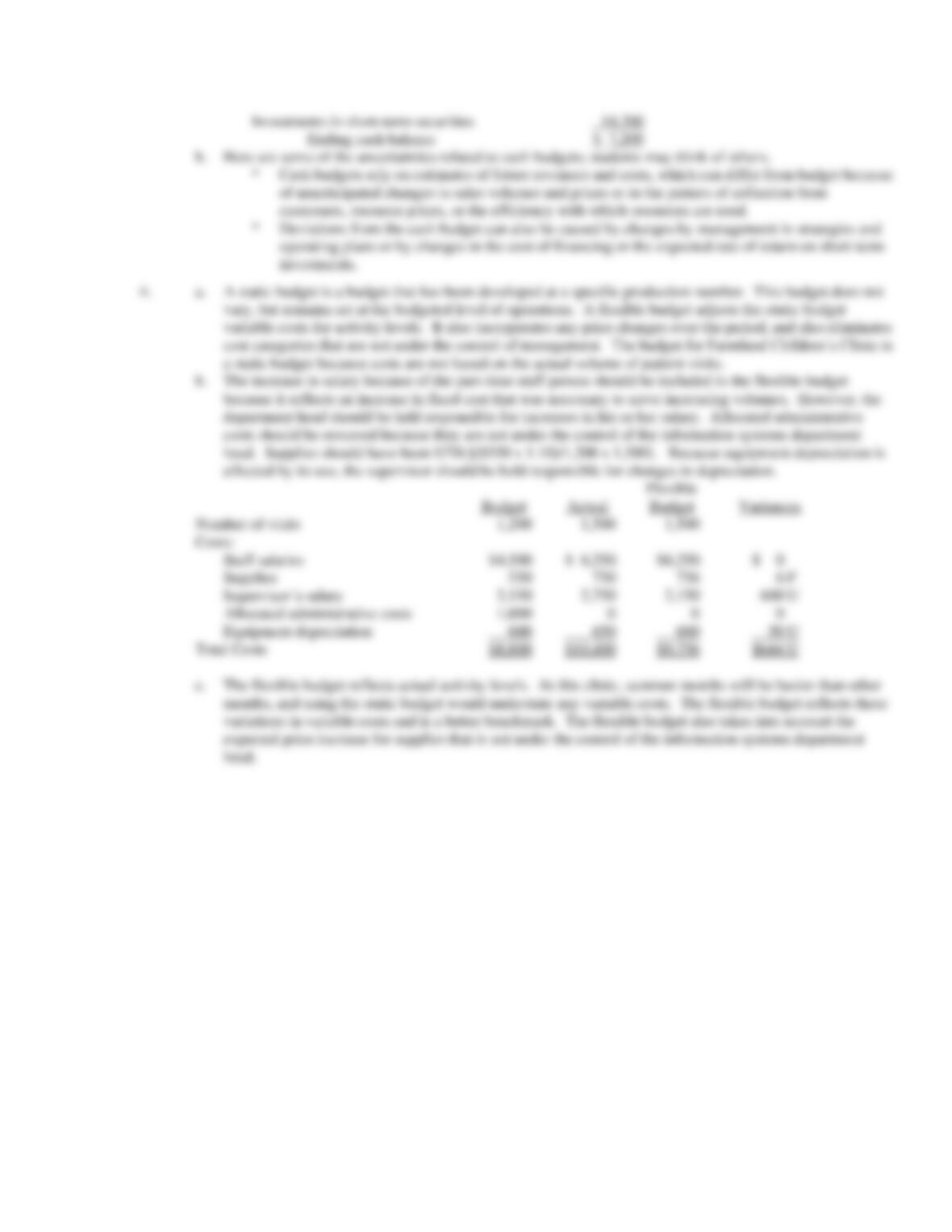
b. Explain why the managers of RLN Corporation cannot be certain that achieving the cash budget
results calculated in part (a).
4. The Farmland Children’s Clinic is located in a small rural town. It draws from a wide area, though,
because it is the only children’s clinic in this part of the state. The clinic is usually busier during the
summer than during any other time because parents bring children in for annual physical
examinations and for follow-up on other problems while children are out of school. A new director
was recently hired, and among the new ideas he introduced were responsibility accounting and
monthly cost reports supplied to department heads. Previously, cost data had rarely been presented.
Here is part of the report received by the information systems department:
To: Department Heads
From: Farmland Children’s Clinic Business Manager
Beginning this month, you will receive monthly reports comparing the costs of operating
your department with budgeted costs. The reports will highlight the differences (variations) so you
can identify problem areas in your department. The budget variances will help you identify what
costs are out of line. Of course you will want to pay attention to the largest variances as they are
likely the most important. The first report is attached. Please look it over and get back to me by next
Thursday with information regarding you variances.
Farmland Children’s Clinic
PERFORMANCE REPORT-INFORMATION SYSTEMS
July 20×6
(Over) (Over)
Under Under
Budget Actual Budget Percent
Number of visits 1,200 1,500 (300) (25)%
Costs:
Staff salaries $ 4,500 $6,250 $(1,750) (39)
Supplies 550 750 (200) (71)
Supervisor’s salary 2,150 2,750 (600) (28)
Allocated administrative costs 1,000 1,200 (200) (20)
Equipment depreciation 600 650 (50) (8)
Total Costs $8,800 $11,600 $(2,800) (32)%
Comments: Costs are significantly above budget for the month. Particular attention needs to be paid
to staff and supervisors’ salaries, and supplies.
10-28 Cost Management
The annual budget for 20×6 was constructed by the new administrator, based on an average of the
prior three years’ costs. During this three-year period, all costs had increased each year, with more
rapid increases between the second and third year. Once he developed the average, he deducted 2% to
encourage department heads to better control costs. Monthly budgets were calculated as one-twelfth
of the annual budget. The budgeted patient visits were the average number of visits per month for the
last year.
a. Describe static and flexible budgets and identify what type of budget this is.
b. Actual prices for supplies were expected to be about 10% above the levels in the budget above.
Because of increasing volumes, a part-time staff person was hired during the period. In addition,
the department head received a salary increase. Prepare a flexible budget for performance
evaluation of the head of the Information Systems department, and calculate the budget variances
for the period. Assume that any variable costs vary with the number of visits.
c. Explain why the flexible budget is a better benchmark for the Information Systems department at
Farmland Children’s Clinic than the static budget developed by the clinic director.
Chapter 10: Static and Flexible Budgets 10-29
Answers
True / False
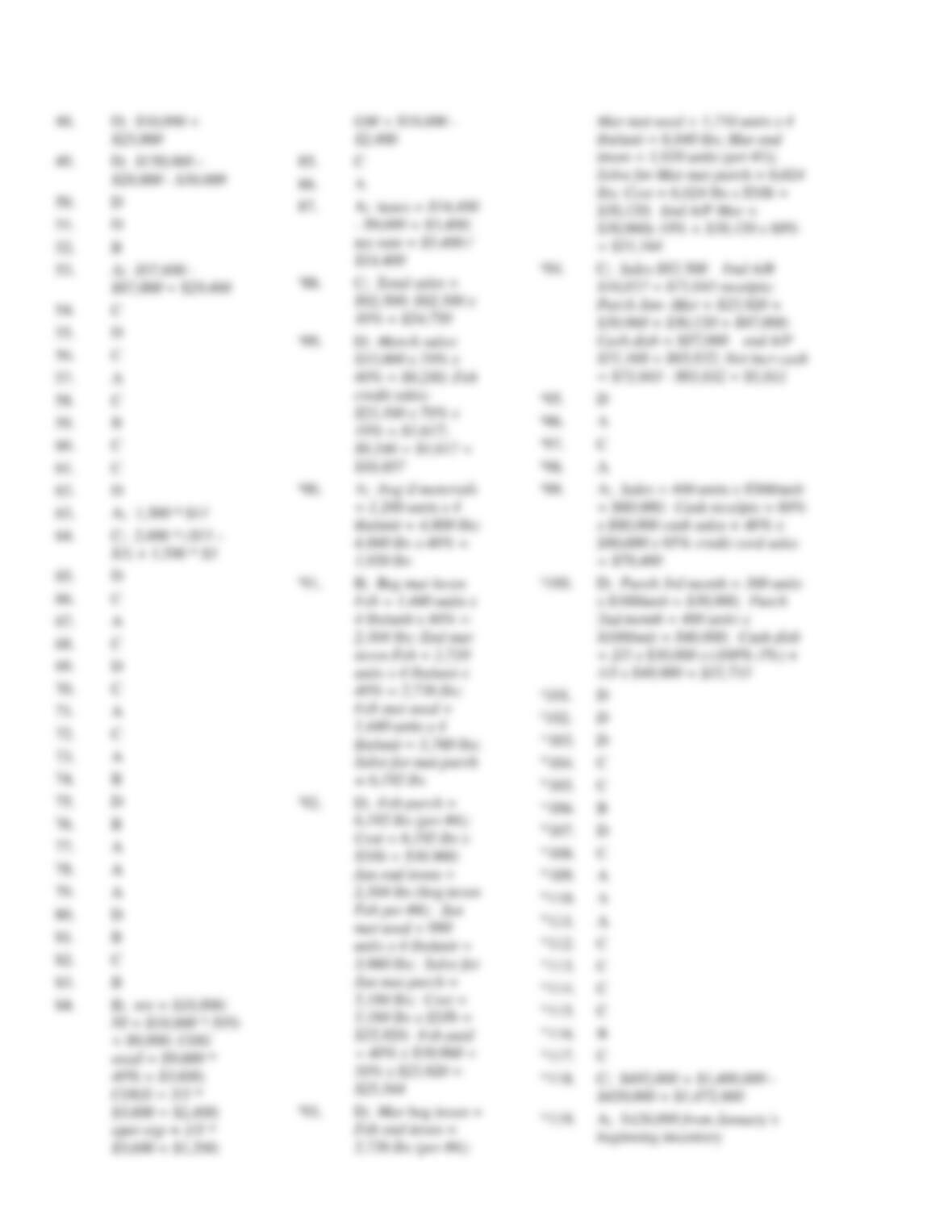
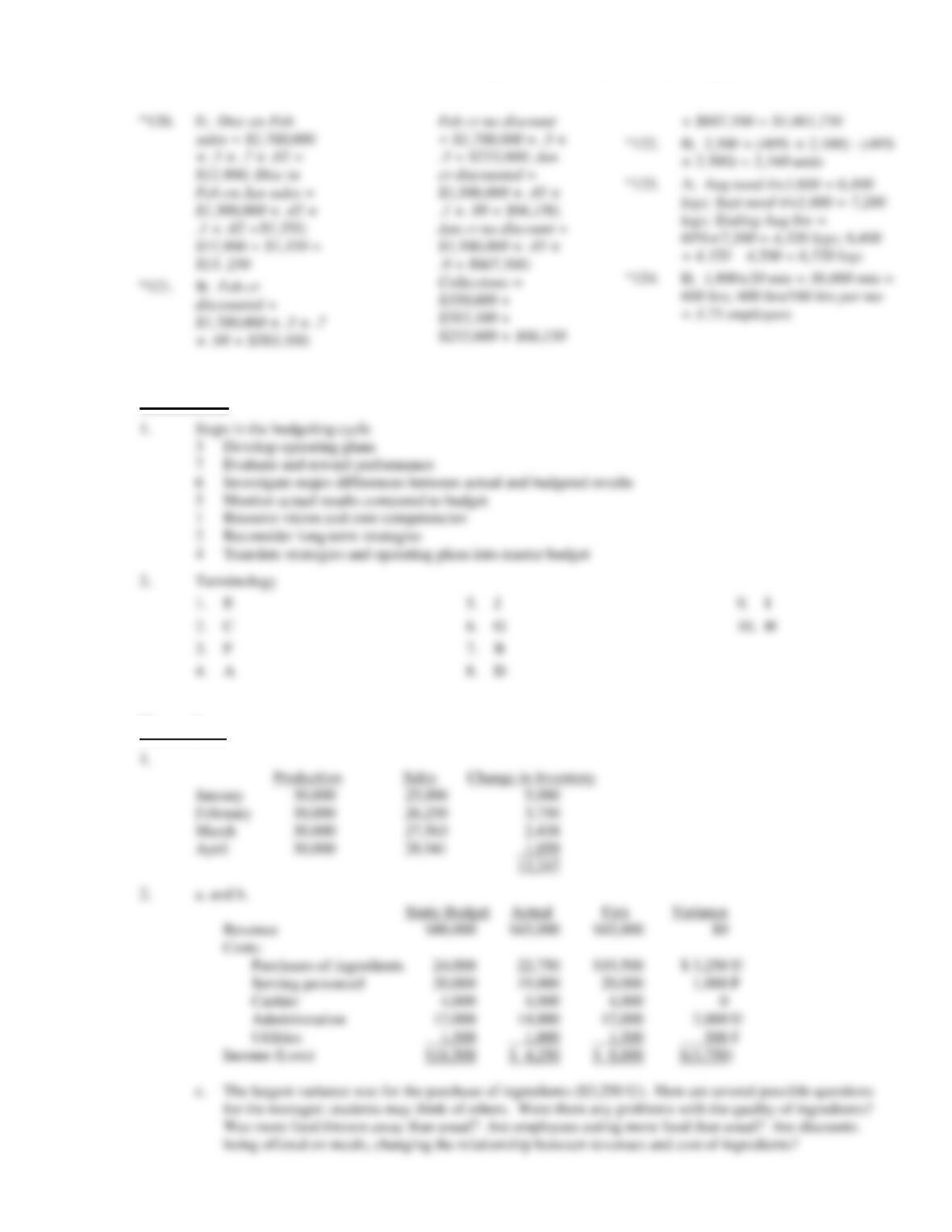
Multiple Choice
10-30 Cost Management
Chapter 10: Static and Flexible Budgets 10-31
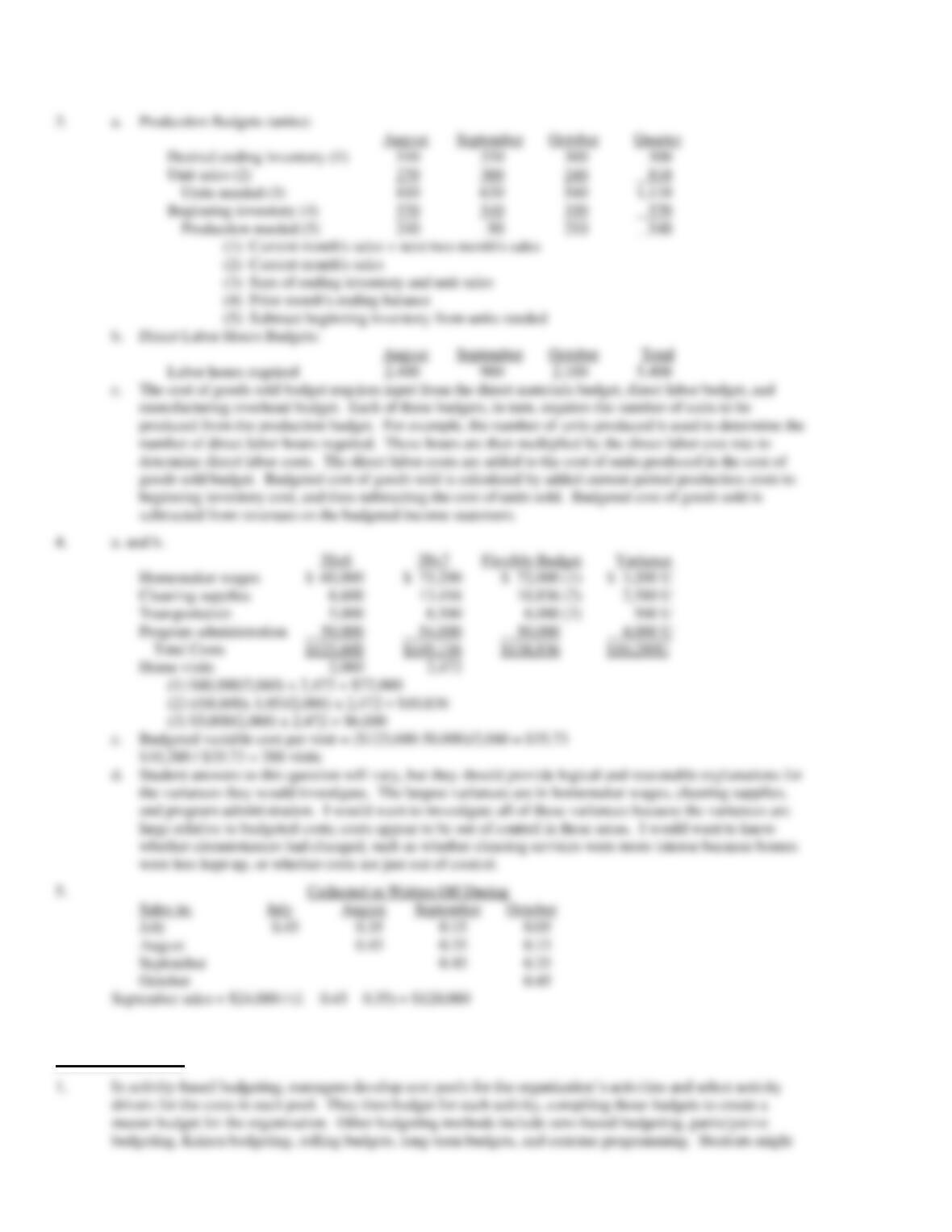
Matching
Exercises
10-32 Cost Management
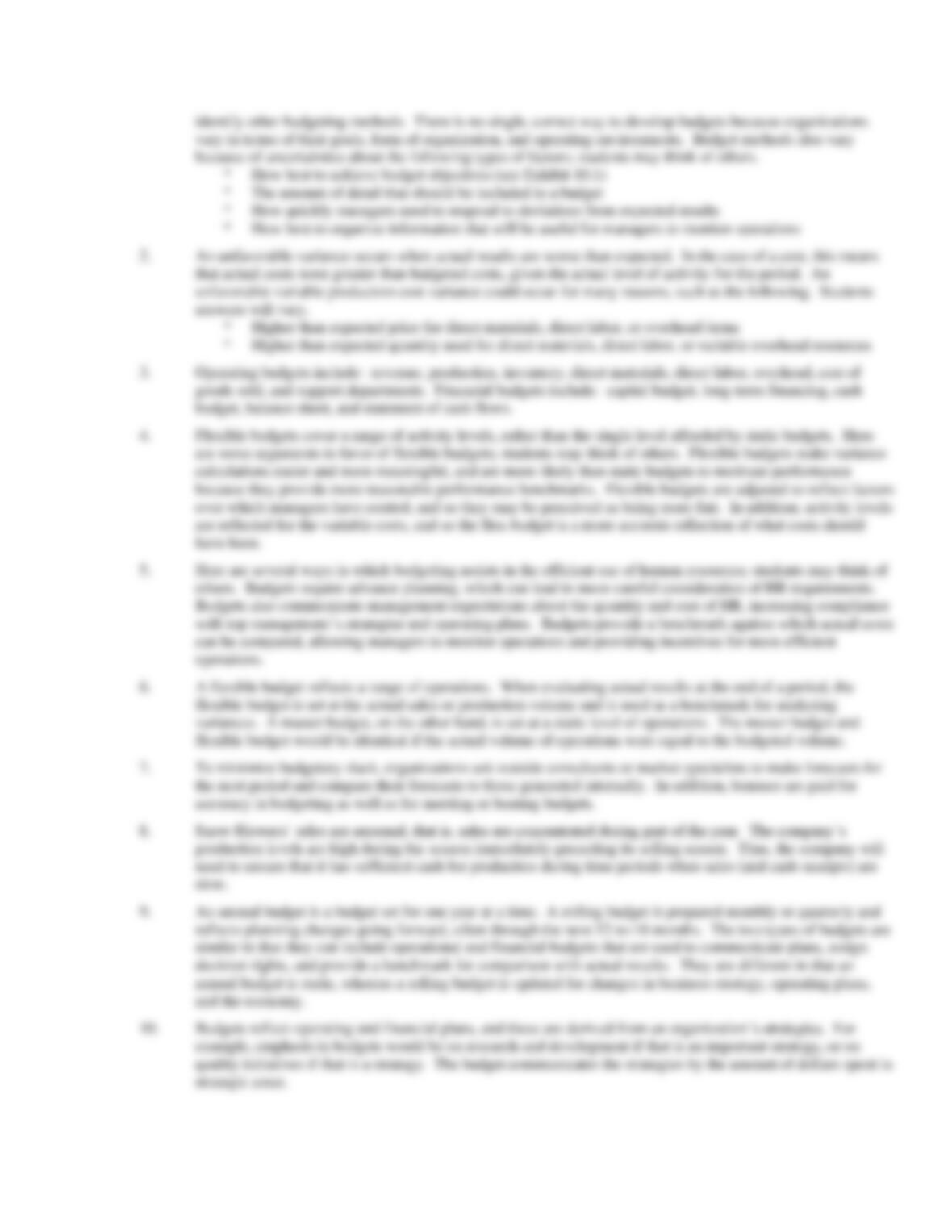
Short Answer
Chapter 10: Static and Flexible Budgets 10-33
10-34 Cost Management
Problems
Chapter 10: Static and Flexible Budgets 10-35