
Exam
Name___________________________________
MULTIPLE CHOICE. Choose the one alternative that best completes the statement or answers the question.
Provide an appropriate response.
1)
If loga x =loga y, then _______ .
1)
A)
a = x = y
B)
x = y
C)
a = 10
D)
No solving or simplification can be made (not enough information).
2)
In solving for x in the equation ex= 12, the preferred way of solving this equation is to
____________ .
2)
A)
raise everything to the power of e
B)
use natural logarithms
C)
raise everything to the power of 10
D)
use common logarithms
SHORT ANSWER. Write the word or phrase that best completes each statement or answers the question.
3)
When using the change–of–base formula for loga x, is there any distinct advantage in
converting it to ln x
ln a rather than log x
log a ?
3)
4)
Is f(x) =1
x its own inverse? Explain.
4)
5)
Explain why 1 is excluded from being a logarithmic base.
5)
6)
Explain the error in the following: log3 2 +log3 M =log3 (2 + M).
6)
7)
Explain why f(x) =2x is an exponential function but f(x) =x2 is not.
7)
8)
Explain why log2 13 is between 3 and 4.
8)
9)
Explain how the equation log x = 1 could be solved using the graph of f(x) = log x.
9)
10)
Explain how the graph of f(x) =ex could be used to graph the function g(x) = 1 + ln x.
10)
11)
Explain how the graph of f(x) = ln x could be used to graph the function g(x) =ex – 1.
11)
12)
For d > 0 and d
0 , explain why d(logd x) = x .
12)
13)
Explain why negative numbers do not have logarithms.
13)
14)
Explain the error in the following: log6 8 –log6 N =log6 (8 – N).
14)
1
15)
What does it mean that a function f has an inverse?
15)
16)
The product, power, and quotient rules enable us to simplify expressions like logars
pv .
Explain why such expressions can always be simplified without using the quotient rule.
16)
17)
Suppose that $1000 is invested for 5 years at 4% interest, compounded annually. In what
year will the most interest be earned? Why?
17)
18)
Explain the error in the following: log4 3y =log4 3 ·log4y.
18)
MULTIPLE CHOICE. Choose the one alternative that best completes the statement or answers the question.
19)
The graphs f(x) =4x and g(x) =1
4x are symmetric with respect to _________ .
19)
A)
the y–axis
B)
the x–axis
C)
y = x
D)
the origin (0,0)
Find f–1(x) for the following one–to–one function f.
20)
f(x) =6x + 1
20)
A)
f-1(x) =x – 1
6
B)
f-1(x) =x
6– 1
C)
f-1(x) =x + 1
6
D)
f-1(x) =-6x – 1
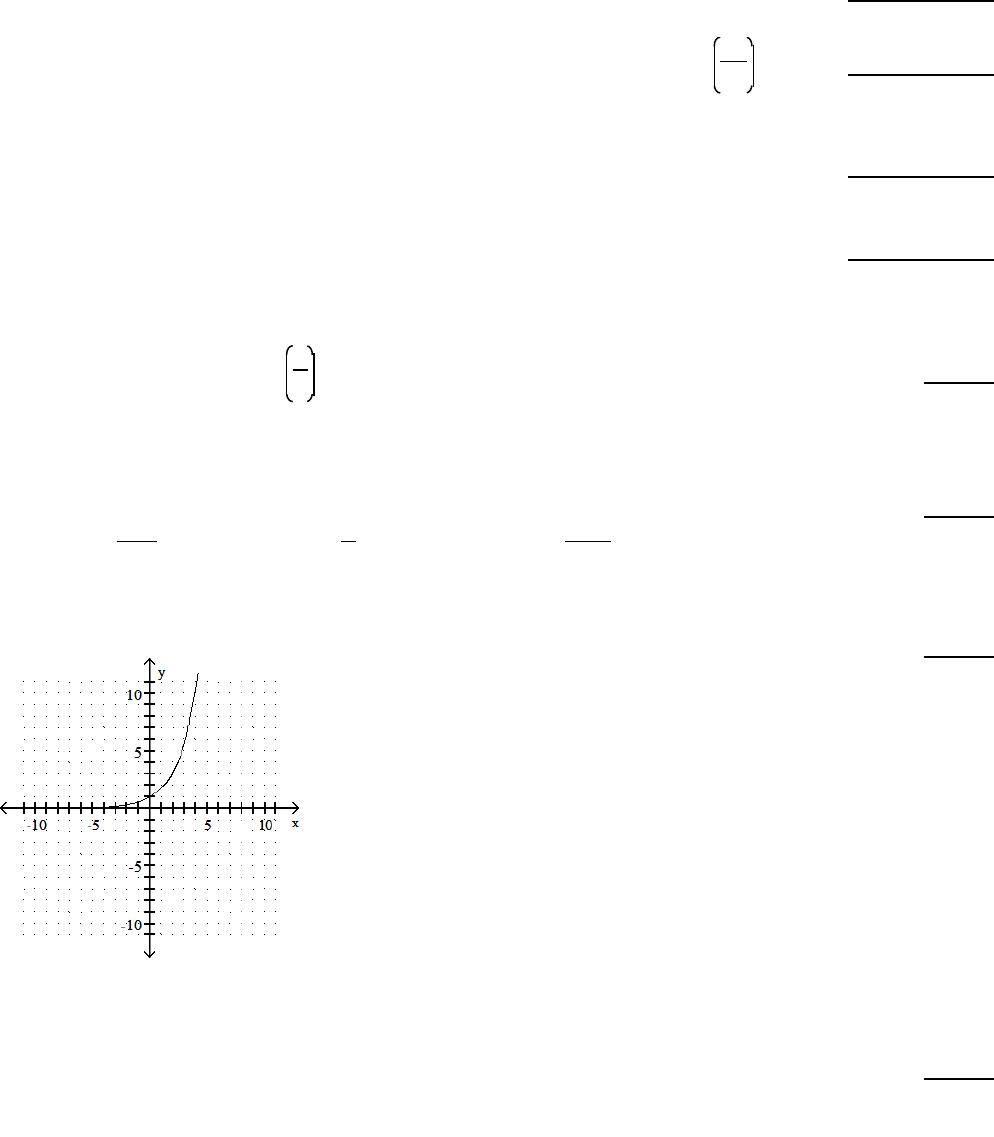
Determine whether or not the function is one–to–one.
21)
21)
A)
Yes
B)
No
Solve the equation.
22)
4x=256
22)
A)
3
B)
64
C)
5
D)
4
Graph.
2
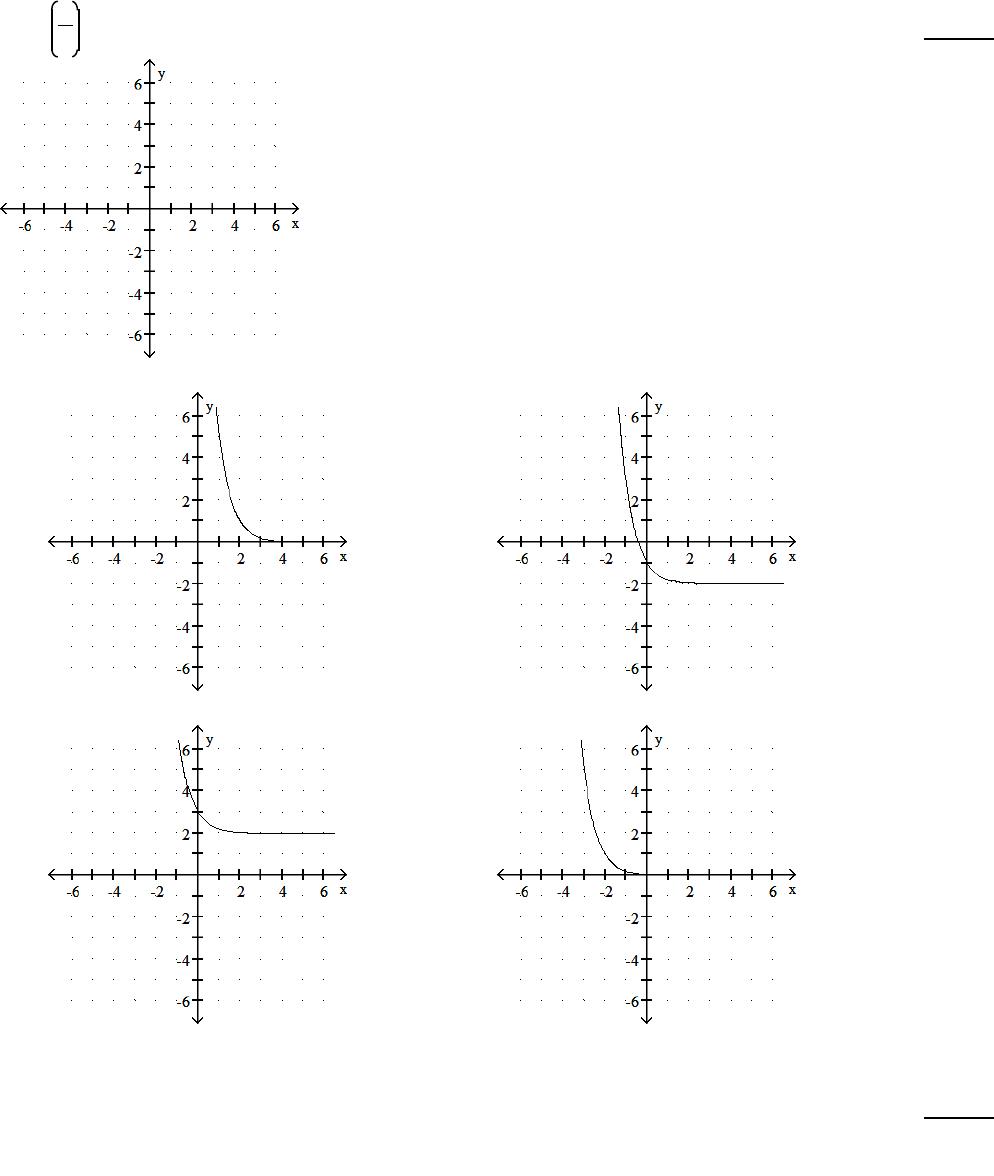
23)
f(x) =1
5 x + 2
23)
A)
B)
C)
D)
Solve. Round your answer to three decimal places if necessary.
24)
55x – 2 =21
24)
A)
0.778
B)
0.687
C)
1.24
D)
-0.022
3
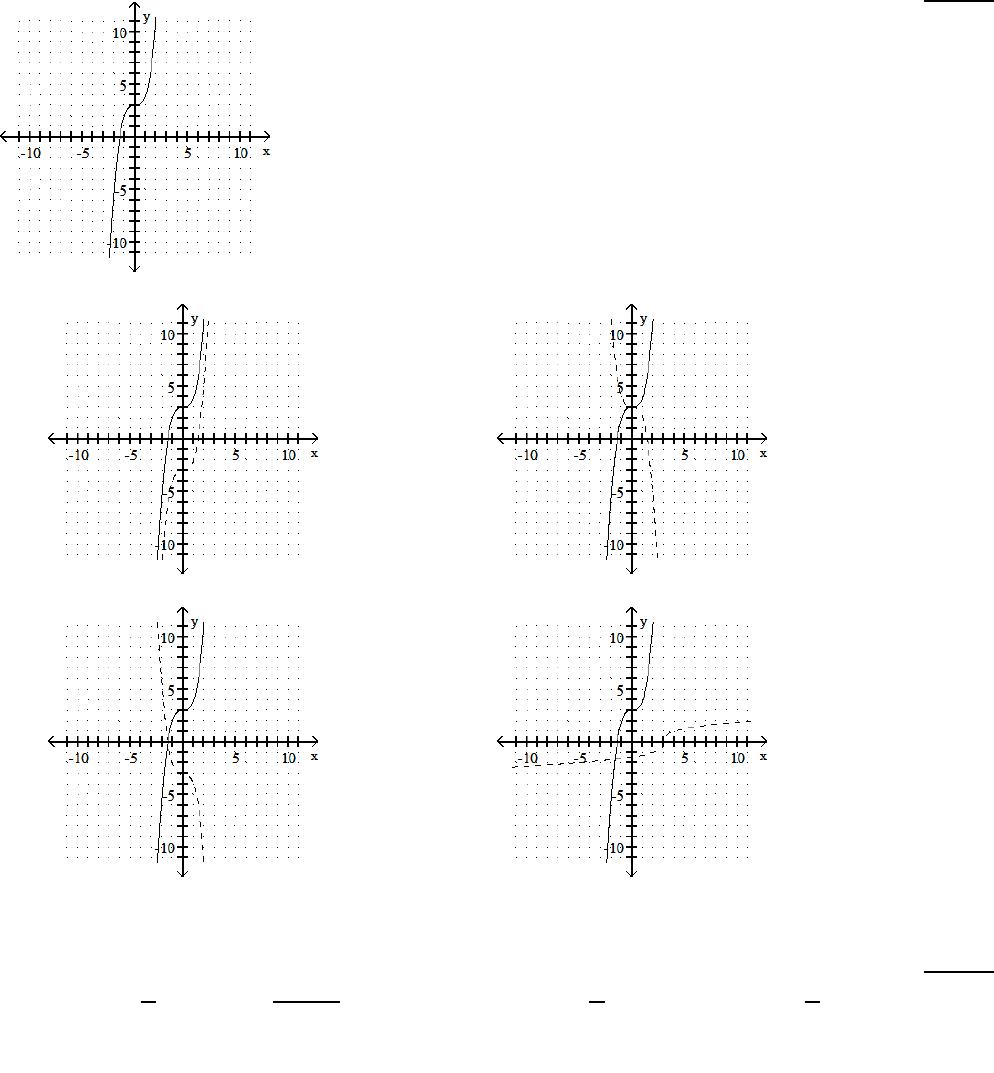
Use the graph of f to sketch a graph of the inverse of f using a dashed curve.
25)
25)
A)
B)
C)
D)
Write in logarithmic form.
26)
165/4 =32
26)
A)
log16 32 =5
4
B)
log432
log516 =16
C)
log32 16 =5
4
D)
log516 =5
4
4
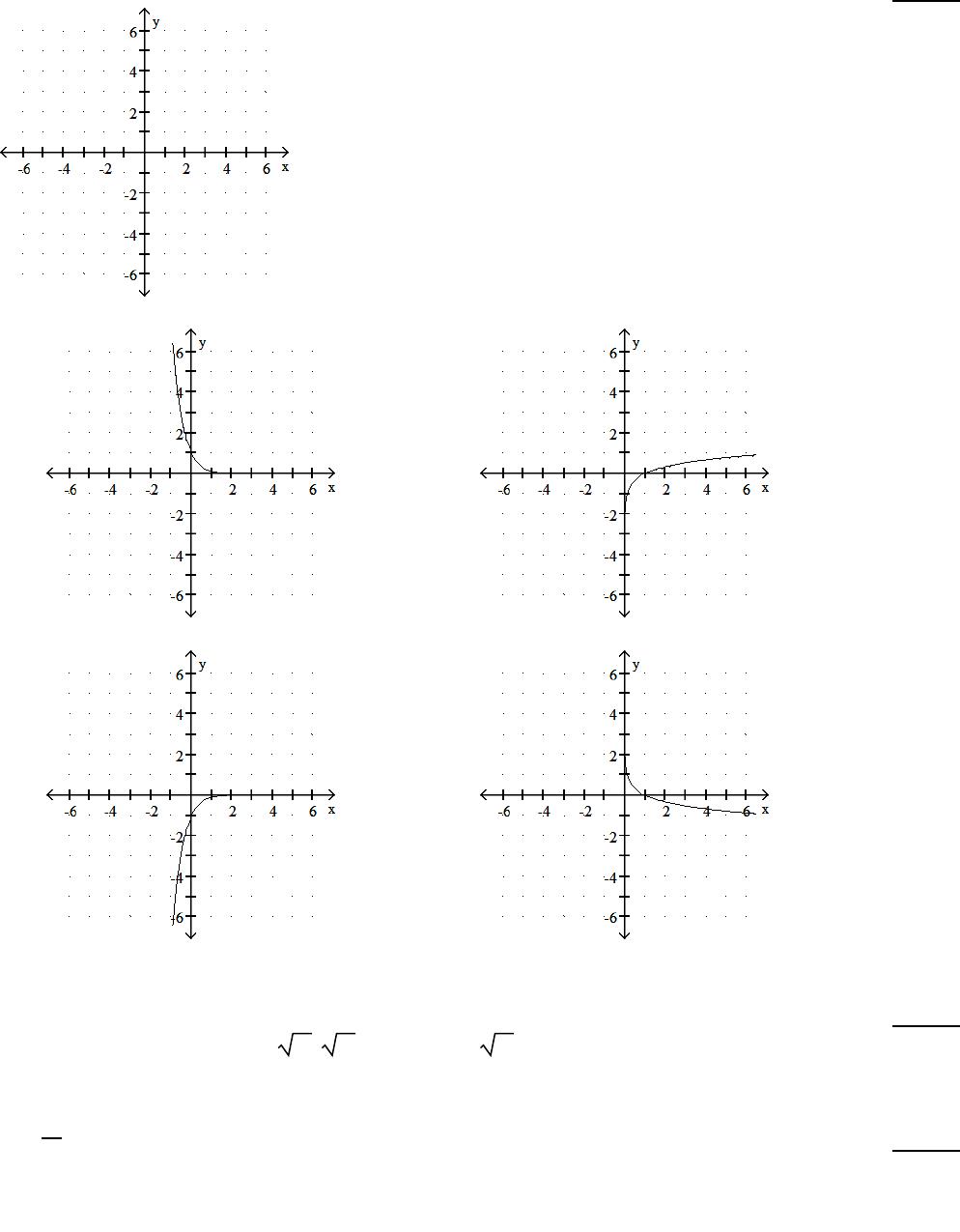
Graph.
27)
f(x) =log1/8 x
27)
A)
B)
C)
D)
Solve the logarithmic equation.
28)
log9 (x – 6) +log9 (x – 6) = 1
28)
A)
9
B)
–37, 37
C)
37
D)
-9, 9
Express as a difference of logarithms.
29)
logb3
w
29)
A)
logb3÷logb w
B)
logb w –logb3
C)
logb3–logb w
D)
log b – log w
5
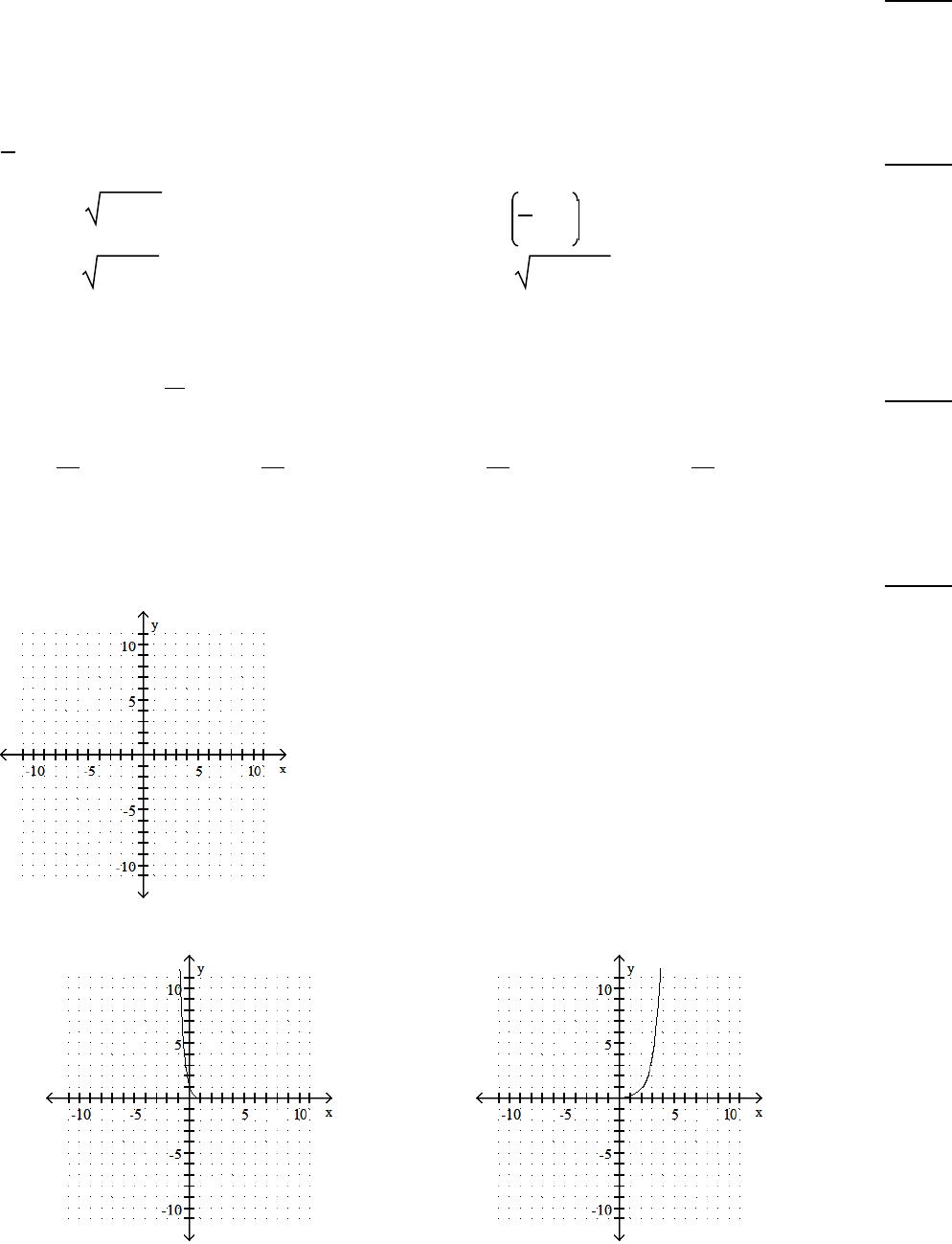
Solve the problem.
30)
The height in meters of women of a certain tribe is approximated by h = 0.52 + 2 log (t/3) where t is
the woman‘s age in years and 1 t 20. Estimate the height (to the nearest hundredth) of a woman
of the tribe 4 years of age.
30)
A)
0.52 m
B)
1.12 m
C)
0.77 m
D)
0.96 m
Write the expression as a single logarithm. Leave your answer in simplest form without negative or fractional exponents.
31)
2
3(logbx6+logby7)
31)
A)
logb3(x6y7)2
B)
logb2
3x6y7
C)
logb(x6y7)3
D)
logb3(x6 + y7)2
Find the composition.
32)
f(x) =7x +9; g(x) =-1
x
Find (f
g)(2).
32)
A)
– 1
23
B)
11
2
C)
– 23
2
D)
45
2
Graph the function. Describe its position relative to the graph of the indicated basic function.
33)
f(x) =4x + 2; relative to f(x) =4x
33)
A)
Moved down 2 unit(s)
B)
Moved right 2 unit(s)
6
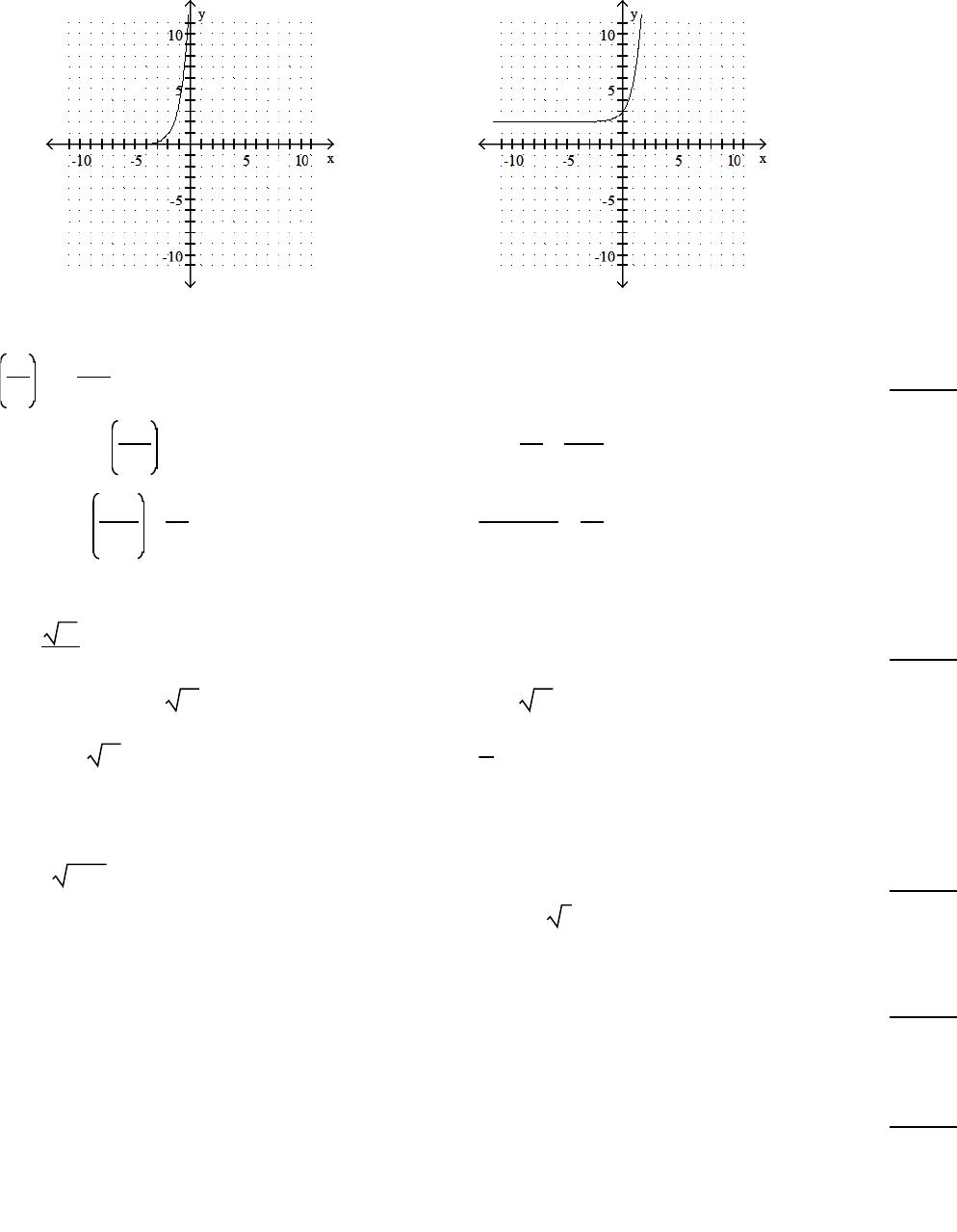
C)
Moved left 2 unit(s)
D)
Moved up 2 unit(s)
Write in logarithmic form.
34)
12
7
-2 =49
144
34)
A)
log12/7 49
144 =-2
B)
log212
7=12-2
7-2
C)
log-2 7-2
12-2 =7
12
D)
log212-2
log27-2 =7
12
Write the expression as the sum or difference of multiples of logarithms.
35)
log413
12
35)
A)
log412 –log413
B)
log413 +log412
C)
log213 –log212
D)
1
2log413 –log412
Find f–1(x) for the following one–to–one function f.
36)
f(x) =3x + 1
36)
A)
f-1(x) =(x – 1)3
B)
f-1(x) =x3– 1
C)
f-1(x) =3x+ 1
D)
f-1(x) =(x + 1)3
Write in logarithmic form.
37)
e7=1097
37)
A)
1097 =loge7
B)
e =log71097
C)
1097 =log7 e
D)
7=loge1097
Solve the problem.
38)
The population growth of an animal species is described by F(t) = 400 log (2t + 3) where t is
measured in months. Find the population of this species in an area 6 months after the species is
introduced.
38)
A)
704
B)
240
C)
74
D)
470
7
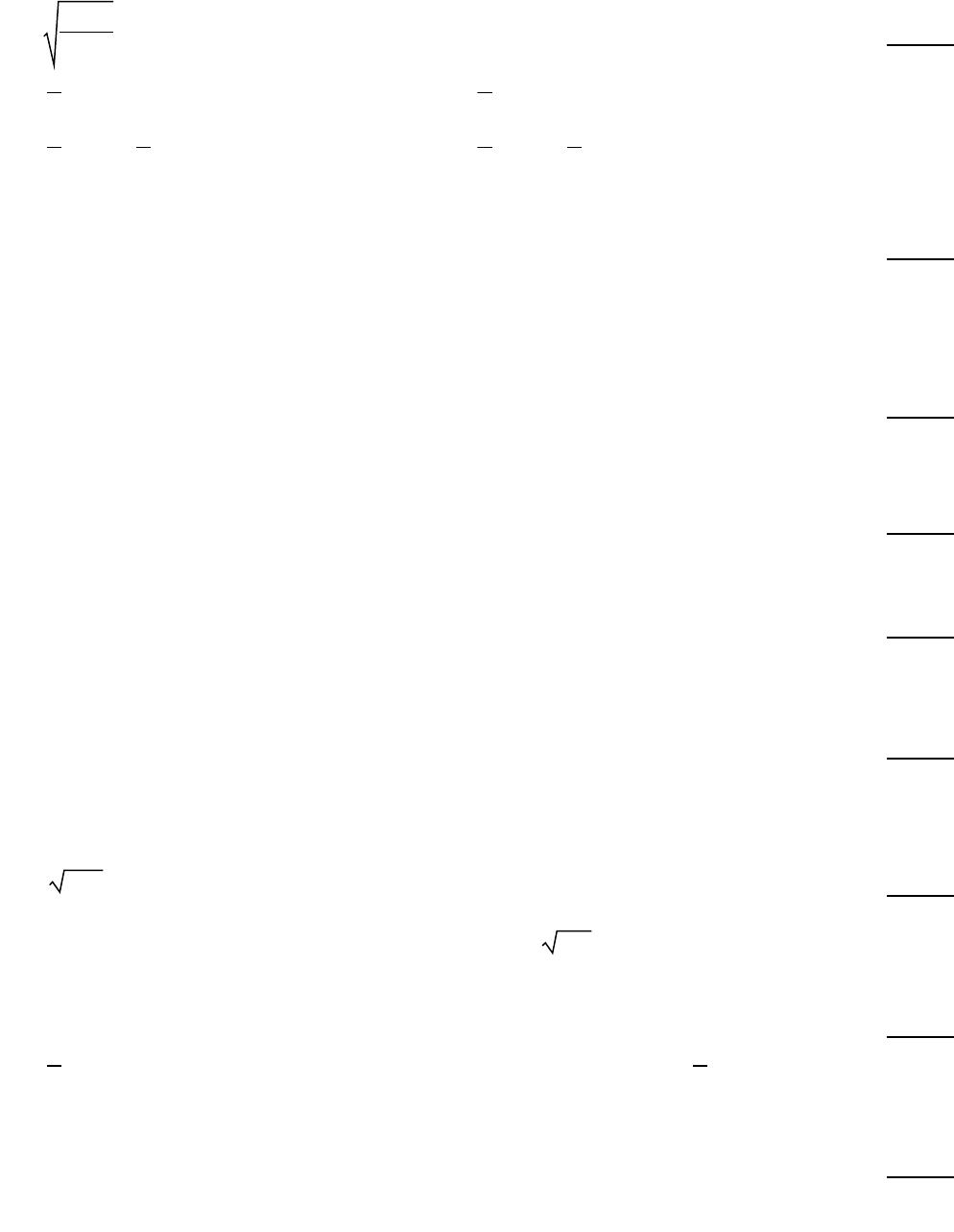
Write the expression as the sum or difference of multiples of logarithms.
39)
logb4 x3b5
y8z16
39)
A)
1
4(logbx3+logbb5–logby8+logbz16)
B)
3
4logb x + 5 – 8 logb y – 16 logb z
C)
3
4logb x +5
4–2logb y +4logb z
D)
3
4logb x +5
4–2logb y –4logb z
Solve the problem.
40)
A computer is purchased for $4400. Its value each year is about 78% of the value the preceding
year. Its value, in dollars, after t years is given by the exponential function V(t) =4400(0.78)t. Find
the value of the computer after 6 years.
40)
A)
$20,592.00
B)
$602.85
C)
$772.89
D)
$990.88
Use the change–of–base formula to find the logarithm. Round your answer to four decimal places.
41)
log20040
41)
A)
1.4363
B)
5.2983
C)
3.6889
D)
0.6962
Solve.
42)
ln e9x =63
42)
A)
7
B)
63
C)
14
D)
17
Express as a sum of logarithms.
43)
log2 xy
43)
A)
log1 x +log1 y
B)
log2 x –log2 y
C)
log2 x +log2 y
D)
log1 x –log1 y
Solve.
44)
The population of a small country increases according to the function B = 2,500,000e0.04t, where t is
measured in years. How many people will the country have after 10 years?
44)
A)
994,850
B)
2,290,727
C)
3,729,562
D)
6,279,716
Find f–1(x) for the following one–to–one function f.
45)
f(x) =x + 6
45)
A)
f-1(x) =x2– 6, x 0
B)
f-1(x) =x2+ 6, x 0
C)
f-1(x) =(x + 6)2
D)
f-1(x) =x – 6
Solve.
46)
log1/3 x –1=1
46)
A)
1
9
B)
–9
C)
9
D)
1
3+1
Provide an appropriate response.
47)
What are the possible values of x in the equation y = log (10 – x)?
47)
A)
(0,
)
B)
(10,
)
C)
(–
, 10)
D)
(–
,
)
8
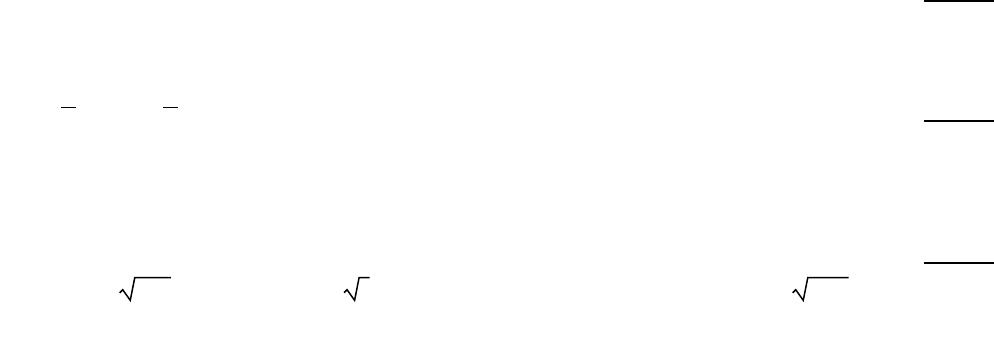
Solve. Round your answer to three decimal places if necessary.
48)
10x – 2 =22
48)
A)
3.435
B)
2.745
C)
3.342
D)
4.2
Determine whether f and g are inverses by determining whether (f
g)(x) = x and (g
f)(x) = x.
49)
f(x) =– 2
7x, g(x) =– 7
2x
49)
A)
Yes
B)
No
Find f–1(x) for the following one–to–one function f.
50)
f(x) =x3– 8
50)
A)
f-1(x) =3x – 8
B)
f-1(x) =3x+ 8
C)
f-1(x) =x3+ 8
D)
f-1(x) =3x + 8
9
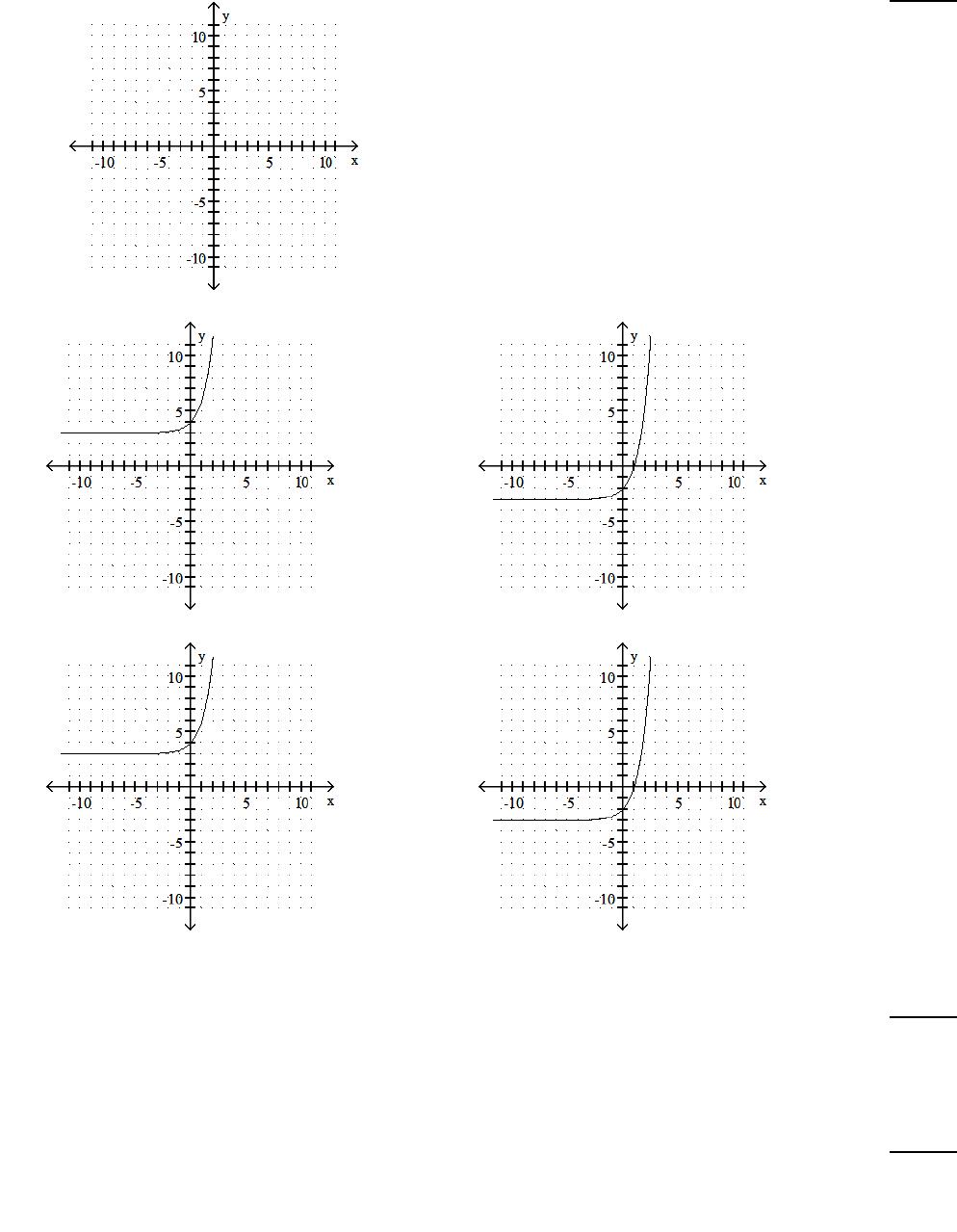
Graph the function. Describe its position relative to the graph of the indicated basic function.
51)
f(x) =3x+ 3; relative to f(x) =3x
51)
A)
Moved down 3 unit(s)
B)
Moved up 3 unit(s)
C)
Moved up 3 unit(s)
D)
Moved down 3 unit(s)
Solve.
52)
How long will it take for the population of a certain country to triple if its annual growth rate is
2.1%? (Round to the nearest year.)
52)
A)
143 years
B)
23 years
C)
1 year
D)
52 years
Find the composition.
53)
f(x) =8x – 4; g(x) =8x2+ 4x + 4
Find (g
f)(-9).
53)
A)
-836
B)
-908
C)
45,908
D)
4924
10

Solve the problem.
54)
The number of bacteria growing in an incubation culture increases with time according to
B = 1900(5)x, where x is time in days. Find the number of bacteria when x = 0 and x =2.
54)
A)
9500; 47,500
B)
1900; 5,937,500
C)
1900; 19,000
D)
1900; 47,500
Solve.
55)
How long will it take for the population of a certain country to double if its annual growth rate is
4.1%? (Round to the nearest year.)
55)
A)
49 years
B)
1 year
C)
17 years
D)
7 years
Solve the problem.
56)
How long will it take for $1500 to grow to $1600 at an interest rate of 7.9% if the interest is
compounded continuously? Round the number of years to the nearest hundredth.
56)
A)
81.69 yr
B)
7.9 yr
C)
0.82 yr
D)
0.08 yr
Determine whether f and g are inverses by determining whether (f
g)(x) = x and (g
f)(x) = x.
57)
f(x) =5
x + 7, g(x) =x – 7
5
57)
A)
Yes
B)
No
Write the expression using a multiple of a logarithm.
58)
log25z
58)
A)
log2z
5
B)
2
5 log z
C)
1
5log2 z
D)
5log2 z
Write in exponential form.
59)
log749 =2
59)
A)
749 =2
B)
492=7
C)
27=49
D)
72=49
Express as a sum of logarithms.
60)
log6 0.10y
60)
A)
log 6+ log 0.10
B)
log6 (0.10 + y)
C)
log6 0.10 +log6 y
D)
log 0.10 + log y
Find f–1(x) for the following one–to–one function f.
61)
f = {(20, 9), (12, 4), (-15, 20)}
61)
A)
f-1 = {(9, 20), (4, 12), (20, -15)}
B)
f-1 = {(9, 20), (-15, 12), (20, 4)}
C)
f-1 = {(20, 4), (20, 12), (20, -15)}
D)
f-1 = {(20, 9), (12, 4), (20, -15)}
Write the expression as a single logarithm. Leave your answer in simplest form without negative or fractional exponents.
62)
4loga7+ 2 loga6
62)
A)
(loga72)(loga62)
B)
loga49
54
C)
loga(28 + 28)
D)
loga(74·62)
11
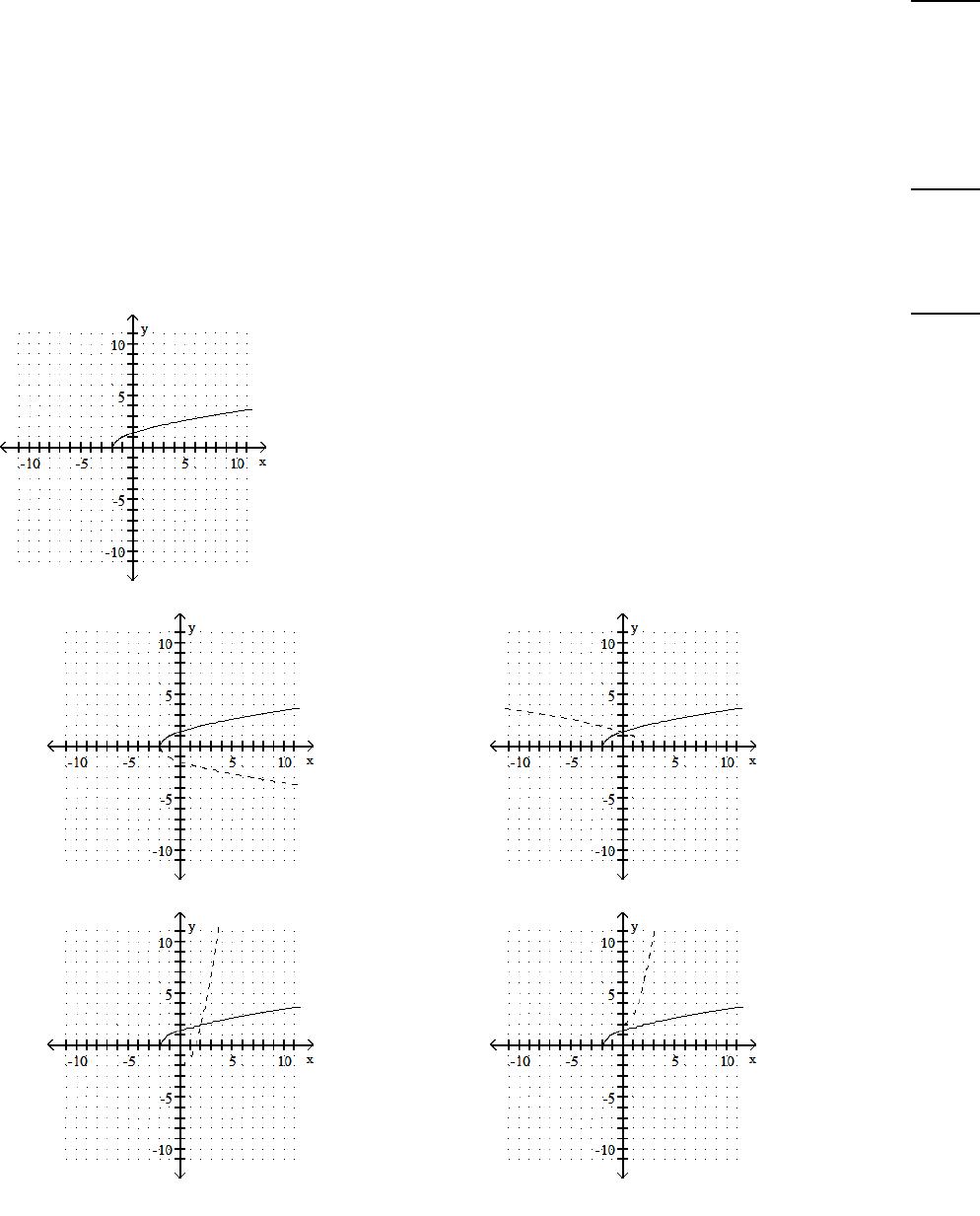
Solve the problem.
63)
Use the formula N = Iekt, where N is the number of items in terms of the initial population I, at
time t, and k is the growth constant equal to the percent of growth per unit of time. A certain
radioactive isotope has a half–life of approximately 1500 years. How many years would be
required for a given amount of this isotope to decay to 25% of that amount?
63)
A)
623 years
B)
2975 years
C)
1125 years
D)
3000 years
Simplify.
64)
log222x
64)
A)
2x
B)
2log22x
C)
22x
D)
2
Use the graph of f to sketch a graph of the inverse of f using a dashed curve.
65)
65)
A)
B)
C)
D)
12
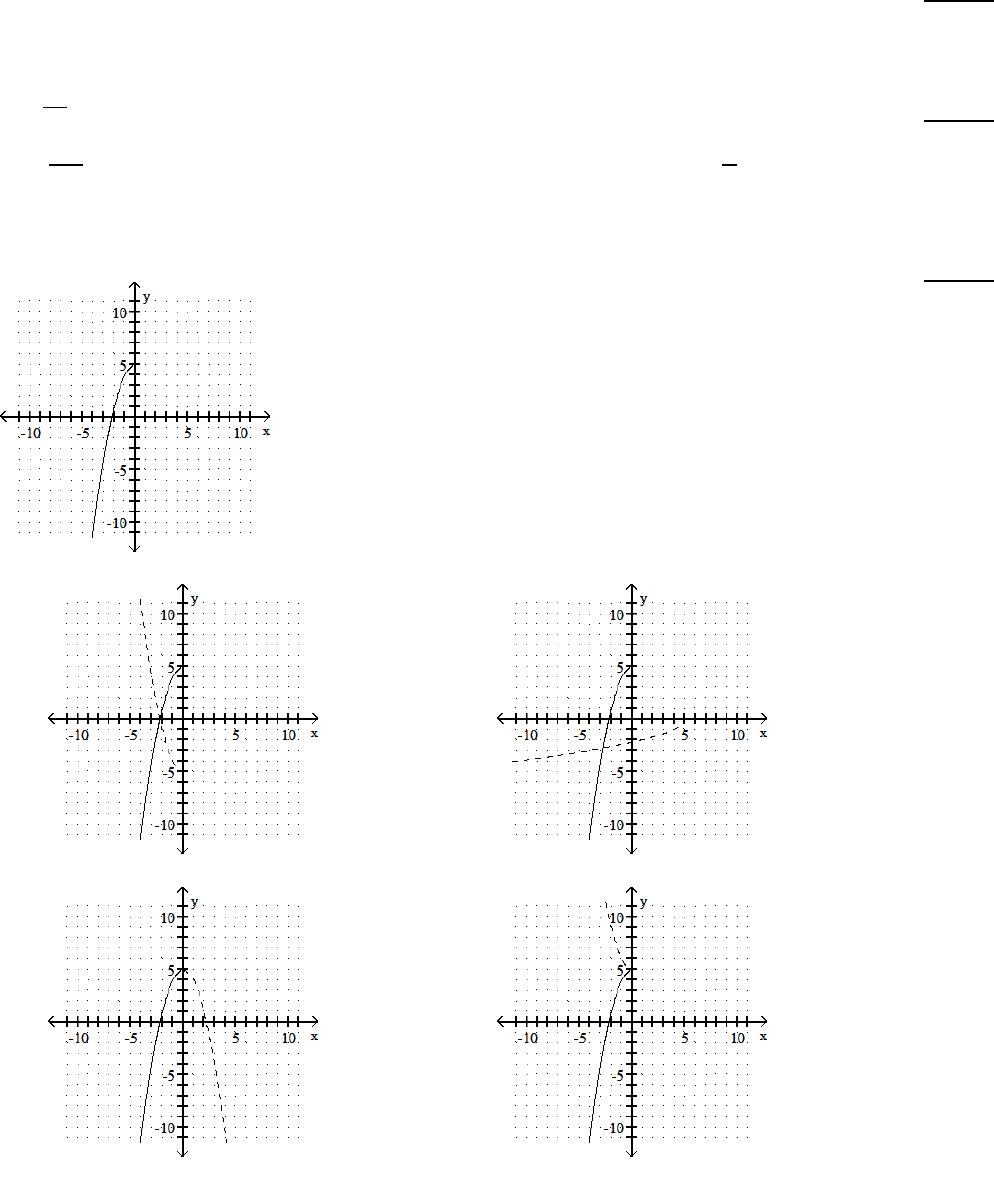
Using a calculator, evaluate to four decimal places.
66)
log 20.93
66)
A)
3.5412
B)
0.8208
C)
1.3208
D)
3.0412
Solve.
67)
log51
25 = x
67)
A)
1
125
B)
2
C)
–2
D)
1
5
Use the graph of f to sketch a graph of the inverse of f using a dashed curve.
68)
68)
A)
B)
C)
D)
13
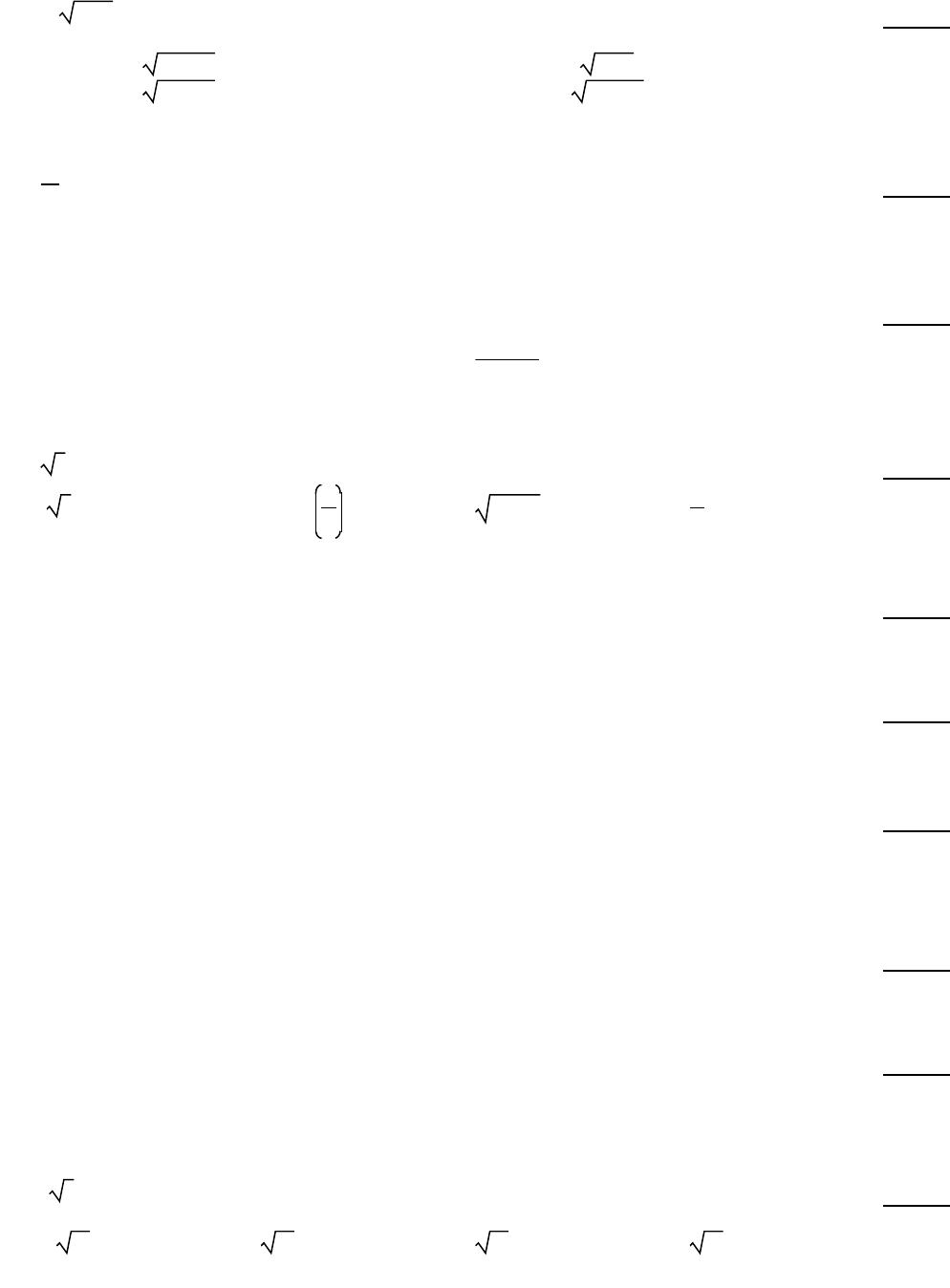
Find the indicated composition.
69)
f(x) =2x + 5; g(x) =9x +12
Find (f
g)(x).
69)
A)
(f
g)(x) =2 9x + 12
B)
(f
g)(x) =18 x + 5+12
C)
(f
g)(x) =2 9x + 17
D)
(f
g)(x) =2 9x + 12 +5
Express as a difference of logarithms.
70)
logaD
P
70)
A)
loga (D–P)
B)
logaP–logaD
C)
logaD÷logaP
D)
logaD–logaP
Express as a single logarithm and, if possible, simplify.
71)
logx24 –logx6
71)
A)
logx4
B)
logx144
C)
logx24
logx6
D)
logx18
Write the expression using a multiple of a logarithm.
72)
log6y
72)
A)
ylog6
B)
y log61
2
C)
log6 y
D)
1
2log6 y
Provide an appropriate response.
73)
Given that f and g are inverse functions, then the range of f is the ________ of g.
73)
A)
range
B)
function
C)
domain
D)
inverse
Use the change–of–base formula to find the logarithm. Round your answer to four decimal places.
74)
log50.664
74)
A)
-3.9305
B)
-0.1778
C)
-0.2544
D)
7.5301
Compute the compound interest.
75)
At what interest rate must $4400 be compounded annually to equal $12,923.65 after 14 yr? (Round
to the nearest percent.)
75)
A)
9%
B)
7%
C)
10%
D)
8%
Find the exact value of the logarithm using logbbx= x.
76)
log 0.0001
76)
A)
-5
B)
–4
C)
4
D)
5
Compute the compound interest.
77)
Sun Woo Kim invested $7000 at 8% compounded quarterly. How much will be in the account in 3
years? Round to the nearest cent.
77)
A)
$8877.69
B)
$17,627.19
C)
$8817.98
D)
$7428.46
Find the composition.
78)
f(x) =x; g(x) = 4x – 14
Find (f
g)(9).
78)
A)
221
B)
21
C)
23
D)
22
14

Provide an appropriate response.
79)
What is another way of expressing the composition (f
g)(x)?
79)
A)
(g
f)(x)
B)
g[f(x)]
C)
(g
f)(y)
D)
f[g(x)]
Solve. Round your answer to three decimal places if necessary.
80)
45– 3x=1
256
80)
A)
1
64
B)
3
C)
128
D)
–3
Solve.
81)
Atmospheric pressure (in pounds per square inch) is a function of the altitude above sea level and
can be modeled by P(a) = 14.7e-0.21a, where P is the pressure and a is the altitude above sea level in
miles. Find the atmospheric pressure at 3.39 miles above sea level. Round your answer to the
nearest hundredth.
81)
A)
11.92 psi
B)
29.96 psi
C)
7.21 psi
D)
0.50 psi
Express as a sum of logarithms.
82)
log2 (116 ·266)
82)
A)
log230,856 +log230,856
B)
log22+log116 116 +log266 266
C)
log2116+log2266
D)
log1162+log2662
Solve.
83)
The number of books in a small library increases according to the function B =2600e0.02t, where t is
measured in years. How many books will the library have after 5 years?
83)
A)
3273
B)
5987
C)
2600
D)
2873
Using a calculator, evaluate to four decimal places.
84)
ln 2,800,000
84)
A)
0.0672
B)
3.3322
C)
14.8451
D)
6.4472
Provide an appropriate response.
85)
Exponential functions and logarithmics function _______ .
85)
A)
have identical domains and ranges
B)
are equivalent
C)
are linear
D)
are inverses
Decide whether the given functions are inverses.
86)
f = {(-1, -4), (2, 5), (5, -1), (6, 9)}
g = {(-4, -1), (5, 2), (-1, 5), (9, 6)}
86)
A)
Yes
B)
No
15
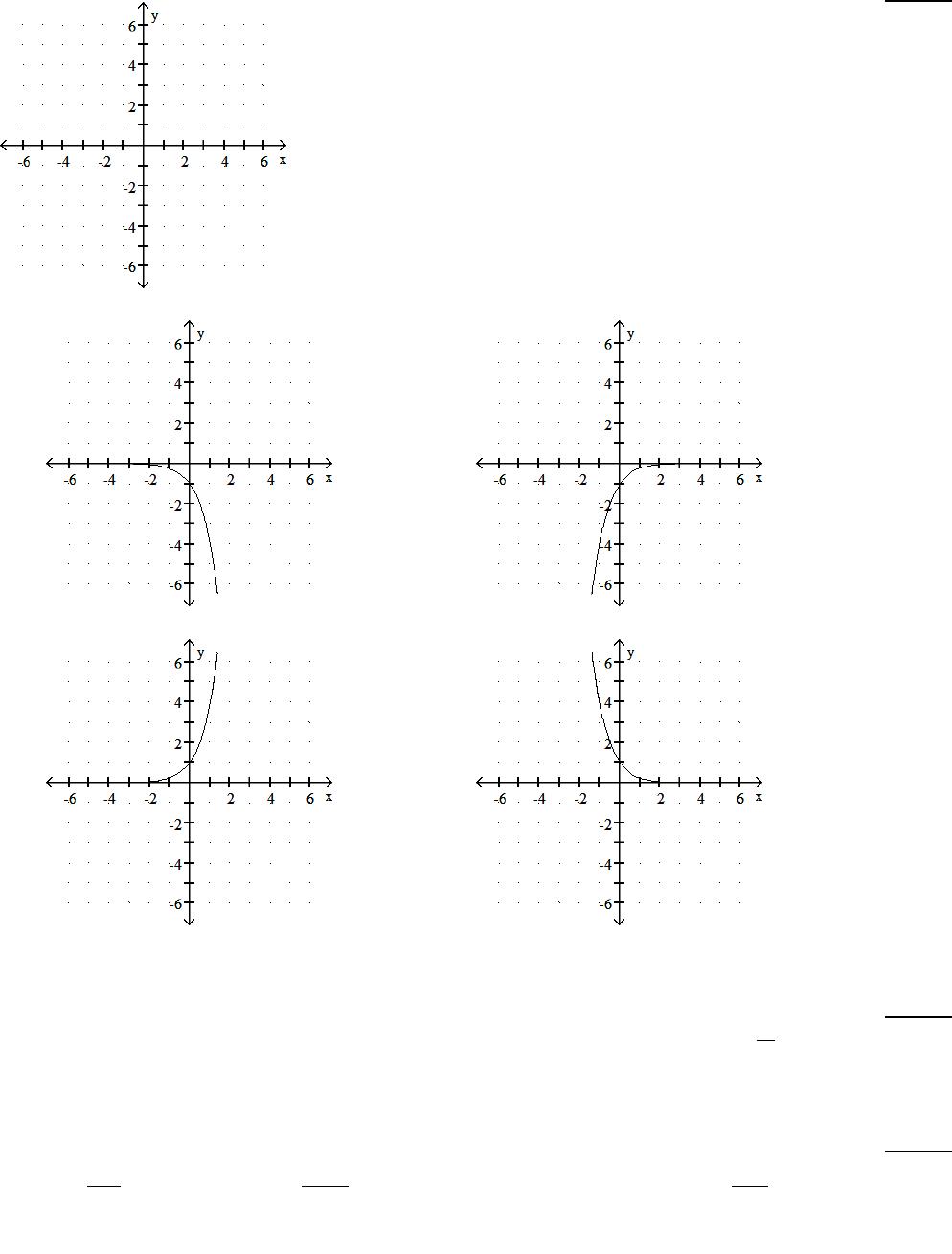
Graph.
87)
f(x) =4-x
87)
A)
B)
C)
D)
Find f–1(x) for the following one–to–one function f.
88)
f(x) = x +3
88)
A)
f-1(x) = –x +3
B)
f-1(x) = x –3
C)
f-1(x) =3– x
D)
f-1(x) =x
3
Write the expression as a single logarithm. Leave your answer in simplest form without negative or fractional exponents.
89)
logaq–logar+ 5 logap
89)
A)
logaq
p5r
B)
logaqp5
r
C)
logaqp5r
D)
loga5qp
r
16

Solve.
90)
log3 x =2
90)
A)
8
B)
5
C)
9
D)
6
Provide an appropriate response.
91)
If two functions are inverses of each other, then their graphs are symmetric with respect to
________ .
91)
A)
the x–axis
B)
the y–axis
C)
the origin (0, 0)
D)
y = x
Express as a single logarithm and, if possible, simplify.
92)
logba–logby
92)
A)
logba– y
B)
log2b a
y
C)
logba
y
D)
logby
a
Find f–1(x) for the following one–to–one function f.
93)
f = {(0, 0), (1, 1), (2, 2), (3, 3)}
93)
A)
f-1 = {(0, 0), (–1, 1), (–2, 2), (–3, 3)}
B)
f-1 = {(0, 0), (1, 1), (2, 2), (3, 3)}
C)
f-1 = {(0, 0), (1, –1), (2, –2), (3, –3)}
D)
f-1 = {(0, 0), (–1, –1), (–2, –2), (–3, –3)}
Solve the problem.
94)
If f(x) gives the time in hours to travel x miles at 48 miles per hour, then what does f-1(x) give?
94)
A)
The hours taken to travel 48 miles
B)
The miles traveled in x hours
C)
The miles traveled in 48 hours
D)
The hours taken to travel x miles
95)
The space in a landfill decreases with time as given by the function F(t) = 290– 90 log5 (4t + 1),
where t is measured in years. How much space is left when t =1?
95)
A)
200
B)
210
C)
110
D)
380
Use the change–of–base formula to find the logarithm. Round your answer to four decimal places.
96)
log1/25
96)
A)
-0.4307
B)
-2.3219
C)
0.3979
D)
1.0000
Compute the compound interest.
97)
Sven invested $3500 at 4% compounded annually. How much will be in the account in 6 years?
Round to the nearest cent.
97)
A)
$4428.62
B)
$3570.59
C)
$3500.47
D)
$928.62
Solve the problem.
98)
Use the formula D = 10.0 log (S/S0), where the loudness of a sound in decibels is determined by S,
the number of watt/m2 produced by the soundwave, and S0= 1.00 ×10⁻¹² watt/m2. A certain noise
measures 75 decibels. If the intensity is multiplied by 1000, how many decibels will the new noise
measure? (Round to an appropriate number of significant digits.)
98)
A)
75,000 decibels
B)
78 decibels
C)
105 decibels
D)
225 decibels
17
Find the composition.
99)
f(x) =-4x – 3; g(x) =3x2+ 8x – 8
Find (f
g)(-9).
99)
A)
-655
B)
425
C)
355
D)
3523
Solve.
100)
log2 x +9=5
100)
A)
16
B)
11
C)
1
11
D)
1
16
101)
Newton’s Law of Cooling states that if a body with temperature T1 is placed in surroundings with
temperature T0 different from T1, then the body will either cool or warm to temperature T(t) after
time t, in minutes, where T(t) = T0 + (T1 – T0)e-kt.
A dish of lasagna baked at 400°F is taken out of the oven into a kitchen that is 68°F. After 7 minutes,
the temperature of the lasagna is 329.7°F. What will its temperature be 13 minutes after it was taken
out of the oven? Round your answer to the nearest degree.
101)
A)
290°F.
B)
281°F.
C)
275°F.
D)
266°F.
Solve the problem.
102)
The sales of a mature product (one which has passed its peak) are given by the function S(t)= S0e-at,
where t is time in years. Find the sales after 12 years if a = 0.13 and S0 = 94,300.
102)
A)
82,804
B)
19,816
C)
9908
D)
17,400
Find the indicated composition.
103)
f(x) =5x + 14; g(x) =5x – 1
Find (f
g)(x).
103)
A)
(f
g)(x) =25x + 13
B)
(f
g)(x) =25x + 69
C)
(f
g)(x) =25x + 9
D)
(f
g)(x) =25x + 19
Solve the problem.
104)
Maria invested $5000 at 9% compounded annually. How much will be in the account after 4 years?
Round to the nearest cent.
104)
A)
$7057.91
B)
$5151.70
C)
$2057.91
D)
$5003.36
Write the expression as a single logarithm. Leave your answer in simplest form without negative or fractional exponents.
105)
log4 m +log4(13m –10)
105)
A)
log4(m2+13m –10)
B)
log413m2
10
C)
log4m
13m – 10
D)
log4(13m2–10m)
Decide whether the given functions are inverses.
106)
f = {(1, 1), (–2, –4), (10, -4), (12, 4), (0, 9)}
g = {(1, 1), (4, –2), (-4, 10), (4, 12), (9, 0)}
106)
A)
No
B)
Yes
18
Compute the compound interest.
107)
John Lee’s savings account has a balance of $3787. After 5 years, what will the amount of interest be
at 4% compounded annually? Round to the nearest dollar.
107)
A)
$151
B)
$811
C)
$825
D)
$820
Express as a difference of logarithms.
108)
loggM
60
108)
A)
logg (M –60)
B)
logg M ÷logg60
C)
logg60 –logg M
D)
logg M –logg60
Find the exact value of the logarithm using logbbx= x.
109)
log 1
100
109)
A)
3
B)
–2
C)
-3
D)
2
Solve the problem.
110)
How long will it take a sample of radioactive substance to decay to half of its original amount, if it
decays according to the function A(t) =550e-0.065t, where t is the time in years? Round to the
nearest hundredth year.
110)
A)
10.66 years
B)
97.08 years
C)
107.74 years
D)
35.75 years
Simplify.
111)
8log85x
111)
A)
8x
B)
8x
C)
85
D)
5x
Write the expression as a logarithm of a quantity to a power. Leave answers in simplest form without negative or
fractional exponents.
112)
1
2logc49
112)
A)
1
2logc7
B)
logc49
C)
logc7
D)
logc49
2
Solve the equation.
113)
4x=1
256
113)
A)
1
64
B)
1
4
C)
–4
D)
4
Write the expression as the sum or difference of multiples of logarithms.
114)
log15 4 r
s
114)
A)
log15 s–log15 4–1
2log15 r
B)
log15 4+log15 r–log15 s
C)
log15 4+1
2log15 r–log15 s
D)
log15 (4 r) +log15 s
19

Solve. Round your answer to three decimal places if necessary.
115)
7x + 1 =42
115)
A)
1.921
B)
6.273
C)
2.921
D)
0.921
Decide whether the given functions are inverses.
116)
f = {(3, 36), (4, 49), (5, 64), (6, 81), (7, 100)}
g = {(36, 3), (49, 4), (64, 5), (81, 6), (100, 7)}
116)
A)
No
B)
Yes
Simplify.
117)
6log68
117)
A)
68
B)
6
C)
8
D)
1
Write the expression as the sum or difference of multiples of logarithms.
118)
logbm7p6
n3b8
118)
A)
7logb m + 6 logb p – 3 logb n – 8
B)
logbm7+logbp6+logbn3–logbb8
C)
m7p6–n3b8
D)
7logb m + 6 logb p – 3 logb n + 8
Use the change–of–base formula to find the logarithm. Round your answer to four decimal places.
119)
log10030
119)
A)
1.354
B)
0.7386
C)
3.4012
D)
4.6052
Express as a single logarithm and, if possible, simplify.
120)
logw (x2–4) –logw (x –2)
120)
A)
logw(x2– 4) – (x – 2)
B)
logw (x2–4)(x –2)
C)
logw (x2– 4)
logw (x – 2)
D)
logw (x +2)
Express as a sum of logarithms.
121)
log66
13Z
121)
A)
log6 Z +log13 Z
B)
log66Z +log613
C)
log66–log613 +log6 Z
D)
log66
13 + Z
20
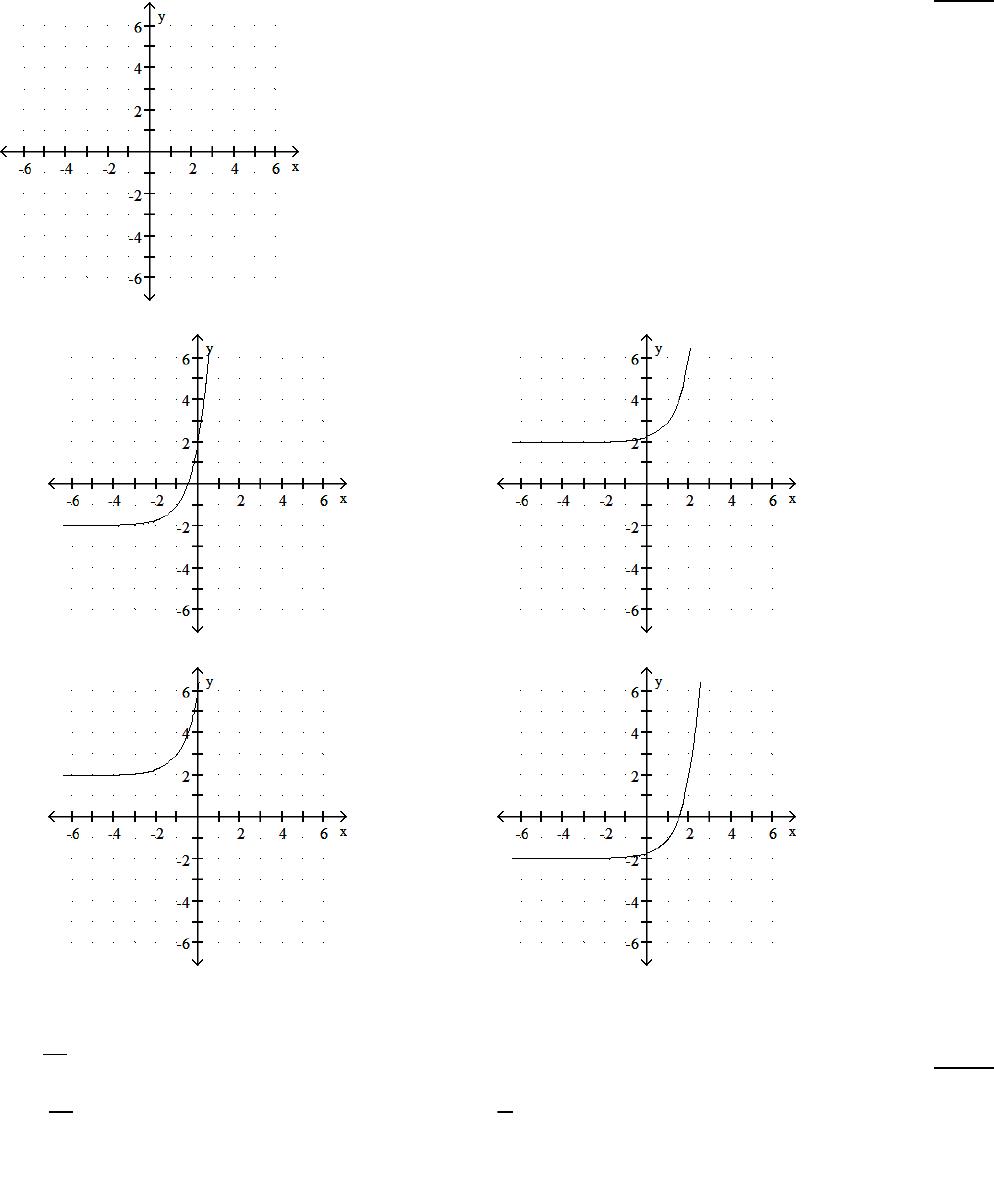
Graph.
122)
f(x) =4x + 1 – 2
122)
A)
B)
C)
D)
Solve. Round your answer to three decimal places if necessary.
123)
4x=1
64
123)
A)
1
16
B)
-3
C)
1
3
D)
3
21
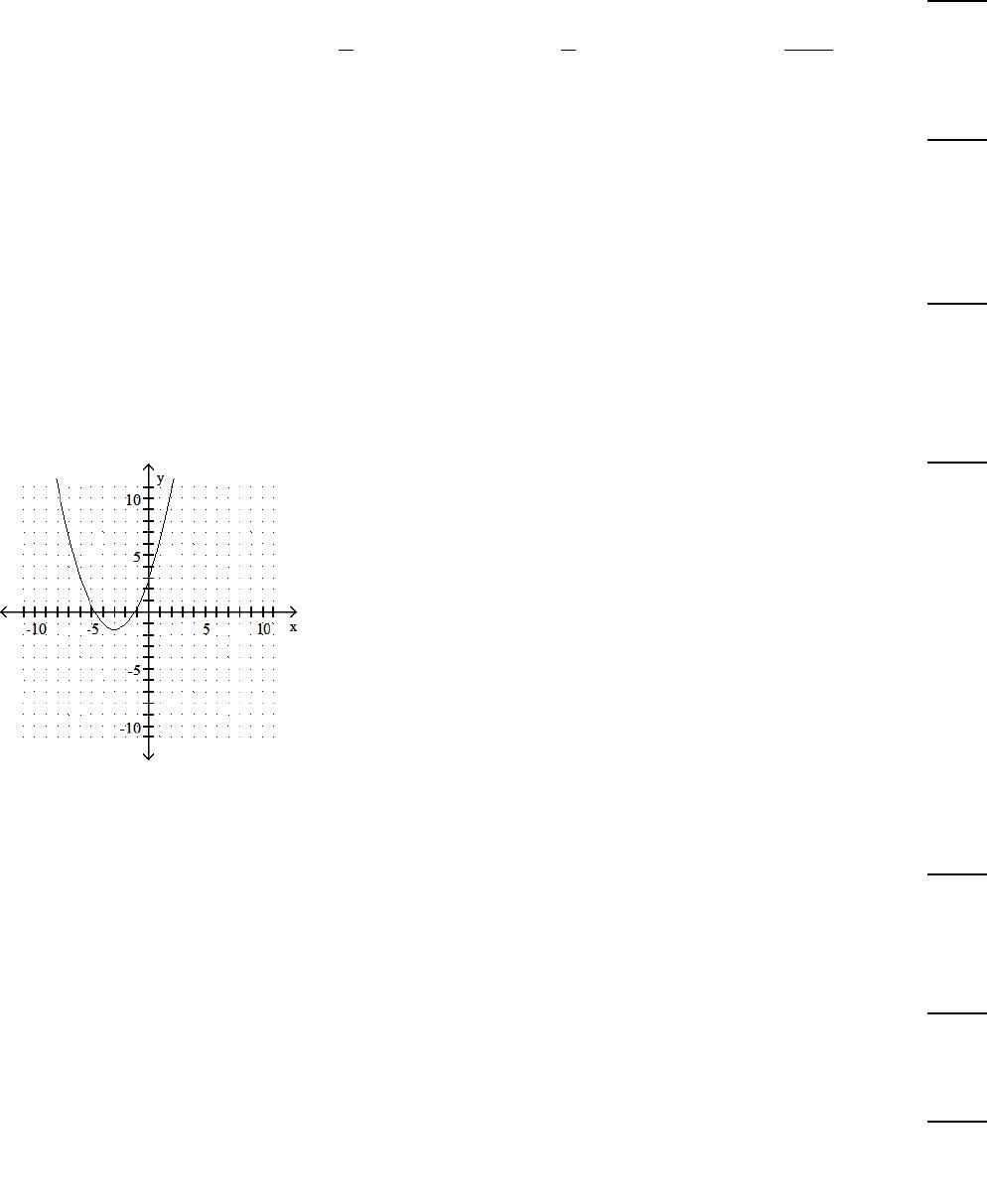
Solve the problem.
124)
A size 12 dress in Country C is size 64 in Country D. A function that converts dress sizes in
Country C to those in Country D is f(x) = 2(x +20). Find the inverse function.
124)
A)
f-1(x) = x – 20
B)
f-1(x) =x
2– 20
C)
f-1(x) =x
2+20
D)
f-1(x) =x – 20
2
125)
Suppose that f(x) gives the time in hours to travel x miles at 41 miles per hour. If you evaluate
f-1(6), what are you finding?
125)
A)
The hours taken to travel 41 miles
B)
The miles traveled in 41 hours
C)
The miles traveled in 6 hours
D)
The hours taken to travel 6 miles
Solve.
126)
An economist predicts that the buying power B(x) of a dollar x years from now will be given by the
formula B(x) =0.22x. How much will today’s dollar be worth in 7 years? Round the answer to the
nearest cent.
126)
A)
$0.35
B)
$0.00
C)
$1.54
D)
$1.53
Determine whether or not the function is one–to–one.
127)
127)
A)
No
B)
Yes
Decide whether the given functions are inverses.
128)
f = {(-9, 15), (6, 0), (0, 22), (15, -9)}
g = {(15, -9), (0, 6), (22, 0), (-9, 15)}
128)
A)
No
B)
Yes
Solve. Round your answer to three decimal places if necessary.
129)
3x + 5=8x
129)
A)
7.54
B)
3.66
C)
-5.6
D)
5.6
Decide whether the given functions are inverses.
130)
f = {(3, 16), (4, 24), (5, 32), (6, 40), (7, 48)}
g = {16, 3), (24, 4), (32, 5), (40, 6), (48, 7)}
130)
A)
No
B)
Yes
22

Solve the logarithmic equation.
131)
ln x – ln (x –5) = ln 3
131)
A)
5 ln 3
ln 3 – 1
B)
15
2
C)
No solution
D)
-2
Solve the problem.
132)
A sample of 250 grams of radioactive substance decays according to the function A(t) = 250e-0.033t,
where t is the time in years. How much of the substance will be left in the sample after 10 years?
Round to the nearest whole gram.
132)
A)
1 gram
B)
0 grams
C)
180 grams
D)
9 grams
Write in exponential form.
133)
log31=0
133)
A)
10=3
B)
31=0
C)
30=1
D)
03=1
Solve the problem.
134)
Suppose that y =2 – log (100 – x)
0.3 can be used to calculate the number of years y for x percent of a
population of 735 web-footed sparrows to die. Approximate the percentage (to the nearest whole
per cent) of web-footed sparrows that died after 1 yr.
134)
A)
48%
B)
44%
C)
50%
D)
52%
Write the expression as the sum or difference of multiples of logarithms.
135)
log2x7y2
6
135)
A)
7log2 x + 2 log2 y +log26
B)
7log2 x – 2 log2 y –log26
C)
(log2 x)7+( log2 y)2–log26
D)
7log2 x + 2 log2 y –log26
Write the expression as a logarithm of a quantity to a power. Leave answers in simplest form without negative or
fractional exponents.
136)
3log4y
136)
A)
4log3y3
B)
log4y3
C)
log3y4
D)
3log4y3
23
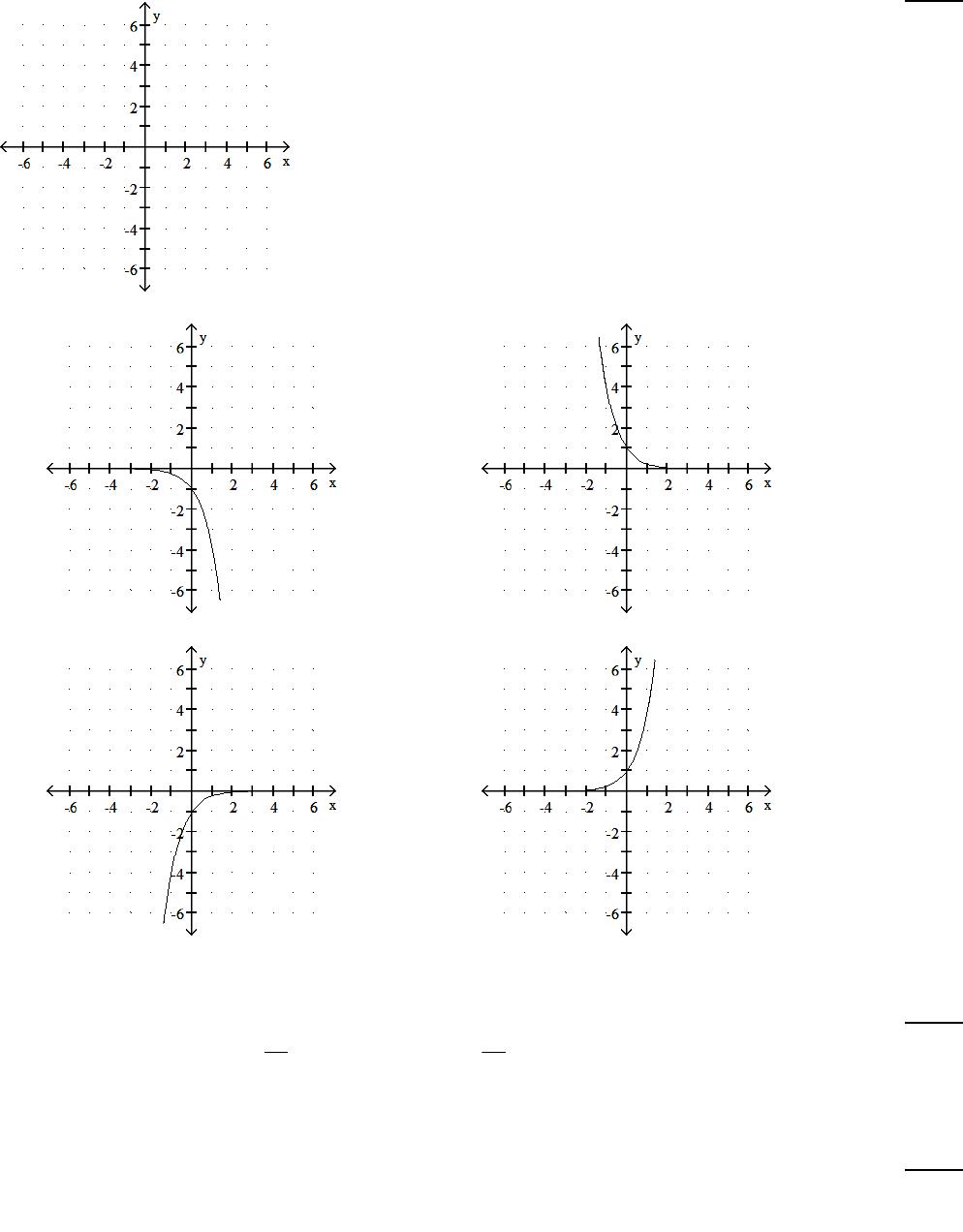
Graph.
137)
f(x) =4x
137)
A)
B)
C)
D)
Solve.
138)
log4 x +3=6
138)
A)
64
B)
1
64
C)
1
61
D)
61
Write in logarithmic form.
139)
62=36
139)
A)
log236 =6
B)
log62=36
C)
log36 6=2
D)
log636 =2
24
Decide whether the given functions are inverses.
140)
f = {(-3, 6), (3, -3), (0, 7)}
g = {(-3, 3), (7, 0), (6, 6)}
140)
A)
Yes
B)
No
Find the indicated composition.
141)
f(x) =x2+ 2; g(x) =5x + 1
Find (f
g)(x).
141)
A)
(f
g)(x) =25x2+ 10x + 1
B)
(f
g)(x) =25x2+ 5x + 3
C)
(f
g)(x) =25x2+ 10x + 3
D)
(f
g)(x) =5x2+ 11
Determine whether f and g are inverses by determining whether (f
g)(x) = x and (g
f)(x) = x.
142)
f(x) =x2– 7, g(x) =x + 7
142)
A)
Yes
B)
No
Write the expression as a single logarithm. Leave your answer in simplest form without negative or fractional exponents.
143)
6logcx–logcy
143)
A)
logc (x6–y)
B)
logcx6÷logcy
C)
logc6x
y
D)
logcx6
y
Solve the problem.
144)
Find the hydrogen ion concentration of a solution whose pH is 6.5. Use the formula pH = -log [H+].
144)
A)
3.16 × 10⁻⁷
B)
-0.8129134
C)
0.81291336
D)
3.16 × 10⁶
Solve.
145)
Newton’s Law of Cooling states that if a body with temperature T1 is placed in surroundings with
temperature T0 different from T1, then the body will either cool or warm to temperature T(t) after
time t, in minutes, where T(t) = T0 + (T1 – T0)e-kt.
A cup of coffee with temperature 105°F is placed in a freezer with temperature 0°F. After 5
minutes, the temperature of the coffee is 69.3°F. What will its temperature be 20 minutes after it is
placed in the freezer? Round your answer to the nearest degree.
145)
A)
16°F
B)
18°F
C)
17°F
D)
20°F
The percentage, P, of students who recall the important features of a lecture after x days is given by the formula
P = 95 – 30 log2 x. Use this formula and the change–of–base formula to find the percentage, P, of a lecture retained after
the given number of days. Round your answer to the nearest whole percent.
146)
6 days
146)
A)
41%
B)
17%
C)
21%
D)
27%
Solve. Round your answer to three decimal places if necessary.
147)
31+ 2x=27
147)
A)
9
B)
–1
C)
3
D)
1
25
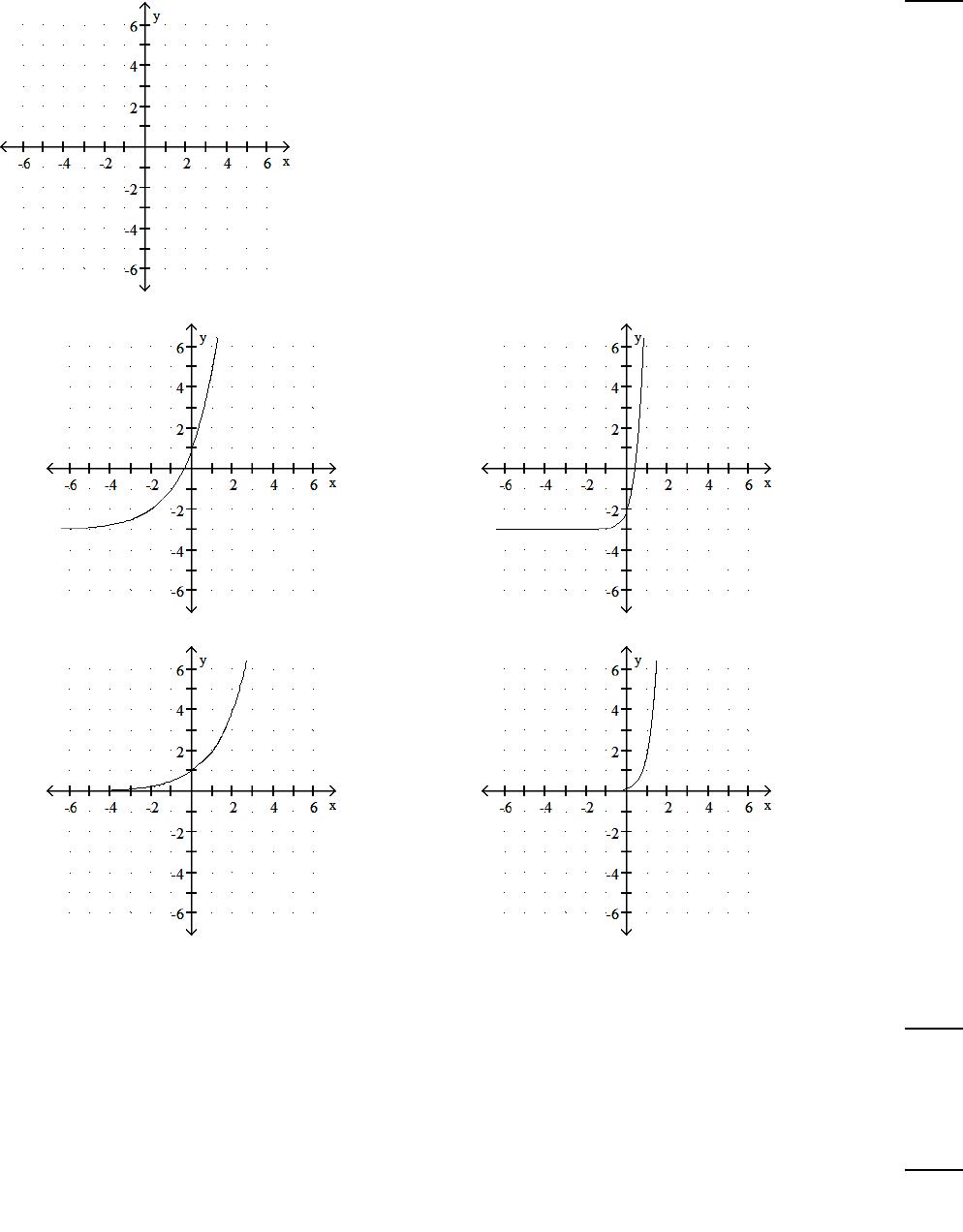
Graph.
148)
f(x) =24x – 3
148)
A)
B)
C)
D)
Find f–1(x) for the following one–to–one function f.
149)
f = {(–7, 3), (–1, 1), (6, 2), (8, 4)}
149)
A)
f-1 = {(3, –7), (1, –1), (2, 6), (4, 8)}
B)
f-1 = {(–3, 7), (–1, 1), (–2, –6), (–4, –8)}
C)
f-1 = {(7, –3), (1, –1), (–6, –2), (–8, –4)}
D)
f-1 = {(–3, 7), (–1, –1), (2, –6), (4, –8)}
Use the change–of–base formula to find the logarithm. Round your answer to four decimal places.
150)
log27
150)
A)
2.8074
B)
5.6148
C)
-2.8074
D)
0.3562
26
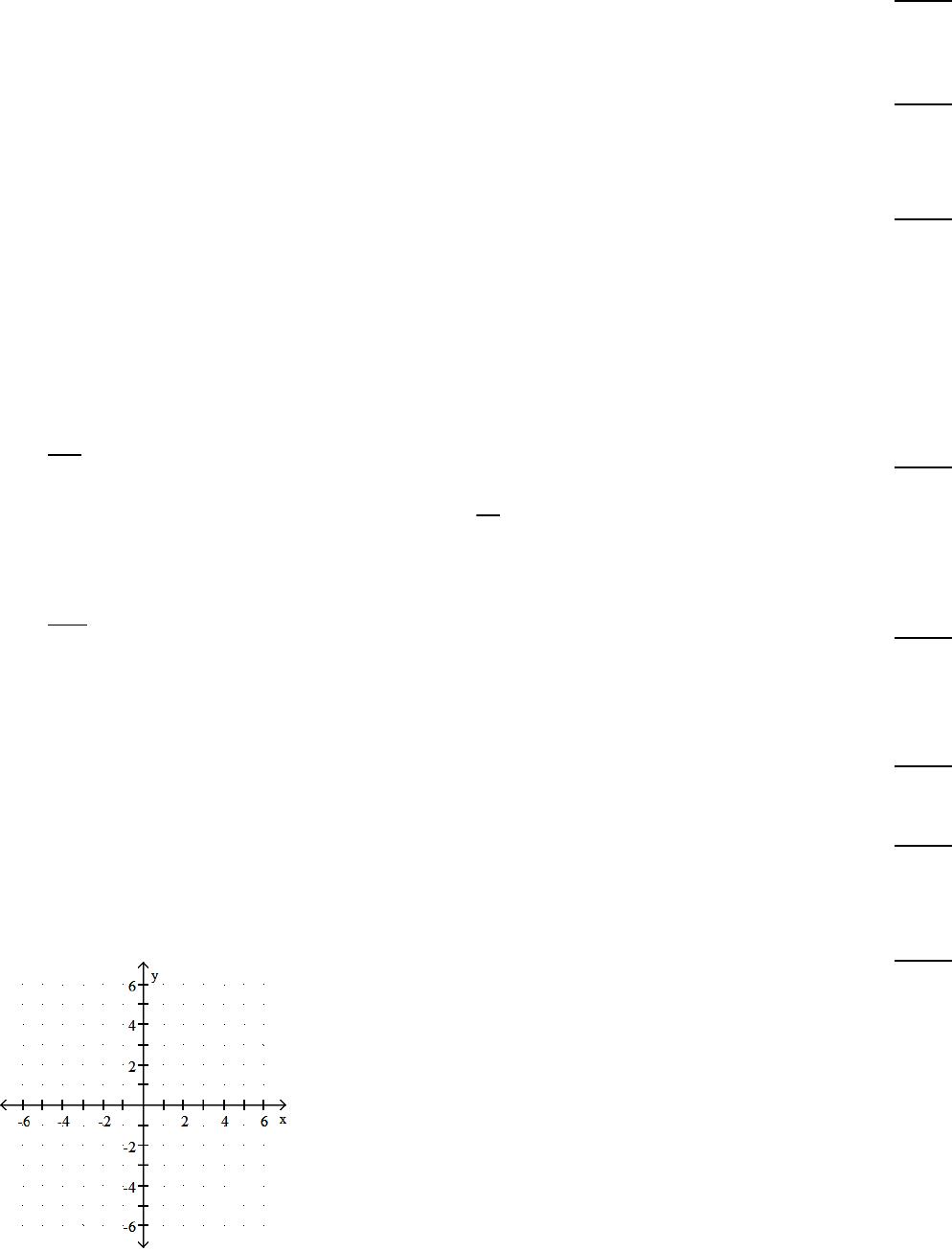
Solve the logarithmic equation.
151)
log (x + 10) – log (x + 4) = log x
151)
A)
2
B)
6
C)
2, –5
D)
No solution
Write in exponential form.
152)
loge3=1.099
152)
A)
31.099 = e
B)
e3=1.099
C)
e1.099 =3
D)
3e=1.099
Solve the problem.
153)
Use the formula D = 10.0 log (S/S0), where the loudness of a sound in decibels is determined by S,
the number of watt/m2 produced by the soundwave, and S0= 1.00 ×10⁻¹² watt/m2. What is the
intensity in watt/m2 of a noise measured at 84 decibels? (Round to an appropriate number of
significant digits.)
153)
A)
4.4 ×10¹⁵ watt/m2
B)
2.5 ×10⁻³ watt/m2
C)
2.5 ×10⁻⁴ watt/m2
D)
8.4 ×10⁻¹⁰ watt/m2
Write the expression using a multiple of a logarithm.
154)
logb1
y10
154)
A)
–10 logby
B)
10 logby
C)
1
10 logby
D)
b log10 y
Determine whether f and g are inverses by determining whether (f
g)(x) = x and (g
f)(x) = x.
155)
f(x) =x – 4
7, g(x) = –7x + 4
155)
A)
Yes
B)
No
Solve.
156)
e-t =0.04 (Round your answer to four decimal places).
156)
A)
3.3189
B)
-3.2189
C)
3.2189
D)
3.0189
157)
9logt27 =27
157)
A)
2
B)
27
C)
9
D)
3
Graph.
158)
f(x) =5-x – 1
158)
27
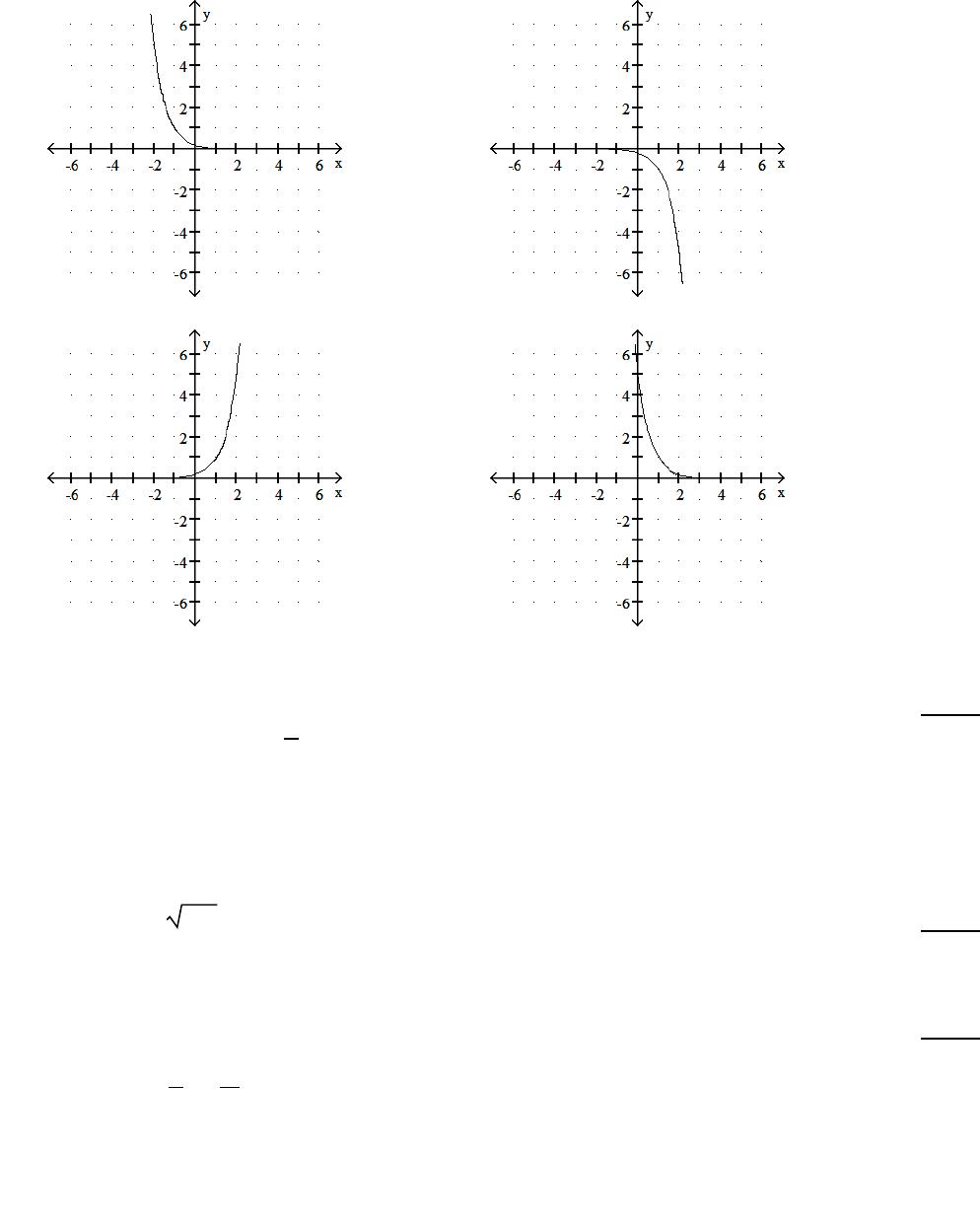
A)
B)
C)
D)
Solve the problem.
159)
A size 44 dress in Country C is size 6 in Country D. A function that converts dress sizes in Country
C to those in Country D is f(x) =x
2– 16. Find the inverse function.
159)
A)
f-1(x) = 2x +16
B)
f-1(x) = x +16
C)
f-1(x) = 2(x – 16)
D)
f-1(x) = 2(x +16)
Determine whether f and g are inverses by determining whether (f
g)(x) = x and (g
f)(x) = x.
160)
f(x) =x3+ 3, g(x) =3x – 3
160)
A)
Yes
B)
No
Solve.
161)
The annual depreciation rate r (0 < r < 1) of a car purchased for P dollars and worth A dollars after t
years can be modeled by the following formula:
log (1 – r) = 1
t log A
P.
Find the depreciation rate of a car that is purchased for $31,000 and is sold 4 years later for $14,000.
Express your answer as a percentage, and round the answer to the nearest whole percentage.
161)
A)
-18%
B)
-82%
C)
82%
D)
18%
28

Compute the compound interest.
162)
How long will it take for $1800 to grow to $3700 at an interest rate of 2.3% if the interest is
compounded continuously? Round the number of years to the nearest hundredth.
162)
A)
3.13 yr
B)
2.3 yr
C)
3132.81 yr
D)
31.33 yr
Solve. Round your answer to three decimal places if necessary.
163)
7x=22
163)
A)
0.63
B)
2.145
C)
3.143
D)
1.588
Solve the logarithmic equation.
164)
log (5+ x) – log (x – 4) = log 4
164)
A)
7
B)
C)
– 7
D)
3
2
Solve the problem.
165)
What is the intensity in watt/m2 of a noise measured at 80 decibels? D = 10 log (S/S0), where S0 is
10-12 watt/m2. (Round to 3 significant digits.)
165)
A)
2.98 ×10¹⁵ watt/m2
B)
8×10⁻¹⁰ watt/m2
C)
1×10⁻³ watt/m2
D)
1×10⁻⁴ watt/m2
Express as a single logarithm and, if possible, simplify.
166)
loga0.01 +loga1000
166)
A)
loga10
B)
loga1
100000
C)
loga0.01 ·loga1000
D)
0.01 loga1000
Determine whether f and g are inverses by determining whether (f
g)(x) = x and (g
f)(x) = x.
167)
f(x) =7x + 3, g(x) =x – 3
7
167)
A)
Yes
B)
No
Compute the compound interest.
168)
How long must $6000 be in a bank at 6% compounded annually to become $12,797.57? (Round to
the nearest year.)
168)
A)
13 yr
B)
15 yr
C)
14 yr
D)
12 yr
Express as a single logarithm and, if possible, simplify.
169)
log412 +log49
169)
A)
log421
B)
log821
C)
log8108
D)
log4108
Express as a sum of logarithms.
170)
log2 (4·16)
170)
A)
log24+log216
B)
log24+log216 +log22
C)
log22+log24
D)
log42+log162
29
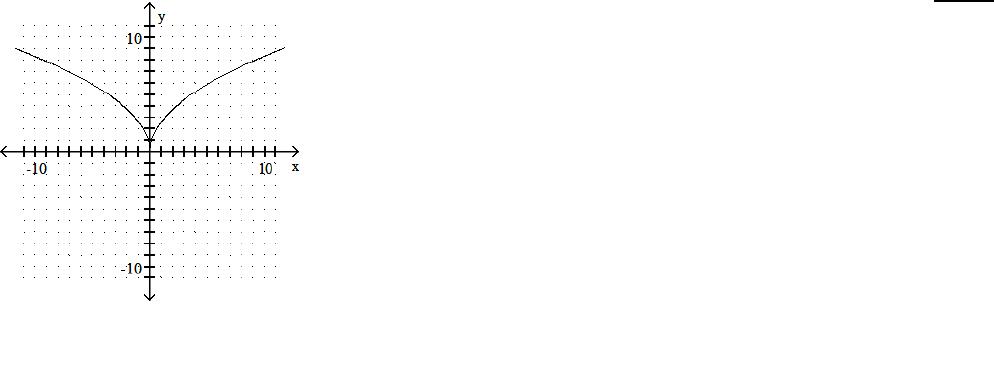
Determine whether or not the function is one–to–one.
171)
171)
A)
No
B)
Yes
30
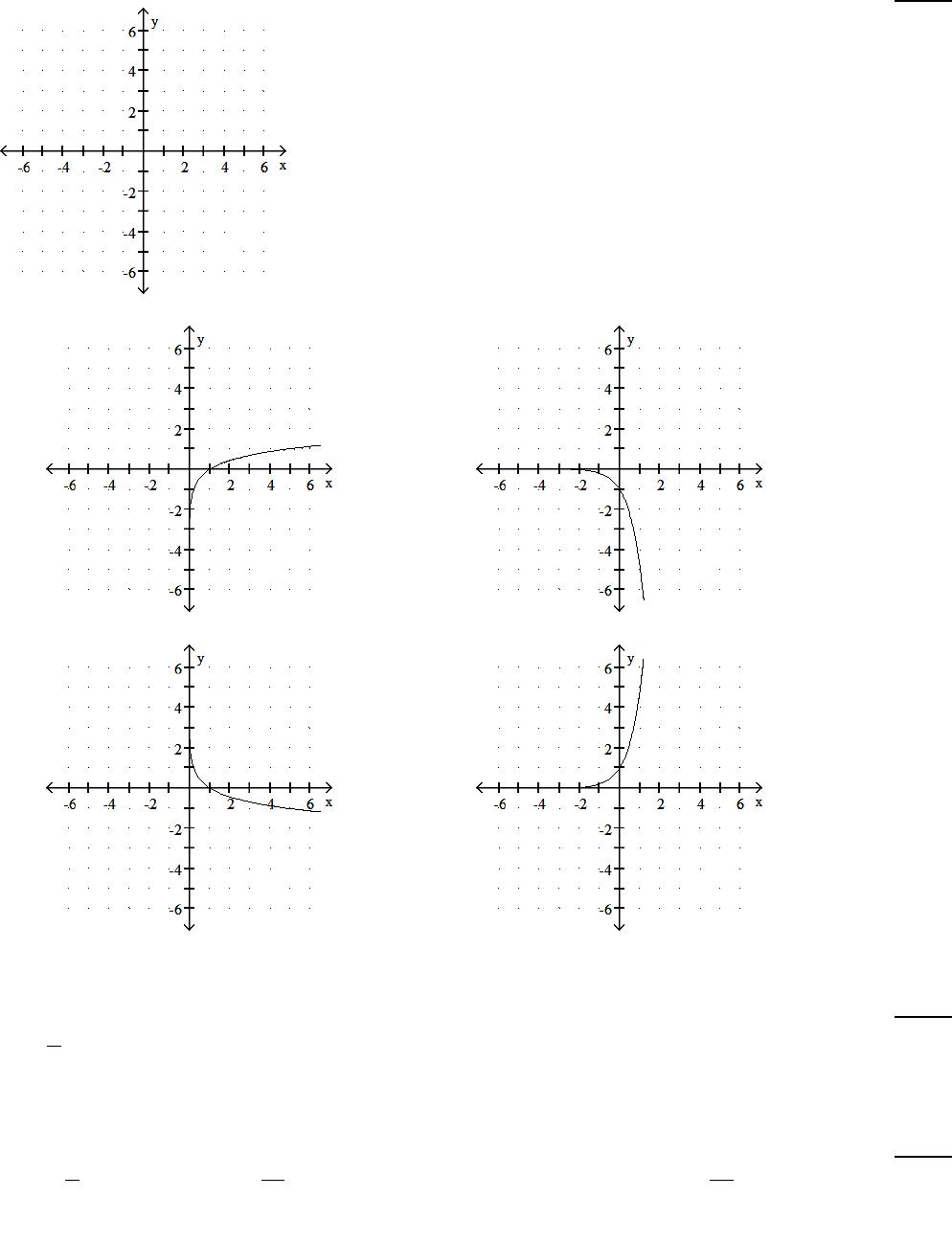
Graph.
172)
f(x) =log5 x
172)
A)
B)
C)
D)
Solve.
173)
log3 x = –2
173)
A)
1
9
B)
8
C)
–9
D)
–6
Solve the logarithmic equation.
174)
ln (5x – 6) = ln 12 – ln (x – 2)
174)
A)
2, 2
5
B)
16
5
C)
D)
0, 16
5
31
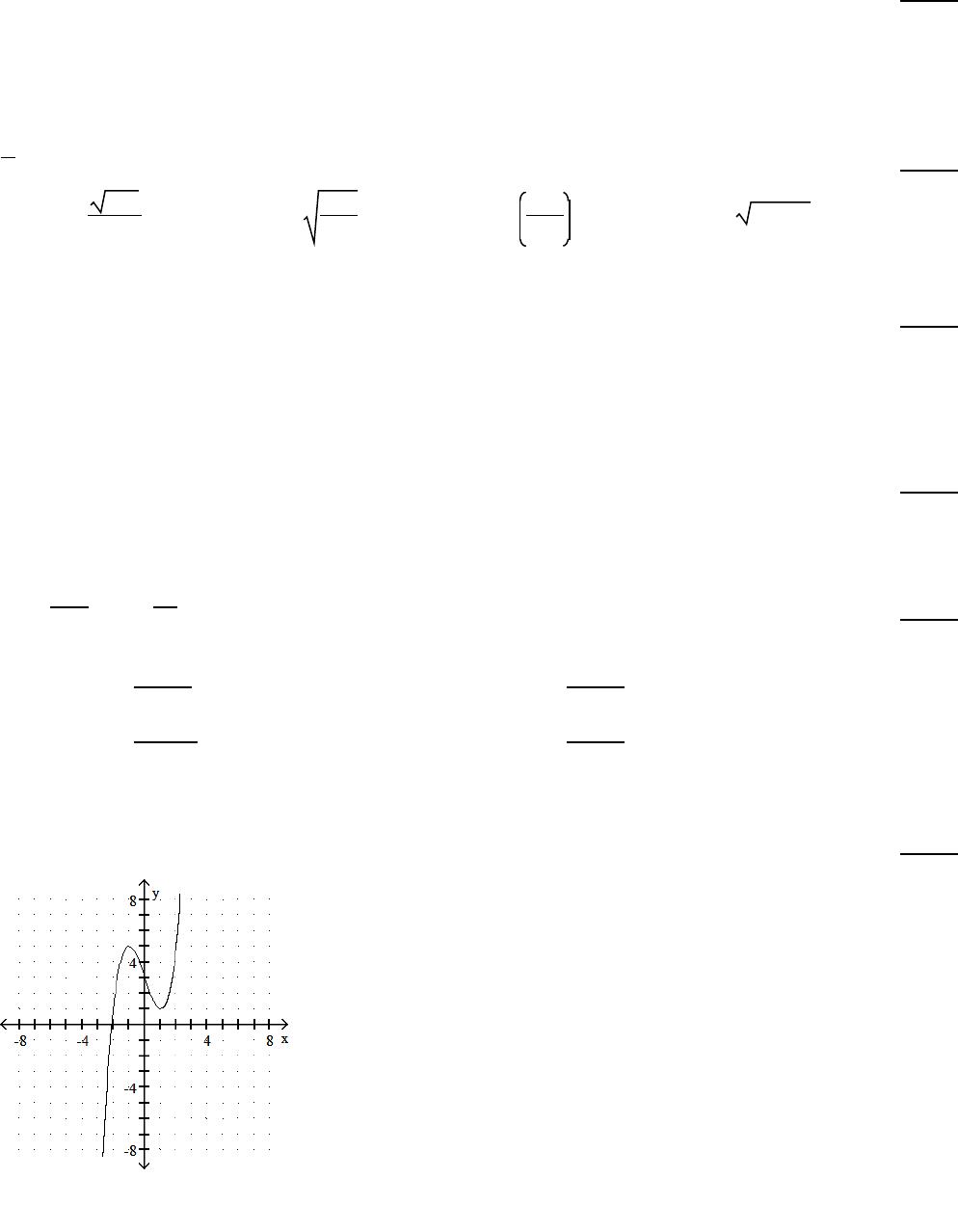
Write the expression as the sum or difference of multiples of logarithms.
175)
loga8x6yz3
175)
A)
8+loga y +logaz3
B)
18 loga8xyz
C)
loga8– 6 loga x –loga y – 3 loga z
D)
loga8+ 6 loga x +loga y + 3 loga z
Write the expression as a single logarithm. Leave your answer in simplest form without negative or fractional exponents.
176)
1
2[log4(r –6) –log4 q]
176)
A)
log4r – 6
q
B)
log4r – 6
q
C)
log4r – 6
2q
D)
log4r – 6 – q
Solve the problem.
177)
Suppose that f(x) gives the cost of a rental car after x days of use at $48 per day. If you solve the
equation f -1(x) = 201, what are you finding?
177)
A)
The number of days rented for $48
B)
The number of days rented for $201
C)
The cost of rental for 48 days
D)
The cost of rental for 201 days
Write the expression using a multiple of a logarithm.
178)
log 9 x9
178)
A)
9log 9 x
B)
log 99
C)
log 99x
D)
log 99·log 9 x
Find the indicated composition.
179)
f(x) =4
x – 8 ; g(x) =7
6x
Find (f
g)(x).
179)
A)
(f
g)(x) =24x
7– 48x
B)
(f
g)(x) =4x
7– 48x
C)
(f
g)(x) =24x
7+ 48x
D)
(f
g)(x) =7x – 56
24x
Determine whether or not the function is one–to–one.
180)
180)
A)
No
B)
Yes
32
Solve the problem.
181)
The decay of 956 mg of an isotope is given by A(t) = 956e-0.033t, where t is time in years. Find the
amount left after 33 years.
181)
A)
322 mg
B)
161 mg
C)
925 mg
D)
311 mg
Write the expression as a logarithm of a quantity to a power. Leave answers in simplest form without negative or
fractional exponents.
182)
5logby
182)
A)
logby5
B)
5logby5
C)
log5yb
D)
b log50 y5
Solve the problem.
183)
The half–life of a certain radioactive substance is 10 years. Suppose that at time t = 0, there are 22 g
of the substance. Then after t years, the number of grams of the substance remaining will be N(t) =
22(1/2)t/20. How many grams of the substance will remain after 100 years?
183)
A)
0.69 g
B)
0.17 g
C)
0.09 g
D)
0.34 g
Using a calculator, evaluate to four decimal places.
184)
ln 0.991
184)
A)
-0.0090
B)
0.0039
C)
-0.0039
D)
0.0090
Solve the problem.
185)
Sun Woo Kim invested $2500 at 4% compounded semiannually. How much will be in the account
after 8 years? Round to the nearest cent.
185)
A)
$3431.96
B)
$3421.42
C)
$4682.45
D)
$2929.15
Write the expression as a single logarithm. Leave your answer in simplest form without negative or fractional exponents.
186)
2log2(3x – 6) – 3 log2(5x – 1)
186)
A)
log2(3x – 6)2
log2(5x – 1)3
B)
log2[(3x – 6)2(5x – 1)3]
C)
log2(3x – 6)2
(5x – 1)3
D)
log2[(3x – 6)2–(5x – 1)3]
Solve the problem.
187)
The amount of particulate matter left in solution during a filtering process is given by the equation
P =1000(2)-0.4n, where n is the number of filtering steps. Find the amounts left for n = 0 and n = 5.
(Round to the nearest whole number.)
187)
A)
2000, 250
B)
1000, 250
C)
1000, 4000
D)
1000, 31
Write in exponential form.
188)
logw Q =18
188)
A)
Qw=18
B)
w18 = Q
C)
18w= Q
D)
Q18 = w
33

Find f–1(x) for the following one–to–one function f.
189)
f = {(2, 4), (5, 7), (3, 6), (8, 1)}
189)
A)
f-1 = {(–4, 2), (–7, 5), (–6, 3), (–1, 8)}
B)
f-1 = {(4, 2), (7, 5), (6, 3), (1, 8)}
C)
f-1 = {(2, –4), (5, –7), (3, –6), (8, –1)}
D)
f-1 = {(–2, –4), (–5, –7), (–3, –6), (–8, –1)}
Determine whether f and g are inverses by determining whether (f
g)(x) = x and (g
f)(x) = x.
190)
f(x) = x – 2, g(x) = x + 2
190)
A)
Yes
B)
No
Solve. Round your answer to three decimal places if necessary.
191)
73x =2x + 1
191)
A)
0.553
B)
0.356
C)
1.356
D)
0.135
Solve the logarithmic equation.
192)
log2 (3x –4) =2
192)
A)
8
3
B)
5
C)
log22 + 4
3
D)
4
3
Compute the compound interest.
193)
Assume the cost of a car is $23,000. With continuous compounding in effect,find the number of
years it would take to double the cost of the car at an annual inflation rate of 6.4%. Round the
answer to the nearest hundredth.
193)
A)
156.93 yr
B)
10.83 yr
C)
1.57 yr
D)
167.76 yr
Using a calculator, evaluate to four decimal places.
194)
log 70
194)
A)
1.3451
B)
4.7485
C)
4.2485
D)
1.8451
Express as a single logarithm and, if possible, simplify.
195)
loga69 +loga2
195)
A)
69 loga2
B)
loga138
C)
loga69 ·loga2
D)
loga69
2
Solve.
196)
The population of a particular city is increasing at a rate proportional to its size. It follows the
function P(t) = 1 + ke0.03t, where k is a constant and t is the time in years. If the current population
is 50,000, in how many years is the population expected to be 125,000? (Round to the nearest year.)
196)
A)
31 yr
B)
13 yr
C)
195 yr
D)
18 yr
Solve the problem.
197)
The intensity of a certain noise is 1.28 ×10⁻⁸ W/cm2. How loud, in decibels, is this sound level? Use
the formula D = 10 log (I/I0), where I0 = 10-16 W/cm2. (Round to the nearest decibel.)
197)
A)
81 decibels
B)
34 decibels
C)
-21 decibels
D)
82 decibels
34
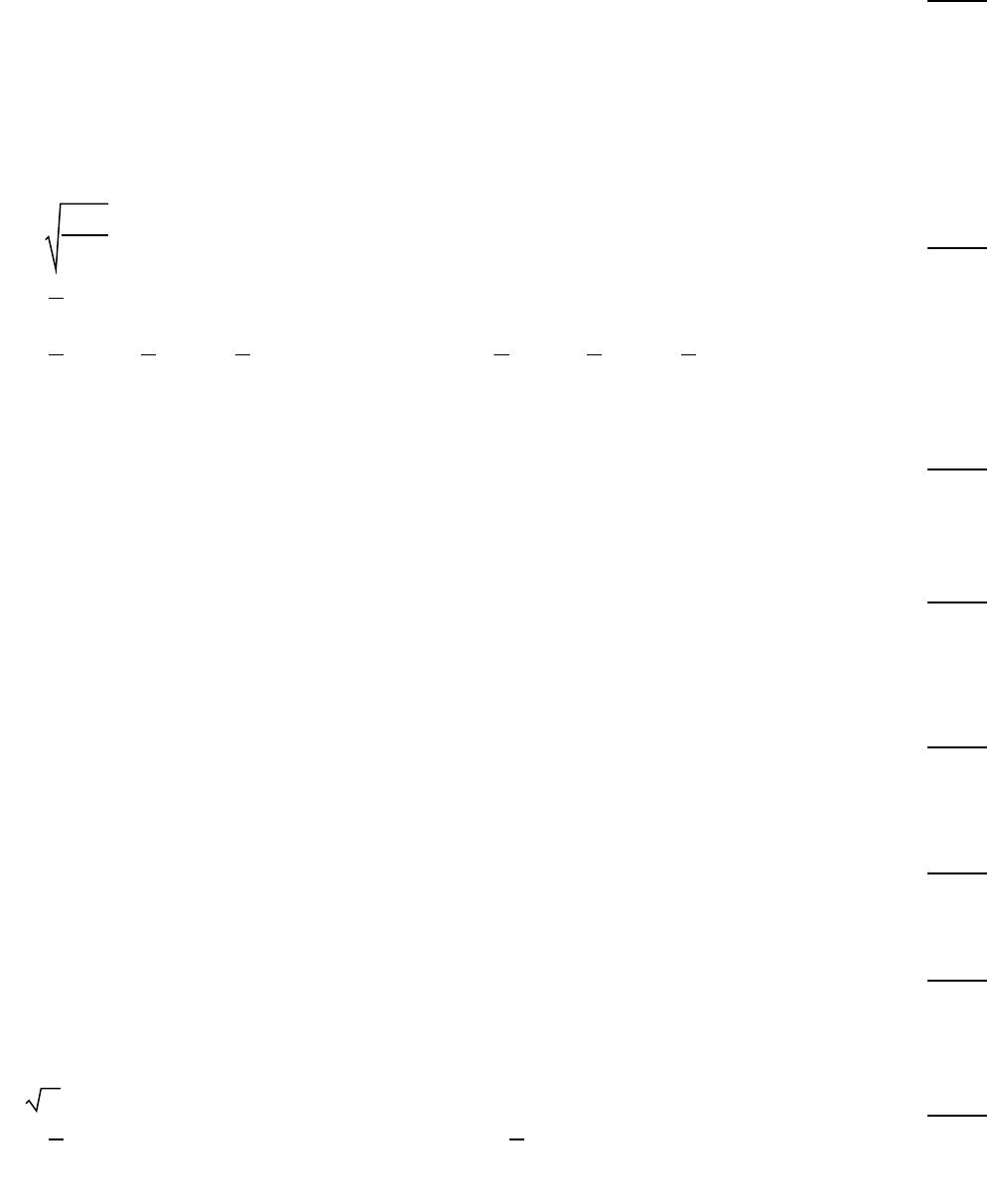
Solve.
198)
The thickness of an airport runway’s pavement is determined by the weight of the planes using it.
The relationship between runway thickness x, in inches, and gross airplane weight y, in thousands
of pounds, can be modeled by the equation y = 18.29(1.279)x. If a loaded cargo plane weighs
300,000 pounds, what must the minimum thickness of the runway be? Round any partial inch up to
the nearest whole inch.
198)
A)
39 in.
B)
11 in.
C)
12 in.
D)
40 in.
Write the expression as the sum or difference of multiples of logarithms.
199)
loga3 x2
y7z4
199)
A)
1
3logax2–logay7–logaz4
B)
2loga x – 7 loga y – 4 loga z
C)
2
3loga x –7
3loga y –4
3loga z
D)
2
3loga x –7
3loga y +4
3loga z
Compute the compound interest.
200)
$8000 is invested at 9% compounded quarterly. In how many years will the account have grown to
$13,500? Round to the nearest tenth of a year.
200)
A)
6.1 years
B)
5.9 years
C)
1.1 years
D)
11.8 years
Solve.
201)
How long will it take for the population of a certain country to double if its annual growth rate is
0.6%? Round to the nearest year. Use the exponential growth model P(t) = P0ekt.
201)
A)
333 yr
B)
50 yr
C)
1 yr
D)
116 yr
Express as a single logarithm and, if possible, simplify.
202)
log58+log57
202)
A)
log515
B)
log10 15
C)
log10 56
D)
log556
Solve.
203)
e-0.07t=0.21 (Round your answer to four decimal places).
203)
A)
-16.6979
B)
-13.2963
C)
12.0875
D)
22.295
Solve the logarithmic equation.
204)
log (x – 9) = 1 – log x
204)
A)
-10
B)
-10, 1
C)
-1, 10
D)
10
Find the exact value of the logarithm using logbbx= x.
205)
ln 4 e
205)
A)
1
4
B)
–4
C)
–1
4
D)
4
35
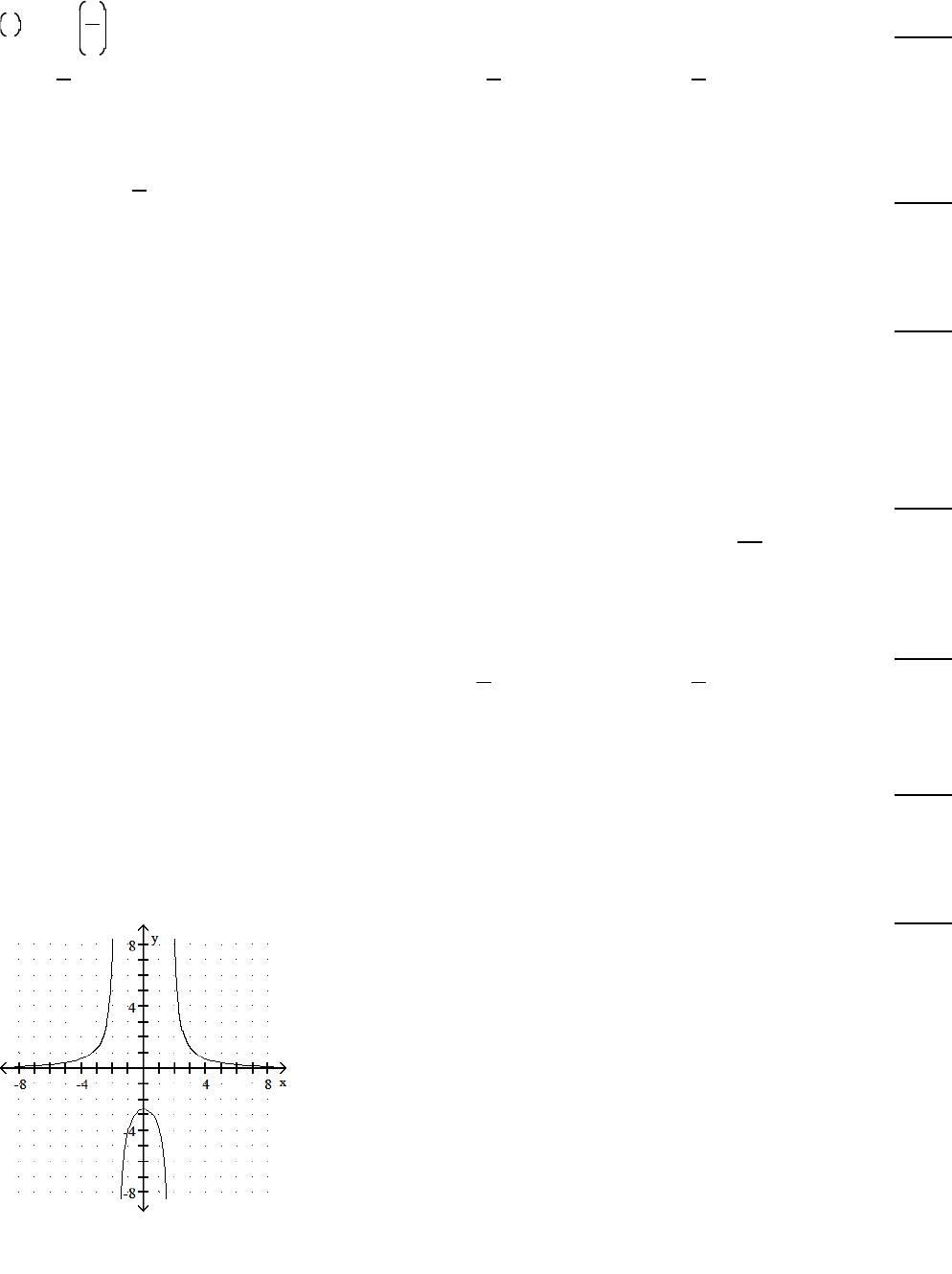
Solve the equation.
206)
8 x + 1=1
2 x – 1
206)
A)
– 1
2
B)
– 1
C)
– 1
4
D)
1
2
Determine whether f and g are inverses by determining whether (f
g)(x) = x and (g
f)(x) = x.
207)
f(x) =6x, g(x) =6
x
207)
A)
Yes
B)
No
Provide an appropriate response.
208)
By definition of an exponential function, if f(x) =bx is an exponential function, then b must be
_______ .
208)
A)
greater than one
B)
greater than or equal to zero
C)
greater than or equal to one
D)
greater than zero and not equal to one
Write the expression as a logarithm of a quantity to a power. Leave answers in simplest form without negative or
fractional exponents.
209)
-5 logcx
209)
A)
log-5 x-c
B)
log5xc
C)
logc(-x)-5
D)
logc1
x5
Solve the logarithmic equation.
210)
log 5x = log 3+ log (x + 4)
210)
A)
6
B)
-6
C)
7
4
D)
3
2
Decide whether the given functions are inverses.
211)
f = {(3, 2), (6, 4), (9, 6), (12, 8), (15, 10)}
g = {(2, 3), (-4, 6), (6, 9), (8, 12), (10, 15)}
211)
A)
No
B)
Yes
Determine whether or not the function is one–to–one.
212)
212)
A)
No
B)
Yes
36

Solve the equation.
213)
9x=813x + 5
213)
A)
– 5
2
B)
2
C)
– 2
D)
– 1
2
Using a calculator, evaluate to four decimal places.
214)
log 6664
214)
A)
8.8045
B)
9.3045
C)
3.8237
D)
3.3237
Write the expression using a multiple of a logarithm.
215)
logby3
215)
A)
b log3y
B)
3logby3
C)
b log30 y3
D)
3logby
Solve the equation.
216)
36– 3x=1
27
216)
A)
–3
B)
9
C)
1
9
D)
3
Solve the problem.
217)
Use the formula N = Iekt, where N is the number of items in terms of the initial population I, at
time t, and k is the growth constant equal to the percent of growth per unit of time. An artifact is
discovered at a certain site. If it has 48% of the carbon–14 it originally contained, what is the
approximate age of the artifact? (carbon–14 decays at the rate of 0.0125% annually.)
217)
A)
2550 years
B)
4160 years
C)
3840 years
D)
5872 years
Solve.
218)
The height in meters of females in a certain ethnic group is approximated by h = 0.52 + 2 log (t/3)
where t is the girl’s age in years and 1 t 20. Estimate a girl’s height at 4 years of age in this
particular ethnic group. Round to the nearest hundredth.
218)
A)
0.52 m
B)
0.77 m
C)
0.96 m
D)
1.12 m
Write in logarithmic form.
219)
2-2 =1
4
219)
A)
log-2 1
4=2
B)
log1/42=-2
C)
log2-2 =1
4
D)
log21
4=-2
220)
10-5 =0.00001
220)
A)
log5-5 = 0.10
B)
log5 0.10 =-5
C)
log10 0.00001 =-5
D)
log10 -5 =0.00001
Solve.
221)
There are currently 57 million cars in a certain country, decreasing by 1.9% annually. How many
years will it take for this country to have 31 million cars? (Round to the nearest year.)
221)
A)
32 years
B)
14 years
C)
171 years
D)
26 years
37
Solve the problem.
222)
Use the formula N = Iekt, where N is the number of items in terms of the initial population I, at
time t, and k is the growth constant equal to the percent of growth per unit of time. There are
currently 78 million cars in a certain country, decreasing by 0.8% annually. How many years will it
take for this country to have 60 million cars? Round to the nearest year.
222)
A)
33 years
B)
361 years
C)
18 years
D)
23 years
Express as a single logarithm and, if possible, simplify.
223)
log68–log6m
223)
A)
log6m
8
B)
log68
m
C)
log6 (8– m)
D)
log12 8
m
Provide an appropriate response.
224)
Logarithms with a base of 10 are called _______ logarithms, and base–e logarithms are called
_______ logarithms.
224)
A)
common; natural
B)
common; exponential
C)
natural; exponential
D)
natural; common
Graph the function. Describe its position relative to the graph of the indicated basic function.
225)
f(x) =4x– 4; relative to f(x) =4x
225)
A)
Moved down 4 unit(s)
B)
Moved down 4 unit(s)
38
C)
Moved up 4 unit(s)
D)
Moved up 4 unit(s)
Solve the problem.
226)
The population growth of an animal species is described by F(t) = 500+ 50 log3 (2t + 1) where t is
measured in months. Find the population of this species in an area 13 month(s) after the species is
introduced.
226)
A)
650
B)
335
C)
1850
D)
945
Express as a difference of logarithms.
227)
log32
5
227)
A)
log35–log32
B)
log32–log35
C)
log32+log32
D)
log32÷log35
Express as a single logarithm and, if possible, simplify.
228)
logat+logas
228)
A)
logats
B)
logat
s
C)
loga (t+ s)
D)
logat·logas
Write in exponential form.
229)
logw z =5
229)
A)
zw=5
B)
z5= w
C)
w5= z
D)
5w= z
Write in logarithmic form.
230)
32=9
230)
A)
log32=9
B)
log29=3
C)
log39=2
D)
log93=2
Compute the compound interest.
231)
How long will it take for $8400 to grow to $20,100 at an interest rate of 9.9% if the interest is
compounded quarterly? Round the number of years to the nearest hundredth.
231)
A)
9.24 yr
B)
24.47 yr
C)
8.92 yr
D)
35.69 yr
Provide an appropriate response.
232)
If (a, b) is an ordered pair on the graph of f, what are the coordinates of the ordered pair on the
graph of f-1?
232)
A)
(a, b)
B)
(–a, –b)
C)
(–b, a)
D)
(b, a)
39
Find the composition.
233)
f(x) =5x + 9; g(x) =4x2
Find (g
f)(x).
233)
A)
(g
f)(x) =76
B)
(g
f)(x) =16 76
C)
(g
f)(x) =762
D)
(g
f)(x) =89
Determine whether f and g are inverses by determining whether (f
g)(x) = x and (g
f)(x) = x.
234)
f(x) =8 + x
x, g(x) =8
x – 1
234)
A)
Yes
B)
No
Decide whether the given functions are inverses.
235)
f = {(3, 10), (10, -5), (-5, -9)}
g = {(10, 3), (-5, 10), (-9, 3)}
235)
A)
No
B)
Yes
Provide an appropriate response.
236)
A function has an inverse if and only if the function is ___________ .
236)
A)
linear
B)
unique
C)
one–to–one
D)
able to be graphed
Solve the equation.
237)
243x=81
237)
A)
4
5
B)
1
5
C)
5
4
D)
1
4
Solve the problem.
238)
The amount of particulate matter left in solution during a filtering process decreases by the
equation P = 400(0.5)0.8n, where n is the number of filtering steps. Find the amounts left for n = 0
and n = 5. (Round to the nearest whole number.)
238)
A)
400, 13
B)
400, 25
C)
800, 25
D)
400, 6400
Determine whether or not the function is one–to–one.
239)
239)
A)
Yes
B)
No
40
Express as a single logarithm and, if possible, simplify.
240)
loga1,000,000 –loga1000
240)
A)
loga999,000
B)
loga1
1000
C)
1000 loga1,000,000
D)
loga1000
Graph.
241)
f(x) = –5x
241)
A)
B)
C)
D)
41
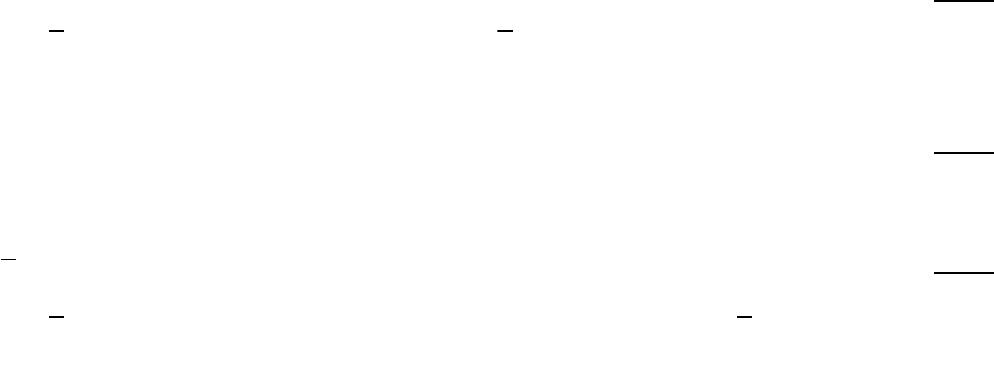
Solve.
242)
log2 x = –3
242)
A)
1
8
B)
-6
C)
1
9
D)
-1
Solve the equation.
243)
2x + 1 =16
243)
A)
-1
B)
4
C)
-3
D)
3
Solve.
244)
1
2log2 x +8=7
244)
A)
1
4
B)
–4
C)
4
D)
–1
4
42
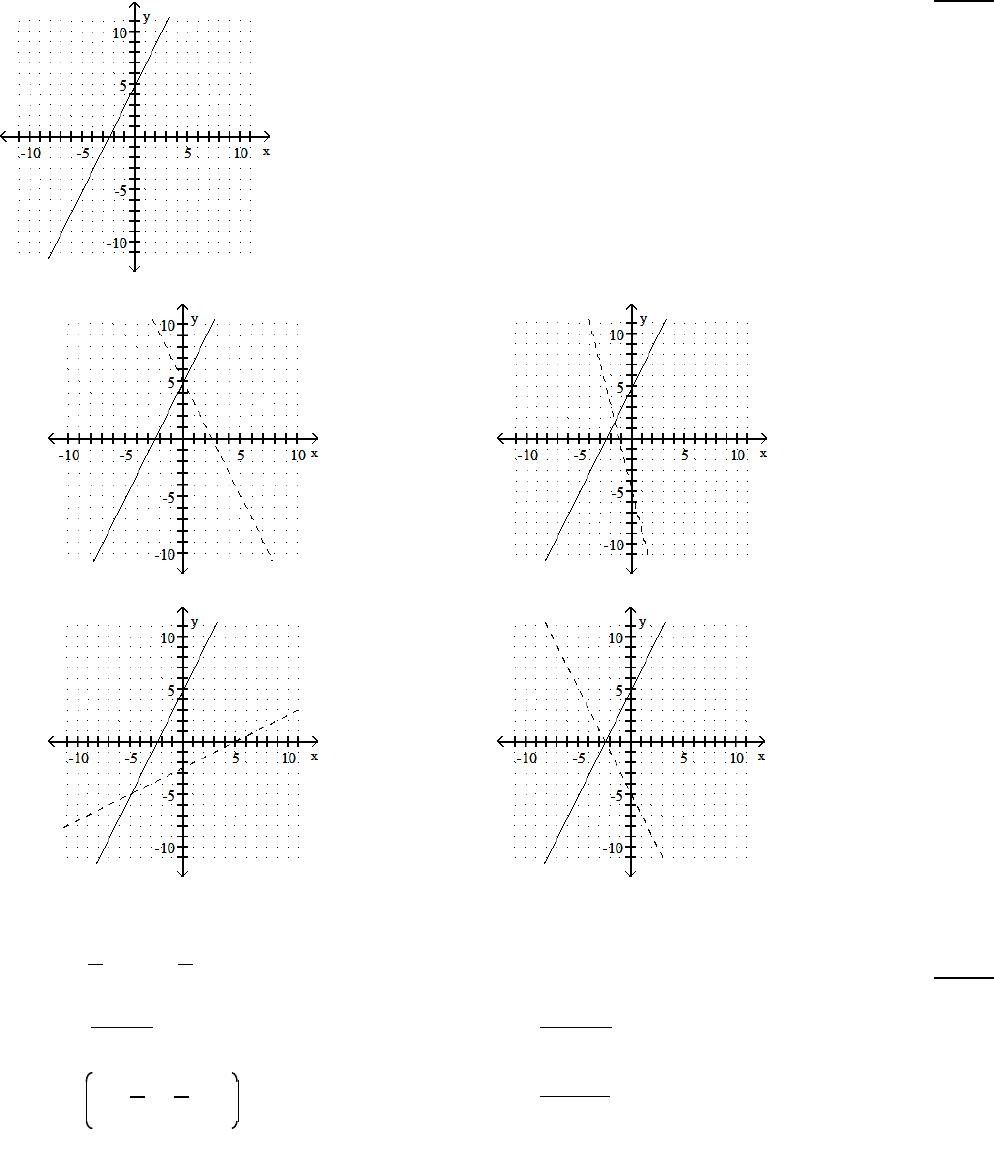
Use the graph of f to sketch a graph of the inverse of f using a dashed curve.
245)
245)
A)
B)
C)
D)
Write the expression as a single logarithm. Leave your answer in simplest form without negative or fractional exponents.
246)
5logaq–3
5logar+1
6logaf– 3 logap
246)
A)
logaq5f1/6
r3/5p3
B)
logaq5p3
f1/6r3/5
C)
loga5q – 3
5r + 1
6f– 3p
D)
logaq5r3/5
f1/6p3
43
Find the composition.
247)
f(x) =4x +7; g(x) =-2
x
Find (g
f)(3).
247)
A)
55
3
B)
13
3
C)
– 2
19
D)
– 38
3
Decide whether the given functions are inverses.
248)
f = {(3, 10), (4, 12), (5, 14), (6, 16), (7, 18)}
g = {(10, 3), (12, 4), (14, 5), (16, 6), (18, 7)}
248)
A)
No
B)
Yes
Solve.
249)
logx81 =4
249)
A)
4 or -4
B)
3 or -3
C)
3
D)
4
250)
e5x =7(Round your answer to four decimal places).
250)
A)
9.7296
B)
3.8056
C)
0.2299
D)
0.3892
Find the exact value of the logarithm using logbbx= x.
251)
ln e3
251)
A)
3
B)
4
C)
–3
D)
2
Solve the problem.
252)
A temperature of 32° Fahrenheit is equal to a temperature of 0° Celsius. A function that converts
temperatures in Fahrenheit to those in Celsius is f(x) =5
9(x – 32) Fahrenheit. Find the inverse
function.
252)
A)
f-1(x) = x + 32
B)
f-1(x) =5
9(x – 32)
C)
f-1(x) =9
5x + 32
D)
f-1(x) =9
5x – 32
Using a calculator, evaluate to four decimal places.
253)
ln 0.000777
253)
A)
7.1601
B)
-7.1601
C)
3.1096
D)
-3.1096
Solve the problem.
254)
The hydrogen ion concentration of a substance is about 4.2 ×10⁻⁶ moles per liter. Find the pH.
Round to the nearest tenth. Use the formula pH = –log [H+].
254)
A)
–6.6
B)
5.4
C)
5.7
D)
6.6
Graph.
44
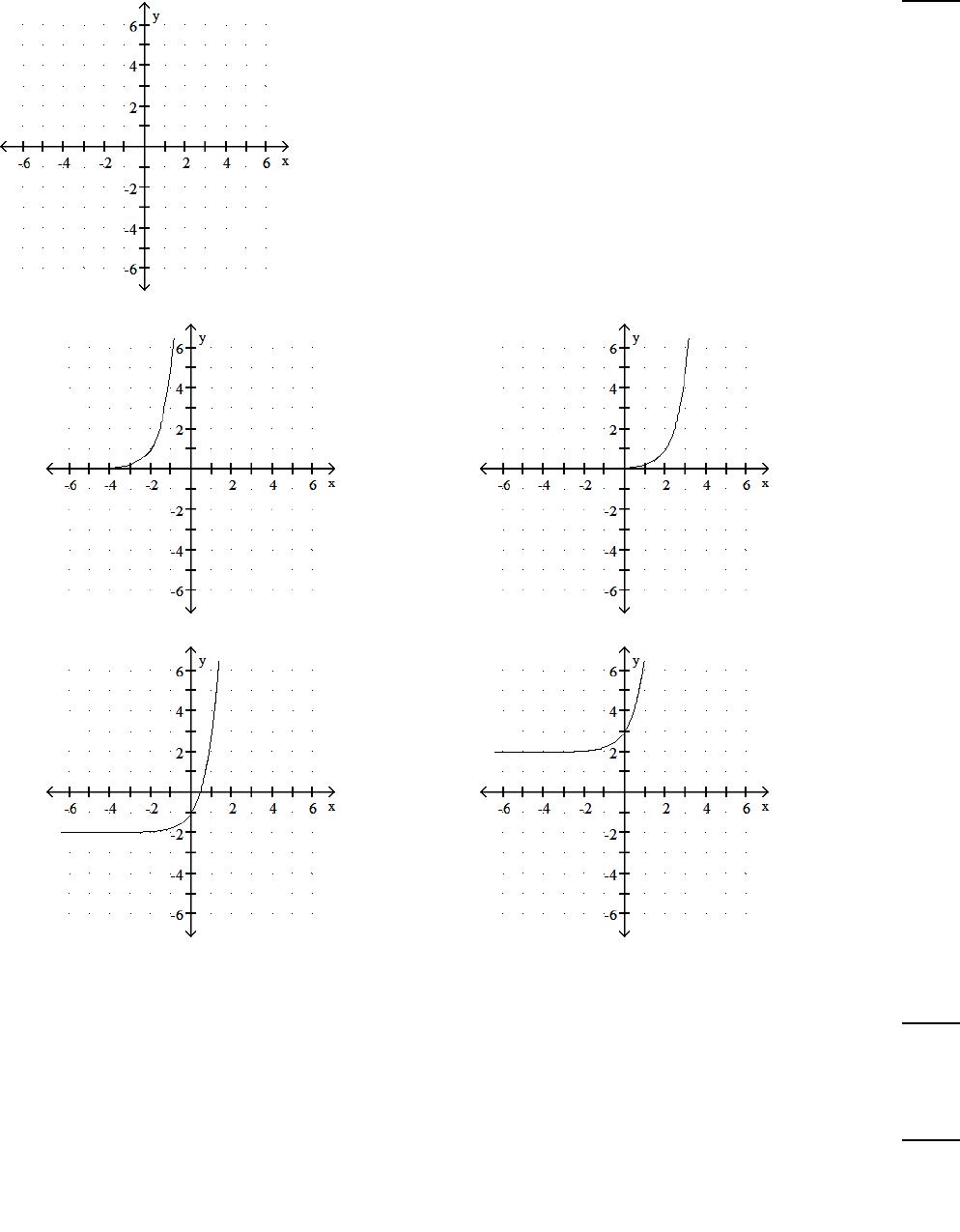
255)
f(x) =5x+ 2
255)
A)
B)
C)
D)
Express as a sum of logarithms.
256)
log49x
256)
A)
log29+log2 x
B)
log49+log4 x
C)
log29–log2 x
D)
log49–log4 x
Solve.
257)
How long will it take for prices in the economy to double at a 5% annual inflation rate? Use the
exponential growth model P(t) = P(t) = P0ekt. (Round to the nearest year.)
257)
A)
17 yr
B)
23 yr
C)
12 yr
D)
14 yr
45
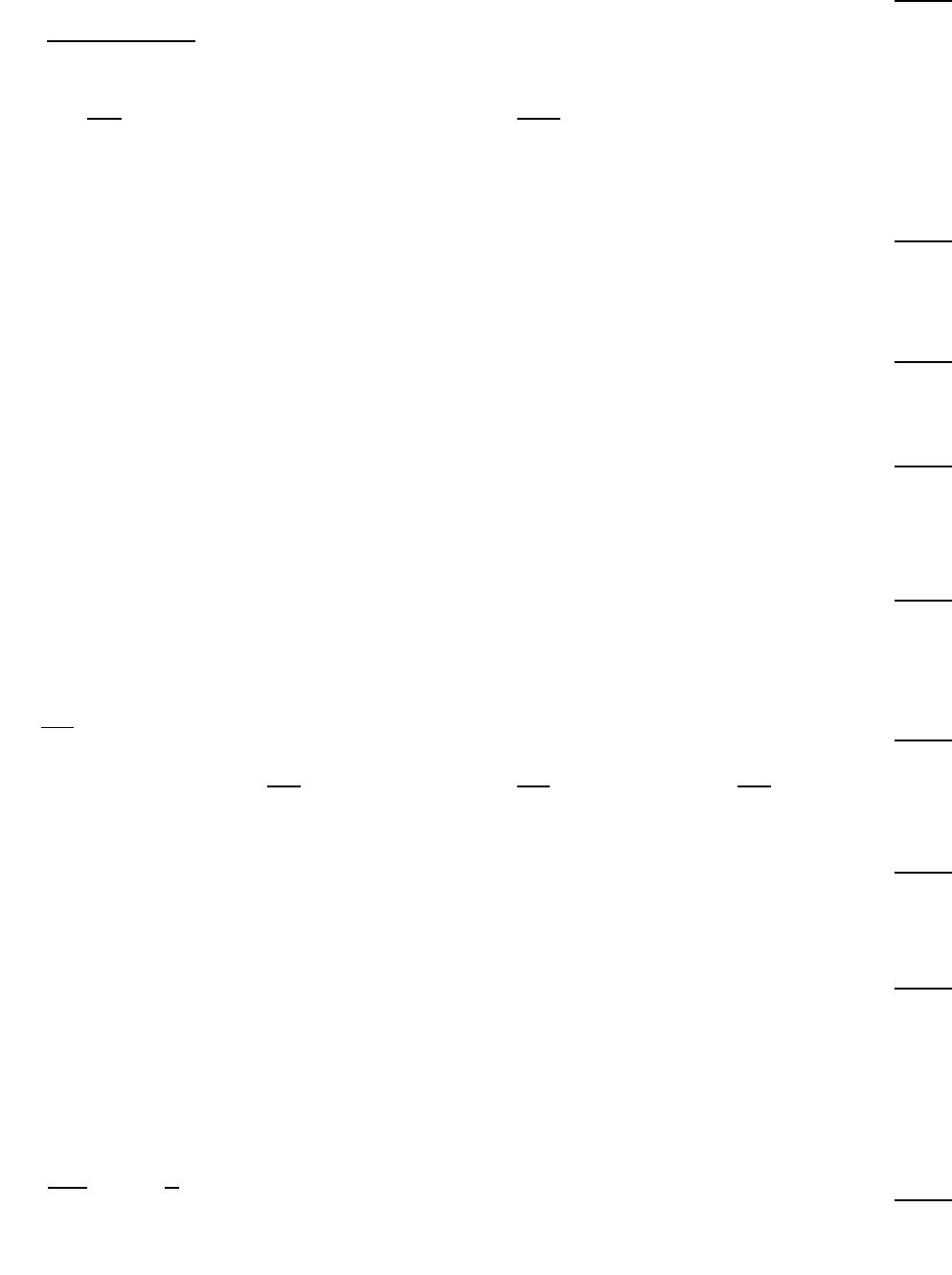
Write the expression as a single logarithm. Leave your answer in simplest form without negative or fractional exponents.
258)
loga6x +5(loga x –loga y)
258)
A)
(loga6x)(logax5)
logay5
B)
loga(6x +x5–y5)
C)
loga6x6
y5
D)
loga30x2
y5
Solve.
259)
log327 = x
259)
A)
3
B)
9
C)
81
D)
30
Find the exact value of the logarithm using logbbx= x.
260)
log 1000
260)
A)
–3
B)
2
C)
3
D)
4
Provide an appropriate response.
261)
What are the possible values respectively of the domain, x, and the range, y, of the equation
y = ln x ?
261)
A)
(0,
); (–
,
)
B)
(0,
); (1,
)
C)
(0,
); (0,
)
D)
(–
,
); (–
,
)
Solve the problem.
262)
The number of acres in a landfill is given by the function B = 7700e–-0.02t, where t is measured in
years. How many acres will the landfill have after 7 years? (Round to the nearest acre.)
262)
A)
5578 acres
B)
15,139 acres
C)
6575 acres
D)
6694 acres
Write in exponential form.
263)
log51
625 = –4
263)
A)
5625=4
B)
(1
625)4=5
C)
45=1
625
D)
5-4 =1
625
264)
log10 1,000,000 =6
264)
A)
610 =1,000,000
B)
1,000,0006= 10
C)
1,000,00010 =6
D)
106=1,000,000
Solve the problem.
265)
Use the formula D = 10.0 log (S/S0), where the loudness of a sound in decibels is determined by S,
the number of watt/m2 produced by the soundwave, and S0= 1.00 ×10⁻¹² watt/m2. A certain noise
produces 1.14 ×10⁻⁵ watt/m2 of power. What is the decibel level of this noise? (Round to an
appropriate number of significant digits.)
265)
A)
162 decibels
B)
61 decibels
C)
71 decibels
D)
7 decibels
Determine whether f and g are inverses by determining whether (f
g)(x) = x and (g
f)(x) = x.
266)
f(x) =4 – x
x, g(x) = – 4
x
266)
A)
Yes
B)
No
46
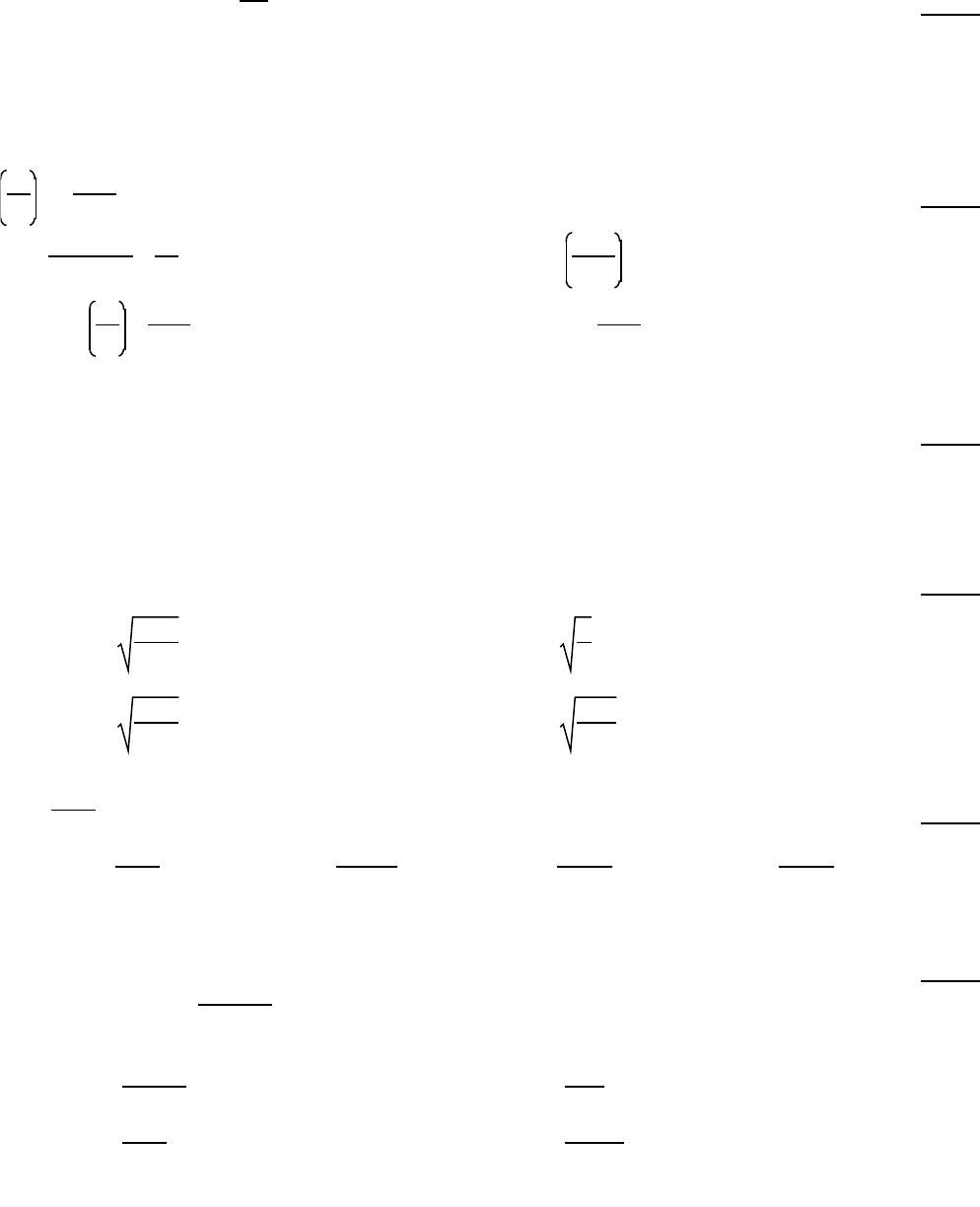
Solve the problem.
267)
The function Y(x) =54.42 ln x
3.5 can be used to estimate the number of years Y(x) after 1980
required for a certain country’s population to reach x million people. In what year will the country’s
population reach 15 million?
267)
A)
About 2059
B)
About 2069
C)
About 2064
D)
About 2049
Write in logarithmic form.
268)
11
10 3=1331
1000
268)
A)
log31331
log31000 =11
10
B)
log11/10 1331
1000 =3
C)
log311
10 =1331
1000
D)
log11/10 3=1331
1000
Solve the problem.
269)
The number of bacteria growing in an incubation culture increases with time according to
B = 5600(2)x, where x is time in days. Find the number of bacteria when x = 0 and x = 5.
269)
A)
11,200; 179,200
B)
5600; 22,400
C)
5600; 56,000
D)
5600; 179,200
Find f–1(x) for the following one–to–one function f.
270)
f(x) =8x3– 7
270)
A)
f-1(x) =3x + 7
8
B)
f-1(x) =3x
8+ 7
C)
f-1(x) =38
x + 7, x -7
D)
f-1(x) =3x – 7
8
271)
f(x) =5
x + 2
271)
A)
f-1(x) =x + 2
5
B)
f-1(x) =-2x + 5
x
C)
f-1(x) =2+ 5x
x
D)
f-1(x) =x
2+ 5x
Solve the problem.
272)
An organization determines that the cost per person of chartering a bus is given by the formula
C(x) = 150 + 5x
x,
where x is the number of people in the group and C(x) is in dollars. Find the inverse function.
272)
A)
C-1(x) =150 + x
5
B)
C-1(x) =150
x – 5
C)
C-1(x) =150
x + 5
D)
C-1(x) =5
x – 150
47
Find the indicated composition.
273)
f(x) =4x + 5; g(x) =5x +7
Find (g
f)(x).
273)
A)
(g
f)(x) =4 5x + 5
B)
(g
f)(x) =4x + 5+7
C)
(g
f)(x) =4 5x + 12
D)
(g
f)(x) =20 x + 5+7
Use the change–of–base formula to find the logarithm. Round your answer to four decimal places.
274)
log519.35
274)
A)
1.2867
B)
0.5432
C)
3.8700
D)
1.8408
Compute the compound interest.
275)
Andrea Gilford’s savings account has a balance of $1531. After 3 years, what will the amount of
interest be at 10% compounded annually? Round to the nearest dollar.
275)
A)
$498
B)
$512
C)
$507
D)
$76
Simplify.
276)
log332
276)
A)
32
B)
2log33
C)
1
D)
2
Solve the problem.
277)
How long will it take for $5800 to grow to $28,900 at an interest rate of 3.3% if the interest is
compounded quarterly? Round the number of years to the nearest hundredth.
277)
A)
195.47 yr
B)
151.61 yr
C)
48.87 yr
D)
49.46 yr
Solve.
278)
e0.03t+1=6(Round your answer to three decimal places).
278)
A)
0.048
B)
1.609
C)
59.725
D)
53.648
Write in exponential form.
279)
log10 9=0.9542
279)
A)
100.9542 =9
B)
109=0.9542
C)
90.9542 = 10
D)
0.954210 =9
Find the indicated composition.
280)
f(x) = 4x2+ 2x + 4; g(x) =2x – 3
Find (g
f)(x).
280)
A)
(g
f)(x) =8x2+ 4x + 5
B)
(g
f)(x) =8x2+ 4x + 11
C)
(g
f)(x) = 4x2+ 2x + 1
D)
(g
f)(x) = 4x2+ 4x + 5
48
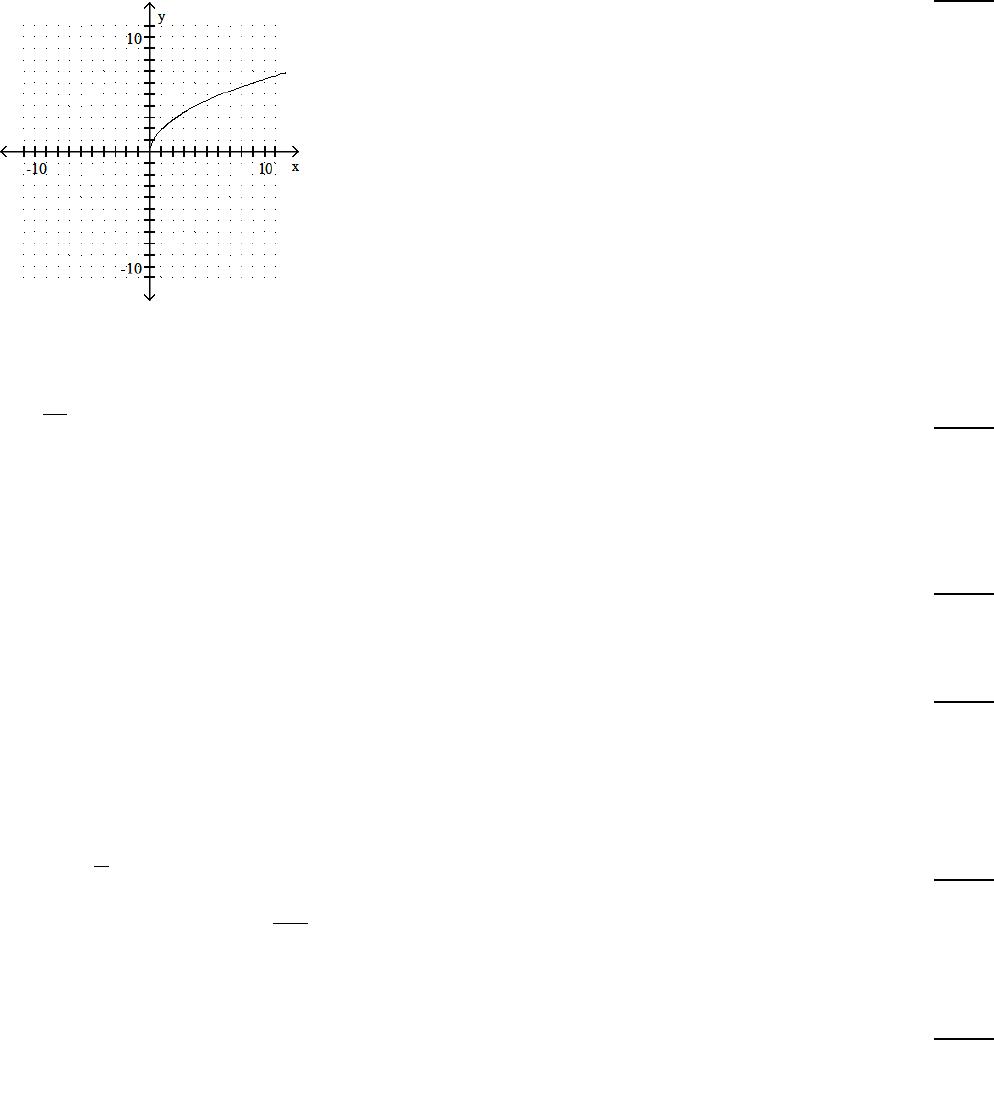
Determine whether or not the function is one–to–one.
281)
281)
A)
No
B)
Yes
Express as a difference of logarithms.
282)
log813
11
282)
A)
log413 –log411
B)
log811 –log813
C)
log813 –log811
D)
log813 ÷log811
Using a calculator, evaluate to four decimal places.
283)
ln 183
283)
A)
0.1914
B)
2.2625
C)
5.2095
D)
67.5277
Solve the problem.
284)
The number of dislocated electric impulses per cubic inch in a transformer increases when
lightning strikes by D =8100(5)x, where x is the time in milliseconds of the lightning strike. Find the
number of dislocated impulses at x = 0 and x =2.
284)
A)
8100; 25,312,500
B)
8100; 81,000
C)
8100; 202,500
D)
40,500; 202,500
Solve.
285)
log125 x =2
3
285)
A)
5
B)
250
3
C)
25
D)
125
Using a calculator, evaluate to four decimal places.
286)
log 0.83
286)
A)
0.3137
B)
-0.1863
C)
-0.5809
D)
-0.0809
49
Solve.
287)
The annual depreciation rate r (0 < r < 1) of a car purchased for P dollars and worth A dollars after t
years can be modeled by the following formula:
log (1 – r) = 1
t log A
P.
Find the depreciated value of a car 5 years after it is purchased new for $30,000 if the depreciation
rate is 21%. Round your answer to the nearest dollar.
287)
A)
$23,700
B)
$6300
C)
$9231
D)
$12
Solve the equation.
288)
3
5 x =81
625
288)
A)
4
B)
–4
C)
3
D)
5
Express as a single logarithm and, if possible, simplify.
289)
log59–log5x
289)
A)
log10 9/x
B)
log5 (9– x)
C)
log59/x
D)
log5x/9
Solve.
290)
log3 1 = x
290)
A)
9
B)
0
C)
1
D)
3
Express as a sum of logarithms.
291)
logr8T
291)
A)
log 8+ log T
B)
logr8+logr T +logr r
C)
logr8+logr T
D)
log7 r +logT r
Graph the function. Describe its position relative to the graph of the indicated basic function.
292)
f(x) =1–5-x; relative to f(x) =5x
292)
50
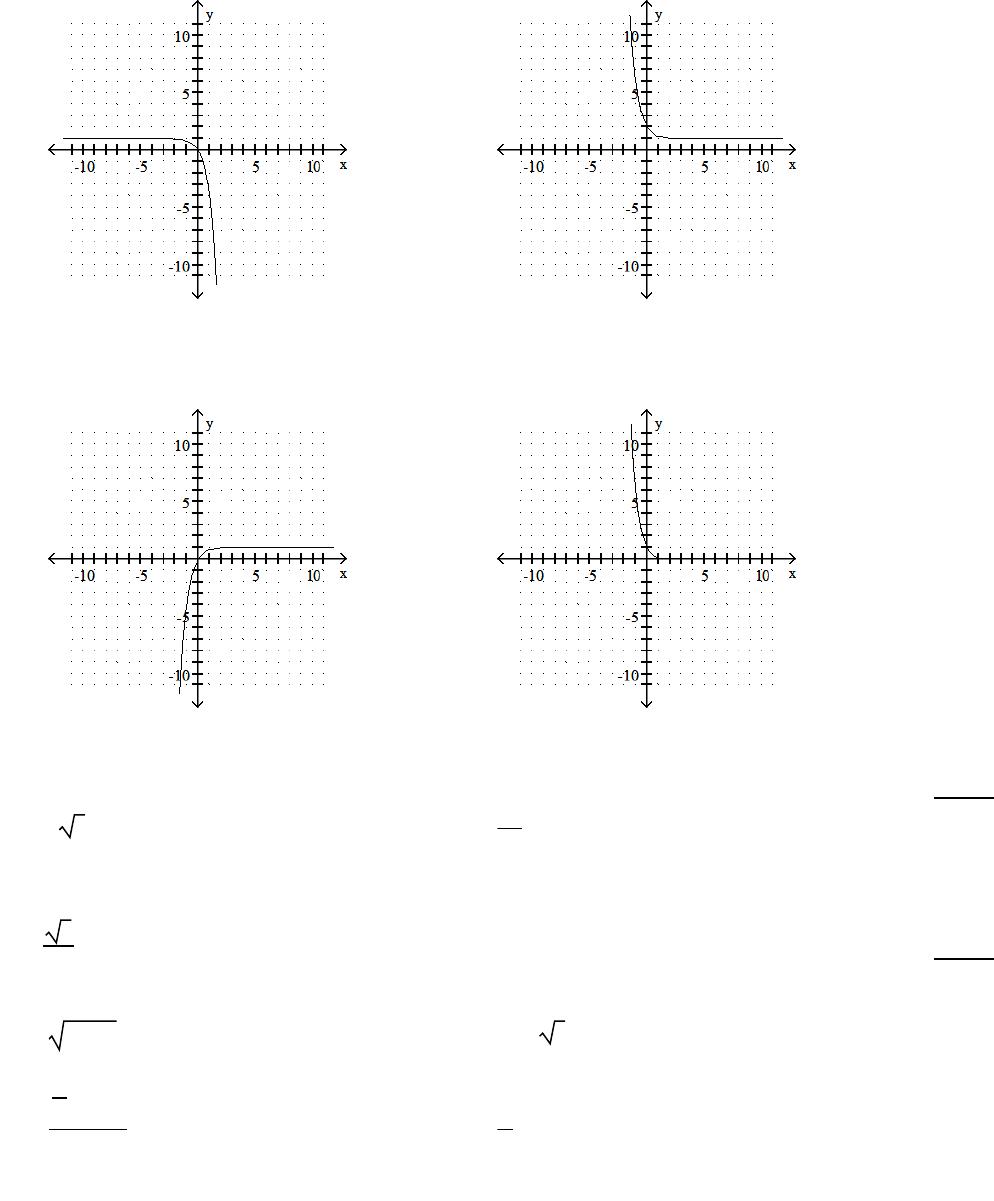
A)
Moved up 1 unit(s);
reflected across, y–axis;
reflected across x–axis;
B)
Moved up 1 unit(s);
reflected across, y–axis;
reflected across x–axis;
C)
Reflected across y–axis;
reflected across x–axis;
moved up 1 unit(s)
D)
Reflected across y–axis;
reflected across x–axis;
moved down 1 unit(s)
Solve the logarithmic equation.
293)
log4 (x +4) +log4 (x –4) =1
293)
A)
2 5
B)
4
C)
65
4
D)
20
Write the expression using a multiple of a logarithm.
294)
log66
13
294)
A)
log66–log613
B)
log66+log613
C)
1
2log66
log613
D)
1
2log66–log613
Graph.
51
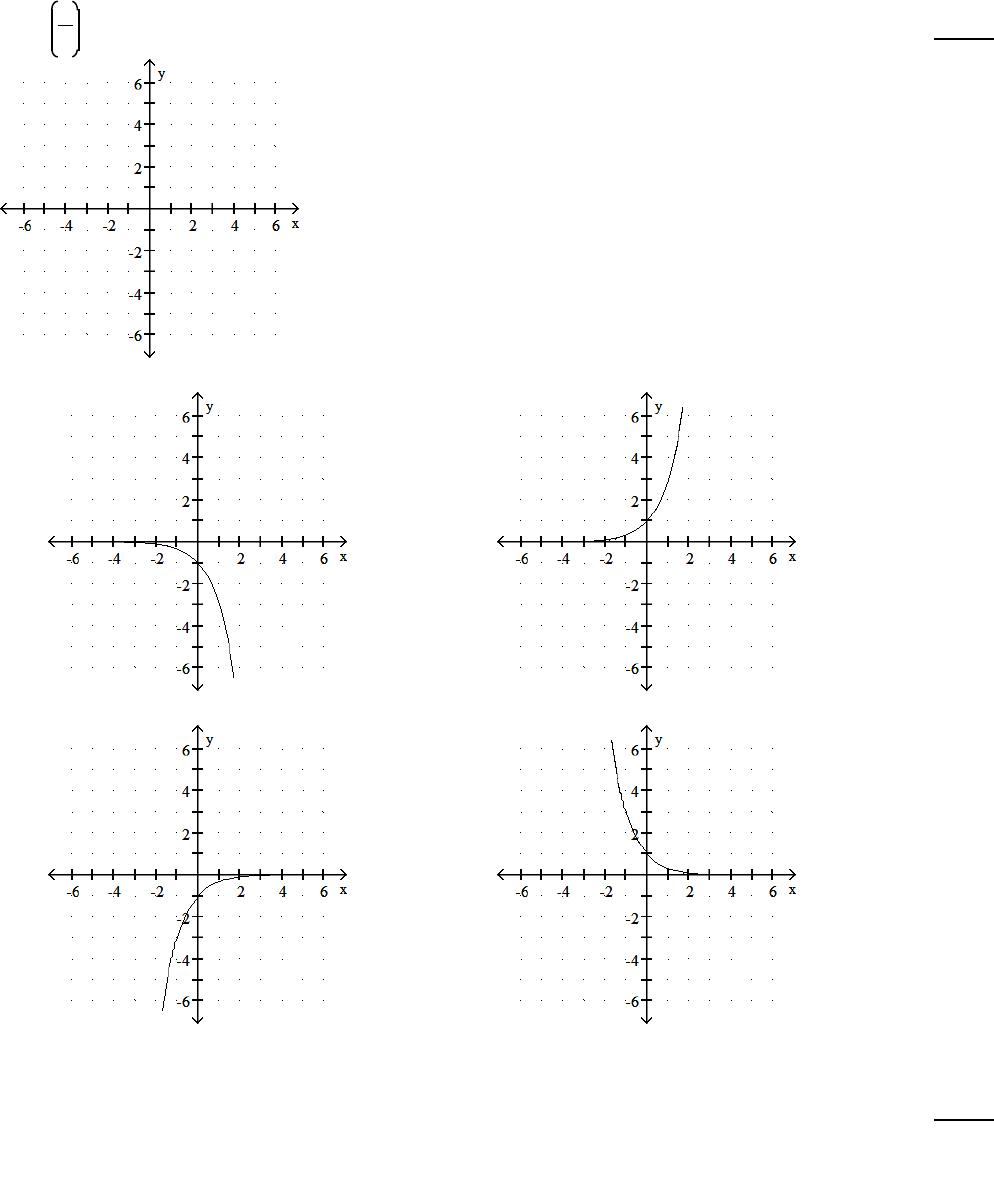
295)
f(x) =1
3 x
295)
A)
B)
C)
D)
Write in logarithmic form.
296)
103=1000
296)
A)
log10 1000 =3
B)
log31000 = 10
C)
log10 3=1000
D)
log3 10 =1000
52
Write the expression as the sum or difference of multiples of logarithms.
297)
logbx9y8
z5
297)
A)
1
2logbx9+logby8–logbz5
B)
9
2logb x + 8 logb y – 5 logb z
C)
9
2logb x +4logb y –5
2logb z
D)
9
2logb x –4logb x +5
2logb z
Express as a sum of logarithms.
298)
logx5yz
298)
A)
logx5+logx y +logx z
B)
log5 y +log5 z
C)
logx (5+ y + z)
D)
(logx5)(logx y)(logx z)
Express as a difference of logarithms.
299)
log10 8
3
299)
A)
log103–log108
B)
log108÷log103
C)
log10 (8–3)
D)
log108–log103
Graph the function. Describe its position relative to the graph of the indicated basic function.
300)
f(x) =2x – 2; relative to f(x) =2x
300)
A)
Moved up 2 unit(s)
B)
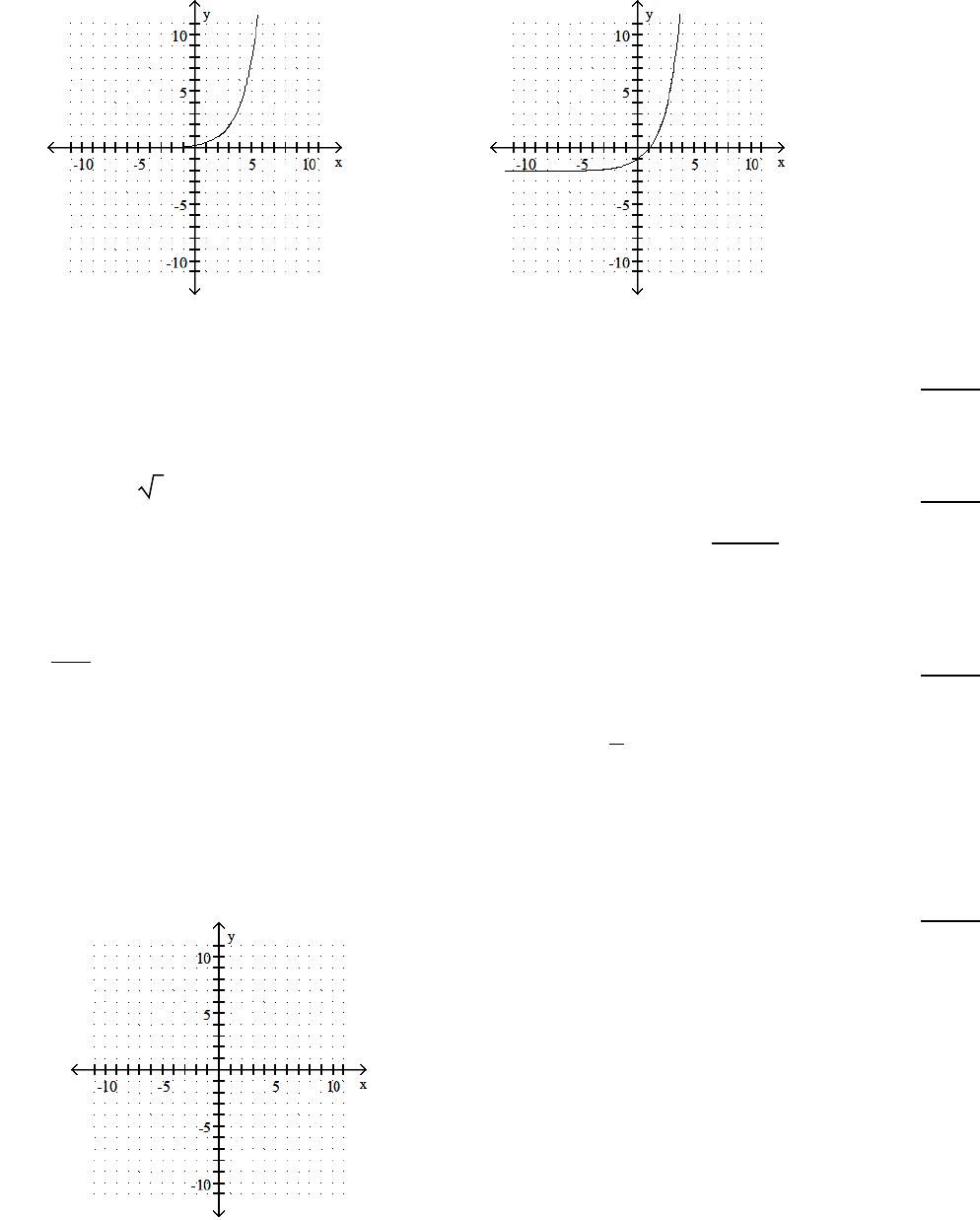
Moved left 2 unit(s)
53
C)
Moved right 2 unit(s)
D)
Moved down 2 unit(s)
Solve. Round your answer to three decimal places if necessary.
301)
4x=16
301)
A)
4
B)
2
C)
1
D)
3
Write the expression as a single logarithm. Leave your answer in simplest form without negative or fractional exponents.
302)
logax6– 2 logax
302)
A)
logax7
B)
logax5
C)
loga(x6– x)
D)
logax6
loga x
Find the indicated composition.
303)
f(x) =x – 5
8; g(x) =8x + 5
Find (g
f)(x).
303)
A)
(g
f)(x) = x
B)
(g
f)(x) = x –5
8
C)
(g
f)(x) = x + 10
D)
(g
f)(x) =8x + 35
Graph the function. Describe its position relative to the graph of the indicated basic function.
304)
f(x) = –4x + 3; relative to f(x) =4x
304)
54
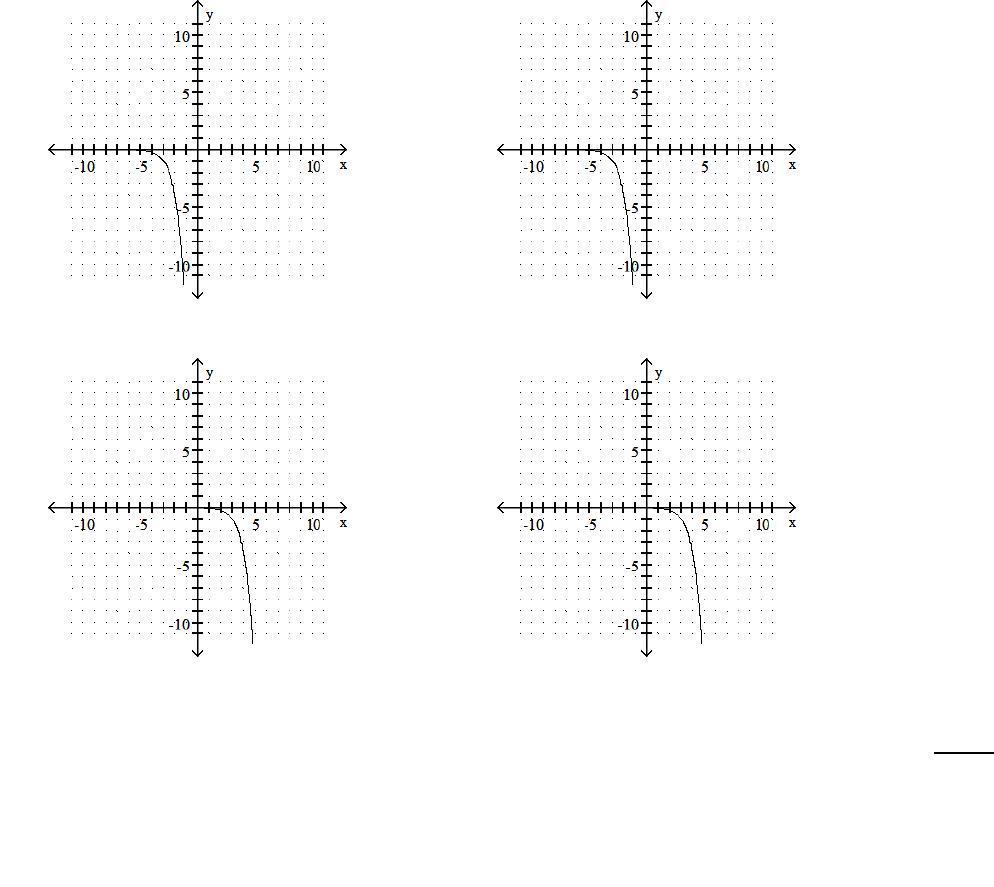
A)
Moved left 3 unit(s);
reflected across x–axis
B)
Moved right 3 unit(s);
reflected across x–axis
C)
Moved right 3 unit(s);
reflected across x–axis
D)
Moved left 3 unit(s);
reflected across x–axis
Solve the problem.
305)
Use the formula N = Iekt, where N is the number of items in terms of the initial population I, at
time t, and k is the growth constant equal to the percent of growth per unit of time. A certain
radioactive isotope decays at a rate of 0.2% annually. Determine the half–life of this isotope, to the
nearest year.
305)
A)
347 years
B)
151 years
C)
3 years
D)
250 years
55
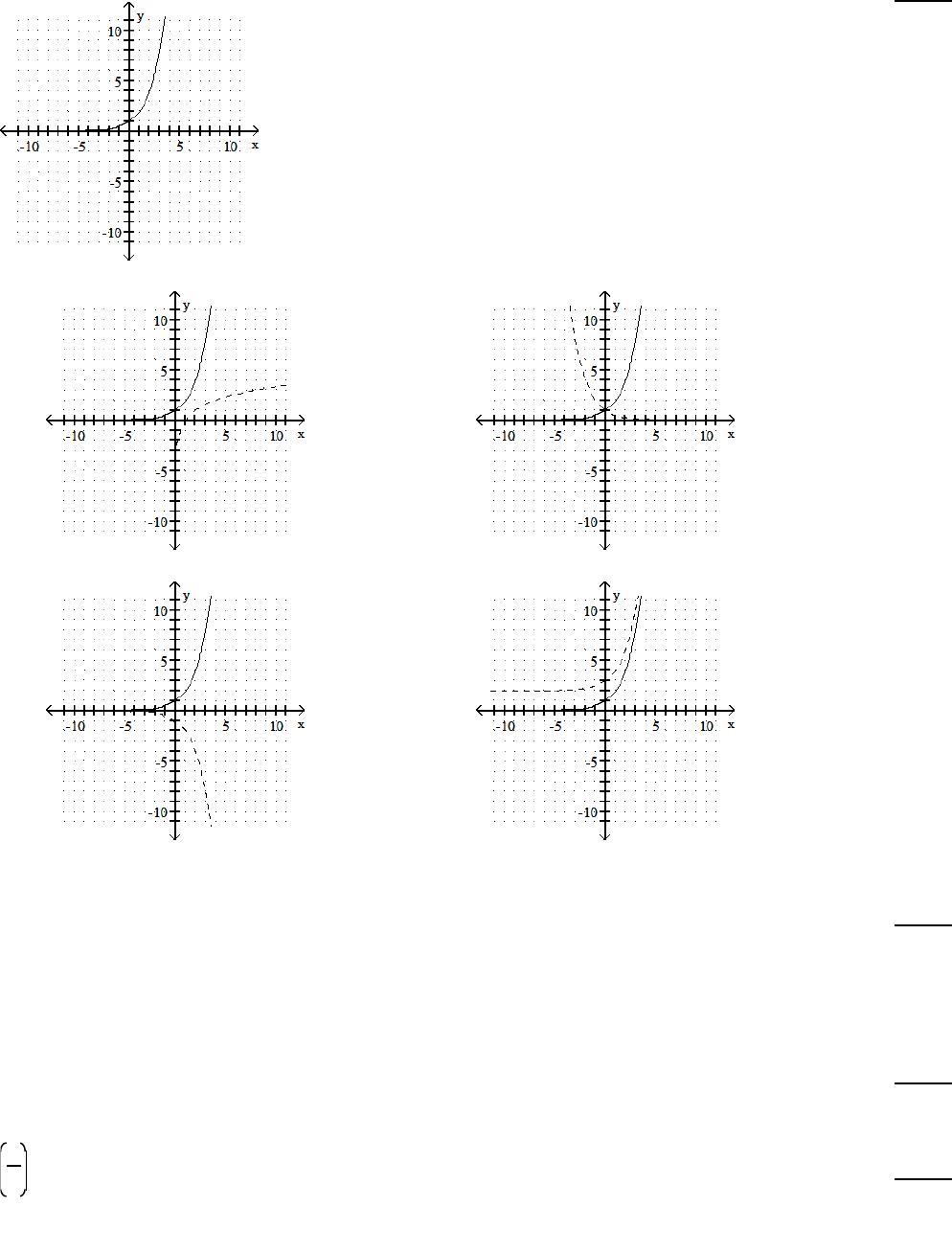
Use the graph of f to sketch a graph of the inverse of f using a dashed curve.
306)
306)
A)
B)
C)
D)
Find the indicated composition.
307)
f(x) =-4x + 4; g(x) =3x + 3
Find (g
f)(x).
307)
A)
(g
f)(x) =-12x – 9
B)
(g
f)(x) =-12x + 15
C)
(g
f)(x) =-12x + 16
D)
(g
f)(x) = x + 15
Solve the equation.
308)
41+ 2x=64
308)
A)
16
B)
1
C)
4
D)
–1
309)
1
2 x =8
309)
A)
3
B)
–8
C)
–1
D)
–3
56
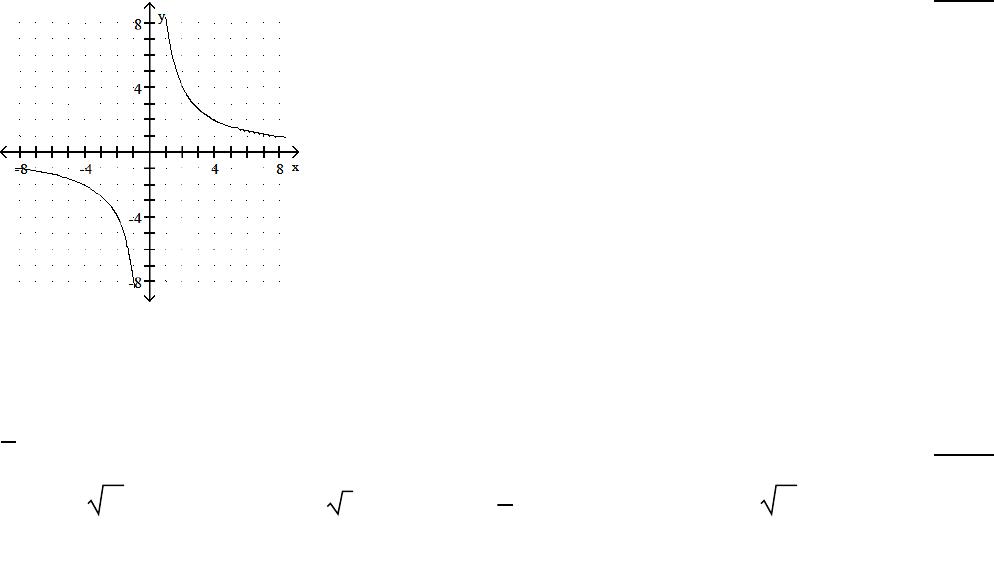
Determine whether or not the function is one–to–one.
310)
310)
A)
No
B)
Yes
Write the expression as a logarithm of a quantity to a power. Leave answers in simplest form without negative or
fractional exponents.
311)
7
8logc x
311)
A)
logc7x8
B)
7logc8x
C)
1
8logcx7
D)
logc8x7
57
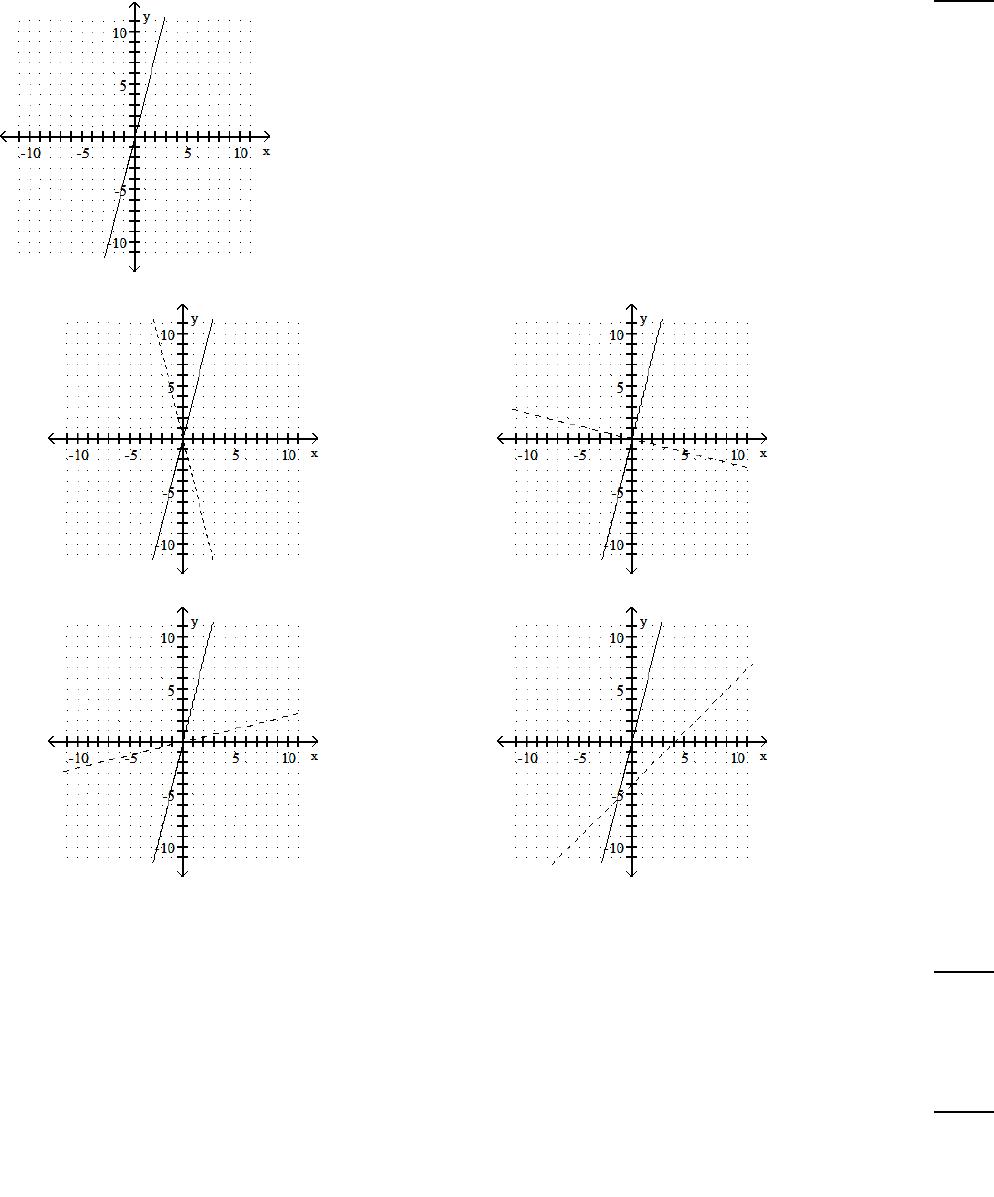
Use the graph of f to sketch a graph of the inverse of f using a dashed curve.
312)
312)
A)
B)
C)
D)
Solve the problem.
313)
If f(x) gives the cost of a rental car after x days of use at $37 per day, then what does f-1(x) give?
313)
A)
The number of days rented for x dollars
B)
The number of days rented for 37 dollars
C)
The cost of rental for x days
D)
The cost of rental for 37 days
Write the expression using a multiple of a logarithm.
314)
log5y7
314)
A)
7log5y7
B)
5log7y7
C)
7log5y
D)
5log7y
Graph.
58
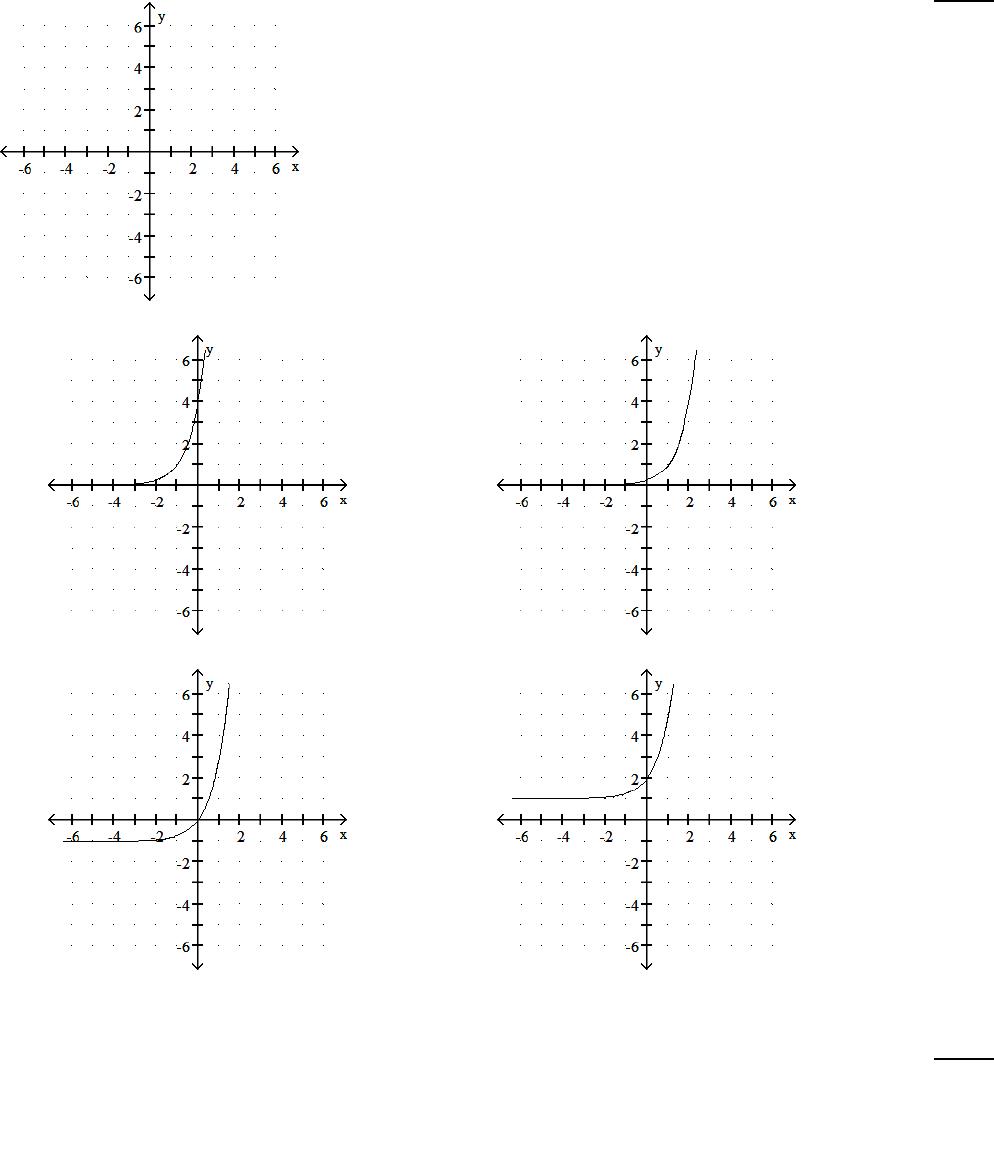
315)
f(x) =4x + 1
315)
A)
B)
C)
D)
Solve the problem.
316)
Suppose f(x) =30.2 +1.3 log (x + 1) models salinity of ocean water to depths of 1000 meters at a
certain latitude. x is the depth in meters and f(x) is in grams of salt per kilogram of seawater.
Approximate the salinity (to the nearest hundredth) when the depth is 609 meters.
316)
A)
82.82
B)
-26.58
C)
85.42
D)
33.82
59
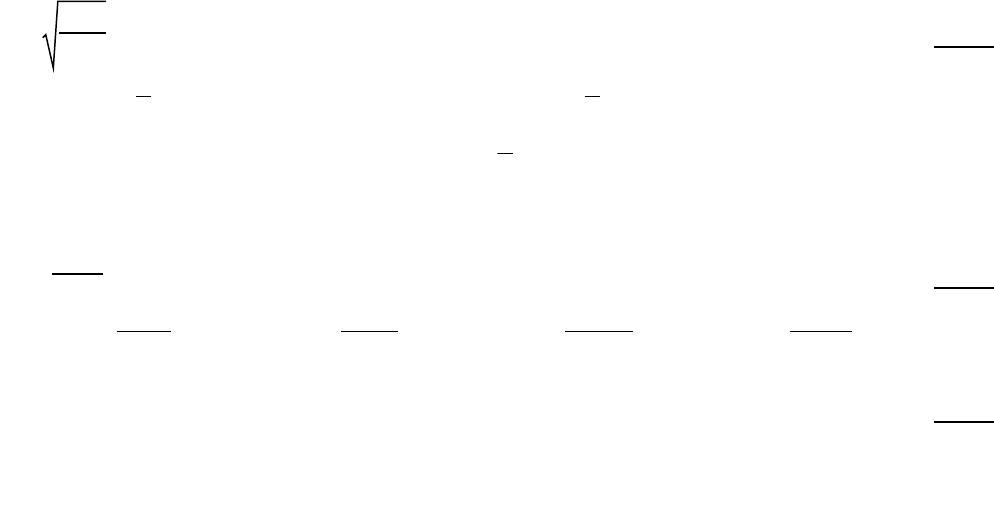
Write the expression as the sum or difference of multiples of logarithms.
317)
logba8b6
a2b3
317)
A)
4logb a –3
2
B)
3logb a +3
2
C)
6logb a + 3
D)
1
2(logba6+ logb3)
Find f–1(x) for the following one–to–one function f.
318)
f(x) =x – 10
x + 9
318)
A)
f-1(x) =x + 10
9 + x
B)
f-1(x) =-9x – 1
x – 10
C)
f-1(x) =-9x – 10
x – 1
D)
f-1(x) =9x – 10
x – 1
319)
f = {(–3, –3), (–2, –2), (–1, –1), (0, 0)}
319)
A)
f-1 = {(–3, 3), (–2, 2), (–1, 1), (0, 0)}
B)
f-1 = {(–3, –3), (–2, –2), (–1, –1), (0, 0)}
C)
f-1 = {(3, –3), (2, –2), (1, –1), (0, 0)}
D)
f-1 = {(3, 3), (2, 2), (1, 1), (0, 0)}
60
Answer Key
Testname: C10
61
Answer Key
Testname: C10
62
Answer Key
Testname: C10
63
Answer Key
Testname: C10
64
Answer Key
Testname: C10
65
Answer Key
Testname: C10
66
Answer Key
Testname: C10
67