Exam
Name___________________________________
MULTIPLE CHOICE. Choose the one alternative that best completes the statement or answers the question.
1)
________ is (are) not part of an ophiolite complex.
1)
A)
Steeply inclined, basaltic dikes
B)
Intrusive, coarse–grained gabbro
C)
Residual, unmelted, crustal lithosphere
D)
Basaltic lavas and pillow lavas
2)
________ are not associated with a mid–ocean ridge.
2)
A)
Submarine basaltic lava eruptions
B)
Shallower depths than abyssal plains
C)
Very thin, ocean floor, sediment layers
D)
Deep ocean trenches
3)
Submarine canyons found on the continental slope and rise have been created ________.
3)
A)
because of a plate plunging into the mantle
B)
by faulting
C)
by rivers during the ice age
D)
none of these
4)
Seamounts ________.
4)
A)
are volcanoes that form on the ocean floor
B)
form only in the Pacific Ocean basin
C)
are submarine canyons found near Australia
D)
are a special type of oceanic trench

5)
Where in the oceans are biological communities thriving without sunlight?
5)
A)
around fissure vents for flood basalts
B)
in muds of deep–ocean trenches
C)
in shallow water, coral reefs
D)
around seafloor, hot spring vents
6)
In the 1870s, the ________ was involved in the first far–reaching, comprehensive study of Earth’s
oceans.
6)
A)
H.M.S. Moonbeam
B)
H.M.S. Brit
C)
H.M.S. Bismarck
D)
H.M.S. Challenger
7)
________ proposed a hypothesis (that later became a theory) on the creation of atolls.
7)
A)
Isaac Newton
B)
Charles Darwin
C)
Charles Lyell
D)
James Hutton
8)
________ is the oceanward edge of a continental shelf.
8)
A)
The top of the abyssal plain
B)
The deepest portion of a deep–ocean trench
C)
The base of the continental rise
D)
The top of the continental slope
9)
An echo sounder operates by measuring the time required for a ________.
9)
A)
radar beam to travel from a ship to the seafloor and back
B)
sound pulse to travel from a ship to the seafloor and back
C)
radar beam to travel from a harbor patrol boat to a fuzz–buster on a speeding yacht
D)
light beam to travel from a satellite at a known altitude to the sea bottom and back
10)
Geologically, what is the best way to explain the thousands of feet of coral limestone beneath most
atolls?
10)
A)
An eroded volcanic seamount rose thousands of feet after the limestone formed.
B)
Sea level has fallen thousands of feet since the reef began to grow.
C)
The eroded volcano slowly sank as sea level remained steady or rose gradually.
D)
The volcano never reached the surface, allowing a very thick cap of coral limestones to
accumulate.
11)
The continental rise is located ________.
11)
A)
between an abyssal plain and continental slope
B)
at the top of a mid–ocean ridge
C)
at the seaward edge of a deep ocean trench
D)
at the top of the continental slope
A
12)
Oceans cover approximately ________ of Earth’s surface area?
12)
A)
70%
B)
10%
C)
90%
D)
50%
A
13)
Water depths and seafloor topography are now routinely determined by ________.
13)
A)
by satellite–linked, laser reflector systems
B)
computerized, satellite–mounted, parallel transponder systems
C)
ship–mounted, optical–fiber satellite uplink systems
D)
ship–mounted echo sounders
D
D
14)
Which of the following is NOT true of deep ocean trenches?
14)
A)
They may act as sediment traps.
B)
They are long and narrow depressions.
C)
They are geologically very stable.
D)
They are sites where plates plunge back into the mantle.
15)
Which one of the following is not connected in any way with submarine, hot spring vents?
15)
A)
black smokers on a mid–ocean ridge
B)
ecological communities living without photosynthesis
C)
sediment rich in metallic sulfides
D)
thick turbidites on the continental rise
16)
Young oceanic lithosphere typically experiences what type of subduction and at what angle?
16)
A)
Spontaneous Subduction; steep angle
B)
Forced Subduction: steep angle
C)
Spontaneous Subduction; shallow angle
D)
Forced Subduction; shallow angle
17)
Geologically, ________ are actually submerged parts of the continents.
17)
A)
abyssal plains
B)
coastal guyots
C)
continental shelves
D)
continental trenches
18)
A(n) ________ is a low lying, coral reef island perched above a sunken, truncated volcano.
18)
A)
fringing reef
B)
guyot
C)
atoll
D)
seamount
19)
The gently sloping submerged surface extending from the shoreline toward the ocean is termed the
________.
19)
A)
submarine canyon
B)
continental shelf
C)
continental slope
D)
continental rise
20)
The ________ lies at the base of the continental slope.
20)
A)
continental rise
B)
off–slope reef
C)
continental rift
D)
offshore shelf
21)
“Black smokers” are associated with ________.
21)
A)
hot water
B)
oceanic ridges
C)
metal–rich sulfide deposits
D)
all of these
SHORT ANSWER. Write the word or phrase that best completes each statement or answers the question.
22)
A(n) ________ is a volcanic mountain, built up from the seafloor, that never reached the sea
surface.
22)
23)
________ is characterized by the subduction of old dense lithosphere.
23)
24)
A low lying, coral limestone island with a central lagoon is called a(n) ________.
24)
25)
Submerged, flat–topped volcanoes that rise from the deep ocean floor are called ________.
25)
26)
________ continental margins typically exhibit wide, extensive, continental shelves.
26)

27)
Valleys that lead from the continental shelf into deeper waters are known as ________.
27)
Word Analysis. Examine the words and/or phrases for each question below and determine the relationship among the
majority of words/phrases. Choose the option that does not fit the pattern.
28)
a. Farallon b. North America c. Pacific d.
Mid–Atlantic Ridge
28)
29)
________ correctly formulated a basic theory concerning the formation of atolls in the
1800s.
29)
30)
A(n) ________ is the vast, relatively deep, flat, sediment–covered portion of the
deep–ocean basin.
30)
Word Analysis. Examine the words and/or phrases for each question below and determine the relationship among the
majority of words/phrases. Choose the option that does not fit the pattern.
31)
a. East African Rift b. Basin and Range c. Red Sea d. Baikal Rift
31)
32)
a. trench b. submarine canyon c. abyssal plain d. seamount
32)
33)
a. manganese nodules b. pillow basalts c. sheeted dikes d. gabbro
33)
34)
a. continental slope b. continental rise c. active continental margin d. continental
shelf
34)
35)
A(n) ________ marks the site where old, oceanic lithosphere begins its descent into a
subduction zone.
35)

TRUE/FALSE. Write ‘T’ if the statement is true and ‘F’ if the statement is false.
36)
Seafloor hot springs occur mainly in oceanic, abyssal plains.
36)
37)
The continental rise lies at the top of the continental slope.
37)
38)
Submarine canyons form the deepest parts of the ocean basins.
38)
39)
The west coast of South America and the east coast of North America have very different
continental margins.
39)
40)
The average height of the continents above sea level is greater than the average depth of the ocean
basins below sea level.
40)
41)
Abyssal plains with sediments covering the seafloor igneous rocks are more extensive in the central
Pacific basin than in the North Atlantic.
41)
42)
Submerged, flat–topped seamounts are known as guyots.
42)
43)
An atoll is a low, coral reef island typically surrounding an interior lagoon.
43)
44)
In the oceans, calcium carbonate is more soluble in warm, surface waters than in deeper, colder
waters.
44)
45)
The Atlantic and Pacific basins have oceanic ridges; the Indian Ocean has no oceanic ridge.
45)
ESSAY. Write your answer in the space provided or on a separate sheet of paper.
Critical thinking and discussion questions. Use complete sentences, correct spelling, and the information presented in
chapter 10 to answer the questions below.
46)
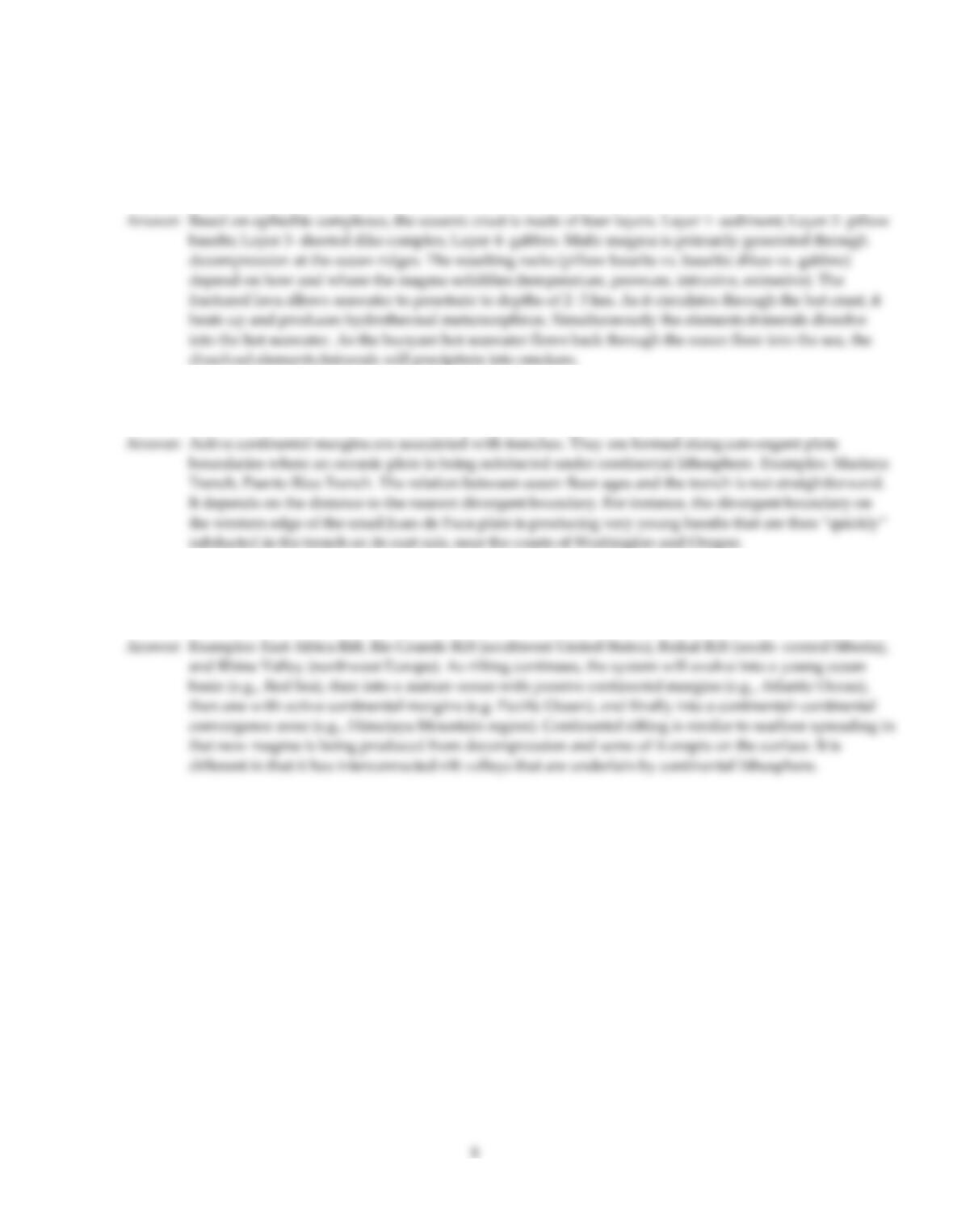
Briefly discuss the formation and structure of oceanic crust. What rock compositions are involved and how do
these compositions change as a result of interaction with seawater?
47)
Where are most of the current active continental margins located on Earth today? Why? What is the relation of
the age of rocks on the ocean floor to the location of these active margins?
48)
List several areas on Earth where continental rifting is occurring today. Eventually, what will happen to these
areas as rifting continues? Finally, how is continental rifting similar to seafloor spreading and how is it
different?

Answer Key
Testname: C10

Answer Key
Testname: C10
10