Stewart – Calculus ET 8e Chapter 10 Form A
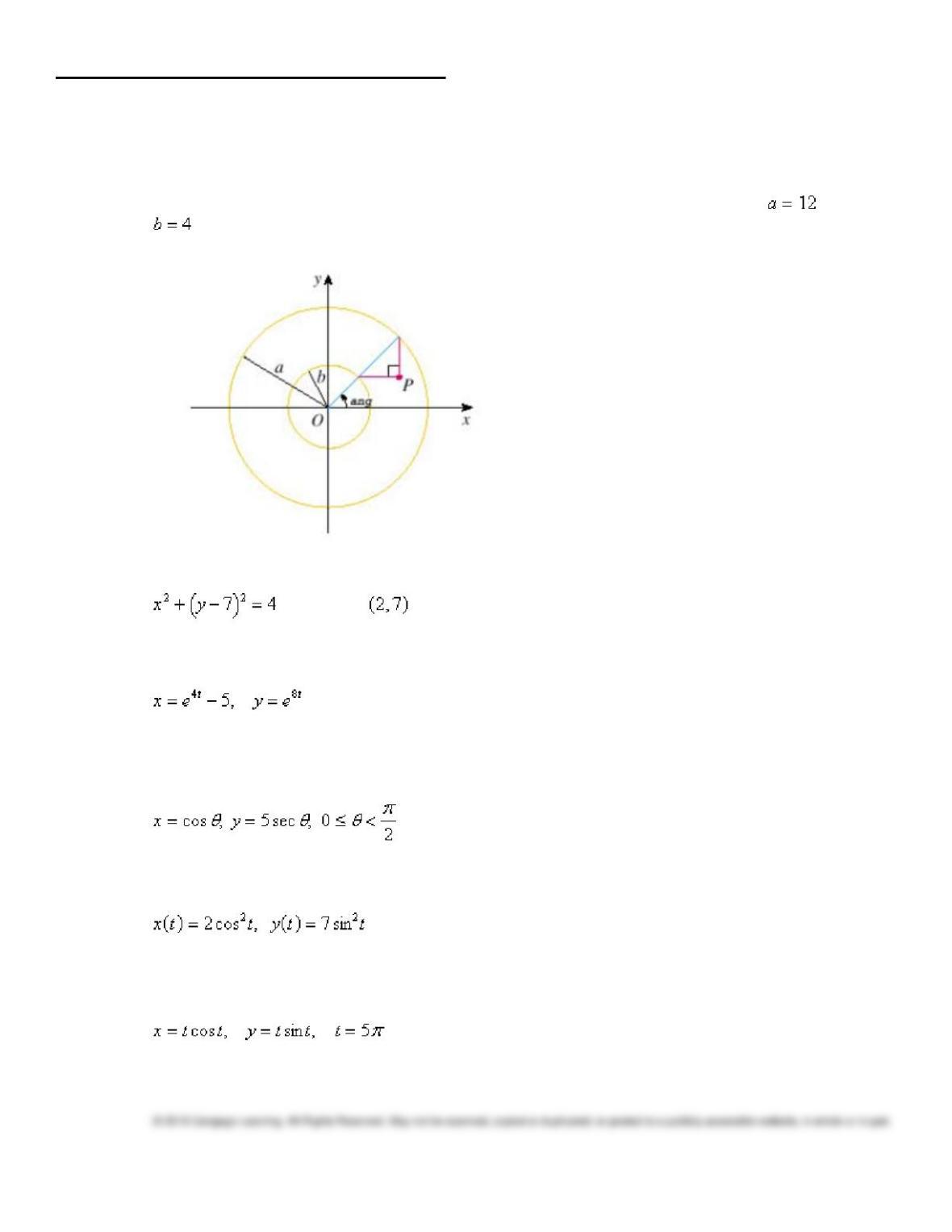
1. If a and b are fixed numbers, find parametric equations for the set of all points P determined as
shown in the figure, using the angle ang as the parameter. Write the equations for and
.
2. Find parametric equations for the path of a particle that moves once clockwise along the circle
, starting at .
3. Eliminate the parameter to find a Cartesian equation of the curve.
4. Sketch the parametric curve and eliminate the parameter to find the Cartesian equation of the
curve.
5. Eliminate the parameter to find a Cartesian equation of the curve.
6. Find an equation of the tangent to the curve at the point corresponding to the given value of the
parameter.
Stewart – Calculus ET 8e Chapter 10 Form A
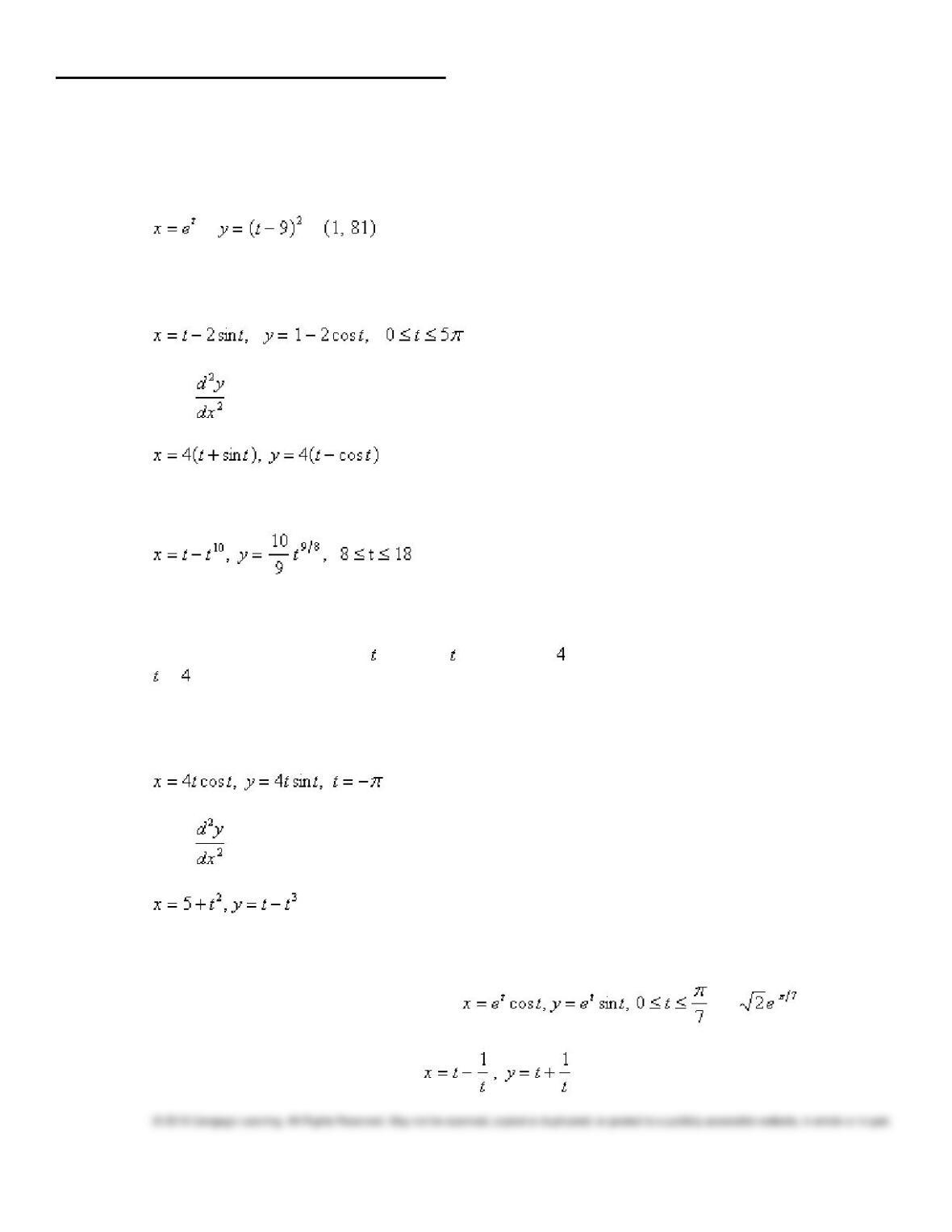
7. Find an equation of the tangent to the curve at the point by first eliminating the parameter.
, ;
8. Set up an integral that represents the length of the curve. Then use your calculator to find the
length correct to four decimal places.
9. Find
.
10. Set up, but do not evaluate, an integral that represents the length of the parametric curve.
11. True or False?
If the parametric curve x f (), y g () satisfies g ‘( ) 0, then it has a horizontal tangent when
.
12. Find an equation of the tangent to the curve at the point corresponding to the given value of the
parameter.
13. Find
.
14. True or False?
The exact length of the parametric curve is .
15. Find the area bounded by the curve and the line y = 2.5.
Stewart – Calculus ET 8e Chapter 10 Form A
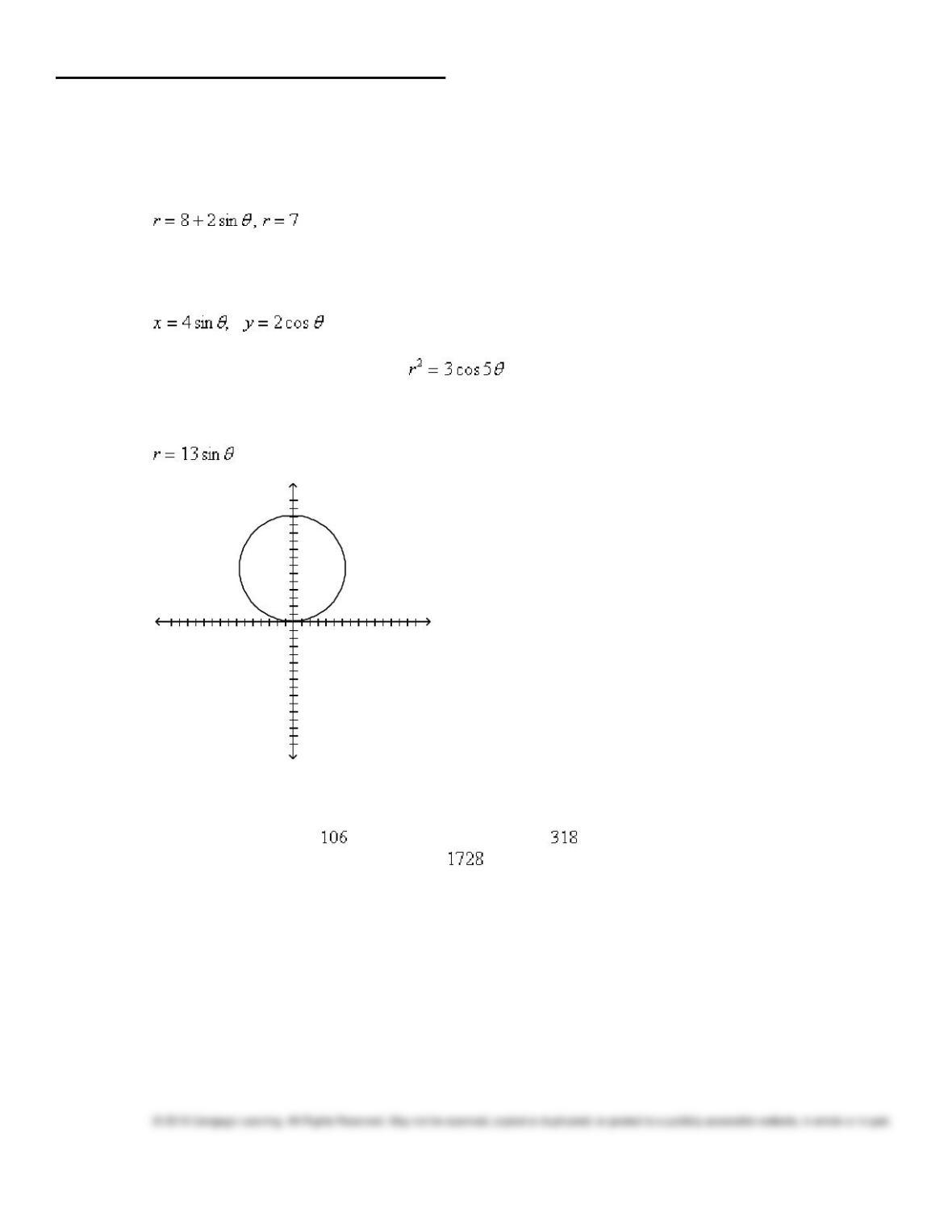
16. Find the area of the region that lies inside both curves.
17. Using the arc length formula, set up, but do not evaluate, an integral equal to the total arc length of the
ellipse.
18. Find the area enclosed by the curve .
19. Find the area that the curve encloses.
2 4 6 8 10 12 14
20. The point in a lunar orbit nearest the surface of the moon is called perilune and the point farthest
from the surface is called apolune. The Apollo 11 spacecraft was placed in an elliptical lunar orbit
with perilune altitude km and apolune altitude km (above the moon). Find an equation of
this ellipse if the radius of the moon is km and the center of the moon is at one focus.
Stewart – Calculus ET 8e Chapter 10 Form A
Answer Key
Stewart – Calculus ET 8e Chapter 10 Form A
Stewart – Calculus ET 8e Chapter 10 Form B
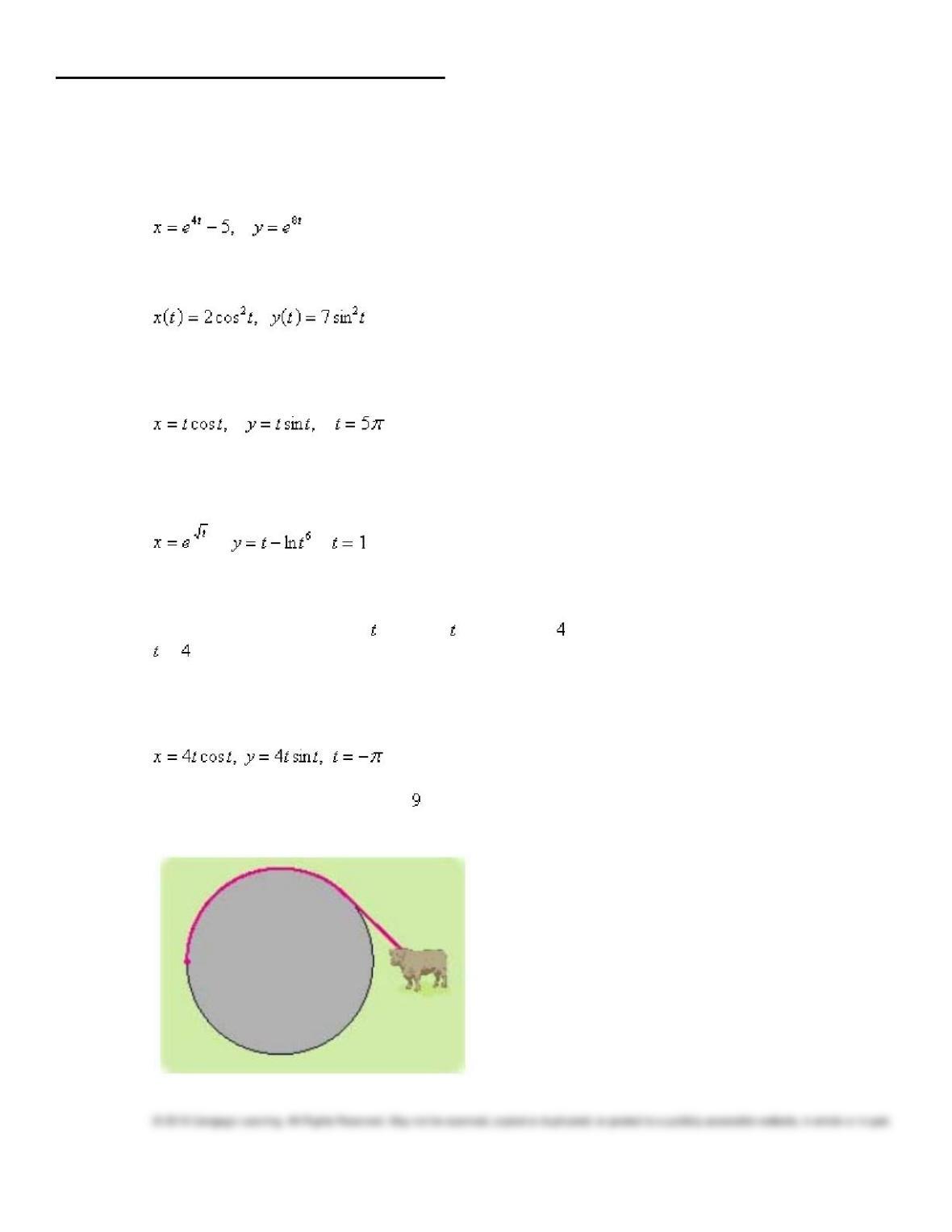
1. Eliminate the parameter to find a Cartesian equation of the curve.
2. Eliminate the parameter to find a Cartesian equation of the curve.
3. Find an equation of the tangent to the curve at the point corresponding to the given value of the
parameter.
4. Find an equation of the tangent line to the curve at the point corresponding to the value of the
parameter.
, ;
5. True or False?
If the parametric curve x f (), y g () satisfies g ‘( ) 0, then it has a horizontal tangent when
.
6. Find an equation of the tangent to the curve at the point corresponding to the given value of the
parameter.
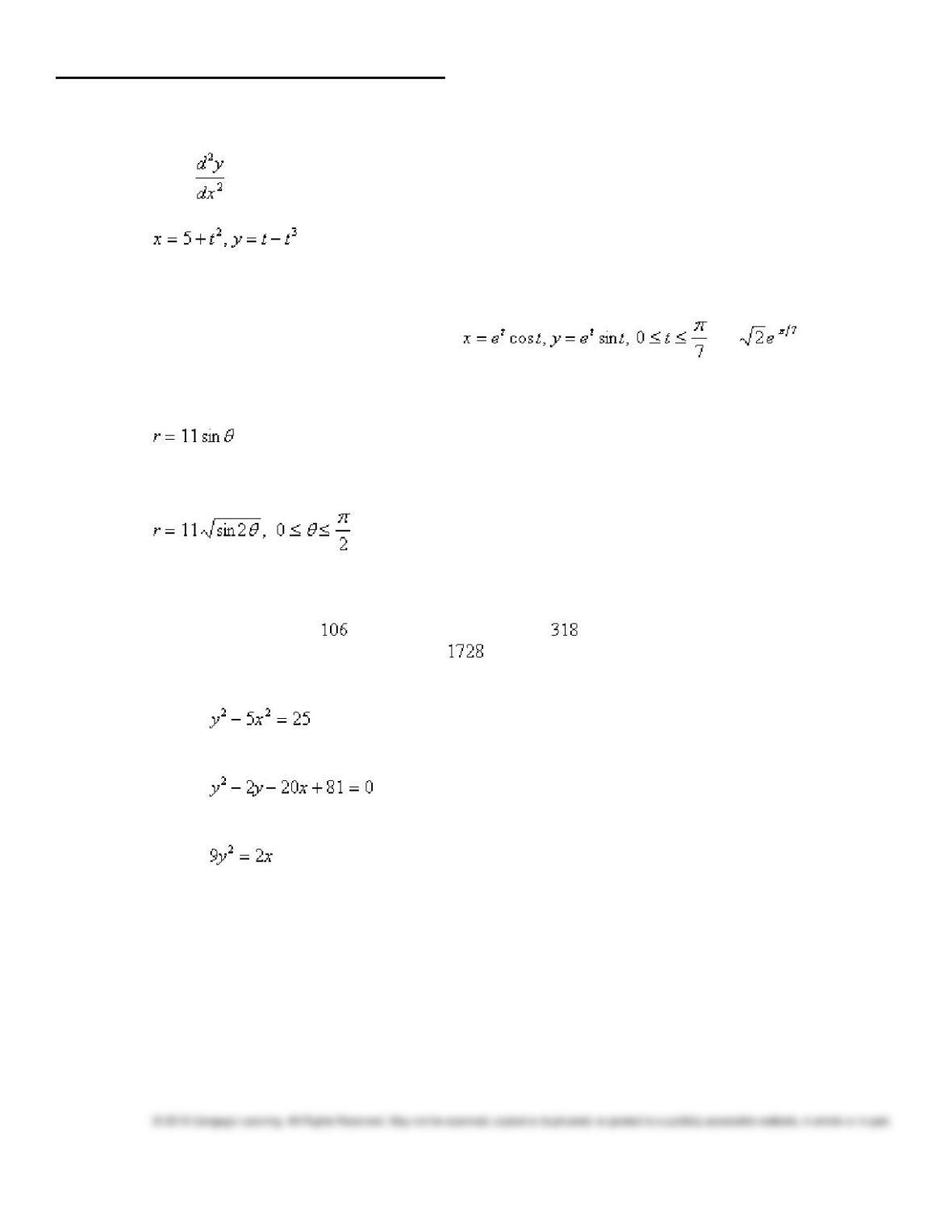
7. A cow is tied to a silo with radius by a rope just long enough to reach the opposite side of the
silo. Find the area available for grazing by the cow. Round the answer to the nearest hundredth.
Stewart – Calculus ET 8e Chapter 10 Form B
8. Find
.
9. True or False?
The exact length of the parametric curve is .
10. Find a Cartesian equation for the curve described by the given polar equation.
11. Find the area of the region that is bounded by the given curve and lies in the specified sector.
12. The point in a lunar orbit nearest the surface of the moon is called perilune and the point farthest
from the surface is called apolune. The Apollo 11 spacecraft was placed in an elliptical lunar orbit
with perilune altitude km and apolune altitude km (above the moon). Find an equation of
this ellipse if the radius of the moon is km and the center of the moon is at one focus.
13. Find the vertices, foci, and asymptotes of the hyperbola.
14. Find the vertex, focus, and directrix of the parabola.
15. Find the vertex, focus, and directrix fo the parabola.
16. Find an equation of the conic satisfying the given conditions.
Hyperbola, foci (5, 6) and (5, –4), asymptotes x = 2y +
3
and x = – 2y +
7
17. Find an equation of the conic satisfying the given conditions.
Hyperbola, foci (5, 6) and (5, –2), asymptotes x = 2y +
1
and x = – 2y +
9
Stewart – Calculus ET 8e Chapter 10 Form B
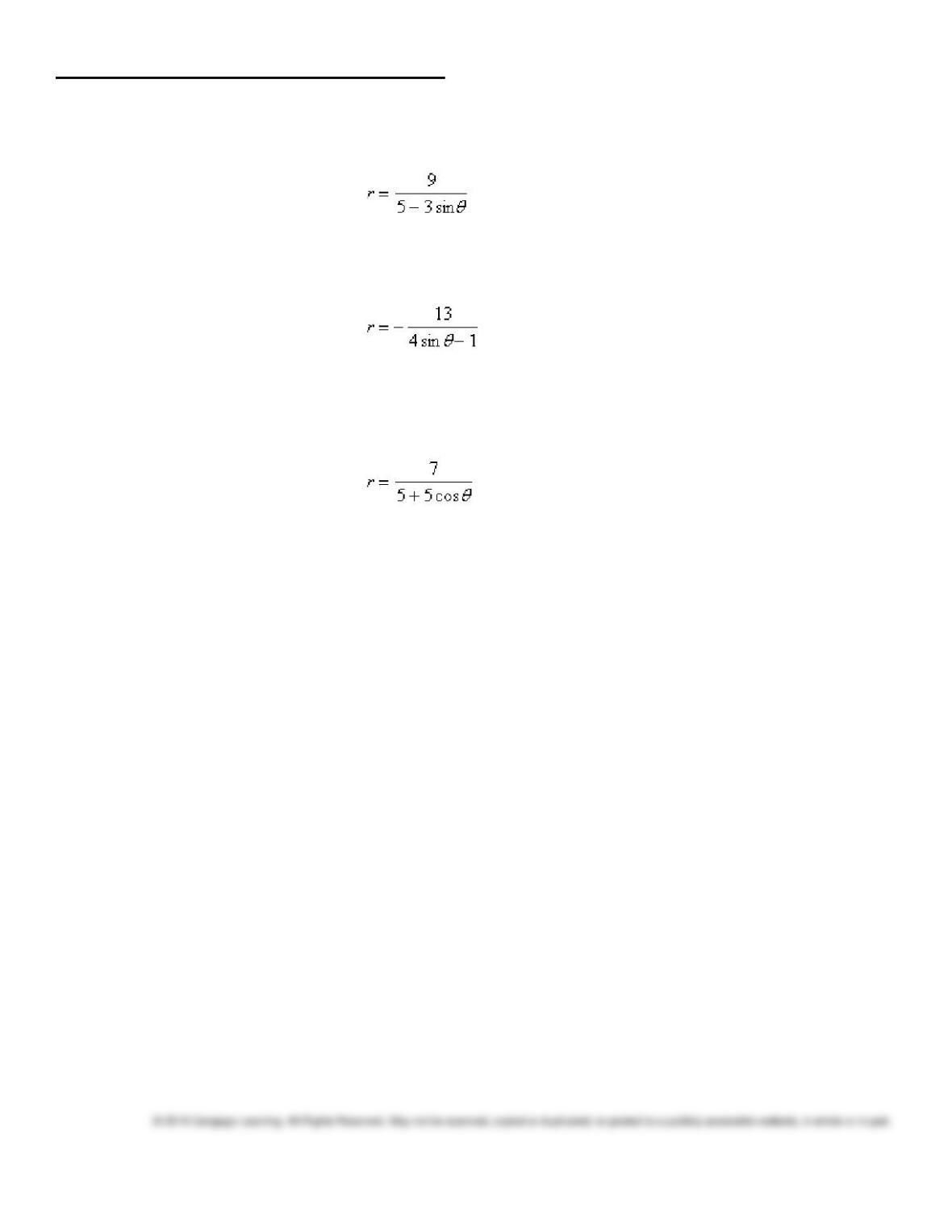
18. Consider the polar equation .
(a) Find the eccentricity and an equation of the directrix of the conic.
(b) Identify the conic.
(c) Sketch the curve.
19. Consider the polar equation .
(a) Find the eccentricity and an equation of the directrix of the conic.
(b) Identify the conic.
(c) Sketch the curve.
20. Consider the polar equation .
(a) Find the eccentricity and an equation of the directrix of the conic.
(b) Identify the conic.
(c) Sketch the curve.
Stewart – Calculus ET 8e Chapter 10 Form B
Answer Key
Stewart – Calculus ET 8e Chapter 10 Form B
Stewart – Calculus ET 8e Chapter 10 Form B
Stewart – Calculus ET 8e Chapter 10 Form C
Select the correct answer for each question.
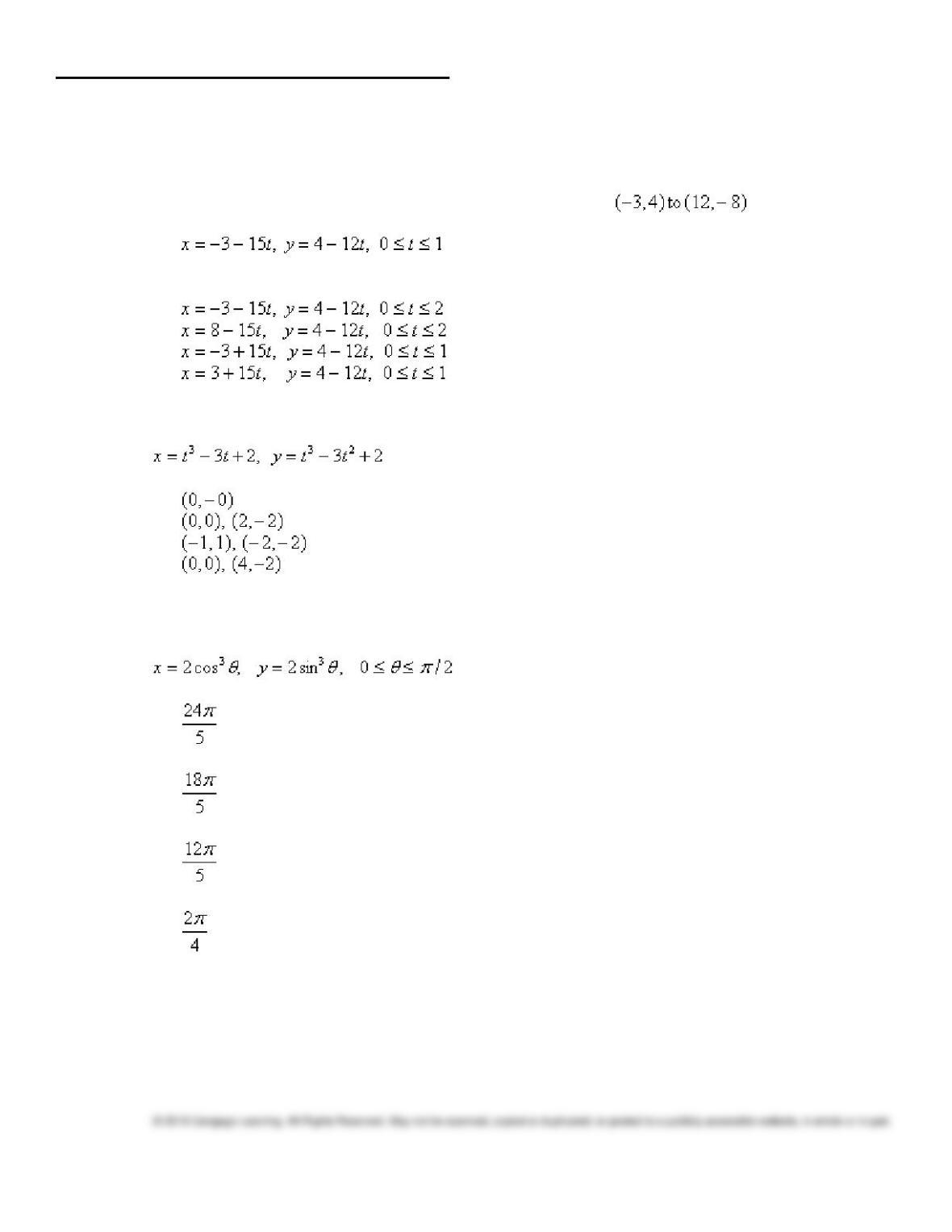
____ 1. Find parametric equations to represent the line segment from .
a.
b.
c.
d.
e.
____ 2. Find the point(s) on the curve where the tangent is horizontal.
a.
b.
c.
d.
e. None of these
____ 3. Find the exact area of the surface obtained by rotating the given curve about the x-axis.
a.
b.
c.
d.
e. None of these
Stewart – Calculus ET 8e Chapter 10 Form C
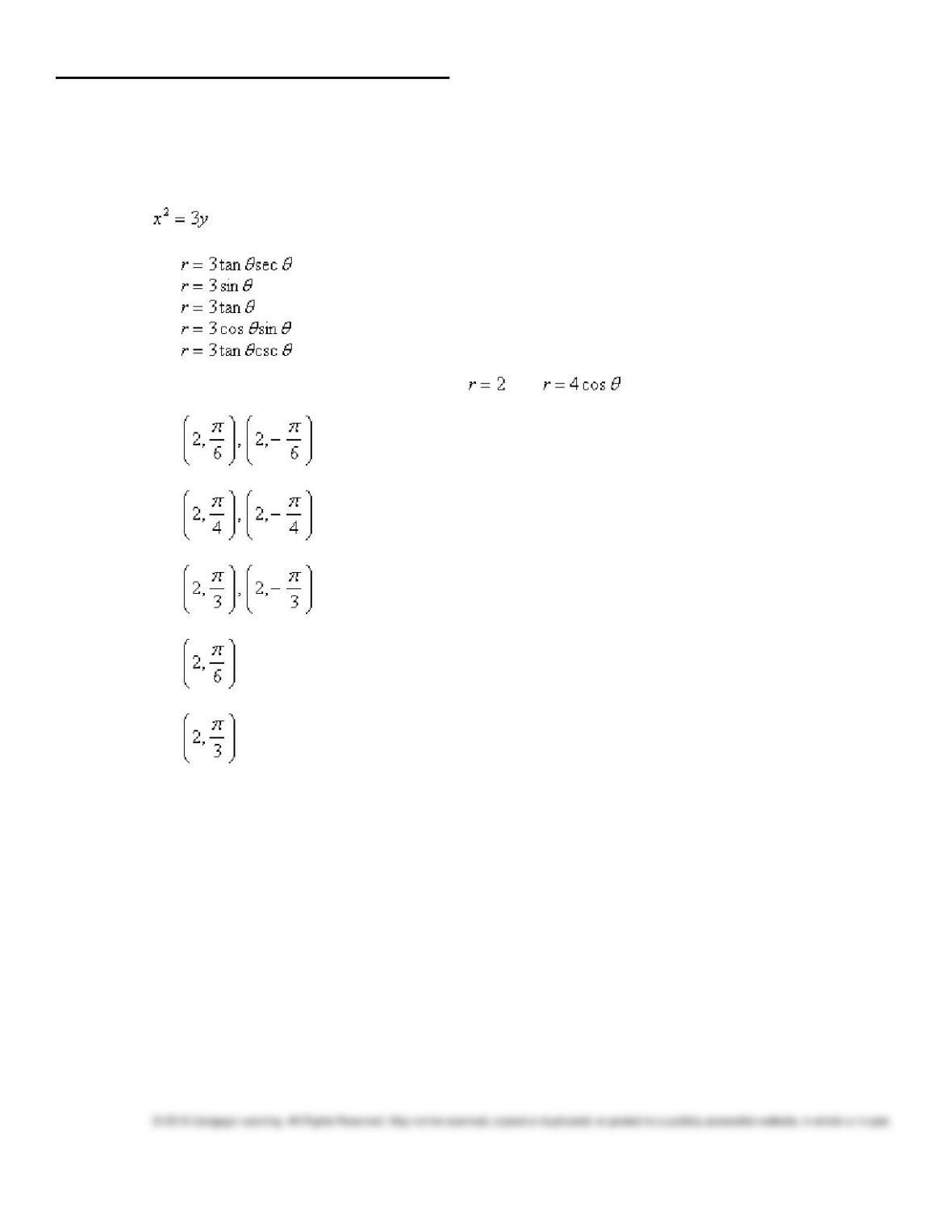
____ 4. Find a polar equation for the curve represented by the given Cartesian equation.
a.
b.
c.
d.
e.
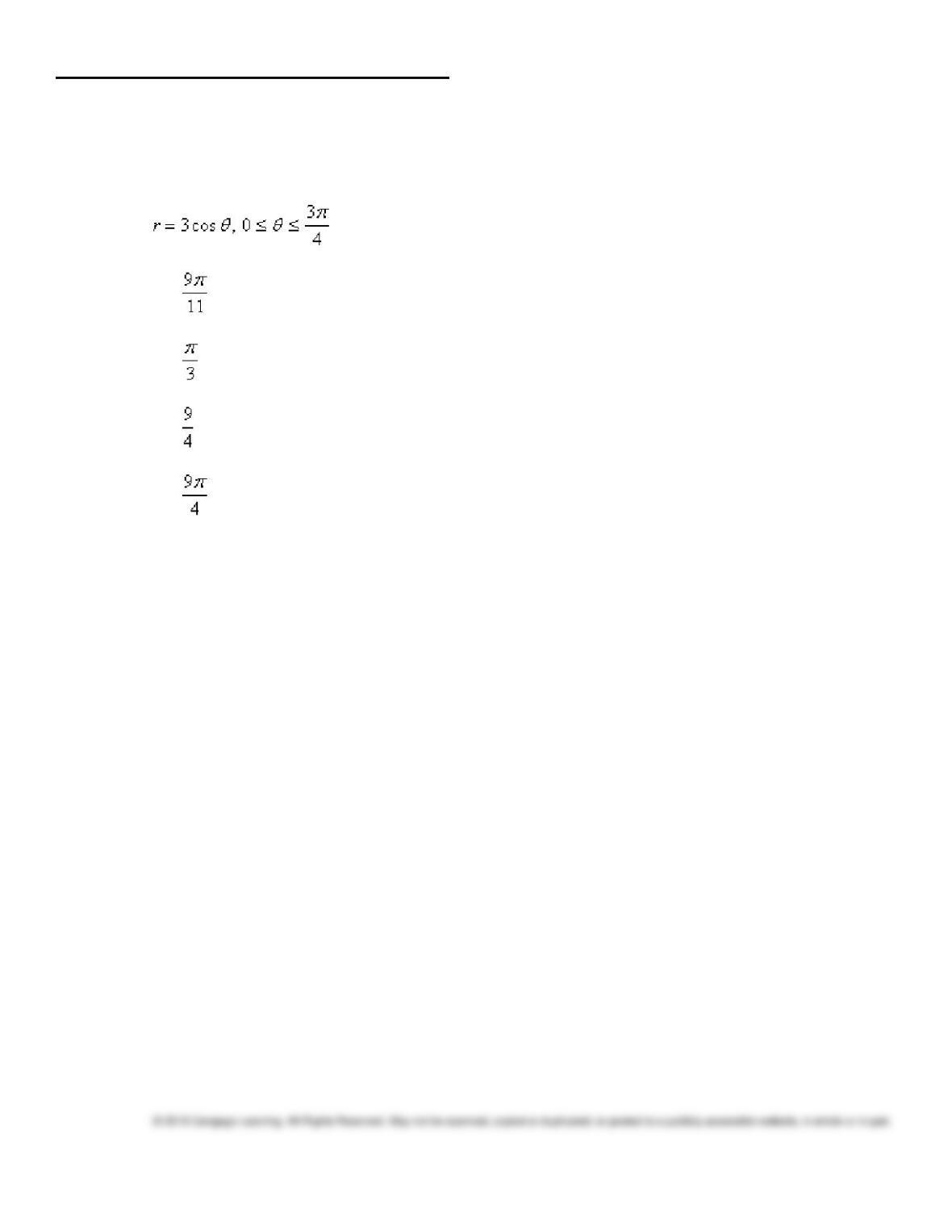
____ 5. Find the point(s) of intersection of the curves and .
a.
b.
c.
d.
e.
Stewart – Calculus ET 8e Chapter 10 Form C
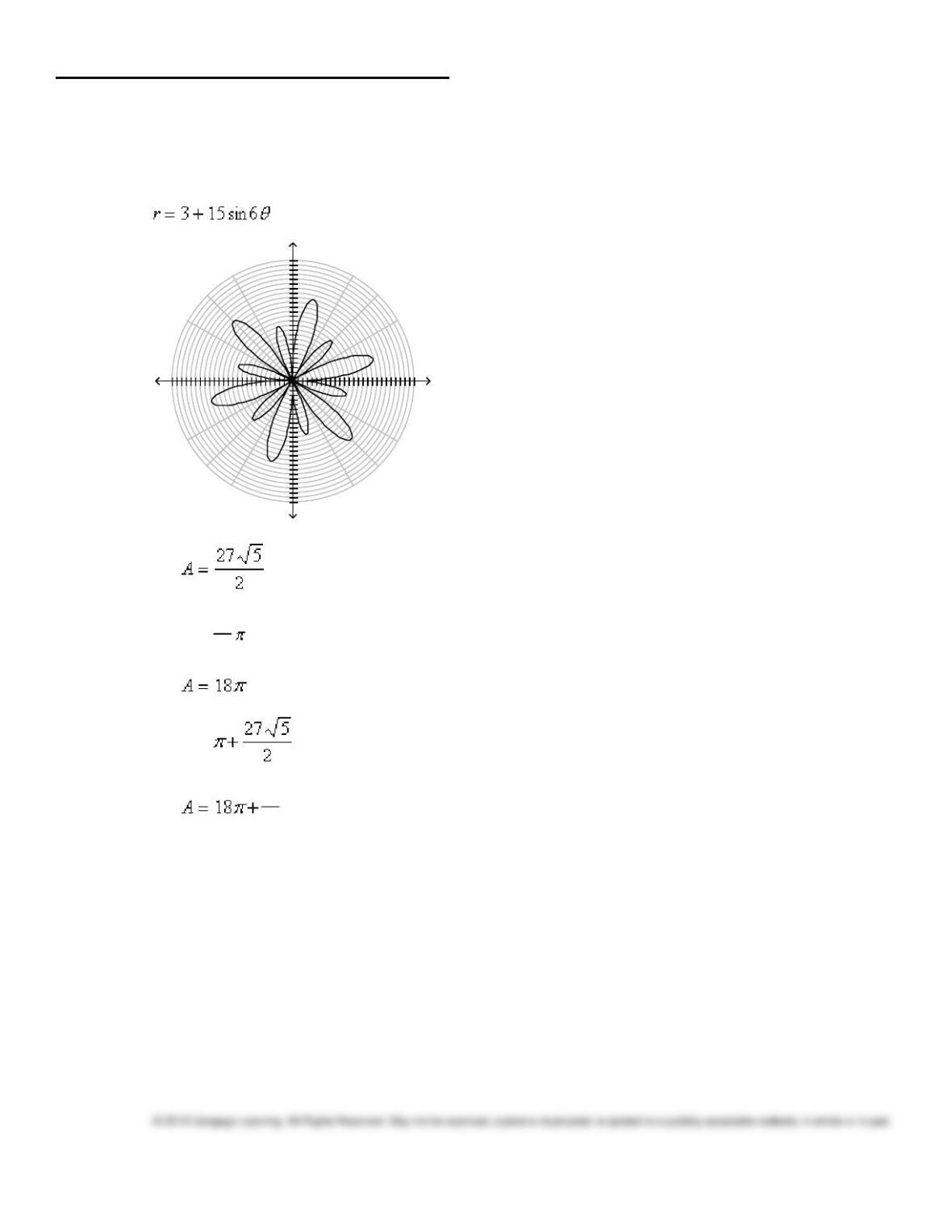
____ 6. Find the length of the polar curve.
a.
b.
c.
d.
e. None of these
Stewart – Calculus ET 8e Chapter 10 Form C
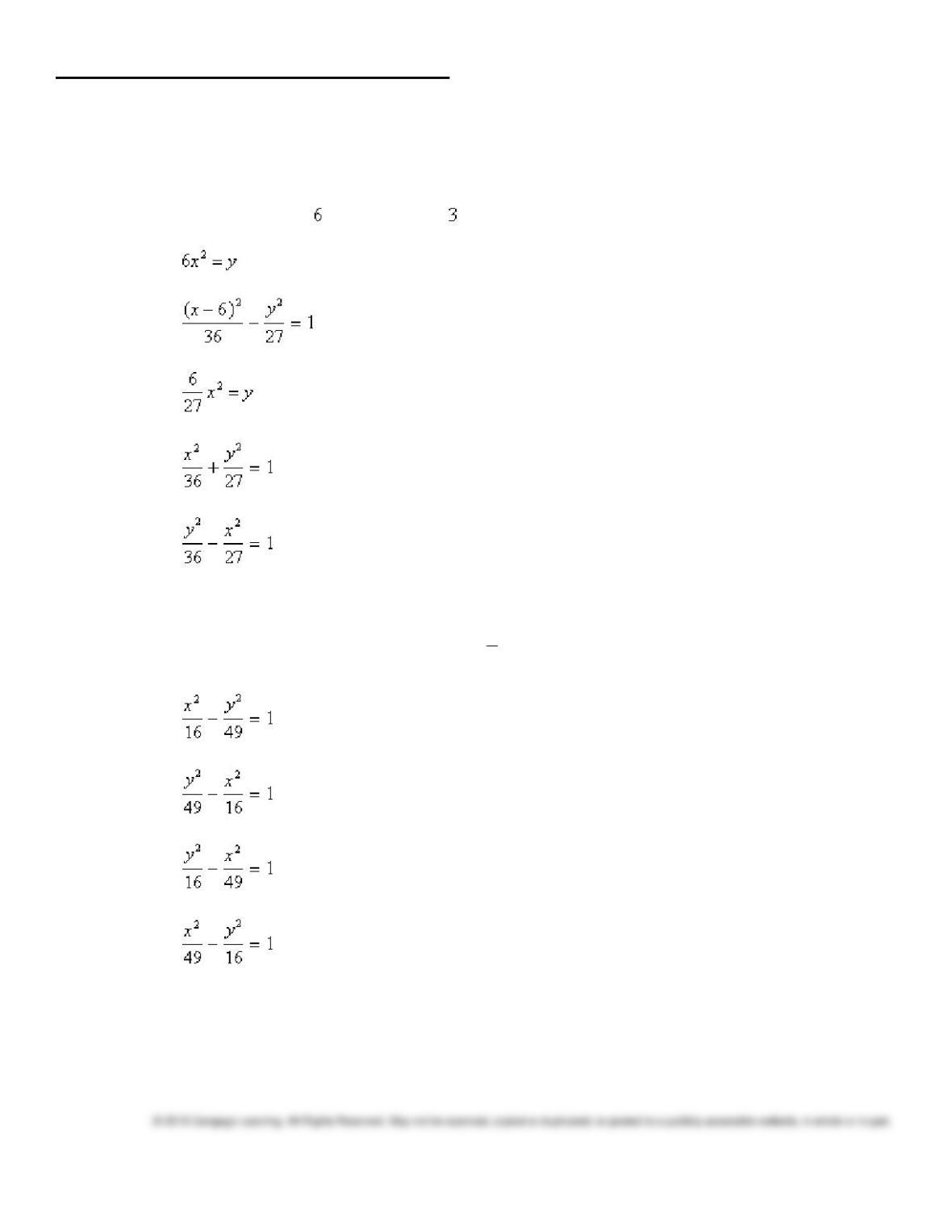
____ 7. The graph of the following curve is given. Find the area that it encloses.
4 8 12 16 20 24
a.
b. A =
81
2
c.
d.
A =
e.
81
2
Stewart – Calculus ET 8e Chapter 10 Form C
____ 8. Find an equation for the conic that satisfies the given conditions.
hyperbola, foci (0, ± ) , vertices (0, ± )
a.
b.
c.
d.
e.
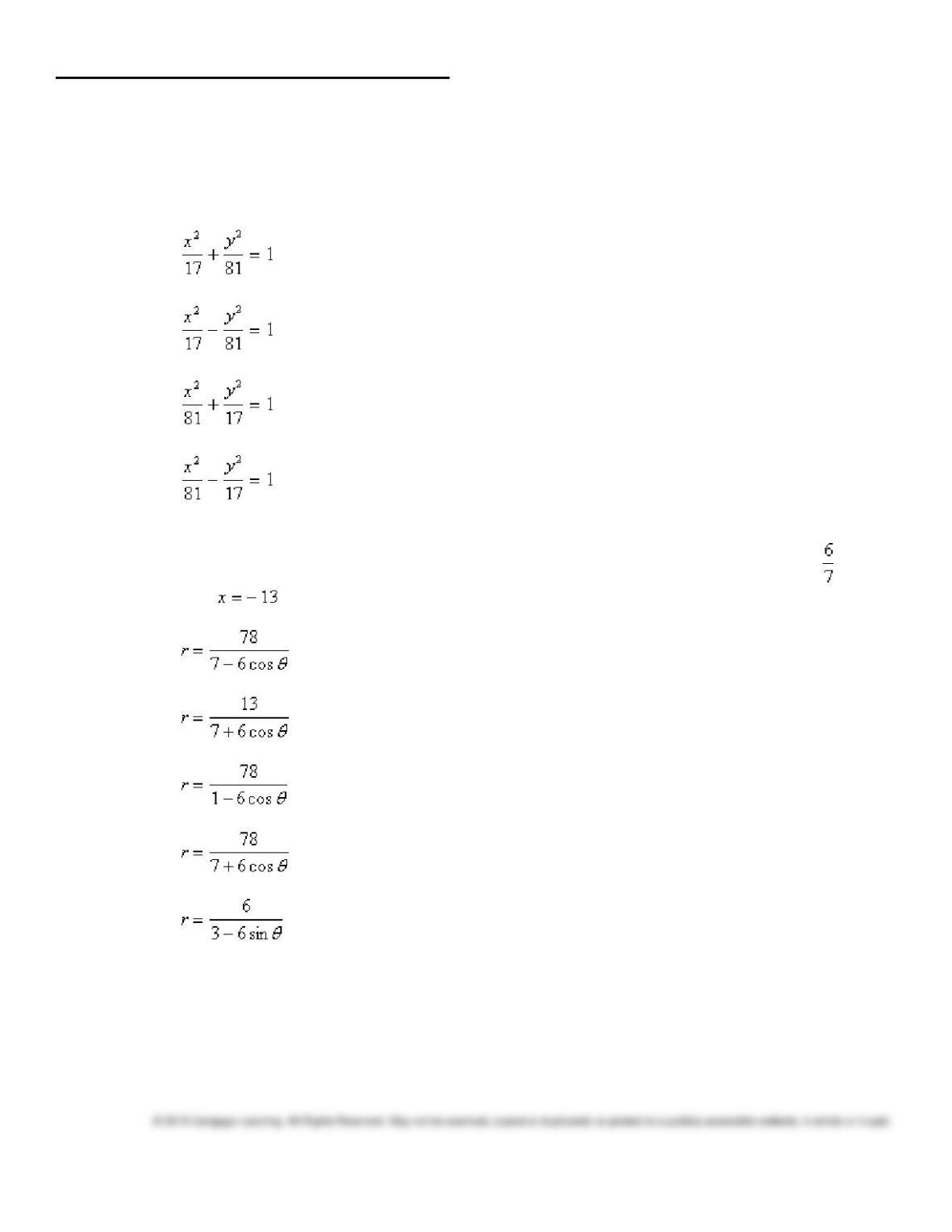
____ 9. Find an equation of the hyperbola centered at the origin that satisfies the given condition.
Vertices: (± 4, 0), asymptotes: y = ±
7
4
x
a.
b.
c.
d.
Stewart – Calculus ET 8e Chapter 10 Form C
____ 10. Find an equation of the ellipse that satisfies the given conditions.
Foci: (0, ± 8), vertices (0, ± 9)
a.
b.
c.
d.
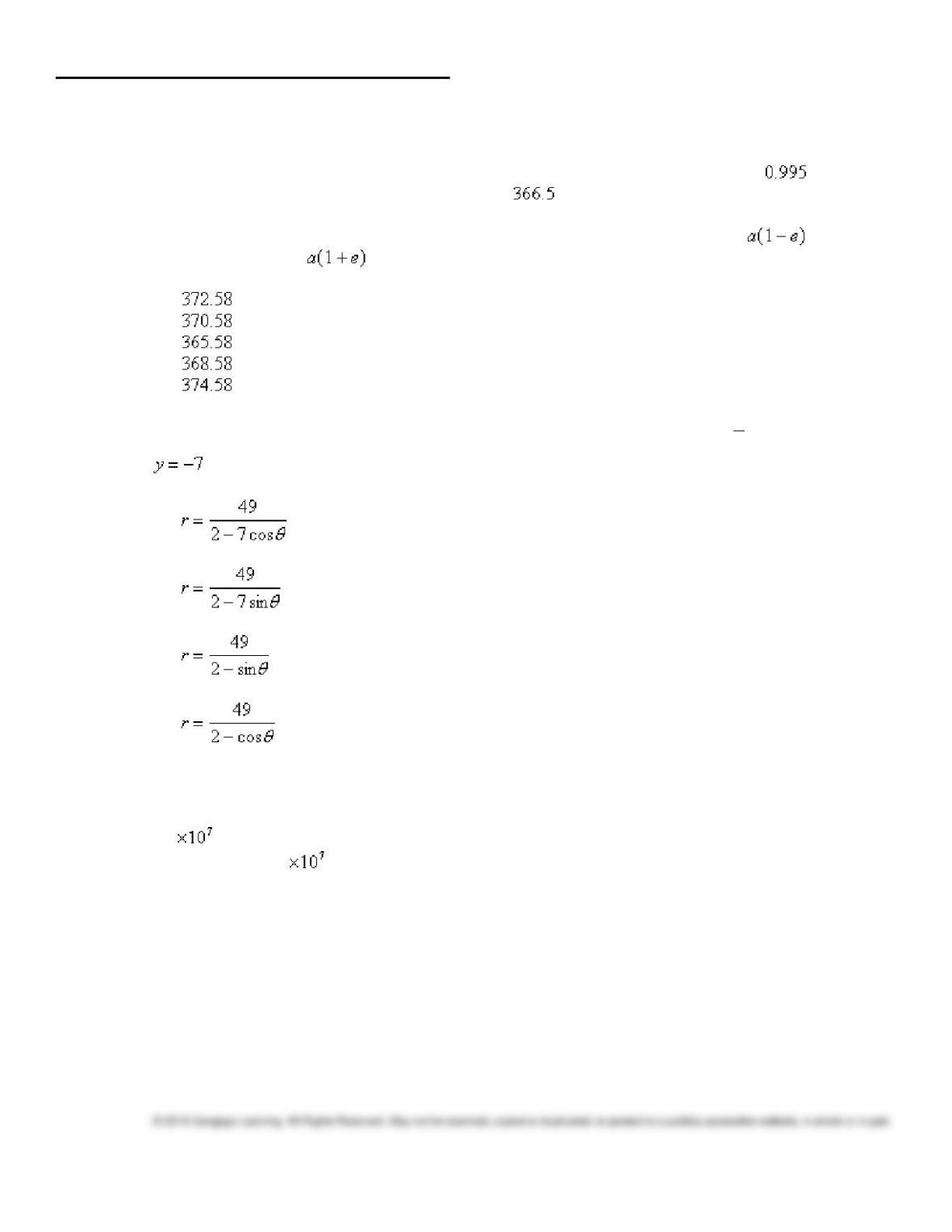
____ 11. Write a polar equation in r and
of an ellipse with the focus at the origin, with the eccentricity and
directrix .
a.
b.
c.
d.
e.
Stewart – Calculus ET 8e Chapter 10 Form C
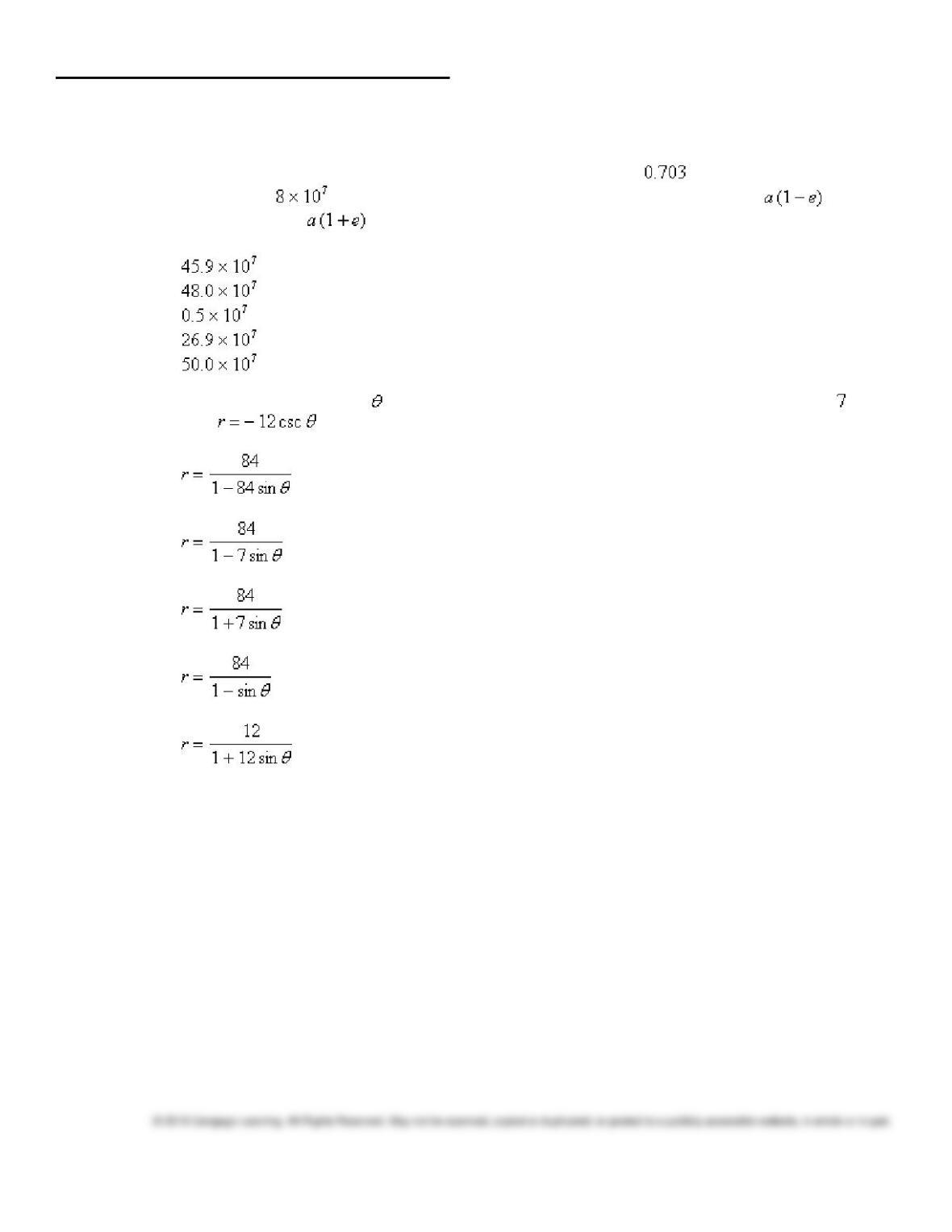
____ 12. The orbit of Hale-Bopp comet, discovered in 1995, is an ellipse with eccentricity and one
focus at the Sun. The length of its major axis is AU. [An astronomical unit (AU) is the
mean distance between Earth and the Sun, about 93 million miles.] Find the maximum distance
from the comet to the Sun. (The perihelion distance from a planet to the Sun is and the
aphelion distance is .) Find the answer in AU and round to the nearest hundredth.
a. AU
b. AU
c. AU
d. AU
e. AU
____ 13. Write a polar equation of the conic that has a focus at the origin, eccentricity
7
2
, and directrix
. Identify the conic.
a. , hyperbola
b. , hyperbola
c. , ellipse
d. , ellipse
____ 14. Suppose a planet is discovered that revolves around its sun in an elliptical orbit with the sun at one
focus. Its perihelion distance (minimum distance from the planet to the sun) is approximately
2.3 km, and its aphelion distance (maximum distance from the planet to the sun) is
approximately 2.7 km. Approximate the eccentricity of the planet’s orbit. Round to three
decimal places.
a. 1.174
b. 12.5
c. 0.08
d. 0.852
Stewart – Calculus ET 8e Chapter 10 Form C
____ 15. The planet Mercury travels in an elliptical orbit with eccentricity . Its minimum distance
from the Sun is km. If the perihelion distance from a planet to the Sun is and the
aphelion distance is , find the maximum distance (in km) from Mercury to the Sun.
a. km
b. km
c. km
d. km
e. km
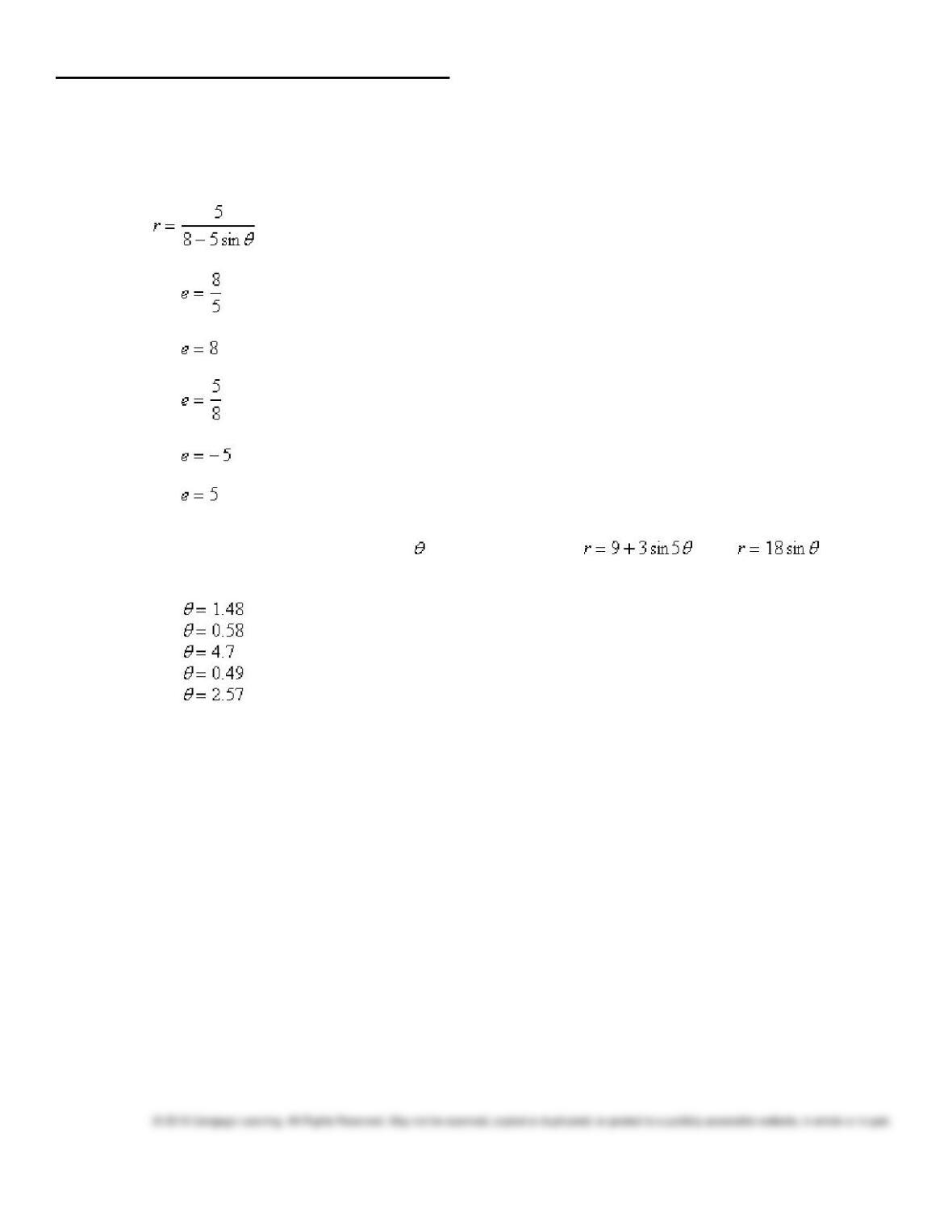
____ 16. Write a polar equation in r and of a hyperbola with the focus at the origin, with the eccentricity and
directrix .
a.
b.
c.
d.
e.
Stewart – Calculus ET 8e Chapter 10 Form C
____ 17. Find the eccentricity of the conic.
a.
b.
c.
d.
e.
____ 18. Use a graph to estimate the values of for which the curves and
intersect. Round your answer to two decimal places.
a.
b.
c.
d.
e.