
10-1
Chapter 10 Stockholders’ Equity Answer Key
True / False Questions
1.
Assets plus liabilities equal stockholders’ equity.
2.
Paid-in Capital is the amount stockholders have invested in the company.
3.
Retained Earnings is the amount stockholders have invested in the company.

10-2
4.
Angel investors are investors that focus on companies at or near bankruptcy.
5.
All publicly held corporations in the United States are regulated by the Securities and
Exchange Commission.
6.
Limited liability means that even in the event of bankruptcy, stockholders in a corporation
can lose no more than the amount they invested in the company.

10-3
7.
Owners in a sole proprietorship or a partnership can be held personally liable for debts the
company has incurred, over and beyond the investment they have made.
8.
A corporation has limited liability and attracting outside investment is easier relative to
sole-proprietorships and partnerships.

10-4
9.
A corporation has lower taxes and less paperwork relative to sole–proprietorships and
partnerships.
10.
An S Corporation allows a company to enjoy limited liability as a corporation, but tax
treatment as a partnership.
11.
Authorized stock is the number of shares that have been sold to investors.

10-5
12.
Outstanding stock is the number of shares held by investors.
13.
Par value is the legal capital per share of stock that’s assigned when the corporation is
first established.
14.
Par value has a direct relationship to the market value of the common stock.

10-6
15.
A company credits Additional Paid-in Capital for the portion of the cash proceeds above
par value received for the issuance of stock.
16.
The number of shares outstanding is equal to the number of shares issued minus the
number of shares repurchased.

10-7
17.
In the event a corporation is dissolved, common stockholders receive preference over
preferred stockholders in the distribution of assets.
18.
Convertible preferred stock allows the stockholder to convert shares of preferred stock
into common stock at a specified conversion ratio.
19.
Cumulative preferred stock means that dividends accumulate interest during the year.

10-8
20.
We usually record preferred stock as equity and report it in the stockholders’ equity
section of the balance sheet just above common stock.
21.
Treasury stock is the repurchase of a company’s own issued stock.
22.
If a company purchases shares of another company, it records this transaction as treasury
stock.

10-9
23.
Stock repurchases reduce the number of shares outstanding, thereby increasing earnings
per share.
24.
We record treasury stock at the cost of the shares acquired.
25.
Treasury stock is a contra-equity account because treasury stock increases total
stockholders’ equity.

10–10
26.
When we reissue treasury stock, we report the difference between its cost and the cash
received as an increase/decrease in additional paid-in capital.
27.
Retained earnings represent the earnings retained in the corporation – earnings not paid
out as dividends to stockholders.
28.
The amount of retained earnings equals net income minus dividends for the current year.

10–11
29.
If a company has expenses that are more than revenues, the net loss decreases retained
earnings.
30.
Dividends are paid on all shares issued by the company including treasury stock.
31.
Total assets, total liabilities, and total stockholders’ equity do not change as a result of a
stock dividend.

10–12
32.
Small stock dividends are recorded by debiting Retained Earnings for the par value per
share.
33.
No journal entry is made to record a stock split.
34.
A stock split has no effect on the total of any account in stockholders’ equity.

10–13
35.
Common stock is listed before preferred stock in the balance sheet.
36.
We can estimate the average purchase cost of treasury stock per share by dividing the
treasury stock balance by the number of shares repurchased.
37.
The statement of stockholders’ equity shows how each equity account changed during the
year.

10–14
38.
The stockholders’ equity section of the balance sheet shows how each equity account
changed during the year.
39.
The return on equity measures the ability of company management to generate earnings
from the resources that owners provide.
40.
We compute the return on equity ratio by dividing net income by ending stockholders’
equity.

41.
Earnings per share (EPS) measures the net income earned per share of common stock
outstanding.
42.
We calculate earnings per share as net income divided by the average shares outstanding
during the period.
43.
Earnings per share is useful in comparing earnings performance across companies.

10–16
44.
We calculate the PE ratio as the stock price divided by earnings per share so that both
stock price and earnings are expressed on a per share basis.
Multiple Choice Questions
45.
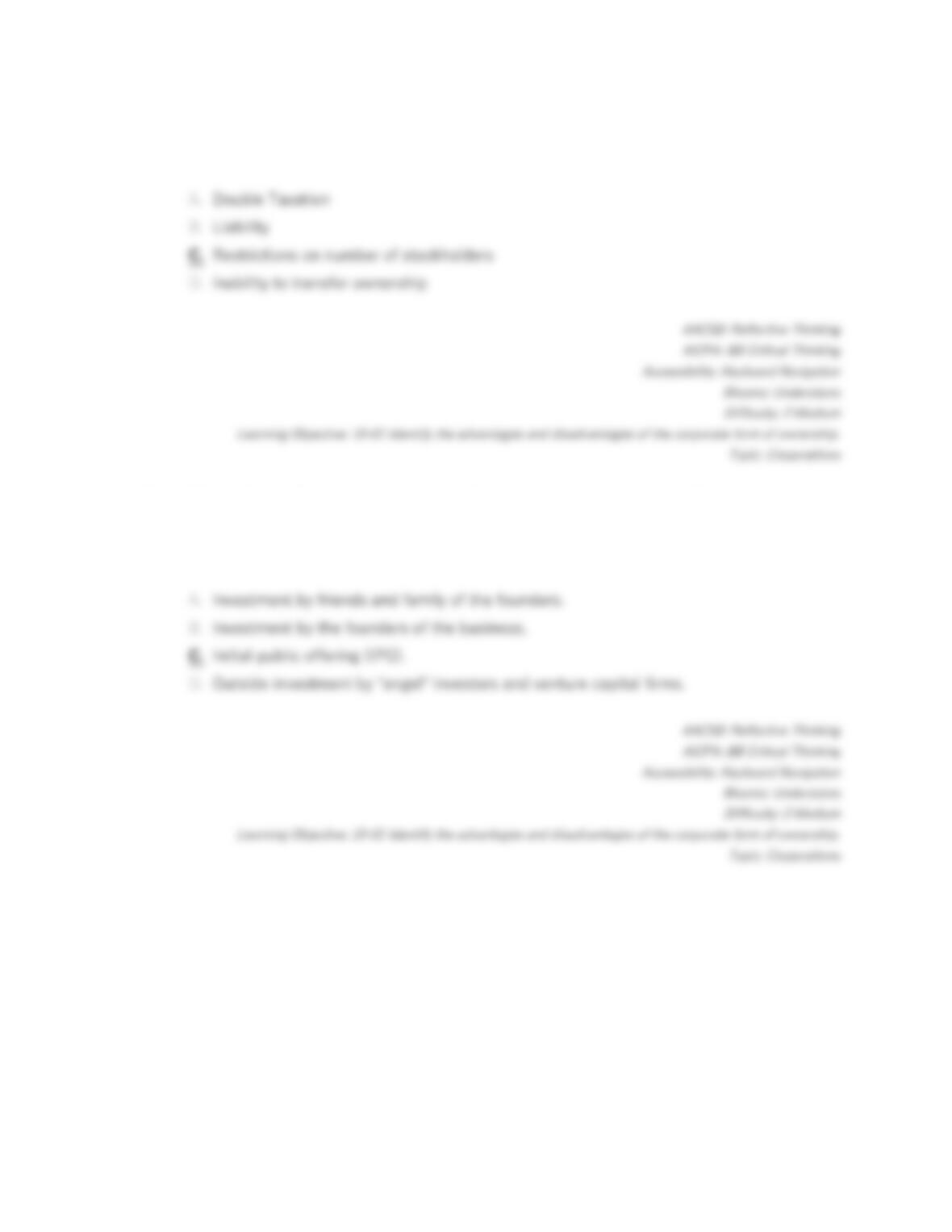
Which of the following accounts is not reported in the stockholders’ equity section of the
balance sheet?
10–17
46.
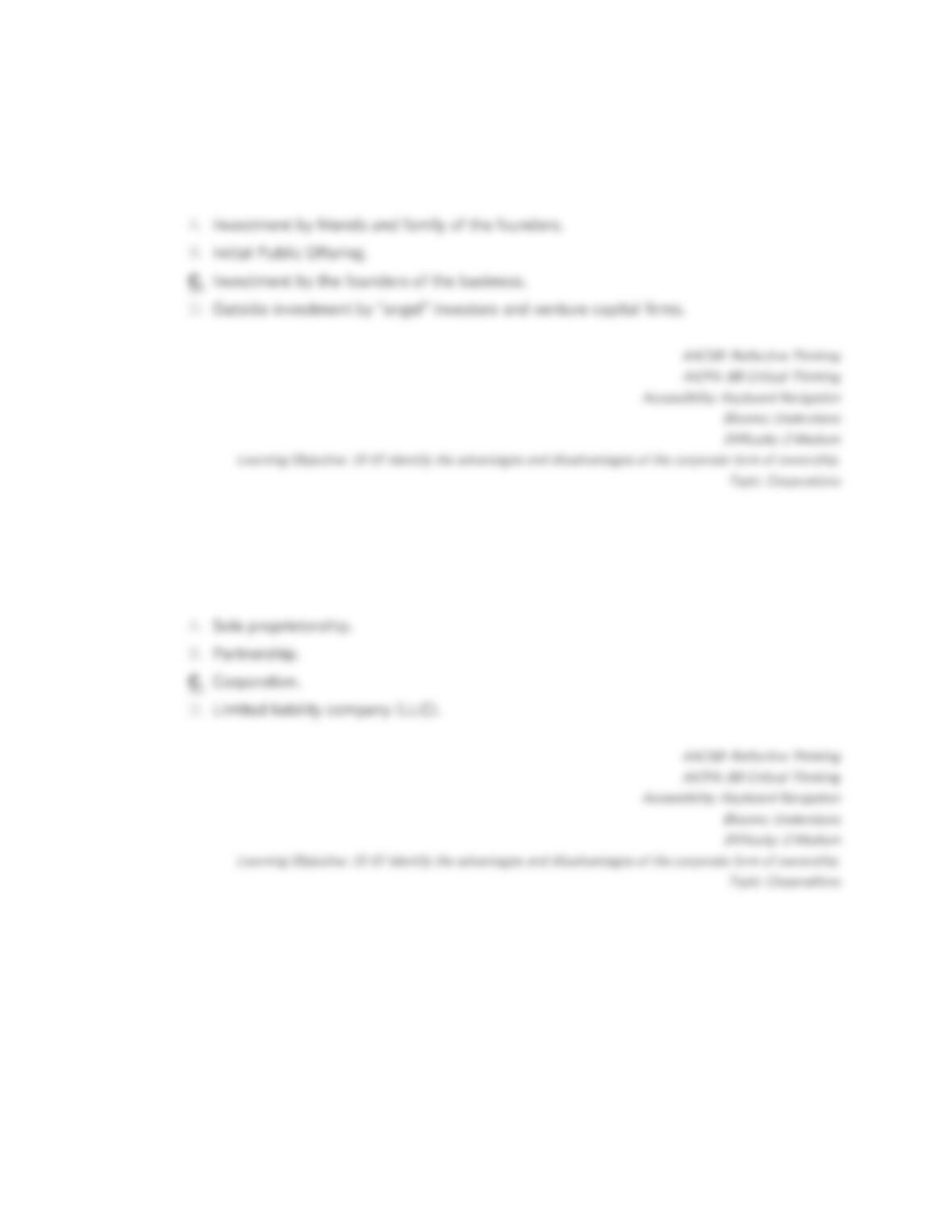
Which of the following is a disadvantage of an S Corporation?
47.
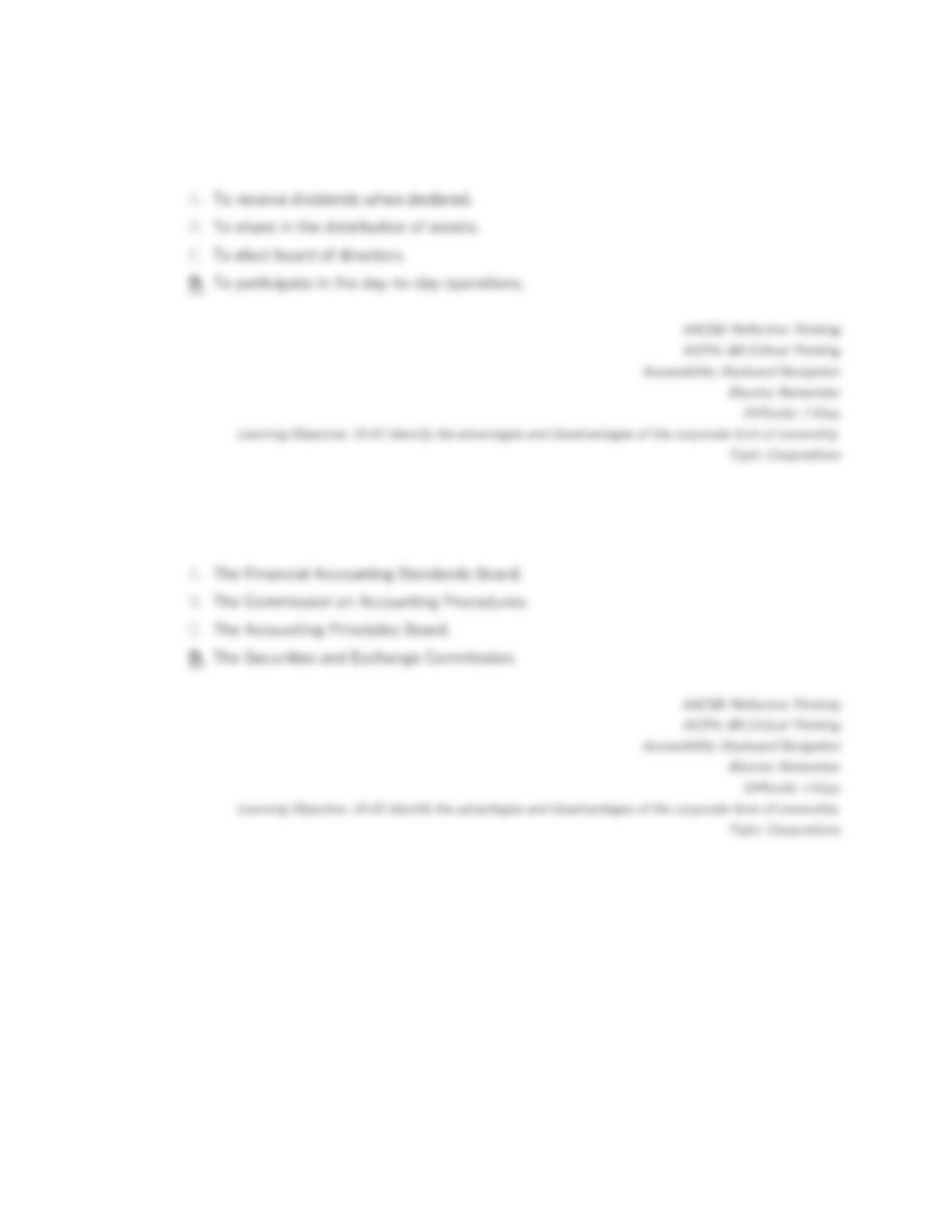
Which of the following stages of equity financing comes last in the traditional order of
progression?
10–18
48.
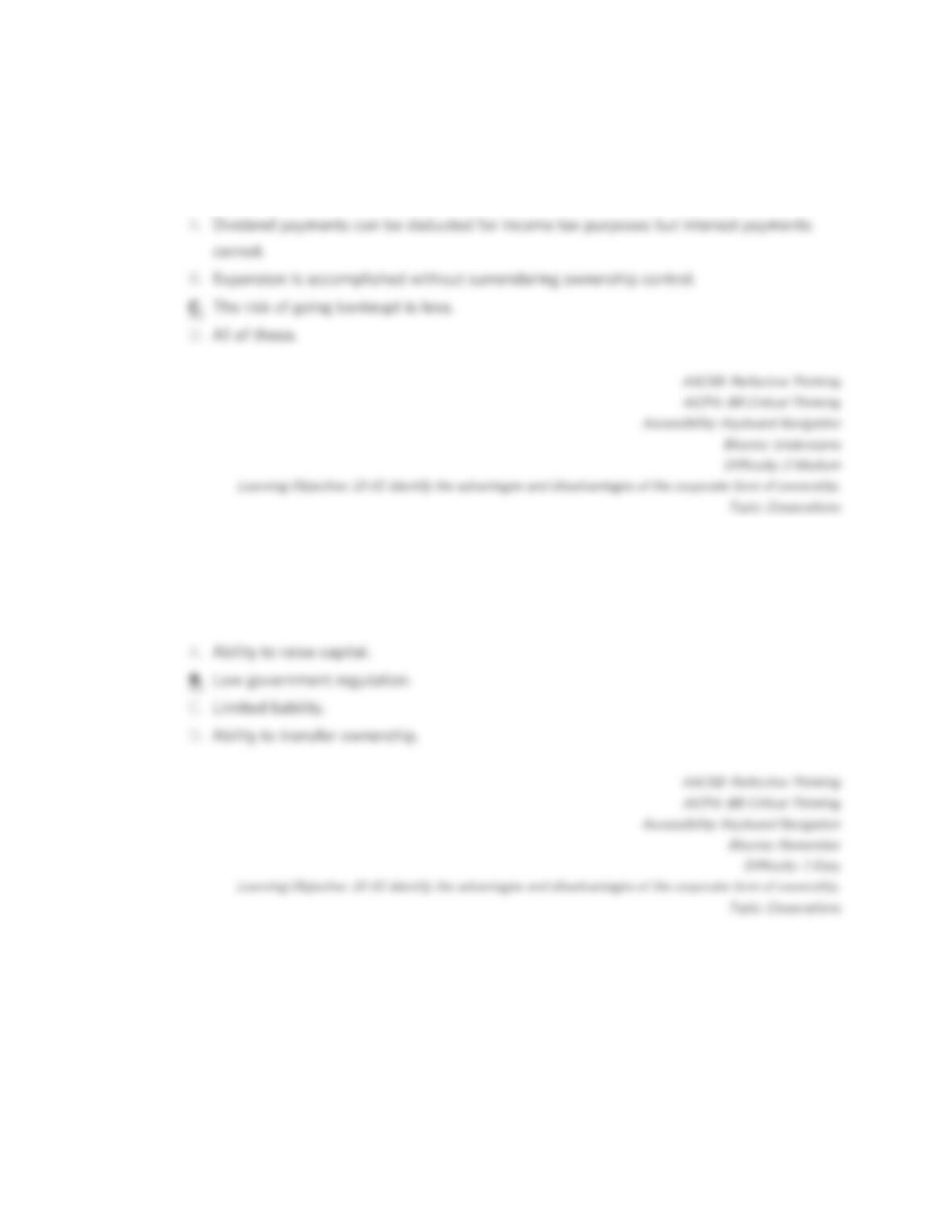
Which of the following stages of equity financing comes first in the traditional order of
progression?
49.
In terms of total sales, assets, and earnings, the dominant form of business organization is
a:
10–19
50.
Common stockholders usually have all of the following rights except:
51.
All publicly held corporations are regulated by what government organization?
10–20
52.
Which of the following is a reason that a corporation would prefer to issue stock instead of
bonds?
53.
Advantages of the corporate form that have led to the growth of this form of business
ownership include all of the following except: