
Chapter 10—Nucleotides and Nucleic Acids
MULTIPLE CHOICE
1. Complete hydrolysis of nucleic acids liberates all of the following EXCEPT:
a.
2-deoxyribose from DNA.
b.
nitrogenous bases.
c.
amino acids.
d.
phosphoric acid.
e.
ribose from RNA.
2. Which is a six-membered heterocyclic aromatic ring?
a.
pyrimidine
b.
purine
c.
anose
d.
sugar portion of DNA
e.
ribonucleotide
3. ____ is the most oxidized state for a purine derivative and is ____ found in nucleic acids.
a.
Guanine; always
b.
Adenine; always
c.
Hypoxanthine; never
d.
Xanthine; always
e.
Uric acid; never
4. All are important functional groups participating in H-bond formation EXCEPT:
a.
amino group of the cytosine, adenine and guanine.
b.
the ring nitrogens at position 3 of pyrimidines and 1 of purines.
c.
the electronegative oxygen atoms.
d.
the electron density in the double bonds of the bases.
e.
the carbonyl group at position 4 of uracil and thymine, position 2 of cytosine, and position
6 of guanine.
5. All are characteristics of pyrimidines EXCEPT:
a.
six membered ring.
b.
heterocyclic.
c.
conjugated.
d.
fused five membered rings.
e.
two nitrogens separated by a carbonyl.

6. Which of the following properties describe both purines and pyrimidines?
a.
they are aromatic
b.
they are composed of 6-membered rings
c.
they exhibit strong absorption of UV light
d.
they always contain a carbonyl group
e.
both A and C are correct
7. Nucleotides have a nitrogenous base linked to a sugar by a:
a.
-anhydride bond.
b.
-ester bond.
c.
-N-amide bond.
d.
-N-acetal (glycosidic) bond.
e.
-N-hemiacetal bond.
8. Nucleosides are relatively stable to ____ hydrolysis, and pyrimidine nucleotides are stable to ____
hydrolysis, but purine nucleotides are unstable to ____ hydrolysis.
a.
base; acid; acid
b.
base; base; acid
c.
acid; base; base
d.
acid; acid; base
e.
none are true
9. The net charge on nucleotide monophosphates is:
a.
+1
b.
0
c.
−1
d.
−2
e.
−3
10. cAMP and cGMP are ____ with phosphate esterified as a cyclic ____ and are important as ____ of
cellular metabolism.
a.
nucleotides; phosphodiester; inhibitors
b.
nucleotides; phosphomonoesters, regulators
c.
nucleotides; phosphodiesters, regulators
d.
nucleosides; phosphomonoesters, stimulators
e.
all of the above
11. Which molecule contains an phosphoanhydride bond?
a.
DNA
b.
AMP
c.
UDP
d.
RNA
e.
cAMP

12. All of the following are examples of nucleotide functions EXCEPT:
a.
CTP in phospholipid synthesis.
b.
UTP in complex carbohydrate synthesis.
c.
ATP in energy for the cell.
d.
GTP in protein synthesis.
e.
TTP in phosphoryl group transfers.
13. Nucleotide triphosphates and nucleotide diphosphates often form stable complexes with:
a.
Na+
b.
Fe+3
c.
K+
d.
Mg+2
e.
None of the above.
14. In phosphoryl group transfer reactions, the ____ of the nucleotide serves as an information symbol,
channeling the nucleotide to appropriate metabolic activities.
a.
sugar
b.
diphosphate anhydride
c.
sugar-phosphate ester
d.
base
e.
none are true
15. Which of the following statements regarding the structure of DNA is correct?
a.
the two strands are parallel.
b.
the two strands are held together by intrachain hydrogen bonds.
c.
the two strands have complementary base pairing.
d.
the hydrogen bonding that holds the helix together is always between two purines or
between two pyrimidines.
e.
the ratio of adenine to guanine is the same in all organisms.
16. In a double-stranded nucleic acid, guanine typically base-pairs with:
a.
adenosine.
b.
uracil.
c.
inosine.
d.
thymine.
e.
cytosine.
17. In a sample of double-stranded DNA containing 32% cytosine, the percentage of adenine would be:
a.
32%
b.
68%
c.
18%
d.
0%
e.
insufficient information to answer question

Garrett/Grisham 5e Test Bank 4
18. The convention in all notations of nucleic acid structure is to read the polynucleotide chain from the
____ of the polymer to the ____.
a.
poly U head; poly A tail
b.
3′-end; 5′-tail
c.
5′-end; 3′-end
d.
poly-p head; 5′-end
e.
none are true
19. All of the following are important characteristics of DNA EXCEPT:
a.
a 1:1 ratio between pyrimidine residues and purine residues.
b.
adenine base pairs with uracil.
c.
hydrogen bonding between base pairs.
d.
information contained in the sequence of one strand conserved in the sequence of other
strand.
e.
information is accessed through transcription of the information into RNA.
20. What is the nucleotide sequence of the DNA strand that is complementary to 5′-
ATCGCAACTGTCACTA-3′?
a.
5′-TAGCGTTGACAGTGAT-3′
b.
5′-UAGUGACAGUUGCGAU-3′
c.
5′-TAGCGTTGACAGTGAT-3′
d.
5′-TAGTGACAGTTGCGAT-3′
e.
5′-ATCACTGTCAACGCTA-3′
21. In eukaryotic cells, DNA is found principally in the nucleus, but it also occurs in ____ and in ____.
a.
ribosomes; mitochondria
b.
mitochondria; chloroplasts
c.
chloroplasts; peroxisomes
d.
peroxisomes; vacuoles
e.
vacuoles; mitochondria
22. In eukaryotic cells, a class of ____- and ____-rich proteins called ____ interact ionically with the
anionic phosphate groups in the DNA backbone to form ____.
a.
lysine; leucine; prions; ribosomes
b.
arginine; lysine; histones; nucleosomes
c.
arginine; alanine; histones; nucleosomes
d.
arginine; lysine; prions; ribosomes
e.
none are true.
23. Prokaryotic chromosomes are typically ____, while eukaryotic chromosomes are ____
a.
circular; linear and richly protein-associated
b.
circular and richly protein-associated; linear
c.
linear and richly protein-associated; circular
d.
linear; circular and richly protein-associated
e.
none are true.

24. Eukaryotic mRNAs are synthesized in the nucleus, are called ____, and contain noncoding regions
called ____ because they intervene between coding regions called ____.
a.
poly A RNAs; noncodons; codons
b.
poly A RNAs; intervening sequences; codons
c.
heterogeneous nuclear RNAs; intervening sequences (introns); codons
d.
heterogeneous nuclear RNAs; intervening sequences (introns); exons
e.
none of the above.
25. ____ are attached to hnRNAs and mRNAs after transcription has been completed and is essential for
efficient translation and stability of the mRNAs.
a.
exons
b.
entrons
c.
poly(A) tails
d.
poly(U) tails
e.
All are true
26. 30S rRNA is a designation of the ____ of the RNA molecule.
a.
number of sugars
b.
sedimentation coefficient
c.
splicing coefficient
d.
sequence repeats
e.
splicing number
27. Which of the following correctly describes tRNA molecules?
a.
each amino acid in proteins has at least three unique tRNA species dedicated to
chauffeuring its delivery to ribosomes for insertion into growing polypeptides.
b.
they are small molecules containing 73 or 74 bases.
c.
they often contain bases such as inosine or pseudouridine
d.
the 5’ end of the molecule is the site of attachment for the amino acid
e.
none of the above is correct
28. ____ are important in the processing of eukaryotic gene transcripts into mature messenger RNAs for
export from the nucleus into cytoplasm.
a.
snRNAs as snRNPs
b.
tRNAs
c.
rRNAs
d.
siRNAs
e.
stRNAs

29. RNA is ____ stable to alkaline hydrolysis than DNA because RNA’s vicinal ____ group makes the 3′-
phosphodiester bond susceptible to ____ cleavage.
a.
less; 3′-OH; nucleophilic
b.
less; 2′-OH; nucleophilic
c.
more; 2′-OH; electrophilic
d.
more; 2′-OH; nucleophilic
e.
more; 3′-OH; electrophilic
30. All are true for enzymes that cleave nucleic acids EXCEPT:
a.
They are of the lyase class of enzymes.
b.
They are called nucleases.
c.
They belong to the sub-class of phosphodiesterases.
d.
They are found in all cells for “house keeping“, and secreted by the pancreas for digestion.
e.
They are found in fungi and snake venoms
31. Which of the following statements correctly identifies a type II restriction endonuclease?
a.
They work on both DNA and RNA.
b.
They recognize a palindromic sequence and cut just before the palindromic sequence.
c.
The result of this endonuclease is blunt ends.
d.
They degrade DNA by subsequently removing bases from each end.
e.
They cut DNA only at sites in specific nucleotide sequences with a two-fold axis of
symmetry.
32. All are necessary for restriction endonuclease mapping of DNA molecules EXCEPT:
a.
Determining the 5′- and/or 3′-ends of the molecule.
b.
Electrophoresis of fragments.
c.
Hydrolysis with two or more endonucleases.
d.
Knowing where each endonuclease hydrolyzes.
e.
All are true.
33. If a restriction site of 6 bases starts with 5’-TGG, what are the last three bases in the sequence?
a.
5’–ACC–3’
b.
5’–GGT–3’
c.
5’–CCA–3’
d.
5’-TGG-3’
e.
none of the above
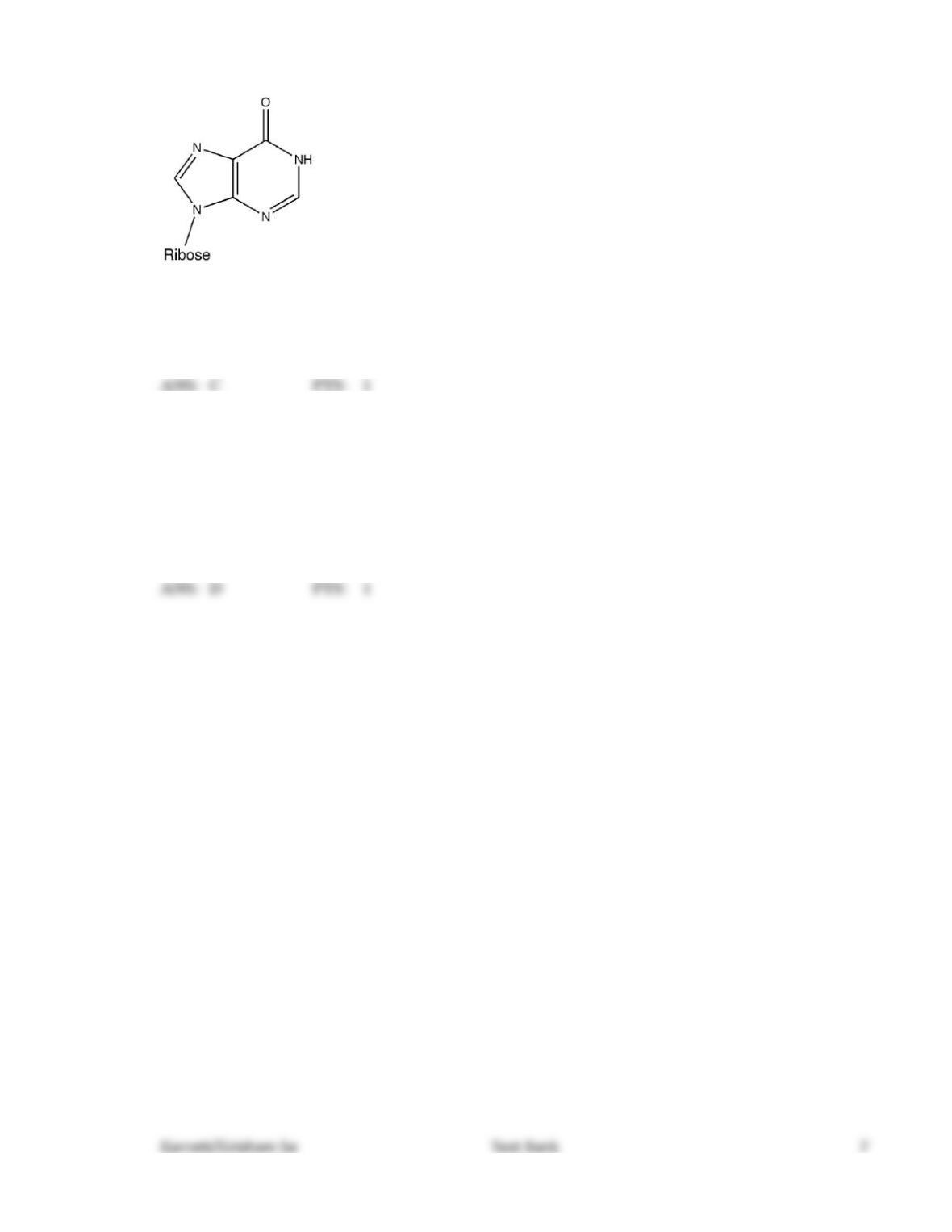
34. Inosine, one of the common alternative bases found in RNA, is shown below. How would inosine
form hydrogen bonds in a double helical section of RNA?
a.
1 H-bond donor group, 0 H-bond acceptor groups
b.
0 H-bond donor groups, 1 H-bond acceptor group
c.
1 H-bond donor group, 1 H-bond acceptor group
d.
2 H-bond donor groups, 1 H-bond acceptor group
e.
1 H-bond donor group, 2 H-bond acceptor groups
35. Which of the following restriction sites would provide staggered 3’ends? The restriction site in each
sequence is shown with an arrow.
a.
5’-TTCGAA-3’
b.
5’-GTTAAC–3’
c.
5’–CCCGGG–3’
d.
5’-CTGCAG-3’
e.
none of the above